Skip to content



Among the many power moves embraced by modern ecommerce businesses, tabletop photography is probably the most effective and creative one. It gives them a significant edge in this highly visual ecommerce world where buyers expect clarity and detail before they hit the “place order” button. But what exactly is tabletop photography, and how is it different from other types of product photography? We have answers to all your questions in this comprehensive guide.
What is tabletop photography?
Tabletop photography is a type of product photography where you shoot items on a flat surface, usually a table. It is supported by simple backdrops and minimal props. This type of photography is quite effective in highlighting the product’s features in a clean and visually consistent way.
What sets tabletop photography apart from other forms of ecommerce product photography is the focus on simplicity and control. Instead of capturing products in visually busy environments, tabletop setups allow you to eliminate distractions. You can showcase your product exactly as the buyer should see it – clear and realistic.
Types of tabletop photography
Depending on the shooting angle and the aesthetic you want to achieve, tabletop photography can be approached in three main ways. Here they are:
1. Flat Lay tabletop photography
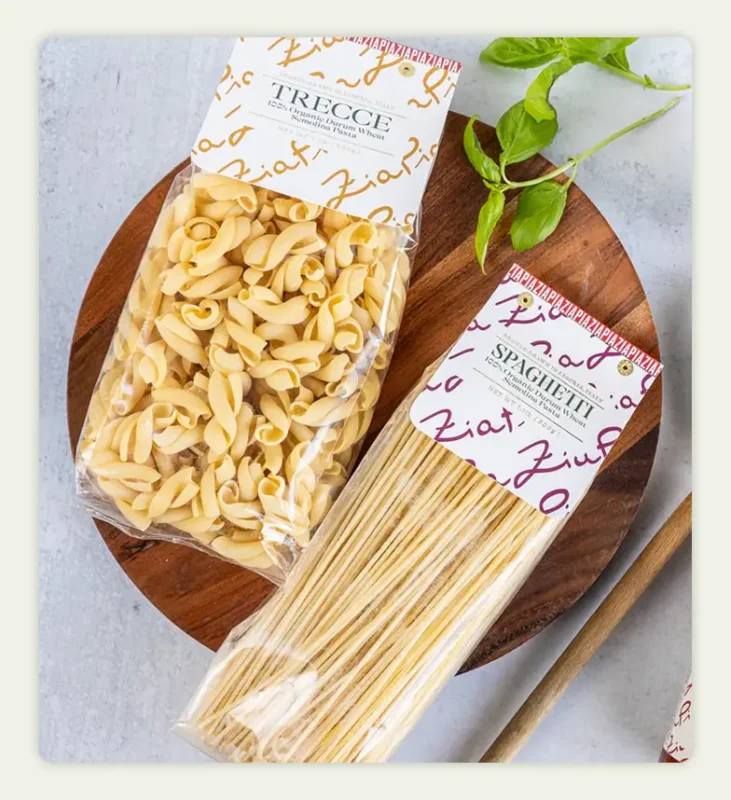
In this type, you arrange products on a flat surface and shoot them from directly above. This style is perfect for showcasing multiple items together. For instance, you could photograph a collection of skincare products that’s part of a routine or food items that’re part of a bundle. The overhead perspective offers a clean and organized look.
2. Styled / lifestyle tabletop photography
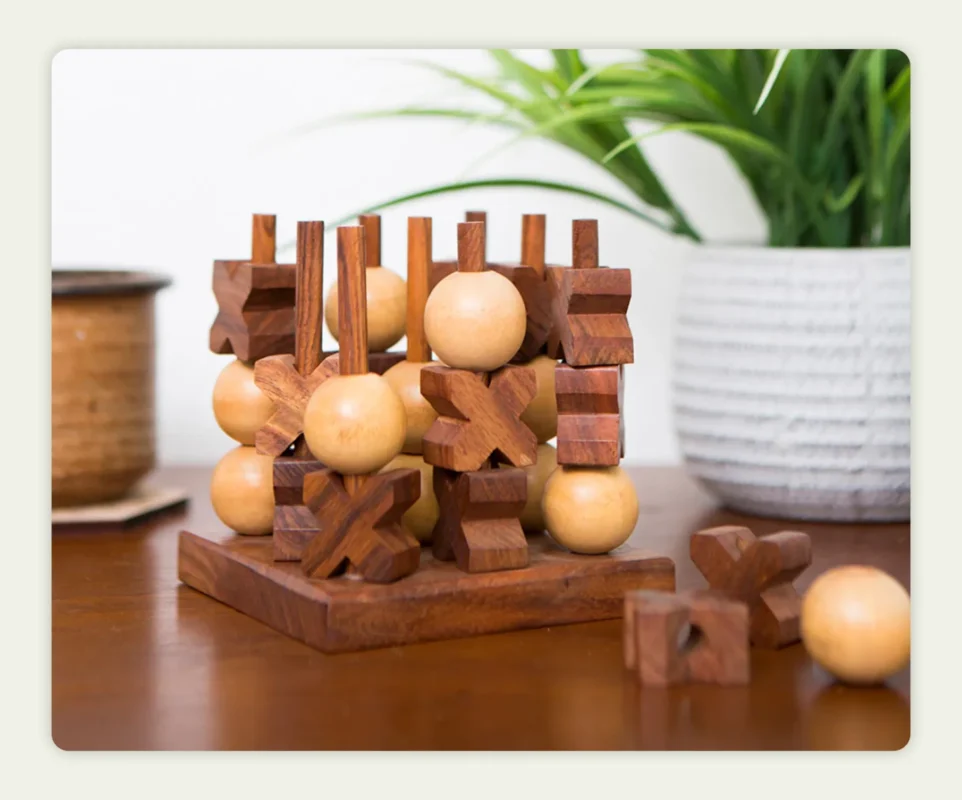
This photography style brings a touch of storytelling into the frame. Instead of displaying products in isolation, you add complementary props or backgrounds to show how the product fits into real life. For example, you could capture a coffee mug beside an open book or a candle on a wooden tray. These small (but effective) elements create mood and context, which, in turn, make your product more aspirational.
3. Isolated/white background photography
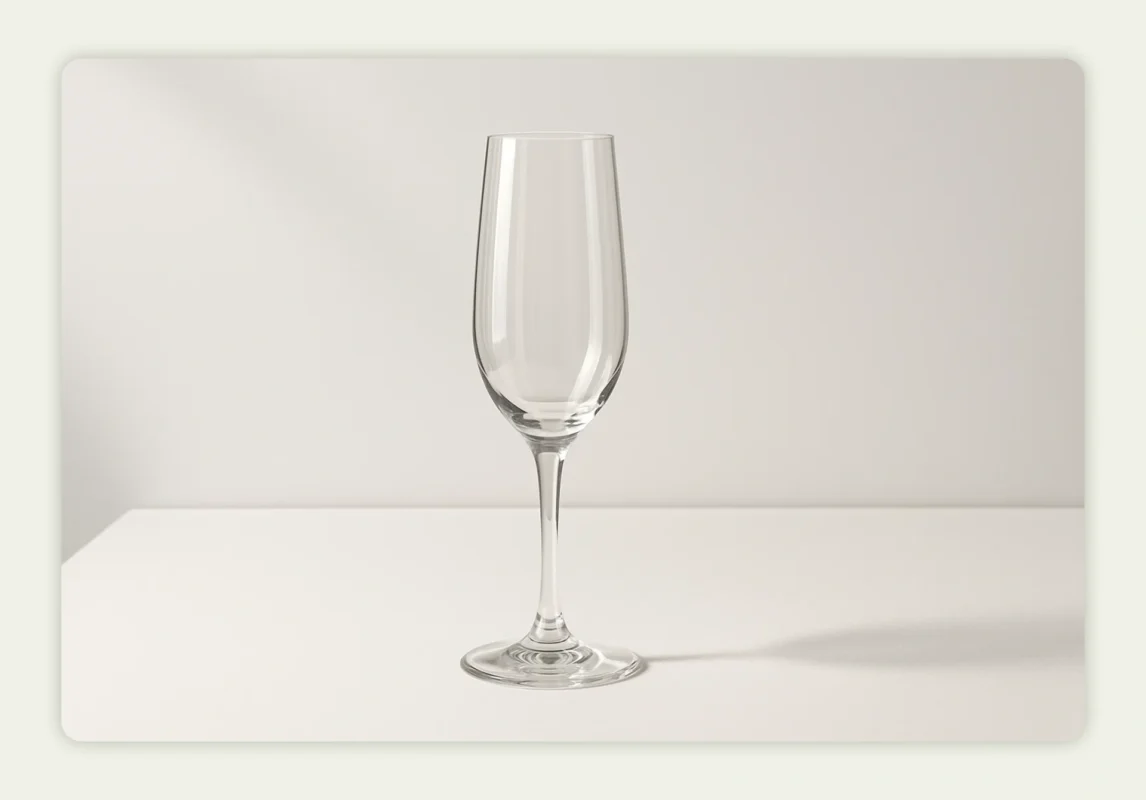
This type follows the typical ecommerce standard. In this, the product is shot alone against a clean white background. The goal is accuracy with zero distractions. It ensures uniformity across listings, which, in turn, builds trust and boosts conversion rates.
What are some must-have gear and tools for tabletop photography?
To start with tabletop photography, you need a smart mix of essential tools for professional-looking product shots. Here are some must-have and nice-to-have gears and tools you need –
1. Camera and lenses
While smartphones can work for quick shots, an ecommerce catalog benefits immensely from the precision of a DSLR or mirrorless camera. When you pair it with a macro or a 50mm prime lens, you will end up with extra-sharp details and realistic and accurate colors. The right camera and lenses typically ensure that you capture your products without distortion, which is critical for winning buyer trust.
2. Lighting setup (Softboxes, reflectors, and LEDs)
Good lighting is the secret sauce behind every jaw-dropping product shot. Softboxes and LED panels create even lighting that highlights textures and eliminates harsh shadows. This makes your products look polished and true to real life. Reflectors, on the other hand, help fill in dark areas. This ensures every image meets ecommerce standards and looks consistent across your catalog.
3. Backgrounds and props
For ecommerce listings, clean and neutral backgrounds (especially white) help your product stand out and meet platform guidelines. Props are optional but useful for lifestyle shots where you want to showcase your products along with complementary items that are not too distracting.
4. Tripods and stabilizers
A solid tripod is essential for maintaining consistency across product angles. This is particularly important when shooting large catalogs. It prevents motion blur and keeps your framing identical from one product to the next. It also speeds up your workflow. For flat lays, an overhead stabilizer or boom arm ensures perfectly aligned top-down shots.
8 steps to capture the perfect tabletop product photograph
Creating high-quality tabletop product photos requires a thoughtful workflow and a bit of creative discipline. Following a structured process ensures your images are upload-ready in no time. Here are 8 essential steps that are part of this structured process:
Step 1: Plan your shoot and concept
Before you pick up the camera, chart out the overall direction of your shoot. A well-defined concept ensures that every creative decision you make, from the composition to the lighting style, works together to highlight your product in the best possible way. Once your concept is set, you can move forward with confidence, knowing that the shoot will be consistent and aligned with your needs and your brand’s visual identity.
Here’s everything you need to plan/account for before starting your photoshoot:
| Planning aspect | Examples |
| Shoot objective | High product clarity/highlight key features/improve conversion rates |
| Target audience | Retailers/wholesalers/value-driven buyers/premium buyers |
| Brand mood | Minimal/premium/playful/natural/bold/colorful |
| Shot list | Hero shot/45° angle/top-down/close-ups/texture/macro |
| Props | Neutral props/color-matched accents/context items |
| Background | White seamless/colored paper/textured board/fabric |
| Lighting direction | Softbox on left/reflector on right/top fill light/natural window light |
| Technical requirements | High-resolution/consistent aspect ratio/RAW format |
Step 2: Set up the table and background
Your table surface and background form the visual tone of your entire shoot. You cannot compromise on their quality. Always use a sturdy shooting table with enough space for your products and props. The table can be any color of your choice as long as it meets your brand aesthetics.
When it comes to background, you can choose seamless white ones or textured boards for lifestyle shots. You may also opt for colored backdrops for brand-centric visuals. But make sure the background is clean and wrinkle-free. More importantly, they must be properly positioned to avoid time-consuming fixes during editing.
Step 3: Mount the camera
Stability is critical in tabletop photography. Mount your camera on a tripod to keep your framing consistent across shots. This is especially useful when you are capturing multiple angles or variations. Adjust the height and angle based on the concept. For example, eye level for larger products or top-down for flat lays.
💡Tip: Lock your settings (ISO, aperture, shutter speed) to maintain visual uniformity.
Step 4: Arrange the lighting
Lighting determines how appealing and professional your product looks. Use soft, diffused light through softboxes or LED panels. This will help avoid harsh shadows and highlights. Place your key light to one side of the product and add a fill light or reflector on the opposite side. This will balance contrast.
💡Tip: For reflective items, adjust your shooting angle and light position carefully to avoid unwanted glare. Slight shifts in camera height or light direction can dramatically reduce reflections.
Step 5: Place and style your products
Position your product in the center of the frame. Make sure it’s dust-free and aligned properly. For ecommerce, styling should be minimal. It should be just enough to make the product look polished without distracting from the key subject. If props are used, choose ones that support the brand story. They should enhance the scene rather than overpower the main item.
💡Tip: Take a moment to adjust small details like labels and folds.
Step 6: Fine-tune lighting
Once the product is placed, refine your lighting setup. Adjust brightness and test additional reflectors to soften shadows or add highlights where needed. Pay attention to the product’s materials. For instance, matte items often need more directional light. On the other hand, shiny surfaces may require diffusers or flags to control reflections. This additional confirmation step ensures your image looks 100 percent professional before you begin shooting.
Step 7: Capture multiple frames and angles
Don’t stop at a single shot. Capture the product from various angles: front, back, side, top, and 45-degree. Today’s buyers expect a full visual understanding of what they’re buying. Take multiple exposures and compositions to give yourself options during selection. For detail-oriented products, take macro shots to highlight textures or craftsmanship.
Step 8: Edit and finalize
Post-production is where your image is polished to perfection. Adjust exposure, white balance, color, and contrast to ensure true color representation. Clean up any dust spots and ensure the background looks seamless. To maintain catalog uniformity, crop images consistently and export them in the required dimensions and file formats. A good edit shouldn’t alter the product but should present it in its most accurate form.
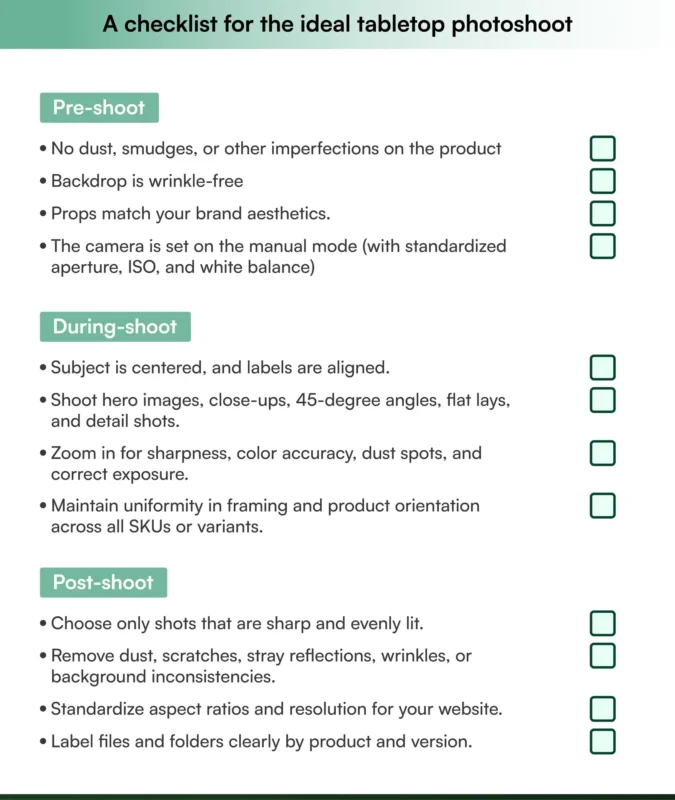
Additional best practices to make your tabletop product photograph stand out
To push your tabletop product images beyond the basics, a few smart refinements can make all the difference. These best practices help you achieve the visual appeal demanded by today’s ecommerce buyers to convert:
- Experiment with backgrounds: Switch between white, colored, or textured backdrops. See which one enhances your product’s personality and select that.
- Use natural light whenever possible: A soft window light can create flattering and diffused illumination. This reduces harsh shadows and keeps your product looking true to life.
- Use reflective surfaces smartly: Acrylic sheets or glossy tiles can add subtle reflections to your products. This will give them a premium feel.
- Always use a tripod or cable release: Stabilizing your camera avoids motion blur. This ensures consistent framing across your entire product catalog.
- Try symmetrical product photos to create harmony: When you keep your products centered and balanced in the frame, it will naturally draw the viewer’s eye.
- Use only complementary props: Choose simple and brand-aligned props. More importantly, they should enhance the product story without competing for attention.
- Incorporate scale indicators: Include subtle reference items or hand placements when necessary. This will help buyers accurately understand product size.

Is AI the future of tabletop photography?
Let’s face it – Traditional tabletop photography can get incredibly expensive. Hiring a professional studio typically can cost you anywhere between $800–$1,500 for a full-day session. This will rise exponentially when you have a large catalog.
Even a DIY setup isn’t necessarily budget-friendly. Purchasing a DSLR, softboxes, reflectors, backgrounds, and basic props all add up to your costs. Combined with the time required to learn composition and editing, the effort can create production bottlenecks before you even know.
With AI product photo generators, such scalability issues are non-existent. These platforms can deliver studio-quality results at a fraction of the traditional cost and time. Wondering how?
For starters, routine tasks like lighting correction, shadow creation, smart cropping, and background cleanup are automated with remarkable accuracy. Secondly, these platforms come with advanced capabilities, such as auto-generating lifestyle scenes and batch-editing entire product catalogs. This makes your tabletop photography workflow far more efficient and cost-effective
As AI evolves, its impact on tabletop photography will only grow stronger. For new and upcoming ecommerce brands, the ability to produce high-quality visuals quickly, affordably, and creatively will become a key advantage in competing with larger, better-resourced players.
And remember, tabletop photography is only one piece of the transformation. AI is reshaping multiple areas of ecommerce, from operations to customer experience. If you’d like to explore the broader impact, check out this article: AI in ecommerce – Transforming the future of online business.
Meet WizStudio: The smarter way to create high-impact tabletop visuals

WizStudio is an AI-powered platform that was designed to transform your ordinary tabletop product photos into high-impact visuals, without the complexity, cost, effort, or time associated with traditional tabletop studio setups. Instead of juggling props and multiple editing tools, you can transform your images using our intelligent AI-driven enhancements and generate creative variations.
Here are some key capabilities of WizStudio:
- Lifestyle image generator: You can transform simple tabletop shots into immersive lifestyle scenes in seconds. Just upload your base product image, describe the desired setting, and let AI handle the styling. No props to source or no elaborate sets to build.
- Multiproduct staging: Bring multiple products together in a cohesive tabletop arrangement without physically placing them side by side. WizStudio lets you position and style several SKUs digitally, creating catalog-ready group tabletop shots in minutes.
- AI editing & enhancement suite: Refine and polish your tabletop visuals with intelligent editing tools that mimic expert retouching. Add natural, realistic shadows, remove unwanted elements, extend canvases for flexible cropping, etc.
- Hybrid “done-for-you” service: If you want the human touch to refine your tabletop visuals, WizStudio can help with that too. Our Done-For-You service blends AI efficiency with human creative finesse. You upload your product photos, and our experts enhance and refine them. We will deliver professional-quality visuals without the effort of managing a full shoot.
Below is a quick comparison to highlight how using WizStudio compares with the traditional tabletop photography workflow:
| Aspect | WizStudio | Traditional tabletop photography |
| Time | Minutes. AI handles lighting, cleanup, shadows, and variations instantly. | Hours or days. Setup, shooting, reshoots, and manual post-production take longer. |
| Cost | Low and predictable. No studio rentals or high-end gear required. | High. Cost can escalate quickly when you have a large catalog. |
| Consistency | High. Easy to maintain uniform angles and style across entire catalogs. | Varies. It depends heavily on lighting conditions and the photographer’s skill. |
| Skills needed | Minimal. No photography or editing expertise required. | High. Requires extensive knowledge of composition and editing. |
| Creative variations | Generates multiple themes and lifestyle scenes from a single image. | Limited. Each variation requires a new shoot or extensive manual editing. |
| Scalability | Easily scales to hundreds or thousands of SKUs with batch processing. | Difficult. Each product requires a separate setup and manual editing. |
| Revisions | Instant. AI can update backgrounds, lighting, shadows, or crops in seconds. | Slow. Reshoots or detailed retouching are often needed for even minor changes. |
Want to experience WizStudio first hand? Sign up for a free trial now.
Frequently asked questions
1. How to take a top-down photo?
To capture a clean top-down photo, mount your camera directly above the setup using a tripod with a horizontal arm or a sturdy overhead rig. Keep the background flat and clutter-free. Use soft and even lighting. More importantly, ensure all objects are aligned within the frame. Finally, take multiple shots to adjust spacing and angles.
2. What equipment do I need to start tabletop photography at home?
A basic home setup only requires a camera or smartphone, a tripod, and soft lighting (window light). You can use simple backgrounds like whiteboards or colored sheets. You can also use small props available at home to enhance the visual.
3. How do I set up lighting for tabletop photography to avoid harsh shadows?
Use soft lighting to minimize harsh shadows. Natural lighting works well. If you have the budget, you can invest in a softbox or LED panel and place them at a 45-degree angle. Additionally, you may add a reflector opposite the light to fill in shadows and maintain balance. A word of caution. Avoid placing lights too close or too directly, as this creates unwanted contrast.
4. How do I use shooting tents or domes for tabletop photography?
Shooting tents(light tents) or light domes diffuses light evenly around your product. They reduce glare and harsh shadows. To use them, place your product inside and light it from the sides or top. Use the built-in diffusing fabric to soften the illumination. They are especially useful for reflective objects and small ecommerce items that need uniform lighting.
5. What backgrounds work well for tabletop photography?
White, neutral, or lightly textured backgrounds work best for tabletop photography because they keep the product or main subject in focus. They also make sure that your catalog remains consistent. You can choose colored or white paper, acrylic sheets, or fabric, depending on your brand aesthetic.
6. What are the common mistakes to avoid in tabletop photography?
Common mistakes include using harsh artificial lighting, cluttered backgrounds, inconsistent angles, and ignoring reflections or dust. Overusing props or mixing color tones can also distract the viewer’s attention from the product.
7. How can tabletop photography help e-commerce brands improve their product listings?
High-quality tabletop photography enhances clarity about your product and builds trust in the buyer’s mind. Clean visuals help buyers understand size and features, ultimately increasing conversions. High quality tabletop photography also strengthens brand identity and reduces returns by accurately representing what customers will receive.
8. How do I photograph small objects effectively on a tabletop?
Use a macro lens or your camera’s macro mode to capture fine details. Ensure the object is well-lit with diffused light to avoid harsh shadows. Use reflectors to brighten darker areas. Keep the background simple and stabilize the camera with a tripod to maintain sharp focus, especially at close distances.
9. What are some unique tabletop photography ideas?
Experiment with creative concepts like mirror reflections, textured backgrounds, monochrome color themes, or levitation-style compositions. Try arranging products in geometric patterns or using dramatic side lighting. Try incorporating subtle motion with falling elements. Seasonal setups can also make your final shot fresh and unique.