Skip to content



Every successful ecommerce experience, from product discovery to repeat purchases, is shaped by one invisible factor – your catalog. When your catalog is well-structured, operations feel effortless. When it isn’t, even the best storefronts start to break down. Yet many businesses pour resources after resources into the most sophisticated ecommerce platforms and automation tools, only to see disappointing results. The reason is simple: their catalogs are fragmented and manually maintained. They are only built for internal convenience rather than being based on real buying behavior. So now the key question is – what is the right way to manage an ecommerce catalog? We will answer this, plus several other critical questions, in this blog.
What is catalog management in ecommerce?
Ecommerce catalog management is the process of structuring and maintaining all product-related information in a dynamic interface that can be viewed by buyers. In the B2B context, effective catalog management ensures that your buyers see the right products at the right price based on their account or contract. Here are the key components of B2B catalog management:
- Structuring products into logical categories and hierarchies based on how buyers search and purchase.
- Managing SKUs, variants, bundles, and staying up to date with B2B ecommerce trends.
- Defining and applying customer-specific, tiered, and contract-based pricing rules.
- Maintaining accurate product attributes, specifications, and technical data.
- Managing rich media such as images, datasheets, certifications, and manuals.
- Controlling catalog visibility by customer, region, channel, or sales role.
- Enforcing buying rules like minimum order quantities, pack sizes, and units of measure.
- Governing approvals and versioning to prevent catalog inconsistencies
Interestingly, many businesses mistake catalog management for simple product listing. The difference is significant. Product listing is static and surface-level. It simply involves adding items to a B2B ecommerce platform and publishing them online. Catalog management, on the other hand, is dynamic and rule-driven. It governs how products are grouped, who can see what, how pricing is applied, and how updates flow across systems without breaking downstream processes.
Similarly, catalog management in ecommerce is often used interchangeably with terms like PIM and inventory management. Again, there are a world of differences between them. Here’s how they differ:
- Ecommerce catalog management: Involves structuring products for buying and applying pricing and visibility rules.
- Product Information Management (PIM): Focuses on centralizing, enriching, and standardizing product data.
- Inventory management: Revolves only around tracking stock levels, movement, and availability

Why proper B2B catalog management is critical in ecommerce?
In B2B commerce, catalogs tend to expand rapidly while pricing structures grow increasingly complex. When catalog management is weak, this complexity quickly translates into friction for buyers and inefficiencies for internal teams. Proper ecommerce product catalog management addresses these challenges and is critical for the following reasons:
1. Improves buyer experience
B2B buyers expect clarity and speed. A well-managed catalog ensures they consistently see relevant products, accurate pricing, correct stock availability, and reliable product information every time they log in. Clear specifications and customer-specific visibility eliminate guesswork from the buying process. This, ultimately, results in faster purchases and a more seamless buying experience.
2. Results in faster sales cycles
When catalogs are structured correctly, buyers can self-serve with confidence instead of relying on back-and-forth with sales teams. Sales reps also benefit from having instant access to approved products and availability. This allows the reps to generate quotes and close deals faster. Fewer clarifications mean shorter sales cycles and quicker time to revenue.
3. Reduces manual errors
Manual catalog updates on spreadsheets and one-off overrides are a common source of pricing mistakes and order errors in B2B. Proper catalog management centralizes rules and data. More importantly, it ensures consistency across channels. This reduces costly errors in pricing, product selection, and order fulfillment that can hamper customer trust and lead to costly financial errors.
4. Brings down operational overhead
Without structured catalog management, your teams will end up spending significant time fixing inconsistencies and performing duplicate work. A centralized catalog minimizes rework and reduces dependency on manual interventions. This allows your sales, marketing, operations, and ecommerce teams to work from the same source of truth.
5. Allows scaling of the business
As your B2B business grows, catalogs expand, customer segments multiply, and pricing models become more complex. Strong catalog management makes this growth manageable. New products and markets can be added without breaking existing workflows. This means you can scale digital sales without a proportional increase in operational complexity.
What are some common B2B ecommerce catalog management challenges?
B2B ecommerce catalogs are fundamentally more complex than B2C catalogs and have their own set of unique challenges. Below are some of them:
1. Managing customer-specific pricing
In B2B, pricing is rarely universal. Different customers have different negotiated rates and contract pricing. Adding to this complexity are volume-based discounts and region-specific price lists. Managing all these variations accurately and ensuring the right customer sees the right price every time quickly becomes difficult without a centralized pricing logic tied to the catalog.
2. Supporting multiple catalogs for different buyer personas
Many B2B businesses need separate catalogs for distributors, retailers, agents, and other wholesalers. These catalogs may differ in product availability and pricing. Maintaining multiple catalogs without duplicating data or creating inconsistencies easily becomes a major operational hurdle.
3. Handling large SKU volumes with complex attributes
B2B catalogs often contain thousands, or even tens of thousands, of SKUs. Each of them will have multiple attributes such as size, material, packaging, compliance data, and variants. Keeping this data clean and searchable is difficult. This is especially true when updates are frequent, and the data is sourced from multiple spreadsheets.
4. Managing tiered pricing and MOQ rules
Tiered pricing, minimum order quantities (MOQs), case packs, and quantity breaks are common rules in B2B commerce. The challenge lies in applying these rules dynamically within the catalog while keeping the buying experience simple and transparent for customers.
5. Supporting assisted selling alongside self-serve buying
B2B buyers don’t always operate in self-serve mode. Some orders require sales rep involvement for configuration or bulk purchasing. Catalogs must support both self-serve buyers and assisted selling workflows using the same product data and pricing rules, without creating parallel systems. This is not easy.
6. Managing product visibility
Not every product should be visible to every buyer. Some items may be restricted by customer type, geography, contract terms, or stock availability. Managing fine-grained product visibility rules at scale, while avoiding accidental exposure or missed sales opportunities, is a recurring challenge for most B2B teams.
7. Integration challenges
B2B catalogs don’t operate in isolation. They must integrate with ERP systems, inventory management tools, pricing engines, CRM platforms, and order management systems. Misaligned data models or partial integrations can result in outdated pricing, incorrect availability, wrong product data, and poor buyer experiences.
What is an ecommerce catalog management solution, and what are its types?
An ecommerce catalog management solution is a system designed to manage and govern all product-related information and tie customer-specific pricing, contract-based catalogs, availability rules, and buying constraints into a single (and controlled) source of truth.
An ecommerce catalog management platform addresses all the core challenges highlighted in the previous section. Instead of maintaining wholesale pricing data in one tool, customer data in another, and inventory data in a third system, a product catalog management software ensures everything is managed centrally, and all the rules are applied automatically without manual intervention.
A modern catalog management solution is also built to handle large SKU volumes with complex attributes without compromising performance or usability.
Key features of an ecommerce catalog management platform
When selecting an ecommerce catalog management solution, the key is to focus on platforms that offer the right set of capabilities, not just broad functionality. These features directly determine how well your catalog can handle B2B complexity and support digital sales at scale:
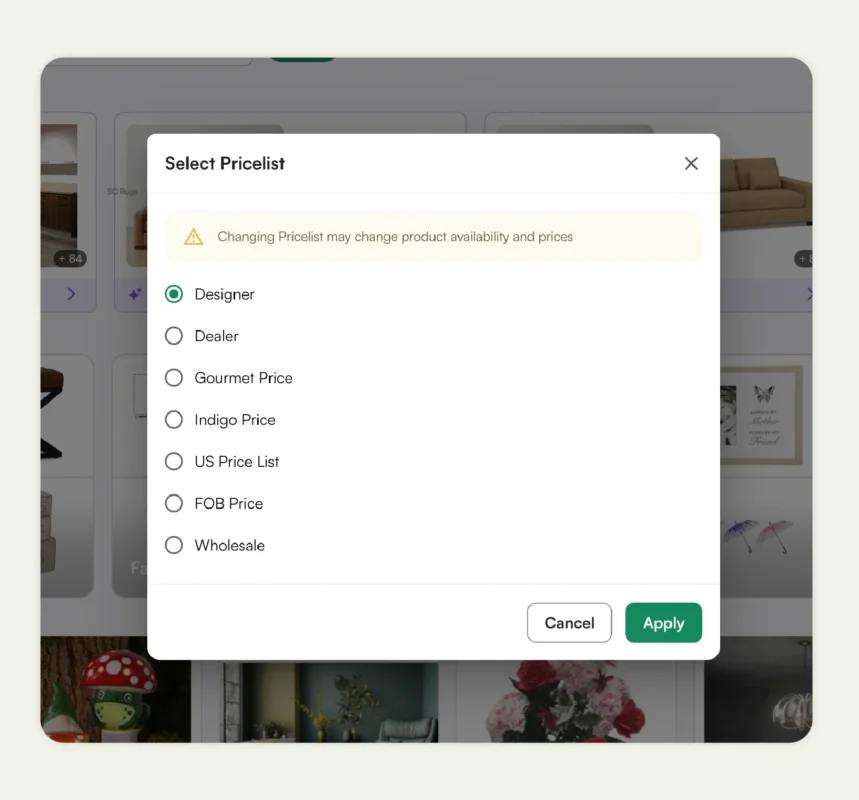
- Multiple price lists: The catalog management solution must support multiple price lists mapped to specific buyers or accounts. This allows you to apply negotiated pricing, contract rates, and promotional discounts digitally, without manual overrides or pricing conflicts.
- Seamless integration with ERP: Your catalog must reflect real-time product, availability, pricing, and customer data. However, most of this data lives in the ERP. So, the solution you pick should offer tight ERP integration. This will ensure the catalog stays accurate and reliable across all buying touchpoints.
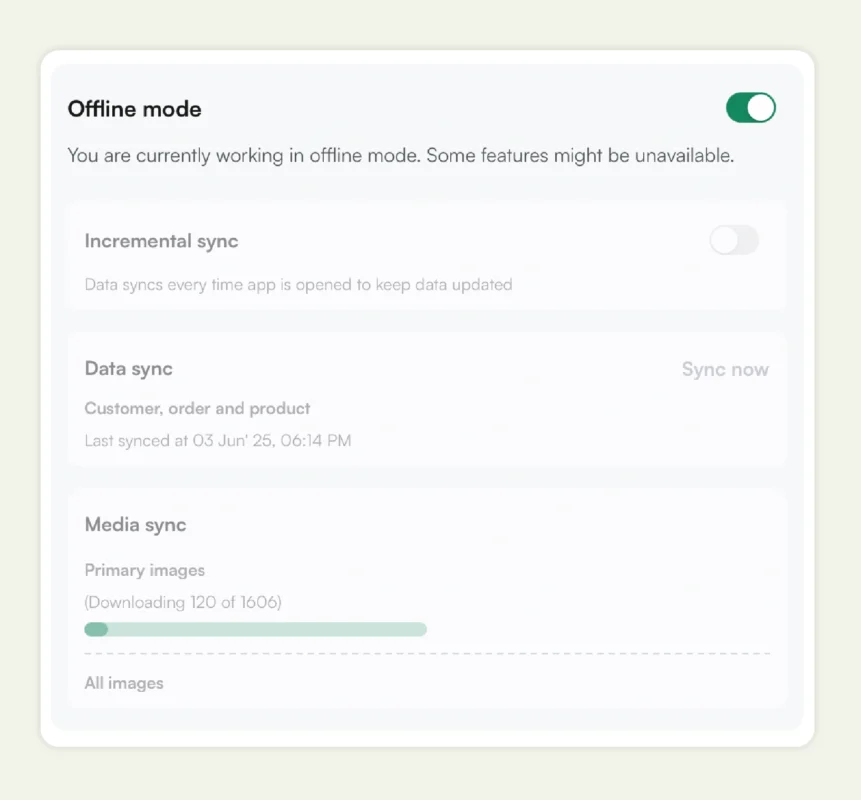
- Offline catalog access and order capture: Your field sales teams might often operate in environments with limited or unreliable connectivity. That’s why the solution you pick must offer offline access to catalog management. This ensures selling continues uninterrupted, regardless of network conditions.
- Rule-based MOQ, pack size, and quantity controls: B2B orders often come with constraints such as minimum order quantities, case packs, and fixed quantity increments. The catalog management solution you pick should enforce these rules directly through simple configurations.
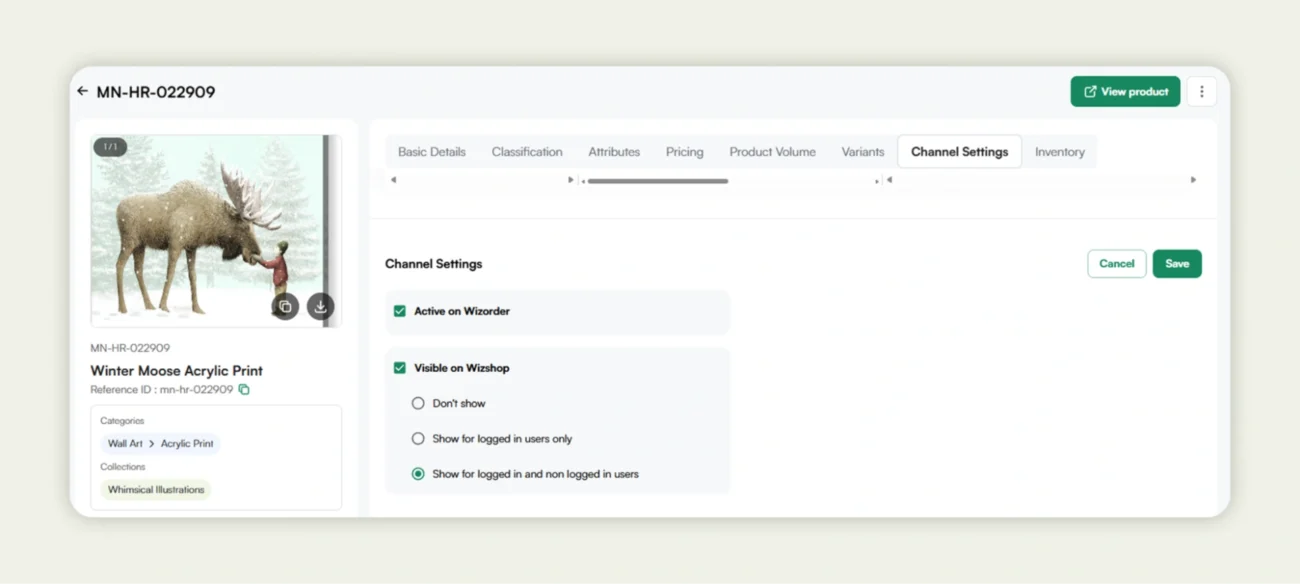
- Product visibility management: In B2B, not all products should be visible to every buyer. The solution must allow you to control product visibility based on customer accounts, roles, regions, or contract terms. This ensures buyers only see relevant and authorized products.
- Workflow and approval management: Catalog updates, such as price changes or product removals, often require internal approvals. The solution must support built-in workflows and approval mechanisms to help prevent accidental changes.
- High-performance search: In B2B, catalogs can grow larger before you know. The solution should support quick search and filtering across large SKU volumes. This enables your reps and buyers to find the right products quickly.
Ecommerce catalog management best practices
These best practices will help you keep your catalogs clean and aligned with how your buyers actually purchase:
- Design catalogs around buying workflows, not internal product hierarchies: Structure categories and navigation based on how your buyers search and compare your products, instead of focusing too much on how your products are organized internally. This will reduce friction and speed up purchasing.
- Standardize product attributes and naming: Use consistent naming conventions and attribute formats across all your SKUs. Standardization will improve product search accuracy and simplify catalog maintenance, even if you scale rapidly.
- Regularly audit and clean catalog data: Periodically review the catalog to remove obsolete SKUs and fix incomplete attributes. Don’t forget to correct outdated pricing and availability. When you have clean data, there will not be any errors during ordering.
- Establish clear ownership and approval workflows for catalog updates: Clearly define who can create, edit, delete, and approve catalog changes. When you have structured workflows, data quality is ensured, and accidental updates are prevented.
- Keep contract-based catalogs time-bound and version-controlled: Contract pricing and associated catalogs should have clear validity periods and version history. This will avoid expired pricing being applied and make it easier to manage renewals and future negotiations.
Implementing these best practices consistently requires more than process discipline. It requires a platform designed to handle B2B catalog complexity.
Catalog management solutions for industrial distributors
Industrial distributors require catalog management solutions that can handle large SKU volumes, highly technical product attributes, and frequent updates tied to ERP systems. These solutions accommodate complex attribute structures, compatibility data, and compliance requirements common in industrial catalogs. Strong ERP integration ensures pricing, availability, and product data remain accurate across all sales channels. Additionally, these systems support contract pricing, customer-specific catalogs, and workflows that allow both self-serve buyers and sales-rep-assisted purchases to operate seamlessly from the same centralized catalog. Platforms built for industrial distributors, like WizCommerce, are designed to handle these exact complexities efficiently, providing centralized catalog management, ERP integration, and buyer-specific configurations.
Benefits of outsourcing ecommerce catalog management
Outsourcing catalog management helps businesses reduce operational workload while maintaining accuracy across large and complex product sets. External specialists can deliver faster catalog updates and ensure data quality, freeing internal teams to focus on strategic tasks. Outsourcing also provides access to expertise in structuring catalogs, managing pricing rules, and maintaining ERP integrations. For growing businesses, it can be more cost-effective than scaling in-house operations, especially when handling seasonal spikes or expanding product lines. Leveraging specialized solutions sets the stage for platforms like WizCommerce to manage catalogs efficiently at scale.

Why is WizCommerce the best ecommerce catalog management solution for B2B brands?
If you are looking for a platform that goes far beyond basic catalog management, your search will culminate with WizCommerce. WizCommerce is a comprehensive B2B ecommerce platform designed to manage your entire selling lifecycle, right from catalog setup to handling payments. Built B2B-first, WizCommerce understands how wholesale selling actually works, and that’s why its catalogs are dynamic, buyer-specific, and deeply connected to ERP systems.
Some of the WizCommerce’s key B2B ecommerce features related to catalog management include:
- Buyer-specific catalogs and pricing – Create segmented catalogs with custom price lists, contract pricing, and login-based visibility to support negotiated B2B relationships at scale.
- Scalable handling of complex product data – Manage thousands of SKUs, variants, and attributes without compromising data consistency or usability.
- ERP-driven accuracy – Keep catalogs in sync with leading ERPs to reflect real-time product, pricing, and inventory data. For the full list of ERPs and other tools supported by WizCommerce, check our integrations page.
- Configuration-first flexibility – Modify catalog rules, visibility, and workflows through built-in settings instead of custom development.
- Offline-ready catalogs for field sales – Enable uninterrupted selling with full catalog access and order capture, even without internet connectivity.
- Unified experience for buyers and reps – Support both self-serve buyers and assisted selling using the same live catalog and pricing logic via dedicated apps for reps and buyers.
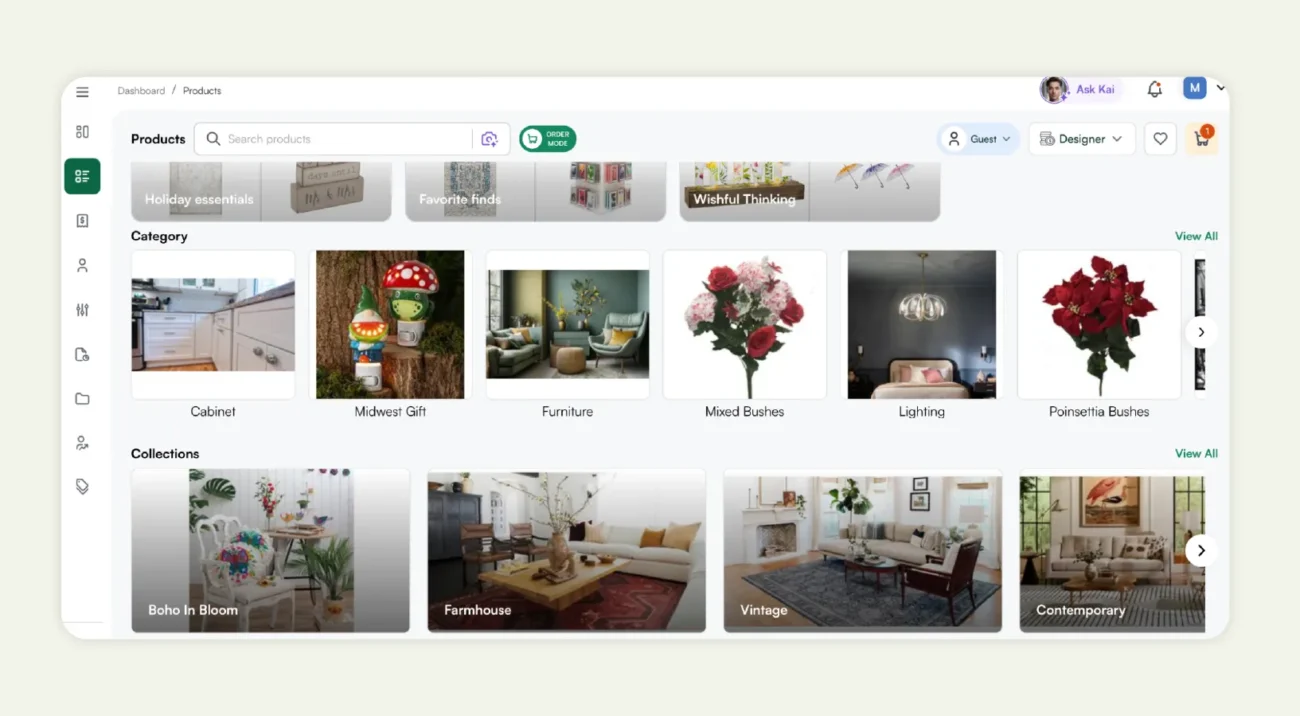
Howard Elliott Collections, the popular home decor brand, used WizCommerce to transform their catalog management workflows into a dynamic, buyer-friendly system. Before WizCommerce, their existing website prevented customers from shopping with the velocity they were looking for. Similarly, their sales reps didn’t have the tools to quickly guide buyers through a large assortment.
With WizCommerce’s AI-enhanced B2B ecommerce platform, Howard Elliott could now offer an intuitive site to their buyers that looked and functioned the same before and after login. Their buyers now had access to powerful filters, real-time inventory visibility, and the ability to shop on their own schedule, without relying on sales reps for basic information. This optimized catalog experience led to a significant increase in online engagement, faster cart building, and higher order volumes.
So, if you want to sell smarter and with complete control of buyer experiences, just like Howard Elliott Collections, check out WizCommerce now. Book a free demo now.
Frequently Asked Questions
How can automating ecommerce catalog management improve my store’s efficiency?
Automating ecommerce catalog management improves store efficiency by reducing the manual effort involved in updating data related to products, including their pricing and availability. It minimizes errors and speeds up catalog updates. Automation also supports faster product launches for your online store and smoother and error-free coordination between your ecommerce, sales, operations, and marketing teams.
Which catalog management software is recommended for ecommerce businesses?
The catalog management software recommended for ecommerce businesses depends on your business model, your target audience, and the complexity of product content. Most businesses typically benefit from catalog management tools that support customer-specific pricing, ERP integration, multiple catalogs, and role-based visibility for digital assets. WizCommerce is one of the best ecommerce catalog management companies today that not only offers all these features but is also carefully designed for rapid business growth and a seamless online shopping experience for your buyers.
What features should I look for in ecommerce catalog management software?
The features you should look for in ecommerce catalog management software include centralized product data management, customer-specific pricing, product visibility controls, ERP integration, support for large SKU volumes, workflow approvals, and high-performance search. Capabilities like MOQ rules, multi-catalog support, and assisted selling are also critical.
How does effective product catalog management impact online sales?
Effective product catalog management impacts online sales by improving buyer confidence and customer experience through accurate product information, relevant pricing, and clear availability across all your online sales channels. This reduces friction in the buying process, shortens sales cycles, lowers cart abandonment, and drives customer loyalty. For B2B, it also enables faster reordering, higher average order value, and better conversion rates.
What steps are involved in setting up an ecommerce product catalog?
The steps involved in setting up an ecommerce product catalog typically include structuring your product categorization, defining attributes, importing product details, including product titles, product categories, product descriptions, and product images, setting pricing and availability rules, and configuring visibility for different buyers. This is followed by testing navigation and ordering flows to ensure the catalog supports real buying behavior.
How do you manage bulk product listings efficiently?
Bulk product listings are managed efficiently through a centralized catalog management system that supports bulk imports and automated updates. Integrating the catalog management solution with ERP and inventory systems further reduces duplication due to manual data entry. Standardized attributes and validation rules also help maintain consistency even when handling thousands of SKUs.
What is catalog management software?
Catalog management software is a platform used to organize product data across your ecommerce channel. It centralizes product information, pricing, availability, and visibility rules, enabling you to manage complex catalogs efficiently and with great data accuracy, all the while delivering enhanced customer engagement and consistent user experience.