Skip to content



Choosing the right B2B e-commerce platform in 2026 is a margin decision, not a tech decision. The wrong pick forces your team to fix orders by hand, your AR team to chase POs, and your buyers to call instead of reorder. The right one moves wholesale, distribution, and manufacturing teams from manual order entry to a system that actually scales with revenue.
This guide compares the 15 best B2B e-commerce platforms in 2026 on what wholesale buyers care about: customer-specific pricing, PO and net terms, ERP fit with QuickBooks, NetSuite, or SAP, and time-to-launch. If the problem you’re actually solving is on the sales side rather than the storefront – accounts, follow-ups, which buyers have gone quiet – that’s a different shortlist, and we compare the best CRM features for wholesalers separately. Use the comparison table below to shortlist the top B2B e-commerce platforms in two minutes, then read the full breakdowns to find the one that fits your order volume, ERP stack, and wholesale workflow.
What Are the Best B2B E-Commerce Platforms in 2026?
The best B2B e-commerce platforms in 2026 are WizCommerce, Shopify Plus, and BigCommerce B2B Edition for most mid-market wholesalers, distributors, and manufacturers. The right pick depends on your industry segment, order volume, and ERP stack. Here is how the top B2B e-commerce platforms compare across the three biggest segments: manufacturing, distribution, and wholesale, with a full side-by-side comparison in the table below.
Best B2B E-Commerce Platforms at a Glance
Shortlisting from 15 platforms is hard without seeing them side by side. The table below compares every platform in this guide on the six criteria B2B buyers actually weigh: who it fits best, what it costs to start, whether it was built for B2B from day one, its standout feature, and how it connects to your ERP. Use it to cut the list to three:
| Platform | Best For | Starting Price | B2B Native | Top Feature | ERP Integration |
| Shopify Plus | SMB to mid-market with DTC and B2B | Custom | Partial | Headless storefront plus B2B portal | NetSuite, QuickBooks via apps |
| BigCommerce B2B Edition | Mid-market distributors | Custom | Yes | Shared shopping lists, quote-to-order | NetSuite, SAP native connectors |
| WizCommerce | Wholesalers, distributors, and manufacturers with field sales teams | Custom | Yes | WizShop B2B storefront, WizOrder – B2B Sales Rep App, and AI Co-worker for orders and quotes | Native QuickBooks, NetSuite, SAP B1, Shopify two-way sync |
| OroCommerce | Enterprise B2B and distribution | Custom | Yes | Multi-org account hierarchy | SAP, Oracle ERP, Salesforce |
| Salesforce Commerce Cloud B2B | Salesforce CRM-centric enterprises | Custom | Yes | Native CRM plus commerce integration | Full Salesforce ecosystem |
| Adobe Commerce (Magento) | Complex catalogs, custom workflows | Custom | Partial | Unlimited customization | SAP, Oracle, Epicor |
| SAP Commerce Cloud | SAP ERP-centric enterprises | Enterprise | Yes | Real-time ERP inventory and pricing | SAP S/4HANA native |
| Virto Commerce | Manufacturers with complex pricing | Open source plus SaaS | Yes | Modular composable architecture | Any (API-first) |
| NetSuite SuiteCommerce | NetSuite ERP users | Custom | Yes | Real-time inventory from ERP | NetSuite native |
| Sana Commerce | SAP and Microsoft Dynamics users | Custom | Yes | ERP-native storefront | SAP, Microsoft Dynamics |
| WooCommerce B2B | WordPress-based small business | Custom | Partial | WordPress flexibility, low cost | QuickBooks via plugins |
| Elastic Path | Composable commerce, tech teams | Custom | Yes | Headless API-first architecture | Any (API-first) |
| VTEX | Latin America and global enterprise | Custom | Yes | Unified marketplace plus B2B | SAP, Oracle |
| Optimizely Commerce | Content plus commerce integration | Custom | Partial | CMS plus ecommerce in one platform | SAP, Episerver ecosystem |
| Commercetools | Developer-first composable builds | Custom (consumption-based) | Yes | MACH architecture, infinite scale | Any (API-first) |
The fastest way to read this table is to filter by your ERP first, then by your order model. If you run QuickBooks and your reps take orders in the field, your shortlist is two or three rows long, not fifteen.
Top 15 B2B E-Commerce Platforms in 2026
The 15 platforms below cover every meaningful B2B e-commerce use case in 2026, from $1M wholesalers running QuickBooks to $500M manufacturers running SAP S/4HANA. Each breakdown covers what the platform is built for, its strongest features, where it falls short, and the buyer it actually fits. Here’s how each one stacks up for real B2B operations:
1. Shopify Plus
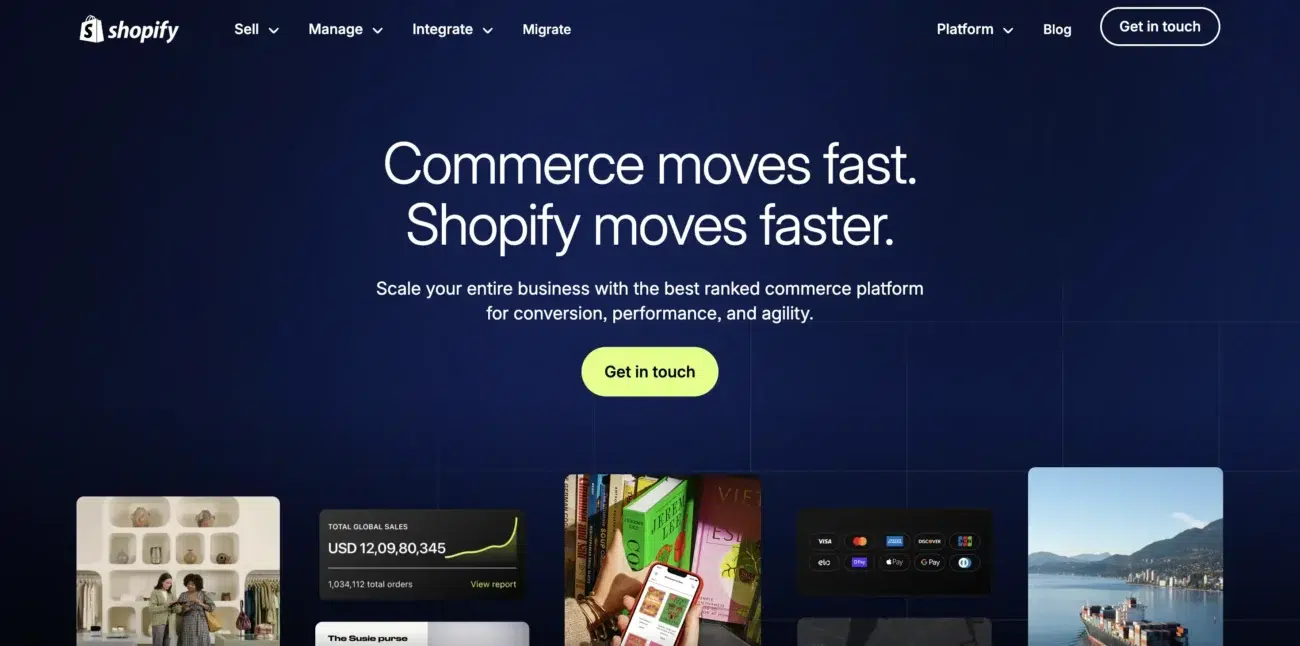
Shopify Plus is the enterprise tier of Shopify, with a native B2B feature set rolled out from 2022 onward. It is built for brands running DTC and wholesale from one admin, with company accounts, customer-specific price lists, net terms, and a wholesale storefront sitting alongside the consumer store. It suits SMB to mid-market sellers who want speed to launch over deep B2B customization.
Key Features
- Native B2B portal with company accounts and buyer roles
- Customer-specific price lists, volume pricing, and net terms
- Headless commerce through the Hydrogen framework
- Large app marketplace including QuickBooks, NetSuite, and Avalara connectors
- High uptime SLA with dedicated merchant success manager
Pros
- Same admin handles DTC and B2B, which is unique in this space
- Fast go-live among enterprise platforms
- Massive app ecosystem covers most integration gaps
Cons
- PO checkout typically needs third-party apps
- Account hierarchies are shallow compared to OroCommerce or SAP
- ERP integration depends on connectors, not native sync. If NetSuite is the ERP, the best NetSuite ecommerce connectors for Shopify are compared in our guide.
2. BigCommerce B2B Edition
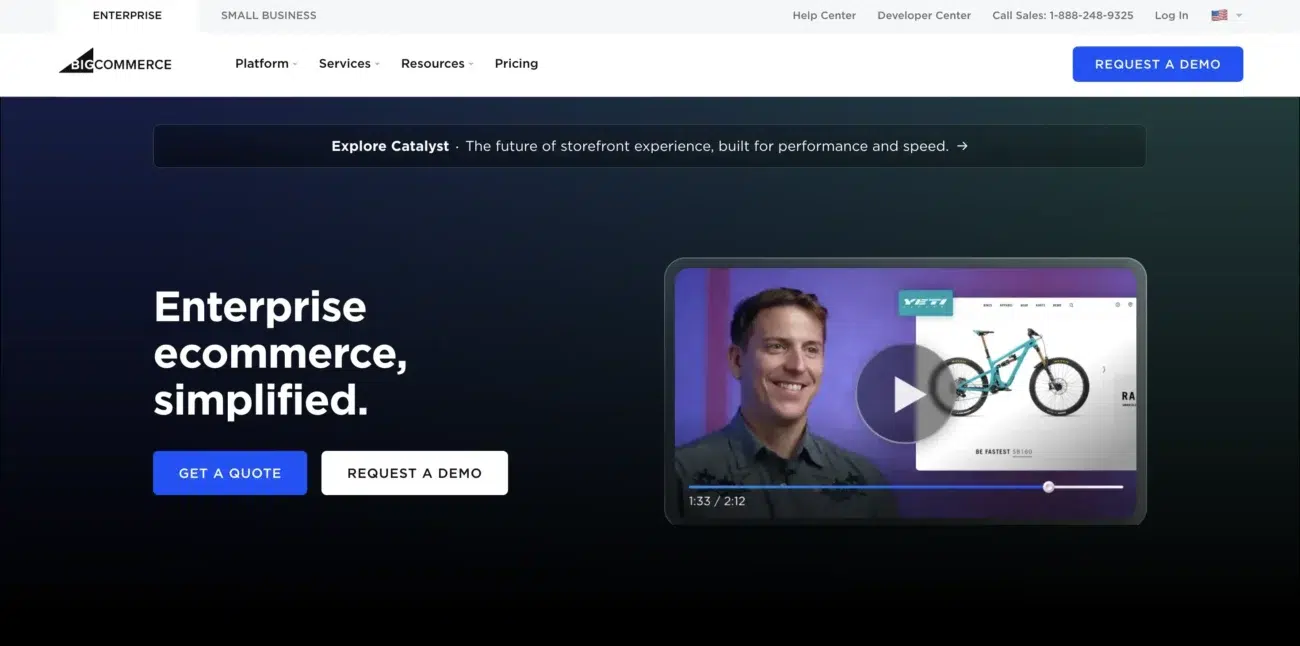
BigCommerce B2B Edition is a co-built product with BundleB2B, shipping with the workflows mid-market distributors usually pay extra for. Quote management, shared shopping lists, corporate accounts, and net payment terms are part of the base product. Its open API lets teams customize the backend without going fully headless, which suits distributors with non-standard pricing or approval logic.
Key Features
- Quote management with back-and-forth negotiation
- Shared shopping lists and procurement approval workflows
- Corporate accounts with sub-accounts and role-based permissions
- Multiple net payment terms built in
- Native connectors for NetSuite, SAP, and Salesforce
Pros
- Strongest out-of-the-box quote-to-order workflow
- Open API allows backend customization without headless rebuild
- Solid documentation and partner ecosystem for distributors
Cons
- B2B Edition is an add-on, so total cost stacks
- Mobile order-taking is weaker than WizCommerce
- Headless implementation needs real developer investment
Also read: BigCommerce vs WooCommerce: Which one is the best?
3. WizCommerce
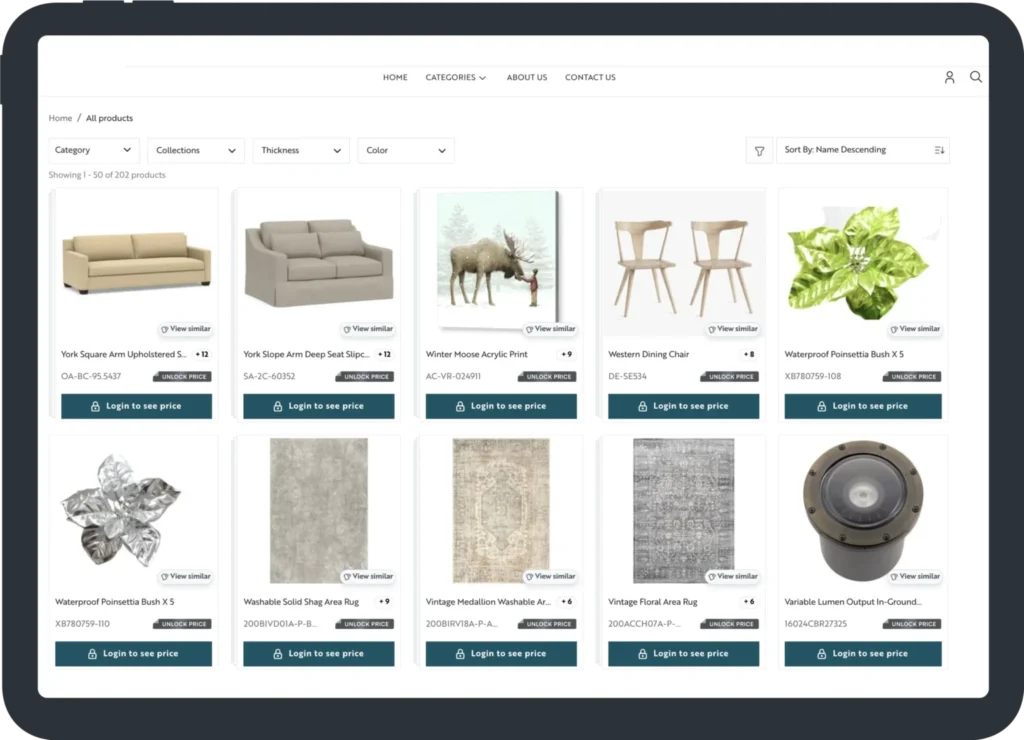
WizCommerce’s WizShop is the best B2B e-commerce solution currently available that is designed for wholesalers, manufacturers, and distributors seeking seamless operations and superior customer experiences. The core of the platform is built to cater to B2B needs. By combining AI-driven insights with robust integrations, WizCommerce delivers end-to-end solutions for bulk ordering, custom pricing, and advanced product discovery, empowering businesses to scale faster in competitive markets.
Key Features of WizCommerce’s B2B e-commerce platform
- Consistent data across systems: Sync orders, customer information, and product details automatically between WizCommerce, your ERP, and other channels, reducing errors and saving time.
- One customer record across commerce and sales: the storefront, the rep app and the CRM for ecommerce distributors read the same account, so pricing, order history and open deals aren’t split across three systems that need syncing.
- Custom price lists and approval flows: Allocate tailored pricing, freight, and payment terms for each client segment and integrate approval steps to streamline onboarding and ensure accurate billing.
- Advanced product discovery: Provide buyers with a typo-tolerant search bar, intuitive filters, and clear sort options so they can quickly locate products, even in extensive catalogs.
- One-click reordering: Enable repeat customers to place large orders in seconds using previously saved SKUs, addresses, and payment details, minimizing friction in the sales process.
- Seamless ERP integration: Integrates with all ERPs. Business data can flow directly from your ERP to WizCommerce for real-time stock visibility and reliable pricing without manual data entry.
- AI-driven product recommendations: Boost sales with Amazon-like suggestions based on buyer history. When items are out of stock, propose suitable substitutes to avoid missed opportunities.
- Flexible B2B checkout: Offer multiple billing and shipping options, add notes or preferred delivery dates, and support various B2B payment methods, ensuring a tailor-made checkout experience.
- Self-service and automated communications: Customers can access order status, invoices, and tracking links on demand while automated notifications update them on new orders, shipping details, and payment reminders.
Also read: Top 10 B2B commerce features every scaling business needs in 2026
Benefits of WizCommerce’s B2B e-commerce platform
- Improved efficiency: Automated processes, from pricing to inventory updates, free teams to focus on growth-oriented initiatives.
- Greater customer satisfaction: A very prompt customer support team. Personalized catalogs and a streamlined checkout experience encourage loyalty and repeat purchases.
- Scalable growth: Handle bulk orders, large product catalogs, and international sales with robust integrations and flexible architecture.
- Reduced errors and costs: Accurate, real-time data syncing reduces manual input, decreasing order mistakes and operational expenses.
- Enhanced revenue potential: Smart recommendations and quick reorder tools help capture upsells, cross-sells, and new market opportunities.
- Quick to market: With WizCommerce, you can go live in less than 30 days.
Drawbacks of WizCommerce’s B2B e-commerce platform
- Exclusively B2B-focused: WizCommerce zeroes in on wholesale and large-scale business needs. Companies that require B2C or direct-to-consumer capabilities may need additional platforms or integrations to serve those audiences effectively.
4. OroCommerce
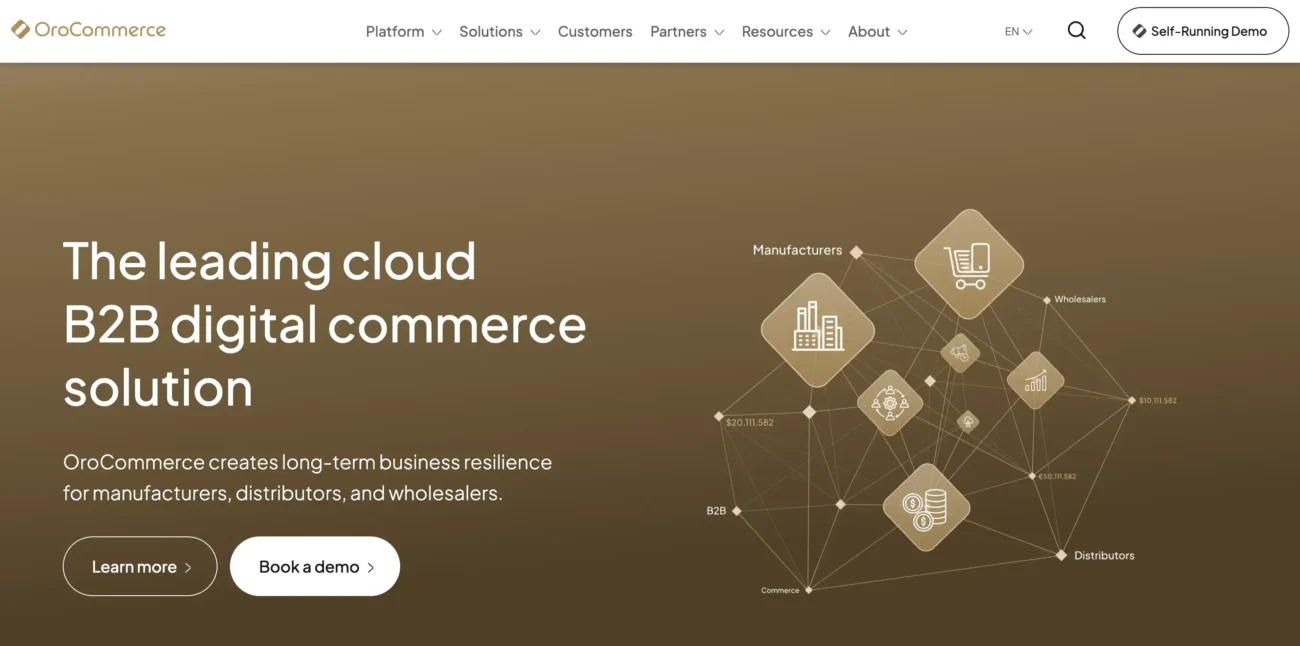
OroCommerce was built exclusively for B2B from day one, not retrofitted from a B2C product. It targets enterprise distributors and manufacturers with multi-org account structures, complex contract pricing, and demanding approval workflows. The platform ships with a built-in CRM, an RFQ engine, and a marketplace module, which is rare in this category. It is available as cloud SaaS or self-hosted open source.
Key Features
- Multi-level account hierarchy with granular role-based permissions
- Price list engine with contract, segment, volume, and promotional pricing together
- Built-in CRM (OroCRM)
- RFQ workflow with approval stages
- Personalized catalog visibility per account
- Marketplace capability for multi-vendor B2B
Pros
- Most sophisticated account hierarchy on the market
- Pricing engine handles contract logic competitors cannot model
- Open-source Community Edition for teams that want full control
Cons
- Long implementation timelines
- Needs ongoing developer resources to maintain and extend
- Total cost of ownership is high for smaller businesses
5. Salesforce Commerce Cloud B2B
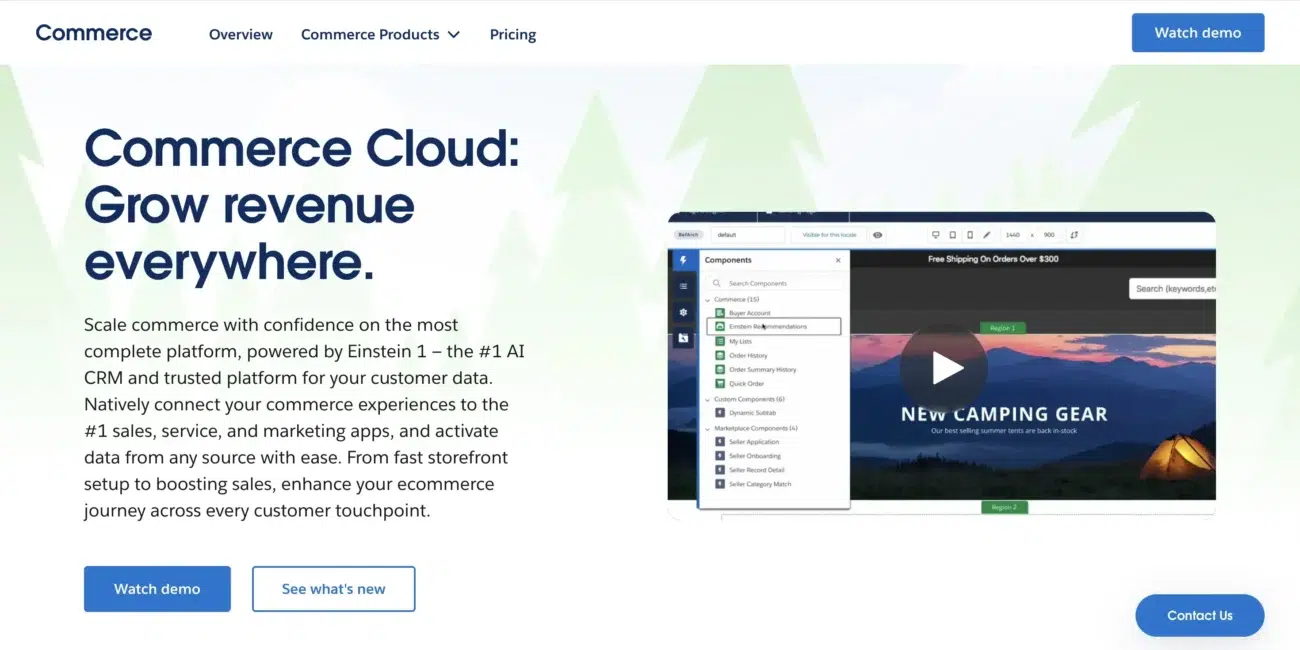
Salesforce B2B Commerce, formerly CloudCraze, was rebuilt natively on the Salesforce platform after acquisition. It shares the same data model, customer record, and admin as Sales Cloud, Service Cloud, and CPQ. For enterprises where Salesforce is the system of record, the integration depth eliminates the data silos that usually sit between commerce, sales, and service teams.
Key Features
- Native Salesforce platform with one data model across commerce, CRM, and service
- 360-degree buyer view combining service, sales, and ecommerce history
- AI-powered recommendations through Einstein
- Native CPQ integration for configure-price-quote
- Contract and entitlement management
- Multi-org and multi-locale enterprise support
Pros
- No data silos between commerce, CRM, and service teams
- CPQ integration handles complex enterprise quoting
- Einstein AI surfaces buyer intent across the full customer record
Cons
- Total cost of ownership is among the highest in the market
- Heavy Salesforce lock-in once embedded
- Implementation requires experienced SI partners and long timelines
6. Adobe Commerce (Magento)
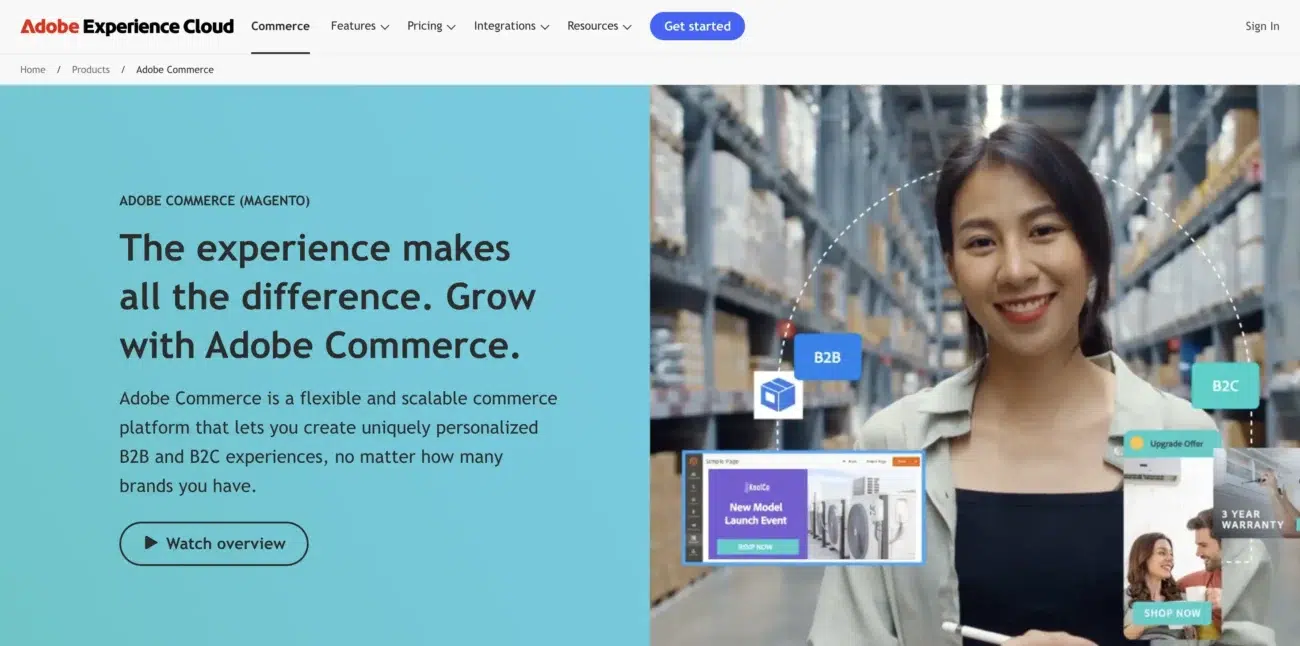
Adobe Commerce is the platform of choice for businesses with genuinely complex catalogs: thousands of configurable products, custom attributes, multiple regional storefronts, and pricing logic that no SaaS platform can model. The native B2B module ships with company accounts, shared catalogs, negotiated price lists, requisition lists, and quick order. It runs as on-prem or cloud, with extensive customization potential.
Key Features
- Shared catalogs with per-account product and price visibility
- Requisition lists for repeat ordering
- Credit limit management per account
- Multi-store, multi-currency, multi-language out of the box
- Large extension marketplace
- Page Builder CMS for content-heavy product pages
Pros
- Unmatched flexibility for complex catalogs and custom workflows
- Large agency and partner ecosystem for implementation
- Native B2B module included with Commerce licenses
Cons
- High ongoing development and maintenance cost
- Slower innovation cycle than SaaS competitors
- Security patching responsibility falls on the merchant for on-prem
7. SAP Commerce Cloud
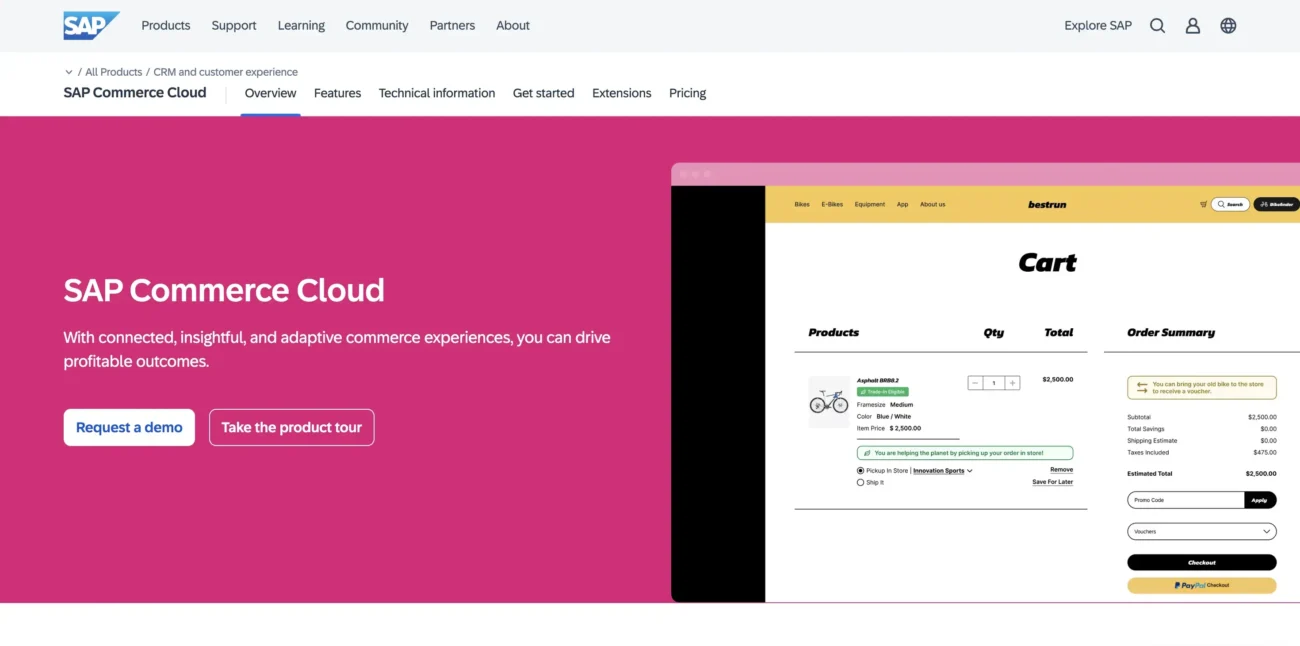
SAP Commerce Cloud, formerly Hybris, is built for enterprises whose operations already run on SAP. The integration with SAP S/4HANA is native, so inventory updates, customer-specific pricing, and credit checks happen in real time, not in scheduled batches. It ships with industry accelerators for manufacturing, distribution, and utilities, plus deep configure-price-quote support through SAP CPQ.
Key Features
- Native SAP S/4HANA integration with real-time pricing and inventory
- Customer-specific pricing from SAP condition records
- SAP CPQ integration for complex quote workflows
- Industry accelerators for manufacturing, distribution, and utilities
- Multi-site and multi-brand management
- Split shipments and backorder visibility
Pros
- Only platform with truly native SAP S/4HANA real-time sync
- Industry accelerators speed enterprise implementation
- Handles enterprise-scale traffic and SKU counts reliably
Cons
- Cost and complexity only justified inside the SAP ecosystem
- Long implementation timelines
- Customization requires specialized SAP SI partners
8. Virto Commerce
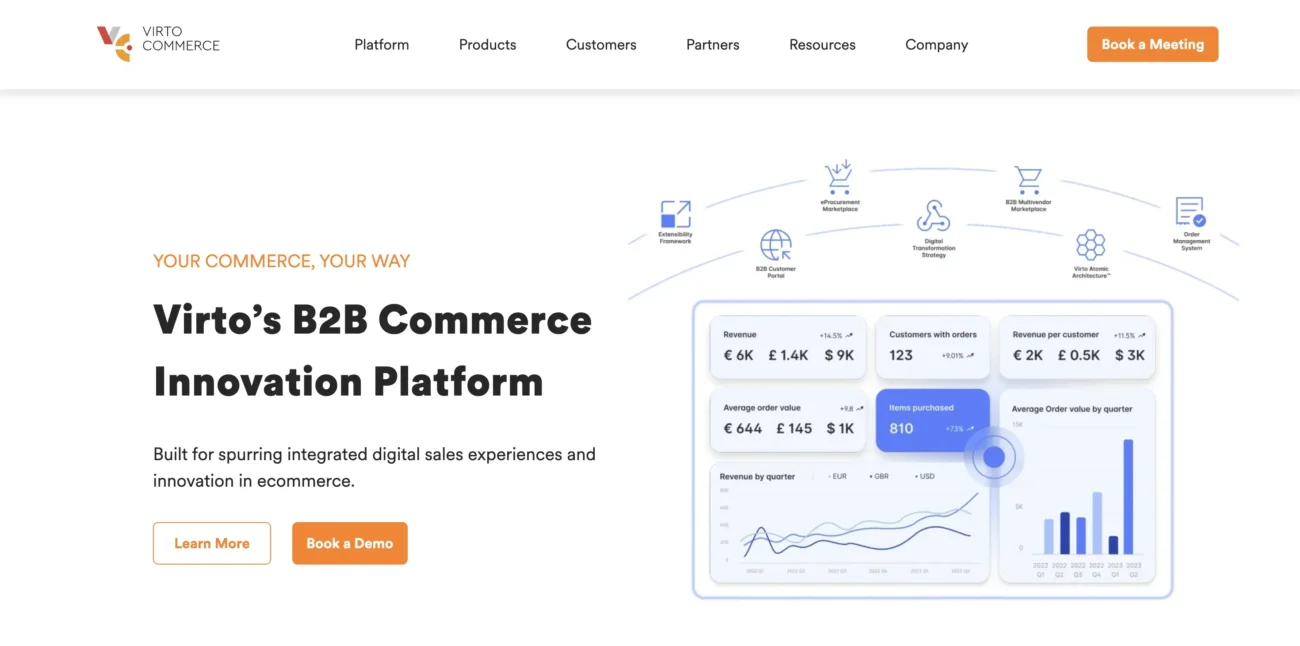
Virto Commerce is an open-source, API-first B2B platform built in modules. Manufacturers with non-standard pricing models, like formula-based pricing, multi-warehouse allocation, or per-account catalog overlays, can extend or replace individual modules without forking the codebase. It has strong fit inside the Microsoft ecosystem, with native Azure deployment and Dynamics 365 integration.
Key Features
- Modular open-source architecture on a public GitHub repository
- Pricing engine with formula-based and condition-driven logic
- Personalized catalog views per account
- Multi-tier order approval workflows
- Subscriptions and recurring ordering
- Strong Microsoft ecosystem fit (Azure, Dynamics 365)
Pros
- Modular architecture lets you replace any component
- Pricing engine handles logic SaaS platforms cannot model
- Open-source foundation removes vendor roadmap dependency
Cons
- Requires in-house developer team to operate
- Smaller partner ecosystem than Adobe or SAP
- Less out-of-the-box B2B UX polish than SaaS alternatives
9. NetSuite SuiteCommerce
SuiteCommerce is to NetSuite what SAP Commerce is to SAP: the native ecommerce layer built directly on top of the ERP. Inventory, customer-specific pricing, order fulfillment, and self-serve order history share the same data model as NetSuite itself, which eliminates the integration work other platforms force on teams. It only makes sense if NetSuite is already your ERP.
Key Features
- Single data model with NetSuite ERP, no sync required
- Customer-specific pricing from NetSuite price levels
- Real-time inventory from every warehouse location
- Customer Center for self-serve order history, invoices, and returns
- B2B account hierarchy with role-based access
- Promotions and coupons through the NetSuite engine
Pros
- Zero integration work between commerce and ERP
- Real-time inventory and pricing across every warehouse
- Customer self-service for invoices and returns built in
Cons
- Only viable if you are already running NetSuite ERP
- Storefront UX flexibility lags headless platforms
- Implementation through NetSuite SPs adds cost on top of license
10. Sana Commerce
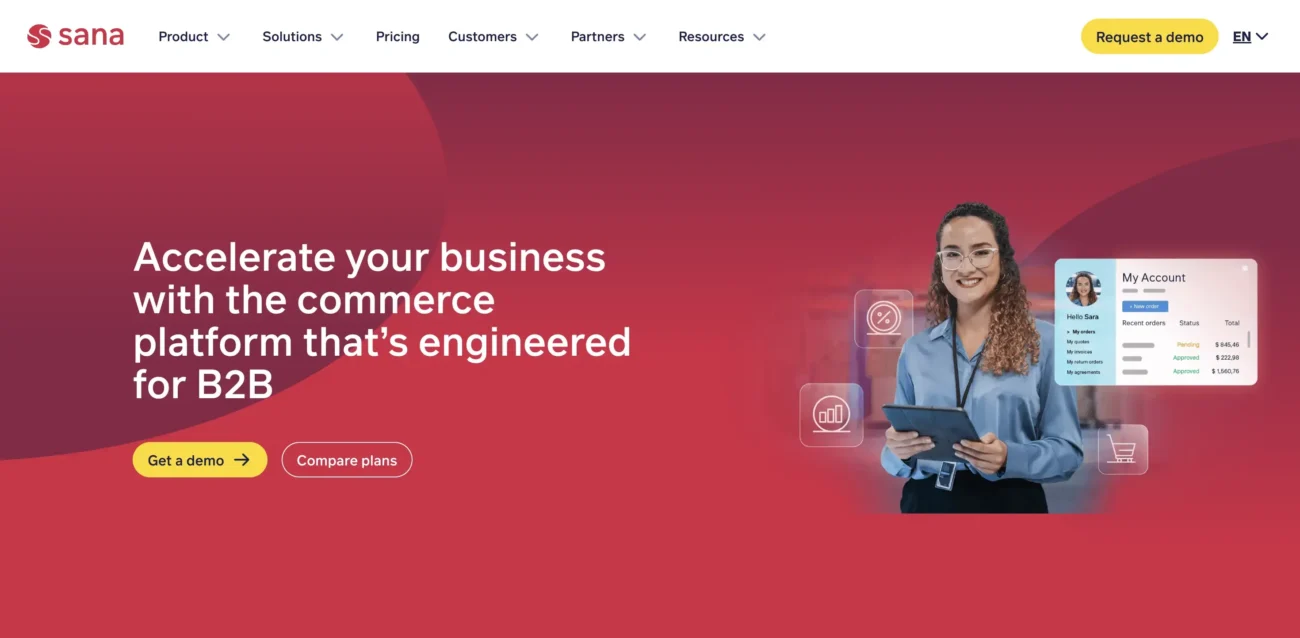
Sana Commerce builds its storefront directly on top of your ERP data, not alongside it. There is no second product catalog to maintain. The ERP is the catalog. That eliminates the most common B2B ecommerce failure mode: storefronts showing outdated pricing or wrong inventory because the sync failed. It supports SAP ECC, S/4HANA, and Microsoft Dynamics NAV, AX, and D365 natively.
Key Features
- ERP-native architecture with product data, pricing, and inventory in ERP
- Customer-specific pricing and credit terms from the ERP customer master
- Self-serve order history, invoice downloads, and returns
- One-click reorder from previous orders
- Supports SAP ECC, S/4HANA, Microsoft Dynamics NAV, AX, and D365
Pros
- ERP stays the single source of truth, no data drift
- Strong fit for SAP and Dynamics shops outside the native platforms
- Faster implementation than SAP Commerce Cloud
Cons
- Only relevant inside the SAP or Microsoft Dynamics ecosystem
- Storefront design flexibility is limited
- Smaller partner network outside Europe
11. WooCommerce B2B
WooCommerce is the free, open-source e-commerce plugin for WordPress, which powers a large share of the web. Paired with B2B plugins like WholesaleX, Wholesale Suite, or B2BKing, it delivers a workable B2B setup for small wholesalers on a tight budget. The trade-off is that you are assembling a solution from plugins instead of buying an integrated product, and maintenance overhead grows with the stack.
Key Features
- Hide prices and add-to-cart from non-logged-in users
- Tiered pricing through Wholesale Suite or Dynamic Pricing
- Tax exemption certificate management
- QuickBooks integration through third-party plugins
- Full WordPress flexibility for content and SEO
Pros
- Lowest total cost of ownership on this list
- Full WordPress flexibility for content marketing and SEO
- Large plugin ecosystem covers most basic B2B needs
Cons
- Plugin stack creates maintenance and update conflicts
- Security and performance fall entirely on the merchant
- Not built for businesses scaling past early-stage volume
12. Elastic Path
Elastic Path is a headless, API-first commerce platform built for organizations assembling a best-of-breed stack: their own CMS, search, and PIM, connected through commerce APIs. Recent B2B releases added multi-buyer organizations, price books per account, and catalog-based account assignment. It fits inside a composable MACH architecture for engineering-led enterprises.
Key Features
- API-first headless architecture
- Multi-buyer organizations with role-based access
- Price books per account or segment
- Catalog-based account assignment
- Fits inside a composable MACH stack
Pros
- More flexibility than Shopify Plus at comparable scale
- True composable architecture without vendor lock-in
- B2B features mature enough for enterprise use
Cons
- No out-of-the-box frontend, you build it
- Heavy developer dependency for ongoing changes
- Smaller partner ecosystem than Commercetools
13. VTEX
VTEX is a full-featured commerce platform with strong native B2B and a built-in marketplace engine. It dominates enterprise commerce in Latin America and is growing in North America and Europe. The unified B2B, B2C, and marketplace model is compelling for distributors who want to host their own marketplace or sell across regions and channels on one platform.
Key Features
- Unified B2B, B2C, and marketplace in one platform
- Native B2B account management, price tables, and credit
- Multi-store and multi-region management
- Strong order management and fulfillment tooling
- Native connectors for SAP and Oracle
Pros
- One platform handles B2B, B2C, and marketplace operations
- Strongest fit for LATAM and EMEA enterprise commerce
- Marketplace engine is mature and battle-tested
Cons
- High entry price for enterprise commitment
- Less North American partner depth than Shopify Plus or BigCommerce
- Steeper learning curve for teams new to the platform
14. Optimizely Commerce
Optimizely, formerly Episerver, is the strongest fit when content drives commerce. Technical documentation, spec sheets, configurators, and product education are part of the buying journey for industrial and technical B2B buyers. The CMS and ecommerce share the same data model, and Optimizely’s original A/B testing and personalization tools are mature and well-adopted.
Key Features
- Native CMS plus ecommerce on one data model
- A/B testing and personalization built in
- B2B account management and price lists
- Strong content workflow tooling
- Fits enterprises with large editorial teams
Pros
- Best-in-class A/B testing and personalization for B2B
- CMS and commerce share one data model, no content drift
- Strong fit for technical and industrial B2B sellers
Cons
- B2B feature depth lighter than OroCommerce or Adobe Commerce
- Implementation cost runs high for full content plus commerce build
- Smaller partner ecosystem than Adobe or Shopify
15. Commercetools
Commercetools coined the MACH architecture (Microservices, API-first, Cloud-native, Headless) and is the reference implementation for composable commerce. Every capability, including cart, pricing, catalog, and promotions, is a separate microservice behind an API. There is no frontend. Engineering teams build it. It is the most future-proof architecture available, and the most demanding to operate.
Key Features
- Pure MACH architecture
- Independent microservices for every commerce capability
- B2B features for company accounts, quotes, and approvals
- Cloud-native infrastructure built for scale
- Fits inside any composable enterprise stack
Pros
- Most future-proof architecture for long-term platform investment
- Infinite scale and flexibility for engineering-led enterprises
- Strong B2B feature set for composable builds
Cons
- Requires a full-time engineering team to operate
- No turnkey path, every project is custom
- Consumption-based pricing can scale unpredictably
Best B2B E-Commerce Platforms by Industry Segment
Best B2B e-commerce platforms for manufacturers
Manufacturers should prioritize OroCommerce, Virto Commerce, or SAP Commerce Cloud based on ERP environment and customization needs, and Oro and Virto both appear among the 40+ wizcommerce competitors set against each other on catalog size, offline access and ERP depth. Manufacturing B2B commerce demands contract pricing tied to ERP, per-account catalog visibility, and configure-price-quote workflows that generic e-commerce platforms handle poorly. Smaller manufacturers often start with WizCommerce or BigCommerce B2B Edition for faster deployment.
Manufacturing businesses face requirements that do not exist in other B2B segments. Here is what the best B2B e-commerce platforms for manufacturers have to handle:
- Product configurators: Customers specify dimensions, materials, finishes, or assembly options before ordering. The platform needs to capture configuration logic at the point of order, validate combinations against production rules, and price each configuration accurately without rep intervention. Most B2B e-commerce platforms force this into clunky workarounds that buyers abandon.
- Contract pricing tied to ERP: Each customer’s pricing is negotiated, contract-bound, and tied to specific commercial terms. The platform must pull pricing live from the ERP customer master, not from a stored price list, so every quote and order reflects the active contract. Without this, your team rebuilds pricing logic in two places and rebuilds it badly.
- Long lead times with accurate ATP: Manufactured items have real lead times driven by production scheduling, not warehouse stock. Buyers need accurate available-to-promise dates at the point of order, pulled from MRP or production planning. A platform that just reports warehouse availability sends buyers wrong promises that the operations team has to clean up after.
- ERP-driven availability and reservations: Inventory in manufacturing is dynamic, with allocations against work orders, in-transit components, and customer reservations. The storefront has to reflect those allocations in real time. SAP Commerce Cloud, Sana Commerce, and SuiteCommerce handle this natively. Most other platforms approximate it through batch syncs that go stale fast.
For SAP manufacturers, SAP Commerce Cloud or Sana Commerce delivers native ERP connectivity without middleware. NetSuite manufacturers default to SuiteCommerce. Microsoft Dynamics 365 manufacturers fit Sana Commerce. Mid-market manufacturers without a deep ERP commitment fit OroCommerce for complex pricing, or WizCommerce when rep-driven ordering is part of the workflow.
Best B2B e-commerce platforms for distributors
Distributors should evaluate BigCommerce B2B Edition, OroCommerce, or WizCommerce as the top three options, depending on whether they prioritize quote workflows, account complexity, or hybrid digital plus outside sales. Distribution commerce has unique requirements: large SKU catalogs, multi-warehouse inventory, supplier-contract-driven pricing, and PO-based ordering, all of which most B2C e-commerce platforms handle poorly.
Distributors win or lose on the buying experience, which means speed, accuracy, and account-specific pricing have to be sharper than what any competitor offers. Here is what the best B2B ecommerce platforms for distributors have to handle:
- Fast reordering for repeat buyers: Distribution buyers reorder the same SKUs every week, sometimes every day. The platform must support one-click reorder, CSV upload, item number entry, and saved order lists so buyers complete an order in under a minute. Any friction in this flow pushes them off the portal and back onto email, phone, or fax.
- Multi-warehouse inventory visibility: Distributors stock the same SKU across multiple warehouses, often with different reservation rules per customer. The platform needs to show availability by warehouse, not just aggregate stock, so buyers know which location will fulfill the order and when. Aggregate stock numbers mislead buyers and create order corrections downstream.
- Quote-to-order workflows for outside reps: Outside sales reps negotiate pricing in the field, then convert that negotiation into a locked order. The platform must support quote creation, internal approval, customer acceptance, and conversion to order with the negotiated terms preserved. BigCommerce B2B Edition handles this natively. Most other B2B e-commerce platforms force a workaround.
- PO capture, credit limits, and EDI: Distribution buyers run on POs, net terms, and credit limits, and large retail customers expect EDI integration. The platform should capture PO numbers at checkout, run real-time credit checks, push invoices into AR, and support EDI for tier-one customers. Without these, your AR team spends every Friday chasing exceptions.
Where general platforms like Shopify Plus and BigCommerce serve every industry at once, wholesale-native tools niche down to distribution specifics: multi-warehouse availability, rep order-taking, and ERP-driven pricing are built in rather than bolted on, which is why a focused platform like WizCommerce often fits distributor workflows more closely than a generalist.
Best B2B e-commerce platforms for wholesale businesses
For wholesale businesses, WizCommerce, Shopify Plus, and BigCommerce B2B Edition are the strongest options in 2026, and within that group a b2b ecommerce solution for home decor needs three things the others treat as edge cases: designer wishlists, swatch and finish variants, and order capture on a market floor. Presenting those swatches and finishes well matters too — the same visual standards the best photographer websites hold their catalogs to apply just as much to a B2B storefront’s product pages. Wholesale ordering typically involves trade show sales, rep-driven account activation, and customer-specific price lists, all of which these three B2B e-commerce platforms handle natively. Shopify Plus fits brands also selling DTC. WizCommerce fits pure-play wholesale with active trade show and field operations.
Wholesale businesses, especially in branded goods, food and beverage, and lifestyle products, have more seasonal variability and trade-show-driven customer acquisition than industrial distributors. If you sit on the industrial side of that line, industrial B2B ecommerce runs on a different priority set — part-number cross-references, unit-of-measure conversions, and branch-level stock. Here is what the best B2B e-commerce platforms for wholesalers have to handle:
- Seasonal catalog and pre-order management: Wholesale buying happens in cycles, with pre-orders, forward orders, and seasonal catalogs that go live months ahead of shipping. The platform must support pre-order capture against future inventory, manage seasonal catalogs with start and end dates, and convert forward orders into shipments automatically when the season opens. Apparel and footwear brands run the most demanding version of this, with market-week pre-orders placed months before delivery — see B2B ecommerce fashion for how that cycle is handled.
- Trade show order taking, often offline: A large share of wholesale orders still close on a trade show floor, often on tablets with no WiFi. The platform needs a dedicated trade show app that captures orders, leads, and catalog presentations completely offline, then syncs the moment connectivity returns. WizCommerce ships this natively. Most other B2B ecommerce platforms cannot do it at all, which is why teams often end up bolting on a dedicated show tool — see how the two approaches compare in this Perenso alternative breakdown.
- MOQ enforcement and per-account catalogs: Wholesale buyers must hit minimum order quantities by SKU, category, or order total, and each account often sees a curated catalog based on segment, region, or retailer tier. The platform should enforce MOQs at the cart and serve customized catalog views per account, without forcing reps to police minimums manually after the order.
- Integration with Shopify or DTC channels: Many wholesale brands also sell DTC, often on Shopify. The wholesale platform must sync inventory, products, and orders with the DTC store so the two channels never fight over the same stock. WizCommerce offers native two-way Shopify sync, and Shopify Plus runs both channels from one admin out of the box.
WizCommerce fits wholesalers running pure-play wholesale with active trade show selling and per-account catalog presentation. Shopify Plus fits when the brand also sells DTC through Shopify and wants one admin for both channels. BigCommerce B2B Edition fits wholesale operators who need quote workflows alongside catalog-driven ordering. Gift, home decor, and accessories brands sit squarely in that first group, where B2B gift accessories covers the seasonal assortment, pre-pack, and market-ordering specifics.
Best B2B E-Commerce Platforms with ERP Integration
The best B2B e-commerce platforms for ERP integration are WizCommerce for QuickBooks, NetSuite, and SAP Business One, SuiteCommerce for NetSuite, SAP Commerce Cloud for SAP S/4HANA, and Sana Commerce for SAP and Microsoft Dynamics, so a sana commerce netsuite integration sits outside the two ERP families the platform was built around, and NetSuite shops end up comparing portals that read NetSuite stock and customer-level rates directly.
ERP integration is the single biggest predictor of a successful B2B e-commerce project, so match the platform to your ERP before you weigh anything else.
A connector and an integration are not the same thing. Our NetSuite ecommerce connectors guide sets out where that line falls and who maintains the sync. Real ERP integration syncs customer-specific pricing, inventory, orders, and credit limits in real time and in both directions, so your storefront always shows what your ERP already knows. Here is how the top B2B e-commerce platforms line up by ERP:
| Your ERP | Best-fit platforms | Integration depth |
|---|---|---|
| QuickBooks | WizCommerce, Shopify Plus, BigCommerce B2B Edition | WizCommerce syncs customers, products, inventory, and orders both ways with no middleware; Shopify Plus and BigCommerce connect through apps. |
| NetSuite | SuiteCommerce, WizCommerce | SuiteCommerce shares one data model with NetSuite; WizCommerce offers native two-way sync. |
| SAP S/4HANA | SAP Commerce Cloud, Sana Commerce | Real-time pricing and inventory pulled straight from S/4HANA. |
| SAP Business One | WizCommerce, Sana Commerce | WizCommerce integrates natively with SAP B1 for pricing, inventory, and orders. |
| Microsoft Dynamics | Sana Commerce, Virto Commerce | Native Dynamics 365 supports ERP as the source of truth. |
| Any ERP (API-first) | Commercetools, Elastic Path, Virto Commerce | API-first architecture, so your team builds the sync depth you need. |
For wholesalers and distributors running QuickBooks, WizCommerce is the strongest ERP-integrated choice, with native two-way sync on customers, products, inventory, and orders and no third-party middleware to maintain. Shopify Plus and BigCommerce B2B Edition connect to QuickBooks through apps, which works, though sync depth and error handling depend on the connector. If you run NetSuite, SuiteCommerce shares one data model with the ERP, and WizCommerce offers native two-way sync when rep-driven ordering is part of the workflow. If you run SAP S/4HANA, SAP Commerce Cloud and Sana Commerce give you real-time pricing and inventory from the ERP. If you run SAP Business One, WizCommerce integrates natively. Microsoft Dynamics teams fit Sana Commerce or Virto Commerce.
General-purpose platforms like Shopify Plus and BigCommerce cover ERP integration broadly across every industry, which is a strength for reach and a limit for depth. Wholesale-native platforms go narrower on purpose. WizCommerce is built only for wholesalers, distributors, and manufacturers, so its ERP sync, order-taking app, and pricing logic map directly to how a distributor actually sells: field reps writing orders, buyers reordering the same SKUs, and every order landing in the ERP without rekeying. When ERP depth and distributor workflow both matter, that focus is the deciding factor.
Common Mistakes Businesses Make When Choosing a B2B E-Commerce Platform
Most B2B e-commerce projects do not fail because the platform is bad. They fail because the wrong platform got picked for the wrong reasons. The same mistakes show up across wholesalers, distributors, and manufacturers every quarter when comparing B2B e-commerce platforms, and they cost months of lost time, real money, and stalled adoption. Here are the mistakes to watch for before you sign a contract:
- Picking a B2C platform with a B2B plugin: Teams pick the familiar B2C brand and assume a wholesale plugin will close the gap. It rarely does. PO checkout, account hierarchies, and ERP sync are not features you bolt on later. The platform either handles them natively or your team works around the gaps every day, which kills adoption fast.
- Ignoring ERP compatibility until implementation: ERP integration is the single biggest cause of failed B2B e-commerce projects. Teams pick a platform on storefront looks, then discover the connector to NetSuite, SAP, or QuickBooks is fragile, batch-only, or missing entirely. The platform comparison should start with ERP fit, not end with it, every time.
- Buying for the wrong order model: A platform built for self-serve buyers will not serve a sales-rep-driven business, and vice versa. Wholesale businesses with active trade show selling and outside reps need mobile order-taking, offline support, and rep tools. Teams that skip this filter end up with a beautiful storefront and reps still taking orders on email.
- Underestimating implementation and customisation cost: The license fee is rarely the real cost. Implementation, ERP middleware, custom development, and managed services often run several times the platform price in year one. Teams that budget only for the license get a nasty surprise in the SOW from the SI partner, and the project stalls in finance approval.
- Skipping pilot testing with real buyers: Most teams demo platforms with a sales rep clicking through happy-path workflows. The right test is putting a real buyer on the portal with their actual account, their actual catalog, and their actual pricing. That surfaces every edge case the demo hid, before you have signed a multi-year contract.
- Over-customizing instead of changing process: Every custom feature adds cost, slows upgrades, and creates fragility. Teams that customize the platform to match every legacy workflow end up with a system nobody can maintain. The better move is to change the workflow to match modern B2B ecommerce platform patterns wherever the legacy way is not a real differentiator.
- Choosing on features instead of workflow fit: Long feature checklists are easy to win on paper and easy to lose in production. The right question is not what the platform can do, it is whether your reps, buyers, and AR team will actually use it daily. A platform with 80% of the features and 100% adoption beats one with 100% of the features and a half-empty portal.
Avoiding these mistakes is the difference between a B2B e-commerce platform that lifts revenue and one that sits half-used for two years. Get the ERP fit, order model, and adoption test right, and most of the rest takes care of itself.
How To Choose the Right B2B E-Commerce Platform
Choosing a B2B e-commerce platform is a decision your team will live with for years, and the right approach is a short, ordered checklist, not a 200-row feature spreadsheet. The questions below cut the field of 15 B2B e-commerce platforms down to a real shortlist of two or three in under a week. Here is the framework to use when you start evaluating B2B ecommerce platforms:
- Map your primary order model first: Decide whether your orders come mostly through self-serve buyers, mostly through outside reps, or through a hybrid mix of both. The answer changes the shortlist completely. Rep-driven wholesalers need mobile order-taking and offline support for trade shows and field operations. Self-serve distributors need a sharper buyer portal. Hybrid teams need both in one platform.
- Match the platform to your ERP next: ERP compatibility is the single biggest predictor of project success. If you run NetSuite, SuiteCommerce and WizCommerce are obvious starters. If you run SAP, look at SAP Commerce Cloud or Sana Commerce first, then weigh a sana commerce alternative that reads SAP stock and account-level rates without tying a storefront change to the next ERP release window. If you run QuickBooks, WizCommerce, Shopify Plus, and BigCommerce B2B Edition stay on the list. Eliminate everything else early.
- Set a realistic implementation timeline: Decide how fast you actually need to be live and pick from the B2B e-commerce platforms that can hit that window. WizCommerce and Shopify Plus go live in weeks. BigCommerce B2B Edition takes a few months. OroCommerce, Adobe Commerce, and SAP Commerce Cloud run quarters or longer. Mismatched timelines kill projects before they launch.
- Define your real total cost of ownership: Add up the license, the implementation, the middleware, the ongoing development, and the internal headcount needed to run the platform. Some B2B e-commerce platforms win on sticker price and lose on TCO. Others cost more upfront and pay back through faster launch and lower maintenance. Run the three-year math, not the monthly fee. Our guide to B2B commerce platform pricing breaks each of those layers down, including the hidden costs that surface in year one.
- Pressure-test field sales and buyer workflows: Run a real pilot with a live rep and a live buyer on their actual catalog, pricing, and account. Watch how an order moves from the customer call to ERP. Watch how a quote becomes an order. Every gap that shows up in the pilot will show up at scale, so it is cheaper to find them before you sign.
- Verify ERP integration depth, not just existence: A connector is not an integration. Ask whether inventory, customer-specific pricing, and credit limits sync in real time or in batches. Ask what happens when the ERP goes down. Ask how upgrades are handled. The answer separates B2B ecommerce platforms that ship orders cleanly from those that ship reconciliation work.
- Check rep and buyer adoption signals before signing: Talk to customers running the platform in your industry, at your size, with your ERP. Ask what their rep adoption rate looks like at month three. Ask how many of their accounts moved fully online. Real adoption numbers from real peers tell you more than any demo, deck, or feature comparison ever will.
A B2B e-commerce platform that wins on this framework will fit your order model, integrate with your ERP, launch in your timeline, and earn adoption from both your reps and your buyers. Get those four right and the platform decision becomes obvious.
FAQs on Best B2B E-Commerce Platforms
1. What is the best B2B e-commerce platform in 2026?
The best B2B e-commerce platform in 2026 depends on order model, ERP, and business size. For mid-market wholesalers and distributors, WizCommerce, Shopify Plus, and BigCommerce B2B Edition lead the shortlist. For enterprise buyers with complex pricing, account hierarchies, or ERP-heavy operations, OroCommerce, SAP Commerce Cloud, and Adobe Commerce are the strongest options. The right pick depends on which segment you fit and which ERP you run.
2. How do B2B e-commerce platforms differ from B2C software?
B2B e-commerce platforms support customer-specific pricing, PO checkout, net terms, account hierarchies, and real-time ERP sync, which consumer software does not handle natively. B2C tools are built for single buyers paying by card, while B2B e-commerce platforms are built for procurement teams, contract pricing, and ERP-driven inventory and accounts. The gap is wider still with a C2C business model, where the platform brokers between individual sellers and buyers and owns neither the pricing nor the inventory. The 15 vendors compared in this guide are all built for B2B workflows that B2C platforms cannot match.
3. How much do B2B e-commerce platforms cost in 2026?
B2B e-commerce platforms cost $50 to $500 per month for entry-level options like WooCommerce with B2B plugins, $2,500+ per month for mid-market platforms like Shopify Plus and BigCommerce B2B Edition, and $50,000+ per year for enterprise B2B e-commerce platforms like Adobe Commerce, OroCommerce, and SAP Commerce Cloud. Salesforce B2B Commerce Cloud carries the highest total cost of ownership across license, implementation, and middleware. Pricing scales with order volume, user count, and integration depth.
4. Which B2B e-commerce platforms integrate natively with QuickBooks?
WizCommerce, Shopify Plus, and BigCommerce B2B Edition all support QuickBooks integration, but with different depth. WizCommerce offers native QuickBooks integration with two-way sync on customers, products, inventory, and orders, with no third-party middleware required. Shopify Plus and BigCommerce B2B Edition support QuickBooks through connectors. For wholesalers running QuickBooks as the primary ERP, native integration is the criterion that separates the shortlist.
5. Which B2B e-commerce platforms are best for wholesale distributors?
For wholesale distributors, the strongest options are BigCommerce B2B Edition, OroCommerce, and WizCommerce. BigCommerce B2B Edition fits distributors needing quote-to-order workflows. OroCommerce fits enterprise distributors with complex multi-org account hierarchies and contract pricing. WizCommerce fits distributors running a hybrid digital plus outside sales model with active trade show and field operations. The right choice depends on whether your priority is quote workflows, account complexity, or rep-driven ordering.
6. Do these vendors support purchase orders and net terms?
Yes, most B2B-native platforms support PO checkout, credit limit management, and net-30 or net-60 payment terms. WizCommerce, OroCommerce, BigCommerce B2B Edition, and SAP Commerce Cloud all handle this natively. Shopify Plus supports POs but often requires third-party apps for advanced credit workflows. WooCommerce needs B2B plugins to enable PO functionality at all. The depth of credit-limit and approval workflow handling varies significantly across vendors.
7. Is Shopify Plus a good B2B e-commerce platform for wholesale?
Shopify Plus includes a native B2B feature set with company accounts, customer-specific price lists, and net terms, all added since 2022. It works well for brands selling both DTC and wholesale from one admin. For pure-play wholesale distributors with complex pricing, active outside sales, or deep ERP needs beyond QuickBooks, WizCommerce or BigCommerce B2B Edition are typically stronger options. The decision usually comes down to whether the brand also runs DTC on Shopify.
8. How long does it take to implement a B2B e-commerce platform?
Implementation timelines for B2B e-commerce platforms vary widely by vendor complexity. Shopify Plus runs a few months for B2B setups. WizCommerce typically goes live in 30 to 60 days including ERP integration. BigCommerce B2B Edition takes a few months for full configuration. OroCommerce, Adobe Commerce, and SAP Commerce Cloud often run multiple quarters end to end, including ERP middleware setup. Faster timelines correlate strongly with native ERP integration depth, not platform feature breadth.
9. What features matter most when comparing B2B e-commerce platforms?
The features that matter most when comparing B2B e-commerce platforms are customer-specific pricing, PO and net terms checkout, account hierarchies with role-based permissions, one-click reorder, real-time ERP sync, and mobile order-taking for outside sales reps. A platform that handles all six natively replaces manual work across sales, AR, and customer service teams. Long feature checklists matter less than depth on these six core workflows.
10. What is the difference between mid-market and enterprise B2B e-commerce platforms?
Mid-market B2B e-commerce platforms like WizCommerce, Shopify Plus, and BigCommerce B2B Edition deploy in weeks to a few months, fit budgets in the low-to-mid five figures annually, and target wholesalers and distributors with standard ERP setups. Enterprise B2B e-commerce platforms like OroCommerce, SAP Commerce Cloud, Adobe Commerce, and Salesforce B2B Commerce Cloud require multi-quarter implementations, six-figure-plus annual budgets, and fit large enterprises with complex multi-org account structures, custom pricing models, and deep ERP customization.
11. Is B2B e-commerce software the same as a B2B e-commerce platform?
Yes, B2B e-commerce software and B2B e-commerce platform mean the same thing in practice. Both describe the system wholesalers, distributors, and manufacturers use to sell online with customer-specific pricing, PO and net terms, account hierarchies, and ERP sync. This guide compares 15 of these platforms so you can shortlist the software that fits your order model and ERP.
12. Which B2B e-commerce platforms have the best ERP integration?
WizCommerce, SuiteCommerce, SAP Commerce Cloud, and Sana Commerce lead on ERP integration. WizCommerce offers native two-way sync with QuickBooks, NetSuite, and SAP Business One. SuiteCommerce shares one data model with NetSuite. SAP Commerce Cloud and Sana Commerce sync in real time with SAP and Microsoft Dynamics. Match the platform to your ERP first, then weigh order model and timeline.