Skip to content



A B2B e-commerce platform for distributors is purpose-built to handle the unique complexity of wholesale distribution, from customer-specific contract pricing to seamless integration with your enterprise resource planning (ERP) system. Distributors who adopt the right e-commerce solution are reporting 15–25% increases in average order value and 40–60% digital order rates within 18 months of launch.
That stat alone should get your attention. But most distributor e-commerce projects fail not because the technology doesn’t work, but because teams choose a platform designed for retail and try to force it into wholesale workflows. The result? Months spent trying to make contract pricing work, followed by abandoned projects and damaged customer relationships.
This guide is built to prevent that. Whether you’re searching for the best B2B e-commerce platform for distributors for the first time or fixing a stalled implementation, we’ll walk through exactly what distributors need, which platforms deliver, and how to measure success.
What is a B2B e-commerce platform for distributors?
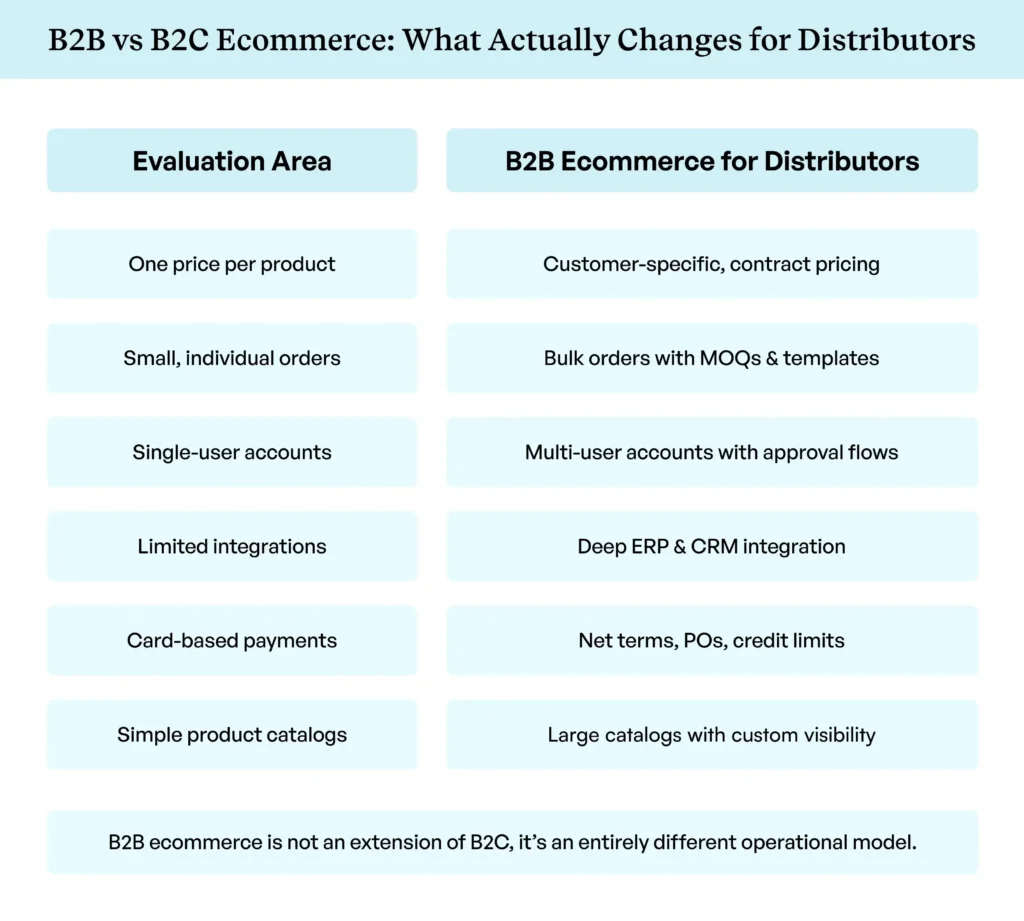
A B2B e-commerce platform for distributors is a specialized online store and selling system that handles the full operational complexity of wholesale distribution, customer-specific contract pricing, bulk ordering with minimum order quantities (MOQs), multi-warehouse inventory management, and deep ERP integration. It is not a Shopify store with a wholesale plugin bolted on, and the same holds on the WooCommerce side, where teams pricing b2bking alternatives tend to begin by counting the plugins the stack needs and what they cost together each month, which can run past $1,500.
In B2C, you have one price per product, simple checkout, and individual shipments. Scale down again to C2C ecommerce and even the seller is an individual, with no account structure on either side of the transaction. In wholesale distribution, a single customer might have negotiated pricing across 10,000 SKUs, need to place complex orders against multiple ship-to addresses, require approval workflows before orders are processed, and expect real-time inventory counts synced from your ERP every few minutes. These are fundamentally different business needs. That gap is what B2B in e-commerce has to solve, and it shapes which model fits your business.
B2B ecommerce accounted for 16% of all manufacturing and distribution sales in 2024, and that share is growing fast. Buyers now expect to browse your catalog, check stock, see their contract pricing, and reorder at 11 pm without calling anyone. This digital transformation is not optional; it is the new standard for customer expectations. In fact, this shift is exactly how mid-market distributors are competing with giants, moving away from manual spreadsheets to reclaim market share.
Also read: What is B2B commerce
8 essential features in the best B2B e-commerce software for distributors
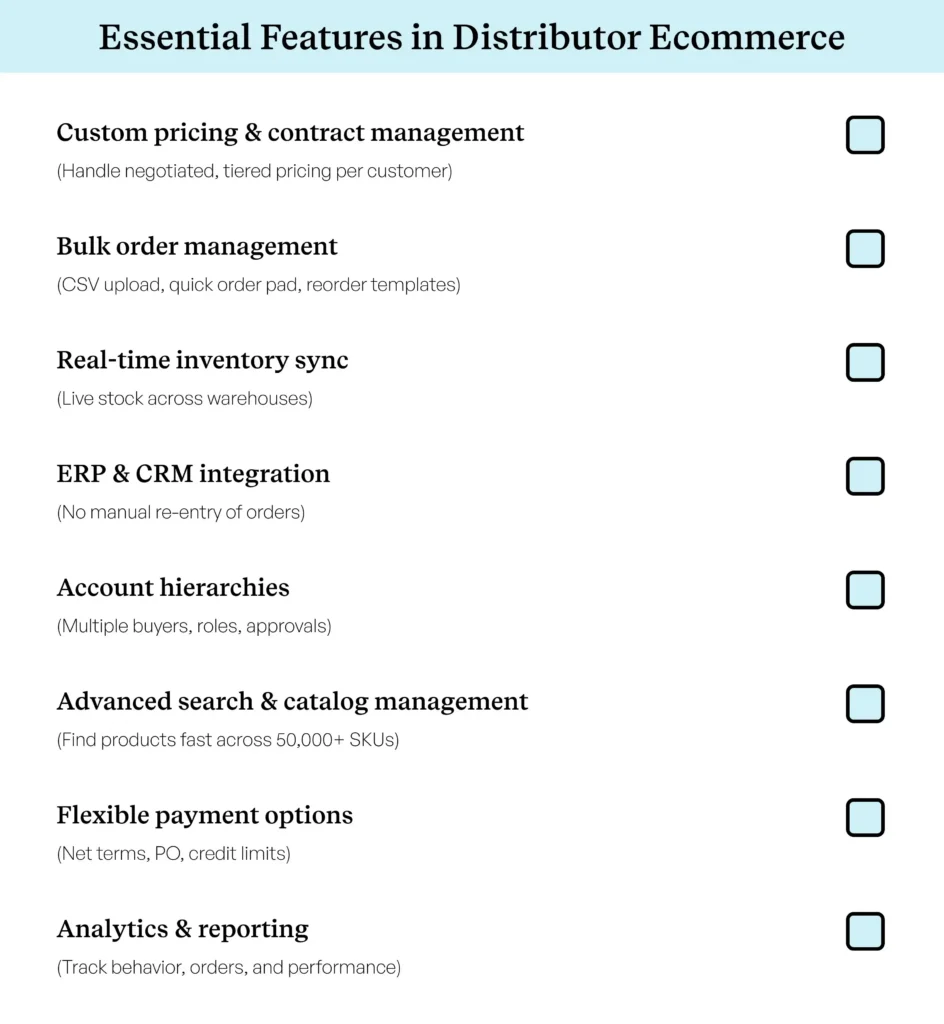
Not every e-commerce solution can handle wholesale distribution. Below are the essential features that define the best B2B e-commerce software for distributors, and why each one matters specifically for wholesale operations. Use this as your evaluation checklist:
1. Custom pricing and contract management
Distributors don’t sell at list price. The right e-commerce solution must support customer-specific pricing, volume discounts, contract-negotiated rates, tiered pricing by quantity breaks, and promotional pricing that layers on top of contracts. The best platforms pull pricing directly from your ERP in real time, so there is never a mismatch between what the portal shows and what the invoice says.
2. Bulk order management for large order volumes
Your customers place large order volumes across dozens of SKUs. They need a quick-order pad to paste part numbers and quantities, not click “Add to Cart” 500 times. Look for: CSV upload ordering, quick-order forms, reorder-from-history, and saved order templates. These key features streamline operations and cut manual tasks throughout your entire order fulfillment workflow.
3. Real-time inventory synchronization
Nothing destroys customer satisfaction faster than a “backordered” email the day after an order is placed. Your platform must sync inventory management data from your ERP, ideally with multi-warehouse inventory sync, in real time. Customers should see available-to-promise quantities and understand shipping costs before they check out.
4. ERP and CRM systems integration
This is non-negotiable. Your online store is an extension of your enterprise resource planning system, not a standalone tool. Orders placed online must flow through your B2B wholesale order management system and into your ERP for order fulfillment, eliminating manual tasks and re-keying. CRM for distributors should also sync to capture customer interactions and sales activity, giving your team a complete picture of customer behavior.
Also read: Full breakdown of B2B commerce features
5. Customer account hierarchies
Distribution customers are organizations, not individuals. A single account may include a corporate HQ, regional offices, and branch locations, each with different ship-to addresses, authorized buyers, and approval limits. Your platform needs parent-child account structures, role-based access, and configurable approval workflows that match your customers’ business model.
6. Advanced search, filtering, and catalog management
When your catalog exceeds 50,000 SKUs, search is the primary navigation tool. The best B2B e-commerce solution for distributors delivers faceted search by product attributes (size, material, voltage, brand), part-number lookup with cross-references, and autocomplete tuned to industry terminology. Variant-heavy categories push this hardest — a B2B wholesale clothing catalogue multiplies every style across sizes and colourways, so filters have to combine both without burying the buyer. Solid catalog management with detailed product information also supports search engine optimization, driving organic online sales by helping your product lines rank on search engines.
7. Flexible payment options
B2B payments are fundamentally different from B2C. The right e-commerce platform supports payment methods like purchase orders, net-30/60/90 terms, credit limit enforcement, ACH, and credit card processing, often all within the same account. PCI-DSS compliance is table stakes. These flexible payment options improve customer experience and have a direct impact on your bottom line.
8. Analytics and reporting
You cannot optimize your bottom line without data. Look for dashboards covering order volume by customer/product/channel, conversion rates, customer behavior patterns, abandoned carts, and portal adoption metrics. The best platforms push data back to your ERP or BI tool, enabling smarter marketing campaigns, sharper customer service, and a more data-driven sales process.
Learn more: Efficiency at Every Click: B2B Sales Automation for Time Optimization
5 Best B2B e-commerce platforms for distributors: A comparison
Choosing the right e-commerce platform is the single highest-leverage decision you’ll make. Here’s how the top five options for the best B2B ecommerce software for distributors stack up, evaluated on integration capabilities, pricing depth, and fit for wholesale operations:
| Platform | Best for | Key strength | ERP integration | Pricing model |
| WizCommerce | Wholesale distributors wanting AI-powered efficiency | AI-driven ordering + wholesale-native features; seamless integration out of the box | QuickBooks, SAP, Dynamics, NetSuite | SaaS subscription |
| OroCommerce | Mid-to-large distributors with complex workflows | Purpose-built B2B; strongest workflow engine and integration capabilities | SAP, Dynamics, NetSuite, custom API | License + hosting |
| BigCommerce B2B | Distributors wanting fast time-to-market | Ease of use + SaaS simplicity; good for simpler business models | Via connectors (Celigo, etc.) | SaaS subscription |
| Adobe Commerce | Enterprise distributors with dev resources | Deep customization; highest level of control over user experience | Strong native connectors | License + hosting |
| k-ecommerce | Distributors on Acumatica / Dynamics / SAP B1 | Tightest ERP integration for supported platforms; strong catalog management | Native: Acumatica, Dynamics, SAP B1 | SaaS subscription |
WizCommerce is purpose-built for wholesale distribution, combining AI-driven order suggestions with wholesale-native key features, without an enterprise price tag or a 12-month implementation timeline. OroCommerce offers exceptional depth for complex workflows with strong integration capabilities. BigCommerce delivers the fastest time-to-market but hits limitations when pricing logic gets complex, and jewelry ecommerce hits that wall first, because a ring priced by metal weight and stone grade needs a rule per variant, not one fixed price per SKU. Adobe Commerce provides the highest level of control but demands significant developer resources. K-ecommerce excels when ERP integration is the primary concern.
When evaluating any of these, insist on demos using your real data, especially for pricing and ERP integration. The best B2B e-commerce platform for distributors is the one that fits your current needs without requiring six months of customization just to get started. True seamless integration between your online store and ERP is the benchmark for any platform you consider.
If your shortlist also needs to cover the sales side, that’s a separate comparison – we look at the best CRM for distributors with order entry on its own criteria.
Also read: 15 best B2B e-commerce platforms
Why B2B e-commerce for distributors drives real ROI
The ROI from a distributor’s e-commerce platform goes beyond online orders. Here is what actually changes, across revenue, operations, customer satisfaction, and team performance.
Increased revenue and market reach
The most immediate impact of the right e-commerce solution is access to customers you’d never reach through traditional channels. A sales rep covers a territory; a well-optimized online store covers the country. Distributors consistently report 15–25% lifts in average order value when customers can browse the full catalog online instead of ordering from memory or a printed price sheet, directly boosting online sales and improving your bottom line.
Operational efficiency and streamlined operations
This is where the compounding returns live. Distributors who implement e-commerce report 62% increased productivity, 58% improved order accuracy, and 45% larger basket sizes (Handshake). Every order flowing through the portal, instead of a phone call, is one your team doesn’t have to manually key into the ERP. This dramatically reduces manual tasks and helps you streamline operations across your entire order fulfillment cycle.
WizCommerce customer Innovation Lighting saw a 50% reduction in sales operations time after launching their B2B portal, not an incremental improvement, but a fundamental restructuring of the entire sales process.
Better user experience and customer service
Self-service is what modern customer expectations demand. Customers want to check pricing at 10 pm, verify stock before calling, download invoices without emailing your AR team, and track orders without waiting on hold. A B2B ordering platform delivers 24/7 customer service without burdening your team, improving both user experience and customer satisfaction.
Data-driven insight into customer behavior
When orders flow through a portal, you gain visibility into customer behavior you never had before. Which products get searched but not purchased? Which customers browse weekly but order monthly? Every click informs smarter marketing campaigns, better catalog management, and a more targeted sales process, turning your online store into a source of competitive intelligence.
Sales rep enablement, not replacement
The right e-commerce platform replaces the lowest-value manual tasks your reps currently perform, re-keying orders from voicemails, looking up stock for the tenth time today, and processing routine reorders. When the portal handles that work, your reps invest their time in net-new business development, complex quotes, and building customer relationships. The portal elevates your sales process; it does not replace the human element. Distributors who also need reps writing orders in person tend to compare a platform covering both the portal and rep ordering against a dedicated rep tool, which is the case laid out in this Perenso alternative breakdown.
Distributors whose reps also deliver and settle on the same visit run a different model again — a route accounting system handles that van-sales workflow rather than a buyer-facing storefront.
How to implement B2B e-commerce for distributors?
Implementation is where most distributor e-commerce projects succeed or fail. Careful planning at every stage is what separates successful digital transformation from expensive write-offs. Distributors using a staged rollout see 3.2x higher customer adoption rates than those who try to launch everything at once (Growmax, 2026).
Phase 1: Planning and requirements (months 1–2)
Map your current order workflow end-to-end. Identify where manual tasks create bottlenecks and which parts of the sales process can move to self-service. Define portal requirements based on actual customer interactions and business needs, not a vendor’s feature checklist. Set success benchmarks at 6, 12, and 18 months. Designate a dedicated internal project lead. Start with your most digitally savvy customer segment to prove the model quickly.
Phase 2: Platform selection and setup (months 3–4)
Evaluate platforms against your actual requirements, especially integration capabilities, pricing complexity, and catalog management scope. The two questions every vendor must answer convincingly: “Show me how contract pricing works for a customer with 5,000 negotiated line items,” and “Show me a live seamless integration with [your ERP].” Choosing the right ecommerce platform at this stage protects your customer relationships and saves months of rework.
Phase 3: Data migration and integration (months 5–6)
This is the hard part. Product data, customer data, pricing data, inventory management feeds, all of it must be clean and mapped before go-live. Budget more time than you expect for enterprise resource planning integration (typically 4–8 weeks of development and validation).
Pro tip: Launch with your top 5,000 SKUs representing 80% of revenue. Richer detailed product information for the long-tail SKUs can come in phase two.
Phase 4: Launch and customer onboarding (months 7–8)
Don’t just send an email and hope customers log in. Follow these best practices for launch:
- Have each sales rep personally walk their top 10 accounts through a 15-minute portal demo
- Offer first-order incentives, free shipping, or a small discount on their first online order
- Ensure detailed product information and accurate pricing are live before go-live
- Prominently display payment options and shipping costs in the portal UI
- Set up a dedicated support channel for portal questions in the first 60 days
Also read: How to Master B2B Omnichannel Commerce?
Phase 5: Optimization and scaling (month 9+)
Once live, the real work begins. Monitor adoption metrics weekly. Identify customers who logged in but didn’t order; they likely hit friction in the user experience. Review search queries to surface catalog management gaps. Expand product coverage and refine detailed product information as customer behavior data accumulates. The portal is a living system, not a one-time project.
Track these KPIs to measure whether your B2B e-commerce platform for distributors’ investment is performing:
| KPI | Target (18 Months) |
| Digital order rate | 40–60% of eligible orders |
| Average order value (online vs. offline) | 15–25% lift online |
| Customer reorder rate | 70%+ through portal |
| Quote-to-order conversion | 35–45% digital vs. 20–30% email/PDF |
| Support ticket reduction | 30–40% decrease |
| Sales rep time on selling activities | 50%+ of time on new business |
One stat every distributor should pause on: 68% of industrial manufacturers who attempted ecommerce with B2C-adapted platforms abandoned the project within 18 months (Growmax, 2026). Platform selection is the difference between a thriving digital channel and a write-off that damages customer satisfaction and your bottom line. If you distribute industrial, MRO, or electrical products, purpose-built industrial B2B ecommerce sidesteps that failure mode from the start.
Common challenges distributors face and how to solve them
1. “Our sales team thinks e-commerce will replace them”
This is the most common internal objection, and the data says otherwise. Reps at distributors with e-commerce portals consistently outperform those without because they spend less time on manual tasks and more time selling. Frame the portal as the tool that finally gives them back their time and provides unprecedented visibility into customer behavior and customer interactions they’ve never had before.
2. Complex catalog migration
Don’t try to perfect everything before launch. Start with the top 20% of SKUs that drive 80% of revenue. Build out detailed product information and catalog management iteratively. A live portal with 10,000 well-described products and a strong user experience beats a perpetually delayed launch with a perfect but invisible catalog.
3. ERP integration delays
Choose a platform with pre-built connectors for your specific ERP; this can save months. Define a tight scope for v1 seamless integration: orders flowing in and inventory flowing out. Price sync and A/R balances follow in phase two. Strong integration capabilities at the outset prevent the most costly re-work scenarios.
4. Low customer adoption after launch
This almost always traces to one of three causes: customers don’t know the portal exists (a marketing problem), the user experience is too complicated (a UX problem), or their pricing isn’t reflected accurately (a trust problem). One-on-one sales rep outreach drives more adoption than any email campaign. Addressing payment options and shipping costs upfront removes two of the most common friction points.
5. Balancing self-service with relationship selling
The best distributor ecommerce platform implementations optimize when and where human touchpoints happen. Routine reorders and stock checks go through the portal. Complex quotes, new product consultations, and customer service escalations go through reps. On a single platform, both channels strengthen customer interactions and protect your bottom line.
Also read: Complete guide to B2B customer portal
WizCommerce: The B2B e-commerce platform built for distributors
Most e-commerce platforms were built for retail and later retrofitted for wholesale, and a woocommerce b2b plugin is that retrofit made explicit: the storefront stays B2C and the wholesale rules sit on top, so each core or theme update becomes a compatibility test someone has to run before release. WizCommerce was built differently, designed from day one as a B2B e- commerce platform for distributors, with wholesale workflows, complex pricing, and order fulfillment requirements at its core. The result is a distributor e-commerce platform that actually fits the way distribution businesses operate.
While other platforms require months of customization to support basic B2B e-commerce for distributors’ needs, WizCommerce delivers them out of the box:
- AI-powered order suggestions: Based on customer behavior and reorder patterns, WizCommerce’s AI sales copilot proactively surfaces what customers are likely to need, increasing basket size and reducing the manual tasks your team handles daily. To get a full picture of how these AI solutions are reshaping B2B e-commerce, read our deep dive on understanding the role of AI in the distribution process.
- Contract pricing and account hierarchies: Sync directly with your ERP for seamless integration across all customer interactions, no pricing mismatches, no manual reconciliation.
- Catalog management built for scale: Handle large order volumes, detailed product information, advanced search, and customer-specific visibility rules across tens of thousands of product lines.
- Flexible payment options: WizCommerce payment solution supports purchase orders, net terms, and credit limits, all fully integrated into the online store and synced to your ERP.
- Streamlined onboarding: Most distributors are live in weeks, not months. WizCommerce’s implementation approach is designed around your current needs and your business model, not a generic enterprise rollout.
WizCommerce customers across wholesale distribution consistently report the same shift: sales teams stop spending time on manual tasks and start spending it on customer relationships. Customer service improves because buyers have 24/7 access to their pricing, inventory, and order history. Customer satisfaction rises. And the bottom line benefits from higher average order values, fewer errors, and online sales that scale without scaling headcount.
How it looks in the real world: A case study
Innovation Lighting, a specialty lighting distributor, needed to digitize its catalog and reduce the manual burden on its sales team. After evaluating several platforms, including Ecat and Repzi, they chose WizCommerce for its wholesale-specific key features, seamless integration capabilities, and straightforward onboarding.
Innovation Lighting saw a 50% reduction in sales operations time. Their team redirected those hours toward new customer acquisition and strategic account development, exactly the kind of digital transformation that lets a distributor compete and win in today’s e-commerce market.
This resulted in better user experience for customers, improved order fulfillment efficiency, and more strategic rep time, which is what the right B2B ecommerce for distributors solution makes possible. The same pattern holds across home, gift, and decor distribution, where B2B gift accessories covers the seasonal assortment and market-ordering specifics.
Watch the full testimonial here.
WizCommerce is the right e-commerce platform for wholesale distributors who want:
- A platform designed around their business model, not adapted from retail
- Seamless integration with their current ERP and CRM systems from day one
- A single platform that unifies online sales, customer interactions, inventory management, and order fulfillment
- AI-powered efficiency and the best B2B e-commerce platform for distributors, without enterprise-level cost or timeline
If that describes your current needs, WizCommerce is the right e-commerce solution worth exploring.
Book a demo now to increase your order value and build a self-service experience your customers expect.
FAQs on B2B E-Commerce Platform for Wholesale
1. What is B2B e-commerce for distributors?
B2B e-commerce for distributors is a digital commerce platform enabling wholesale businesses to sell through self-service online portals. Unlike B2C platforms, it supports contract pricing, large order volumes, purchase orders, account hierarchies, and seamless ERP integration, an ecommerce solution purpose-built for distributor business needs.
2. How is the best B2B e-commerce software for distributors different from B2C?
The differences are fundamental. The best B2B e-commerce software for distributors must handle customer-specific contract pricing, complex orders with MOQs, net payment terms, multi-buyer account hierarchies, and real-time inventory management. Standard B2C platforms lack these essential features entirely, which is why most retail-adapted implementations fail in wholesale distribution.
3. Do distributors really need an e-commerce solution?
Absolutely. The e-commerce market for B2B is projected to exceed $3 trillion in the US by 2027, and 70%+ of buyers research online before engaging a rep. WizCommerce helps distributors meet rising customer expectations through a purpose-built distributor e-commerce platform, without the complexity or cost of a full enterprise implementation.
4. What key features define the best B2B e-commerce platform for distributors?
The best B2B e-commerce platform for distributors must deliver: customer-specific contract pricing, bulk order management, real-time inventory management, seamless ERP integration, account hierarchies, advanced catalog management, flexible payment options, and analytics dashboards. If a vendor cannot demonstrate all eight essential features with your actual data, keep evaluating.
5. How much does a B2B e-commerce platform for distributors cost?
SaaS platforms like WizCommerce typically run $500–$5,000/month, depending on volume and features, because a cloud-based B2B order management system bundles hosting, upgrades, and support into the subscription. Enterprise platforms (OroCommerce, Adobe Commerce) start at $50,000–$250,000+ in licensing plus $100,000–$500,000+ in implementation. Choosing the right e-commerce solution from the start avoids costly replatforming. Budget for what truly fits your current needs.
6. How long does it take to implement B2B e-commerce for distributors?
A realistic timeline for B2B e-commerce for distributors is 6–9 months from kickoff to go-live. SaaS platforms like WizCommerce with pre-built ERP connectors can launch in 3–4 months. The biggest variable is ERP complexity. Careful planning and clean product data consistently accelerate timelines and keep implementation costs in check.
7. Will e-commerce replace our sales reps?
No. The right e-commerce solution replaces manual tasks, order re-keying, stock lookups, and routine reorders, not people. Distributors using WizCommerce report reps become more productive, spending more time building customer relationships and pursuing new business. ecommerce removes administrative burden from your sales process, not the human element from your team.
8. How can distributors drive customer adoption of a new e-commerce platform?
The highest-impact approach is personal rep outreach: a 15-minute portal walkthrough per top account, first-order incentives, and a dedicated support channel for 60 days. Fixing user experience friction early, especially login complexity and pricing accuracy, is critical. WizCommerce’s onboarding support helps distributors achieve strong adoption quickly and with minimal disruption.
9. What integrations are most critical for a distributor e-commerce platform?
ERP integration is the foundation of any distributor e-commerce platform; without it, you manage two disconnected systems. Priority integrations after ERP: CRM systems for customer interactions, PIM for catalog management and detailed product information, warehouse management for inventory management, and a payment gateway for flexible payment options. Integration capabilities should be your primary evaluation criterion.
10. How do distributors measure ROI from their e-commerce investment?
Distributors measure ROI by tracking five core metrics: digital order rate (target 40–60%), average order value lift (15–25%), customer reorder rate (70%+), quote-to-order conversion (35–45%), and support ticket reduction (30–40%). Most distributors reach positive ROI within 12–18 months, often with efficiency gains from reduced manual tasks alone covering the full platform cost.