Skip to content



B2B e-commerce is experiencing unprecedented growth, with global B2B e-commerce projected to reach $20.9 trillion by 2027. This explosive expansion is fundamentally reshaping how businesses connect, collaborate, and conduct digital commerce with one another through innovative digital channels and advanced e-commerce strategies.
At the heart of this transformation lies a critical decision that can make or break your digital commerce strategy: choosing the right B2B e-commerce model. Unlike the relatively straightforward world of B2C retail, B2B commerce involves complex customer experience processes, intricate approval workflows, personalized pricing structures, and long-term relationship dynamics that require specialized approaches to meet the unique needs of business operations.
Whether you are a manufacturer looking to eliminate intermediaries, a wholesaler seeking to digitize your operations, or a distributor planning to scale across multiple channels, understanding the distinct B2B e-commerce models will help you make an informed decision that aligns with your business growth goals, available resources, and long-term growth objectives. This guide provides practical insights on implementation, common pain points to avoid, and how modern e-commerce platforms are making it easier than ever to launch and scale e-commerce sales while leveraging data analytics and market research to drive success.
What are B2B e-commerce models?
B2B e-commerce models define how businesses sell to other businesses through digital channels, with platform choice shaped by buyer type and operational needs, making B2B ecommerce for distributors a practical model for complex wholesale workflows. Unlike B2C models, which focus on individual consumer transactions, b2b models in e-commerce accommodate the unique complexities of business-to-business commerce, including bulk ordering, custom pricing tiers, approval workflows, and long-term partnership dynamics that address the specific customer base needs of business buyers.
How B2B differs from B2C models?
The b2b advantages and disadvantages versus B2C become clear when you compare these two fundamentally different business models.
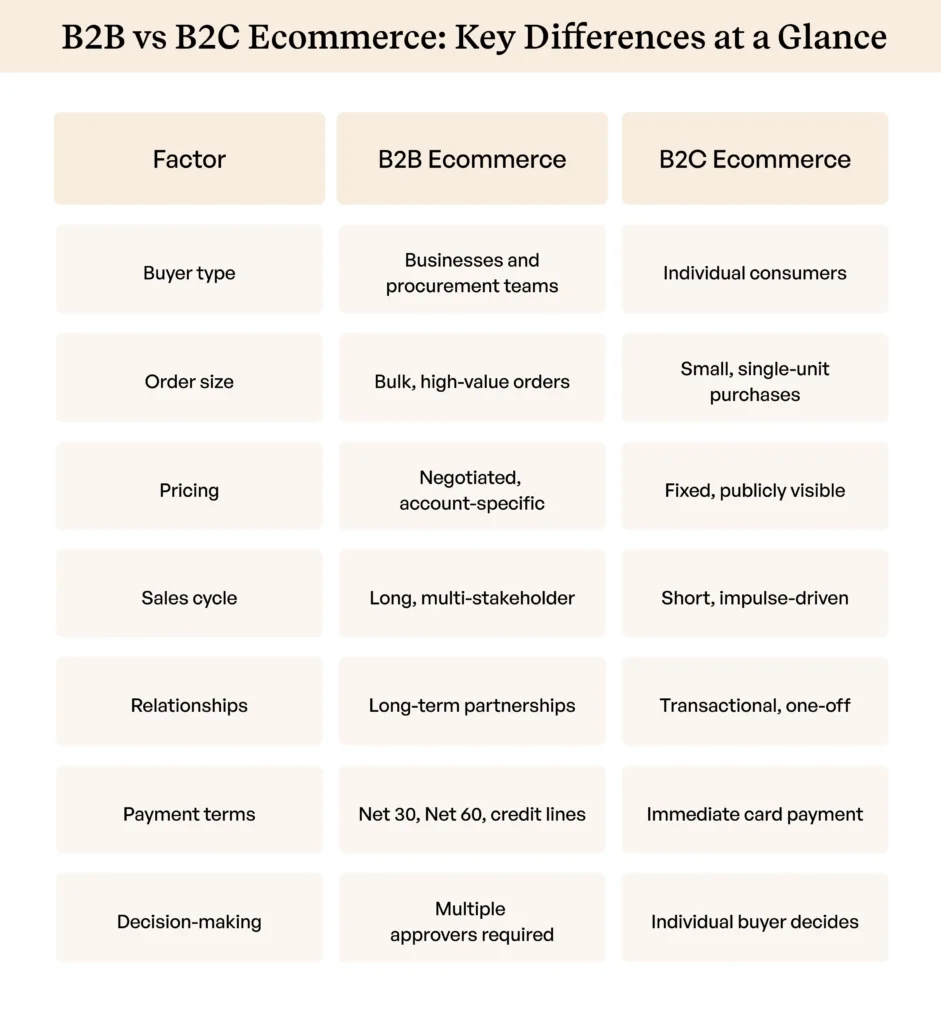
Key structural differences that shape B2B e-commerce models:
- Multiple stakeholders in the sales process requiring approval workflows
- Personalized pricing based on customer relationships and volume commitments
- Complex integrations with enterprise resource planning and inventory management systems
- Emphasis on extensive customization and scalability to enhance the user experience
Why model choice matters for success?
The e-commerce model you choose directly impacts three core areas of your business performance:
- Operational efficiency: Your choice determines the integration complexity, automation capabilities, and potential for workflow optimization across digital channels, directly reducing operational costs as your e-commerce sales grow.
- Customer experience: Different B2B e-commerce models offer varying levels of personalization, self-service options, and relationship-building tools that enhance customer satisfaction and create a superior customer experience throughout the sales process.
- Growth strategy: Each B2B e-commerce model provides different scalability paths, market reach potential, and e-commerce sales optimization opportunities to reach potential customers and explore new markets across digital channels.
Whether you select a supplier-oriented approach for maximum control, a marketplace model for quick market entry, or a hybrid solution for diversified reach, your decision influences everything from customer service costs to long-term profitability. Understanding these strategic implications through best practices and case studies is essential for choosing a model that aligns with both your current capabilities and future ambitions.
Also read: Top 10 B2B e-commerce best practices to stay ahead in 2026
6 Main B2B e-commerce models you should know
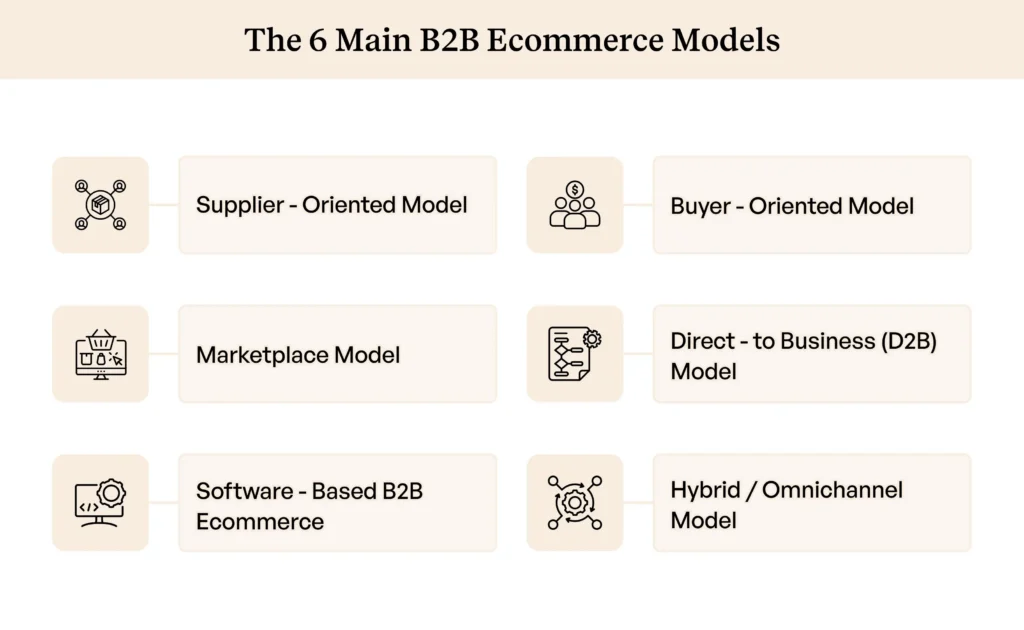
Understanding the landscape of B2B e-commerce models is crucial for making strategic decisions that will drive your business forward. Each e-commerce model offers distinct approaches to customer relationships, operational control, and market reach. These six primary models are shaping modern B2B e-commerce today.
1. Supplier-oriented model
Definition: The supplier-oriented model gives manufacturers, wholesalers, or distributors complete control over their e-commerce platform, enabling direct relationships with buyers without intermediaries.
How it works: In this model, your business owns and operates the entire e-commerce infrastructure. You maintain direct control over product catalogs, pricing strategies, customer base onboarding, and the complete buyer journey. Potential customers access your custom-branded online platform where they can browse products, place orders, and manage their accounts according to your specific business rules and workflows.
Key advantages:
- Complete pricing control: Set personalized pricing tiers for different customer base segments, volume discounts, and special contract rates.
- Enhanced profit margins: Eliminate middleman fees and commission structures that affect bottom line profitability.
- Superior brand control: Maintain consistent brand experience across all customer touchpoints to strengthen brand awareness.
- Real-time inventory management: Provide accurate stock levels and delivery timelines directly from your enterprise resource planning systems.
- Customer relationship ownership: Build and maintain direct relationships with buyers, gathering customer’s order history data for future sales process strategies.
Main disadvantages:
- Higher initial investment: Requires significant upfront costs for platform development, hosting, and maintenance.
- Technical complexity: Demands internal technical expertise or reliable technology partners.
- Marketing responsibility: You are responsible for driving traffic and acquisition of new customers through digital marketing without marketplace exposure.
- Platform maintenance: Ongoing updates, search engine optimization, and performance optimization become your responsibility.
Best for: Established wholesalers and distributors with strong product catalogs, existing customer relationships, and the resources to invest in comprehensive digital transformation.
Modern B2B E-Commerce platforms like WizShop enable this model through features such as custom-branded websites, personalized pricing matrices, and customer-approval workflows that streamline B2B operations while maintaining full control.
Also read: E-commerce catalog management
2. Buyer-oriented model
Definition: In the buyer-oriented model, large purchasing organizations create procurement platforms that invite multiple suppliers to compete for their business.
How it works: Large enterprises or buying groups establish digital procurement platforms where approved suppliers can submit bids, showcase products, and compete for contracts. These platforms typically feature reverse-auction capabilities, supplier scorecards, and integrated approval workflows to streamline procurement for the buying organization.
Key advantages:
- Competitive pricing: Suppliers compete directly, often resulting in better pricing for buyers, improving customer satisfaction
- Streamlined procurement: Centralized online sales portal reduces administrative overhead and standardizes purchasing and sales processes.
- Vendor management: Simplified supplier onboarding, business performance tracking, and management of customer relationships.
- Compliance integration: Built-in approval workflows ensure purchases meet organizational policies and budget constraints.
Main disadvantages:
- Complex supplier onboarding: Requires extensive supplier education and platform adoption.
- High platform maintenance costs: Significant investment in technology infrastructure and ongoing support.
- Limited supplier control: Suppliers have minimal influence over the customer experience and e-commerce platform features.
- Dependency risks: Heavy reliance on the buyer’s platform can limit supplier flexibility.
Best for: Large enterprises with substantial purchasing power, complex procurement requirements, and the resources to manage a comprehensive supplier ecosystem.
3. Marketplace model
Definition: The B2B marketplace business model connects multiple buyers and sellers through a third-party platform that facilitates transactions while providing infrastructure and services.
How it works: Third-party platforms like Alibaba, Amazon Business, or specialized industry marketplaces provide the technical infrastructure, customer traffic, and transaction processing. Sellers list their products, buyers browse and purchase, while the marketplace handles payment processing, dispute resolution, and often logistics coordination.
Key advantages:
- Rapid market entry: Access to established customer bases without building your own traffic for e-commerce sales.
- Lower initial investment: Minimal upfront costs compared to building proprietary e-commerce platforms. What each model costs to run varies widely once implementation, integrations, and transaction fees are counted — our guide to B2B commerce platform pricing breaks those layers down by model.
- Technical infrastructure included: Platform handles hosting, security, online sales portal, payment processing, and mobile optimization.
- Built-in trust mechanisms: Established marketplaces provide buyer confidence through reviews, ratings, and dispute resolution, improving brand visibility.
- Market testing opportunities: Ideal for validating product development or entering new markets geographically.
Main disadvantages:
- Limited brand control: Restricted customization options and reduced brand awareness.
- Commission fees: Platform fees can significantly impact bottom line, ranging from 3% to 15%.
- Platform dependency: Limited control over policy changes, algorithm updates, or sudden platform shutdowns.
- Intense competition: Direct competition with other sellers often leads to price wars, affecting average order value.
- Restricted customer data: Limited ability to build direct customer relationships and gather customer behavior insights.
Best for: New businesses entering B2B e-commerce, companies testing market demand, or organizations seeking to supplement existing sales channels with minimal investment.
4. Direct-to-business (D2B) model
Definition: The D2B model involves businesses selling directly to other businesses without intermediaries, often focusing on specialized products or niche new markets.
How it works:Manufacturers or specialized service providers bypass traditional distribution channels to sell directly to end-user businesses. This model involves custom product configurations, specialized expertise, and direct relationship building. Companies combine online platforms with dedicated sales representatives to serve specific e-commerce verticals and grow their customer base.
Key advantages:
- Direct customer relationships: Build stronger partnerships through direct communication and customized customer service.
- Higher profit margins: Eliminate distributor markups and retailer commissions to protect bottom line.
- Faster customization capabilities: Direct communication enables quicker product development and specialized e-commerce solutions.
- Market feedback access: Immediate insights from end users drive product development and improvement.
- Brand visibility control: Communicate value propositions and expertise directly to decision-makers through digital marketing.
Main disadvantages:
- New customers acquisition challenges: Building brand awareness and a customer base requires significant marketing campaigns investment.
- Higher sales team and digital marketing costs: Direct customer acquisition costs more than channel partner e-commerce sales.
- Limited initial market reach: Restricted geographic or industry coverage compared to established distribution networks.
- Resource intensity: Requires a dedicated sales team, customer service, and technical support capabilities.
Best for: Niche product manufacturers, specialized service providers, and companies with unique value propositions that benefit from direct customer relationships.
5. Software-Based B2B E-Commerce
Definition: This model leverages comprehensive software platforms that integrate e-commerce functionality with broader business operations, creating unified digital commerce ecosystems.
How it works: Businesses implement integrated software solutions that combine online store fronts with enterprise resource planning systems, inventory management, CRM platforms, and automated workflows. These platforms include AI-powered features for recommendations, pricing optimization, and customer behavior insights, creating a seamless business performance environment.
Key advantages:
- Integrated business operations: Seamless data flow between e-commerce sales, inventory management, accounting, and customer service systems.
- Automated workflows: Eliminate manual data entry, reduce phone calls, and human error through intelligent automation across the sales process.
- Real-time visibility: Live inventory tracking, order processing status updates, and business performance analytics.
- Scalable growth infrastructure: E-commerce platforms grow with your business without requiring complete system overhauls.
- AI-powered insights: Advanced analytics and recommendations drive better business growth decisions.
- Mobile optimization: Sales representatives can access full platform functionality from anywhere, ideal for field reps attending trade shows or making on-site client visits.
Main disadvantages:
- Learning curve complexity: Team training and adoption can be challenging and time-consuming
- Subscription and integration costs: Ongoing platform fees and integration expenses can be substantial
- Vendor dependency: Switching platforms later becomes complex due to data migration and workflow disruption
- Integration challenges: Legacy system compatibility issues may require additional development work
Best for: Growing businesses seeking operational efficiency, companies with complex B2B requirements, and organizations ready to invest in comprehensive digital transformation.
Modern solutions like WizCommerce exemplify this model, offering integrated platforms that combine WizShop for online wholesale storefronts, WizOrder for AI-powered sales rep order intake, WizStudio for e-commerce catalog imagery, and WizPay for flexible payment processing, supporting repeat orders and scalable growth.
6. Hybrid/Omnichannel model
Definition: The hybrid model strategically combines multiple sales channels, including direct online platforms, marketplaces, and traditional sales methods to maximize market reach and e-commerce sales opportunities. Apparel is the clearest example — a brand may sell wholesale to retailers, run its own DTC store, and write orders at market weeks, all from one catalogue. B2B fashion e-commerce platforms are built around that three-channel reality.
How it works: Businesses maintain their own e-commerce platforms while simultaneously selling through third-party marketplaces, maintaining sales representative relationships, and operating physical showrooms. This approach requires sophisticated inventory management and channel coordination to ensure consistent customer experiences and support repeat orders across all digital channels.
Key advantages:
- Diversified online sales streams: Multiple digital channels reduce dependency risks and capture different customer base segments.
- Maximum market reach: Access potential customers who prefer different purchasing channels and online platforms.
- Risk distribution: Platform changes or market shifts affect only part of total e-commerce sales.
- Channel optimization: Leverage each channel’s strengths for specific customer behavior types or product categories, improving brand visibility.
- Competitive resilience: Reduced vulnerability to competitors or e-commerce website policy changes.
Main disadvantages:
- Inventory management complexity: Coordinating stock levels across multiple digital channels requires sophisticated enterprise resource planning systems.
- Channel conflict potential: Price discrepancies or availability differences can confuse potential customers and damage customer relationships.
- Operational complexity: Managing multiple e-commerce platforms, commission structures, and customer service channels increases operational costs.
- Brand awareness consistency challenges: Maintaining uniform messaging across diverse online platforms requires careful coordination of marketing campaigns.
Best for: Growing businesses with established operations, companies seeking to scale across new markets, and organizations with resources to manage complex b2b e-commerce multi-channel operations.
The B2B advantages vary significantly depending on which model aligns with your business model, customer base, and growth objectives. While the disadvantages of B2B business model implementations often center around complexity and resource requirements, the right e-commerce model choice can transform these challenges into competitive advantages that drive scalable growth and stronger customer relationships.
| B2B e-commerce models at a glance | |||
| Model | Key advantages | Key disadvantages | Best for |
| Supplier-oriented | Full brand control, higher margins | High investment, marketing responsibility | Established wholesalers and distributors |
| Buyer-oriented | Competitive pricing, streamlined procurement | Complex onboarding, high maintenance | Large enterprises with procurement complexity |
| Marketplace | Rapid market entry, low investment | Limited brand control, commission fees | New entrants and market testers |
| Direct-to-business | Direct relationships, higher margins | High acquisition costs, limited reach | Niche manufacturers and specialists |
| Software-based | Full integration, AI-powered automation | Learning curve, vendor dependency | Growing businesses seeking efficiency |
| Hybrid and omnichannel | Diversified reach, risk distribution | Inventory complexity, channel conflicts | Scaling businesses across multiple markets |
4 Specialized B2B models
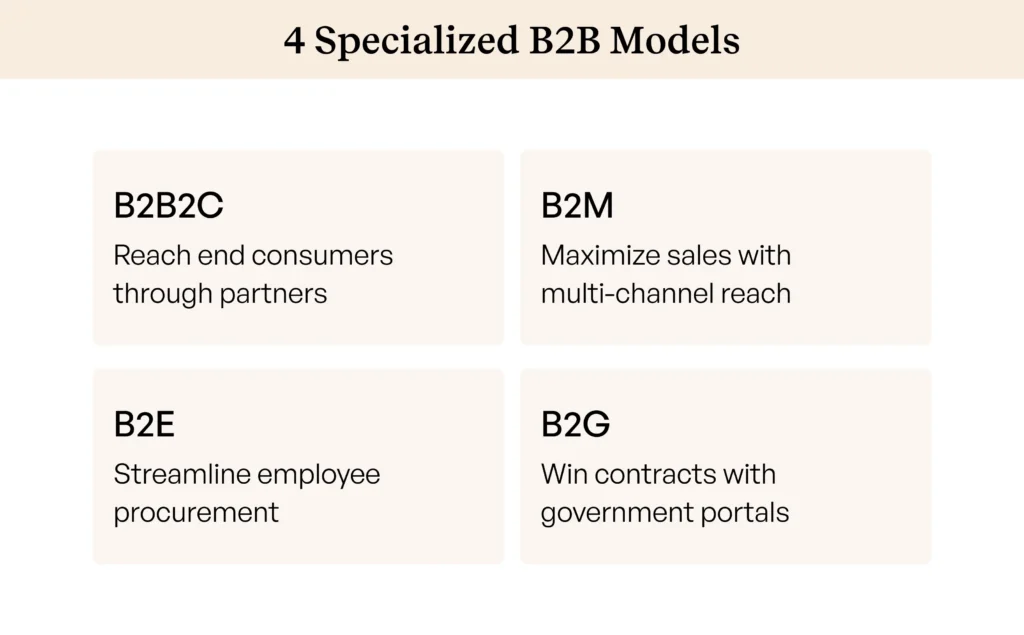
Beyond the six primary B2B e-commerce models, several specialized approaches cater to specific business operations scenarios and market reach requirements. Understanding these variations helps you identify niche opportunities that better serve your unique e-commerce business context and digital transformation strategy.
- B2B2C (Business-to-Business-to-Consumer) is a partnership model in which your business sells products to another company, which then resells them to end consumers. This approach is particularly effective for manufacturers partnering with retailers or service providers who handle direct consumer relationships.
- B2M (Multi-channel) involves simultaneously managing various online sales channels including direct e-commerce websites, marketplaces, physical locations, and sales representatives. This comprehensive approach maximizes market reach but requires sophisticated inventory management and channel coordination to deliver consistent customer service across all digital channels.
- B2E (Business-to-Employee) focuses on internal procurement online platforms where organizations create specialized portals for employee purchasing. These platforms feature approval workflows, budget controls, and compliance tracking for items ranging from office supplies to specialized equipment, helping reduce operational costs through centralized order processing.
- B2G (Business-to-Government) requires specialized features for government procurement processes. This model demands compliance with complex regulations, specialized bidding processes, and extensive documentation requirements. Success in B2G often requires dedicated compliance teams and an understanding of public sector procurement cycles and supply chain management.
Each specialized model often requires unique platform capabilities. For instance, B2G models need extensive audit trails and compliance reporting, while B2B2C requires seamless integration between partner systems.
Modern platforms like WizCommerce address these complexities through customizable workflows, extensive integration capabilities, and compliance features that adapt to specialized requirements. When considering specialized models, evaluate whether your business has the resources and expertise to manage the additional operational complexity while delivering the superior customer experience these models demand.
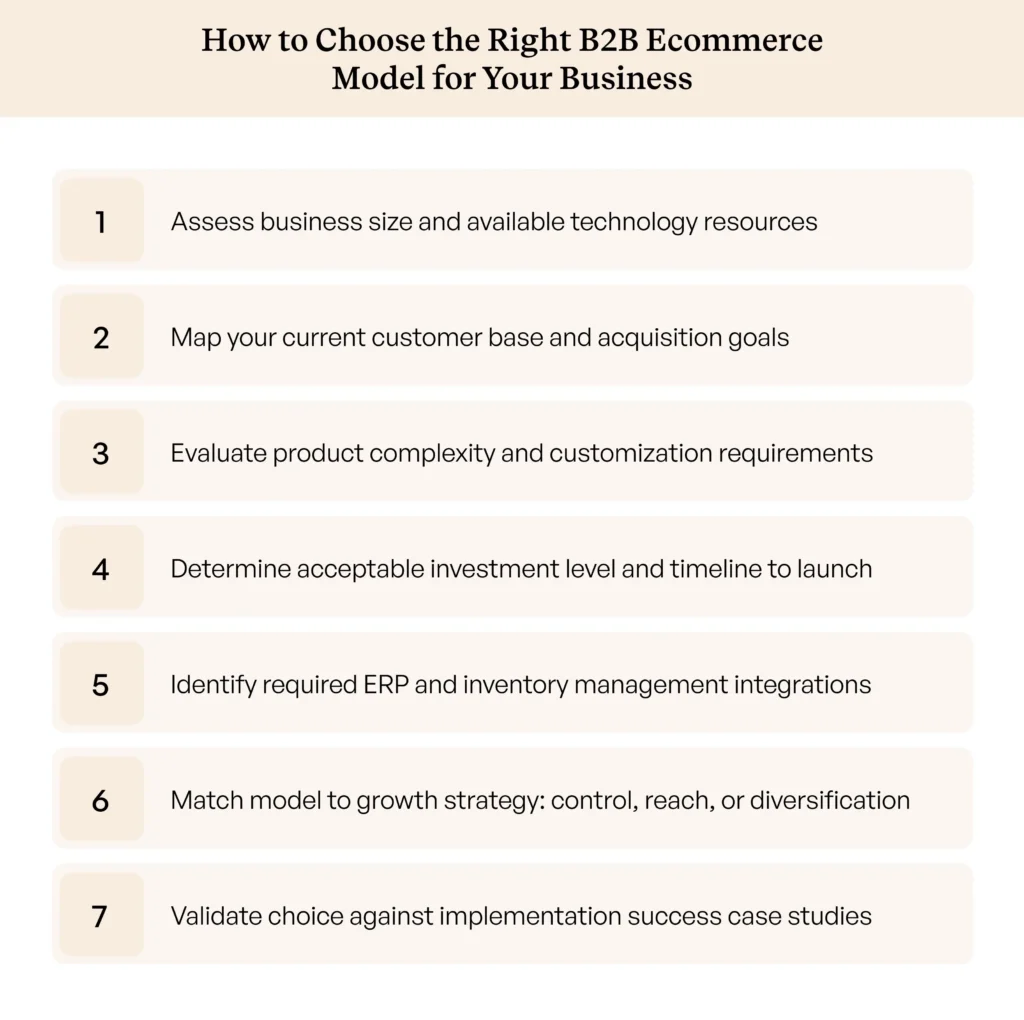
How to choose the right B2B e-commerce model?
Selecting the optimal B2B e-commerce model requires careful evaluation of multiple factors that directly impact your business performance and scalable growth potential. Understanding B2B e-commerce benefits and potential challenges ensures your choice aligns with both current capabilities and future objectives. The right e-commerce model supports your digital transformation while keeping operational costs under control.
- Business size and resources significantly influence model selection. Startups and smaller e-commerce businesses benefit from marketplace models due to lower initial investment and built-in potential customer traffic, though the shortlist of b2b wholesale marketplace options narrows fast once minimum order values, category approval and commission tiers are compared. Established enterprises with dedicated IT resources can leverage supplier-oriented models for maximum control and customization across their e-commerce site and web store.
- Customer base characteristics determine whether you need new customers or should focus on serving existing customer relationships. If you have strong established partnerships, a supplier-oriented approach maximizes customer’s order history value. For businesses seeking to expand market reach, marketplace or hybrid models provide broader online sales coverage across new markets.
- Product complexity affects e-commerce platform requirements significantly. Simple commodity products work well in marketplaces where customer behavior drives discovery, while custom-configured or highly technical products benefit from direct models that support detailed specifications, personalized pricing, and dedicated sales team support through the full sales process.
- Start with marketplace models if you’re new to digital commerce and need immediate market access. Choose supplier-oriented approaches when you have established customer relationships and want maximum control. Consider hybrid models when seeking diversified reach while maintaining brand control.
- Common implementation pitfalls include choosing based solely on cost without considering scalable growth needs, underestimating integration complexity with existing enterprise resource planning systems, and inadequate planning for customer service support requirements. Many e-commerce businesses also overlook the importance of mobile optimization for the sales team and sales representatives productivity.
Solutions like WizCommerce address these challenges through proven integration capabilities with 1000+ business implementations, offering 83% reduction in order processing time while supporting multiple model approaches through their comprehensive platform suite.
Once you’ve identified the right model, explore our guide to the best B2B e-commerce software to find the right technology to power it.
Implementation success tips
Successfully implementing your chosen B2B e-commerce model requires strategic planning and attention to critical technical and operational details. Understanding common disadvantages of B2B e-commerce helps you proactively address potential challenges during implementation.
- Prioritize system integration from day one. Seamless connectivity with existing ERP, inventory management, and accounting systems prevents data silos and operational disruptions. Plan for comprehensive data migration and establish clear integration timelines. Many businesses underestimate integration complexity, leading to extended implementation periods and user adoption challenges.
- Focus on mobile-responsive design since sales teams increasingly rely on mobile devices for customer interactions. Your platform must deliver full functionality across tablets, smartphones, and desktop environments. Mobile optimization directly impacts sales productivity and customer satisfaction, particularly for field-based sales operations.
- Implement AI-powered features to enhance customer experience and operational efficiency. AI-driven product recommendations, personalized search capabilities, and automated workflow suggestions significantly improve conversion rates and order values. Modern B2B buyers expect sophisticated digital experiences comparable to consumer platforms.
- Plan for scalability by selecting platforms that grow with your business without requiring complete system overhauls. Consider future feature needs, integration requirements, and user volume projections. Scalable infrastructure prevents costly migrations as your business expands.
- Establish comprehensive training programs for all user groups including sales teams, customer service representatives, and end customers. User adoption directly correlates with implementation success, yet many businesses inadequately invest in training resources.
- Monitor key performance indicators from launch including order processing times, customer adoption rates, and system performance metrics. Regular monitoring enables rapid identification and resolution of issues before they impact customer satisfaction.
WizCommerce exemplifies successful implementation through their integrated approach, offering less than 30 days to go live while providing comprehensive training and support resources that ensure sustainable adoption and growth.
Build your B2B e-commerce with WizCommerce
Selecting the right B2B e-commerce model is only the beginning of your digital transformation journey. Success depends on implementing a comprehensive solution that seamlessly integrates with your existing operations while providing the flexibility to adapt as your business grows.
Complete B2B commerce solution
WizCommerce offers an all-in-one AI-powered platform specifically designed for wholesalers, distributors, and manufacturers looking to excel in any B2B e-commerce model. Their integrated suite includes:
-
- WizShop: Custom-branded B2B e-commerce platform featuring personalized pricing matrices, customer approval workflows, and real-time inventory management. Perfect for supplier-oriented models where brand control and direct customer relationships are paramount.
- WizOrder: AI-first wholesale order intake app that modernizes how sales reps take orders, with AI-powered product discovery, instant quote generation, customer collections, and offline order intake for field selling. Ideal for businesses implementing hybrid or direct-to-business models.
- AI Co-Workers: WizCommerce’s AI product suite includes:
- AI Sales Copilot: Gives reps quick access to customer insights, order history, quotes, inventory details, and next-best actions through conversational queries.
- AI Order Entry Assistant: Captures POs from emails, PDFs, scans, and other formats, validates the details, and creates ERP-ready orders.
- AI Quote Automation Assistant: Supports quote creation and follow-up workflows, helping sales teams respond faster with less manual effort.
- WizPay: Comprehensive B2B payment processing solution supporting multiple payment terms, automatic card updates, and PCI-DSS compliant security measures essential for any B2B model. See our breakdown of the best B2B payment platforms to compare your options.
- WizStudio: WizStudio strengthens the visual side of wholesale commerce by helping teams create catalog-ready product images with AI. Instead of relying on repeated photoshoots for every catalog update, wholesalers can use it to improve product presentation across e-commerce portals, digital catalogs, line sheets, and buyer-facing sales assets.
Alt Text: B2B e-commerce solutions offered by WizCommerce
Measurable business impact
WizCommerce has demonstrated significant results across 1000+ business implementations:
- 83% reduction in order-taking time through streamlined workflows and automation
- 80% faster quote-to-cash process via integrated systems and AI-powered insights
- 25% increase in average order value through intelligent product recommendations
- 30% increase in online active customers within the first quarter
- Less than 30 days to go live with comprehensive training and support
Perfect for any B2B model
Whether you’re implementing a supplier-oriented approach for maximum control, exploring marketplace opportunities for rapid expansion, or developing a hybrid strategy for diversified reach, WizCommerce provides the technical foundation and operational tools to succeed.
The platform’s extensive integration capabilities with ERP, inventory, accounting, and logistics systems ensure seamless data flow regardless of your chosen model. Custom integrations are available for specialized requirements, making it adaptable to unique business processes and industry-specific needs.
Ready to transform your B2B commerce operations? Schedule a Demo
FAQs on B2B E-Commerce Models
1. What is the B2B model of commerce?
The B2B model in e-commerce refers to online commercial transactions between businesses rather than between businesses and individual consumers. These B2B e-commerce models accommodate complex business operations requirements like bulk order processing, personalized pricing, approval workflows, and long-term contract relationships. Unlike B2C models, b2b e-commerce focuses on building lasting customer relationships, handling complex procurement processes, and integrating with enterprise resource planning and inventory management platforms across online channels.
2. What are the four types of B2B models?
The four most widely recognised B2B e-commerce model types are: 1) Supplier-Oriented Model where businesses control their own e-commerce platform and customer relationships directly, 2) Marketplace Model where third-party platforms connect multiple buyers and sellers, 3) Buyer-Oriented Model where large purchasing organizations create procurement platforms for supplier competition, and 4) Hybrid/Omnichannel Model that combines multiple sales channels including direct platforms, marketplaces, and traditional sales methods.
3. What is the difference between B2B and C2C models of e-commerce?
B2B e-commerce involves transactions between businesses and focuses on wholesale relationships, bulk ordering, custom pricing, and complex approval processes. C2C (consumer-to-consumer) e-commerce enables individual consumers to sell to other consumers through platforms like eBay or Facebook Marketplace. B2B transactions typically involve larger order values, longer sales cycles, and relationship-based selling, while C2C focuses on individual item sales, peer-to-peer transactions, and simpler payment processes.
4. What is an example of a B2B model?
A classic example of a B2B marketplace business model is Alibaba, where manufacturers list products for wholesalers and distributors to purchase in bulk quantities. Another example is a supplier-oriented model, such as a manufacturer using WizShop to create its own branded e-commerce platform, allowing approved retailers to access personalized pricing, place bulk orders, and manage their accounts directly, with custom approval workflows and payment terms.
5. Which e-commerce type is the most successful?
Success depends on the business context and objectives rather than on the model type. The advantages of B2B e-commerce vary significantly by company size, resources, and customer base. Marketplace models excel for rapid market entry with lower investment, while supplier-oriented models provide maximum control and higher profit margins for established businesses. Hybrid models often prove most successful for growing companies, offering diversified revenue streams while maintaining customer relationships across multiple channels.
6. What are the advantages of B2B e-commerce?
The advantages of b2b e-commerce include reduced operational costs through automated order processing, expanded market reach through online channels, improved customer experience via self-service portals, stronger customer relationships through customers’ order history data, and scalable growth potential without proportional increases in sales team size. B2B e-commerce benefits also include greater supply chain management visibility, higher average order value through AI-powered recommendations, and more efficient digital marketing than traditional phone-call-based selling.
7. What is a B2B e-commerce marketplace?
A B2B e-commerce marketplace is a third-party online platform that connects multiple business buyers and sellers to facilitate transactions at scale. Unlike a supplier-oriented e-commerce site where one business controls the full digital commerce experience, a marketplace aggregates sellers across categories, handles order processing, payment infrastructure, and often customer service dispute resolution. Well-known examples include Alibaba, Amazon Business, and Faire.
8. What is the difference between B2B and B2C e-commerce?
B2B e-commerce serves business buyers with high-volume repeat orders, negotiated pricing, enterprise resource planning integration needs, and multi-stakeholder approval workflows. B2C e-commerce serves individual consumers with fixed pricing, instant checkout, and single-decision purchases. The B2B advantages for platform operators include higher average order value, stronger long-term customer relationships, and more predictable online sales from repeat orders. The core difference lies in the sales process complexity: B2B requires a dedicated sales team support, supply chain management integration, and customer service continuity. This goes beyond what standard B2C e-commerce platforms are designed to deliver.