Skip to content



B2B vs C2C e-commerce platforms are two major forces powering today’s online marketplace. Understanding the difference between B2B and C2C e-commerce can help you choose the right strategy, tech stack, and growth plan.
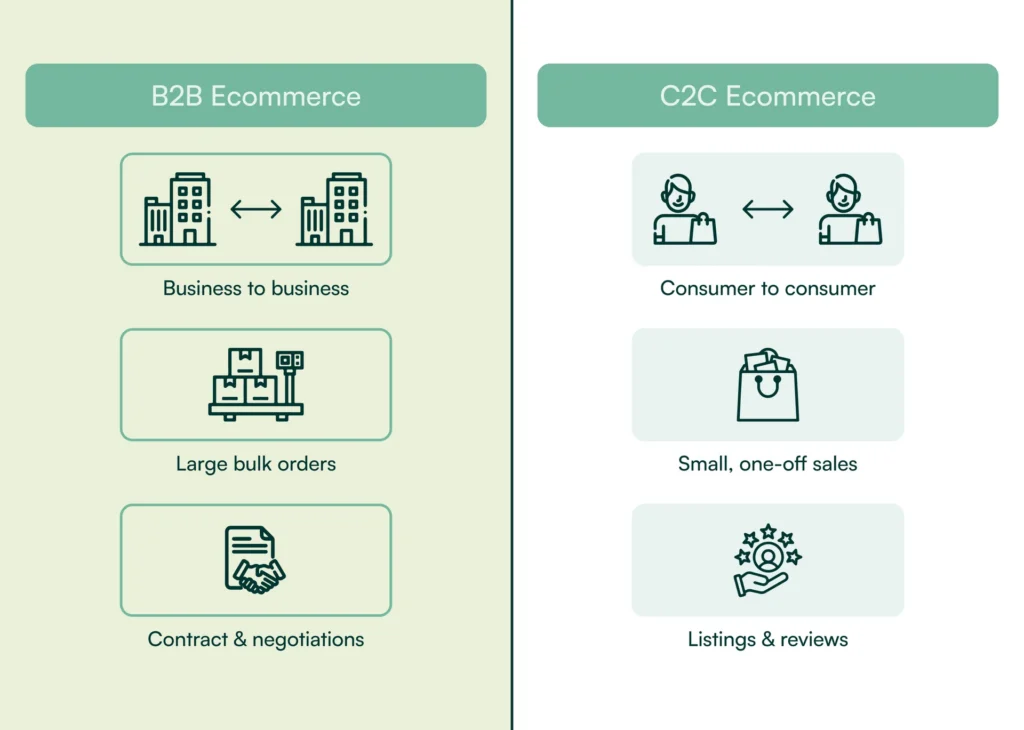
B2B and C2C commerce models differ based on who is buying and who is selling. In B2B e-commerce, transactions happen from one business to another (brands, wholesalers, manufacturers, distributors). Orders are usually larger, pricing is often negotiated, and workflows can include approvals, invoicing, credit terms, and recurring purchases. There is more than one B2B e-commerce model to choose between, and each carries its own trade-offs.
In contrast, C2C e-commerce enables consumer-to-consumer transactions, where individuals sell directly to other individuals. It thrives on variety, speed, and user-driven marketplace activity. An e-commerce platform for both C2C and B2B can support listings, peer reviews, secure payments, dispute handling, and community trust, making it flexible and accessible for everyday sellers.
In this post, we’ll break down B2B vs C2C e-commerce platform features in depth, real-world examples, pros and cons, and the things to consider so you can confidently pick or build the model that fits your goals.
What is B2B e-commerce?
Picture a digital marketplace built for businesses, not everyday shoppers; that is B2B e-commerce. A B2B e-commerce marketplace uses a model where companies buy and sell products, services, and resources online to keep their operations running smoothly.
At its core, B2B e-commerce is all about business-to-business transactions. Unlike B2C (business-to-consumer), which targets individual buyers, B2B platforms are designed to meet commercial needs. That typically means bulk purchasing, contract-based pricing, and often a higher level of customisation and negotiation.
Because buying decisions are usually made by teams (not one person), B2B platforms also tend to support features like quote requests, tiered pricing, approval workflows, and invoicing, making them ideal for long-term partnerships and repeat orders.
Characteristics of B2B e-commerce
- Transactions between companies: In B2B e-commerce, transactions occur between entities such as manufacturers, wholesalers, distributors, and retailers — usually within a single vertical ecommerce category, since contract pricing and catalog structure are built around one industry’s norms. For example, a gift shop chain might buy bulk seasonal inventory from a B2B gift accessories wholesaler using an online store/platform.
- Volume purchases: Companies often buy in large quantities to meet their business demands. Whether it’s raw materials, machinery, or specialized services, these bulk purchases help businesses sustain and scale their operations.
- Negotiation and personalization: Unlike typical consumer purchases, B2B transactions often involve detailed negotiations. Customization of products or services to meet specific business needs is common. For instance, a manufacturer might require specific modifications to machinery, which would be negotiated and arranged through the platform.
- Relationship management: Success in B2B e-commerce relies heavily on building and maintaining strong, long-term relationships. Businesses need to trust their partners to deliver consistently, making relationship management a critical component.
WizCommerce: An example of a B2B platform
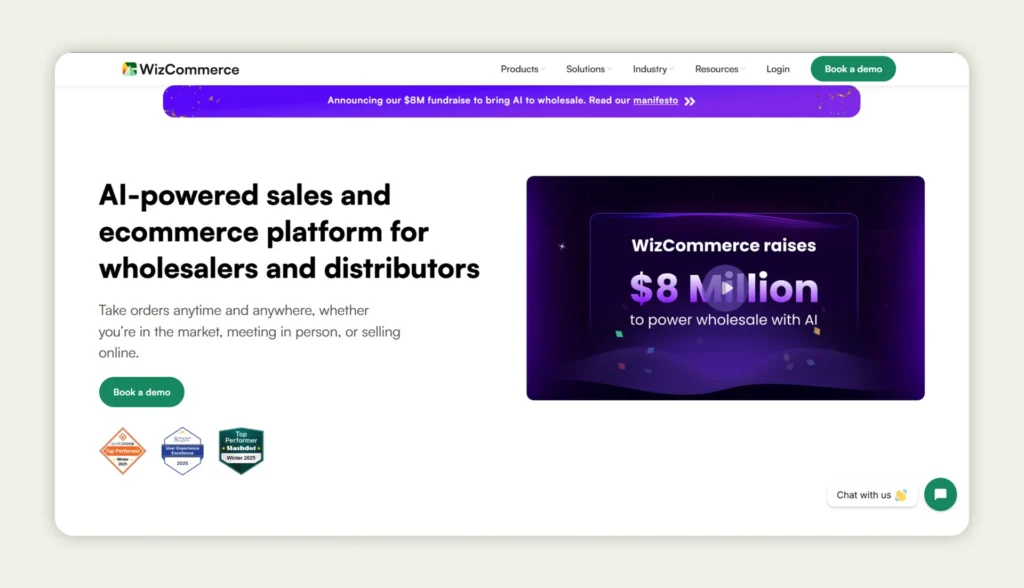
WizCommerce is an AI-powered e-commerce platform designed for wholesalers, manufacturers, and distributors. WizShop serves as the customer-facing B2B e-commerce platform where buyers place orders, while WizOrder, a sales rep app, lets reps take orders and check live inventory in the field. Together, these solutions provide an integrated, ERP-friendly workflow for modern wholesale selling.
With WizCommerce, you can seamlessly connect your sales process with real-time inventory management, improving efficiency, accuracy, and customer satisfaction while supporting long-term growth.
Understanding B2B e-commerce is crucial for any business looking to scale its operations and foster long-term partnerships. As the digital landscape continues to evolve, leveraging a robust B2B and C2C e-commerce platform could be the key to staying competitive and ensuring sustained growth.
Also read: Examples of B2B e-commerce
Strengths and challenges in B2B e-commerce
| Strengths | Challenges |
| Faster online ordering and tracking reduce manual effort and procurement delays. | Detailed discussions on pricing, quantities, delivery terms, and contracts still require clear negotiation processes. |
| Broader supplier options allow for comparing prices, terms, and products to secure better deals and flexibility. | E-commerce platforms must sync with ERP, inventory, accounting, and CRM systems to prevent bottlenecks and errors. |
| Automation reduces operational costs like paperwork and middlemen, freeing up budget for growth. | Strong security is vital to protect sensitive data and transactions, as breaches can damage reputation and relationships. |
What is C2C e-commerce?
C2C e-commerce (consumer-to-consumer e-commerce) is a model where individuals buy and sell directly to one another through an online marketplace. Instead of a business selling to a customer, consumers play both roles (buyer and seller), creating a flexible, community-driven way to trade goods and services. While the platform may provide tools like listings, payment options, and trust features, the transaction itself is still consumer-to-consumer.
When comparing C2C vs B2B, the main difference is who’s transacting. In C2C, it’s individuals selling to individuals; in B2B, it is businesses selling to businesses. Popular examples of the C2C e-commerce model include marketplaces like eBay and Facebook Marketplace, as well as sharing-economy platforms like Airbnb, where the platform is used by individual customers.
Characteristics of C2C e-commerce
- Direct consumer participation: In C2C e-commerce, consumers are at the heart of every transaction. They can sell their products or services directly to other consumers, eliminating the need for companies or commercial intermediaries. This direct participation fosters a sense of community and personal connection in the marketplace.
- Diversity of products and services: From second-hand items and handmade crafts to more niche services like tutoring or hosting, consumers can find or offer almost anything. Apparel shows the split clearly: individuals resell single garments peer-to-peer, while brands move full seasonal collections to retailers through a B2B apparel commerce platform with negotiated pricing and size-and-colour matrices. This diversity attracts a broad audience, making these platforms rich with unique opportunities.
- Flexibility and freedom: One of the most appealing aspects of C2C e-commerce is the flexibility it offers. Consumers have the freedom to set their prices, terms, and conditions for each transaction. Whether selling a vintage item or offering a personalized service, the seller controls how they engage with buyers.
- Platform intermediation: Although transactions occur between consumers, specialized online platforms facilitate these exchanges. These platforms, such as eBay or Etsy, provide the necessary tools and infrastructure to ensure transactions are smooth and secure. They also offer features like payment processing, dispute resolution, and customer service to enhance user experience.
eBay: An example of a C2C e-commerce platform
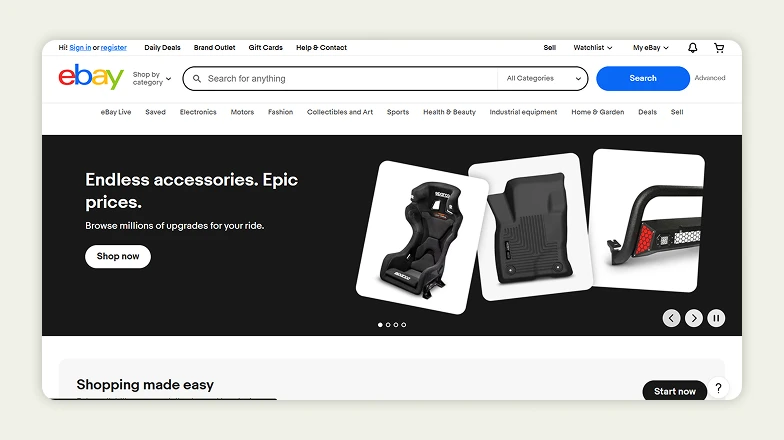
eBay is a global online marketplace where individuals and businesses can buy and sell. As one of the most recognized C2C platforms, eBay allows users worldwide to buy and sell a wide range of products, both new and used. Its auction-style listings and vast user base make it a go-to for many consumers. However, it also supports B2B (business-to-business) transactions, with businesses using the platform to sell products to other companies or consumers.
Understanding C2C e-commerce is essential for anyone looking to explore new avenues in the digital marketplace. Whether you’re a buyer seeking unique products or a seller looking to reach a wider audience, engaging with B2B and C2C e-commerce platforms can open up a world of opportunities.
Strengths and challenges of C2C business platforms
| Advantages | Disadvantages |
| Access to a global pool of buyers and sellers, increasing transaction volume and liquidity. | Crowded product categories make it harder for sellers to stand out and gain visibility. |
| Allows users to monetize unused items, skills, or hobbies, boosting platform activity and user retention. | Platforms must invest in reviews, identity checks, and secure payments to reduce fraud. |
| Interest-based communities drive repeat usage, stronger trust signals, and higher engagement over time. | Disputes over product quality, delivery, or refunds require clear policies and reliable resolution systems. |
| Centers around identity verification and fraud prevention. | Trust and security require investment in buyer/seller protection, raising operational costs. |
What is the difference between B2B and C2C e-commerce platforms?
| Area | B2B e-commerce platforms | C2C e-commerce platforms |
| Who’s buying/selling | Businesses sell to businesses (wholesalers, distributors, manufacturers, retailers). | Consumers sell to consumers via a marketplace that facilitates the exchange. |
| Typical order size & frequency | Larger, repeat orders; replenishment and account-based purchasing are common. | Often smaller, one-off purchases (secondhand goods, handmade items, peer-to-peer services). |
| Pricing | Contract/negotiated pricing, volume tiers, customer-specific price lists. | Usually seller-set, market-driven pricing (list it, negotiate, sell). |
| Sales cycle | Longer sales cycles: quotes, approvals, purchase orders, and relationship selling. | Faster cycles: discover → message → pay → ship/pickup, with minimal formal steps. |
| Core platform features | Catalog management, bulk ordering, ERP/CRM integration, invoicing, order history, account hierarchies. | Listings, messaging, ratings/reviews, escrow/secure payments, buyer protection, dispute handling. |
| Trust & risk management | Focus on compliance, credit terms, permissions/roles, audit trails, and secure account access. | Focus on identity signals (profiles), reviews, verification, fraud prevention, and resolution workflows. |
| Payments | Net terms, invoicing, PO-based purchasing, sometimes ACH/wire. | Cards, wallets, escrow-like flows; platform-mediated payments are common. |
| What “great” looks like | Reduced quote-to-cash time, fewer order errors, higher repeat revenue per account, tighter ops visibility. | More active sellers/buyers, higher transaction volume, strong review scores, low dispute/fraud rates. |
| Examples | WizCommerce (B2B portal + mobile ordering for wholesalers/distributors, with ERP integrations, bulk ordering, pricing support). | eBay / Etsy-style marketplaces; Airbnb-style peer-to-peer services. |
If you’re a wholesaler or distributor, the big takeaway is that B2B platforms must handle account-specific pricing, bulk ordering, and system integrations, which is why the shortlist usually narrows to distributor-specific e-commerce software rather than a general storefront. That is exactly the lane WizCommerce is built for (WizShop + WizOrder), streamlining wholesale selling and ordering end-to-end. If your reps write orders in the field or at trade shows, that combination is also why teams evaluate it as an alternative to Perenso rather than running a separate ordering tool alongside their storefront.
Also read: B2B vs B2C E-commerce: Understanding the Differences
Conclusion
Understanding the difference between B2B and C2C e-commerce is essential for winning in today’s digital marketplace. While both models create powerful opportunities, they require different approaches: B2B e-commerce platforms succeed when order management, pricing workflows, integrations, and security are optimized, while C2C e-commerce platforms thrive on trust-building, smooth dispute resolution, and a strong community experience.
When you align the right strategy with the right B2B and C2C e–commerce model, you can accelerate growth, improve customer experiences, and stay competitive. Cost is part of that alignment. What a B2B platform charges — subscription, transaction fees, implementation, integrations — varies widely, and our guide to B2B commerce platform pricing sets out how those layers add up.
If you’re operating in B2B and relying on manual processes or disconnected tools, don’t let outdated systems slow you down. Book a demo with WizCommerce to see how streamlined mobile ordering and integrated sales workflows can help you scale faster.
FAQs on B2B vs C2C E-Commerce Platforms
1. What is the most popular C2C website?
By sheer reach, Facebook Marketplace is often the most-used C2C-style destination, estimates put it at hundreds of millions of monthly shoppers.
That said, eBay is still the most iconic “classic” C2C marketplace globally (buy/sell between individuals), and it remains one of the biggest buyer–seller platforms worldwide.
2. Which is the best example of C2C?
eBay is a textbook C2C example because it was built to match buyers and sellers directly through an online marketplace (auctions and fixed-price).
3. What are the pros and cons of C2C?
Pros of C2C e-commerce include a huge variety and reach, extra income opportunities for sellers, and strong community effects. Its cons include trust/fraud risk, inconsistent quality, disputes, and logistics challenges.
4. What is the best C2C marketplace?
The best C2C marketplace would depend on what you’re looking for. For local pickup & everyday items, Facebook Marketplace is a prominent one. For resale, collectibles, auctions, broad global demand, eBay is popular. For handmade/vintage goods, Etsy is a common go-to (often “C2C-like,” though many sellers operate as small businesses).
5. Is Amazon C2C or B2C?
Amazon is primarily B2C, and it also runs a massive third-party marketplace, so it’s best described as a hybrid (B2C + marketplace), with a dedicated B2B arm via Amazon Business.
6. Is eBay a B2B or C2C company?
eBay is best known as C2C, but it also supports lots of business sellers, so in practice it’s C2C + B2C (and some B2B activity).