Skip to content



B2B e-commerce (business-to-business e-commerce) is the online sale of products or services between two businesses, typically through a digital storefront, buyer portal, marketplace, or sales rep app, with the order flowing into an ERP or order management system on the back end. A wholesaler selling to retailers, a manufacturer selling to distributors, a brand selling to resellers on a marketplace, all of it counts. The buyer is another company, the order moves through a digital channel, and the workflow handles things a consumer cart never has to: tiered pricing, case packs, net terms, ERP sync.
The market is bigger than most people think. EMARKETER reports US B2B e-commerce hit $2.297 trillion in 2024, with Forrester projecting it will reach $3.067 trillion by 2027 at an 11% annual growth rate. Mordor Intelligence puts the global B2B e-commerce market at $36.86 trillion in 2026, growing to over $60 trillion by 2031. Most of it happens behind buyer logins and partner portals, which is why it gets less attention than the consumer side.
This guide answers the questions wholesalers and distributors ask most often when evaluating B2B e-commerce for the first time. What it is. How it works. How it differs from B2C. The four main models with real examples. Why the market is growing. The benefits, the challenges, what it costs, and what the ROI looks like. How AI is changing the category. The trends shaping 2026. And how to choose a platform that fits your model, your vertical, and your ERP.
What is B2B E-Commerce and How Does it Work?
B2B e-commerce is the buying and selling of goods or services between two businesses through an online channel. The buyer is another company, not an end consumer. The seller could be a wholesaler, distributor, manufacturer, brand, or marketplace. The transaction runs through a digital storefront, buyer portal, marketplace, EDI connection, or sales rep app, and the order flows into an ERP or order management system on the back end.
The category covers more than a website with a shopping cart. A B2B wholesale seller who lets retail buyers reorder through a private portal is doing B2B e-commerce. A manufacturer who quotes a custom run through a configurator is doing B2B e-commerce. A distributor whose sales rep writes a case-pack order on an iPad at a trade show is doing B2B e-commerce. A brand that lists on a marketplace like Faire is doing B2B e-commerce. The common thread is that a business is placing the order, and the workflow has to handle business-grade complexity.
The Five Stages of a B2B E-Commerce Order
A B2B e-commerce transaction moves through five stages, each one carrying business-specific logic the buyer never has to think about.
- Authentication: The buyer logs into a portal or app that recognizes their company, their location, and their role. A purchasing manager sees different options than a store-level approver. The platform pulls account history, credit limit, and any open quotes.
- Catalog and pricing: The buyer sees a catalog scoped to their account. SKUs they qualify for, case packs that apply to them, and prices calculated from their tier, contract, and volume. Two buyers logging into the same site can see two different prices on the same product.
- Cart and approval: The buyer builds a cart, often across multiple ship-to addresses. Approval workflows route to the right manager or AP contact when the order crosses a threshold. The cart can sit for days without timing out because B2B buying cycles take longer than B2C.
- Checkout and payment: The buyer picks net terms, ACH, or saved card. Tax exemption certificates apply automatically. The order generates a purchase order document the AP team can match later. No credit card friction for a buyer who has been pre-approved.
- ERP write-back: The order writes into the seller’s ERP (NetSuite, SAP, Microsoft Dynamics, Epicor, Fishbowl, QuickBooks) with the right account code, the right inventory hold, and the right tax treatment. Fulfillment, invoicing, and reorder workflows then run off that ERP record.
The five-stage flow is what makes B2B e-commerce hard to fake with a consumer cart. Each stage carries logic a B2C platform was not designed for, and bolting it on with apps tends to create gaps that show up in production.
How is B2B E-Commerce different from B2C E-Commerce?
B2B e-commerce sells to businesses with negotiated pricing, multi-stakeholder buying, and ERP-driven fulfillment. B2C e-commerce sells to individual consumers with public pricing, single-buyer checkout, and consumer shipping. The operational gap underneath that headline is wider than most operators expect, and it shows up in every part of the workflow from catalog to checkout to fulfillment.
For a deeper insight, see our breakdown of B2B vs B2C e-commerce.
B2B vs B2C: The operational differences
| Dimension | B2B E-Commerce | B2C E-Commerce |
|---|---|---|
| Buyer | A business, with multiple users per account | One individual shopper |
| Pricing | Tiered, contract-based, account-specific | Public, same for everyone |
| Catalog Visibility | Customer-specific, sometimes private | Public, same catalog for all |
| Order Size | Large carts, multi-ship-to, hundreds of SKUs | A few items, single ship-to |
| Payment | Net terms, ACH, PO, partial payments, credit limits | Credit card or wallet at checkout |
| Tax | Exemption certificates by account | Standard sales tax |
| Sales Cycle | Days to months, often quote-driven | Minutes |
| Account Structure | Company with buyers, approvers, locations | One user, one history |
| Reorder Behaviour | High repeat, reorder-from-history central | Occasional, discovery-driven |
| Integration | Must write to ERP in real time | Can sit in the storefront database |
What are the Six Main Types of B2B E-Commerce?
The six main types of B2B e-commerce are B2B2C, wholesale, manufacturer-to-distributor, marketplace, B2B2B, and B2G. They are defined by who is selling to whom and shape what the platform must support. Most operators run one as their primary motion and one or two as secondary motions.
The six B2B e-commerce models, compared:
| Model | Who sells to whom | Order pattern | Platform must handle |
|---|---|---|---|
| B2B2B | Manufacturer sells to distributor who sells to another business (often a contractor, reseller, or fabricator) | Multi-tier, channel-specific pricing, drop-ship across tiers | Tier-aware catalogs, partner portals, channel inventory visibility, drop-ship workflows, multi-level pricing |
| B2B2C | Brand sells to a business that sells to the end consumer | Mid-size, recurring, channel-shared inventory | Layered pricing (wholesale + retail), channel separation, shared inventory |
| B2G | Business sells to a government agency (federal, state, municipal, school district, public hospital) | Contract-driven, compliance-heavy, audit-traceable | Cooperative-contract pricing, punch-out into government procurement systems, compliance fields, pricing audit trails |
| Wholesale | Brand or distributor sells in bulk to retailers and resellers | Large, multi-SKU, tiered pricing, case packs | Customer-specific catalogs, MOQs, case packs, multi-ship-to, sales rep workflow |
| Manufacturer to distributor | Manufacturer sells to distributors who resell downstream | Configurable, contract-priced, long sales cycle | Configure-price-quote (CPQ), contract pricing, lead-time management |
| Marketplace | Many sellers list to one shared buyer base | Variable size, commission-based, high acquisition value | Multi-seller catalog, payment splitting, channel-level inventory, marketplace fee logic |
1. B2B2B
In B2B2B, a manufacturer sells to a distributor who sells to another business downstream — typically a contractor, reseller, or fabricator. The chain is two tiers deep on the seller side, and each tier needs its own catalog and pricing. A Carrier-to-Watsco-to-HVAC-contractor flow is B2B2B, and it is the default model in HVAC, electrical, plumbing, automotive aftermarket, and industrial MRO. The platform needs tier-aware portals, channel-specific pricing, and drop-ship logic between manufacturer and distributor. In practice the distributor runs an e-commerce platform built for distributors for its own downstream buyers rather than selling through the manufacturer’s.
2. B2B2C
In B2B2C, a brand sells to a business that sells to the end consumer. The brand is technically B2B, but the buying experience is shaped to look and feel like B2C for the final shopper. A specialty coffee roaster who sells to independent cafes, then powers a co-branded web-store the cafe uses for retail customers, is running a B2B2C motion. The platform needs strong catalog flexibility and channel separation.
3. B2G
In B2G, a business sells to a government agency — federal, state, municipal, or a school district buying through a cooperative like GSA, NASPO, or OMNIA Partners. The product is the same, but the workflow is not: pricing is locked to a contract, catalogs need compliance flags, and orders need an audit trail. A janitorial supplier selling to a school district through OMNIA is running B2G even if the rest of their business is straight wholesale. The platform needs contract pricing, punch-out into government procurement systems, and pricing history for compliance audits.
4. Wholesale
Wholesale is the model most operators reading this guide live in. A brand or distributor sells in bulk to retailers, resellers, and other resale buyers. Order sizes are large, the catalog runs to thousands of SKUs, and pricing depends entirely on the buyer. Case packs, MOQs, customer-specific catalogs, and tiered pricing are the daily reality, and this is where the gap between a B2C platform and a wholesale-native platform shows up the fastest. WizCommerce is built primarily for this model.
5. Manufacturer to distributor
In the manufacturer-to-distributor model, a manufacturer sells to distributors who resell into a downstream channel. Orders are often configurable: a manufacturer of commercial lighting fixtures might quote a 200-unit run with a custom finish and a 12-week lead time. The sale takes weeks, the quote goes through several rounds, and the order is built around a contract more than a cart. The platform requirement is a strong CPQ flow, contract pricing, and quote-to-order conversion.
6. Marketplace
A B2B e-commerce marketplace is a platform where many sellers list to a shared base of buyers. Faire, Mable, Bulletin, Ankorstore, and Joor all run B2B marketplaces. Amazon Business and Alibaba run horizontal B2B marketplaces at much larger scale. The model is attractive for brands that want demand without building their own buyer base, and the trade-off is margin: the marketplace takes a cut, and the brand does not own the customer relationship.
Learn more about how B2B marketplaces work.
What are Real-World Examples of B2B E-Commerce?
Real-world B2B e-commerce examples include home furnishings wholesalers running buyer portals plus trade-show sales rep apps, food distributors handling weekly commodity-priced reorders with cold-chain metadata, jewellery brands writing showroom orders on iPads, industrial parts distributors with technical-spec search, and fashion brands managing line-sheet-driven pre-orders. Each vertical’s workflow looks different, which is why vertical fit matters more than feature breadth.
Industry-by-industry workflow comparison
| Vertical | Order pattern | Platform must handle | Where a B2C platform breaks |
|---|---|---|---|
| Home Furnishings | Online reorders plus trade-show bursts | Case packs, multi-ship-to, sales rep app, NetSuite sync | Trade-show offline order writing, line-sheet generation |
| Food and Beverage | Weekly recurring, commodity-driven pricing | Dynamic pricing, cold-chain metadata, route-based fulfillment | Compliance fields, weekly price updates by SKU |
| Jewellery wholesale | Small line count, high AOV, rep-led | Showroom mode, trade-show offline writing, reorder flow | Rep-first writing surface, photography catalog quality |
| Industrial Parts | Daily, technical-spec-driven, same-day ship | Technical search (thread pitch, material grade), account pricing, same-day inventory | Faceted technical search, account-level pricing exactness |
| Fashion and apparel | Pre-order plus in-season reorder | Line sheets, drop-ship workflow, seasonal catalog publishing | Pre-order logic, line-sheet PDF generation, drop-ship routing |
What are the Benefits of B2B E-Commerce?
The benefits of B2B e-commerce show up in five places: order accuracy, sales team productivity, buyer retention, operating cost, and forecasting quality. Operators who move off email-and-spreadsheet workflows commonly see double-digit gains in all five within a year.
- Higher order accuracy: The single largest source of B2B order errors is rekeying. A buyer emails a list, a CSR types it into the ERP, a digit gets transposed, the shipment goes out wrong. A B2B e-commerce platform removes the rekey step. Wholesalers who move to a digital order workflow commonly report 80% or higher reductions in order entry errors, and the cost of those errors (returns, freight, credit memos, CSR time) usually pays for the platform several times over in year one.
- More selling time, less order admin: In an email-and-spreadsheet shop, the sales team spends most of its time on order admin: chasing missing line items, fixing pricing, sending shipment updates. A real B2B e-commerce platform absorbs that work. The buyer self-serves reorders, tracks shipments, and downloads invoices. A sales rep who spends 60% of their time on admin and 40% on selling, switched onto a platform that flips that ratio, doubles their selling capacity.
- Stronger buyer retention: B2B buyers expect to reorder at 11 PM on a Sunday, track a shipment from a phone, and download an invoice without emailing AR. A B2B e-commerce platform delivers that experience. An email-and-spreadsheet workflow does not. Wholesalers who launch a real buyer portal commonly report reorder rate increases of 10% to 20% in the first year, mostly from existing buyers placing more orders more often.
- Lower operating cost across order-to-cash: The hidden cost of email-and-spreadsheet is the headcount it requires. Two CSRs to key orders, a sales ops person to reconcile spreadsheets, a finance person to chase net-terms invoices. A platform that absorbs the order, pricing, and invoicing workflow lets that headcount be redirected. Wholesalers who consolidate three or four point tools into one platform typically report 25% to 40% reductions in operating cost on the order-to-cash side.
- Better data and forecasting: A digital order workflow generates clean data on every transaction. Which buyer is reordering, which is drifting, which SKU is moving in which region, at what margin. The same data that takes a sales ops analyst a week to assemble from spreadsheets is available in a dashboard. Forecasting gets sharper, buyer outreach gets more targeted, and inventory planning gets less defensive.
What are the Biggest Challenges in B2B E-Commerce?
The biggest challenges in B2B e-commerce are ERP integration, customer-specific pricing logic, sales rep adoption, multi-channel inventory drift, and migration risk from legacy systems. Most failed B2B e-commerce launches stall on one of these, and most of them are avoidable with the right platform and a staged rollout.
- ERP integration: The most common cause of stalled B2B e-commerce launches is ERP integration treated as a back-end detail. The ERP (NetSuite, SAP, Microsoft Dynamics, Epicor, Fishbowl, QuickBooks) is the system of record. The platform has to write to it cleanly from day one, in real time, with the right account code and tax treatment. If the integration is nightly batch instead of real-time, the operator ends up running two ledgers and reconciling by hand. The fix is to name the ERP during platform evaluation and only consider platforms with a pre-built connector and two reference customers on that exact combination.
- Sales rep adoption: Sales reps will refuse to use a B2B e-commerce platform that does not work at a trade show with flaky wifi or in a basement showroom with no signal. The platform’s mobile app has to write orders offline, then sync when connectivity returns. Most B2C-derived platforms cannot do this. Most generic B2B platforms do it poorly. A wholesale-native option like WizOrder, the WizCommerce’s B2B order taking app , handles offline writing for case packs, tiered pricing, and customer-specific catalogs.
- Customer-specific pricing logic: Two buyers logging into the same site should see two different prices on the same product, calculated from their tier, contract, volume history, and any active promotion. That sounds simple. In production, it has to apply consistently across the portal, the sales rep app, the marketplace channel, and any embedded payment flow, with the same logic every time. The most common failure is pricing that displays correctly in the portal but breaks when the order writes to the ERP.
- Multi-channel inventory drift: Brands running an owned site plus a marketplace channel plus an EDI feed plus a sales rep app find that inventory goes out of sync between them within hours unless the platform handles channel-level inventory logic. The result is over-promised stock, cancelled orders, and angry buyers. The platform must hold a single inventory record and publish channel-specific views, not run separate stocks per channel.
- Migration from legacy systems: Moving off a legacy ERP-embedded ordering system or a custom-built portal is a project, not a software install. Data quality is usually worse than the team expects, integration debt is usually higher, and buyer adoption requires retraining. The staged-launch approach (one segment, then add) reduces the risk substantially. A big-bang cutover with 800 buyers and no fallback path is how migrations become emergencies.
What do B2B Buyers Expect in 2026?
B2B buyers in 2026 expect six things from a seller’s e-commerce experience: rep-free self-service, AI-assisted research, omnichannel continuity, large-dollar checkout without friction, mobile parity with desktop, and accurate negotiated pricing on every page. The buyer now researches, compares, and often completes the purchase before a sales rep is involved.
- Two out of three B2B buyers prefer a rep-free buying experience. Gartner’s 2026 survey of 646 B2B buyers found 67% prefer to buy without rep involvement, up from 61% a year earlier. The shift is structural – buyers now research, compare, and validate on their own, engaging a rep only for contextual judgment they cannot get online.
- Nearly half of B2B buyers now use AI tools during a purchase. The same Gartner 2026 survey found 45% of buyers used AI during a recent purchase. Buyers arrive at the seller’s site with the comparison already done and questions pre-screened – a platform without clean product data is invisible at the moment of intent.
- Self-service and remote sales now drive 34% of B2B revenue. McKinsey’s 2024 B2B Pulse survey found e-commerce has ranked the most effective sales channel four years running, and 39% of buyers now place orders above $500,000 through digital or remote channels – up from 28% two years earlier.
- B2B buyers use ten channels and punish suppliers who fragment across them. McKinsey found decision-makers use 10.2 channels on average, up from five in 2016, and 54% would abandon a purchase or switch suppliers over a poor omni-channel experience. Price and order history must match on web, phone, and mobile.
- Most B2B buyers are dissatisfied with their digital experience, and Millennials most of all. Forrester found over 80% of global B2B buyers are “not very satisfied” with their chosen vendor, and 87% of Millennial and GenZ buyers report dissatisfaction in at least one area versus 73% of older buyers.
- Net terms and online reordering are non-negotiable expectations. A 2025 industry survey found 66% of B2B buyers abandon purchases when preferred payment terms are not offered, and Shopify’s 2025 research found 79% prefer to place repeat orders online. A credit-card-only checkout filters the seller out of consideration.
What are the B2B E-Commerce Trends Shaping 2026?
Four trends are shaping B2B e-commerce in 2026 alongside the AI shift: headless architecture replacing monolithic stacks above $20M in revenue, embedded payments pulling AR into the platform, marketplace strategies running parallel with owned e-commerce, and vertical-specific platforms outperforming horizontal ones.
- Headless B2B e-commerce is the new default above $20M: Headless separates the buyer-facing storefront from the commerce engine, connected through APIs. The same engine can power a public buyer portal, a private dealer portal, a sales rep app, and a marketplace channel. Wholesalers above $20M in revenue are increasingly going headless to avoid the rebuild cycle that hits every two to three years on a monolithic stack.
- Embedded payments and net terms are pulling AR into the platform: Payment in B2B used to live outside the e-commerce platform. Embedded payment platforms now bring the whole flow into the ordering surface. Third-party financing partners underwrite net terms at checkout, so the seller gets paid on shipment while the buyer keeps the float. WizPay, the WizCommerce B2B payments product, is built on this pattern.
- Marketplace strategy runs in parallel with owned e-commerce: The old debate (own your site or list on a marketplace) is dead. Fast-growing brands do both: an owned site for high-value buyers and existing accounts, and marketplaces (Faire, Mable, Joor, Amazon Business) for new-buyer acquisition. The platform requirement is multi-channel inventory and pricing logic.
- Vertical-specific platforms are outperforming horizontal ones: A horizontal B2B e-commerce platform is built for “any B2B seller.” A vertical platform ships with the workflows the industry needs out of the box: line sheets for fashion, cold-chain for food, technical search for industrial, showroom mode for jewelry. Wholesalers are increasingly choosing vertical fit over horizontal feature breadth because implementation ships in 90 days instead of 18 months.
How do you Choose a B2B E-Commerce Platform?
You choose a B2B e-commerce platform by matching it to your model, your vertical, and your ERP, then verifying fit with two reference customers using the same combination. The best B2B e-commerce software is the one that scores well on all three rarely needs heavy customization, ships in 90 days, and stays cheaper to run over three years than a horizontal platform configured into shape.
1. Match the platform to your model
If the business is primarily wholesale, the platform must handle case packs, MOQs, customer-specific catalogs, tiered pricing, and a sales rep app. If the business is primarily B2B2C, the platform needs strong channel separation and layered pricing. If the business is primarily manufacturer-to-distributor, the platform needs CPQ and contract pricing. If the business is primarily marketplace, the platform needs multi-seller and commission logic. A platform built for one model rarely does the others well.
2. Match the platform to your vertical
The right platform for a fashion brand is not the right platform for an industrial parts distributor. Vertical fit shows up in the features the platform ships with out of the box: line sheets for fashion, technical search for industrial, cold-chain metadata for food, showroom mode for jewelry, drop-ship workflows for D2C-adjacent wholesale. A horizontal platform can be configured to handle most of these, but the configuration debt compounds.
3. Match the platform to your ERP
The ERP integration is the single most important technical fit. A pre-built connector with the ERP the business already runs (NetSuite, SAP Business One, Microsoft Dynamics 365 Business Central, Epicor, Fishbowl, QuickBooks, Sage) saves months of implementation time and reduces ongoing maintenance to near zero. A custom integration is a multi-month engineering project that has to be rebuilt every time either system gets a major update.
4. Evaluate total cost of ownership
License cost is one input. TCO over three years (license, implementation, integration, plugins, custom dev, internal team time) is the right number to compare. A platform that costs more per month but ships with a pre-built ERP connector and zero plugin subscriptions usually has lower TCO than a cheaper platform that requires five plugins and a custom integration.
5. Verify with reference customers
Ask every vendor for two reference customers running the same model, same vertical, and same ERP. Talk to them. Ask how the launch went, what broke in the first six months, what the ongoing platform team looks like, and whether they would buy the platform again. Reference customers on a different combination are not useful comparisons.

Why WizCommerce Is Built for Wholesale B2B E-Commerce?
WizCommerce is an AI commerce platform built specifically for wholesalers, distributors, and manufacturers who run on complex sales workflows, large catalogs, and ongoing customer relationships, the areas where generic e-commerce platforms and legacy systems consistently fall short.
Its B2B e-commerce platform, WizShop, avoids the incremental approach of bolting plugins onto a B2C cart or stitching together separate point tools that never quite work as a single system. Every wholesale-native capability buyers and operators need is in one product, from custom-branded portals to AI-powered search to real-time ERP sync.
What WizShop delivers in one B2B e-commerce platform?
- Custom-branded B2B e-commerce portal letting wholesalers launch a fully branded buyer experience without engineering work or third-party storefront builders.
- Multi-level pricing and personalized pricing matrices applying customer-specific, tier-based, and contract pricing automatically so every buyer sees the price they qualify for.
- Customer-specific catalogs showing each account the SKUs, segments, and curated assortments that apply to them, with the rest hidden.
- Bulk order management and bulk SKU upload handling large multi-line carts, CSV uploads, and high-quantity ordering without breaking the checkout.
- One-click reorder and quick reorder flow turning repeat purchases into a single tap from order history, the dominant ordering pattern in wholesale.
- Infinite variants with swatches supporting wholesale catalogs with deep size, color, material, and configuration variants that B2C platforms cap out on.
- AI-powered product recommendations suggesting alternatives for out-of-stock items, surfacing upsell opportunities, and lifting average order value at checkout.
- AI-powered intelligent search and filters with typo-tolerant search, attribute-level filtering, category browsing, and a “View Similar” feature that helps buyers find products fast in deep catalogs.
- Customer approval workflows routing large or out-of-policy orders to the right approver inside the buyer’s organization before the order writes to the seller’s ERP.
- Quote management and quoting workflows letting buyers request a quote, receive it, and convert it to an order inside the same portal with no re-entry.
- MOQ enforcement at the cart applying minimum order quantities by SKU, category, or order total automatically, with no manual policing by sales reps.
- Punch-out catalog capabilities connecting cleanly into enterprise buyers’ procurement systems so large buyers can browse the catalog and push purchase orders directly from their own procurement stack.
- Net terms, ACH, credit card, and digital wallet payments at checkout giving B2B buyers the payment flexibility they expect without forcing credit card friction.
- Real-time ERP and accounting integration with NetSuite, QuickBooks (Desktop and Online), Fishbowl, and other wholesale stacks, keeping inventory, pricing, and orders in sync without nightly batch jobs.
- Built-in wholesale CRM unifying customer relationships, order history, contact records, and engagement data inside the same platform that runs ordering.
- Advanced reporting and analytics surfacing reorder patterns, account health, SKU velocity, and margin signals in dashboards instead of requiring an analyst to assemble them.
- Device-agnostic buyer experience delivering the same portal across desktop, mobile, and tablet, on iOS or Android, in browsers or in apps.
- Sub-30-day go-live with a pre-built ERP connector and a staged buyer onboarding plan, against the 9-to-18-month timelines typical of horizontal enterprise platforms.
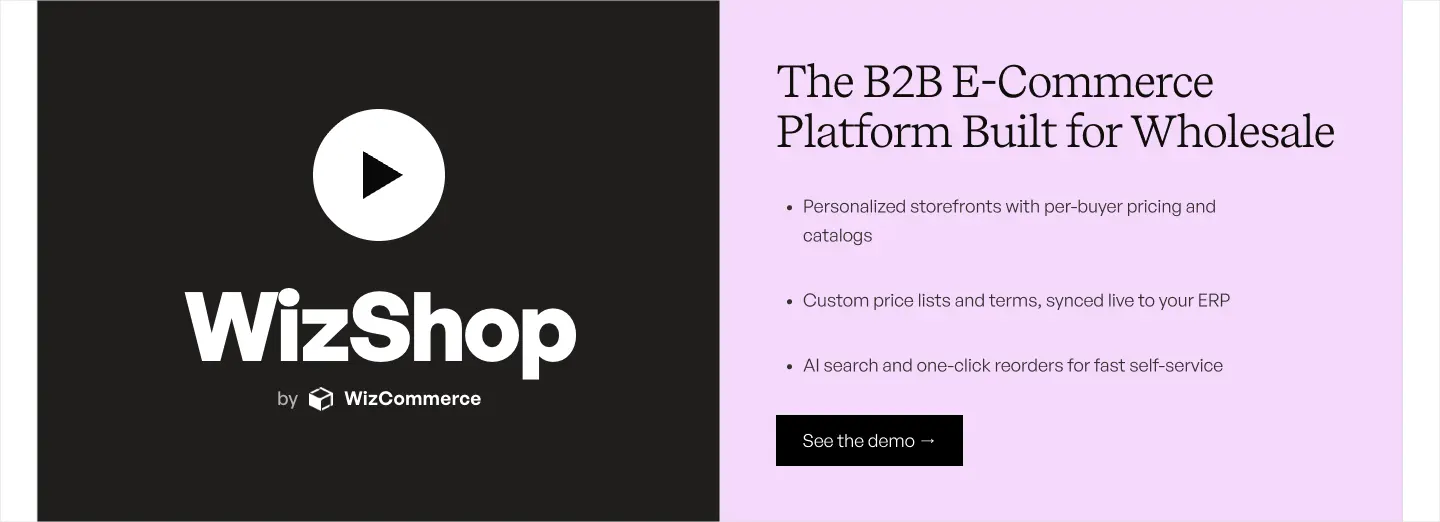
Together, these capabilities give wholesale buyers the self-service experience they now expect while letting operators run high-volume, complex catalogs without manual data entry, plugin sprawl, or the eventual re-platforming project that follows a B2C-derived stack. You can explore the WizCommerce B2B e-commerce platform for a closer look at how WizShop fits into your model and vertical.
FAQs on B2B E-Commerce
1. Is B2B e-commerce bigger than B2C e-commerce?
Yes. B2B e-commerce is roughly five times larger than B2C e-commerce by transaction value. Forrester puts the US B2B market at over $2 trillion annually, while US B2C is around $1.1 trillion. Globally, Mordor Intelligence projects B2B e-commerce at $36.86 trillion in 2026, more than three times global B2C.
2. Can Shopify or BigCommerce handle B2B e-commerce?
Shopify and BigCommerce can handle some B2B e-commerce, but they were built for B2C and stretched into B2B with native features and apps. They hold for small wholesale operations and typically strain between $5M and $30M in annual wholesale revenue. Common breaking points are case packs, customer-specific catalogs at scale, sales-rep offline order writing, and real-time ERP integration.
3. How long does a B2B e-commerce launch take?
A B2B e-commerce launch on a vertical-fit platform with a planned ERP integration typically takes 60 to 90 days for a controlled pilot, then two to three quarters to roll out to the full buyer base. A launch on a horizontal platform with custom ERP integration usually takes 9 to 18 months. The biggest accelerator is picking a platform that already ships with the specific ERP integration you need.
4. What ERP integrations should a B2B e-commerce platform support?
A B2B e-commerce platform should support the ERP the business already runs. The most common in mid-market wholesale are NetSuite, SAP Business One, Microsoft Dynamics 365 Business Central, Epicor Prophet 21, Fishbowl, Sage, and QuickBooks (Desktop and Online). Ask the vendor for a pre-built connector and two reference customers on the same combination before signing.
5. What features matter most in a B2B e-commerce platform?
The features in a B2B e-commerce platform that matter most are tiered and account-specific pricing, customer-specific catalogs, case packs and MOQs, multi-ship-to checkout, net terms and ACH payment, real-time ERP integration, a sales rep app with offline order writing, quote-to-order workflow, and reorder-from-history. The exact priority depends on the model and the vertical.
6. Do I need a B2B e-commerce platform if my business is small?
A B2B e-commerce platform earns its place once a small wholesaler is processing more than 30 to 50 orders per week, running tier pricing for more than 20 buyers, or losing more than two hours a week to order entry errors. Below that, a well-configured B2C platform with B2B apps can work. Above that, the workarounds usually cost more than a wholesale-native platform.
7. Can I use a B2B marketplace and have my own B2B e-commerce site at the same time?
You can use a B2B marketplace and run your own B2B e-commerce site at the same time, and most fast-growing brands do exactly that. The marketplace (Faire, Joor, Amazon Business, Alibaba) acquires new buyers. The owned site retains them and runs higher-margin repeat business. The platform requirement is multi-channel inventory and pricing so the same SKU can sell on both at different prices without going out of sync.
8. What does B2B e-commerce mean in simple terms?
In simple terms, B2B e-commerce means selling goods or services to other businesses through an online channel. The buyer is a company, the order moves through a digital storefront, portal, marketplace, or sales rep app, and the order writes back to the seller’s ERP. It covers wholesalers, distributors, manufacturers, and brands selling to resale buyers.
9. What is the difference between B2B e-commerce and a B2B marketplace?
B2B e-commerce is a seller’s own digital channel – their website, buyer portal, or sales rep app – where they sell directly to business buyers. A B2B marketplace is a third-party platform like Faire, Joor, or Amazon Business where many sellers list to a shared buyer base. The marketplace acquires the buyer and takes a commission; the seller’s own e-commerce site retains the buyer and runs higher-margin repeat business. Most fast-growing wholesalers do both.
10. How is AI changing B2B e-commerce in 2026?
AI is reshaping B2B e-commerce on both sides of the transaction. On the buyer side, Gartner found 45% of B2B buyers used AI tools during a recent purchase, using LLMs to compare vendors, screen specs, and pre-build orders before contacting a seller. On the seller side, AI now powers product search, recommends substitutes for out-of-stock items, converts emailed POs into draft orders, and flags pricing or fulfillment errors before they reach the ERP.
11. What is headless B2B e-commerce?
Headless B2B e-commerce separates the buyer-facing storefront (the “head”) from the commerce engine (the “body”), connecting them through APIs. The same engine can power a public buyer portal, a private dealer portal, a sales rep app, and a marketplace channel – all with consistent pricing and inventory. Wholesalers above $20M in revenue increasingly choose headless architecture to avoid the rebuild cycle that hits monolithic stacks every two to three years.
12. What is a punch-out catalog and why does it matter in B2B?
A punch-out catalog lets a buyer browse the seller’s catalog from inside their own procurement system (Coupa, SAP Ariba, Oracle, or a government procurement portal) and push the resulting purchase order back to the seller without leaving their environment. It is essential for selling to enterprise procurement teams, large healthcare systems, universities, and government agencies, all of whom mandate procurement-system-driven purchasing. A B2B e-commerce platform without punch-out cannot serve those buyer segments.
13. What is the average ROI of a B2B e-commerce platform?
Most wholesalers see ROI on a B2B e-commerce platform within the first year, driven by reduced order entry errors, lower CSR headcount, and higher reorder rates from existing buyers. Common year-one gains include 80%+ reductions in order entry errors, 25–40% reductions in order-to-cash operating cost, and 10–20% increases in reorder rates. The platform usually pays for itself before the second annual license renewal.
14. Is B2B e-commerce growing or shrinking?
B2B e-commerce is growing fast and is now larger than B2C by a wide margin. EMARKETER reported US B2B e-commerce hit $2.297 trillion in 2024, and Forrester projects it will reach $3.067 trillion by 2027 at an 11% annual growth rate. Globally, Mordor Intelligence puts the B2B e-commerce market at $36.86 trillion in 2026, growing to over $60 trillion by 2031. The growth is structural, not cyclical – driven by a generational shift in B2B buyers who prefer digital over phone-and-email purchasing.