Skip to content



The order desk at a typical mid-market wholesaler runs on two speeds. Orders from the mandated chain accounts arrive through EDI and post to the ERP without a human touch. Everything else arrives as emailed PDFs, spreadsheets, and portal notifications, and it all waits for someone to key it in. The EDI vs AI order entry question comes up the moment a wholesaler decides that the second pile has to stop being manual.
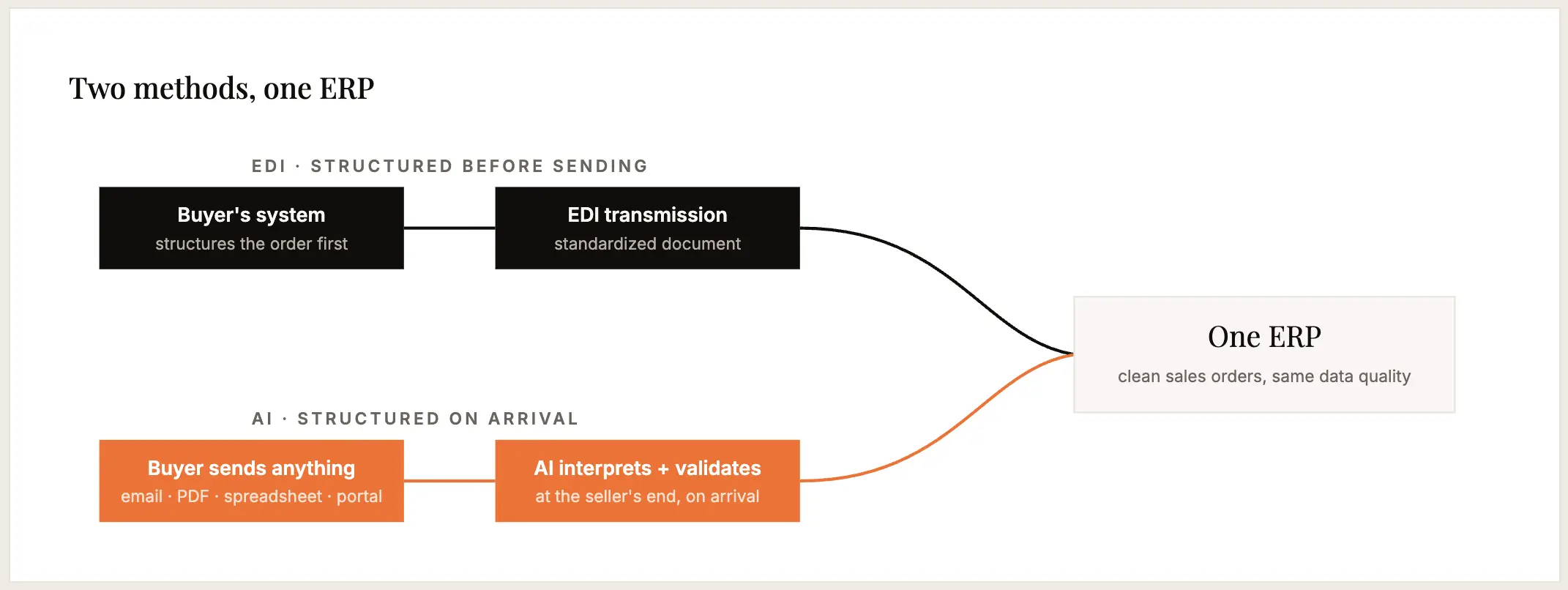
Both are methods of automating order entry, and the difference between them is not age or quality but mechanism. EDI structures an order at the buyer’s end before it is ever sent. AI order entry interprets an order at the seller’s end after it arrives. Nearly everything that matters in the comparison follows from that one distinction.
EDI vs AI Order Entry: What Is the Difference?
EDI and AI order entry automate the same job by opposite means. Electronic data interchange (EDI) is the computer-to-computer exchange of standardized business documents between trading partners whose systems agreed on a format in advance, which means the order arrives already clean and posts without interpretation. AI order entry is order-intake software that reads unstructured purchase orders in whatever form they arrive and converts them into validated ERP sales orders. EDI vs artificial intelligence order entry therefore comes down to a choice between structuring data before transmission and interpreting it after arrival, and that choice drives everything else in the comparison.
The mechanics of the first method live in standardized documents. A buyer’s procurement system transmits an electronic purchase order, and the acknowledgment, the ship notice, and the invoice travel back over the same rails, the full document loop that EDI for wholesalers is built on. The second method has no document standard at all, which is precisely the point, because it exists for the orders that never conform to one.
Most pages ranking for this comparison stop at the word complementary. That answer is true and also unhelpful, since an operator deciding where an automation budget goes needs to know how the two methods behave differently under real order flow, rather than the bare fact that they can coexist inside the same ERP.
Two Methods, One Job: How Each Order Reaches the ERP
EDI earns its automation before the first order ever moves. Both trading partners adopt the same document schema, build the maps that translate it into each system, and test the connection until documents flow clean in both directions, which is why an EDI relationship begins with weeks of setup and ends with orders that post untouched for years. Once the connection runs, the method is nearly invisible, and a chain account can send a blanket purchase order with weekly releases against it while the whole arrangement runs itself in the background.
AI order entry spends nothing on pre-agreement and does all of its work at the moment of arrival. The buyer changes nothing about how they order, and the seller’s system reads the email body, the PDF attachment, or the portal notification, matches the lines to the catalog, and validates pricing and inventory against ERP rules before drafting the sales order. The mechanics of how AI order entry works, from extraction through confidence scoring, run identically no matter which format shows up, because the method was built for the absence of format.
Set EDI versus AI order processing side by side and the contrast becomes a before-and-after question. One method guarantees structure before transmission and asks the buyer to help guarantee it. The other manufactures the structure after arrival and asks nothing of the buyer at all.
EDI and AI Order Entry Differences: The Five That Matter
Five differences separate the two methods, and they decide every practical question that follows. The methods diverge on where the data gets structured, who carries the adoption burden, what unit each one scales by, what kind of logic each one runs on, and what failure looks like when something goes wrong.
Where the data gets structured: the buyer’s end or the seller’s
EDI structures the order inside the buyer’s system before transmission, which means the quality of the data is settled before the seller ever sees it. The seller receives a document that is correct by contract, with part numbers, quantities, and terms already in the agreed format. AI order entry accepts that the buyer will send whatever their own workflow produces, and it performs the structuring at the seller’s end after the order lands. The same distinction holds when the frame widens from order entry to EDI compared to AI order management, since every downstream workflow inherits its data quality from whichever end structured the order first.
Who carries the adoption burden
EDI asks the trading partner to invest before a single order flows, in software, in mapping, and in certification against the seller’s requirements, which is why only large partners ever say yes. AI order entry asks the buyer for nothing, not a portal login, not a document standard, not a behavior change of any kind. That asymmetry explains the adoption pattern visible across wholesale distribution, where a seller can roll out AI order entry unilaterally in weeks, while every EDI relationship is a bilateral project measured in months. The method a wholesaler can deploy alone tends to be the method that reaches the most accounts.
How each method scales: per connection or per format
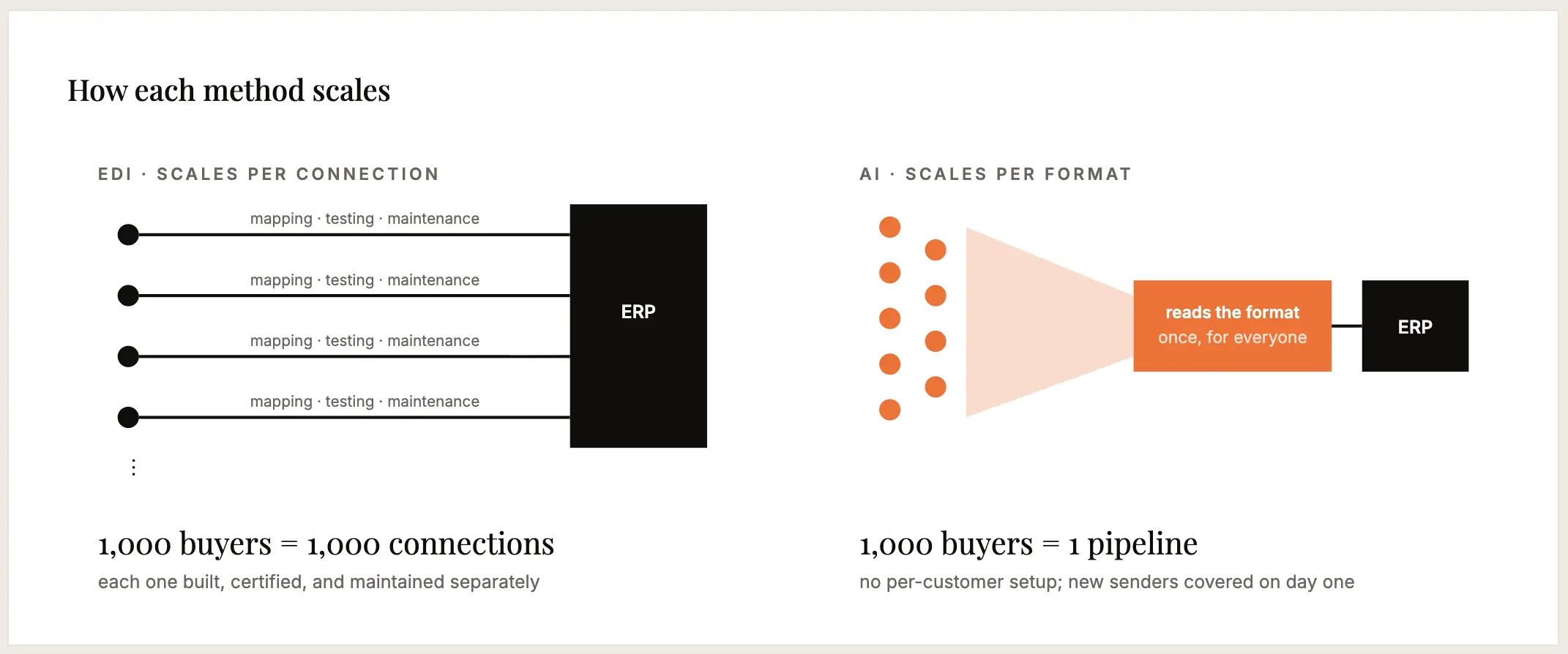
EDI scales by connection, and every new trading partner is a new build with its own mapping, its own testing cycle, and its own maintenance. A wholesaler with a thousand small buyers would need a thousand separate EDI connections to cover them, which is why no wholesaler has ever tried. AI order entry scales by format, so once the system reads emailed PDFs, every account that emails PDFs is covered without any per-customer work. One method’s coverage grows one partner at a time, and the other grows one format at a time across the entire account list at once.
Deterministic vs probabilistic: how each handles the unexpected
EDI runs on deterministic logic, meaning a document either conforms to the schema or it fails, with no judgment involved anywhere. That rigidity is the feature, because both sides promised in advance that the data would be right, and the contract removes the need for checking. AI order entry runs on probabilistic logic, reading intent rather than validating syntax, and it does the checking a person used to do. That interpretive flexibility is also what separates it from template-driven capture, the gap the OCR vs AI order entry comparison turns on. Operators describe manual order entry as more checking than typing, and AI performs exactly that checking line by line, scoring its own confidence and flagging the line where a buyer wrote a part number in their own dialect, with a prefix or a dropped space the catalog never used.
What failure looks like in each method
EDI fails structurally, and it fails quietly. A partner updates a routing guide, a map drifts out of date, a certificate expires, and the connection needs constant attention from whoever owns it, with problems often invisible until orders stop arriving. AI order entry fails probabilistically and visibly, one order at a time. A low-confidence line routes to a human for review, the exception is contained to that single order, and the rest of the queue keeps flowing. Neither failure mode is free, but they are budgeted differently, since one is an ongoing engineering liability and the other is a few minutes of review time made visible in a queue.
| Dimension | EDI | AI order entry |
| Data structured at | Buyer’s end, before transmission | Seller’s end, after arrival |
| Adoption burden | On the trading partner | On no one; buyer changes nothing |
| Setup unit | Per connection (mapping, testing, certification) | Per format, once |
| Scaling unit | One partner at a time | All senders of a format at once |
| Logic | Deterministic; conforms or fails | Probabilistic; interprets and scores confidence |
| Failure mode | Structural and silent; breaks need engineering | Per-order and visible; exceptions route to review |
| Best fit | High-volume standardized partners | Unstructured orders from everyone else |
What Does the Per-Order Math Miss?
Per-order price comparisons miss the shape of each method’s cost, and the shape is what decides the budget. Across the sales conversations WizCommerce has with wholesalers, EDI operators sometimes point out that a live EDI connection can cost well under a dollar per transaction, cheaper per order than most AI order entry pricing. The observation is accurate, and per-transaction price is still a marginal cost, the only place where EDI ever looks inexpensive.
EDI’s real cost curve is a step function that climbs with every connection. Each new partner brings setup, mapping, and certification, followed by a maintenance tax that rarely makes it into the brochure, because partners change routing guides, connections break without warning, and someone has to keep massaging every integration for as long as it lives. AI order entry’s cost sits flat across senders, since nothing is built per customer and the five hundredth account costs the same to onboard as the first, which is to say nothing.
Weighing EDI against AI order processing on per-order price alone treats the marginal cost as the whole cost. The better question is how many senders share one pipe. A mandated partner sending hundreds of standardized orders a month spreads its connection cost until each order carries pennies, while three hundred email-ordering accounts would each need their own pipe, and no per-transaction discount ever recovers three hundred setup projects.
EDI or AI for Order Entry: Which Method Fits Which Orders?
The method should follow the order source rather than the technology preference. EDI fits partners who can send structured documents at volumes that justify a dedicated connection, and AI order entry fits every order that arrives unstructured, which in most wholesale books is the majority of order count.
The orders EDI was built for
EDI belongs to the accounts that mandate it and the accounts whose volume earns it. A chain retailer sending hundreds of standardized purchase orders a month is exactly the relationship the method was designed around, and no interpretation layer improves on a document that arrives perfectly structured by agreement. Whether a given operation still needs those connections at all is an account-mix question rather than a technology one, and mapping accounts by how their orders arrive answers whether wholesalers still need EDI with more rigor than any feature comparison.
The EDI dead zone: too big for a portal, too small for EDI
Wholesale account lists carry a stranded middle band that neither traditional answer reaches. These are buyers running their own ERP across a handful of locations, large enough that ordering through a webstore feels beneath their process, yet nowhere near the volume that justifies an EDI connection. The segment surfaces constantly in the conversations WizCommerce has with wholesalers, accounts too small to justify an EDI connection and too set in their own purchasing process to accept a webstore or portal. The dead zone is not an edge case, because in most wholesale books it holds the bulk of the active account count, and it is the segment AI order entry was effectively built for. Downstream, automated order processing inherits whatever data quality intake produced, which is why the EDI vs AI question in order fulfillment resolves exactly the way it does at order entry.
When AI order entry is the wrong answer
A wholesaler whose order flow is already overwhelmingly EDI, with only a trickle of emailed orders in a normal week, gains little from an interpretation layer and should not buy one. The method earns its keep in proportion to the volume of unstructured orders it absorbs, and an operation without that volume has no job for it to do. Honest fit runs in both directions, which is exactly why the comparison deserves a mechanism-level answer instead of a sales pitch dressed as one.
Can AI Order Entry Sit on Top of EDI?
It can, and that possibility resolves the entire complements-or-methods debate. Viewed as business processes, EDI and AI order entry are two different methods of automating order entry, each owning a different slice of the order book. Viewed architecturally, they operate at different layers, because EDI is a transport and schema layer that moves pre-structured documents between systems, while AI order entry is an interpretation and validation layer that manufactures structure where none exists. A validation layer has no reason to stop at email.
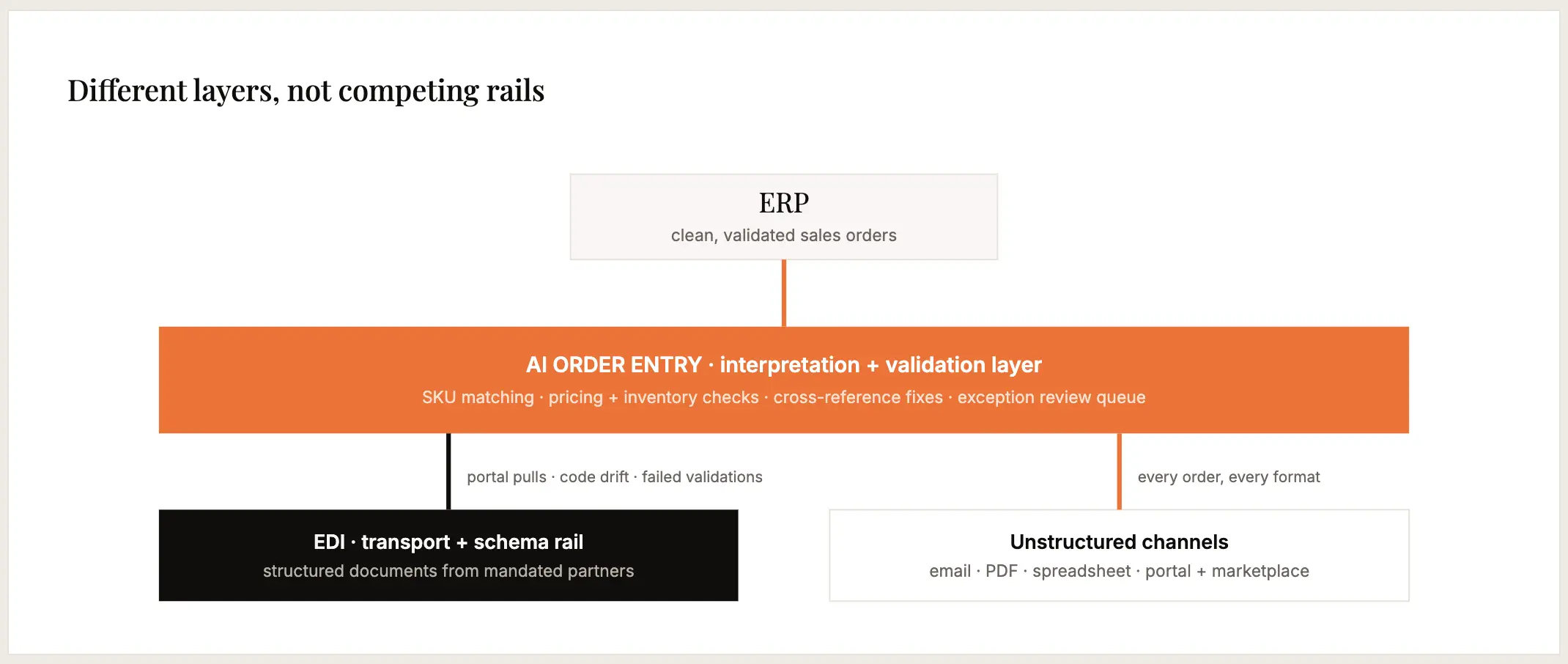
Three patterns from wholesale operations show the layer working above the rail. Some trading partners run EDI programs that never push documents outward, so the seller’s staff log into the buyer’s system every morning and pull orders down as PDFs, a retrieval loop that AI ingestion closes entirely.
Buyer item codes also drift away from the seller’s catalog over years of catalog changes, and the cross-reference cleanup that drift creates is interpretation work even when the order itself arrived through EDI. EDI orders that fail ERP validation on pricing or availability can land in the same exception queue as flagged email orders, which gives the order desk one review surface instead of two. In each case the rail keeps doing what it does well, and the interpretation layer handles what the rail was never designed to see.
Where Ella – an AI Order Entry Platform by WizCommerce Fits?
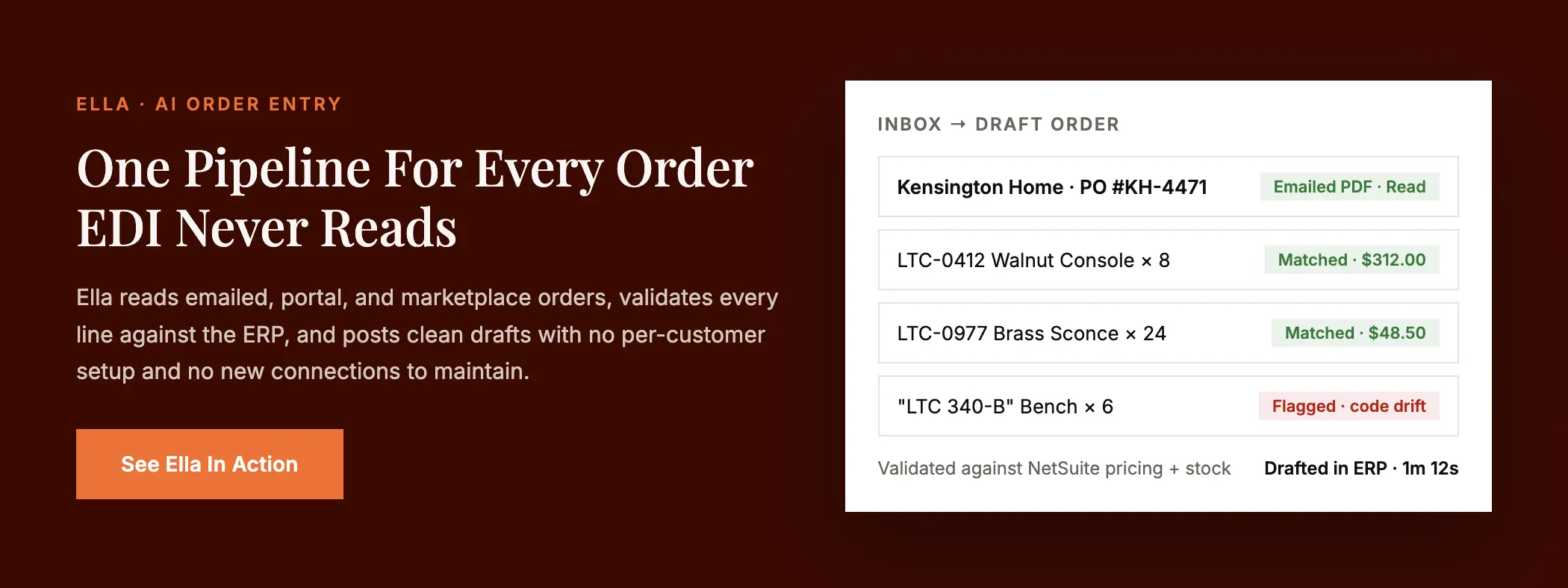
Ella, an AI order entry software, is the interpretation and validation method in production form. Ella reads the orders that arrive without structure, including emailed PDFs, spreadsheets, plain text in the email body, portal and marketplace notifications, and photographed orders from a trade show floor. Every extracted line is matched to the catalog, validated against ERP pricing, inventory, and customer rules, and posted as a clean draft sales order, with only genuine exceptions routed to a person. Existing EDI connections stay exactly as they are, because Ella works beside the rail on everything the rail never reached, and works above it where interpretation is needed. For a wholesaler running the two-speed order desk this piece opened with, the second pile stops being manual without the first pile changing at all, the same shift a home décor wholesaler made when it automated order entry across its channels.
Conclusion
The EDI vs AI order entry question was never about which method wins, because each one automates the orders the other cannot touch. EDI belongs where structure exists before sending, AI order entry belongs where structure has to be created on arrival, and both belong in the same ERP. The wholesalers getting this right sort their orders by how they arrive, then give each pile the method it was built for.
FAQs
Is EDI the same as AI order entry?
EDI and AI order entry are different methods that automate the same job. EDI moves pre-structured documents between systems that agreed on a format in advance, while AI order entry reads unstructured orders after they arrive and creates the structure itself. The first method depends on the buyer participating, and the second requires nothing from the buyer at all.
Can AI replace EDI?
AI order entry replaces manual order entry rather than the EDI rail itself. Mandated retail partners keep EDI alive because their routing guides require it, and no interpretation layer improves a document that already arrives perfectly structured. What AI does replace is the re-keying of every order EDI never reached, and it can also work above EDI on retrieval, cross-referencing, and exception handling.
Can AI do order entry?
AI handles order entry by reading an incoming order in any format, extracting the line items, matching them to the seller’s catalog, and validating price and availability against the ERP. Orders that pass validation post as draft sales orders without a human touch, and lines the system is less confident about route to a person for a short review.
Do wholesalers need both EDI and AI order entry?
Most mid-market wholesalers with mandated retail partners end up running both methods side by side. EDI carries the standardized volume from the accounts that require it, AI order entry absorbs the emailed, portal, and marketplace orders that make up the rest of the book, and both feed the same ERP at the same data quality.
Which is cheaper, EDI or AI order entry?
A live EDI connection can cost less per transaction, and that comparison hides where EDI’s costs are concentrated. EDI spends per connection, through setup, mapping, certification, and ongoing maintenance for every partner, while AI order entry costs stay flat no matter how many customers send orders. High-volume partners justify connection costs, and the long tail of smaller accounts never does.
Can an AI order entry read EDI orders?
AI order entry can ingest EDI documents, though the more common pattern is AI working around the edges of EDI. That includes pulling orders from partner systems that never push documents outward, fixing item cross-references that drift over time, and reviewing EDI orders that fail ERP validation in the same exception queue as email orders.
What is EDI in order processing?
EDI in order processing is the computer-to-computer exchange of standardized business documents between trading partners. A buyer’s system transmits an electronic purchase order in an agreed format, the seller’s system translates it directly into the ERP, and confirmations, ship notices, and invoices travel back over the same connection without anyone re-keying data.