Skip to content



Somewhere in every wholesaler’s inbox history sits the email that started their EDI program, the one where a top retail account announced that all suppliers must transact electronically by next quarter and attached a forty-page routing guide. The wholesaler complied, because the account was worth the effort. Yet a walk past the order desk today shows a split picture in which the EDI orders from that one account flow clean into the ERP, while a marketplace that was supposed to be electronic still makes someone download and re-key PDFs, and the other three hundred accounts keep ordering the way they always have, by email.
That split screen is the honest state of EDI for wholesalers in 2026, and it is why “do we still need it” is the wrong shape for the question. The better questions ask which accounts EDI serves, what it costs to serve them that way, and what covers everyone else. This guide works through all three, from the transaction codes and compliance rules to a decision framework any wholesaler can run against their own account list, with the costs stated in numbers rather than adjectives. The short version up front is that EDI is not obsolete but bounded, and the wholesalers getting order intake right have stopped treating it as the whole answer.
What Is EDI for Wholesalers?
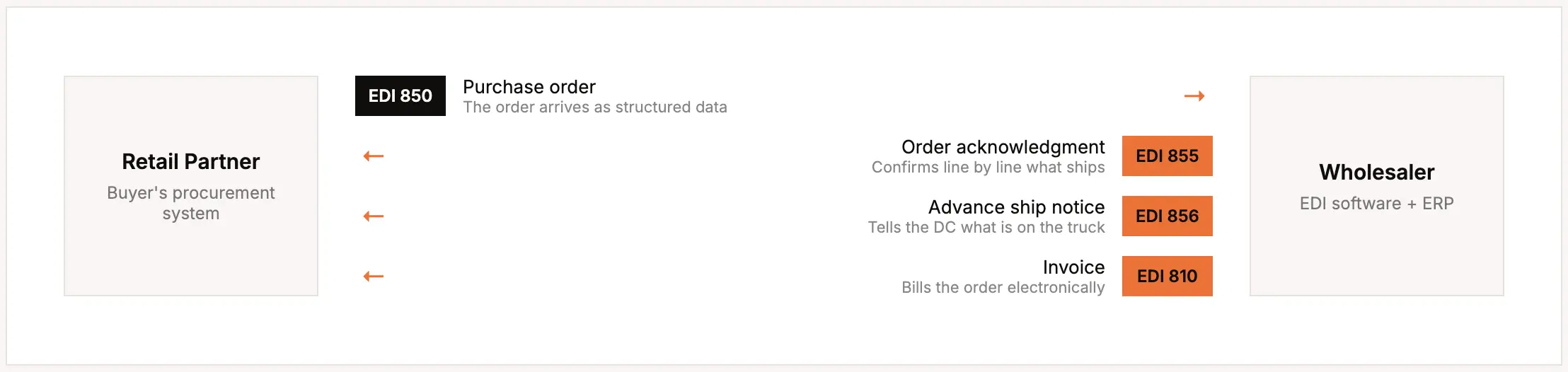
Electronic data interchange for wholesale is the computer-to-computer exchange of standardized business documents (purchase orders, invoices, and ship notices) between a wholesaler and its trading partners, with no email and no re-keying in between. Instead of a buyer at a retail chain emailing a PDF, the buyer’s procurement system transmits a structured document that the wholesaler’s system reads and processes automatically.
How EDI works in a wholesale operation
A retail partner’s system sends the purchase order as a standardized transaction set over a secure connection, either through a value-added network or a direct protocol like AS2. The wholesaler’s EDI software translates that document into the ERP’s format, creates the sales order, and sends back an acknowledgment confirming the order was received and can be fulfilled. From there the flow continues through fulfillment, with the wholesaler’s system telling the buyer’s system what is shipping and when, and the invoice follows the same electronic path back.
A transaction set is the unit of EDI, a numbered and rigidly formatted document type that both sides agree to exchange. The numbering is the part that trips up newcomers, because the documents are named by code rather than by plain language, and the codes carry the whole conversation between the two systems. Once a team learns the handful of codes its partners use, the rest of EDI stops feeling like jargon, because every code maps to a document the order desk already handles today in email form.
The EDI documents wholesalers use: 850, 855, 856, 810, and 870
The EDI 850 is the purchase order, the document that starts everything; when a chain retailer orders electronically, an 850 is what lands in the supplier’s system. The 855 is the purchase order acknowledgment, confirming line by line what the supplier can fulfill. The 856 is the advance ship notice that tells the buyer’s warehouse exactly what is on the truck, down to carton contents and tracking numbers. The 810 is the invoice, and the 870 is the order status report suppliers send when a buyer wants progress updates on open orders.
Wholesalers moving goods through third-party warehouses add the logistics pair of the 940 warehouse shipping order and the 945 shipping advice, which keep EDI integration running across wholesale logistics without a phone call between the wholesaler and the 3PL. The 940 tells the warehouse what to ship and where, and the 945 confirms back what left the dock, so the ERP and the 3PL stay synchronized order by order. Most wholesale EDI programs run on six to eight document types, and the 850, 855, 856, and 810 do the heavy lifting.
What EDI compliance means for wholesale businesses
EDI compliance means meeting a specific retail partner’s rules for how documents are formatted, when they are sent, and how shipments are labeled. Every major retailer publishes a routing guide, and the guide has teeth, because a late 856, a missing field, or a mislabeled carton triggers a chargeback that comes straight out of the supplier’s margin on the order. For wholesale businesses selling into big-box retail, compliance is not a technology preference; it is a condition of keeping the account.
That is also why the question in this article’s title has a different answer for different tiers of the account list. When a partner who represents a third of a wholesaler’s revenue mandates EDI, the cost-benefit analysis is already over. The interesting decisions all live below that tier.
What Does EDI Capable Mean (and Do You Need to Be)?
Being EDI capable means your business can electronically send and receive standardized documents such as purchase orders, invoices, and shipping notices directly between your system and a trading partner’s system.
In simple terms, instead of a customer emailing a PO that someone has to enter manually, an EDI-capable customer can send that order directly into your systems in an agreed EDI format.
What is EDI capability?
EDI capability is the technical setup that makes that system-to-system exchange possible.
Typically, you need:
- EDI software or a managed EDI provider to translate the documents.
- A connection with the trading partner, such as AS2 or a value-added network.
- ERP mapping so customer SKUs, quantities, pricing, and other fields reach the correct places in your system.
- Support for the required EDI formats and documents, such as ANSI X12 and transaction sets including the 850, 855, 856, and 810.
Your EDI format capability simply describes which EDI standards and document types your system can send and receive.
Being EDI capable is also different from being EDI compliant. Capability means you have the technology to exchange EDI documents. Compliance means your setup meets a particular trading partner’s rules for formats, fields, timing, and other requirements.
What Are the Benefits of EDI for Wholesale Suppliers?
Where EDI runs, it reliably delivers orders that arrive without keying errors, compliance with the partners who demand it, predictable document flow for logistics, and processing that happens without anyone watching an inbox. Those benefits are real, and they explain why EDI has survived every technology that was supposed to replace it.
Fewer keying errors on high-volume accounts
An 850 arrives as structured data, which means the quantity in the buyer’s system is the quantity in the supplier’s system, with no human interpreting a PDF in between. For a partner sending hundreds of standardized orders a month, that removes the entire class of transcription errors manual entry produces, from transposed quantities to wrong SKUs and stale prices. The error rate on a well-mapped EDI connection rounds to zero, which is a standard no manual process can match on volume accounts.
Retailer compliance without chargebacks
The same rigidity that makes EDI expensive to set up is what makes it dependable once it runs. Documents go out in the required format, on the required schedule, with the required data, every time, because the system enforces the routing guide instead of relying on a busy CSR to remember it. Wholesalers who move from manual compliance to automated EDI document flow typically watch chargeback deductions shrink to exceptions rather than a monthly line item.
Predictable order flow for wholesale logistics
EDI gives the wholesaler’s warehouse and its partners’ warehouses the same picture at the same time. The 856 tells the buyer’s DC what is coming before the truck arrives, the 940 and 945 coordinate third-party logistics without phone calls, and the whole chain runs on documents instead of voicemails. One honest caveat belongs here, because classic EDI is batch-based, which means “real-time EDI for wholesale transactions” usually translates to near-real-time, with documents moving on schedules measured in minutes to hours. For replenishment cycles that is more than fast enough; for the truly real-time use cases, a different technology enters the conversation, and the next section compares the two directly.
Where EDI Falls Short for Wholesale Distributors
EDI’s limits show up in three places. The cost and setup burden weighs on mid-market wholesalers, the marketplaces and portals only half-support it, and the long tail of buyers will never adopt it at all. Understanding these three gaps matters more than any feature list, because they define which parts of the order flow EDI can never automate.
The cost and setup reality for mid-market wholesalers
Across the mid-market wholesalers WizCommerce talks to, managed EDI programs commonly run $3,000 to $7,000 per month once network fees, document fees, and mapping maintenance are counted, and standing up a new trading partner takes weeks to months of testing before the first clean order flows. Every partner has their own routing guide, which means every new relationship is a new mapping project. For a wholesaler with three large mandated partners, that math works. For a wholesaler hoping to extend EDI across eighty mid-sized accounts, it never does, and the vendors quoting the program know it.
The partial-EDI gap: marketplace and portal orders that still get re-keyed
Here is the gap that surprises operators most, which is that a large share of “electronic” order channels still end in manual work. Marketplaces and partial-EDI portals deliver an order notification, sometimes a PDF attached to an email, sometimes an alert that requires logging in and downloading, and the order data never reaches the ERP on its own. The mechanics are worth spelling out because they explain where the hours go, since a portal alert arrives, someone logs in and downloads the order document, opens it beside the ERP, and keys it in line by line while checking each SKU against the catalog.
Run the economics on that loop and the problem sharpens. The business pays the marketplace its fee for generating the order, then pays entry labor on the same order a second time, which quietly doubles the cost of every order from that channel. Across wholesale operations this is one of the most common and least discussed drains on an order desk, precisely because everyone assumed the channel was already automated when they signed up for it.
The long tail of buyers who will never adopt EDI
Sellers have spent years trying to move customers onto portals and EDI connections, and the market has delivered its verdict, because small and mid-market buyers refuse and keep emailing purchase orders. The buyer with three stores is not going to stand up an EDI connection to order from a supplier, and pushing them toward one risks the relationship over a workflow preference. For most mid-market wholesalers, this long tail is not an edge case; it is the majority of the account list, which means the majority of order volume flows through the one channel EDI will never touch.
EDI vs API: What Is the Difference for B2B Integration?
The difference between EDI and API comes down to how the conversation between systems happens. EDI exchanges standardized batch documents on a schedule, while an API lets two systems ask each other questions and get answers in real time. EDI works like a formal letter with a required format, while an API works like a phone line that never closes. For B2B integration, that distinction decides which technology fits which trading relationship.
| Parameter | EDI | API |
| Data format | Standardized transaction sets (850, 856, 810) | Flexible, defined per integration |
| Speed | Batch, minutes to hours | Real time |
| Partner onboarding | Weeks to months per partner | Days, when both sides have modern systems |
| Cost model | Network and document fees, mapping maintenance | Development time, then low run cost |
| Best fit | Mandated retail partners, high-volume standardized flow | Modern SaaS, marketplaces, live inventory and status |
Where APIs win
APIs win wherever the trading partner runs modern software and the use case needs immediacy. Live inventory checks, real-time order status, instant pricing lookups, and marketplace connections all fit the API model, because the request-response pattern answers questions the moment they are asked. Onboarding moves faster as well, since two systems with well-documented APIs can connect in days rather than the weeks-to-months cycle of EDI partner testing.
Where EDI still wins
EDI wins where the partner mandates it, and that single sentence settles most of the debate for wholesalers. Big-box retail, grocery chains, and large distributors standardized on EDI decades ago, and no supplier is going to argue a Fortune 500 procurement department out of its routing guide. For high-volume, standardized, repeat document flow with those partners, EDI remains the most reliable channel built for the job.
Why B2B EDI integration is rarely either/or
The honest answer to the EDI vs API question is that a working wholesale operation usually runs both, with B2B EDI integration handling the mandated head of the account list and APIs connecting the modern systems and marketplaces. The two coexist inside the same ERP without conflict, the way any sound B2B ecommerce ERP integration is built to absorb more than one intake channel. The right question is never “EDI or API” in the abstract, but “what does this specific trading relationship require,” decided partner by partner.
Do You Still Need EDI in 2026? A Decision Framework for Wholesalers
Wholesalers still need EDI in 2026 wherever their largest trading partners mandate it, and they do not need to extend it beyond those partners. EDI earned its place as a channel for a specific tier of trading relationships. The mistake wholesalers make is not running EDI itself, but assuming EDI is the order-intake strategy rather than one pipe within it.
Map the accounts into three tiers
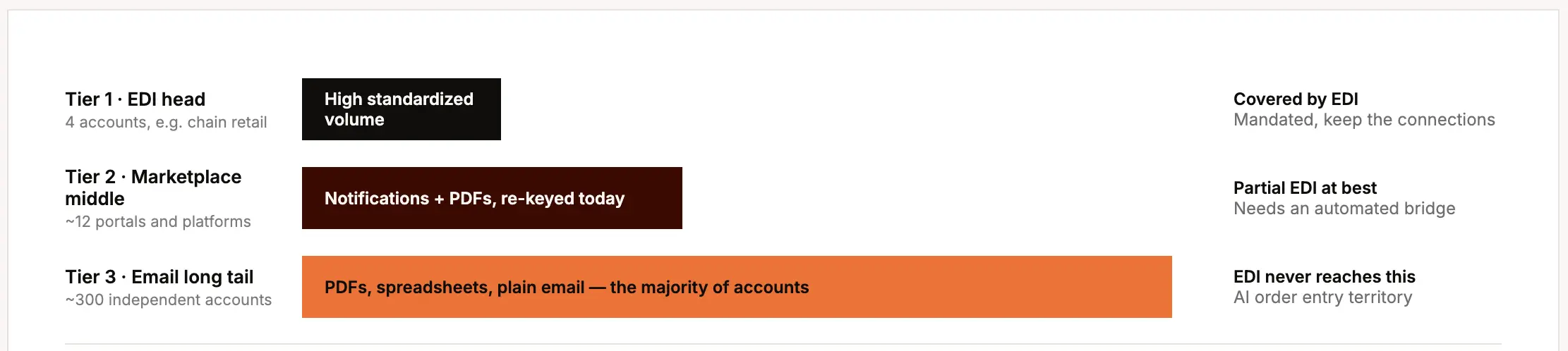
Sort any wholesale account list by how orders arrive and three tiers appear almost every time. Tier one is the EDI head, made up of the big-box and chain partners who mandate electronic documents and send high, standardized volume. Tier two is the marketplace middle, the portals and platforms that generate orders electronically but deliver them as notifications and PDFs that still need a human bridge into the ERP. Tier three is the email long tail, the independent retailers, designers, and small chains who send POs as PDFs, spreadsheets, and plain email text, and who will keep doing so no matter what portal the supplier builds.
The decision rules by partner mix and order volume
Three rules cover nearly every case a wholesaler will meet. When a partner mandates EDI, the right move is to comply, because the account is worth more than the connection costs. If a partner sends fifty or more standardized orders a month and offers EDI, the connection typically pays for itself in eliminated entry labor and errors, so build it.
Below that threshold, the setup cost and per-partner mapping never pay back, and the answer is to automate the channel those buyers already use rather than forcing a new one on them. Running the top twenty accounts through those three rules settles most of the EDI scope decision. The remaining accounts almost always sort themselves into the same tier as the small buyers just classified, so the exercise rarely needs to go deeper than twenty.
The cost test: what EDI software costs against what it saves
For any partner not covered by a mandate, the arithmetic is simple to run. Take the monthly cost of the EDI software and network fees, divide by the number of orders that partner sends, and compare the per-order figure against what a manually keyed order costs in labor. At 15 to 30 minutes per order and a typical burdened CSR rate, the manual side works out to roughly $8 to $15 per order, and any operation’s own payroll numbers will sharpen that range in an afternoon.
Two worked examples show how sharply the math splits. A chain account sending 300 standardized orders a month against a $1,000 monthly connection cost works out to about $3.33 per order, well under the manual cost, so the connection pays for itself before counting the eliminated errors. An independent retailer sending 6 orders a month against the same connection cost works out to $167 per order, more than ten times the manual alternative, and no EDI pricing model changes that verdict. The eighty accounts in that second category are not an EDI problem; they are an automation problem of a different kind entirely, better served by tools built to move purchase orders into the ERP automatically than by more EDI connections.
How Do You Implement EDI as a Wholesaler?
Implementing EDI as a wholesaler comes down to three decisions that cover how to connect, how to onboard each trading partner, and how to budget for the run rate. Getting those three right means the program runs quietly for years, while getting them wrong turns EDI into a second job for whoever owns the ERP.
Choose the connection path: managed provider or in-house
The first decision is whether to run EDI internally or buy it as a managed service. Running it in-house means operating translation software and connections directly, either through a value-added network that relays documents between partners or through direct AS2 connections maintained per partner, and it demands real technical ownership that spans certificate management, mapping updates, and someone on call when a document fails at 6 a.m. A managed EDI provider absorbs all of that for a monthly fee, translating partner documents into the ERP’s format and handling the network layer, which is why most mid-market wholesalers land there. The in-house path only starts to pay when document volume is very high and the technical staff to run it is already on payroll.
Onboard one partner at a time
EDI onboarding happens partner by partner, and each one follows the same arc. It starts with the partner’s routing guide, which specifies every document, field, timing rule, and label they require. The provider or internal team then builds the maps that translate between the partner’s formats and the ERP, and both sides run a test cycle exchanging sample 850s, 855s, and 856s until documents flow clean in both directions. A realistic budget is four to eight weeks per partner for the full cycle, and onboarding several partners in parallel on a first pass is a mistake worth resisting, because early mapping errors compound when nobody has done the loop before.
Budget for the run rate, not just the setup
The setup fee is only the visible cost, while the run rate is the real one. A managed program carries monthly platform fees, per-document or per-kilocharacter transaction fees, and mapping maintenance whenever a partner updates their routing guide, which they do without asking. Those pieces are what add up to the $3,000 to $7,000 monthly range mid-market wholesalers report, and the number scales with partner count more than with order count. That scaling behavior is exactly why the decision framework above matters, since every partner added to EDI adds a permanent run rate and each one has to clear the volume bar on its own.
How Wholesalers Cover the Orders EDI Does Not Reach
Tiers two and three, the marketplace middle and the email long tail, need order entry automation that meets buyers where they already are, and that is what AI order entry does. Instead of asking the buyer to change how they order, the AI reads whatever arrives, in whatever format, and does the work a person used to do between the inbox and the ERP.
AI order entry for the email and PDF long tail
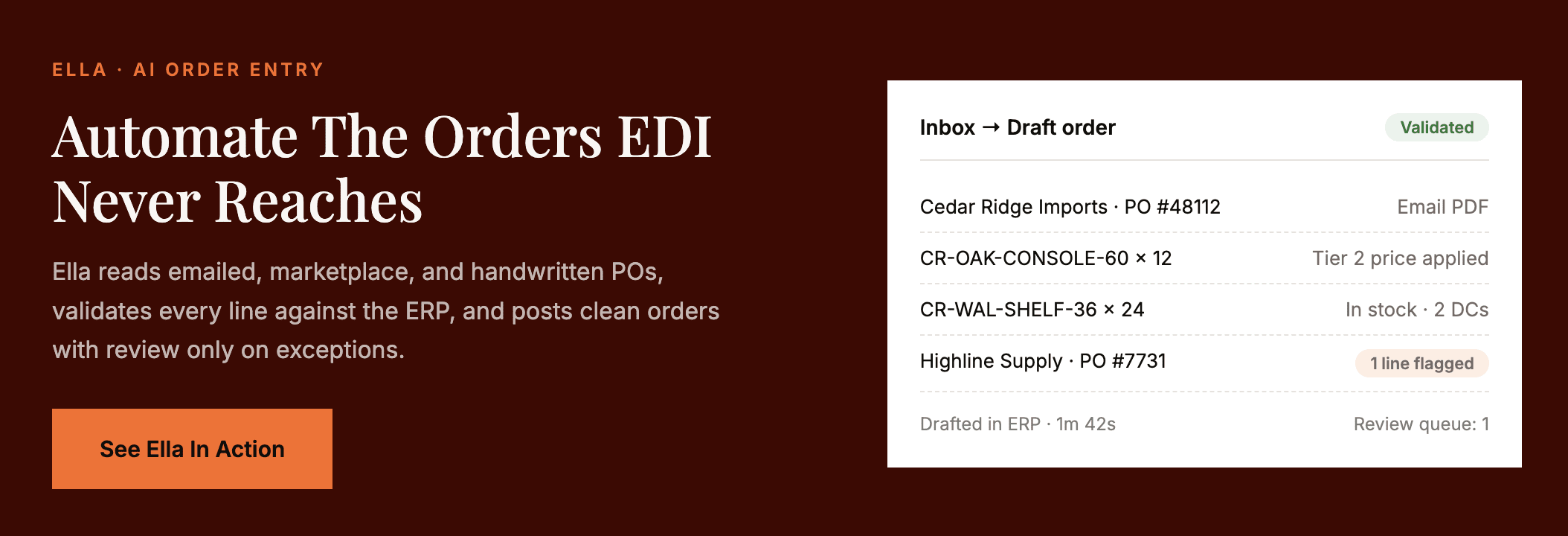
Ella, AI order entry software, reads the orders EDI never touches, including emailed PDFs, spreadsheets, plain text in the email body, marketplace notifications, and even photographed handwritten orders from a trade show floor. It extracts the line items, matches the buyer’s part numbers to internal SKUs, validates pricing and inventory against the ERP, and creates a clean draft sales order with only genuine exceptions routed to a human. The mechanics of how AI order entry works, from semantic extraction to confidence scoring, run the same way across every format a buyer can send.
One pipeline for EDI, marketplace, and email orders
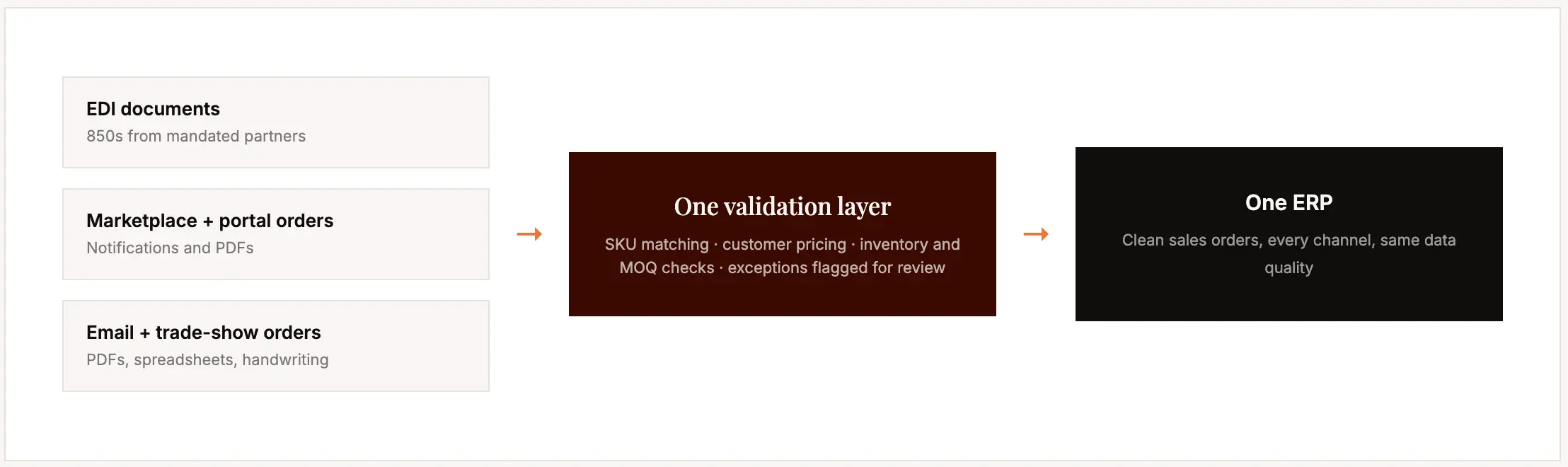
The architecture that wins in 2026 is one validated pipeline with three intakes. EDI documents from mandated partners flow into the ERP the way they always have. Marketplace notifications and portal PDFs route through AI order entry instead of a printer.
Email and trade-show orders from the long tail flow through the same AI layer, validated against the same pricing and inventory rules, so every order reaches the ERP at the same data quality regardless of which door it came through. The order desk stops being the bridge between channels and starts supervising one queue of exceptions. Downstream, automated order processing carries each posted order through holds, fulfillment, and invoicing without another manual touch. The measure that this architecture is working is that nobody in the building re-keys an order, and nobody can tell from inside the ERP which channel any order arrived through.
What this looks like in practice
Picture a mid-market distributor, call them Glenmar Distribution, with four chain accounts on EDI, a dozen marketplace and portal relationships, and three hundred independent retailers who order by email. Before automation, the EDI orders flowed clean while two staff members spent their days on everything else, downloading portal orders each morning, re-keying emailed POs between phone calls, and falling behind every time a trade show or promotion spiked the volume. The math of their day ran roughly sixty non-EDI orders at fifteen to twenty minutes each, which is two full workdays of keying compressed into one.
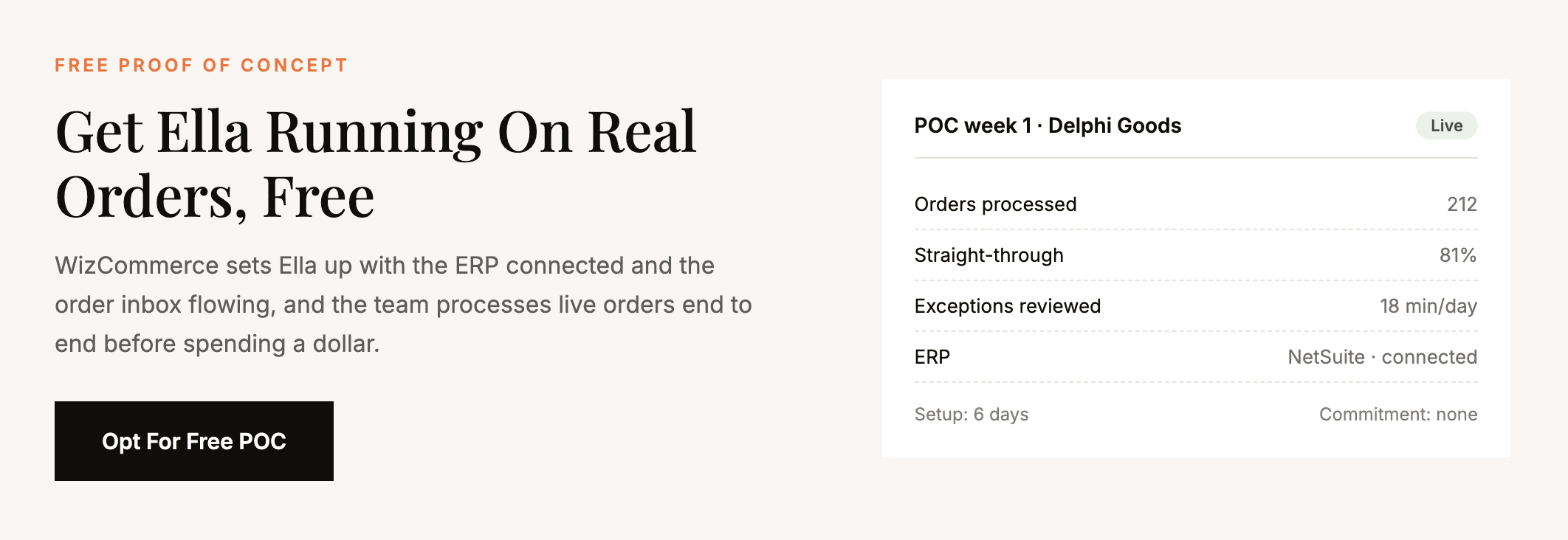
After routing tiers two and three through AI order entry, the shape of the same day changes. Orders extract, validate against pricing and inventory, and land in the ERP as drafts on their own; the two staff members review flagged exceptions for about twenty minutes each morning and spend the rest of their time on customers. Order confirmations go out in minutes instead of hours, the account list can grow without the order desk growing with it, and the EDI connections did not change at all. The rest of the operation caught up to them, the same shift a home décor wholesaler made when it automated order entry across its channels.
The Bottom Line
EDI is not obsolete in 2026, but it is bound to the tier of trading partners it was built for. It remains the right channel for the mandated head of the account list and the wrong tool for everything below it. The wholesalers getting this right have stopped asking whether they need EDI and started asking which orders deserve which pipe. The move that follows from this piece is to map the three tiers this week, run the decision rules, and automate the two tiers EDI was never built to reach.
FAQs – Frequently Asked Questions
Q1: Is EDI obsolete in 2026?
EDI is not obsolete, and it remains the standard for high-volume, mandated trading relationships with big-box retail and large distributors, because those mandates are not going away. What has changed is its scope, since EDI now covers one tier of a wholesaler’s account list, while APIs and AI order entry automate the marketplace and email channels it never reached.
Q2: What are EDI 850 and 870?
The EDI 850 is the electronic purchase order, the document a buyer’s system sends to start an order. The EDI 870 is the order status report, which updates a buyer on where their open orders stand. In a typical wholesale exchange, the 850 arrives, the supplier responds with an 855 acknowledgment, ships against an 856, invoices with an 810, and sends 870s when status is requested.
Q3: What is the difference between EDI and API?
EDI exchanges standardized batch documents on a schedule; an API lets systems exchange data in real time through requests and responses. EDI fits mandated, high-volume retail relationships, while APIs fit modern software connections that need immediacy. Most wholesale operations run both, matched partner by partner rather than choosing one.
Q4: What does EDI cost for a wholesale business?
Across the mid-market wholesalers WizCommerce talks to, managed EDI programs commonly run $3,000 to $7,000 per month across network, document, and maintenance fees, plus weeks to months of setup per trading partner. That cost profile is why EDI makes sense for high-volume mandated partners and rarely pays back on smaller accounts.
Q5: Do small wholesalers need EDI?
Only if a major trading partner requires it as a condition of the relationship. Without a mandate, a small wholesaler’s budget is better spent automating the channels its buyers already use, which for most means email and PDF order intake rather than an EDI network.
Q6: Can EDI and AI order entry work together?
EDI and AI order entry are complements rather than competitors. EDI carries the standardized document flow from mandated partners, while AI order entry reads the emails, PDFs, and marketplace orders EDI cannot, validating everything against the same ERP. The result is one pipeline with the same data quality across every intake.
Q7: What is EDI compliance for wholesale businesses?
EDI compliance means meeting a retail partner’s published rules for document formats, timing, and shipment labeling. A missing required field or a late ship notice triggers a chargeback against the supplier’s invoice. Compliance programs are why mandated EDI is non-negotiable for wholesalers selling into major retail.