Skip to content



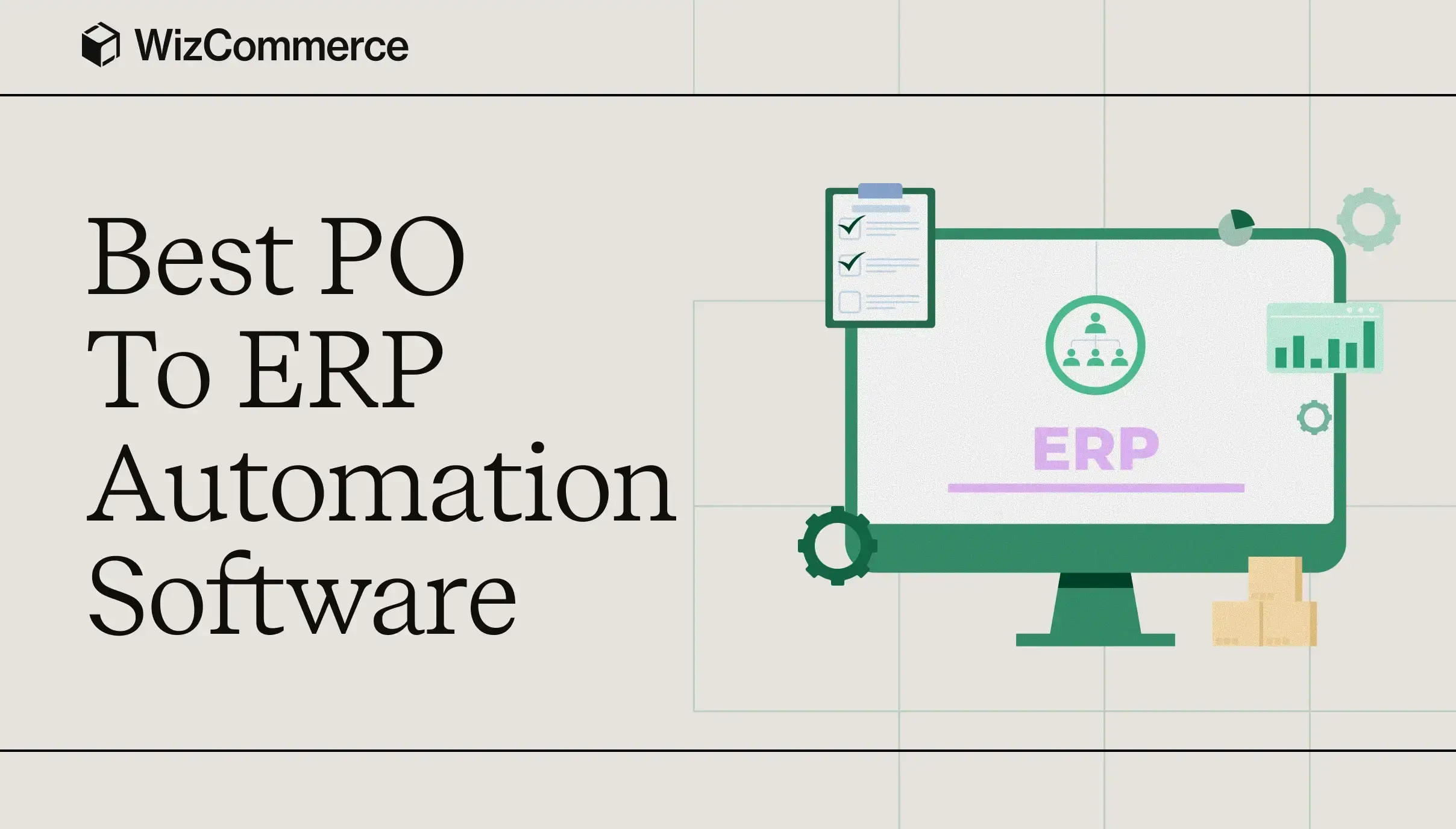
Purchase orders still arrive in the least convenient formats for operations teams. Buyers send PDFs, emails, spreadsheets, scans, EDI files, portal downloads, and handwritten forms. The ERP then expects clean, structured, validated order data that follows its own rules.
That gap creates the real PO (Purchase Order) to ERP automation problem. OCR can read a document, but it cannot always understand customer-specific SKUs, contract pricing, substitutions, shipping rules, inventory constraints, and ERP posting requirements. Traditional middleware can move data, but it struggles when buyer formats change every week.
This blog compares the best PO to ERP automation software for 2026. We will look at what each tool handles well, where the gaps are, and why WizCommerce is the strongest choice for wholesalers and distributors who need AI powered PO capture and ERP-ready automation from a single connected platform.
TL;DR:
|
What is PO to ERP automation software?
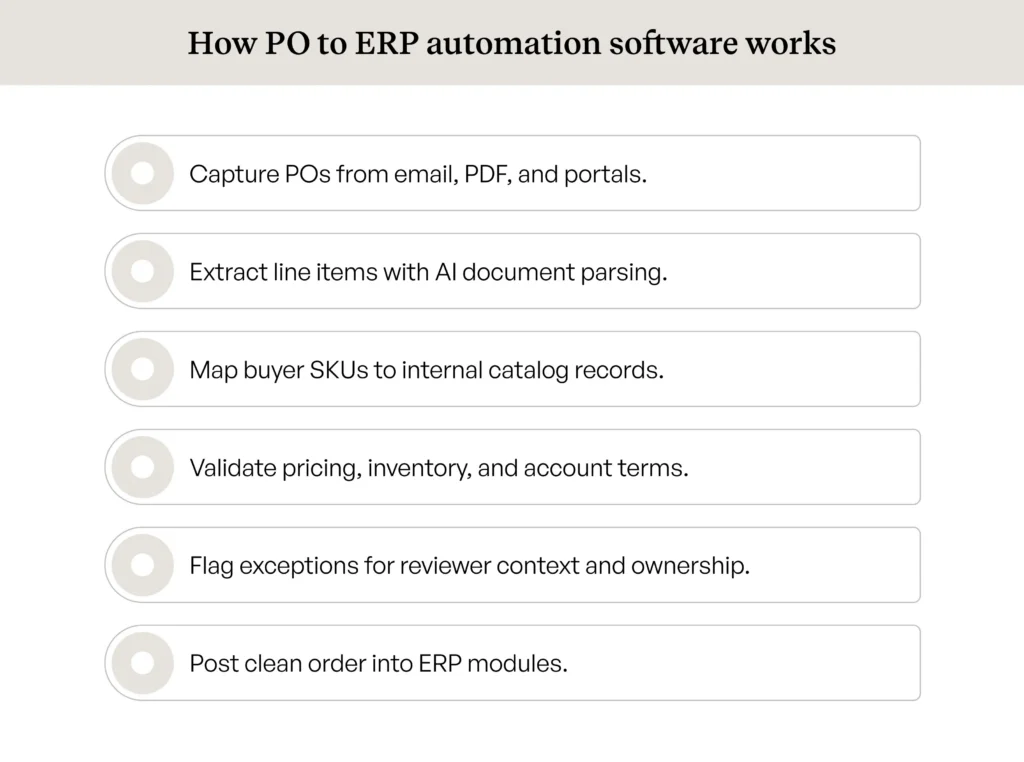
PO to ERP automation software captures purchase orders from buyer channels, extracts order data, validates it, and sends clean records into the ERP. On the sell side, the same mechanics run as sales order processing automation. The best systems go beyond OCR and handle SKU mapping, pricing checks, exception workflows, and ERP sync. They reduce rekeying and manual handling across the order intake workflow and protect downstream order management.
- PO capture from email, PDF, spreadsheet, scan, EDI, and portals.
- Data extraction for buyer names, SKUs, quantities, pricing, and ship-to details.
- Validation against ERP records, contracts, inventory, and account rules.
- ERP posting with exception handling before any order enters fulfillment.
The role of a purchase order in ERP system workflows is to act as the single trusted record that triggers procurement, inventory updates, invoicing, and receipt confirmation across modules.
Every tool below automates a slice of the same lifecycle: purchase order automation spans intake, validation, approval, ERP posting, and three-way matching, and knowing which slice hurts most in your operation decides which tool profile fits.

Why does ERP purchase order processing still create delays?
ERP purchase order processing is delayed because ERPs require structured data, whereas buyers send unstructured documents. Teams still retype order details, manually check pricing, resolve SKU mismatches, and chase missing information.
- Buyer formats change often: Templates, naming conventions, document layouts, and PO headers differ by buyer account. Even experienced operations teams need extra review time before posting orders into the ERP.
- Customer SKUs do not match internal SKUs: Buyer part numbers and supplier catalog codes create matching problems at the line-item level. Each mismatch slows the purchase order creation step and forces reps to confirm intent with the buyer.
- Pricing needs account context: Contract pricing, payment terms, discounts, and agreed rebates vary across customers. Without that context inside the purchase order system, finance teams catch issues after invoicing.
- ERP data must stay clean: Bad orders create fulfillment errors, credit holds, dispute tickets, and customer escalations. Dirty inputs damage analytics, inventory management accuracy, and forecast quality across the procurement process.
- Manual exceptions slow teams down: Reviewers lose time when missing data returns to inboxes without context. Bottlenecks form when no one owns rework, and the workflow stalls before fulfillment.
PO automation cleans the intake; B2B order management software governs every order from the moment it arrives — capture, validation, and the clean record that reaches your ERP, which is why the two run side by side in wholesale operations.
What features define the best purchase order ERP automation software?
The best purchase order ERP automation software combines AI extraction with validation, SKU mapping, exception handling, and native ERP connectivity. A strong tool should reduce rekeying and protect ERP data quality before orders reach fulfillment.
| Feature | Why it matters | What to check |
| Multi-format PO capture | Buyers do not follow one format | Email, PDF, Excel, scan, EDI, portal files |
| Buyer SKU mapping | Buyer codes often differ from seller SKUs | Customer-specific part number mapping |
| ERP validation | Prevents bad data from entering the system | Pricing, inventory, ship-to, MOQ, tax rules |
| Exception workflow | Keeps humans focused on real issues | Contextual flags and reviewer notes |
| Native ERP integration | Reduces middleware risk and broken pipes | Read-write sync with master data and modules |
| AI learning | Improves after corrections | Feedback loop from reviewer actions |
Extraction alone cannot support wholesale operations. The best PO to ERP automation software must understand what a clean order means in your ERP.
For teams comparing AI-first tools specifically for order intake, see our breakdown of the top AI order entry automation software for 2026.
Which are the best PO to ERP automation software options in 2026?
If you’re looking for platforms that automate emailed PDF purchase orders, the important question is how much of the process they can handle without manual intervention. Some tools extract order details from emailed POs and turn them into structured data, while others take that data further by validating it, matching customer SKUs and pricing, and creating sales orders directly in your ERP. This comparison looks at the best PO-to-ERP automation software options based on AI order entry, emailed PDF PO processing, validation, ERP integration, exception handling, and wholesale workflow coverage.
| Platform | PO formats handled | Per-customer templates | Creates the order in your ERP | Best for |
|---|---|---|---|---|
| WizCommerce (Ella) | Emailed PDFs, Fax, Images, spreadsheets, voicemail, Email text, handwritten POs | None | Yes — creates and validates orders directly in the ERP | Wholesalers and distributors that want automated order entry plus quoting, rep tools, and buyer portals |
| Conexiom | PDF, Excel, email, CSV; scans and faxes via Image Validator | Required on Premier; uses adaptive smart templates to map layouts. Not required on Express | Yes — integrates natively with 40+ ERPs | High-volume enterprise order desks where customer-specific mapping is manageable |
| Esker | Email, EDI, portals, punchout, mobile; PDF, TIFF, Word, Excel, JPEG attachments | No — deep learning can process new layouts; optional teaching for recurring formats | Yes — creates validated orders in the ERP | Enterprise shared-service teams and SAP-heavy environments |
| Rossum | PDF, PNG, JPEG, TIFF, Excel, Word via email, API, or upload | None — template-free | Limited — ERP posting is documented more clearly for AP invoices than sales orders | Enterprise teams handling unpredictable document layouts |
| Nanonets | PDF, PNG, JPG, CSV, Excel, TIFF, Word; EDI and fax support advertised | No per-customer template, but fields and table headers require configuration by document type | Claimed for SAP, NetSuite, Oracle, and Dynamics 365; documented workflows are more accounting-focused | Teams looking for self-serve document extraction |
| Docsumo | PDF, images, Excel via email, API, or cloud drives | No template-free claim; PO processing requires training on sample documents | No — extraction and API export only | Finance and lending workflows rather than distributor order entry |
| Lucy | Emailed PDF, HTML, and plain-text emails | Required — one-time mapping per PO layout | Yes — MYOB Acumatica and MYOB EXO Business | Distributors whose customers primarily send emailed PDFs |
| ABBYY Vantage | PDFs, images, Office documents via email, SFTP, API, and scanners | Not typically — pre-trained PO skills cover common formats | No — extraction and handoff; ERP connection generally requires additional automation | Enterprise IDP programs processing multiple document types |
1. WizCommerce

WizCommerce is the best PO to ERP automation software for wholesalers, distributors, and manufacturers who need clean order intake without manual re-entry. Ella, our AI Order Entry Software captures purchase orders from emails, PDFs, spreadsheets, scans, and other buyer formats, then converts them into ERP-ready records.
We go beyond document extraction by connecting PO automation with quoting, sales-rep workflows, buyer portals, and ERP sync. This makes WizCommerce a strong fit for wholesale teams that need accuracy, speed, audit visibility, and full control across the order workflow.
What are the key features of WizCommerce?
- AI-powered order automation: Our AI-powered order automation captures incoming purchase orders from emails, PDFs, scans, and spreadsheets. It validates line items, maps buyer SKUs, and prepares clean ERP records.
- Buyer SKU mapping: Maps customer-specific product codes to internal SKUs without forcing buyers to change their order format. The system learns from corrections so reviewers spend less time on repeated checks.
- ERP-ready validation: Validates SKUs, quantities, pricing, customer data, and inventory rules before any order reaches the ERP. Exceptions appear with full context so reviewers can resolve issues without restarting the workflow.
- AI sales copilot for reps: Our AI sales copilot gives reps account history, order context, inventory data, and next-best actions. Teams respond faster while reducing back-and-forth across inboxes and ERP screens.
- Connected wholesale workflows: WizCommerce connects Ella’s PO capture with the AI Quote Automation Assistant, AI Sales Copilot, B2B order-taking app, B2B portal, and ERP integrations. Teams manage buyer portals, rep-led orders, quotes, and sales conversations from one platform.
How much does WizCommerce cost?
WizCommerce follows custom pricing based on business needs, order volume, integrations, and workflow complexity. Teams can request a demo to see the right package without a free trial gate.
Why is WizCommerce a leading PO to ERP automation software?
WizCommerce is built for the complexity of wholesale orders, never for generic document capture. It integrates AI order entry, quote automation, ERP sync, and sales workflows into one wholesale-native system.
2. Conexiom
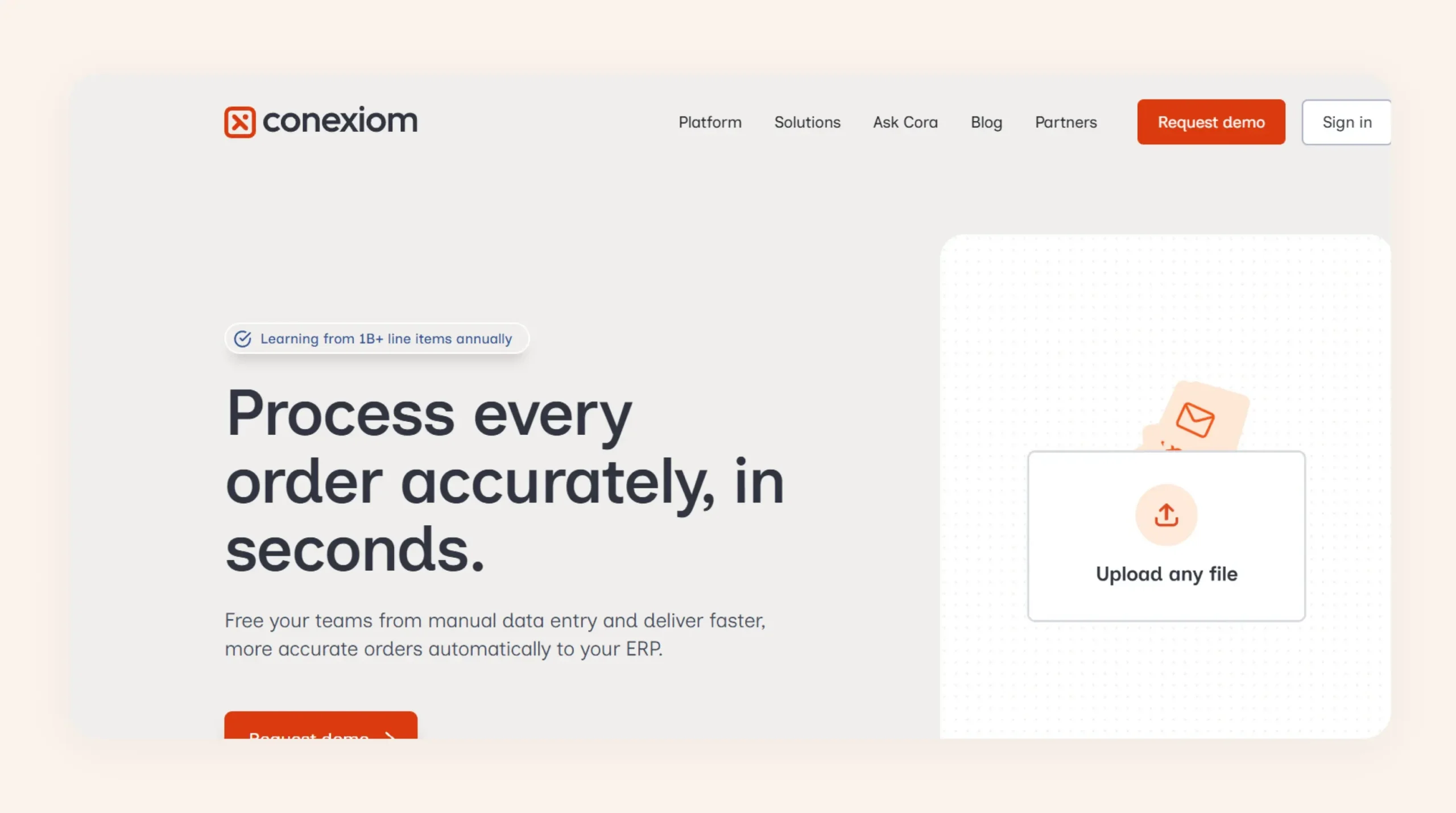
Conexiom is a sales order automation platform built for manufacturers and distributors handling high-volume order intake. It captures orders from emails, PDFs, Excel files, images, and EDI documents. The platform focuses on reducing manual entry and lifting touchless order processing before ERP posting for large enterprises.
What are the key features of Conexiom?
- Automates order capture from many document formats.
- Validates orders before ERP system posting.
- Supports high-volume sales order processing workflows.
What are the pros and cons of Conexiom?
| Pros | Cons |
| Strong order automation | Limited commerce workflows |
| Good enterprise fit | May need extra tools |
| Supports many formats | Less rep-led selling |
Why is WizCommerce a better alternative to Conexiom?
WizCommerce supports AI order automation along with quoting, rep-led selling, buyer portals, and ERP-connected wholesale workflows. Conexiom focuses on order automation, while WizCommerce supports the broader wholesale sales process.
3. Esker

Esker is a broad order management and business process automation platform that covers AP, AR, procurement, and order capture. It serves large enterprises seeking back-office automation across finance teams and supply chain modules. Wholesale teams may find it broader than needed for ERP purchase order processing.
What are the key features of Esker?
- AI-based order capture across many document types.
- Workflow automation for approvals and exceptions.
- ERP integration through connectors and APIs.
What are the pros and cons of Esker?
| Pros | Cons |
| Broad automation suite | Heavy implementation effort |
| Strong enterprise scalability | Less wholesale-native fit |
| Multi-process coverage | Higher total cost |
Why is WizCommerce a better alternative to Esker?
WizCommerce connects AI order entry with wholesale selling workflows, buyer portals, and rep tools. Esker spans broader back-office automation, while WizCommerce is purpose-built for wholesale PO-to-ERP execution.
4. Rossum

Rossum is an AI document processing platform for transactional documents like POs, invoices, and shipping papers. It is strong for extraction and reviewer workflows. Wholesale-specific PO logic, SKU mapping depth, and pricing validation often need extra setup outside the core product.
What are the key features of Rossum?
- AI-based document extraction with reviewer UI.
- Validation rules and confidence scoring.
- Workflow routing and system handoff via API.
What are the pros and cons of Rossum?
| Pros | Cons |
| Strong AI extraction | Limited wholesale logic |
| Good reviewer experience | Manual SKU mapping work |
| Flexible API setup | Needs sales workflow tools |
Why is WizCommerce a better alternative to Rossum?
WizCommerce combines document intelligence with buyer SKU mapping, pricing validation, quoting, and ERP-ready order creation. Rossum extracts data well, while WizCommerce delivers the full wholesale PO-to-ERP workflow.
5. Nanonets
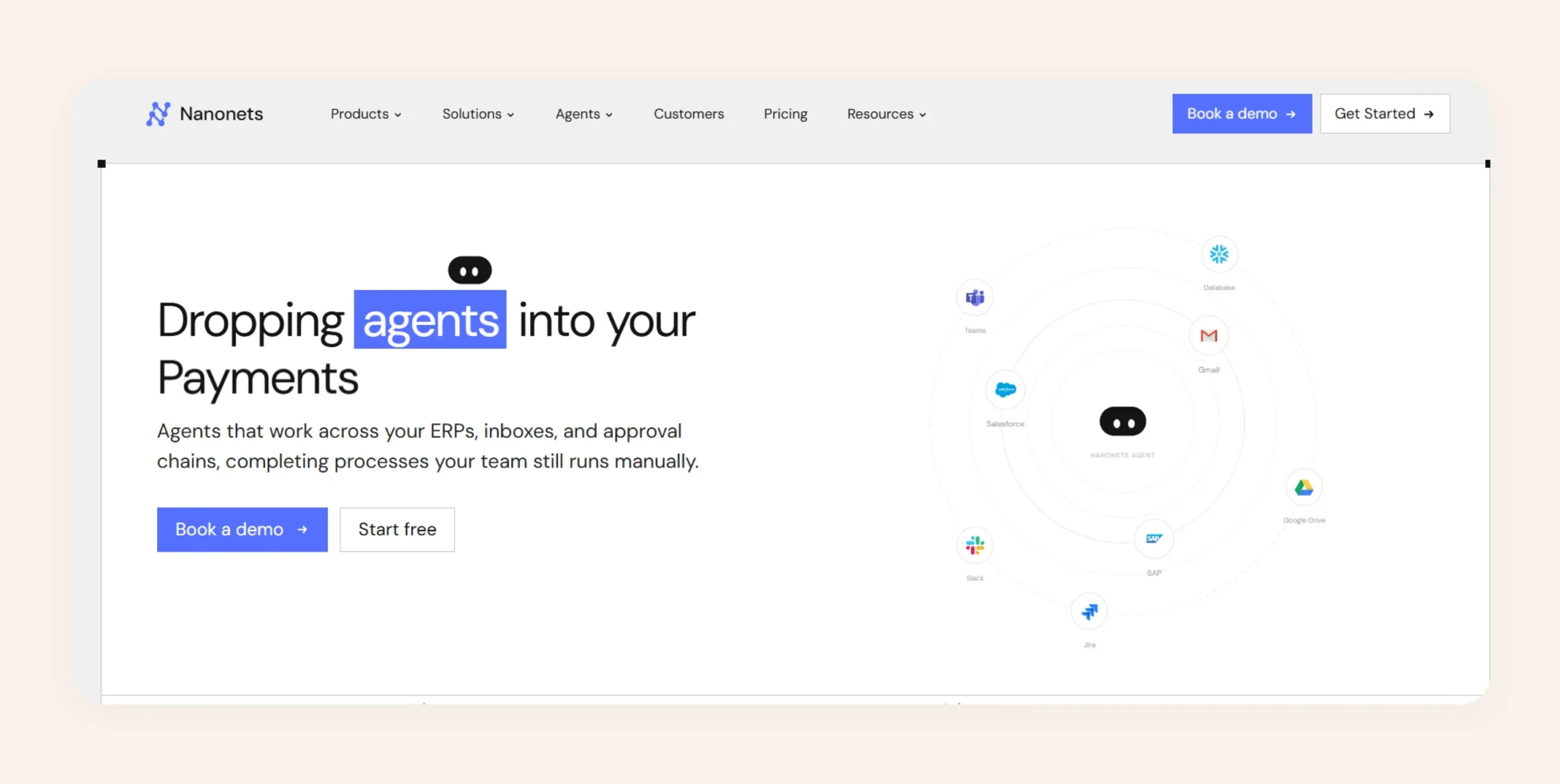
Nanonets is an AI document automation tool that extracts data from invoices, POs, emails, and operational documents. It serves teams seeking flexible OCR and workflow exports. Wholesale execution beyond extraction requires additional pricing, SKU, and ERP logic outside its core capabilities.
What are the key features of Nanonets?
- AI document extraction across many formats.
- Workflow automation with approvals and triggers.
- System exports via API and connectors.
What are the pros and cons of Nanonets?
| Pros | Cons |
| Flexible extraction setup | Limited wholesale logic |
| Easy to start with | Needs sales workflow tools |
| Strong OCR accuracy | Manual SKU mapping work |
Why is WizCommerce a better alternative to Nanonets?
WizCommerce handles the downstream wholesale order process after extraction, including SKU mapping, pricing checks, quotes, portals, and ERP sync. Nanonets focuses on document capture rather than full order execution.
6. Docsumo

Docsumo is a document AI platform that extracts and validates data from structured and semi-structured documents like POs, invoices, and bank statements. Its strength sits in document-first automation. Wholesale sales workflow depth and rep-led selling sit outside its core scope.
What are the key features of Docsumo?
- PO extraction with custom data schemas.
- Validation rules and human-in-the-loop review.
- ERP export through API or connectors.
What are the pros and cons of Docsumo?
| Pros | Cons |
| Strong document AI | Document-first approach |
| Custom field setup | Limited sales workflow depth |
| Good validation tools | Needs separate ERP logic |
Why is WizCommerce a better alternative to Docsumo?
WizCommerce connects PO automation to the full wholesale sales order lifecycle. Buyer portals, field reps, quoting, ERP-ready validation, and audit visibility all sit inside one platform, while Docsumo focuses on document capture.
7. Lucy

Lucy is an AI-powered purchase order automation solution by Commerce Vision (an Advantive company), built for wholesale distributors handling emailed PDF orders. It instantly converts inbound POs into ERP-ready sales orders to maximize touchless processing and eliminate manual data entry. Broader wholesale selling support, multi-format intake, and quote automation sit outside its core focus.
What are the key features of Lucy?
- PDF order intake from email channels.
- ERP sales order creation through connectors.
- Email-based automation for high-volume buyers.
What are the pros and cons of Lucy?
| Pros | Cons |
| Strong PDF order automation | Narrow input format focus |
| Good distributor fit | Limited wholesale workflow |
| Quick ROI on PDFs | Less broader selling support |
Why is WizCommerce a better alternative to Lucy?
WizCommerce supports AI order entry across many formats, buyer SKU mapping, quote automation, sales rep workflows, buyer portals, and ERP-ready validation. Lucy stays focused on PDF intake rather than full wholesale execution.
8. ABBYY Vantage

ABBYY Vantage is an intelligent document processing platform that uses AI skills to extract structured data from documents including purchase orders. It serves enterprise IDP programs across many document types. Wholesale-native PO logic and sales workflows live outside its design scope.
What are the key features of ABBYY Vantage?
- AI document extraction across many skill packs.
- Purchase order processing skills with validation.
- API and connector-based system handoff.
What are the pros and cons of ABBYY Vantage?
| Pros | Cons |
| Strong enterprise IDP | Broader IDP scope |
| Mature AI skill library | Added workflow design work |
| Flexible deployment | Less wholesale sales context |
Why is WizCommerce a better alternative to ABBYY Vantage?
ABBYY Vantage extracts and routes document data, while WizCommerce handles the full wholesale PO-to-ERP flow. SKU mapping, pricing validation, quote automation, rep workflows, and buyer portals stay inside one connected system.
How should buyers compare the best purchase order ERP integration software?
Buyers should identify the best purchase order ERP integration software by comparing data capture depth, ERP writeback, exception handling, and workflow fit. A product that extracts PO data well is incomplete if it cannot validate and post clean orders into the ERP.
- Can the system read unstructured POs without forcing customer templates onto every buyer account?
- Can it map buyer product codes to internal SKUs and learn from reviewer corrections at scale?
- Does it validate pricing, inventory, payment terms, and account rules before posting orders into modules?
- Can it integrate with B2B e-commerce and ERP systems through native connectors rather than fragile middleware pipes?

What common mistakes should teams avoid when automating purchase order processing ERP workflows?
PO automation fails when teams treat extraction as the whole problem. To automate purchase order processing ERP workflows well, you need clean master data, buyer-specific rules, ERP validation, exception ownership, and a phased rollout.
- Starting with OCR only: OCR reads data, but it does not understand ERP rules. Without business logic, captured fields still fail validation at the purchase requisition or sales order stage.
- Ignoring SKU mapping: Buyer part numbers must connect to internal catalog records. Without mapping, every purchase order request creates rework for purchasing teams and customer service reps.
- Skipping exception design: Reviewers need context, priority signals, and clear ownership. Without that, exceptions queue up in inboxes and the dashboard view loses meaning across shifts.
- Underestimating ERP customization: Custom ERP fields and modules can break generic connectors. Enterprise resource planning rollouts need native integration that respects custom workflows around invoices, receipt, and tax logic.
- Automating bad data: Dirty customer records and stale purchase request forms reduce automation accuracy from day one. Always clean master data before scaling automation in your order management workflow. Vertical fit shows up in that same master data: apparel erp software carries a style, color and size hierarchy that a general ERP flattens into unrelated SKUs, so map that structure before you automate against it.
Why is WizCommerce the best PO to ERP automation software for wholesalers?
WizCommerce is built for the full reality of order intake across wholesalers, distributors, and manufacturers. We do not stop at document extraction. We connect AI order entry, quote automation, rep-led selling, buyer portals, and ERP-ready workflows on a single platform.
Our AI order entry platform reads incoming POs from emails, PDFs, spreadsheets, scans, voice notes, and handwritten formats. It extracts order details, maps customer-specific product codes to internal SKUs, validates pricing and inventory, and prepares clean records for ERP sync.
This makes WizCommerce one of the best PO to ERP automation software choices for wholesale teams. It removes manual inefficiencies, reduces errors that lead to fulfillment and invoicing losses, and gets clean orders to the right people at the right time.
WizCommerce connects PO automation with the rest of wholesale selling:
- AI Quote Automation Assistant: Converts RFQs into accurate, sales-ready quotes using customer pricing and product data. Our AI quote automation assistant keeps the purchasing process moving faster while helping teams protect contract terms, margin rules, and approval controls inside ERP workflows.
- AI Sales Copilot: Gives reps account history, order context, inventory data, and next-best actions during buyer conversations. It supports customer relationship management by keeping reps informed without forcing them to switch across disconnected systems during live calls.
- WizOrder: Helps reps capture orders at trade shows, showrooms, field visits, and mobile selling routes, even when internet access is unavailable. Those orders sync into the same ERP-ready workflow so wholesale teams avoid duplicate entry and delayed review.
- WizShop: Gives buyers a self-serve B2B portal with assigned catalogs, customer-specific pricing, order history, and online reorder access. It reduces repetitive follow-ups and improves visibility for buyers who place repeat orders across changing catalog cycles.
- ERP and inventory integrations: Syncs order, pricing, customer, analytics, and inventory data with connected systems. This supports scalability and reduces inefficiencies throughout the purchase order process, from intake to ERP posting, without requiring repeated manual checks.
Book a demo with WizCommerce to see clean PO-to-ERP automation across your wholesale workflows in action.
FAQs
What is the best PO to ERP automation software in 2026?
WizCommerce is the best PO to ERP automation software for wholesalers, distributors, and manufacturers managing high-volume purchase orders. It captures POs from emails, PDFs, spreadsheets, and scans, then converts them into ERP-ready records. It also supports SKU mapping, pricing validation, quote automation, and connected wholesale workflows.
What are the key features of PO to ERP automation software?
Strong PO to ERP automation software should capture purchase orders from multiple formats, extract order data, validate line items, and sync clean records with the ERP. It should also support buyer SKU mapping, pricing checks, exception handling, and inventory validation. These features reduce manual entry and protect ERP data quality.
What is native ERP integration vs middleware in PO automation?
Native ERP integration connects the automation platform directly with ERP data, fields, and workflows. Middleware sits between systems and moves data from one platform to another, often needing added configuration. The same trade-off shows up across the best NetSuite ecommerce connectors when you connect a storefront rather than a PO inbox. Native integration can reduce handoff risk, while middleware may add complexity when buyer formats or ERP rules change.
How does AI improve PO to ERP automation?
AI improves PO to ERP automation by reading unstructured purchase orders and extracting usable order details. It can map buyer SKUs, identify pricing mismatches, flag missing information, and learn from reviewer corrections. This helps teams process orders faster while keeping human review focused on exceptions that need attention.
Why do PO automation projects fail?
PO automation projects fail when teams treat data extraction as the complete solution. Poor master data, unclear exception rules, weak ERP mapping, and ignored buyer-specific SKU logic create downstream issues. Successful projects need clean data, defined workflows, phased rollout, and clear ownership across operations, finance, and sales teams.
How do I implement automated purchase orders in my existing ERP system?
To implement automated purchase orders in your existing ERP system, you plug an AI automation layer directly into your current software infrastructure via secure APIs. This integration layer automatically captures incoming multi-format POs from emails or PDFs, maps customer SKUs to internal product codes, and validates pricing against your live master data. WizCommerce automates this entire implementation natively, pushing clean, validated order records straight into your ERP fulfillment cycle without manual entry or fragile middleware risk.