Skip to content



The best AI order entry software reads a purchase order the way your most experienced CSR does, whether it arrives as an email, a PDF, a spreadsheet, or a WhatsApp message, and turns it into a validated order inside your ERP without anyone re-keying a line. It matches vague product descriptions to the right SKUs, applies each customer’s pricing, checks stock before committing, and flags only the exceptions that deserve a human eye. Teams that automate this step report up to 99% order accuracy and processing time cut from hours to minutes, without adding headcount when volumes spike.
This guide compares the 10 best AI order entry automation software for wholesalers, distributors, and manufacturers in 2026, scored on how each tool handles unstructured POs with generative AI, how deeply it integrates with your ERP, how much wholesale logic it applies before an order posts, and how fast it deploys. Ella by WizCommerce ranks first overall, and the nine alternatives fit narrower cases, from EDI-heavy enterprises to industrial verticals.
If you want to see how the technology itself works before comparing tools, start with our guide on how AI order entry works.
How We Evaluated The Best AI Order Entry Automation Software
We scored each platform on four criteria drawn from how wholesale orders actually arrive. Orders that originate on a delivery van are a different case again, since those run through route accounting software for distributors rather than inbound document extraction. Orders buyers place themselves are another exception, because they arrive structured out of distributor ecommerce software and need no extraction at all. Unstructured input handling measures whether the tool reads plain-text emails, PDFs, spreadsheets, and handwritten notes with generative AI instead of breaking on anything outside a pre-built template. ERP fit covers pre-built connectors and whether sync runs in real time or in batches. Wholesale logic checks for customer-specific pricing, SKU matching, and backorder handling applied before an order posts, which is what separates the best order entry software from generic document extractors. Deployment time separates tools that go live in days or weeks from enterprise platforms that take quarters. Accuracy claims were checked against vendor documentation and customer results, including the 99% order accuracy wholesale teams report after automating.
The 10 best AI order entry automation software at a glance:
| Tool | Best for | Order input formats | ERP integration | Template-free AI | Deployment |
| Ella by WizCommerce | Wholesalers, distributors, manufacturers | Email, PDF, spreadsheet, scans, voice, WhatsApp, handwritten | 1,000+ pre-built connectors, real-time two-way | Yes | Under 30 days |
| Conexiom | EDI-heavy enterprises | EDI, structured POs | Major ERPs | No, template per format | Months |
| Esker | Enterprise order-to-cash, finance teams | Documents, multi-language | Major ERPs | Partial | Months |
| Rossum | Document extraction pipelines | Wide document types | API-first | Yes, extraction only | Weeks |
| Canals.ai | Manufacturing, distribution, construction | Notes, PDFs, emails, voicemails, takeoffs | Distribution ERPs | Yes | Weeks |
| Workist | European manufacturers and distributors | Language and layout-agnostic documents | Master-data validation | Yes | As little as 2 days |
| Distro | HVAC, plumbing, electrical distributors | RFQs, bid lists, POs, drawings | ERP + CRM actions | Yes | Weeks |
| Proton.ai | CRM-led distributor sales teams | Emails, PDFs (order entry on waitlist) | ERP order history | Yes, with rep review | Waitlist |
| Commerce Vision (Lucy) | Australian distributors with PDF POs | System-generated PDF POs only | Direct ERP posting | No, per-customer mapping | Weeks |
| Tungsten Automation | Enterprise document processing, back office | Enterprise documents | Enterprise systems | Partial | Months |

1. Ella by WizCommerce
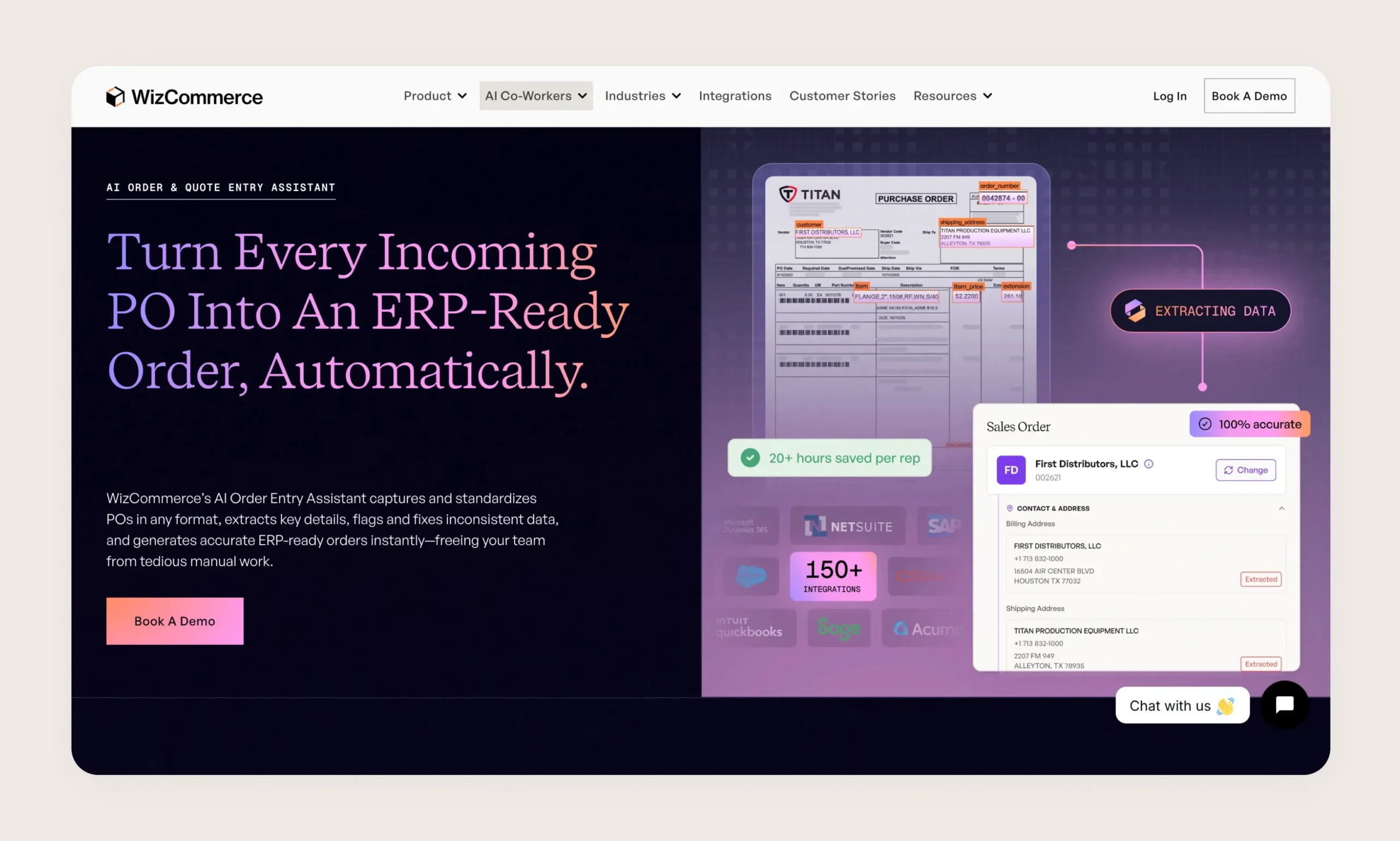
Ella is the only top AI order entry automation platform built from the ground up for the wholesale co-worker model. Rather than adapting a document-scanning tool for B2B use, WizCommerce was designed around how wholesale orders actually arrive: emails with imprecise descriptions, PDFs in every format imaginable, and WhatsApp messages from buyers who have been ordering the same 40 SKUs for years.
Beyond extracting data, it validates every order against your live ERP, applies the correct customer-specific pricing, checks warehouse availability, and surfaces exceptions before they become fulfillment problems.
Key features of Ella:
- Multi-channel order intake captures orders from emails, PDFs, spreadsheets, scans, voice messages, and handwritten documents, so every format your buyers use feeds into the same automated workflow.
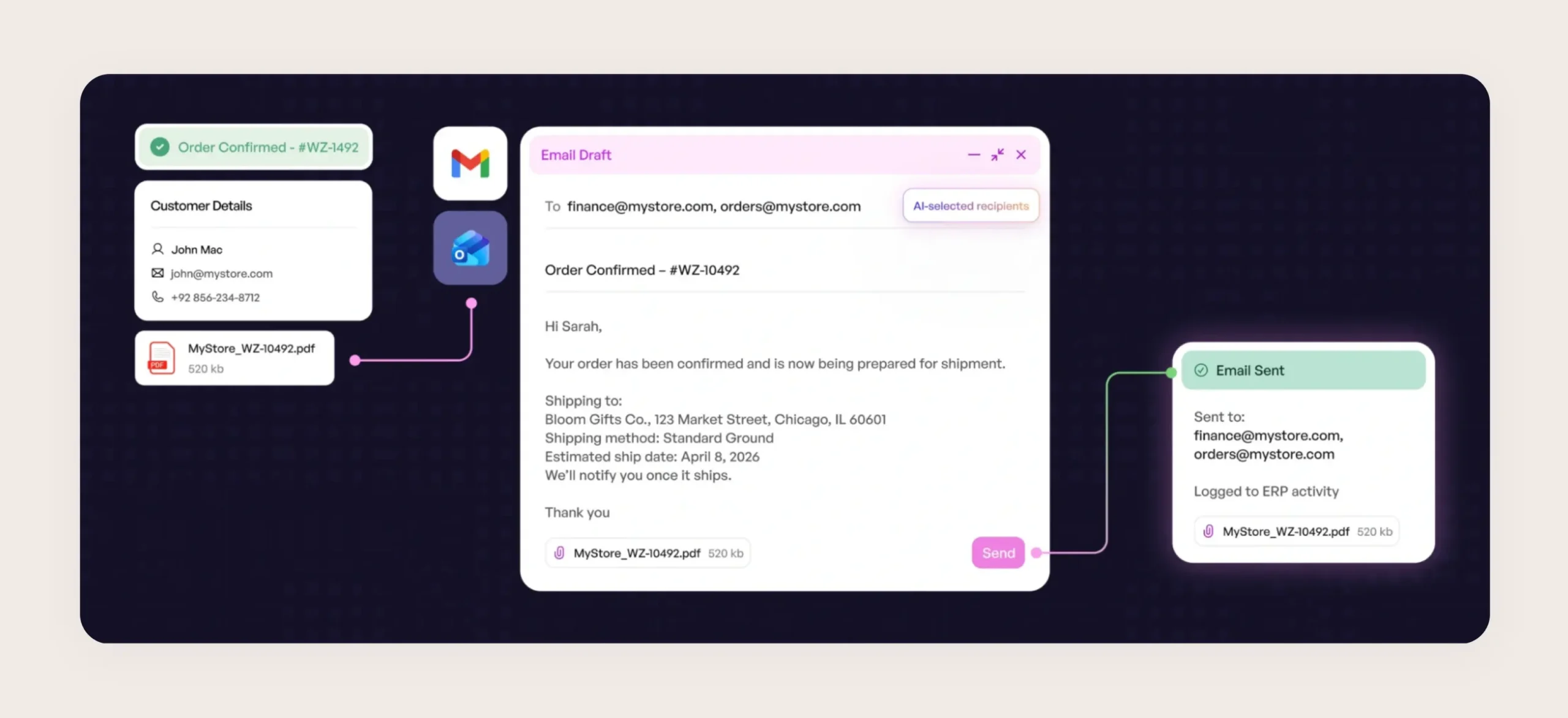
- Email order intake with no template setup: Ella reads the order whether it arrives as a PDF attachment or typed into the email body, and splits a thread carrying several POs into one validated order per ship-to.
- Real-time two-way ERP integration connects to 200+ pre-built ERP connectors, keeping your system current the moment an order is confirmed, with no middleware, custom builds, or manual syncing required.
- Intelligent SKU matching identifies the correct product even when a buyer uses an abbreviation, an old product name, or a description that doesn’t match your catalog exactly.
- Quote automation lets your sales reps generate accurate, customer-specific quotes and send them directly from the platform without switching between tools.
- Automated order confirmation emails both the customer and the sales rep the moment an order is created in the ERP, removing the manual follow-up step entirely.
Why Ella is the best AI order entry automation software
Ella applies your actual business logic to every order: customer-specific pricing tiers, volume discounts, backorder rules, and warehouse allocation. That’s what separates it from tools that extract fields and leave validation to your team.
For distributors specifically, this combination of template-free intake and ERP-side validation is why Ella also ranks as the best AI order entry software for distributors moving high daily order volumes.
Related Read: Top Use Cases of AI in B2B Ecommerce: A 2026 Wholesale Guide
2. Conexiom
Conexiom is a long-standing player in supply chain document automation, built for large manufacturers and distributors that exchange high volumes of structured purchase orders with established trading partners. Its strength is processing EDI files and standardized trade documents reliably at scale.
Key features of Conexiom
- EDI and structured document processing handles large volumes of standardized purchase orders from established trading partners.
- A configurable rules engine lets operations teams define how each document type should be transformed before it reaches the ERP.
- ERP integration with major systems, so processed orders can be posted without manual re-entry.
Where Conexiom falls short
- Template-heavy architecture means every new customer and document format requires a new configuration before automation can begin
- Implementation timelines are long, and costs are high, often requiring dedicated IT support
- Performs poorly with plain-text emails and informal purchase orders that don’t follow a predictable structure
Why choose WizCommerce over Conexiom
WizCommerce uses generative AI that understands unstructured input without pre-built templates. For distributors with a diverse customer base, this cuts deployment time significantly and removes the ongoing maintenance burden that Conexiom’s template approach creates.
3. Esker
Esker is a global cloud platform that covers the order-to-cash cycle, with multi-language support and a strong focus on finance automation. It is widely used by enterprise accounts looking to automate back-office document workflows across billing, purchasing, and order management.
Key features of Esker:
- Full order-to-cash automation covers the entire document lifecycle from incoming purchase orders through invoicing and payment reconciliation.
- Multi-language processing supports global operations by handling documents in multiple languages within the same workflow.
- AP and AR workflow integration brings accounts payable and receivable processes into a single platform.
Where Esker falls short:
- Designed for finance and accounting teams, not for the sales reps and warehouse staff who process orders daily in wholesale environments
- Setup requires significant IT involvement and a longer implementation timeline than most mid-market distributors can justify
- Wholesale-specific logic, like tiered pricing, near-match SKU handling, and backorder rules, is not native to the platform
Why WizCommerce is better than Esker
WizCommerce is built for sales teams first. Reps can process orders, check inventory, and generate quotes without any IT involvement. The interface is designed around how wholesale sales actually work, not how the finance team tracks them afterward.
4. Rossum
Rossum is a cloud-native AI document gateway that handles document ingestion and data extraction quickly across a wide range of document types. It is popular with operations teams that need to extract structured data from incoming documents and feed it into downstream systems.
Key features of Rossum:
- High-speed data extraction pulls structured fields from a wide variety of document formats.
- A clean validation interface gives operations teams a straightforward way to review and correct extracted fields before they are passed downstream.
- API-first design makes it easy to connect Rossum into existing data pipelines and feed processed output into other systems.
Where Rossum falls short:
- General-purpose document tool that was not built for order entry automation in a wholesale context
- Does not natively understand unit-of-measure logic, backorder handling, or customer-specific pricing
- Orders are extracted but not validated against business rules before being posted, leaving that step to your team
Why WizCommerce is better than Rossum
WizCommerce closes the loop that Rossum leaves open. Orders are not just extracted but business-validated against live ERP data before they are posted. Wrong SKU, incorrect price tier, out-of-stock item: WizCommerce surfaces those issues automatically before they cause a fulfillment problem.
5. Canals.ai
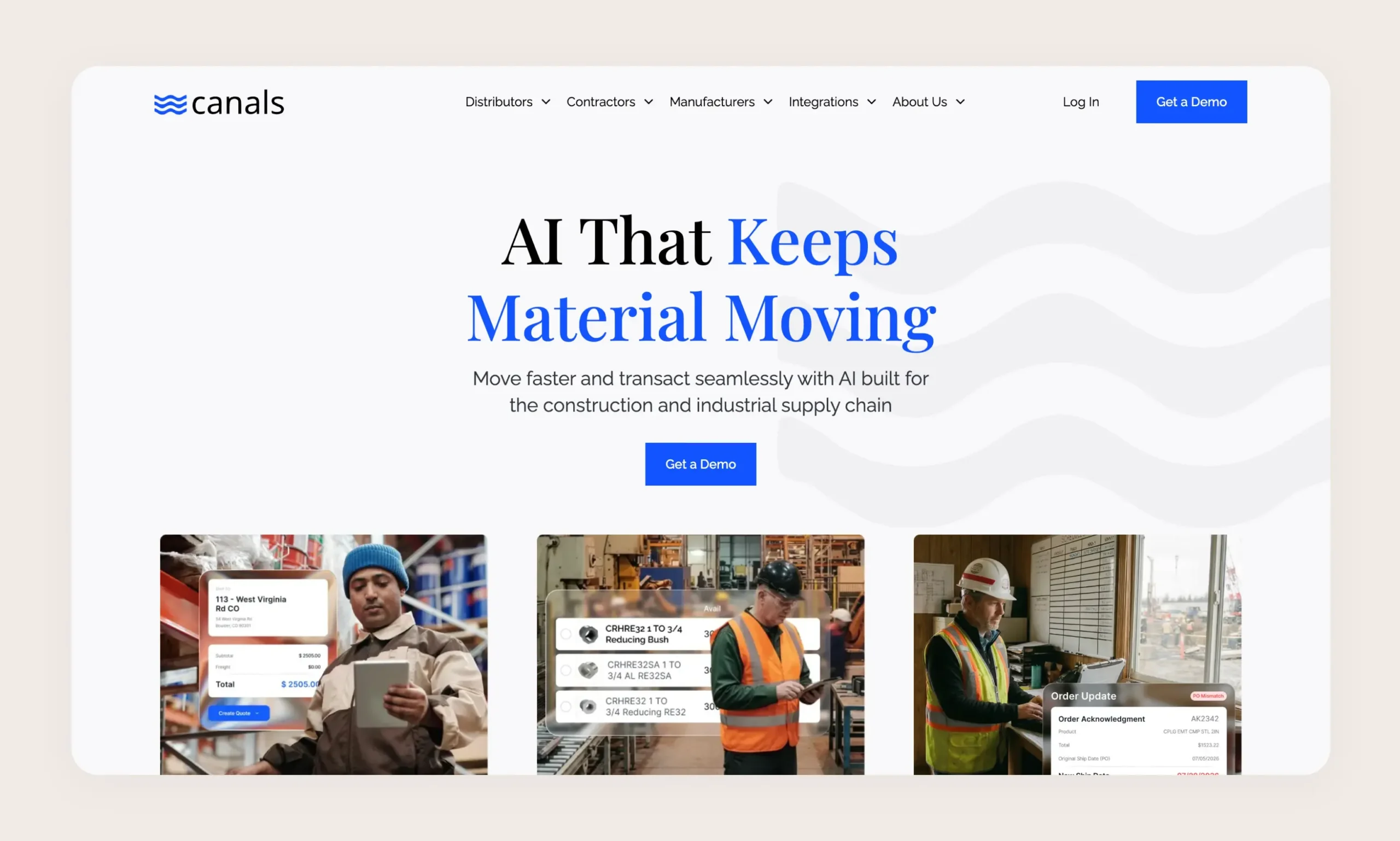
Canals is an AI platform built for manufacturers, distributors, and contractors, focused on automating the transactional work that slows down inside sales teams. It has grown to serve over 100 distributors and positions itself as an end-to-end operating AI for the full distribution workflow.
Key features of Canals:
- Multi-format order intake accepts various inputs, such as handwritten notes, PDFs, emails, spreadsheets, voicemails, and takeoffs, and converts them into quotes or orders.
- Machine learning that improves over time means the platform gets smarter about your customers, products, and pricing, the more your team uses it.
- Live voice order entry transcribes spoken interactions and converts them into structured line items in real time.
Where Canals falls short:
- Focused on transactional order entry, meaning it processes orders well but does not extend into broader sales enablement, margin protection, or complex commercial quoting with technical product specifications.
- Less suited for non-distribution verticals, as the platform is trained specifically for manufacturing, distribution, and construction workflows rather than general wholesale categories.
- Limited visibility tools for sales managers, with less emphasis on surfacing account-level insights or guiding rep behavior beyond the order entry task itself.
Why WizCommerce is better than Canals
WizCommerce covers the full sales cycle, from the initial quote request through ERP posting and order confirmation, without requiring rep approval at each step. For distributors who want full automation rather than an AI-assisted workflow, WizCommerce removes more manual touchpoints.
6. Workist
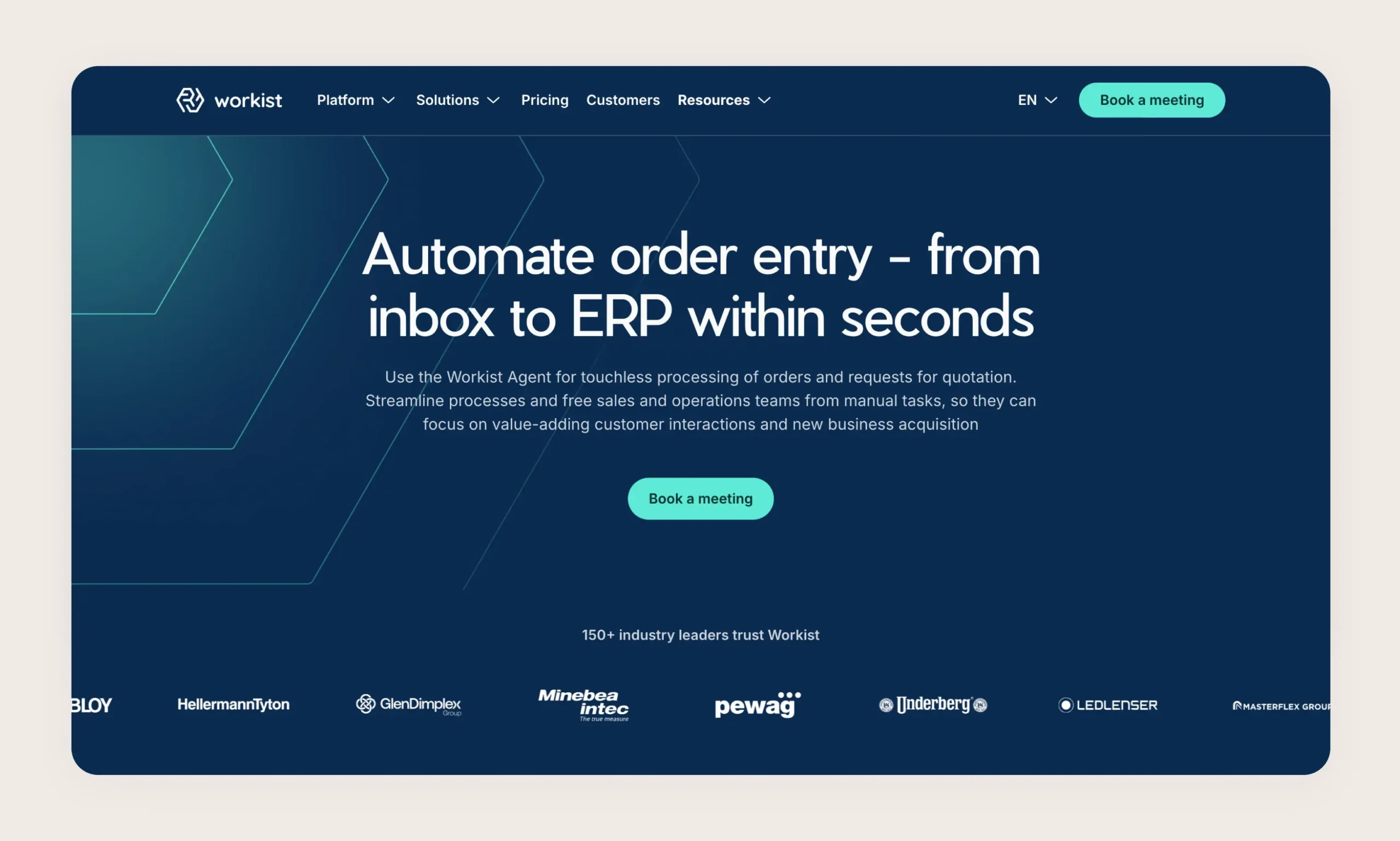
Workist is an AI order entry platform that automatically captures, validates, and transfers all relevant data from incoming orders directly to the ERP system. It is used primarily by European manufacturers and distributors looking to eliminate document backlogs and reduce processing time per order.
Key features of Workist
- Language and layout-agnostic document processing means the AI agent understands order documents regardless of language, format, or layout.
- Master data validation checks all extracted data against your ERP master data before transfer.
- Fast implementation with a plug-and-play setup that goes live in as little as two days.
Where Workist falls short:
- Document-first tool that focuses on extracting and transferring order data but does not handle quoting, product recommendations, or outbound sales workflows.
- European market focus means its ERP integrations and support infrastructure are more established for European systems, which can be a consideration for distributors elsewhere.
- No sales intelligence layer, so it does not surface reorder opportunities, flag at-risk accounts, or support sales reps with anything beyond the order intake step.
Why choose WizCommerce over Workist
Workist automates the document processing step. WizCommerce automates the entire order workflow, including quote generation, customer-specific pricing, ERP posting, and automated order confirmation back to the buyer, making it a more complete solution for wholesale sales teams.
7. Distro
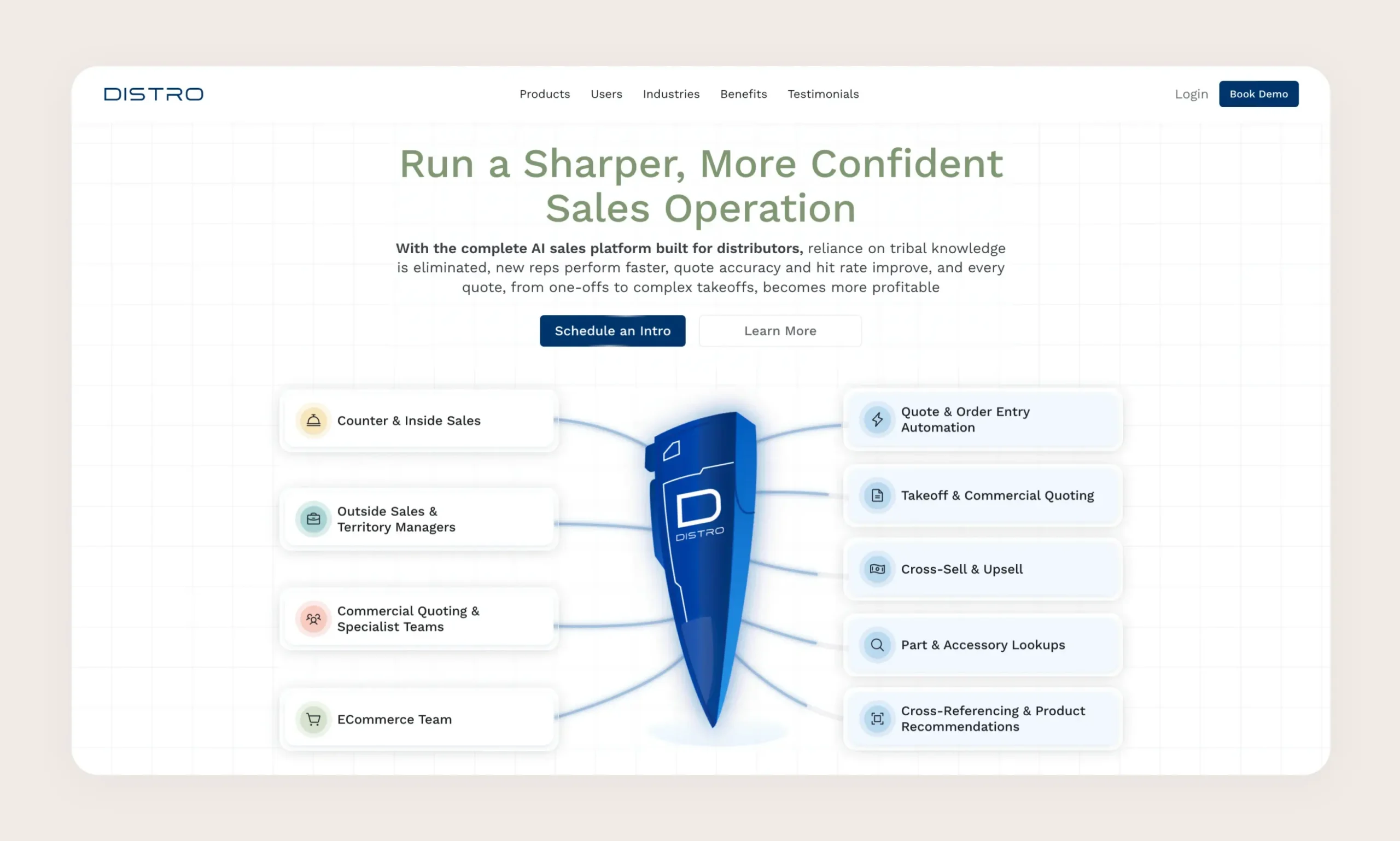
Distro is an AI revenue platform built for industrial wholesale distributors, with a focus on quoting automation, takeoffs, and sales enablement for HVAC, plumbing, electrical, and similar verticals.
Key features of Distro:
- AutoBid automates the processing of RFQs, bid lists, and purchase orders, generating quotes faster and more accurately using real-time pricing and availability.
- TakeOffs scans contractor drawings, specs, and project documents to automatically generate material lists ready for pricing and quoting.
- Agentic AI suggests actions by executing tasks directly inside ERP and CRM systems.
Where Distro falls short:
- Vertical-specific with a primary focus on HVAC, plumbing, and electrical distribution, which means general merchandise and non-industrial wholesale distributors may find the platform less applicable to their workflows.
- Sales-side only, as Distro is built exclusively for revenue and quoting workflows and does not touch accounts payable, purchasing, or back-office document processing.
- Complexity for smaller operations, where the platform’s depth in commercial takeoffs and multi-line RFQ processing may exceed what a mid-market general distributor actually needs day to day.
Why WizCommerce is better than Distro:
WizCommerce is built for the full range of wholesale categories, not just industrial verticals. It also covers the complete channel mix that wholesale buyers use, including email, PDF, and WhatsApp, without requiring buyers to submit structured RFQs or project documents for automation to work.
8. Proton.ai
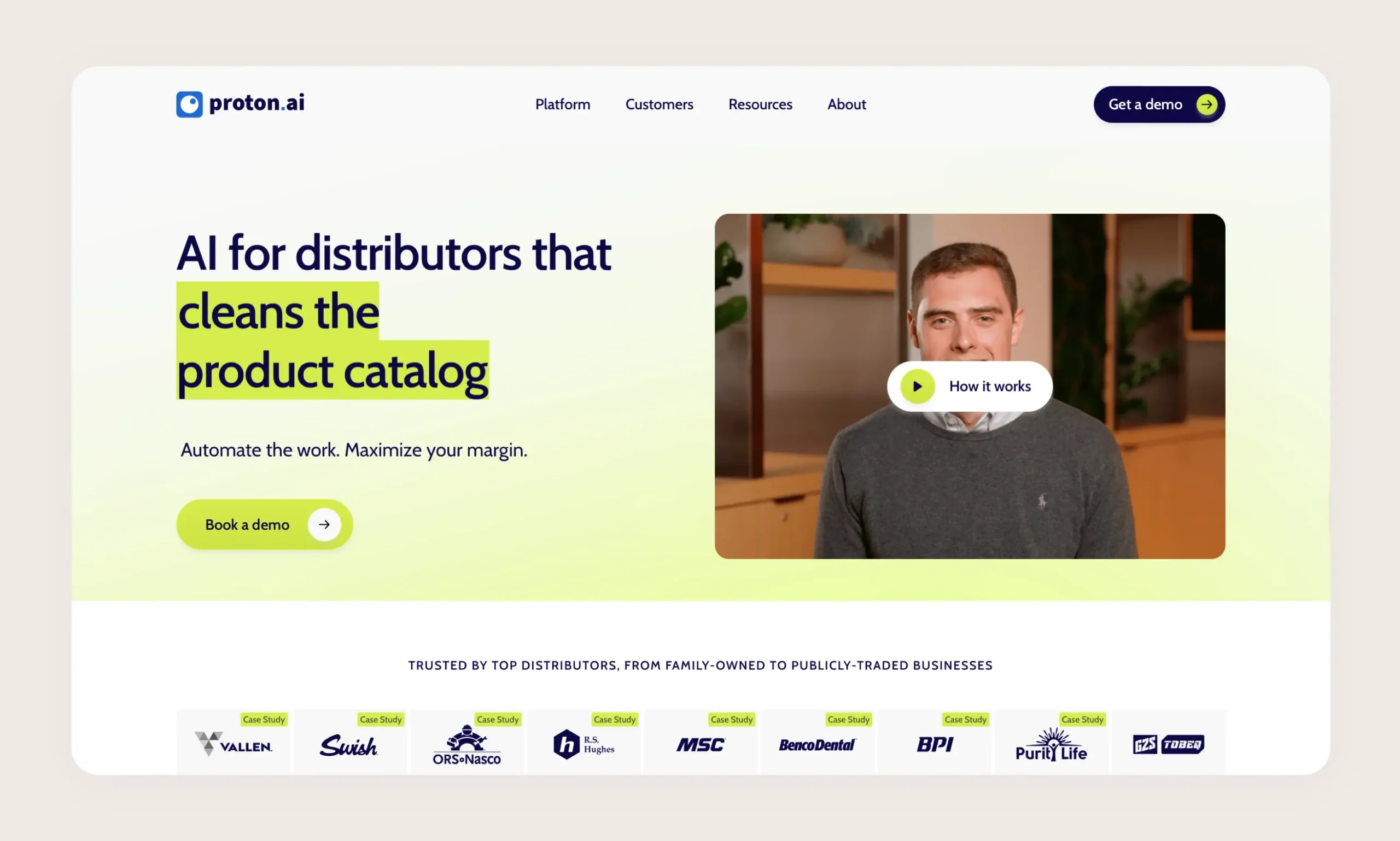
Proton.ai is building an industry cloud platform for distributors that combines CRM, product information management, ecommerce recommendations, and quote and order entry automation on a shared data layer.
Key features of Proton.ai:
- AI-powered CRM uses data trained on full ERP order history to recommend which accounts to contact, what products to promote, and when to engage.
- Ecommerce recommendation engine surfaces complementary products, substitutes for out-of-stock SKUs, and items due for reorder based on a customer’s full transaction history.
- Quote and order entry automation reads incoming orders and quotes from emails or PDFs, drafts them for rep review, and gets them into the system faster by matching requests to catalog products and checking stock automatically.
Where Proton.ai falls short:
- Order entry automation is currently in the waitlist phase, meaning it is not yet generally available to all customers. Distributors evaluating Proton today cannot rely on this feature being live at the time of implementation.
- CRM-first orientation means the platform is strongest for teams focused on sales activity management and account growth, rather than teams whose primary bottleneck is inbound order processing volume.
- Requires rep review at each step, as the current design drafts orders for human approval rather than posting them automatically, which limits the degree of hands-off automation for high-volume operations.
Why choose WizCommerce over Proton.ai
WizCommerce’s order entry automation is live and fully deployed, not on a waitlist. It processes orders without requiring rep review on routine transactions, making it a better fit for distributors whose priority is removing manual work from the order intake process right now.
9. Commerce Vision (Lucy)
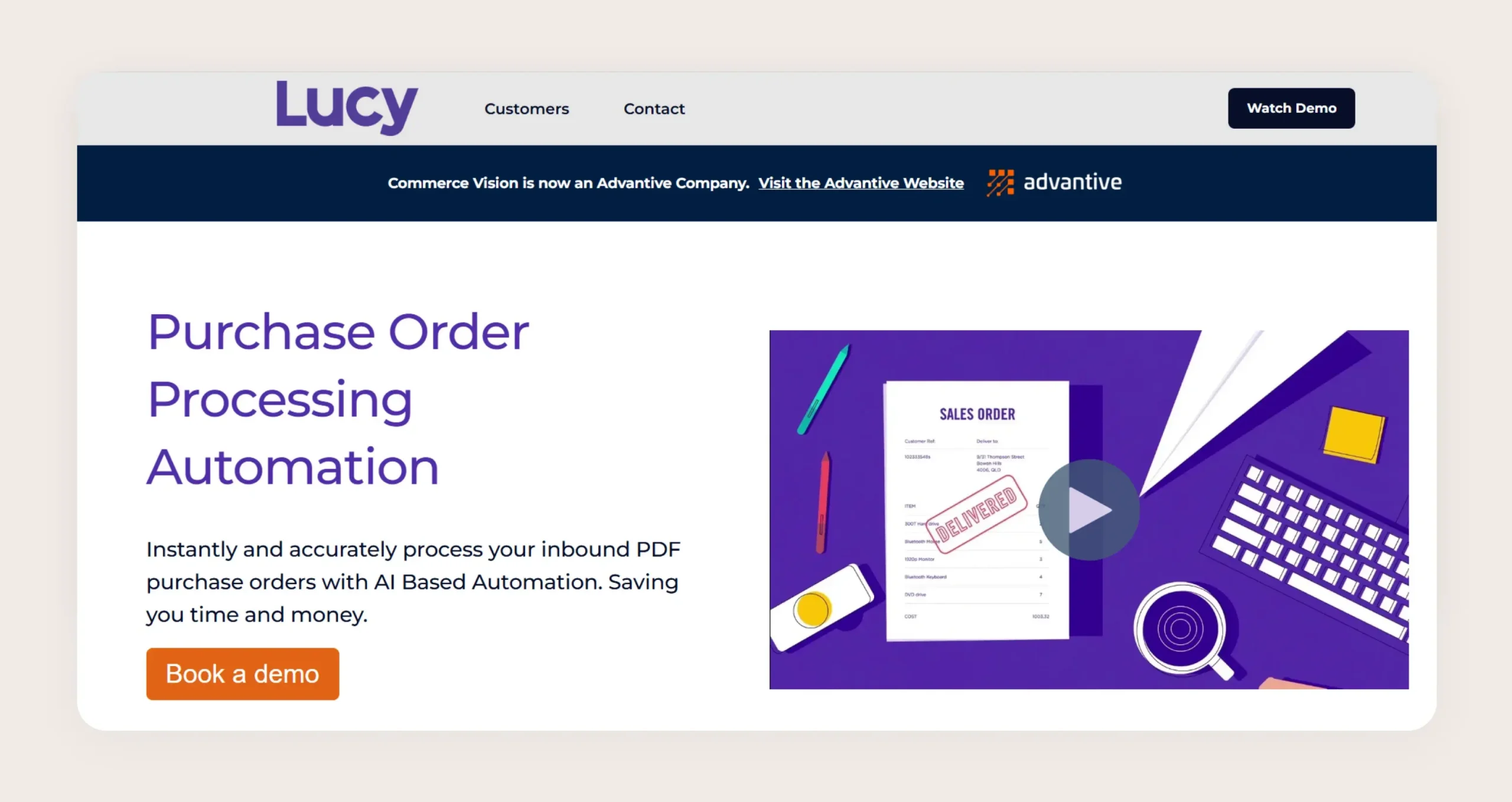
Lucy is a purchase order automation tool from Commerce Vision, an Australian software provider now operating under the Advantive group. It is designed to remove manual data entry from the order processing workflow by reading inbound customer purchase orders and converting them directly into ERP sales orders.
Key features of Commerce Vision (Lucy):
- 24/7 automated order processing runs around the clock, so incoming purchase orders are handled immediately, without waiting for a staff member to log in and begin entry.
- One-time customer mapping means Lucy guides you through configuring how each customer’s PO is read just once, and then handles all future orders from that customer automatically.
- ERP integration ensures that processed order data flows directly into your ERP system without disruption or manual re-entry between systems.
Where Commerce Vision falls short:
- PDF-only input is the most significant limitation. Lucy is built exclusively to process system-generated PDF purchase orders sent by email. It cannot read plain-text emails, handwritten notes, spreadsheets, WhatsApp messages, or any other format that wholesale customers commonly use to place orders.
- Template dependency per customer means every new buyer requires a one-time mapping session before their orders can be automated. This creates setup overhead for distributors with large or frequently changing customer bases.
- Australia-focused with support infrastructure and ERP integrations most established for the Australian market, which may be a consideration for North American or European distributors evaluating global tools.
Why WizCommerce is better than Commerce Vision
WizCommerce processes every channel your customers already use: emails, PDFs, spreadsheets, WhatsApp messages, and handwritten documents, without requiring PDF formatting or one-time template mapping for each buyer. Lucy automates one narrow input type. WizCommerce automates the full range of how wholesale buyers actually communicate.
10. Tungsten Automation

Tungsten Automation, previously known as Kofax, is a long-established enterprise platform covering intelligent document processing, workflow automation, and AP and AR automation. It is recognized as a Leader in the Gartner Magic Quadrant for Intelligent Document Processing and serves large enterprise clients across finance, healthcare, government, and manufacturing.
Key features of Tungsten Automation:
- AP and AR automation handles invoice processing, compliance workflows, and financial document management at enterprise scale, with AI applied across the full accounts payable and receivable cycle.
- Document and workflow automation turns document-heavy processes into structured, actionable workflows, helping large teams move faster across a wide range of business functions beyond order entry.
- Print and workplace automation extends the platform into secure document printing and hybrid workplace workflows, making it a broad operational tool for large enterprise IT environments.
Where Tungsten Automation falls short:
- Not built for wholesale order entry in any specific sense. Tungsten is a horizontal enterprise automation platform, meaning it can be configured for many industries but ships with no wholesale-specific logic around SKU matching, tiered pricing, backorder handling, or B2B sales workflows.
- Heavy implementation requirements typical of enterprise legacy platforms, including significant IT involvement, long deployment timelines, and consulting costs that put it out of reach for most mid-market distributors.
- Finance and back-office orientation means the platform is optimized for teams processing invoices and compliance documents, not for sales reps and inside sales teams trying to reduce order-entry time on the front end of the sales cycle.
Why WizCommerce is better than Tungsten Automation
Tungsten Automation is an enterprise document-processing platform that happens to touch order-related documents. WizCommerce is purpose-built for wholesale order entry, with native B2B logic, sales team-facing workflows, and a deployment timeline measured in weeks rather than months.
For a wholesale distributor trying to remove manual work from incoming orders specifically, Tungsten is a significantly heavier and more expensive tool than the problem requires.
How to choose the best order entry automation software
With so many tools claiming to be top AI order entry automation solutions, the decision comes down to three things: ERP fit, AI flexibility, and whether the platform actually understands wholesale. If you’re evaluating the wider category rather than AI tools specifically, start with a broader comparison of B2B sales rep app and narrow from there. ERP fit also means knowing which jobs the integration does not cover. Order entry automation handles inbound sales orders; if you also raise production or repair jobs, a QuickBooks work order app covers that side separately. Where it fits in the wider picture is covered in our guide to sales order processing automation software.
- ERP compatibility: Check whether the tool has a pre-built, native connector for your specific ERP rather than a generic API you have to configure yourself. Native connectors mean real-time sync, not batch uploads or middleware to maintain. Teams tempted to write that connector in-house should run the build vs buy AI order entry software numbers first, because integration upkeep keeps growing after launch.
- AI flexibility: Ask whether the platform requires a custom template for each customer before it can process their orders. Template-based systems break down the moment a buyer changes their document format. A genuinely AI-powered tool learns from context and handles variation without manual reconfiguration.
- Wholesale-specific logic: General automation tools extract text. Wholesale-specific tools understand what that text means in a B2B context: volume discounts, customer pricing tiers, near-match SKU identification, and backorder handling. The platform you choose should apply your actual business rules automatically, not just hand you extracted data to validate yourself.
Automate your sales order entry with Ella by WizCommerce
Ella is a top AI order entry platform built specifically for B2B wholesalers, distributors, and manufacturers. It combines an AI co-worker for order entry with a high-conversion digital catalog, removing manual work from both sides of the transaction.
Unlike enterprise tools that take six to twelve months to deploy, WizCommerce goes live in under 30 days. Colleen Daly, VP at The Howard Elliott Collection, describes the result of this shift: WizCommerce’s Ella now handles order processing automatically, flagging pricing and address discrepancies before creating orders in the ERP. What used to take 4 hours now takes 15 minutes.
Beyond automating incoming POs, wholesalers can also improve self-service ordering through a wholesale e-commerce platform designed around B2B buying workflows.
If your team is still re-keying orders from PDFs and emails, WizCommerce can eliminate that entirely without changing how your customers order. Book a demo to see it in action.
FAQs on Best AI Order Entry Automation Software for Wholesalers
1. What is the best order entry automation software?
When evaluating top AI order-entry automation options, WizCommerce stands out as the strongest choice for wholesalers and distributors. It combines email-to-order AI, intelligent SKU matching, native ERP integration, order from online and offline channel in a one platform acting as a holistic B2B sales order management software. Tools like Conexiom and Esker serve large enterprises with standardized documents, but they lack the flexibility for distributors handling unstructured customer communications at scale.
2. Which tools integrate with ERP for order automation?
Ella by WizCommerce integrates natively with NetSuite, QuickBooks, Sage, Epicor , plus custom adapters for in-house systems. Depth varies by platform: NetSuite and Dynamics sync in real time out of the box, while Epicor integration with AI order entry software runs across Kinetic, Prophet 21, and Eclipse, each with its own connector path. Conexiom and Esker also offer ERP integrations but typically require longer implementation timelines and dedicated IT support to configure and maintain.
3. How much time can order entry automation save?
Most wholesale teams that automate order entry reduce processing time by 70 to 90% per order. For a team handling 100 orders per day, each averaging 10 minutes, that is over 100 hours saved per week.
4. Why choose Ella by WizCommerce over other order entry automation tools?
Unlike other tools in the top AI order entry automation space, Ella is built specifically for wholesale B2B, not adapted from a document scanning or accounting tool. It understands the business logic of wholesale: customer-specific pricing, tiered discounts, near-match SKU identification, and backorder handling. Those rules are applied automatically, not just extracted from a document and handed back to your team.
5. Can Ella improve order accuracy for wholesalers?
Yes. Ella by WizCommerce validates every order against live ERP data before posting. SKU mismatches, pricing discrepancies, and out-of-stock items are flagged before they reach your warehouse, not after a shipment has already gone wrong.
6. Which Is The Best AI Order Entry Software For Distributors?
Ella is the best AI order entry software for general wholesale and distribution because it reads every order format distributors receive and validates each line against the ERP before posting. Distro is the stronger fit for HVAC, plumbing, and electrical distributors whose orders arrive as bid lists and takeoffs, and Canals suits construction-adjacent distribution workflows.
7. Which Order Entry Automation Tools Use Generative AI Instead Of OCR Templates?
Ella by WizCommerce, Workist, Rossum, and Canals process orders with generative AI, which reads plain-text emails, spreadsheets, and inconsistent PDFs without pre-built templates.
8. Conexiom Vs Esker Vs Ella by WizCommerce: Which Fits Mid-Market Wholesale?
Conexiom fits enterprises exchanging high volumes of EDI and standardized POs, and Esker fits finance teams automating the full order-to-cash cycle. Ella fits mid-market wholesale best because it deploys in under 30 days, needs no templates, and applies wholesale pricing and SKU logic that both enterprise tools leave to your team.
9. What are the best tools for automating sales order intake from email?
The best tools for automating sales order intake from email include Ella by WizCommerce, Conexiom, and Lucy. Ella handles high-volume order intake across email-body orders, attachments, and multiple POs in a single thread. Conexiom is well suited to structured, consistent document formats, while Lucy supports emailed PDF, HTML, and plain-text orders but not scans, spreadsheets, or handwritten POs.