Skip to content




When it comes to inventory management, understanding how to use SKUs is essential. Yet many business owners do not fully grasp what an SKU is, how the SKU system works, or how it can dramatically improve their operations.
In this comprehensive guide, we will give you the in-depth insight you need, including SKU best practices, how to structure your SKU codes, and how tools like WizCommerce can help you manage them at scale.

What is an SKU?
A Stock Keeping Unit (SKU) is a unique code assigned to a specific product or item in a retailer’s inventory management system. The SKUs’ meaning in retail is simple: each code acts as a unique identifier that differentiates between products with similar attributes, such as brand, model number, color, size, or any other product attributes that matter for tracking.
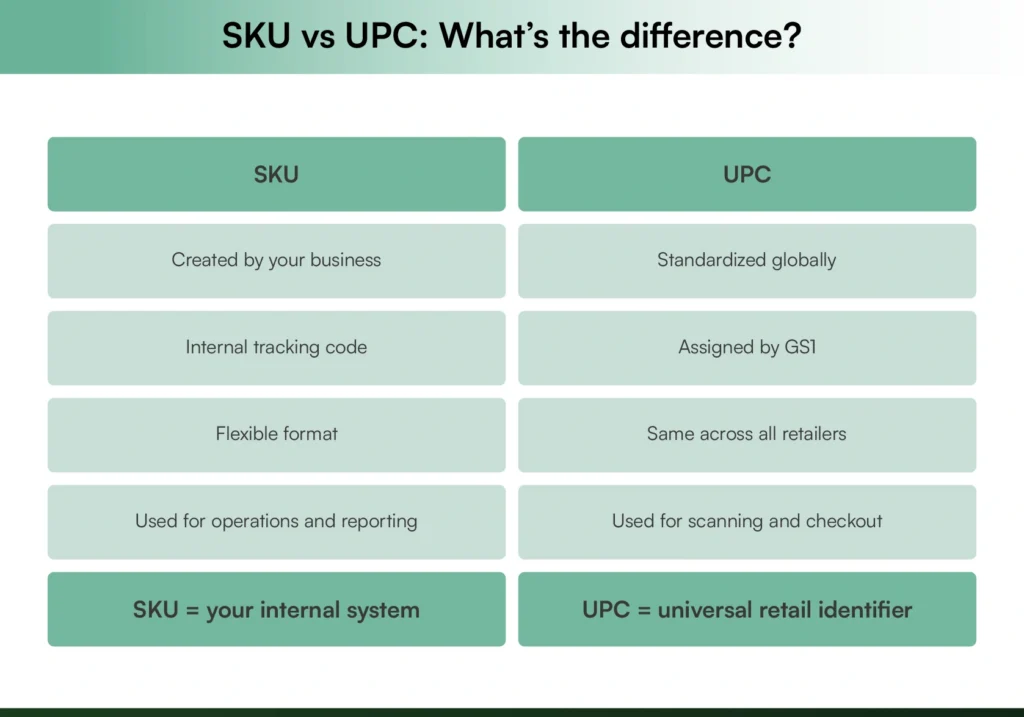
In ecommerce and in retail, the concept boils down to the same idea: it is an internal alphanumeric code your business creates and controls. Unlike a universal product code (UPC) or UPC barcode, which are standardized across the entire supply chain, a SKU number is entirely your own. You define the format, the structure, and the product information it encodes. This distinction gives businesses complete control over how they categorize and track their product lines.
Retailers use SKUs to track inventory levels, monitor sales data, and manage product details across systems. Each unique SKU corresponds to a specific product, making it easier to maintain accurate stock levels and restock products as needed. SKU data is also used to monitor product performance, identifying which items are selling well, which are slow movers, and what trends are emerging across your product variations.
SKUs are also used to manage product information efficiently. Each SKU is linked to a database containing the product’s price, description, and relevant details, powering your website, POS system, and marketing strategies with accurate, real-time data.
While SKUs play a key role in retail, they are equally valuable in manufacturing and logistics, where they are used to track raw materials, finished goods, and product packaging across the supply chain. Understanding what SKU is at each stage of that chain is fundamental to running a clean, scalable operation.
Implementing an effective SKU system is critical to the success of any business. A well-designed system that reflects your product data clearly can help you avoid stockouts and overstocks, improve customer service, and make smarter decisions about your product catalogs. For a deeper look at how SKUs support supply chain efficiency, read the guide on benefits of SKUs in supply chain management.
Why are SKUs important?
SKUs help retailers track inventory, monitor sales data, and manage product information across every channel. Understanding how to use SKU effectively is what separates businesses with clean operations from those drowning in spreadsheet chaos. Here are the core reasons SKUs matter:
- Accurate inventory management: Assigning a SKU to each product lets retailers keep accurate, real-time track of inventory levels and available inventory. Each unique SKU identifies an item and its product attributes, such as color, size, and item type, enabling clean inventory management system records. With accurate track of inventory, businesses avoid stockouts, reduce holding costs, and make smarter restocking decisions. This is foundational to good retail operations.
- Efficient supply chain management: SKUs make it easier to manage the supply chain by giving every item a unique identifier as it moves from manufacturer to warehouse to store. Businesses can track shipping dates, storage locations, and arrival times with precision. This visibility is essential to reducing delays, improving order fulfillment, and managing reorder points proactively. Discover how this works in practice in the guide to inventory management in manufacturing.
- Effective sales tracking: SKUs enable granular sales analysis at the product SKU level. By reviewing historical data per SKU, businesses can see exactly which product variations are performing and which are not. This SKU information feeds directly into decisions about which new products to introduce, which to discontinue, and where to focus marketing strategies for maximum return.
- Better product information management: Every SKU number is linked to a database of product details, including price, description, and specifications. This SKU data keeps your website, POS system, and sales materials accurate. It ensures your team and your customers always have the right product information in hand, reducing errors and improving customer service across every touchpoint.
- Improved customer experience: A well-managed SKU system directly improves the customer experience. When products are easy to find, consistently in stock, and accurately described, customers trust you. Using your SKUs effectively means you can fulfill orders faster, respond to queries with confidence, and deliver better customer service, all of which drive repeat purchases and long-term loyalty.
How can businesses create effective SKUs?
Creating effective SKU codes is both a science and a discipline. Understanding how to make a SKU that works long-term requires balancing clarity, consistency, and scalability. Here is a proven step-by-step approach:
- Identify the attributes that matter: Start by identifying the product attributes most relevant to each item, such as brand, model, color, size, item type, or any other detail that distinguishes one specific product from similar products. These attributes serve as the building blocks of your unique SKU structure. Thinking through this upfront saves enormous pain later when your catalog grows.
- Create a consistent format: Decide on a standard format: a fixed length, a specific sequence, and a consistent order of attributes. For example: BRAND–CATEGORY–COLOR–SIZE becomes WIZCO-SHIRT-BLU-MED. A consistent alphanumeric code format makes SKU management much easier, especially as your team scales. This is the most foundational of all SKU best practices.
- Use a logical sequence: Structure your SKU codes so they flow from general to specific. Start with the broadest identifier, such as brand or category, and move toward the most granular details like size and color, ending with a sequential number. This mirrors how your team and systems actually search for products and makes the SKU number intuitive to decode at a glance.
- Avoid duplicates: Never reuse a SKU. Each unique code must correspond to exactly one specific product, with no exceptions. Duplicate SKU codes cause inventory management system errors, corrupt sales data, and create chaos in order fulfillment. This is one of the most common mistakes businesses make and one of the most expensive to fix.
- Update regularly: A SKU system must evolve with your catalog. Add new SKUs for new products, retire codes for discontinued items, and update records when product attributes change. Regular audits of your SKU data keep your inventory system clean and your product catalogs accurate across all sales channels.
- Train employees: A SKU system is only as good as the people using it. Train your team thoroughly on how to use SKU codes, how to search for them, how to update inventory levels, and how to track sales data. A SKU system is only as good as the people using it. Consistent use by all staff is what makes it meaningful in practice.
For guidance on maintaining consistent SKU data as your product range grows, see the guide on B2B ecommerce catalogs.

7 SKU best practices for error-free tracking
Following these SKU best practices is the difference between an inventory management system that scales and one that breaks. These rules apply whether you are running a SKU for small business or managing thousands of product lines across multiple warehouses.
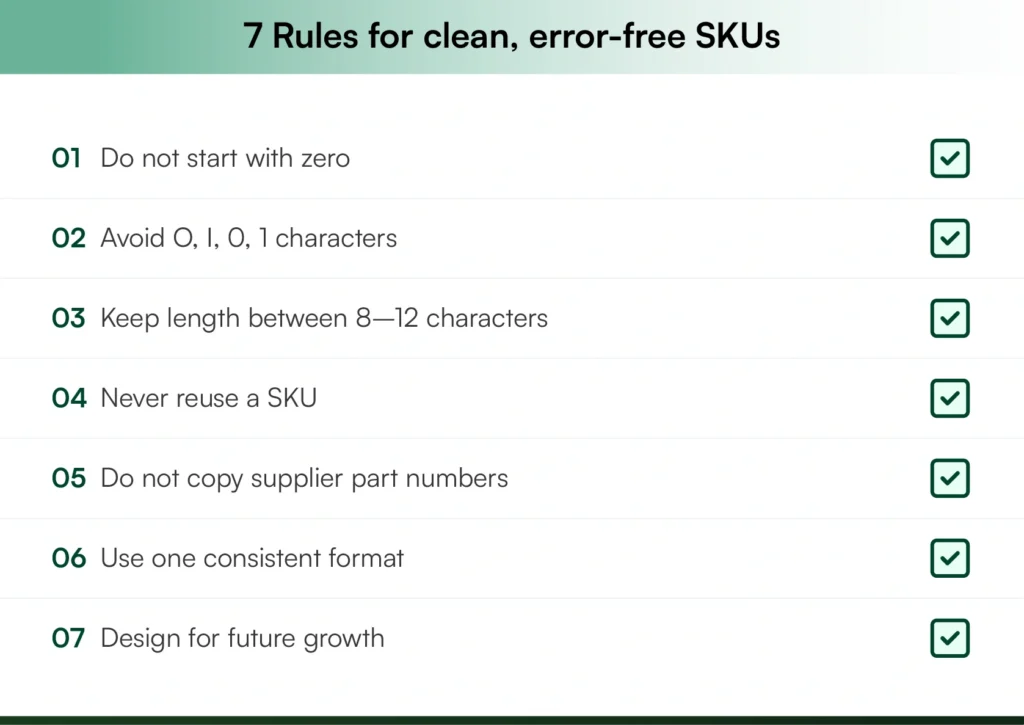
- Never start with zero: A SKU that begins with “0” creates problems in spreadsheets and enterprise resource planning systems, as many automatically drop leading zeros and silently corrupt your data. Always start your SKU codes with a letter or a non-zero digit. This single rule prevents a surprisingly common class of SKU management errors from ever occurring.
- Avoid ‘look-alike’ characters: The letters O and I, and the numbers 0 and 1, are nearly indistinguishable in many fonts and on printed product packaging. Using them in your unique SKU codes invites misreads, manual entry errors, and fulfillment mistakes. Exclude these characters from all SKUs entirely. It is a simple rule that eliminates a persistent source of team confusion.
- Keep it concise: The most effective SKUs are 8 to 12 characters long. Beyond that, they become unwieldy to enter manually, harder to read on UPC or barcodes labels, and more prone to transcription errors. Concise SKU codes are faster to type into your pos system, easier to communicate verbally, and cleaner to display in product catalogs and reports.
- Avoid manufacturer part numbers: Using a supplier’s own part numbers as your internal SKU ties your SKU system to an external party’s logic. If the manufacturer changes their numbering, your SKU data breaks. Always create your SKUs using your internal format. This keeps your inventory management independent and consistent, regardless of supplier changes.
- Do not reuse SKUs: Once a SKU is retired, it should never be reassigned to a different product. Reused SKU codes corrupt historical data, distort sales analysis, and make it impossible to accurately audit past product performance. Treat every retired SKU as permanently off the table. Your SKU management system and your future reporting will be better for it.
- Standardize the format: Every SKU in your system should follow the exact same structural logic. Mixed formats, where some codes start with letters and others with numbers, or where lengths vary randomly, make SKU management inconsistent and error-prone. Standardized unique SKUs with a clear, documented format are the backbone of clean retail operations and reliable inventory levels across all sales channels.
- Keep it scalable: Design your SKU system to accommodate growth from day one. Leave room for new products, additional product variations, and new product lines without having to restructure your entire format. A scalable alphanumeric code system with logical, extendable segments means you will never have to rebuild your inventory management system from scratch as your catalog expands.
How to manage SKUs at scale
As your business grows, learning how to manage SKU proliferation becomes a major challenge. If you’re selling on your own website, Amazon, and maybe a physical pop-up shop, you cannot manage SKUs in silos.This is where centralized inventory management, the kind WizCommerce is built for, becomes essential.
Here is why it’s a non-negotiable for scaling:
- The ‘single source of truth’: When you sell a unit on Amazon, your stock levels automatically update on your main dashboard and every other sales channel. This ensures that your available inventory is always accurate, preventing overselling and the need to send “out of stock” emails to customers. For a deep dive into how centralized systems work, see the guide on cloud-based inventory management software.
- Unified data: Centralization brings all your SKU data, from product details to pricing, into one place. This simplifies retail operations by allowing you to update product descriptions or prices once and have them reflect across all sales channels instantly. Read more about how SKUs support smarter retail operations here.
- Simplified restocking: With all data in one place, you can easily see which items are hitting their reorder points. This real time visibility allows for smarter purchasing decisions, ensuring you always have the right product variations in stock to meet demand. This lowers the risk of stockouts on high-performing product lines and prevents capital from being tied up in slow-moving similar products.

Scale Smarter with WizCommerce
Understanding how to use SKU effectively is only half the battle. The other half is having a platform built to handle them at scale. WizCommerce is purpose-built for wholesalers, distributors, and manufacturers who need every unique SKU working seamlessly across their entire operation.
- AI-powered SKU search that never misses: WizOrder, WizCommerce’s B2B order taking app typo-tolerant, AI-powered search lets sales reps locate any product SKU instantly by name, code, color, size, or even a sample image. Even at 10,000-plus SKUs, your team finds the right specific product in seconds, every time.
- Real-time inventory visibility across every channel: WizCommerce’s centralized inventory management system ensures your stock levels update automatically across your website, ERP, and offline channels the moment a sale is made. Your SKU data is always accurate, always current, and always reliable.
- Automated order entry with Ella: Ella, WizCommerce’s AI order automation agent, reads incoming purchase orders in any format and maps each line to the correct unique SKU automatically. This eliminates manual SKU management errors and reduces data entry mistakes by 90%.
- Personalized catalogs powered by clean SKU data: WizShop, the B2B Ecommerce Platform, uses your centralized SKU data to serve each wholesale customer a tailored catalog with accurate available inventory, relevant product details, and customer-specific pricing, all in real time.
Whether you are a growing SKU for small business or managing thousands of product lines across multiple sales channels, WizCommerce gives you the infrastructure to scale your inventory management cleanly and confidently without rebuilding your systems as you grow.
Ready to take control of your SKUs? Book a demo and see how WizCommerce handles your SKUs at scale.
FAQs
What are common SKU mistakes to avoid?
The most common SKU mistakes include starting codes with zero, reusing retired SKUs, using special characters or look-alike letters, copying supplier part numbers, and failing to standardize the format across the team. Each error corrupts your SKU data and makes accurate inventory management progressively harder.
Do small businesses need SKUs?
Yes. A SKU for a small business is one of the highest-leverage operational investments you can make early. Assigning unique SKU codes to every product variation gives you accurate stock levels, clean sales data, and a foundation to scale without a painful inventory management overhaul later.
How many numbers should a SKU have?
The most effective SKUs are 8 to 12 characters long, combining letters and numbers in an alphanumeric code. This length encodes meaningful product attributes like category, color, and size while remaining short enough for fast manual entry. Final characters typically hold a sequential number for variant differentiation.
What should SKUs not include?
SKU codes should never include special characters (/, &, *, #), leading zeros, look-alike characters (O/0, I/1), spaces, or supplier part numbers outside your control. Keeping your SKUs free from these elements ensures your SKU system stays stable and consistent across all sales channels and platforms.
What does a SKU number tell you?
A well-constructed SKU number encodes brand, type of item, product variations, and a sequential number for specific configurations. For example, WIZCO-SHIRT-BLU-MED communicates brand, item, color, and size instantly. The SKU meaning in business goes further, it gives you visibility into inventory levels, sales data, product performance trends, and product recommendations.