Skip to content



TL;DR
|
Most wholesalers do not set out looking for Shopify B2B alternatives. They start on Shopify because it is familiar, well-documented, and quick to launch. Then wholesale becomes a real part of the business, and the gaps start to show up.
Catalog limits get hit, ERP sync requires a middleware layer that breaks every few months, and sales reps taking orders at trade shows are still on paper because nothing works offline. Transaction fees on high-volume wholesale orders become a line item that makes the finance team uncomfortable.
This is not a Shopify problem. The platform was primarily designed for consumer retail. Shopify Plus, while adding B2B capabilities, is still layered on top of an ecommerce platform that was not built with wholesale complexity as the starting point.
This guide covers the best Shopify B2B alternatives for wholesalers in 2026. Each option is assessed honestly, with a clear view of what it does well and where it shows its limits. The goal is to help you find a platform built for how wholesale works, not one you must bend into shape.
Why do wholesalers look for Shopify alternatives in B2B?
Wholesalers look for Shopify B2B alternatives when the platform directly limits their revenue or prevents them from scaling operations. The decision to evaluate alternatives to Shopify reflects that wholesale revenue has outgrown what the Shopify store was built to support.
- Transaction fees compound at scale: Shopify charges 0.6% to 2% per sale unless you use Shopify Payments exclusively, which adds up quickly at wholesale order values. At high-volume wholesale transactions, this fee structure creates measurable margin erosion that purpose-built wholesale platforms do not impose.
- Catalog and pricing limits: The three-catalog limit on non-Plus plans and pricing tier constraints create a ceiling that most growing wholesale operations hit quickly. Distributors running multiple pricing tiers across distinct customer segments reach that ceiling well before their business reaches operational maturity.
- No native offline selling: Trade shows, showrooms, and field sales, where a large share of wholesale revenue is generated across sales channels, have no native support in Shopify. Sales reps who rely on offline trade show order-taking tools rather than paper lose significantly fewer orders at moments when buyer intent peaks. Check out our blog on how to use Shopify POS for conventions and trade shows.
- ERP integration requires ongoing dev work: Real-time bidirectional sync between Shopify and enterprise resource planning systems like NetSuite or Sage is not built in and demands expensive middleware. Most middleware layers require ongoing maintenance, and failures create data gaps that directly affect order accuracy.
- Checkout compromises in B2B mode: Enabling Shopify B2B disables Shop Pay, Apple Pay, Google Pay, and accelerated checkout options, and blended stores cannot fully separate B2B and DTC checkout behavior. Wholesale buyers expect payment terms, purchase orders, and account-level structures that the standard Shopify checkout architecture was not built to support.
What should you look for in a Shopify B2B alternative?
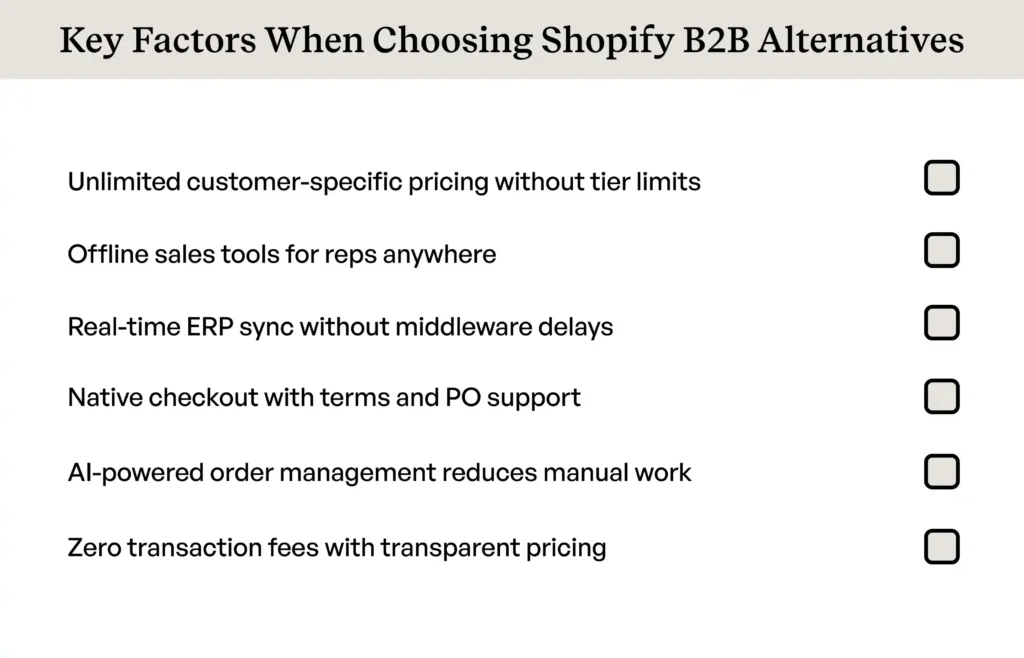
The right ecommerce platform, evaluated using the framework in our B2B platform selection guide, must address the operational gaps that make Shopify alternatives for B2B necessary at wholesale scale. Each requirement below maps to a real gap affecting revenue, margin, or team efficiency. One gap sits outside the platform question entirely: Shopify has no account layer for your sales team, so most wholesalers replacing it end up choosing a CRM at the same time. Our comparison of the best CRM for wholesale distributors covers that half of the decision.
- Your platform must support unlimited customer-specific price lists with no tier caps that restrict growth.
- Native sales reps tools must work offline at trade shows and in the field without requiring connectivity to function.
- Pre-built ERP integrations must deliver real-time sync rather than periodic data pulls that create lag.
- Wholesale-native checkout must support payment terms, purchase orders and multi-buyer account hierarchies natively.
- AI-powered order management and product recommendations must reduce the manual workload across your sales teams.
- Transparent pricing with no per-transaction fees on wholesale orders must be part of the base offering.
- Go-live timelines must stay under 60 days without months of custom development work required.
Also read: Shopify Plus vs Native B2B Ecommerce Platform: Which One Is Better For Wholesalers
Best Shopify B2B alternatives for wholesalers in 2026
These platforms represent the strongest Shopify B2B alternatives in the ecommerce software market for wholesale in 2026. Each carries a different total cost of ownership, business model fit, and implementation timeline suited to a specific operator profile.
| Platform | Transaction fees | ERP integration | Offline selling | Go-live time | Built for wholesale |
| WizCommerce | None | 100-plus pre-built, real-time | Native, offline-first | Under 30 days | Yes, exclusively |
| BigCommerce B2B | None | App-based | No native support | 4 to 8 weeks | Partial |
| Adobe Commerce | None | Custom development required | No native support | 3 to 6 months | Partial |
| OroCommerce | None | Custom development required | No native support | 3 to 6 months | Yes, complex setup |
| NuORDER | None | Limited connectors | No native support | 4 to 8 weeks | Partial, visual focus |
| WooCommerce | None | Plugin-dependent | No native support | Variable | No, plugin-dependent |
WizCommerce
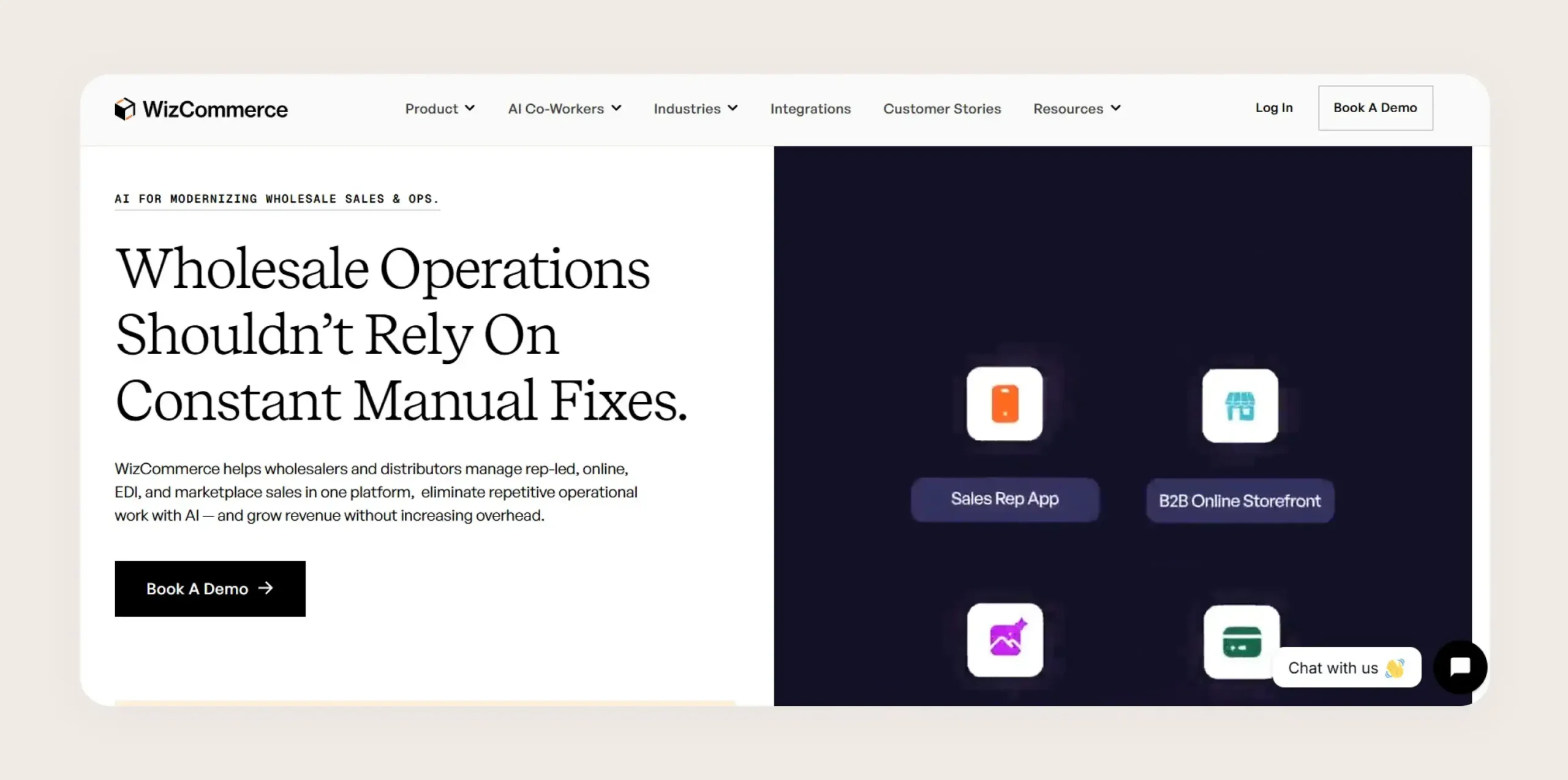
WizCommerce is an AI-powered B2B order management software built specifically for wholesale operations. It is not a retail platform with B2B features added on. Every product in the WizCommerce suite of tools was designed around how wholesalers sell:
- Online portals
- Sales reps in the field
- Incoming purchase orders that need to become clean ERP data
The platform brings together four core products:
- WizShop is a wholesale-native B2B ecommerce platform where buyers self-serve 24/7, see their exact pricing, and place orders against their assigned custom catalogs.
- WizOrder is the sales rep app that works offline at trade shows and showrooms, with automatic sync when connectivity returns.
- WizCRM is the wholesale distributor CRM holding accounts, contacts, deals and rep follow-ups on the same record as the order history, so the relationship and the transaction aren’t split across two systems.
- WizPay handles net terms, ACH, credit cards and custom payment structures embedded directly into the wholesale workflow.
- WizStudio handles product imagery, letting sales teams generate professional catalog and lifestyle photography without coordinating external photoshoots.
What are the Key features of WizCommerce?
- Unlimited buyer-specific price lists: Every account sees their negotiated pricing enforced accurately at every touchpoint, with no catalog caps or tier limitations applied across your customer base.
- Offline rep selling at trade shows: WizOrder lets your sales reps take orders without internet connectivity, with all data syncing automatically once the connection is restored.
- AI Order Entry Assistant: Incoming purchase orders from emails, PDFs, spreadsheets, and scanned documents are converted into clean, ERP-ready orders without any manual data entry from your team.
- 100-plus pre-built ERP integrations: NetSuite, QuickBooks, Fishbowl, Sage, and Microsoft Dynamics all sync with pricing, inventory management, and order data in real time. They function as a complete order management system with no middleware required.
- No transaction fees on wholesale orders: Revenue is not shared back to the platform, which drives operational efficiency at the order values and volumes that wholesale businesses process daily.
- Go live in under 30 days: A dedicated implementation team handles catalog migration, ERP setup, and rep onboarding, so the transition requires minimal effort from your internal team.
Who Should Use WizCommerce?
Wholesalers, manufacturers, and distributors who need a purpose-built B2B platform with AI-powered selling, rep tools, and deep ERP integration.
Why WizCommerce is the best alternative for Shopify B2B?
WizCommerce is built exclusively for wholesale, with native ERP integration, offline rep selling, AI-powered order entry, unlimited buyer-specific pricing, and zero transaction fees. Shopify B2B requires costly workarounds for all of these. See the full side-by-side breakdown of WizCommerce as a Shopify alternative B2B wholesalers can run without apps.
BigCommerce B2B Edition
BigCommerce B2B Edition suits brands already operating a consumer-facing online store that are adding a wholesale channel incrementally. Its feature set reflects a retail-first platform, with B2B functionality layered on top rather than built in natively.
What are the key features of BigCommerce B2B Edition?
- BigCommerce supports headless commerce deployments for custom storefront development without platform restrictions.
- Native quote management lets sales teams build and send price proposals from the admin interface.
- Corporate account management supports multi-user buyer accounts with role-based permissions per contact.
Where BigCommerce B2B Edition falls short?
- ERP integration relies on the app store and app-based third-party connectors rather than native real-time tools.
- No native offline selling exists for trade show reps or field-based selling environments.
- B2B marketing tools require multiple apps, raising the actual cost of ownership above the base plan.
Adobe Commerce (Magento)
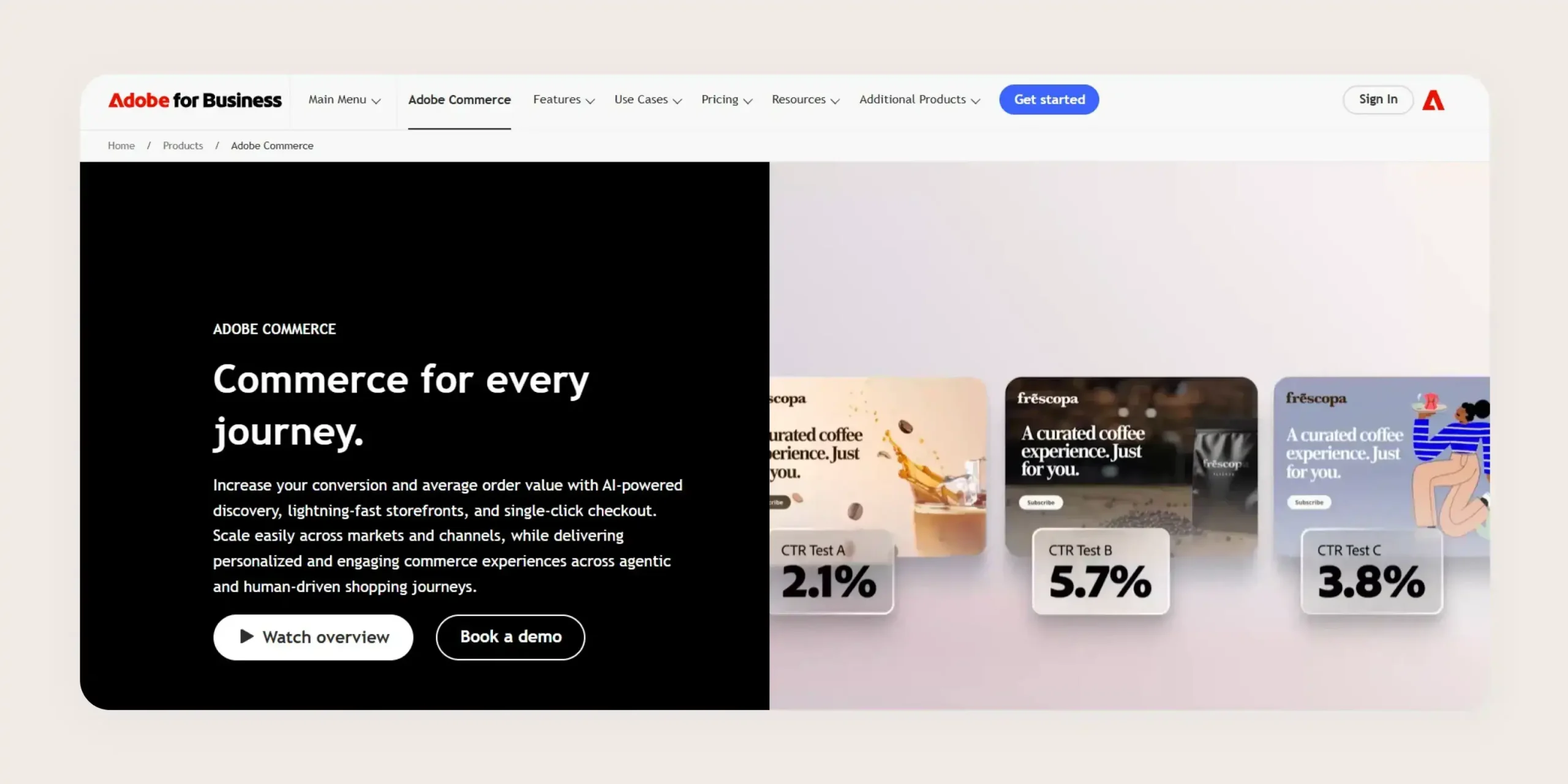
Adobe Commerce gives large enterprises complete control over their commerce stack through an open-source architecture with deep customization options. Achieving that depth requires significant investment in custom development before the platform delivers value at scale.
What are the key features of Adobe Commerce?
- Open-source architecture gives developers complete control over every storefront customization option available.
- Shared catalogs assign specific products and pricing structures to defined buyer customer groups simultaneously.
- RFQ workflows guide wholesale buyers through structured quote negotiation before order confirmation occurs.
- Multi-entity support via Adobe Commerce Cloud lets large enterprises manage multiple brands from one backend.
Where Adobe Commerce falls short?
- Implementation requires extensive custom development and runs for three to six months at a minimum.
- No native offline order-taking exists for reps in field or trade show selling environments.
- Adobe Commerce licensing costs consistently place this platform out of reach for most mid-market wholesalers.

OroCommerce
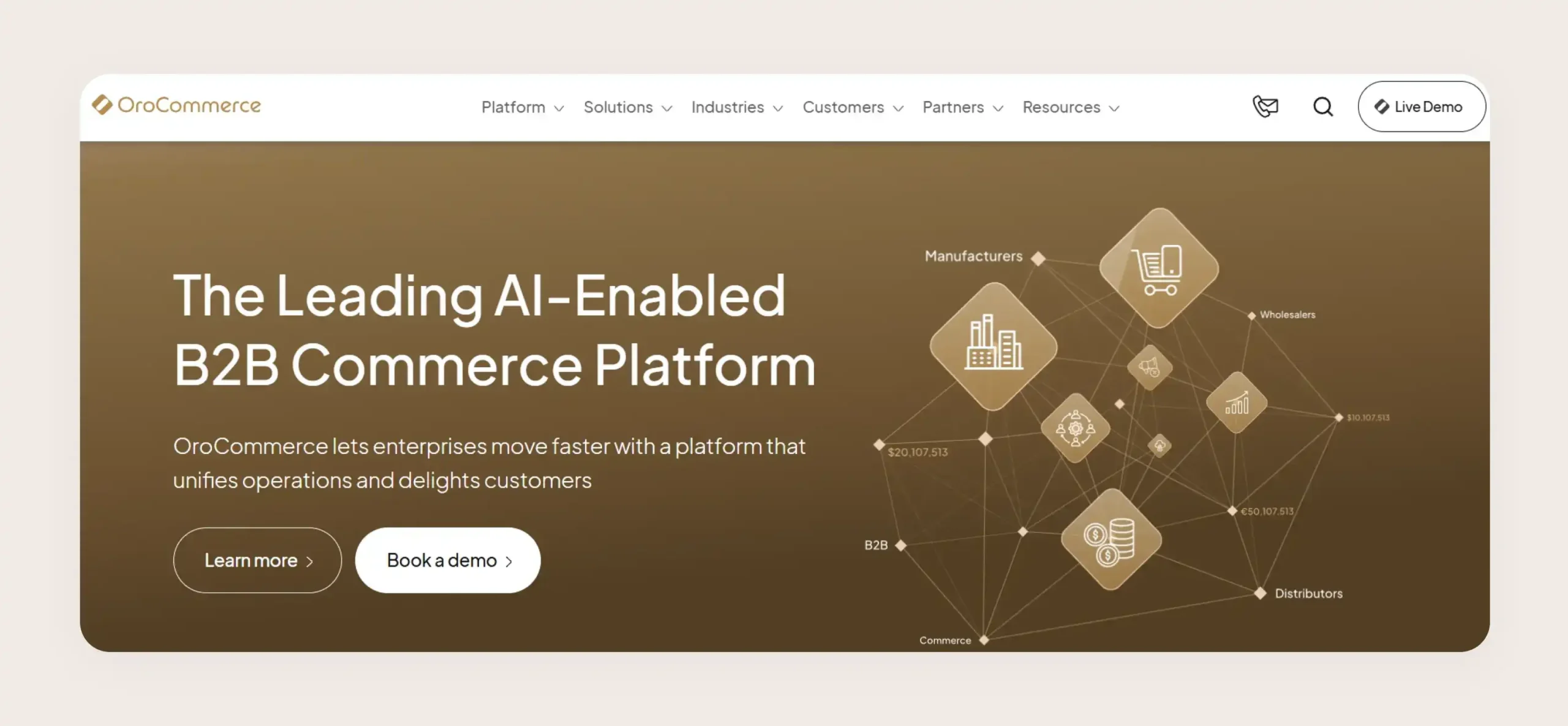
OroCommerce was built by the original Magento team with a dedicated focus on B2B commerce for businesses with complex needs. Unlocking its full capabilities requires implementation timelines better suited to organizations with experienced development teams than fast-moving wholesale operators.
What are the key features of OroCommerce?
- Built-in customer relationship management connects sales activity and customer relationships within one platform.
- RFQ workflows guide buyers through structured quote negotiation before any order is confirmed.
- Corporate account hierarchies support parent-child structures with distinct permissions per organizational entity.
Where OroCommerce falls short?
- Implementation runs three to six months, delaying time-to-revenue for wholesale operators significantly.
- Total cost of ownership is high and consistently strains most mid-market wholesale business budgets.
- No AI-native workflows adapt to customer behavior or automate incoming purchase order documents.
NuORDER by Lightspeed
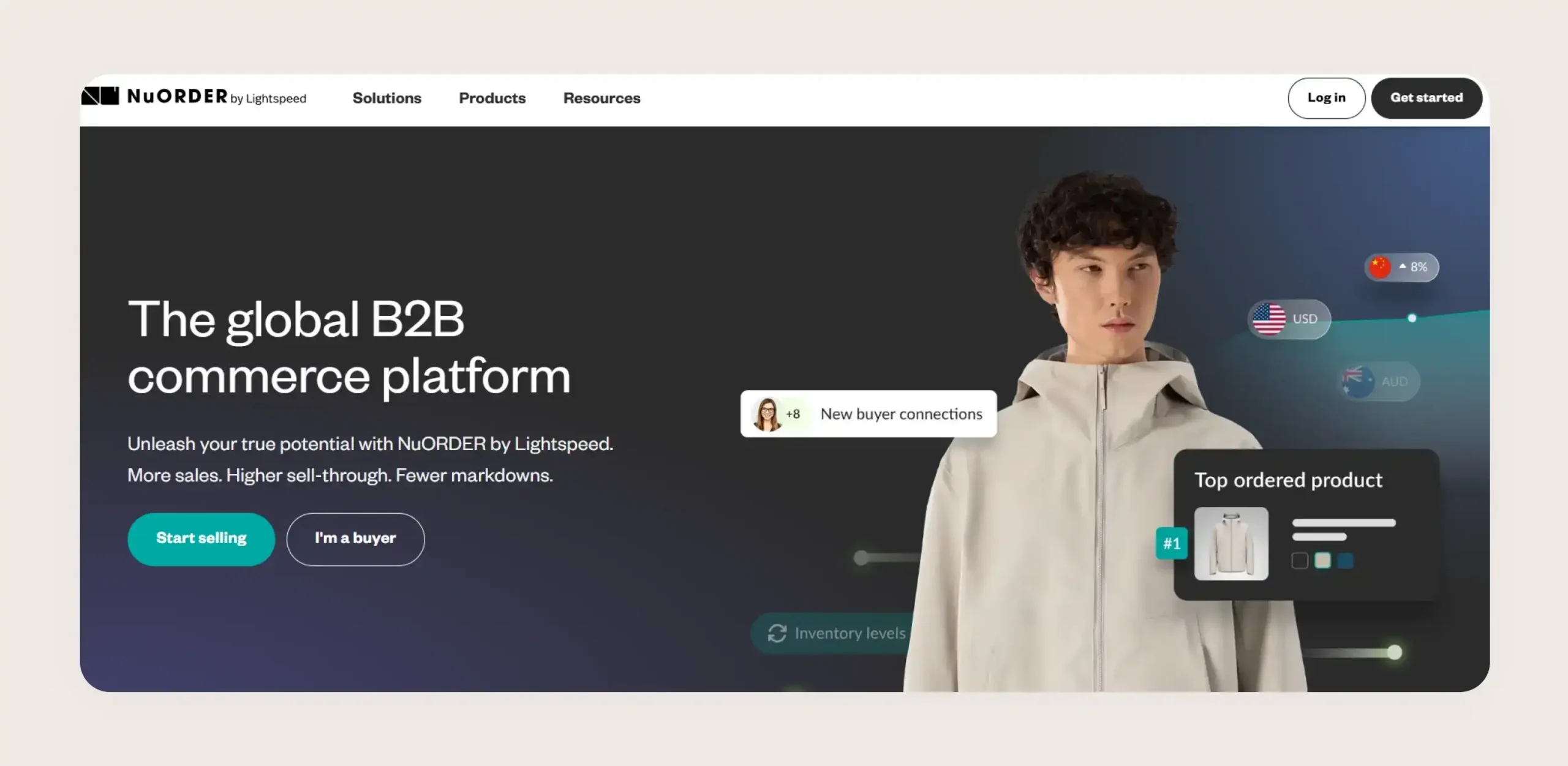
NuORDER by Lightspeed is a visual wholesale platform built for fashion and lifestyle brands that prioritize showroom catalog presentation over operational depth. It functions as a front-end selling tool rather than a complete ecommerce solution for manufacturers or distributors.
What are the key features of NuORDER?
- Visual catalog presentation supports drag-and-drop digital line sheets for showroom and market appointments.
- Shoppable lookbooks let wholesale buyers order directly from styled product imagery during appointments.
- 360-degree product views give buyers a detailed reference before committing to wholesale order quantities.
- Mobile apps for iOS and Android let reps manage social media-linked market appointments and order capture.
Where NuORDER falls short?
- Limited ERP integration makes real-time inventory and pricing sync difficult for distribution operations.
- No AI-powered order processing tools exist for incoming purchase order documents at any tier.
- Fashion and lifestyle focus makes NuORDER a poor ecommerce store fit for industrial wholesalers.
WooCommerce with B2B plugins
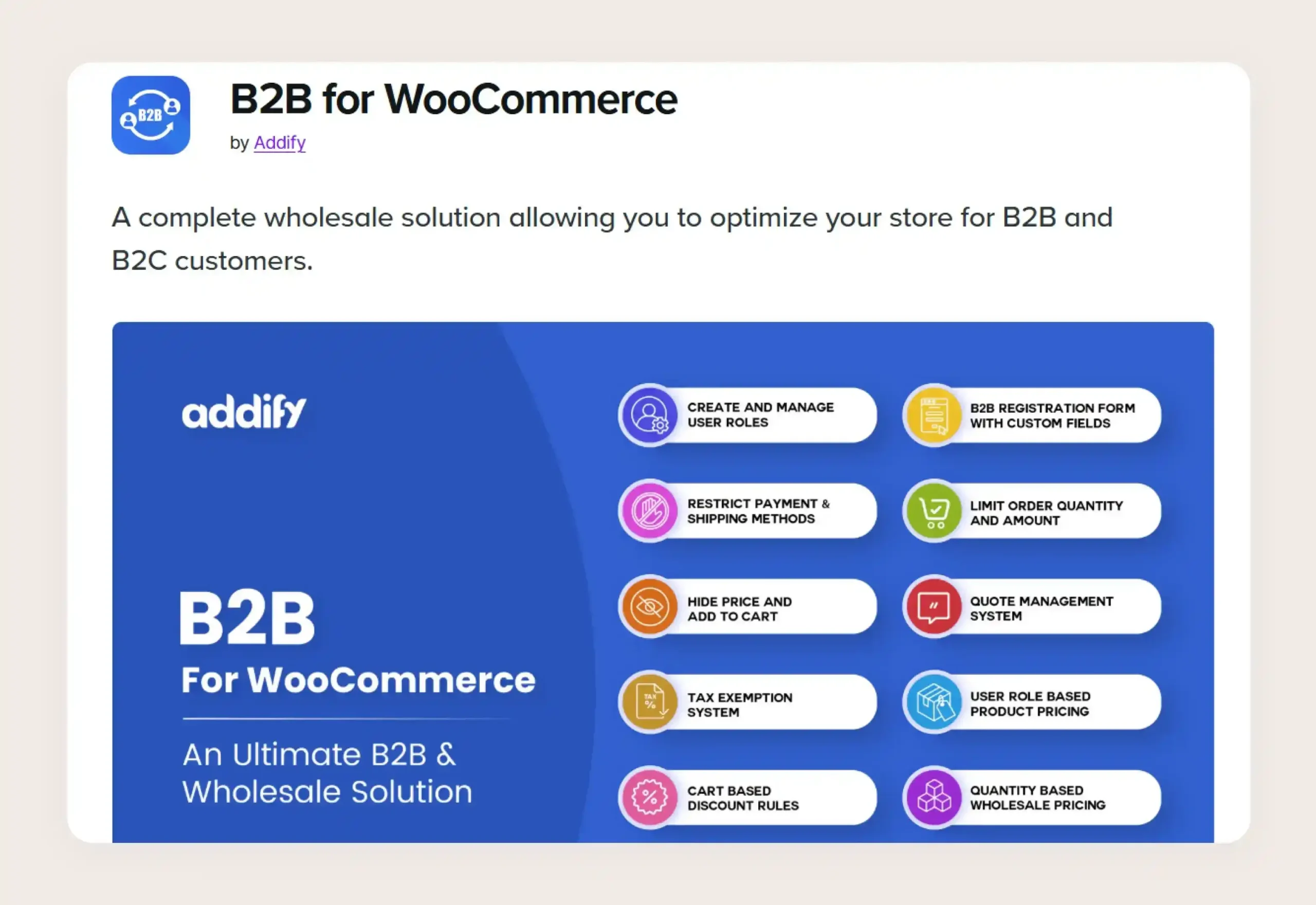
WooCommerce is a free, open-source website builder built on WordPress that requires plugins to enable B2B wholesale functionality for any online business. It shifts full responsibility for security updates, plugin compatibility and technical maintenance onto the business operating it.
What are the key features of WooCommerce B2B?
- Open-source architecture gives developers complete control over every layer of the online store.
- Role-based pricing plugins assign different wholesale price lists to registered buyer groups.
- WordPress integration includes seo tools and content management within the same admin environment.
Where WooCommerce B2B falls short?
- B2B wholesale workflows depend entirely on third-party plugins with reliability risks at scale.
- No native order management system handles complex wholesale accounts or real-time ERP sync.
- Ongoing technical maintenance raises the actual cost of ownership well above the free plan baseline.
What are the key factors to consider when choosing the right Shopify alternative?
The right ecommerce platform for wholesale depends on where wholesale sits in your revenue model. These five factors will help you identify the right choice before committing to any platform migration.
- Sales reps drive meaningful revenue at trade shows or in person: You need offline order-taking as a native feature, not a third-party app that introduces compatibility and sync risks. The absence of this capability translates to lost revenue at every market or trade show your team attends.
- More than three pricing tiers: Catalog caps on Shopify and Shopify competitors like BigCommerce standard plans create immediate friction as your customer base grows. If your business already runs Gold, Silver, Bronze, Distributor, and Retail pricing, your platform must handle all tiers natively from day one. Read a detailed breakdown of Shopify costs here.
- Run on an ERP: Prioritize platforms with pre-built, real-time integrations over API-only connections that require middleware and ongoing developer maintenance. The total cost of ownership for a poorly integrated enterprise resource planning connection compounds in ways rarely visible during the initial evaluation.
- Process high-volume, high-value wholesale orders: Transaction fees on Shopify scale into a significant cost center faster than most businesses anticipate when credit card processing fees stack on top of the platform surcharge. At wholesale order values, even a 0.6% fee adds up to a meaningful margin reduction across a full year.
- Need to go live quickly: Platforms like WizCommerce with dedicated implementation and customer support get you selling in weeks, not months. Customer experience continuity during migration matters as much as the feature set when building your best ecommerce platforms shortlist.
Final thoughts
Wholesale is not a feature you bolt onto a retail platform and expect to scale. It is a fundamentally different selling motion that demands buyer-specific pricing, rep-led order capture, real-time ERP data, and a checkout built for business buyers following best practices for B2B commerce, not individual consumers.
WizCommerce was built with that reality as the starting point. Every product in the platform, WizShop, WizOrder, WizPay, and the AI Co-Workers, exists to solve the operational problems wholesale businesses run into. Among the Shopify alternatives assessed here, it is the only ecommerce solution built exclusively for wholesale from the ground up.
If wholesale is a meaningful part of your revenue today, or a serious growth priority for the year ahead, the platform underneath your operations matters more than most businesses realize until they hit its limits. Finding the right fit early saves the disruption and cost of migrating under pressure later.
Explore WizCommerce’s B2B ecommerce platform to understand what purpose-built wholesale infrastructure looks like in practice.
Get in touch with our team today and get started.
Frequently asked questions
1. Can you run a wholesale business entirely on a platform other than Shopify?
Yes. Purpose-built Shopify B2B alternatives like WizCommerce and BigCommerce run complete wholesale operations without Shopify dependency. These platforms deliver stronger ease of use for B2B workflows and a wholesale-native user experience that Shopify requires third-party apps to replicate for most ecommerce store operators.
2. What is the most affordable Shopify B2B alternative for a small wholesale operation?
WooCommerce’s free plan makes it the lowest-cost entry point for small businesses exploring wholesale. WizCommerce provides essential features at a predictable cost without per-transaction fees eroding margins. Plugin costs and email marketing integrations often erase the apparent cost of ownership advantage WooCommerce initially appears to offer.
How do Shopify B2B alternatives handle sales tax exemptions for wholesale buyers?
Most Shopify B2B alternatives, including WizCommerce and BigCommerce, support tax exemption certificates at account level as advanced features for B2B checkout. Exemption rules apply per company profile, buyer segment or region across all business plans. Initial setup during onboarding eliminates manual tax handling on every order placed through your online store.
Can a Shopify B2B alternative integrate with my existing accounting software?
Yes. WizCommerce provides 100-plus pre-built integrations connecting in real time with QuickBooks, Sage, NetSuite and Microsoft Dynamics as part of its core offering. A dedicated free trial validates integration accuracy before full commitment, and the best Shopify B2B alternatives support accounting connectivity across all business plans selected.
What happens to my existing customer data when I migrate from Shopify to a B2B platform?
Customer data, including account records, order history, pricing agreements and contact information, can be migrated to websites like Shopify alternatives through structured export workflows. WizCommerce’s implementation team handles this during standard onboarding, protecting customer satisfaction throughout the transition period. Platforms with dedicated migration support ensure customer data integrity and operational continuity across the switch.