Skip to content



TL;DR
|
Shopify has made a lot of noise in the B2B space. Its B2B GMV grew over 100% in 2025, and the platform has been rolling out wholesale features at a fast pace. For wholesalers evaluating their options, the pitch is appealing: one platform for both DTC and B2B, a familiar interface, and a brand name with serious credibility.
Here is where wholesalers often run into trouble. Shopify was built for retail. Its B2B capabilities, while improving, are layered on top of a consumer-first architecture. The result is a platform that works well for simpler wholesale setups and shows its limits the moment operations get more complex.
This blog takes an honest look at Shopify Plus vs. B2B e-commerce platforms built specifically for wholesale. We will cover where Shopify delivers, where the gaps appear in practice, and why wholesalers with serious operational complexity tend to outgrow it faster than expected.
What does a modern B2B e-commerce platform need to do?
A modern B2B e-commerce platform must enforce customer-specific pricing, support offline rep selling, handle complex order structures, sync with your ERP in real time, and manage multi-buyer company accounts without manual intervention.
Wholesale is not a retail operation; it handles larger orders. The platform you choose must handle what consumer-first e-commerce tools were never designed to manage at operational scale.
- Customer-specific pricing at scale: Every wholesale buyer operates on negotiated rates finalized during the sales process. Those rates must be enforced precisely at checkout across every order channel without manual intervention. A missed pricing tier or an incorrect price erodes both margin and buyer trust.
- Offline and rep-led selling: A significant share of B2B revenue flows through sales reps at trade shows, showrooms, and in-person meetings. Your platform needs to support this motion natively rather than relying on a wholesale app that sits outside your core order architecture and conflicts with your pricing logic.
- Bulk order management: Wholesale orders carry large quantities, complex product variants, and minimum order quantities that standard checkout flows were never designed to handle. Buyers placing bulk orders by the case or pallet expect a purchasing process that matches how they buy at volume.
- Deep ERP integration: Pricing, inventory, and order data must move between your e-commerce platform and your ERP without lag or manual work in between. A delay in product data synchronization can disrupt an entire order cycle for a high-value account at a critical moment.
- Buyer account structures: A single wholesale company may have multiple buyers, each operating under different permissions, custom pricing tiers, and order history. The platform must manage this hierarchy cleanly without requiring manual configuration to maintain each account relationship over time.
Where Shopify Plus holds up for B2B
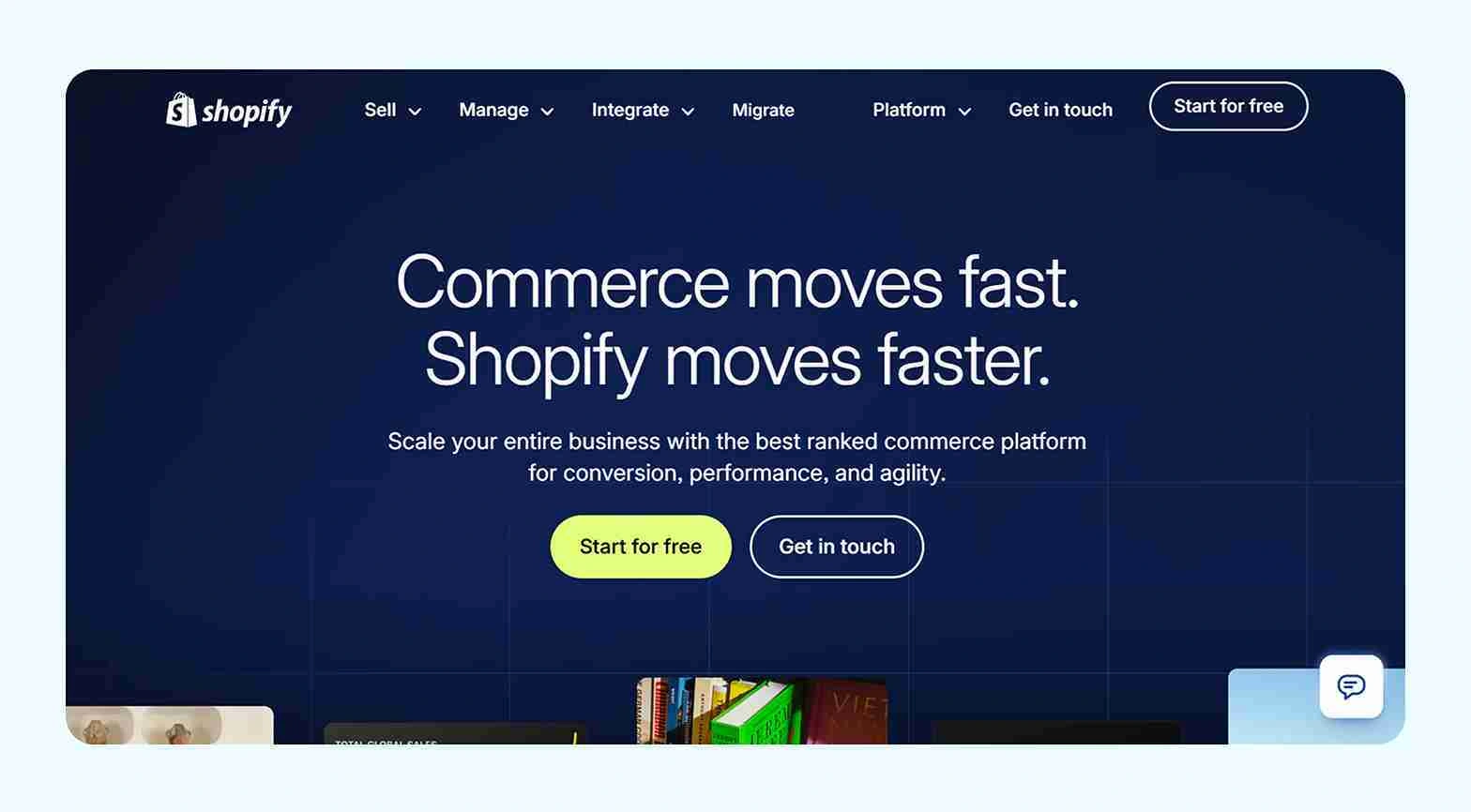
Shopify Plus delivers genuine value for specific wholesale configurations. Understanding where it works helps you assess whether it fits your actual operation before committing resources.
- Blended DTC and B2B operations: Brands running consumer and wholesale channels from the same business benefit from a unified Shopify admin. Company profiles, custom catalogs, and net payment terms work alongside the DTC Shopify store without requiring a separate system to manage each segment independently.
- Self-serve buyer portal: The buyer portal is polished and handles moderate complexity reliably. Wholesale buyers log into their customer accounts, browse assigned catalogs at correct wholesale pricing, place bulk orders, and review order history without pulling a sales rep into routine transactions. The buying experience holds up well at this level of operational complexity.
- Shopify Flow automation: Shopify Flow lets merchants automate repetitive tasks without engineering involvement. Account tagging for customer segmentation, reorder reminders for key accounts, and alerts for orders above a specific order size all run without manual tasks accumulating in the back office across the team.
- App ecosystem and integrations: Shopify has one of the broadest app ecosystems available for commerce. Most accounting platforms, shipping tools, and CRM systems carry native Shopify connectors through the Shopify app store, and the Shopify ecosystem is well-maintained by third-party developers who understand the platform deeply.
Here’s our critical review of whether Shopify works for wholesalers and distributors.
Where Shopify Plus breaks down for serious wholesalers
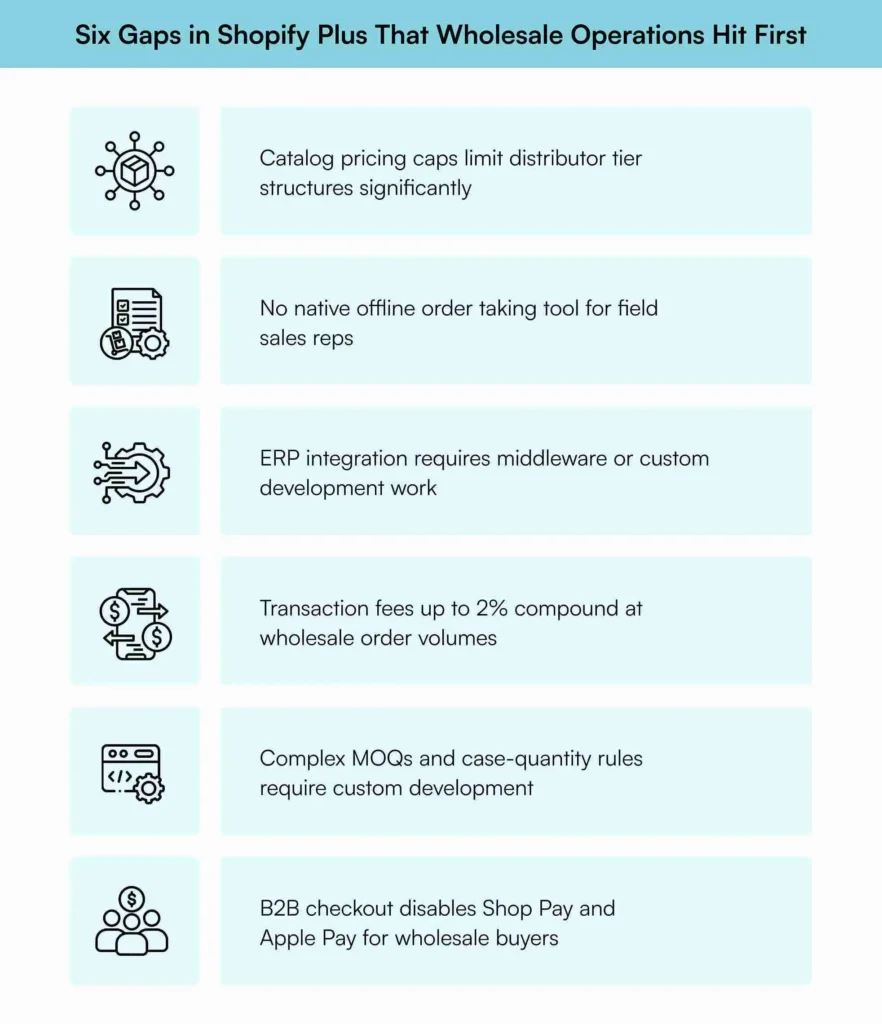
The limitations of Shopify Plus surface fast as wholesale operations scale beyond simple pricing and order structures. These are the failure points wholesale operators encounter most consistently.
- Catalog ceiling and pricing complexity: Shopify Plus caps the number of catalogs available per store. A distributor running Gold, Silver, Bronze, Distributor, and Retail tiered pricing hits the native limit before building a standard wholesale pricing structure. Every additional tier beyond that cap requires custom development or plan upgrades, raising the total cost of ownership for the business. In case you want a detailed breakdown of Shopify pricing for B2B sellers, check out our blog.
- No offline or rep-led selling: Shopify lacks native functionality for sales reps to take orders at trade shows or in the field. This is one of the clearest gaps between Shopify vs. native B2B apps built for wholesale operations. Rep-led selling requires third-party apps from the Shopify app store (e.g., Shopify POS) that do not always integrate cleanly with native B2B pricing and customer account structures.
- Checkout compromises in B2B mode: When Shopify B2B is active, Shop Pay, Apple Pay, and Google Pay are disabled during checkout for wholesale buyers. Discount codes and gift cards apply to both retail customers and wholesale buyers in a blended store, creating pricing exposure that requires careful, ongoing management to contain.
- ERP integration depth: Real-time, bidirectional ERP sync requires significant development work or expensive third-party middleware. Keeping product data reliably synchronized between Shopify and systems like NetSuite or Sage is an ongoing operational burden. Shopify default settings do not accommodate this natively, and the problem compounds as order volume increases across your accounts.
- Transaction fees compound at scale: Shopify charges a third-party gateway fee of between 0.6% and 2% on every sale when using credit cards through external payment providers, with payment processes running outside Shopify Payments. The cost of Shopify at wholesale order values compounds into a meaningful margin reduction that purpose-built wholesale platforms eliminate by design.
- No support for complex MOQs and order rules: Shopify’s native checkout does not handle order minimums, pack sizes, or case-quantity rules without custom development work. These are standard operational requirements for most wholesale businesses, and leaving order limits unaddressed creates account-level risk with every large order that enters the system.
Shopify Plus vs B2B e-commerce platform: Direct comparison
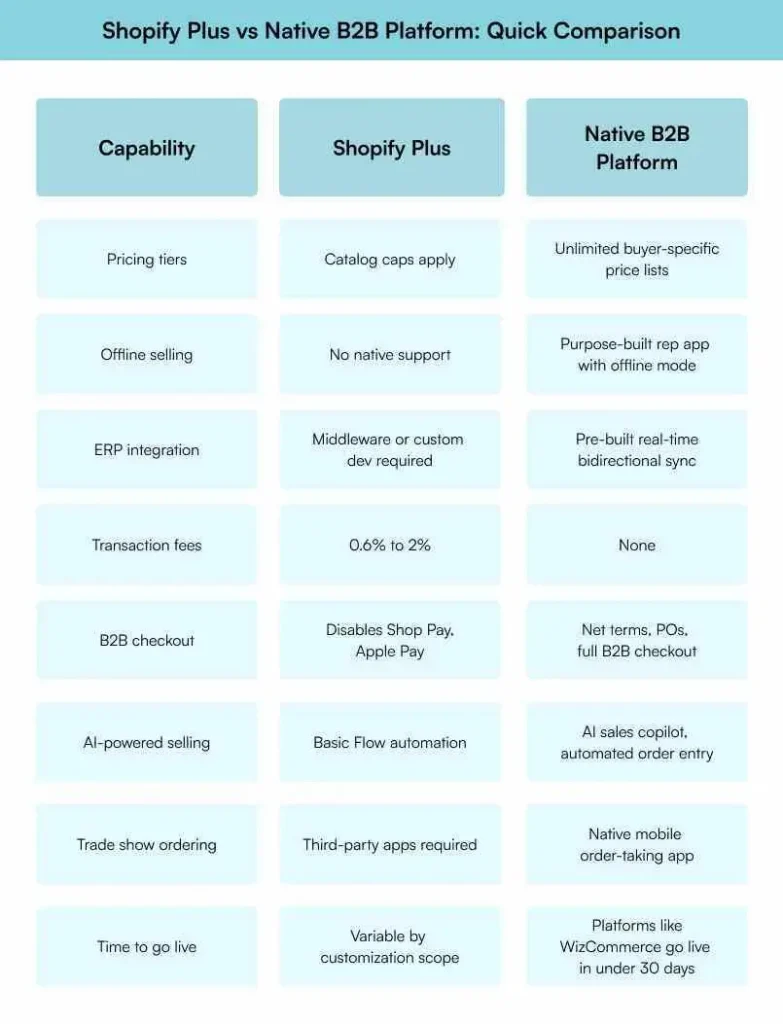
When comparing Shopify vs other platforms purpose-built for wholesale, the gaps become structural issues. They reflect the fundamental difference between a retail system extended for wholesale and a wholesale system built from scratch.
This table maps the main differences between Shopify Plus vs B2B e-commerce software options on capabilities that wholesale operations depend on most.
Which wholesaler is each platform suited for?
The right answer on Shopify B2B vs traditional B2B depends on where wholesale sits in your revenue model and how much operational complexity your accounts require.
Shopify Plus works well when
Your wholesale channel is new, wholesale pricing is simple, and you run both DTC and B2B under the same brand. Sales reps play a minimal role, and customer groups follow simple structures, with minimal deep account-level configuration requirements. For small businesses entering wholesale, the ease of use and familiar Shopify store environment meaningfully reduce time-to-first-order.
The standard plan may even cover initial wholesale experience needs if volume and percentage discounts meet your custom pricing requirements without advanced features or order limits requiring custom development.
A native B2B platform is the better choice when
Wholesale drives a meaningful share of total revenue, and your operations depend on capabilities Shopify does not support without third-party customization. You manage multiple tiered pricing structures, your sales reps sell at trade shows and in person, and your wholesale operation requires real-time ERP data sync without custom connectors or middleware. If that describes your operation, the shortlist narrows to a Shopify alternative B2B wholesalers run natively rather than a retail platform plus a stack of apps.
The same applies if your store serves wholesale customers with unique needs, such as different prices, flexible payment terms, and account-specific order rules. For a distributor selling to trade accounts, a distributor e-commerce platform manages those requirements without manual order entry, hand-maintained customer tags, or workarounds that break under volume. The operational efficiency gains in user experience and shopping experience become measurable within the first quarter of operation.
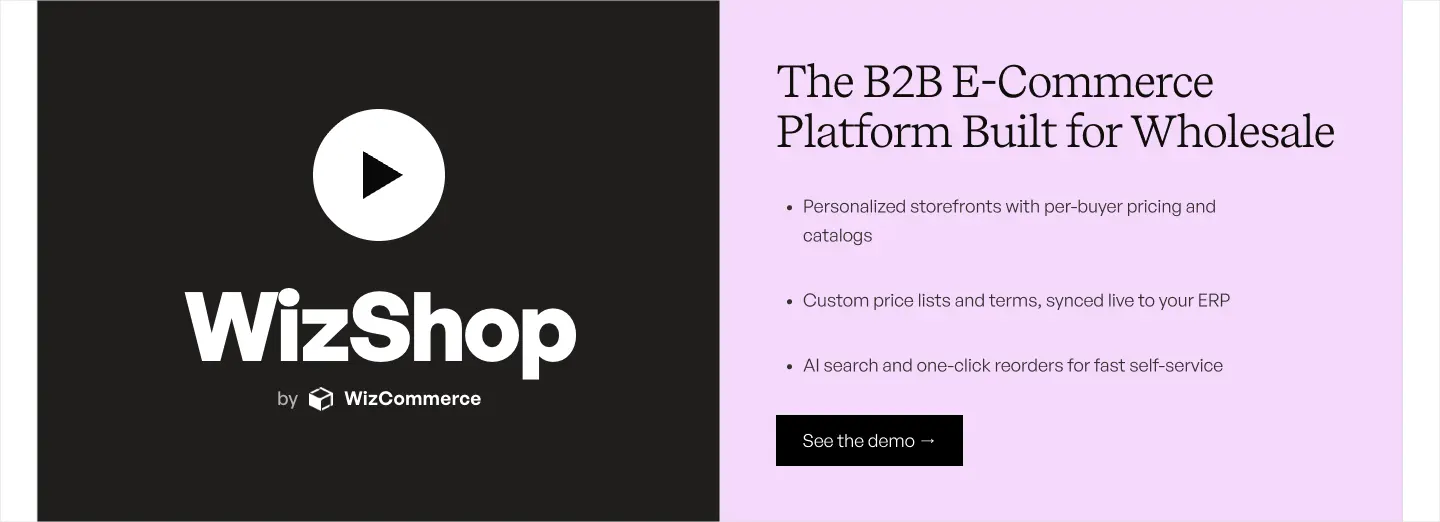
WizCommerce is built for the wholesale complexity that Shopify cannot handle natively
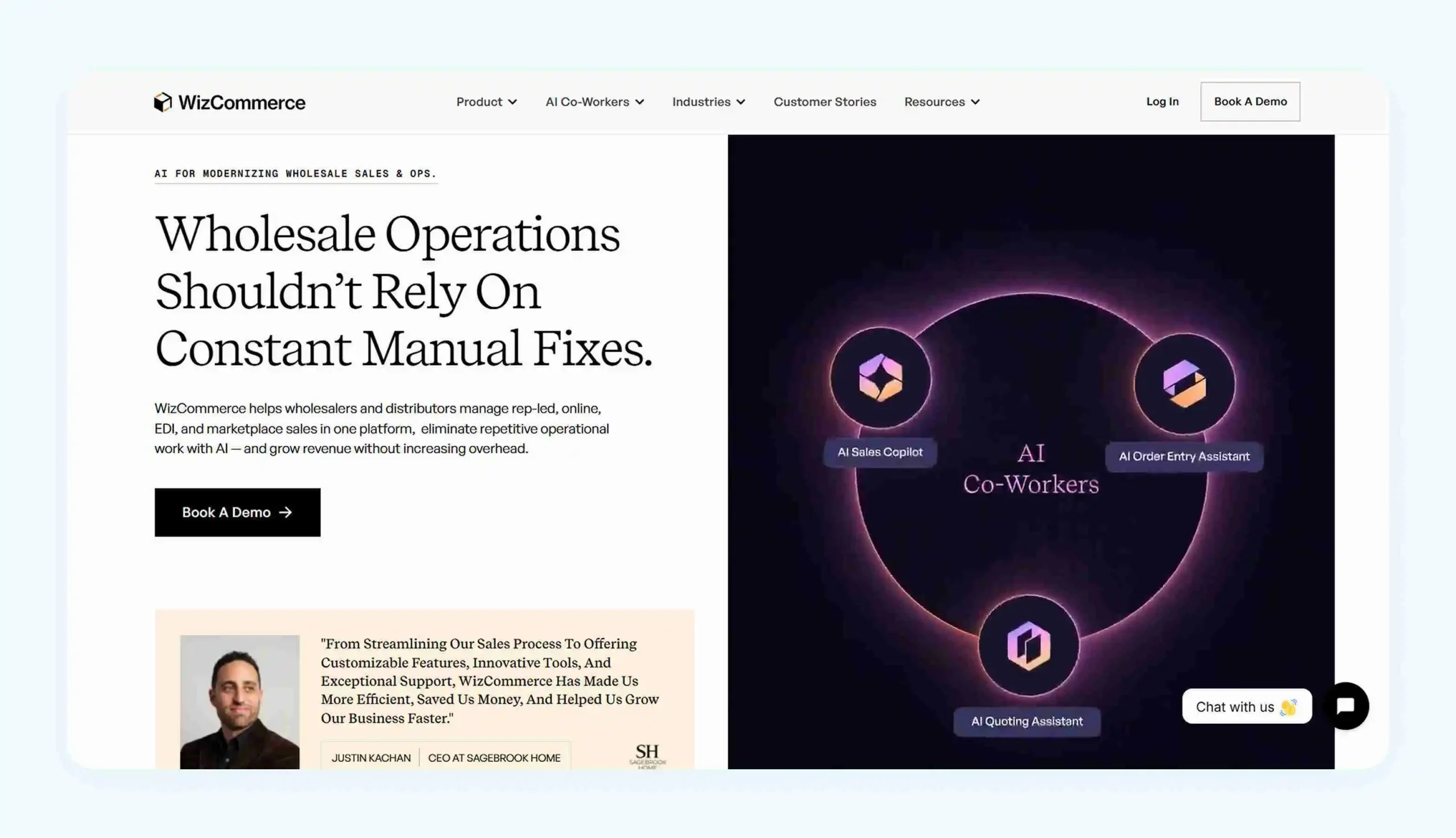 WizCommerce is an AI powered B2B order management platform built specifically for wholesalers, manufacturers, and distributors. Unlike platforms adapted from retail, every feature here has been designed around how wholesale operations run. The result is a system where the capabilities Shopify requires workarounds to deliver are built in natively from day one.
When comparing Shopify vs. other purpose-built wholesale systems, WizCommerce occupies a different category entirely. It is not a wholesale app layered onto a retail e-commerce platform. It is a complete wholesale operation platform with e-commerce, rep selling, payments, and AI built on one B2B order management system.
Understanding how WizCommerce’s B2B e-commerce platform works will help you understand why wholesalers with real operational complexities switch from Shopify Plus:
- WizShop, the B2B e-commerce portal: Buyers self-serve 24/7 with their exact pricing, assigned catalog, and full order history without calling a sales rep. WizShop reflects what wholesale customers expect from a modern, purpose-built online store with custom pricing built in natively.
- WizOrder, the sales rep app: Reps take wholesale orders offline at trade shows and showrooms, with automatic sync restoring all data the moment connectivity returns. WizOrder closes the gap that Shopify vs native B2B apps comparisons expose most visibly for wholesale teams operating in the field.
- AI Order Entry Assistant: Incoming purchase orders from emails, PDFs, spreadsheets, and scanned documents are automatically converted into clean, ERP-ready orders. Manual order entry is eliminated across the back office, freeing your team from the hours of manual work that were consumed in the previous workflow.
- AI Quoting Assistant: It reads inbound Requests for Quotation (RFQs) in any format, understands who sent them (lead or customer), applies the right pricing logic, and creates accurate, sales-ready quotes in minutes, so your team responds faster and wins more deals.
- 100-plus pre-built ERP integrations: Pricing, inventory, and order data sync with NetSuite, QuickBooks, Fishbowl, Sage, and Microsoft Dynamics in real time with no middleware. Integrations with the right tools for wholesale ERP sync are included from day one, without additional development investment.
- No transaction fees on wholesale orders: Revenue is not shared back to the platform, which matters significantly at the order values and volumes that wholesale businesses process. This directly improves margin on wholesale orders without requiring changes to your sales motion or payment processes.
- Go live in under 30 days: A dedicated implementation team handles catalog migration, ERP setup, and rep onboarding so the transition requires minimal internal resources.
Book a demo with WizCommerce to see how a platform built for wholesale handles the complexity that Shopify Plus vs. B2B e-commerce platform comparisons consistently reveal in practice.
FAQs on Shopify Plus vs Native B2B E-Commerce Platform
1. Can you use Shopify Plus and a native B2B platform together?
Yes, some wholesale businesses run Shopify Plus for their DTC channel while using a dedicated B2B platform like WizCommerce for wholesale operations. This approach gives each channel the right tools without forcing wholesale complexity onto a retail-first system. The two platforms synchronize through ERP integration to maintain unified inventory and order data across both channels.
2. Does Shopify B2B work without a Shopify Plus subscription?
Shopify expanded some B2B features to standard plans in 2025, including basic company profiles and limited price lists. The full feature set: unlimited catalogs, direct buyer assignment, and advanced payment terms, remains exclusive to the Shopify Plus plan. Most wholesale businesses with real operational requirements still need the Shopify Plus plan to access a complete wholesale experience on the platform.
3. How long does switching from Shopify Plus to a dedicated B2B platform take?
Timeline varies by catalog size and ERP complexity. Platforms like WizCommerce go live in under 30 days through a guided implementation process covering catalog migration, ERP setup, and rep onboarding. This is significantly faster than the variable customization timelines that Shopify vs. B2B wholesale apps integration approaches entail for distributors and manufacturers operating at scale.
4. What happens to B2B checkout when Shopify B2B is enabled on a blended store?
When Shopify B2B is active, accelerated checkout options, including Shop Pay and Apple Pay, are disabled for wholesale buyers during checkout. Discount codes and gift cards apply across both retail customers and wholesale buyers unless additional configuration separates the two segments. This requires ongoing management to prevent unintended discounts from reaching the wrong customers or affecting margins on wholesale orders.
5. What features do native B2B platforms offer that Shopify Plus does not support natively?
Native B2B platforms include offline rep selling, tiered pricing without catalog caps, pre-built ERP integrations without middleware, zero transaction fees for bulk orders, and AI-powered entry from purchase order documents. These are the capabilities that make Shopify Plus vs. B2B e-commerce platform comparisons critical for distributors and manufacturers.