Skip to content



Shopify is an ecommerce platform that enables businesses to build online stores and process transactions. While it is a dominant player designed mainly for B2C retail, its native capabilities for wholesale are significantly narrower.
In this blog, we break down the Shopify pricing structure to determine whether it is a suitable and cost-effective solution for B2B brands.
Shopify pricing at a glance
Here is a quick snapshot of Shopify pricing plans before the full breakdown. Use this table to compare plans by monthly cost, transaction fees, and staff accounts briefly before diving into the details.
| Plan | Monthly cost (annual billing) | Transaction fee (third-party gateway) | Staff accounts | B2B features |
| Basic | $39 | 2% | 2 | Limited via apps |
| Grow | $105 | 1% | 5 | Limited via apps |
| Advanced | $399 | 0.6% | 15 | Limited via apps |
| Plus | $2,300+ | Negotiable | Unlimited staff accounts | Native B2B suite |
Shopify pricing plans in 2026
Unlike many enterprise platforms, Shopify pricing plans are publicly displayed on the website. However, the advertised monthly fee represents only your baseline investment, not your total cost of ownership.
Here are the four Shopify plans available in 2026:
- Shopify Basic costs $39/month
- Shopify Grow costs $105/month
- Shopify Advanced costs $399/month
- Shopify Plus costs $2,300/month
Shopify now includes a lite version of its native B2B suite on all standard plans. From your admin dashboard, you can create company accounts and assign specific buyers to them, and offer net payment terms such as Net 30 or Net 60, so buyers can check out without paying upfront.
The catch: You are strictly limited to a maximum of three active Shopify B2B price lists. If you have 10 distributors who all receive slightly different pricing structures, standard plans will not handle this natively.
Shopify Basic Plan
Designed for solo entrepreneurs just starting out, the basic plan costs $39 per month. It includes a 2% transaction fees rate with third-party payment providers, but not when using Shopify Payments. It offers:
- 10 inventory locations
- 24/7 chat support
- In-person selling via Shopify POS
- Up to 77% shipping discount
For small businesses testing wholesale, this pricing plan provides a solid foundation but will require right apps from the Shopify app store to handle any meaningful B2B complexity.
Shopify Grow Plan
Targeted at small teams expanding their online store, the Grow Shopify plan costs $105 per month. Third-party payment providers incur a lower transaction fees rate of 1%.
It offers everything covered in the previous plan, plus:
- 5 staff accounts
- Up to 88% shipping discount
- Professional reports
Store owners moving beyond solo selling will find the additional staff accounts useful, though the same three-catalog B2B limitation applies at this tier as with the basic plan.
Shopify Advanced Plan
Built for large businesses seeking global reach, the advanced plan costs $399 per month. The third-party payment processing fees drop further to 0.6%.
It offers everything covered in the previous plan, plus:
- 15 staff accounts
- Enhanced 24/7 chat support
- Third-party calculated shipping rates
- Duties and import taxes
- Custom report builder for advanced analytics
Store owners needing granular advanced features around reporting and logistics will find this tier significantly more capable than Grow, though the B2B catalog cap remains.
Shopify Plus Plan
Engineered for complex businesses and high-volume merchants, this plan starts at $2,300 USD/month (on a 3-year term). It offers customizable transaction fees and rates tailored for high volume.
It offers everything covered in the previous plan, plus:
- Unlimited staff accounts
- 200 inventory locations
- 24/7 live chat support
- Fully customizable checkout
- Up to 200 POS Pro locations
- Native wholesale/B2B selling capabilities
Shopify Plus is where the native B2B suite fully unlocks. Custom catalogs, custom pricing tiers, dedicated buyer portals, unlimited Shopify B2B price lists, and draft order management all become available without relying on the Shopify App store.
Also read: Pitfalls of a B2B ecommerce site on a B2C platform
| Cost component | Basic plan | Shopify Plus |
| Base subscription | $39 | $2,300 |
| App subscriptions | $100 to $400 | $0 to $200 |
| Transaction fees (third-party) | Up to 2% per order | Negotiable |
| Theme and dev costs (amortized) | $30 to $80 | $50 to $150 |
| ERP middleware | $100 to $300 | $100 to $300 |
| Estimated monthly total | $300 to $850-plus | $2,600 to $3,100-plus |
Additional Shopify cost components
The headline Shopify pricing figures are only the starting point. Understanding the full cost of ownership means accounting for the additional layers that most B2B sellers encounter as they scale beyond basic store functionality.
Shopify Plus for B2B
For B2B brands, standard plans lack native wholesale features. To access custom pricing tiers, bulk discounts, and wholesale checkout without a patchwork of apps, businesses must upgrade to Shopify Plus. This significantly raises the Shopify B2B cost, starting at approximately $2,300 to $2,500 per month.
It is a steep commitment for growing B2B merchants coming from lower Shopify pricing plans. The Shopify Plus investment is only financially justified when sales volume and order complexity genuinely require the native B2B capabilities it unlocks.
Transaction and payment processing fees
The Shopify pricing structure is not always transparent about transaction fees. Unless you use the proprietary Shopify payments gateway, Shopify charges a platform transaction fee of 0.5% to 2% on top of your payment gateway’s processing fees (typically 2.9% plus $0.30 per transaction).
On a basic plan using a third-party gateway, a single $100 order can incur over 5% in combined fees. This is a compounding Shopify cost that eats into margins on wholesale orders.
Also read: Shopify for Trade Shows: The Ultimate Guide to Wholesale Orders
Shopify Payments vs third-party payment gateways
Using Shopify Payments eliminates the platform transaction fees entirely. This is the most direct way to reduce ongoing payment processing costs on any Shopify plan. The trade-off is that Shopify Payments is only available in select countries and requires merchants to process all payments through Shopify’s own system.
This limits flexibility for wholesale buyers who prefer credit card networks or regional payment methods outside the Shopify ecosystem. For merchants on Shopify Plus, payment processing fees rates are negotiable at scale, which is one of the clearest financial advantages of the Shopify Plus plan for high-volume B2B sellers.
The cost of the app ecosystem
Shopify’s core platform is intentionally streamlined, which means most B2B merchants must rely on the Shopify App Store for essential wholesale functionality. Adding standard features like minimum order quantities, custom pricing quotes, or bulk pricing typically requires 5 to 10 third-party Shopify App subscriptions. These ongoing costs add $100 to $500-plus per month, often exceeding the base Shopify pricing subscription itself. This does not include the B2B wholesale apps for Shopify that businesses need to replicate native B2B functionality at scale.
Hidden costs of customization and scaling
The advertised base subscription is rarely what B2B sellers pay as they scale. There is a large gap between the advanced plan at $399 per month and Shopify Plus at $2,300-plus per month, with no middle ground. Meaningful B2B customization that includes unique custom workflows, customer groups, and wholesale checkout logic often requires hiring developers for custom Liquid code or purchasing premium Shopify themes from the Shopify theme store ($180 to $350). Theme development and developer fees compound the total cost of ownership in ways that are not visible during the initial plan selection process.
Monthly vs annual billing: How much can you save on Shopify?
Choosing annual billing over monthly billing is the most straightforward way to reduce your Shopify cost without changing plans. Shopify offers approximately 25% savings on all Shopify pricing plans when billed annually versus month-to-month, and this applies across the Basic, Grow, and Advanced tiers. At the Shopify Plus plan level, the discount structure is typically negotiated directly as part of the contract terms.
| Plan | Monthly billing | Annual billing | Annual saving |
| Basic | $49/month | $39/month | ~$120/year |
| Grow | $132/month | $105/month | ~$324/year |
| Advanced | $500/month | $399/month | ~$1,212/year |
| Plus | Variable | From $2,300/month | Negotiated |
Which Shopify B2B pricing plan is right for your business?
Choosing the right Shopify plan depends on your business size, order complexity, number of pricing tiers, and how much of your B2B functionality you need natively versus through apps. Here is how to self-qualify before committing to a pricing plan.
When the Basic plan makes sense
- Your wholesale channel is early-stage, with fewer than three distinct buyer pricing tiers to manage.
- Your sales volume is low enough that transaction fees at the 2% rate do not create a meaningful margin impact across orders.
- You are comfortable supplementing with the right apps from the Shopify app store for basic quote management and volume discounts.
- Your team is small enough that the two-staff accounts limit does not restrict operations or create workflow bottlenecks.
When to upgrade to Grow or Advanced
- Your order volume has grown to where the transaction fees difference between Basic and Grow begins to offset the higher monthly fee across your total transactions.
- Your team has expanded beyond two members and needs additional staff accounts to manage orders, customer inquiries, and draft orders simultaneously.
- You need advanced analytics and custom report builder access to track average order value, customer groups performance, and channel-level profitability.
- Your mobile responsiveness and product pages require more sophisticated Shopify themes and user experience investment than the basic plan supports cleanly.
For a critical breakdown of Shopify’s B2B features and their accessibility, check out our blog.
Shopify B2B pricing in practice: A real wholesale scenario
Understanding Shopify B2B pricing in the abstract is one thing. Seeing what it costs a real wholesale operation each month is where the numbers become actionable.
Consider a mid-size wholesale distributor on Shopify Plus with 200 active buyer accounts across five distinct pricing tiers, 30 inbound purchase orders per week by email, and a sales team of eight reps attending four trade shows annually. Their Shopify B2B cost starts at $2,300 per month for the Shopify Plus plan subscription, but that is only the beginning of their actual monthly spend.
Add $300 to $500 per month for B2B ordering apps, an ERP connector at $150 to $400 per month, and payment processing fees on every wholesale order at the negotiated Plus rate. Post-show, the team spends approximately 15 hours manually re-entering emailed POs as draft orders in the Shopify admin because there is no native automated ingestion. That staff time, at a conservative rate, adds another $400 to $600 in operational cost monthly.
The realistic total cost for this operation runs $3,400 to $4,200 per month before accounting for any theme development, custom domain, or one-off developer work for custom workflows. This is the actual Shopify b2b pricing picture that the published plan page does not show. At that monthly run rate, it is worth pricing a Shopify alternative B2B wholesalers run natively, since most of that spend goes to filling gaps rather than to the platform itself.
Also read: Is Shopify Good for Wholesale? Here’s What You Need to Know
How Shopify compares to WizCommerce
To help you evaluate your options, here is how Shopify pricing plans and capabilities stack up against WizCommerce across the features that matter most for B2B sellers looking for purpose-built B2B ecommerce platforms:
| Capability | Shopify | WizCommerce |
| Platform focus | Primarily built for B2C ecommerce brands and direct sales | Built specifically for B2B ecommerce and wholesale workflows |
| Pricing model | Tiered plans with additional costs from apps and integrations | Predictable pricing with bundled features and fewer hidden costs |
| Cost structure | Plus starts $2,300; apps, middleware, fees increase total cost | Single platform fee, no transaction fees, no middleware required |
| B2B functionality | Available via Plus plan or multiple third-party plug-ins | Fully built-in B2B functionality with no additional tools required |
| User limits | Unlimited staff accounts across all plans and configurations | Unlimited users with structured per-seat licensing based on plans |
| Apps required | Requires multiple apps to enable essential B2B features | Core B2B features included natively without third-party dependencies |
| Catalog & ordering | Advanced wholesale ordering needs apps or custom configurations | Streamlined catalog and ordering workflows designed for B2B buyers |
| Implementation | Often requires agencies, increasing setup time and overall cost | Guided onboarding included with minimal setup complexity required |
| Scalability | Scales well for B2C but struggles with complex B2B needs | Scales efficiently across businesses with growing B2B operational complexity |
| AI capabilities | Depends on third-party apps for automation and AI functionality | Built-in AI coworkers for sales, ordering, and quote automation |
| Ordering/quoting | Requires Plus plan or apps for advanced quoting workflows | Native ordering and quoting with integrated AI assistance tools |
| Integration | ERP integrations require connectors or middleware for data sync | Integrates with ERPs + QuickBooks/NetSuite for real-time sync of orders, inventory, and customer data |
| Product image generation | Not available natively; requires external tools or applications | Native AI image generator: WizStudio |
The biggest difference is that Shopify is built for B2C brands willing to piece together functionality through apps. WizCommerce is purpose-built for B2B ecommerce, with wholesale-specific features such as customer-specific catalogs, quote workflows, and sales-assisted ordering built into the platform.
WizCommerce also costs significantly less than running a full Shopify Plus B2B stack. When you add up Shopify Plus subscription fees, third-party app costs, middleware expenses, and transaction fees at wholesale volumes, the total cost of ownership consistently exceeds what WizCommerce charges for the same capabilities delivered natively.
Why do B2B brands choose WizCommerce?
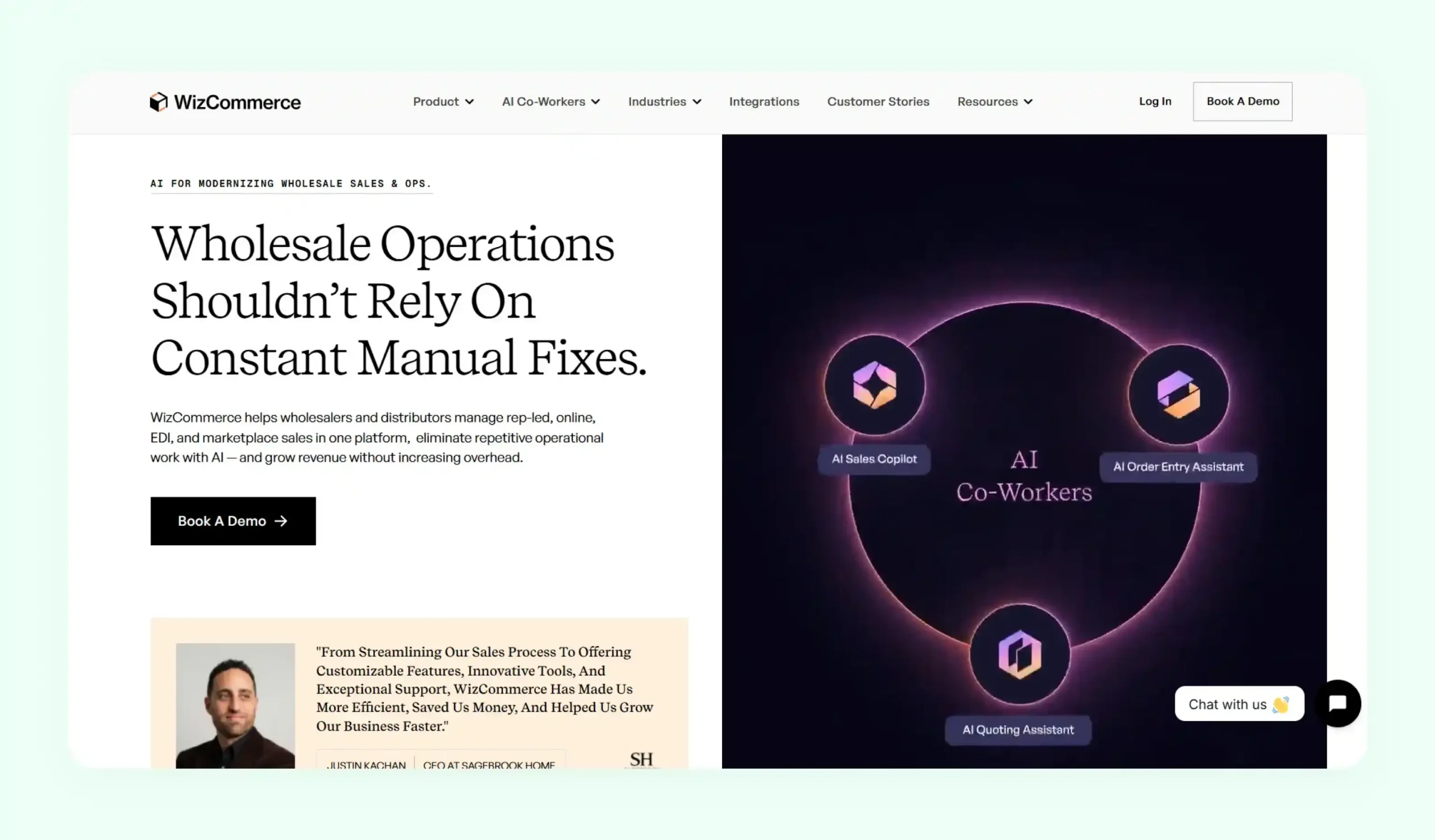
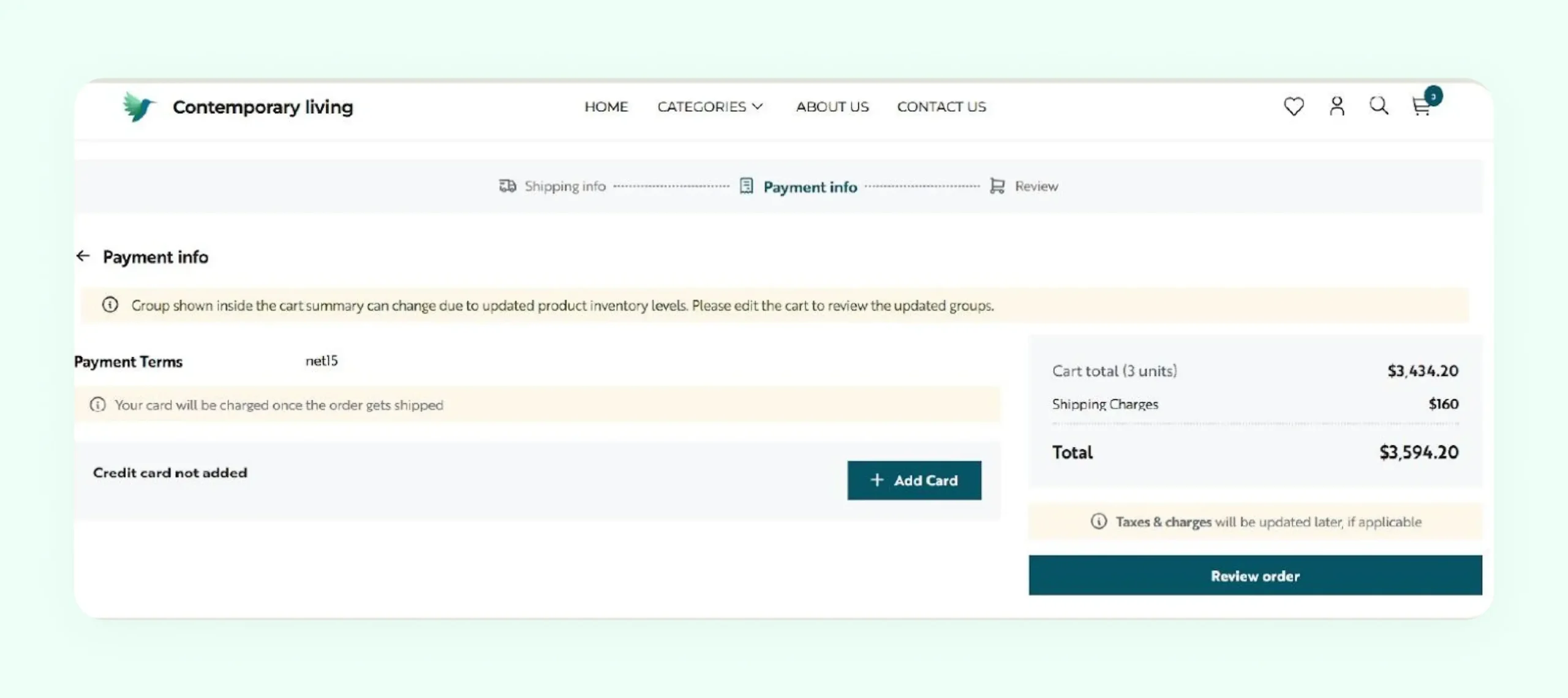
- Native B2B ecommerce: Built specifically for wholesale with custom pricing tiers, quote management, MOQs, volume discounts, and separate trade portals, all without requiring expensive enterprise upgrades or third-party apps.
- Stable, transparent pricing: Eliminates transaction fees on your own sales and avoids the surprise ongoing costs of essential features, keeping more revenue in your business at every level of sales volume.
- Inclusive implementation: Includes guided setup, data migration assistance, and team training as part of the subscription, allowing brands to launch in weeks rather than months.
- Modern AI automation: Built-in AI assistants eliminate manual work without extra integrations:
- AI order entry automation: Processes draft orders and purchase orders automatically.
- AI quoting assistant: Reads inbound RFQs in any format and generates accurate, sales-ready quotes.
- AI sales copilot: Provides reps with instant, data-driven insights during conversations.
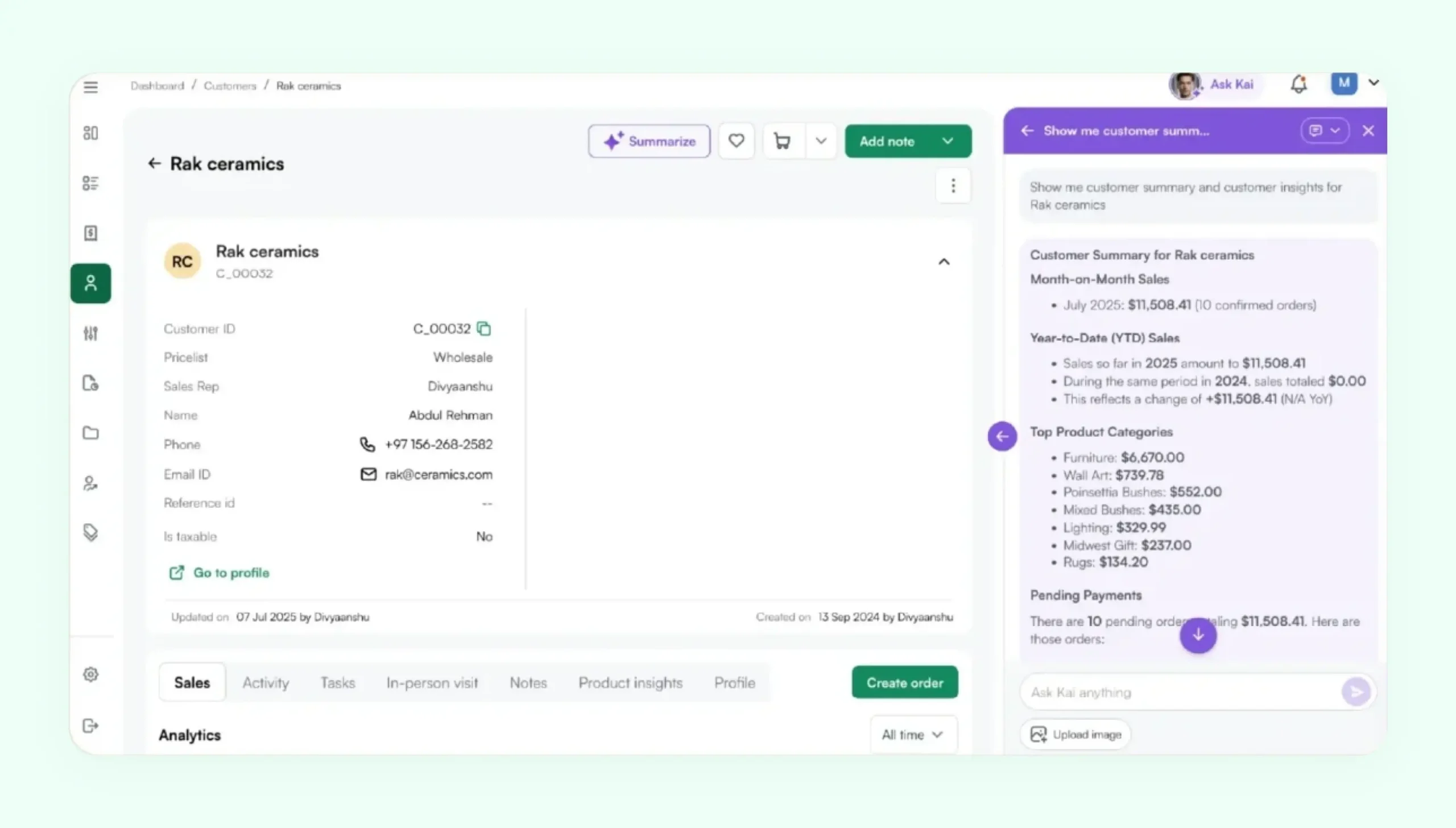
- All-in-one functionality: Reduces software costs and tech stack complexity by including multi-warehouse inventory, customer groups segmentation, flexible payment terms, and advanced analytics directly in the platform. This removes the dependency on external tools that drives up Shopify B2B cost for most operators.
A customer success story: Howard Elliott
By trading fragmented legacy tools for the unified WizCommerce ecosystem, home decor leader Howard Elliott turned operational friction into a high-velocity growth engine. Through the seamless, intuitive B2B interface of WizShop and the AI-powered creative speed of WizStudio, they drove a 15% surge in web orders and onboarded 600 new customers in just six months.
The heavy lifting is now handled by the AI Order Entry Agent that slashed manual processing time from four hours to mere minutes, while the AI Sales Assistant provides reps with the instant, data-driven insights needed to close deals with consultative precision. WizCommerce went beyond modernizing Howard Elliott’s workflow. It fundamentally redefined their “go-to-market” speed, proving that when you automate the mundane with elite AI tools, you unlock exponential scale.
With WizCommerce, your brand can also simplify B2B selling by bringing ecommerce, sales, and operations together by combining the workflows that wholesale brands actually need. Book a demo to see WizCommerce in action.
FAQs
Is there a monthly fee to sell on Shopify?
Yes, Shopify pricing includes a monthly fee. Basic Shopify costs $39/month for a full online store. There’s also Shopify Starter at $5/month, which only supports selling on social media with a buy button, not a complete online store. All plans require ongoing monthly payments; your store becomes inaccessible if payment lapses.
What are the hidden fees on Shopify?
The hidden/additional fees not included in Shopify pricing include transaction fees (0.5%-2% if not using Shopify Payments), credit card processing fees (2.5%-2.9% + $0.30 per transaction), app subscriptions ($100-$400+/month), premium themes ($180-$350), domain costs ($14-$20/year), and potential developer fees for customization. These can triple or quadruple your base monthly subscription cost.
Is it cheaper to sell on Etsy or Shopify?
The cheaper option between selling on Etsy or Shopify depends on your online sales volume and business model. Etsy charges $0.20 per listing plus 6.5% transaction fees, and 3% + $0.25 payment processing fees with no monthly fee. Shopify charges $39+/month plus processing fees but no listing fees (2.5%-2.9% + $0.30). For sales under $500/month, Etsy may be cheaper. Above $1,000-$2,000/month, Shopify pricing typically becomes more cost-effective, though B2B businesses often find WizCommerce offers better total cost of ownership.
How do I avoid fees on Shopify?
You cannot completely avoid Shopify fees, but you can minimize them by: (1) using Shopify Payments to eliminate transaction fees, (2) upgrading to higher-tier plans with lower credit card rates if volume justifies it, (3) negotiating processing rates on Shopify Plus, (4) choosing platforms like WizCommerce with native features to reduce app dependency, and (5) avoiding third-party payment processors that trigger dual fees.
Is Shopify worth the cost for a small business?
Shopify can be worth the cost for small B2C businesses valuing ease of use and willing to accept app-based functionality. However, small B2B or wholesale businesses often find better value in B2B-specialised platforms like WizCommerce, which provide native wholesale features, eliminate hidden and additional costs, and include capabilities that would require expensive Shopify apps. Calculate your total Shopify cost, including apps, transaction fees, and payment processing, before committing.
What are the main differences between Basic Shopify and Shopify Plus?
The Basic Shopify plan is designed for small B2C businesses and lacks native wholesale features, forcing you to rely on third-party apps for things like custom pricing and bulk discounts. In contrast, Shopify Plus is an enterprise-level solution (starting around $2,300/mo) that includes built-in B2B capabilities (a dedicated wholesale portal, net payment terms, and unlimited staff accounts) along with higher API limits and priority support.
Can I change my Shopify pricing plan later if my needs change?
Yes, you can upgrade or downgrade your Shopify plan at any time directly from your admin settings. If you upgrade, the change is typically immediate with a prorated charge, whereas downgrades often take effect at the end of your current billing cycle.
How much does Shopify B2B actually cost per month?
The realistic Shopify B2B cost for a mid-size wholesale operation on Shopify Plus ranges from $3,400 to $4,200 per month when you add the base subscription, B2B app subscriptions, ERP middleware, payment processing fees, and staff time spent on manual processes like PO data entry. The published Shopify B2B pricing figure of $2,300 per month reflects only the base subscription, not the full cost of ownership most wholesale operators experience.
What is the difference between Shopify B2B pricing on standard plans vs Shopify Plus?
On standard plans, Shopify B2B price lists are capped at three active catalogs. Draft orders require manual processing, and native wholesale features like dedicated buyer portals and custom pricing enforcement are unavailable without Shopify app store apps. Shopify Plus unlocks the full native B2B suite with unlimited Shopify B2B price lists, company accounts, net payment terms, and custom workflows. These features come at a starting point of $2,300 per month minimum.
Which Shopify plan is best for a wholesale business?
For wholesale businesses with annual sales volume above $1 million and more than three buyer pricing tiers, Shopify Plus is the only Shopify plan that delivers the native B2B capabilities needed without an extensive Shopify App Store stack. For smaller operations, standard plans with the right apps can bridge the gap temporarily. However, businesses with significant B2B complexity across custom catalogs, payment terms, and ERP-dependent order management consistently find that WizCommerce delivers a lower total cost of ownership at comparable or lower spend than the Shopify Plus plan.