Skip to content



Getting AI to read a purchase order no longer feels like a major engineering project. Give a capable AI model a clean PDF, ask for the customer details and line items, and you can have structured output in seconds. If your customer service representatives spend hours entering orders, it is easy to look at that result and wonder why you would pay for a platform when your own team could build something similar.
That question is reasonable. The problem is that the demonstration leaves out much of the work your order desk actually does. A buyer’s part number needs to become your SKU, a quantity in cases needs the right conversion, and the price on the document needs to agree with the customer’s contract. An order can be perfectly readable and still be wrong for your business.
For most distributors, buying AI order entry software is the better business decision. A specialist platform gives you a starting point for the integrations, validation, exception handling, and review workflows that an internal team would otherwise have to build and maintain. You still own your customer rules and approval decisions; you do not need to own every piece of software used to apply them.
The useful comparison is the cost of getting a correct order into your ERP. This article works through that comparison, including an illustrative build budget, ongoing operating costs, a three-year ownership model, and the conditions that could justify building. The aim is to help you evaluate the complete order process before a convincing prototype becomes a permanent software commitment.
Build vs buy AI order entry software: which should a distributor choose?
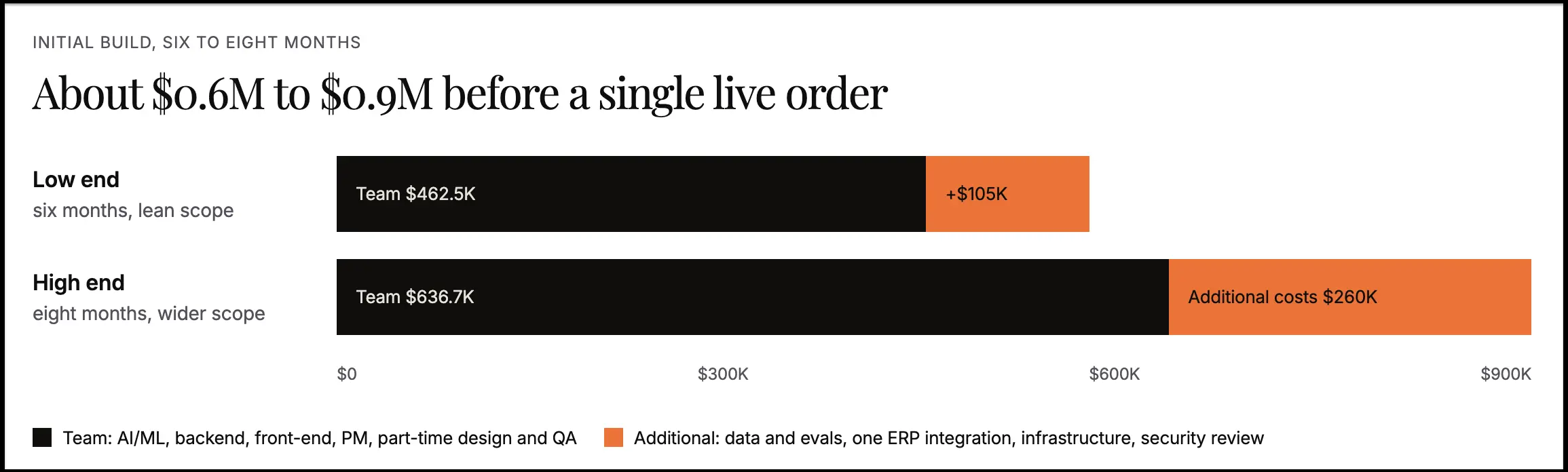
For most distributors, buy the core platform and configure the rules that belong to your business. Production order entry requires customer and SKU matching, pricing and quantity validation, ERP integration, human review, and ongoing support. In the US-based staffing scenario below, the initial build rounds to $0.6M to $0.9M, with roughly $1.2M to $1.9M in technology and maintenance costs over 36 months from project start, assuming six months to launch. These are planning estimates, not an industry average or a vendor quote. Building becomes a serious alternative when a proven platform gap affects your competitive advantage and you can fund the people needed to operate the system for years.
Why the build question is back on the table
Large language models have made it easier to demonstrate the first stage of order automation. An engineer can upload a PO, return its contents as structured data, and assemble a basic review screen without the investment that document processing once required. AI coding tools can shorten parts of that work too, which makes an internal project look more achievable than it did a few years ago.
But lower prototyping effort does not tell you how much production ownership will cost. In June 2025, Gartner predicted that more than 40% of agentic AI projects would be canceled by the end of 2027 because of rising costs, unclear value, or inadequate risk controls. That forecast covers agentic AI broadly, rather than distributor order entry specifically. Its relevance here is the difference between demonstrating a capability and operating it reliably enough to deliver business value.
What building means for order entry
Building an order entry system means owning the process from the incoming document to the confirmed ERP record. Someone must connect the inbox, identify the customer, interpret the order, validate its details, and manage the handoff into the ERP. Your customer service representatives also need a practical way to review uncertain fields, resolve exceptions, and see whether the order was successfully created.
The responsibilities continue after launch. A customer changes its PO format, an ERP administrator adds a required field, or a model update changes how quantities are interpreted. Each change needs investigation, a fix, and testing against orders that already worked. When an order goes missing on a Friday afternoon, the internal team owns the diagnosis and recovery as well.
This is why a build should be funded as an ongoing product. Quotes, blanket-order releases, acquired businesses, and new channels can all expand the original scope. The code you ship in year one is rarely the code you run in year three, and the budget needs to account for the people who will keep adapting it.
Buy, build, or hybrid: how the three options compare
The choice depends on which parts of order entry your business needs to own. Buying gives you responsibility for configuration, data quality, and operational decisions while the vendor maintains the platform. Building adds ownership of the underlying software. A hybrid approach can make sense when a platform covers the common workflow but a narrow piece of proprietary logic needs separate development.
| Path | When it fits | What your team owns |
|---|---|---|
| Buy | An existing platform can meet your order-processing requirements through configuration | Business rules, approval policies, data quality, integration requirements, and vendor management |
| Build | A proven vendor gap affects a strategic workflow, and the economics support ongoing development | The full application, integrations, testing, security, model evaluation, support, and roadmap |
| Hybrid | A platform covers the standard process, but a specific rule or workflow requires an extension | The extension and its maintenance, plus configuration and coordination with the vendor |
Buying is the right starting point because it lets you test whether an existing product can deliver the outcome before committing to a full build. A workflow does not need custom software simply because it has customer-specific rules. First establish whether those rules can be configured; then decide whether the remaining gap is large enough to justify engineering work.
How much does it cost to build AI order entry software in-house?
In the illustrative US staffing model below, a production-focused internal build costs approximately $0.6M to $0.9M before launch and takes six to eight months. The estimate assumes three engineering roles, product management, part-time design and QA, and one ERP integration. It is a budgeting scenario for a substantial internal product, rather than a minimum price for every possible tool. Existing infrastructure, geography, workflow scope, and available staff can change the result considerably.
The team you would staff to ship version one
The work spans document interpretation, backend processing, ERP integration, and the interface your order desk uses. Product management must turn the team’s working knowledge into explicit requirements, while design and QA make the review process usable and test it against real orders. Leaving a role off the proposal does not remove its work; it usually means another person absorbs it.
For compensation context, the US Bureau of Labor Statistics reports a median software developer wage of $135,980 in May 2025. That is salary, rather than the full cost of employing a specialist. The rates below are planning assumptions that include benefits and overhead; they are not BLS estimates for these individual roles. Engineering costs are prorated over six to eight months, while the product and design figures are already totals for the build period.
| Role | Fully loaded planning cost | Cost during a six-to-eight-month build |
|---|---|---|
| AI/ML engineer | $220,000 annually | $110,000 to $146,700 |
| Backend engineer | $190,000 annually | $95,000 to $126,700 |
| Front-end engineer | $155,000 annually | $77,500 to $103,300 |
| Product manager | Total allocation for the build | $110,000 to $140,000 |
| Part-time design and QA | Total allocation for the build | $70,000 to $120,000 |
| Team subtotal | Rounded from the allocations above | $462,500 to $636,700 |
An existing employee still has a cost in this model. If the backend engineer is already on payroll, assigning them to order entry uses time that could have gone to an ERP project, customer portal, or another operational priority. Cash hiring requirements and the economic cost of the project are different questions, and leadership should understand both before approving the build.
The costs the spreadsheet missed
The team also needs representative documents, reliable ERP access, infrastructure, and security controls before processing live orders. These costs are easy to underestimate because a prototype can run on a small sample with manually supplied data. Production has to handle the actual inbox, the actual customer catalog, and the permissions required to create orders without exposing other ERP functions.
| Additional cost | Illustrative allowance |
|---|---|
| Data preparation, labeling, and evaluation sets | $20,000 to $60,000 |
| Integration work for one ERP | $30,000 to $80,000 |
| Infrastructure, pipelines, and monitoring | $40,000 to $80,000 |
| Security review, penetration testing, and access controls | $15,000 to $40,000 |
| Additional-cost subtotal | $105,000 to $260,000 |
| Initial build including the team | Approximately $567,500 to $896,700, rounded to $0.6M to $0.9M |
These allowances represent incremental costs beyond the staffing allocations above. If salaried engineers perform the integration or infrastructure work within the build period, allocate their time once rather than charging it again under a separate line. Multiple ERPs, difficult data cleanup, or extensive custom fields can increase the scope; a well-documented integration and existing infrastructure can reduce it.
How long before you can trust it with real orders?
Six to eight months is the timeline assumed in this planning model, not a universal deployment benchmark. A narrow workflow with clean data may move faster, while several ERPs or complicated approval rules may take longer. The release decision should depend on how the system performs on representative orders, including difficult customers and unusual documents, rather than on whether the first demonstration looked convincing.
Accuracy needs a clear definition too. In a hypothetical test where 75 of 100 orders are correct without intervention, the remaining 25 still need review or correction. That is not a claim about typical internal-build performance. It illustrates why a promising extraction result can leave substantial work on the order desk, especially when each order contains many lines and several fields that must all be right.
Most of the effort between prototype and production goes into discovering those failures and deciding how to handle them. A quantity mismatch may be a simple conversion, an outdated pack size, or an ambiguous customer instruction. The system needs a tested response for each situation before anyone should trust it to create orders with less supervision.
Why does an in-house AI order entry build keep costing money after launch?
In this model, recurring engineering, infrastructure, and security costs total roughly $245,000 to $410,000 a year after launch. Those amounts are planning allowances, not measured distributor averages. The underlying work is unavoidable, however: customer documents change, ERP integrations need upkeep, and the order desk needs support when processing fails. Launch marks the beginning of that responsibility rather than the end of the project.
Maintenance engineers for format and model changes
Allowing for one to one-and-a-half full-time engineers at a $220,000 loaded annual rate produces an engineering budget of $220,000 to $330,000 a year. Their time goes into changed customer formats, integration failures, regression testing, and issues reported by the order desk. The exact staffing level will depend on complexity and volume, but leaving maintenance unassigned simply puts the work back onto the original builders.
The broader engineering problem is well established. Google researchers’ 2015 paper on hidden technical debt in machine learning systems describes the maintenance burden created by data dependencies, configuration, and interactions with surrounding systems. For order entry, those surrounding systems include customer records, price lists, SKU mappings, and the ERP connection. A better model can help extraction while leaving those obligations in place.
Infrastructure and model usage as order volume grows
Model usage is only one part of the operating bill. The system also needs queues, storage, logs, alerts, test environments, and a dependable way to recover interrupted processing. This model allows $15,000 to $60,000 annually for infrastructure and usage, with the actual amount depending on document length, order volume, model choice, and how much infrastructure already exists.
Low extraction prices explain why the prototype looks inexpensive. Google Cloud’s published Document AI pricing includes standard OCR at $1.50 per 1,000 pages within the relevant usage tier and custom extraction at $30 per 1,000 pages before applicable discounts. Those charges cover document processing, not customer matching, pricing decisions, review labor, or successful ERP creation. The comparison that matters is the cost of a correct order in your ERP.
The one-person dependency
When only one or two people understand the customer rules and connector code, an internal tool becomes difficult to support through vacations or departures. An unresolved failure can leave incoming orders waiting while someone learns how the application works. Documentation, cross-training, and recovery procedures reduce that dependency, but all require funded time. Buying gives the team a vendor to escalate to and reduces the specialist knowledge your business needs to retain, while keeping an internal owner responsible for the order process.
Security and access upkeep
Order entry software handles customer information, negotiated prices, and credentials that can create ERP transactions. The ongoing responsibilities include access reviews, logging, patching, credential management, and testing the application as its connections change. This model allows an additional $10,000 to $20,000 annually for security work beyond the engineering allocation, with the final scope set by your security requirements.
Combined with engineering and infrastructure, those allowances bring recurring costs to $245,000 to $410,000 a year. Over 30 months of operation, that is about $612,500 to $1.025M before CSR review labor. A build approved as a short project can therefore become a substantial continuing commitment even when the model itself remains inexpensive to use.
Build vs buy AI order entry: what does the three-year total cost of ownership look like?
Using a six-month build and 30 months of operation, this scenario produces approximately $1.2M to $1.9M in build and operating costs over 36 months from project start. That excludes order-desk labor, error costs, and major scope expansion. Buying is the better default for most distributors because it avoids funding the complete product team, but the financial comparison still needs a scoped vendor quote and measured pilot results.
The formula for three-year TCO and cost per completed order
Three-year total cost of ownership includes development or implementation, technology fees, maintenance, internal administration, review labor, and error-related rework. For a fair comparison from project start, include manual processing during the months before each option goes live. If your finance team evaluates three years after launch instead, use that horizon consistently for every option rather than mixing the two periods.
Cost per correct completed order is that total divided by the number of orders completed correctly over the same period. A completed order has the right customer, ship-to, items, quantities, units of measure, pricing, and required delivery details, with ERP creation confirmed. If an order needs human correction before it becomes correct, count the completed order and include that correction labor in the numerator.
Side by side: building, buying, and hybrid over three years
The build estimates below follow the staffing and operating assumptions already described. The buy and hybrid columns show the costs you need to collect rather than an invented subscription price. A vendor’s license quote alone cannot establish the cheaper option, just as an engineer’s salary alone cannot establish the cost of building. Both need to be translated into the cost of the working process.
| Cost area | Build in-house | Buy a specialist platform | Hybrid |
|---|---|---|---|
| Initial investment | About $0.6M to $0.9M in this scenario | Scoped implementation and integration quote | Platform implementation plus extension development |
| Recurring costs | About $245,000 to $410,000 annually | Subscription, internal administration, and review labor | Subscription plus extension maintenance and review labor |
| Technology and maintenance over 36 months | About $1.2M to $1.9M with a six-month launch | Implementation plus 36 months of applicable fees and administration | The buy costs plus development and maintenance of the extension |
| Time to production | Six to eight months assumed | Confirm after testing the ERP and workflow | Depends on the extension and its dependencies |
| Software maintenance | Internal team | Vendor, within the contracted scope | Shared between your team and the vendor |
The six-month launch assumption is important. Adding the initial build to only two annual maintenance budgets omits the operating months remaining in year one. Here, $0.6M to $0.9M plus 2.5 years at $245,000 to $410,000 gives approximately $1.21M to $1.93M, rounded to $1.2M to $1.9M. A longer build also changes the staffing bill, the operating period, and the time spent processing manually.
At 120,000 eligible non-EDI orders annually, 30 months in production represents 300,000 orders. Dividing the rounded build total by that volume gives roughly $4.00 to $6.33 per order before review labor and error costs, assuming every processed order is eventually completed correctly. At 40,000 orders annually, the same period represents 100,000 orders and roughly $12 to $19 per order. Lower volume gives you fewer orders across which to spread the fixed investment.
Labor can change the result further. The table below uses 120,000 annual orders and a $35 fully loaded hourly cost. Its residual processing times are illustrative scenarios, not measured performance for Ella or internal builds. Use your pilot to replace them with the average time actually spent across clean orders and exceptions.
| Processing scenario | Average minutes per order | Annual order-desk labor |
|---|---|---|
| Manual baseline | 6 | $420,000 |
| Platform scenario | 1.5 | $105,000 |
| Internal-build scenario | 2 | $140,000 |
Why exception labor matters more than model price
Review labor is annual order volume multiplied by the exception rate, minutes per exception, and hourly labor cost, divided by 60. At 120,000 orders, a 20% exception rate, four minutes of review, and $35 an hour, exceptions cost $56,000 annually. Reducing the exception rate to 8% lowers that amount to $22,400, a difference of $33,600 before considering any reduction in downstream errors.
Those percentages are sensitivity scenarios rather than promises about a product. Their purpose is to show why order-level performance deserves more attention than a small difference in extraction pricing. Also avoid counting exception labor twice: if your average minutes-per-order figure already includes those reviews, this calculation explains that labor rather than adding a separate charge to it.
Operating costs that surface after the budget is approved
Master-data cleanup is one of the first hidden demands. Customer aliases, obsolete SKUs, inconsistent pack sizes, and outdated price lists all affect validation. A platform can surface those issues, but someone in your business still needs to resolve them. Include that work in both the buy and build estimates rather than assuming that either option makes unreliable data disappear.
Exception ownership and business continuity need the same attention. Decide who resolves an invalid price, missing customer record, duplicate PO, or unclear delivery instruction, and how orders continue when the automation is unavailable. Recovery must include queued documents, failed ERP writes, and checking whether an earlier submission succeeded before trying again. These are operational requirements even when they do not appear in the product demonstration.
Delayed value also belongs in the decision. In the labor scenario above, moving from six minutes to 1.5 minutes saves $315,000 annually, or $26,250 monthly before platform costs. A later launch postpones that potential capacity saving. Model the delay once, either through pre-launch processing costs or as a separate opportunity-cost comparison, so the same missed saving is not charged twice.
Where do in-house AI order entry builds break down?
The difficult work begins when extracted information has to become a valid order for a particular customer. SKU matching, unit conversions, contract pricing, blanket releases, and exception handling all depend on information outside the document. An internal build also needs to earn the order desk’s trust. Reading the PO well is necessary, but it does not establish that the full process will be faster or more reliable.
Build or buy intelligent document processing? Extraction is only the beginning
If you are evaluating intelligent document processing for order entry, test what happens after the fields are extracted. A document reader can return a part number, quantity, and price without knowing whether any of them can be used in your ERP. The practical scope includes resolving those values against your customer records, product catalog, pricing agreements, and order rules.
Consider a PO line that reads “12 cs BRK-44 blue @ 18.50.” Extracting that text does not establish the sales-order line. In this example, BRK-44 is the buyer’s code for your SKU 7731-BL, and each case contains 12 units, so the requested quantity becomes 144 units if the ERP stores eaches. The system must also determine whether $18.50 is a case price or unit price before validating it against the contract.
Then it needs to check the relevant inventory, confirm the ship-to, and create the line using the ERP’s required fields. A reader that skips the pricing-unit question can extract every character correctly and still create an expensive mistake. This is the central reason to evaluate complete order automation rather than treating extraction capability as proof that the system is nearly finished.
Customer part numbers, units of measure, and blanket orders
Customers often order using their own product codes, abbreviated descriptions, or references from an older catalog. A correct match can depend on the customer as much as on the text itself. Case packs introduce another dependency: the document’s quantity, the selling unit, and the ERP’s stocking unit may differ, and the conversion must preserve both the requested amount and the correct price basis.
Blanket and standing orders need their own handling because an incoming document may release part of an existing agreement rather than request a new independent order. A document can also contain several POs or delivery locations. The system needs to distinguish those cases and retain the relationship between each instruction, customer, ship-to, and resulting ERP record.
Pricing, margin checks, and items that do not exist yet
The price printed on a PO is a customer request, not automatic evidence of the correct price. Contract terms, promotions, quantity breaks, or an expired quote may change what should be applied. If a repeat order arrives with last year’s price, the workflow needs to flag the discrepancy and send it to the right person rather than quietly accepting it.
Made-to-order and newly introduced products create a different problem when the requested item has no permanent ERP record. Some businesses use an approved placeholder workflow; others require item creation before order entry can continue. Either way, automation needs a controlled process and a named owner for the follow-up. Letting a model invent an SKU would bypass the business decision that needs to happen.
Why the last accuracy points are harder to close
An overall accuracy score can hide costly weaknesses. A system might read customer names reliably while struggling with quantities on long POs or units of measure for a particular account. A high field-level score also does not mean the same percentage of complete orders can pass without intervention, because one wrong field can make an otherwise correct order require review.
For example, suppose each of 20 required fields were independently correct 99% of the time. The probability of all 20 being correct would be about 82%. Real field errors are not necessarily independent, so this is an illustration rather than a forecast. It shows why complete-order accuracy, correction time, and performance by customer are more useful release measures than one attractive extraction percentage.
Adoption: the internal tool your team works around
The order desk judges the system by the time it saves. If correcting a draft requires several screens or failed submissions leave CSRs checking the ERP manually, they may return to the process they know. Ask them to process real orders, measure the time taken, and observe where they hesitate or leave the workflow. A bought platform must pass the same test: technical availability means little if the people entering orders find the existing process easier.
What does an in-house AI order entry build need beyond extraction?
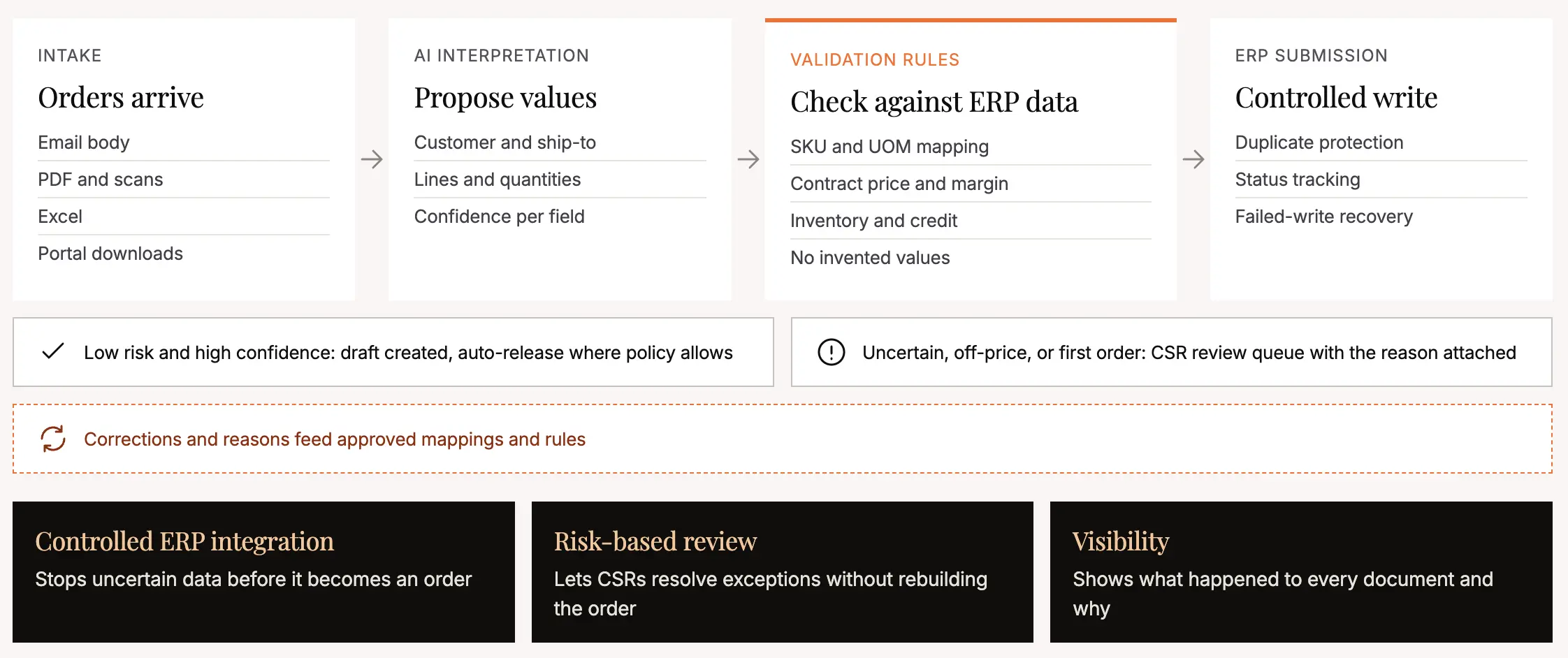
A production system needs controlled ERP integration, risk-based review, and visibility into what happened to every order. These layers determine whether uncertain information is stopped, whether reviewers can resolve it efficiently, and whether failures can be recovered. In a build, your team designs and maintains all three. When buying, they become requirements to verify in the pilot and implementation scope.
How do you integrate LLMs with a legacy ERP for automated purchase orders?
Use the model to interpret the PO and propose structured values, then use defined validation rules and ERP data to decide what can become an order. Customer identity, product references, units, prices, and required fields should be checked before submission. Missing or conflicting information should follow an exception path rather than being completed with an unsupported model guess.
The connection itself may use an API, an approved import, XML, or another supported file handoff, depending on the ERP. Test the actual customer’s custom fields, permissions, and approval requirements in an appropriate environment. Confirming that the ERP brand appears on an integration list does not establish that your specific configuration and required transaction types are covered.
Submission also needs duplicate protection and status tracking. If the ERP creates an order but the response is lost, retrying the request can create another order unless the integration checks what already happened. A dependable connector records the result, reconciles failures, and makes it clear to the order desk whether the document is waiting, rejected, or successfully processed.
How should exception workflows work when AI and CSRs share the work?
Route orders according to defined business risk as well as extraction confidence. An uncertain SKU, an off-contract price, or a first order from a customer can require review even when the document is easy to read. The reviewer should see the flagged field, its source, the reason for the exception, and the permitted action without reconstructing the order from scratch.
Begin with human approval and expand automation only where measured results support it. Capture corrections and their reasons so repeated issues can be addressed through approved mappings or rules. NIST’s AI Risk Management Framework provides a broader foundation for managing AI risks across design, development, deployment, and use; the order-entry application is to assign responsibility and keep oversight proportionate to the consequences of an error.
Confidence scoring, audit trails, and monitoring
Confidence helps reviewers decide where to look, but it should not override a failed price or quantity check. Validate scoring against observed errors and retain the source document, proposed values, human changes, and submission result. Monitoring correction rates, review time, and failed writes by customer and format then shows where the process needs attention. Those records also help distinguish a document-reading issue from unreliable master data or a broken integration, so the team fixes the actual cause.
Why is buying an AI order entry platform the better choice for most distributors?
Buying is the better default because a distributor can use an existing product for the common order workflow instead of funding the entire application and its upkeep. The vendor brings software, integration experience, and support that your team would otherwise need to establish. Your business still needs to define its rules and verify performance, but that work is narrower than becoming the developer of a production order-entry platform.
Value arrives sooner when the foundation already exists
A platform pilot can focus on whether the product handles your orders, ERP configuration, and exceptions. An internal project must first build enough of the product to run that same test. The difference matters because the order desk continues processing manually while the application, review interface, and connector are being developed.
A specialist vendor may already have encountered many of the customer formats, quantity rules, and ERP configurations your team would discover individually. That experience does not guarantee a fit or a fixed rollout date, but it provides a stronger starting point. Confirm the implementation timeline after testing the difficult cases, rather than treating a standard sales estimate as a promise.
The vendor maintains the underlying software
The vendor maintains the application and supported connectors within the agreed service scope, while your team owns its data and configuration decisions. Model changes still need testing, but that evaluation becomes part of the vendor’s product work rather than another internal project. Ask how updates are validated and regressions are handled. With a clear responsibility boundary, your team can receive product improvements without establishing its own continuing engineering and model-maintenance function.
Product improvements can be shared across customers
A specialist platform can reuse improvements to intake, validation, review, and integrations across its customer base. One distributor does not have to fund every common fix or discover every unusual format alone. Customer-specific pricing and mappings still need appropriate separation and permissions, so ask how corrections are retained and controlled. The advantage is access to shared product development: improvements to the common workflow can reach your team without becoming another item on its engineering backlog.
Accountability you can write into a contract
Buying lets you define support coverage, escalation, incident response, and integration responsibilities in writing. Those commitments matter when processing stalls and operations needs a clear owner. Review them alongside data access, export options, and the plan for service interruptions. A well-scoped agreement gives your IT team somewhere to escalate a missed order or failed write, while keeping your business responsible for the continuity decisions it needs to make.
Your team can work on the priorities that make you different
Pricing tools, customer experience, warehouse operations, and ERP improvements all compete for engineering time. Buying order entry lets leadership direct more of that effort toward priorities that distinguish the business, while keeping control over customer rules. On the order desk, the aim is to spend less time typing information already present on a PO and more time resolving exceptions or helping customers. A platform should demonstrate that shift with lower complete cost and less internal effort than a build.
When should a distributor build its own AI order entry software?
Building deserves consideration when a verified platform gap affects a strategic workflow and the economics support sustained internal ownership. The conditions below need to be assessed together. High volume does not compensate for missing support capacity, and a capable engineering team does not make ordinary customer rules a competitive advantage. Test a configurable platform before assuming that owning the software is necessary.
Your workflow is unique in a way that affects competitive advantage
Some distributors differentiate through allocation, configuration, substitution, or unusual contract structures. If that logic directly supports a competitive advantage and existing products cannot represent it, owning the relevant software may have value. First distinguish unique logic from undocumented rules: a customer-specific pack size or approval threshold may be configurable once written down. A build needs a specific commercial requirement that a vendor cannot meet, rather than a general description of the workflow as complex.
You run at enough scale to support the economics
High volume spreads development costs across more orders while increasing demands on reliability, support, and recovery. Building becomes financially credible when its complete cost beats a scoped platform quote over the same period, including continuing engineering and exception labor. Test realistic growth scenarios rather than assuming scale makes the answer obvious. If the saving depends on every future assumption going well, it may be too fragile to justify owning the application and its operational support.
A real proof of concept exposed a hard vendor gap
A genuine gap comes from testing your own orders and ERP workflow. It could be a transaction the connector cannot support or a required business rule that fails for a clear, reproducible reason. Ask whether configuration, an agreed product change, or a narrow extension can solve it. Hybrid makes sense when the missing piece has a manageable maintenance boundary; rebuilding the entire intake, review, and integration process around that gap needs a separate economic justification.
You have strong, lasting internal capacity
A build needs continuing ownership for product requirements, engineering, testing, security, and support. Contractors can help deliver the application, but your business still needs coverage and institutional knowledge after they leave. Assess that commitment against the IT roadmap: an ERP migration or acquisition integration may need the same specialists. The plan should name who maintains order entry after launch, how coverage survives departures, and which other priorities leadership is prepared to defer.
Your data is ready
Customer records, product mappings, units of measure, and pricing rules must be dependable enough for validation. A better model cannot resolve every disagreement between them; the system needs approved sources of truth and an exception path. This requirement applies to buying too. A pilot can reveal cleanup needs, but the business owns the corrections, so data readiness establishes whether automation can work reliably rather than deciding, on its own, which software option to choose.
You have a long-term roadmap worth funding
An internal platform may be justified when order entry belongs to a broader proprietary operating system with funded use cases and lasting product ownership. Compare that roadmap with what an existing platform can provide or support through integrations. Without a continuing commitment, the application risks becoming another legacy system with too little maintenance. For most distributors, buying the common foundation and developing only a demonstrated strategic gap remains the more practical way to support future requirements.
How do you make the build vs buy AI decision for order entry?
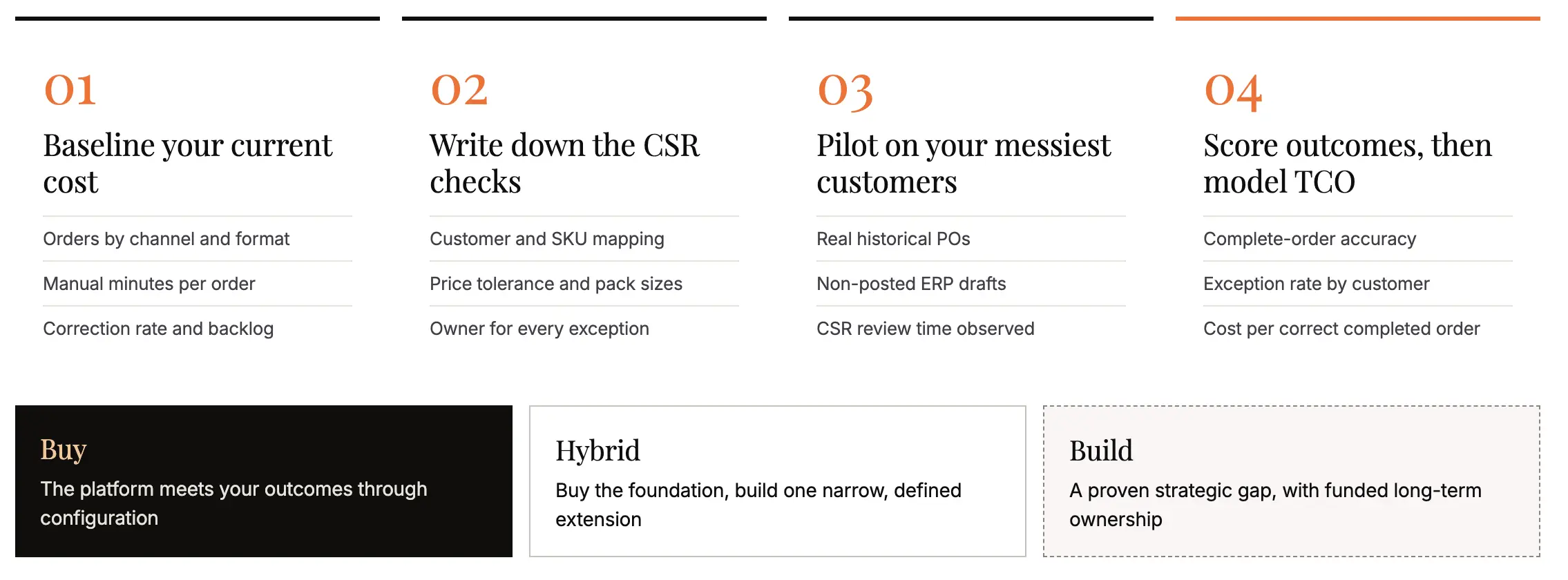
Start with the current order process, document the rules your team applies, and test a vendor on representative difficult orders. Then compare the results with a fully costed build proposal over the same time horizon. This makes buying the first option to prove, while leaving room for a build when the evidence establishes a material gap.
Baseline your current order entry cost
Count orders by channel and format, separating EDI from the documents you intend to automate. Measure entry time across simple and complex orders, including corrections and follow-up, then record hourly labor cost, backlog, and time to confirm ERP creation. These measures give the pilot a concrete baseline. They also distinguish saved capacity from cash savings: fewer processing minutes reduce payroll costs only when staffing or hiring plans change accordingly.
Write down the checks your CSRs make today
Ask experienced CSRs to explain their checks, including customer and ship-to matching, buyer part numbers, pricing, quantities, inventory, credit, dates, and duplicate POs where relevant. Record each rule, its source, and who can resolve the exception. That becomes the test script and helps distinguish standard validation from unusual logic. “Handling our complex orders” is difficult to test; a written rule and a real example establish what the system must actually do.
Run a proof of concept on your messiest customers
Use difficult historical POs alongside straightforward orders so the sample reflects the workload. Keep a separate test set that was not used for configuration, and test through to a confirmed draft or agreed non-live ERP transaction. Include rejected writes and duplicate submissions. Let the CSRs operate the review screen and measure their time, because the pilot needs to demonstrate an easier working process as well as correct extracted information.
Score business outcomes, then model three-year TCO
Measure complete-order correctness, manual minutes, exception rates, successful ERP creation, and release without correction using definitions agreed before the pilot. Replace the three-year model’s assumptions with those results, including pre-launch labor and ongoing administration. If a platform meets the requirements through configuration at an acceptable cost, buy it. If a critical rule remains unsolved, assess whether building that specific piece is enough before funding a complete internal platform.
Why is Ella the buy option built for distributors?
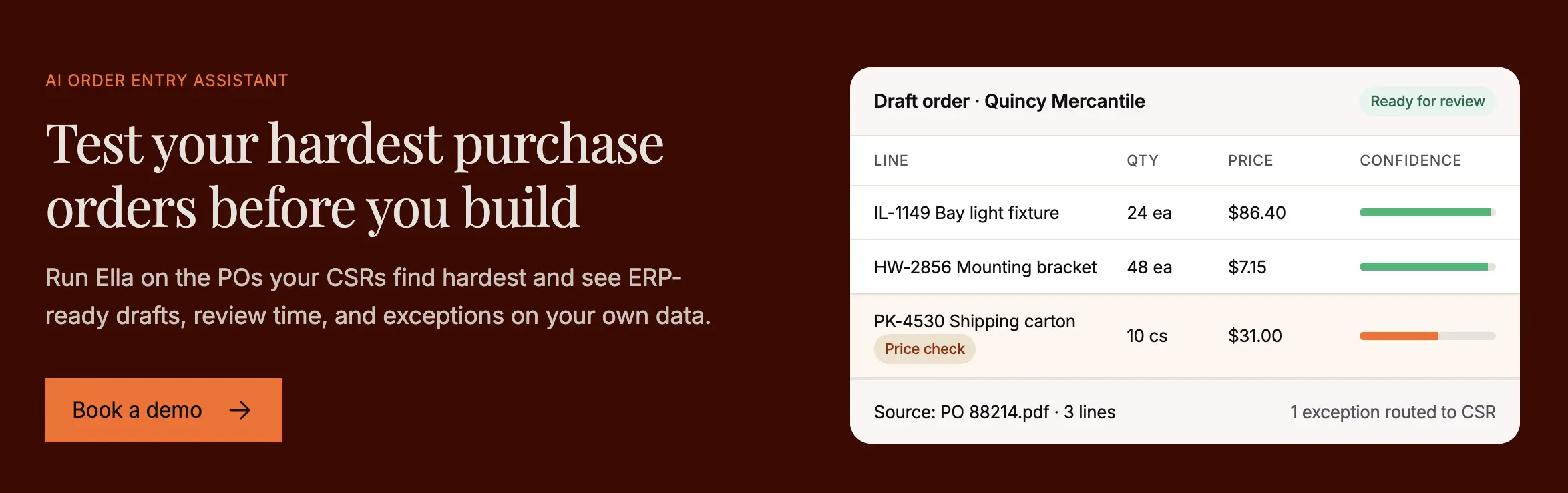
Ella by WizCommerce is designed to turn incoming purchase orders into validated sales-order drafts, with ERP integration and human review built into the workflow. It addresses the work beyond extraction that drives the build decision: identifying the customer, matching products, checking order details, and handling uncertain information. The useful way to evaluate it is on your own documents and ERP requirements.
Order creation connected to your ERP data
Ella uses ERP data to validate customer records, pricing, inventory, and quantity requirements before submission. WizCommerce lists more than 200 pre-built ERP connectors, and its integration documentation describes support for API and FTP connections when additional assessment is needed. Confirm your specific ERP version, custom fields, and transaction scope during the technical review rather than relying only on the connector count.
Customer-specific rules without rebuilding the platform
Ella’s Prompt Builder allows teams to describe customer-specific processing instructions in plain language. That gives your order team a way to express how a customer orders without developing the entire intake and review application. Important pricing, quantity, and approval rules should still be tested against representative POs so configuration produces the intended result.
Product updates driven by more than your own order desk
With Ella, product development draws on the requirements and problems of multiple distributors. A recurring exception, unfamiliar PO format, or difficult review workflow reported by another customer can lead to improvements in the shared platform. Your business can benefit from those updates even before it encounters the same problem. An internal build depends entirely on what your own team discovers and has time to fix, while a specialist vendor has a continuing reason to improve the software across its customer base.
Confidence scores and human review
Ella’s review workflow shows field confidence, source traceability, and whether a value was extracted, defaulted, or changed manually. Reviewers can investigate uncertainty before submission, and high-confidence auto-submission is configurable. This supports a supervised rollout followed by selective automation where your team’s measured results and approval policy justify it.
Different order formats in one workflow
Ella supports incoming formats such as PDFs, spreadsheets, email text, scans, and images. Its documented workflow also handles multiple POs and instructions to combine documents into a draft. Test your difficult examples during evaluation, including unreadable inputs and conflicting instructions, to establish what can move through automatically and what should stay in review.
Ask for an Ella evaluation using the orders your CSRs find hardest to process, along with a quote covering the required integration, implementation, usage, and support. Then compare the measured review time and complete cost with your internal-build proposal. That gives you a buying decision grounded in how the software works for your business.
The decision for most distributors
AI has made it easier to demonstrate purchase-order extraction, but the responsibility for a correct order still includes customer logic, validation, integration, review, and support. For most distributors, buying a specialist platform is the better way to take on that work. It gives the order team an existing process to evaluate while keeping the business in control of its rules and approvals.
Start by testing Ella on your hardest orders and comparing the complete cost with a realistic internal-build plan. If the platform meets your requirements through configuration, you have little reason to recreate its foundation. If it exposes a genuine strategic gap, build only as much as that gap requires, with the ongoing cost and ownership made explicit from the beginning.
FAQ
Is it cheaper to build or buy AI order entry software?
Buying the best AI order entry software is the better financial starting point for most distributors because it replaces responsibility for a complete internal product with a scoped platform investment. In this article’s scenario, building and operating the software costs roughly $1.2M to $1.9M over 36 months from project start, before order-desk labor. Compare that with a vendor’s implementation, subscription, administration, and measured review costs before deciding which option is cheaper for your business.
How much does it cost to build AI order entry software in-house?
The illustrative initial build budget is approximately $0.6M to $0.9M for a six-to-eight-month project with three engineering roles, product management, part-time design and QA, and one ERP integration. Recurring engineering, infrastructure, and security allowances total about $245,000 to $410,000 annually. These are planning assumptions for this scope; geography, existing capabilities, data quality, and additional ERPs can materially change the cost.
How long does it take to build an AI order entry tool you can trust?
The planning model assumes six to eight months, but there is no single timeline that applies to every distributor. A reliable release needs evidence that customer matching, SKU conversion, pricing, review, and ERP creation work on representative orders. A working document-reading prototype can be produced much sooner than the full process, so establish acceptance criteria and use them to decide when the system is ready.
Can we just use ChatGPT or another LLM to read our purchase orders?
A general-purpose LLM can help extract information from many purchase orders, but the output still needs validation before it becomes an ERP order. Customer and product matching, units of measure, contract pricing, duplicate checks, and submission handling require additional logic and data. Use the model as part of a controlled workflow with review for uncertainty rather than treating readable output as a finished sales order.
How should exception workflows work in a hybrid AI order system?
When AI and CSRs share processing, route uncertain or high-risk orders to a review queue that shows the issue and its source. Combine confidence with business checks, since a confidently read price can still violate a contract. Capture corrections, retain submission status, and begin with human approval. Expand automatic release only for the customers and order types whose measured results meet your acceptance criteria.
What is a good exception rate for AI order entry?
There is no universal exception rate that establishes a successful rollout. It depends on document quality, customer mix, business rules, and which orders require review by policy. Measure avoidable corrections separately from mandatory approvals, then compare the remaining minutes per order and error costs with your baseline. The 20% and 8% rates used in this article are sensitivity scenarios, not performance benchmarks or guarantees.
How do you integrate LLMs with a legacy ERP for automated purchase orders?
Let the LLM interpret the document while validating rules and ERP master data control what can be submitted. Use the ERP’s supported API or import mechanism, test required fields and approvals, and create controlled draft transactions first. Add duplicate protection, retry handling, and confirmation tracking so an interrupted response cannot silently lose an order or create it twice. Review ambiguous values instead of inventing missing information.
Can a bought AI order entry platform handle our custom rules and legacy ERP?
A specialist platform may support customer rules through configuration and older ERPs through APIs or approved file handoffs, but the fit must be demonstrated. Test your custom fields, quantity conversions, pricing requirements, and exceptions with real POs. If one requirement remains uncovered, establish whether a narrow extension can solve it before assuming that your business needs to build the entire order-entry application.
When does it make sense to build your own AI order entry software?
Building software for AI order entry makes sense when a proven vendor gap affects a strategically important workflow and a fully cost model supports internal ownership. You also need reliable data, sustained engineering and support capacity, and a roadmap worth funding after launch. High order volume or enthusiasm for AI alone is insufficient; the build should produce a measurable advantage that configuration or a smaller extension cannot deliver.
When does a hybrid build vs buy approach make sense?
Hybrid makes sense when a specialist platform can handle intake, extraction, review, and ERP integration, but a defined piece of proprietary logic requires development. Buy the common foundation and build the specific extension, with clear ownership of testing and maintenance. Keep that boundary narrow, because extensive customization can recreate much of the cost and dependency that buying was intended to reduce.