Skip to content



Shopify is the undisputed king of direct-to-consumer (DTC) retail, leading many distributors to view the Shopify B2B platform as the ultimate way to digitize their operations. But wholesale is not retail. Selling a single item to a consumer requires a vastly different digital architecture than processing a bulk purchase order with negotiated pricing tiers and complex case-pack rules.
While Shopify B2B (specifically on the Shopify Plus tier) is a convenient entry point for DTC brands dabbling in wholesale, dedicated distributors quickly hit roadblocks. At its core, Shopify B2B is just a layer of wholesale features bolted onto a consumer-first engine. Push it to handle true B2B e-commerce realities like offline trade show ordering, emailed PDF purchase orders, or intricate pricing matrices, and the platform struggles. You are quickly forced into a messy, expensive web of third-party apps just to keep operations running.
In this guide, we break down what Shopify Plus B2B actually gets right, where its native limitations will bottleneck your growth, and why scaling operators eventually abandon retail-first systems for purpose-built B2B platforms.

What is Shopify B2B?
Shopify B2B is a suite of wholesale-specific features built into the Shopify platform that allows merchants to sell directly to business buyers. It gives merchants tools for company profiles, custom catalogs, net payment terms, and buyer-specific pricing, all managed through the Shopify admin. These features serve wholesale buyers alongside or separately from DTC consumers on the same Shopify store.
Shopify B2B is not a standalone product. It is a layer of B2B functionality built on top of Shopify’s existing consumer-first architecture. Understanding this distinction helps merchants set realistic expectations about what the platform can handle natively versus what will require apps or custom development to achieve.
What features does Shopify B2B offer?
Company profiles and multi-user permissions
Company profiles let merchants create distinct accounts for each wholesale buyer, with assigned contacts, locations, custom pricing, and payment terms per account. Multiple staff members from the same buyer company can log in with different roles and purchasing permissions, making it easier to serve procurement teams that operate with internal approval hierarchies.
Customer-specific catalogs and pricing
Shopify Plus allows you to create customer-specific catalogs so each business sees products and price lists based on their unique agreements. A hardware supplier could offer different pricing structures to small buyers versus large corporate clients, ensuring each segment gets the custom pricing and products they expect. The B2B e-commerce catalog guide covers how to structure these catalogs effectively for wholesale scale.
Bulk purchasing and quote management
Shopify B2B includes bulk ordering options and built-in quote management through draft orders, enabling buyers to request quotes directly through the platform. Quick order forms streamline this further for high-frequency buyers placing routine purchases at higher order volumes.
Custom payment terms and invoicing
The Shopify B2B platform supports flexible payment terms like net-30 and net-60, with customized invoicing per account. Credit cards, wire transfers, and net payment terms can all be configured per account, as covered in the best B2B payment platforms guide.
Automated reordering options
Shopify B2B offers automated reordering that allows customers to set up recurring purchases based on order history. The Shopify admin tracks and processes each cycle automatically, saving significant time for both merchants and buyers managing regular restocking schedules.
Self-serve buyer portal
The Shopify B2B portal gives wholesale buyers a dedicated login where they can access their custom catalog, review order history, download invoices, and place new orders at their negotiated pricing without contacting a sales rep. The Shopify B2B portal also supports multiple contacts per company account with distinct purchasing roles and visibility settings per user.
Shopify Markets for B2B
Shopify Markets allows merchants to sell to business buyers across different countries from a single Shopify store, with localized pricing, currency, and catalog configurations per market. The depth of localization available through Shopify Markets is primarily designed for DTC use cases and requires additional configuration to serve complex B2B requirements across different languages and tax jurisdictions.
Integration with existing systems and API availability
Shopify supports integrations with third-party tools through its tech stack, maintaining unified data flow across departments. API call limits are higher on Shopify Plus for merchants with heavy integration requirements. Shopify’s API limits on standard plans work for lighter integrations, but complex enterprise resource planning connections typically require middleware or custom development to maintain reliability at wholesale scale.
Features and customizability
Merchants can customize product listings, pricing structures, checkout experience, and order management workflows through Shopify Flow automation. Shopify flow automates repetitive tasks like account tagging and reorder alerts without code. Checkout customization through Shopify functions adds custom logic to the checkout process based on buyer type, order size, or company profile attributes.
Blended vs. dedicated stores
Businesses can choose between a blended store serving both DTC orders and wholesale from one backend, or a dedicated store exclusively for wholesale buyers. A blended store suits merchants managing both channels simultaneously. A dedicated wholesale store allows greater customization but requires maintaining a separate Shopify environment for wholesale customers.
How to access Shopify’s B2B capabilities
Accessing B2B features on Shopify is not as simple as toggling a switch in your settings. Because the platform was fundamentally built for direct-to-consumer retail, acquiring wholesale functionality depends heavily on your pricing tier, your technical setup, and how many workarounds you are willing to manage.
Merchants generally have two paths to access B2B features on Shopify, and the difference between them dictates how much control you have over your wholesale operations.
The App Store route (Standard Shopify Plans)
Standard Shopify plans range from approximately $39 to $399 per month. While these tiers provide an excellent foundation for standard retail, their native B2B functionality is severely limited. Standard plans do not include native company profiles, dedicated B2B portals, or advanced checkout customization. Furthermore, staff accounts are capped, limiting how many of your sales reps can actually use the system.
To build a wholesale channel on a standard plan, B2B sellers are forced to rely on the Shopify App Store. Merchants must piece together their B2B platform by installing third-party apps for custom pricing, quote management, and customer tagging. While this keeps the base subscription cost low, it introduces significant operational friction. Each app adds a recurring monthly fee, requires ongoing maintenance, and introduces the risk of code conflicts as your app stack grows. Additionally, merchants on these plans are subject to transaction fees ranging from 0.6% to 2% per sale, which compounds quickly on high-value wholesale orders.
In case you need a list of the best Shopify wholesale apps, check out our top picks in our blog.
The Native route (Shopify Plus)
When the patchwork of third-party apps becomes too difficult to manage, the only way to access Shopify’s true, native B2B capabilities is to upgrade to Shopify Plus.
Shopify Plus is the enterprise tier, starting at $2,300 per month. This steep jump in price is the threshold B2B sellers must cross to unlock the platform’s core wholesale architecture. Upgrading to Plus finally grants merchants access to native company profiles, custom B2B catalogs, dedicated payment terms per account, and expanded API call limits for heavier ERP integrations.
The Plus plan also offers unlimited staff accounts, a dedicated merchant success manager, and removes the per-transaction fee (provided you use Shopify Payments). For growing wholesalers, the choice often becomes a dilemma: struggle with a fragmented, app-dependent system on standard plans, or absorb a massive $27,000+ annual base fee just to unlock standard wholesale features natively.
For a detailed analysis of Shopify’s pricing for B2B sellers, check out our blog on it.
| Feature | Standard Plans ($39 – $399/mo) | Shopify Plus (Starting at $2,300/mo) |
| Native company profiles | No | Yes |
| Custom B2B catalogs | App-dependent | Native |
| Net payment terms | Limited | Full support |
| Transaction fees | 0.6% to 2% | Removed (with Shopify Payments) |
| Staff accounts | Capped | Unlimited |
| API call limits | Standard | Expanded |
| Dedicated success manager | No | Yes |
| WizCommerce costs significantly less than running a full Shopify Plus B2B stack. When you add up Shopify Plus subscription fees, third-party app costs, middleware expenses, and transaction fees at wholesale volumes, the total cost of ownership consistently exceeds what WizCommerce charges for the same capabilities.
WizCommerce bundles ERP integration, offline rep selling, AI order automation, and unlimited price lists into one predictable platform fee with no per-order surcharges. |
Where Shopify B2B falls short for serious wholesalers
Shopify B2B works well for simple wholesale setups. The limitations surface when pricing complexity, order volume, and channel diversity grow.
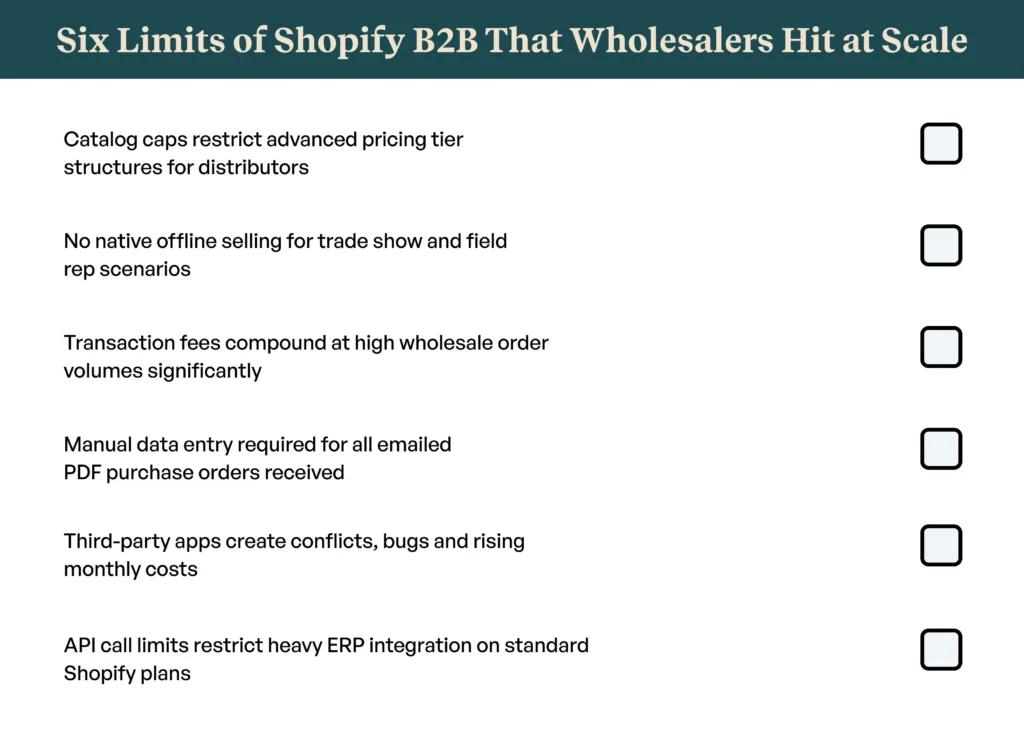
- Catalog and pricing tier limits: Shopify Plus caps the number of catalogs and price lists per store. Distributors running Gold, Silver, Bronze, Distributor and Retail pricing hit that cap before covering a standard wholesale architecture, which a distributor e-commerce platform treats as the baseline rather than a limit. Beyond pricing tiers, Shopify B2B struggles with intricate product modifiers, inner-pack and case-pack quantity rules, and dimensional pricing. These are standard wholesale requirements that demand custom development or expensive apps.
- No native offline selling: A large share of wholesale revenue is generated at trade shows, in showrooms, and through field sales. Shopify POS Pro can capture in-person orders but is not designed for wholesale account complexity, custom pricing, or catalog browsing that trade show selling requires. Reps working with Shopify B2B at events revert to paper or workaround apps, as detailed in the trade show order-taking guide.
- Transaction fees at wholesale volumes: Shopify charges a transaction fee of 0.6% to 2% per sale unless merchants use Shopify payments exclusively. At wholesale order values, these fees compound into a significant cost center.
Manual Data Entry for Emailed Orders
B2B buyers routinely send purchase orders via email as PDFs, spreadsheets, or scanned documents with custom SKUs. Shopify B2B forces staff to manually translate each of these into draft orders inside the Shopify admin.
For wholesale operations receiving dozens of emailed orders daily, this manual work creates processing backlogs, data entry errors, and pulls staff from higher-value tasks. There is no native automated order ingestion in Shopify B2B that converts incoming POs into clean, ERP-ready records without human intervention.
The Hidden Cost of Third-Party Apps
Making Shopify B2B behave like a true wholesale platform requires stacking multiple Shopify app store apps for pricing, quote management, ERP sync, offline selling, and rep tools.
Each app adds a monthly cost. Many apps conflict with each other or with Shopify flow automations, creating bugs that require developer time to resolve. The real cost of ownership for a functional Shopify B2B stack frequently exceeds what a purpose-built wholesale platform charges for the same capability delivered natively.
For a detailed review on whether Shopify is suitable for serious wholesalers, check out our blog on it.
Why B2B-specialized platforms outperform B2C platforms with B2B features added on
Shopify was built for retail. Its B2B features are layered on top of a consumer-first architecture, and that origin shapes what it can handle at wholesale scale. A B2C e-commerce platform optimizes for fast checkout, storefront flexibility, and Shopify payments simplicity.
Wholesale requires a fundamentally different foundation: buyer-specific pricing at every touchpoint, offline order capture for trade shows, real-time ERP sync, and complex order rules like inner packs, case quantities, and dimensional pricing, and the same holds one layer up, where b2b crm software has to attach a negotiated price list to a company account rather than treat each buyer as an individual lead.
These are architectural requirements that platforms like Adobe Commerce and purpose-built B2B tools build from the ground up, rather than bolt on through the Shopify app store. For distributors who have already concluded the retail-first route will not hold, the practical next step is evaluating a Shopify alternative B2B wholesalers run natively instead of assembling one from apps.
Here’s a detailed comparison of Shopify B2B vs native B2B e-commerce platforms.
WizCommerce: The purpose-built B2B platform for wholesale complexity
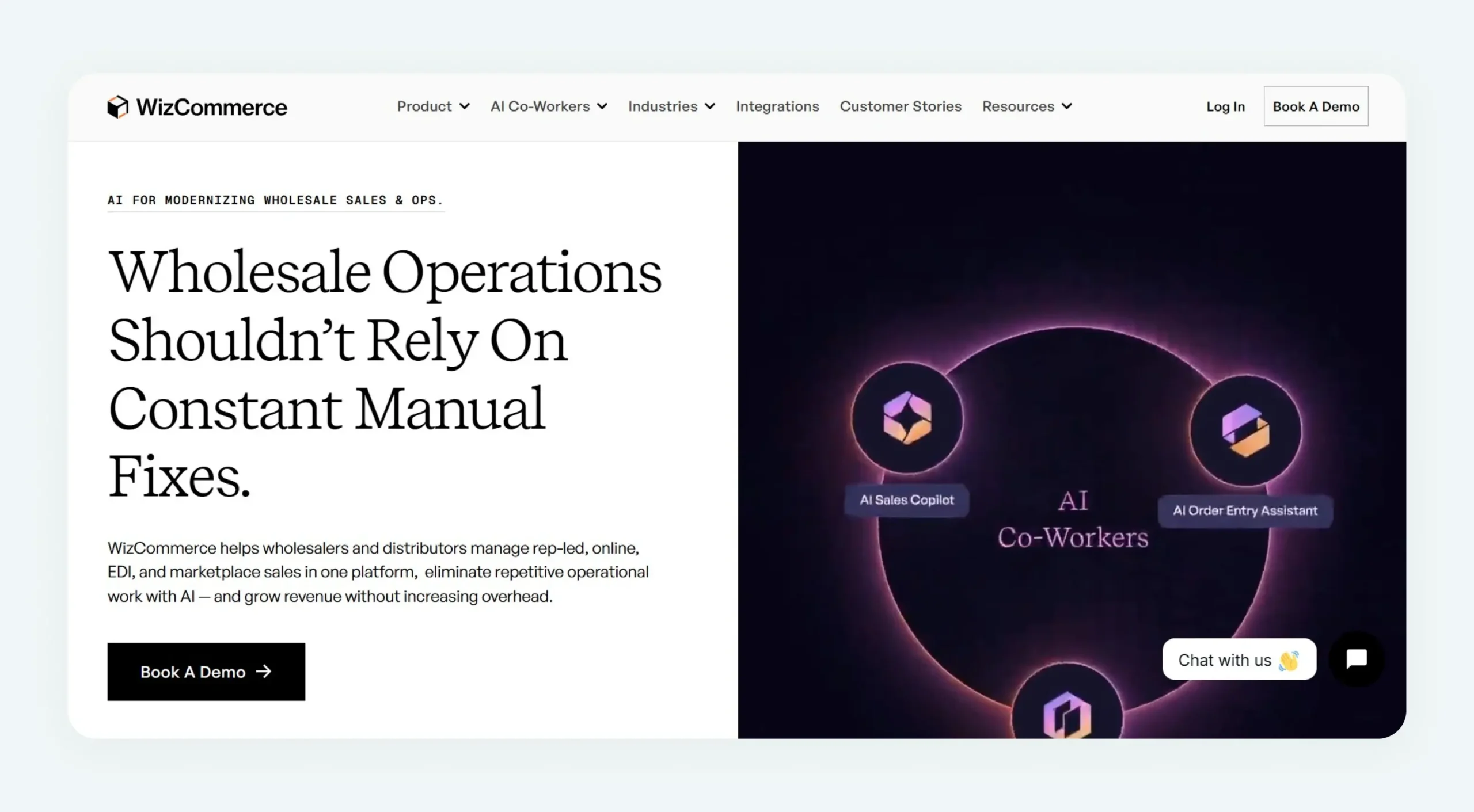
WizCommerce is a purpose-built B2B e-commerce platform for wholesalers, distributors, and manufacturers, not a retail platform with wholesale features added on. Every capability exists to serve the wholesale complex needs that Shopify B2B requires workarounds to replicate.
- Purpose-built for wholesale complexity Shopify cannot handle: WizCommerce supports unlimited price lists, customer-specific catalogs, and persona-based custom pricing out-of-the-box. No apps and no manual overrides. Every buyer sees exactly the right products at the right price from the moment they log in, enabling a genuinely tailored checkout experience at scale.
- Native offline and rep-led selling with WizOrder: WizOrder, the best B2B order-taking app for sales reps, allows your team to capture orders, process quotes, and access full product catalogs without an internet connection. Orders sync automatically when connectivity returns, eliminating lost leads and the manual work errors common at trade shows and field visits.
- AI-powered order automation: WizCommerce’s AI order automation converts incoming POs from emails, PDFs, and spreadsheets into clean ERP-ready orders without staff manually recreating them as draft orders. It eliminates the order-processing backlog that accumulates when wholesale teams rely on manual data entry across high-volume purchase order inflows.
- One review queue for every order: Your team works a single queue in WizCommerce’s B2B order management software whether the order came from the buyer portal, a rep in the field, or a PDF in the inbox. The same pricing, minimum order quantity, and case-pack rules apply to all three before anything reaches your ERP.
- WizStudio: WizStudio handles product imagery, letting teams generate professional catalog and lifestyle photography without external shoots. Unlike Shopify B2B, which relies on the Shopify App Store for any product content tooling, WizStudio is built directly into the WizCommerce platform, saving significant time on catalog management across large SKU libraries.
- Real-time ERP integration with no middleware: WizCommerce integrates natively with QuickBooks, NetSuite, Fishbowl, and 1,000-plus ERP connectors through its Ella order automation agent. This eliminates the order-processing bottlenecks and inventory inconsistencies that plague businesses trying to run wholesale on Shopify’s integration ecosystem.
- No transaction fees on wholesale orders: WizCommerce charges no per-transaction fees for wholesale orders, regardless of the buyer’s bank account or payment method. At high-volume wholesale order values, this difference compounds into a significant advantage compared to the transaction-fee structure that applies across all Shopify plan tiers outside Shopify Payments.
| Capability | Shopify B2B | WizCommerce |
| Pricing tiers | Catalog caps on the Plus plan | Unlimited buyer-specific price lists |
| Offline selling | No native support, Shopify POS pro only | Native offline-first rep app |
| ERP integration | Middleware or custom dev required | 100-plus pre-built real-time connectors |
| Transaction fees | 0.6% to 2% without Shopify payments | None on any wholesale order |
| AI order entry | Not available | Native PDF and email PO processing |
| Trade show ordering | Third-party apps required | Built-in with WizOrder |
| Go-live time | Variable by app configuration | Under 30 days with dedicated support |
Book a free demo with WizCommerce and see what a purpose-built wholesale platform delivers compared to Shopify B2B in practice.
FAQs on Shopify Plus B2B
1. What is the difference between Shopify Plus and Shopify B2B?
Shopify Plus is the enterprise Shopify plan required to access native Shopify B2B features. The Shopify Plus vs Shopify distinction specifically is this: only Plus offers native company profiles, custom catalogs, advanced checkout customization, and expanded API limits without relying on the Shopify app store to fill capability gaps.
2. What exactly is B2B e-commerce?
B2B e-commerce involves online transactions between businesses, such as a manufacturer selling to a wholesaler. Unlike B2C, it requires bulk orders, custom pricing, net payment terms, and complex company profiles. It is built around logic-driven purchasing relationships rather than the individual retail shopping experience that consumer platforms prioritize by default.
3. Why do so many Shopify stores fail?
Many stores fail due to unclear strategy or poor user experience. In B2B on Shopify, failure often comes from not delivering the features wholesale buyers need, like flexible payment terms or easy bulk ordering, creating friction in the checkout process that pushes buyers toward platforms built specifically for wholesale operations.
4. What is the downside of Shopify for B2B?
Shopify B2B adapts from a B2C-first core. Complex needs like multi-level pricing, intricate rep permissions, and matrix ordering require expensive custom apps from the Shopify app store on Shopify Plus, whereas platforms like WizCommerce deliver these natively without configuration overhead or ongoing app maintenance.
5. Is Shopify still worth it in 2026?
Yes, Shopify B2B remains a solid option for merchants with straightforward wholesale needs and manageable sales volume. For rapidly scaling wholesale businesses with complex needs around ERP integration and offline selling, assessing a dedicated platform like WizCommerce as the better option often yields a stronger ROI than relying on Shopify Plus alone.
6. Can I use Shopify B2B without Shopify Plus?
Yes, with limitations. Standard Shopify plans support some B2B functionality through the Shopify app store, but native company profiles, dedicated price lists, and advanced checkout customization require Shopify Plus. For wholesale businesses with higher order volumes, using Shopify Plus is the practical threshold where Shopify B2B becomes usable without heavy app dependency.
7. How many price lists can I have on Shopify B2B?
Shopify Plus supports multiple price lists, but applies catalog limits that distributors with five or more distinct pricing tiers will hit. Each price list must be assigned to a company profile or customer segment. As buyer segments multiply, these caps become a common reason merchants evaluate platforms that support unlimited price lists natively without plan upgrades or custom development.
8. How does Shopify B2B handle ERP integration?
Shopify B2B handles enterprise resource planning integration primarily through third-party connectors or custom development via its API limits. Real-time bidirectional sync between Shopify Plus and ERP systems like NetSuite or Fishbowl requires middleware layers or dedicated developers to maintain. WizCommerce eliminates this with 100-plus pre-built ERP connectors that sync pricing, inventory, and order data in real time with no middleware required.