Skip to content



Is Shopify good for wholesale? It is a burning question for all the wholesalers aiming to upscale their B2B e-commerce sales. Looking at the bigger picture, the overall e-commerce trends are promising. According to the International Trade Administration, the global B2B e-commerce market is now valued at $32.1 trillion in 2025 and is projected to reach $36 trillion by 2026, growing at a 14.5% CAGR. To put that in perspective, B2B e-commerce is already six times larger than the entire B2C e-commerce market.
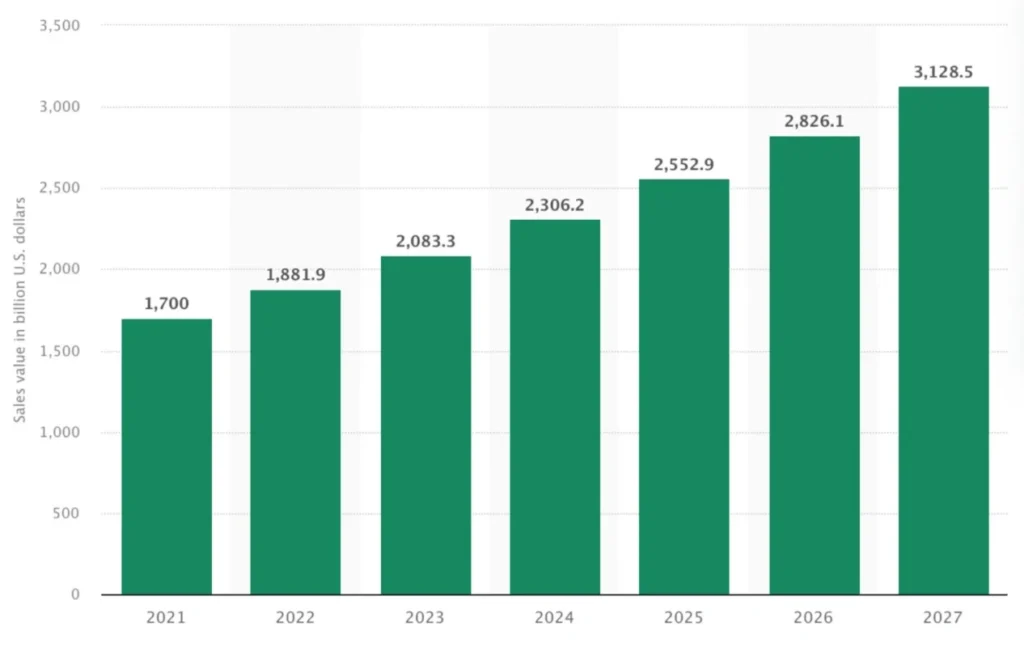
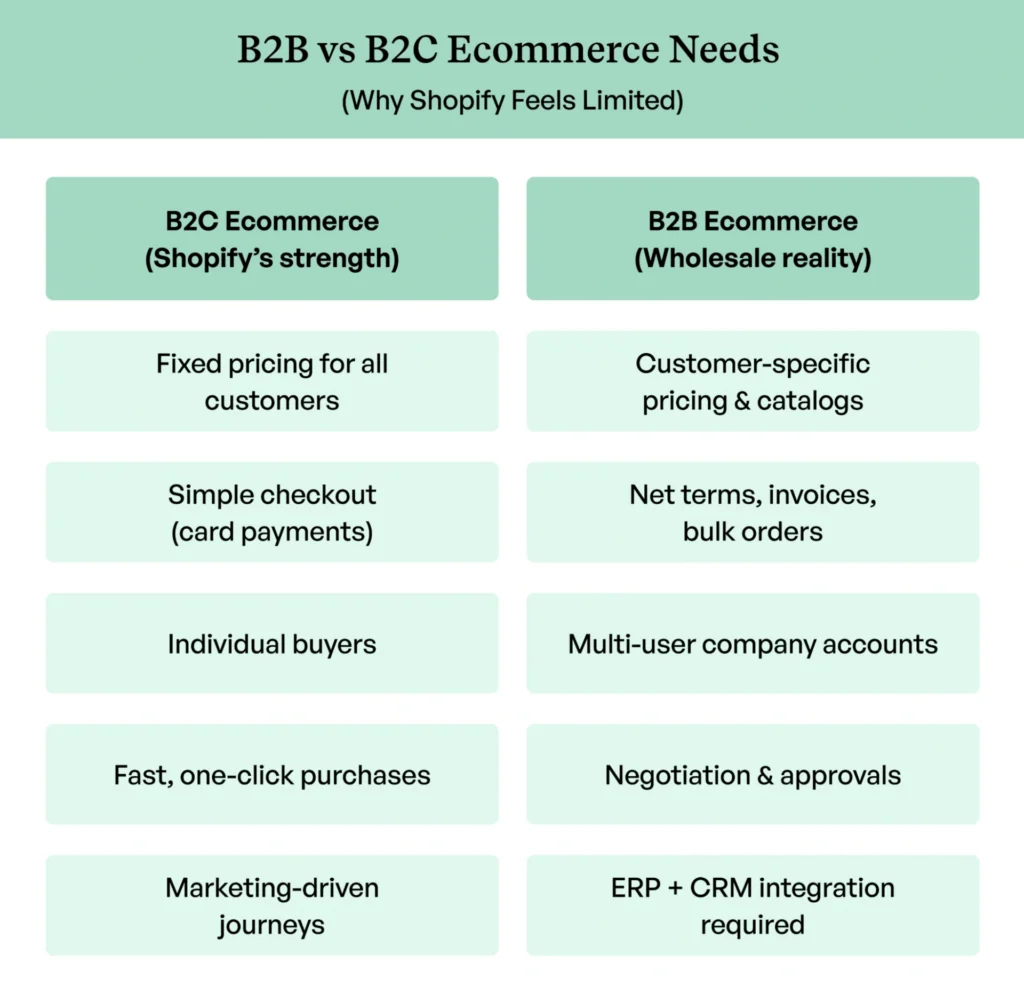
This survey highlights the immense opportunity for wholesalers, but is Shopify the right platform to capture it? Many businesses use Shopify as their e-commerce platform, but most are B2C businesses, and B2C and B2B businesses have fundamentally different needs.
To be fair, Shopify has invested heavily in B2B over the past few years, and in early 2026, it even expanded foundational wholesale features (custom catalogs, volume discounts, company profiles) to merchants on all plans, not just Shopify Plus. That’s a sign the market is moving in the right direction. But Shopify’s B2B expansion is built on top of a platform that was built for retail, not wholesale. The result: features feel retrofitted, pricing structures are rigid, B2B access is complicated, and integrations with the ERP and CRM tools that wholesalers actually use remain a constant challenge.
For businesses running DTC alongside some wholesale volume, Shopify may suffice, but for businesses where wholesale is the business, the gaps quickly become costly.
So, in this blog, we will find an answer to this burning question: Is Shopify good for wholesale? Is Shopify good for B2B?
Why Shopify excels in B2C e-commerce?
Shopify has become a leading platform in B2C e-commerce, tailored specifically for small and medium-sized businesses. It offers tools that simplify online selling. Let’s explore Shopify’s strengths, making it an ideal choice for B2C businesses.
1. Shopify’s user-friendly interface
Shopify stands out for its user-friendly, intuitive, and no-fuss interface. Its drag-and-drop builder makes the store setup process a breeze without requiring any coding skills, and customizable templates empower businesses to create professional, branded stores effortlessly. With tools to simplify tasks like shipping and currency settings, Shopify keeps things efficient, making it ideal for retailers of all sizes.
2. Robust app ecosystem
Shopify’s app ecosystem is one of its greatest assets, which offers over 1,200 apps to enhance functionality and scalability. These apps provide tailored solutions for diverse business needs, from translating stores into multiple languages to streamlining email campaigns and optimizing cookie consent. With these tools, B2C businesses can create engaging customer experiences and stay competitive in a constantly evolving market.
3. Marketing support
Shopify provides comprehensive marketing support to help businesses grow and engage with their audience. Its tools allow you to create discount codes easily, set up email sign-ups, and manage promotions directly from the dashboard. Shopify’s app marketplace also provides access to integrations with email marketing platforms like Mailchimp, Klaviyo, and SMS tools. These apps enable businesses to launch targeted campaigns, automate customer communication, and optimize marketing strategies across multiple channels.
Is Shopify good for B2B wholesale? The limitations to consider
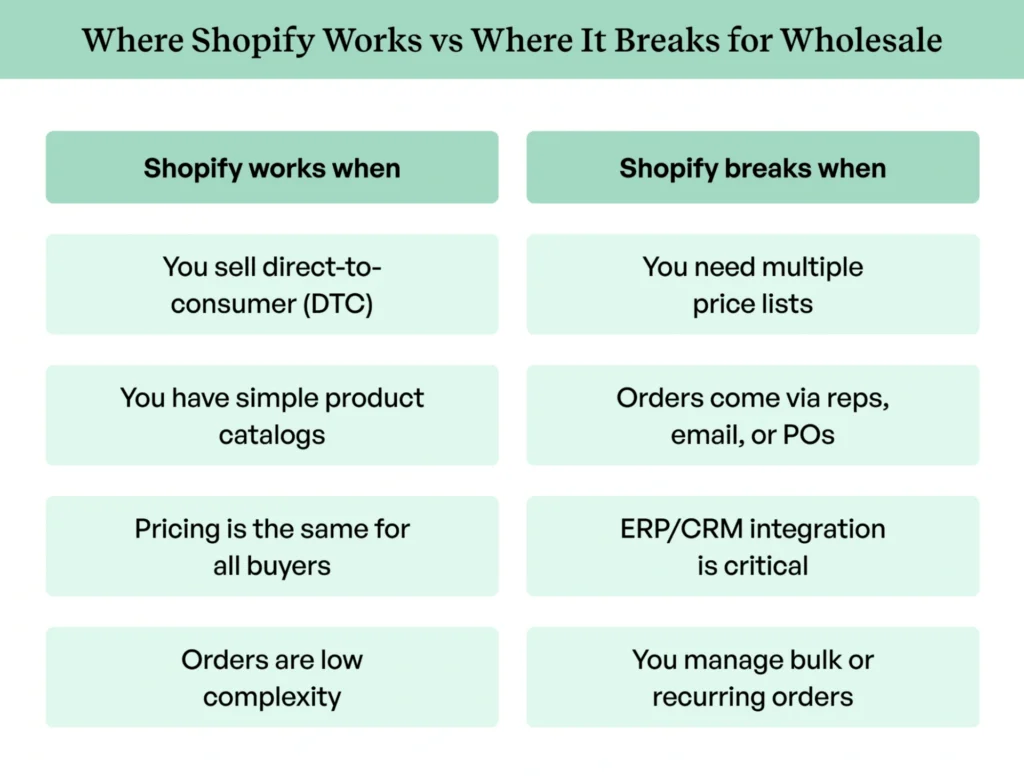
Shopify works well for B2C, but it falls short for B2B. It doesn’t fully support the complexities of wholesale operations, making it less ideal for businesses looking to scale in the B2B space. Here are the limitations of Shopify for B2B e-commerce.
- Expensive Plans with Limited B2B Features
- Limited Customization
- Integration Challenges
- No Multiple Price Lists
- Restricted Data Transfer
- Transaction Fees
- App Dependency
- Restricted User Roles
- Inventory Management Challenge
- Invoicing limitations
1. Expensive plans with limited B2B features
Shopify offers several pricing plans, starting at $25/month and going up to $399/month, with Shopify Plus starting at $2,300/month. In 2026, Shopify moved some foundational B2B features, basic company profiles, up to 3 custom catalogs, and volume discounts to lower-tier plans.
However, the capabilities that serious wholesalers actually need remain Plus-only: unlimited catalogs, direct catalog-to-company assignment, partial payments and deposits, and advanced buyer permissions. And once you start adding the third-party apps needed to fill remaining gaps, costs on any plan can escalate quickly, potentially requiring multiple app subscriptions on top of your monthly Shopify fee. For wholesalers seeking a truly all-in-one solution, Shopify’s pricing structure can become cost-prohibitive without delivering the full functionality required.
2. Limited customization
Shopify’s drag-and-drop feature to customize may seem ideal at first, but it doesn’t suffice to meet the needs of B2B businesses. To meet the B2B wholesale needs, Shopify relies on its proprietary liquid software, which developers do not adopt widely, and creates extra bottlenecks for businesses seeking unique workflows and seamless automation.
Moreover, B2B needs like automatic discounts for specific customers, multiple price lists, customized catalogs, and many more often require third-party tools, making it more complicated. Thus, Shopify’s limited customization makes it a challenging choice for wholesalers looking for a tailored B2B e-commerce experience.
3. Integration challenges
Shopify excels at integrating with the apps available in its app store, but it often stumbles when it comes to integrating with the tools B2B companies rely on, such as enterprise-level CRM or ERP platforms or a wholesale CRM that sales reps and account managers need to reach from the field, with the full account record on the same screen as the price list.
Shopify’s support is also very limited when it comes to custom integrations. Wholesalers are forced to invest more money for third-party solutions or for developers to bridge the gap. A platform tailored for B2B should seamlessly connect with essential business tools, but Shopify’s integration challenges make it less practical for large-scale wholesale operations.
For a detailed comparison of Shopify Plus vs a native B2B e-commerce platform, check out our blog.
4. No multiple price lists
Tailored pricing for different customers is one of the critical aspects of B2B e-commerce, and Shopify is not inherently designed to support such wholesale dynamics. While Shopify Plus offers features like customer-specific pricing through its wholesale channel, it comes with a heavy cost of $2300/month.
For standard Shopify users, creating multiple price lists requires third-party apps or manual adjustments, which are time-consuming and inefficient. This lack of built-in flexibility makes it challenging for wholesalers to manage custom pricing for different clients.
5. Restricted data transfer
Shopify makes it challenging for businesses to transition to another platform if they switch. While you can export basic product information in a CSV file, critical elements like store design, customer data, and transactional history are not easily transferable. This data transfer limitation forces businesses to rebuild essential components from scratch if they move elsewhere.
Businesses will face downtime and must pay additional amounts while migrating from Shopify to another platform. Businesses seeking long-term flexibility should carefully evaluate this restriction, as it may hinder scalability and the ability to adapt to changing needs.
6. Transaction fees
Additional transactional fees are charged by Shopify for those businesses that don’t use their payment system, which significantly reduces wholesalers’ profit margins. These fees quickly add up for the wholesalers who handle high-value or bulk orders. It forces businesses to commit to Shopify payments, which may not support their preferred payment gateways.
For B2B operations, where competitive pricing is critical, these transaction fees present a considerable drawback, making Shopify less appealing for wholesalers focused on maximizing profitability.
7. App dependency
Wholesalers have to depend on a multitude of apps if they want to run their business on Shopify’s core platform. It lacks many key features that wholesalers need, such as advanced tools for Wholesale Pricing (like bulk discounts and volume-based pricing), invoicing, etc. So, they have to depend on third-party apps to access these features, which can increase operational costs and add complexity to site management.
It can create compatibility issues and a fragmented user experience. For wholesalers who require streamlined and scalable solutions, this heavy app dependency can make Shopify a cumbersome and costly option for running a B2B e-commerce business.
Also read: 13 Best Wholesale Apps for Shopify and key features
8. Restricted user roles
Shopify’s user role management system falls short regarding the complex needs of B2B wholesale operations. Granular control over user roles and permissions—such as assigning different access levels for sales reps, account managers, or warehouse staff, is not natively supported. Businesses often need costly custom development to achieve this functionality.
This limitation can lead to inefficiencies and security concerns for wholesalers handling multiple accounts and team workflows. A platform that prioritizes robust user role management is essential for seamless operations, but Shopify’s restricted capabilities make it less suited for B2B businesses.
9. Inventory management challenges
It is evident that wholesale needs are very complex, and Shopify’s inventory management tools are designed for standard operations, which makes it challenging to track stock levels accurately in real-time, increasing the risk of overselling or underselling.
For businesses managing extensive inventories, multiple SKUs, or operating across multiple warehouses, Shopify’s system often falls short without additional apps or custom solutions. This creates inefficiencies and adds operational challenges for wholesalers who need precise inventory control to meet B2B demands.
10. Invoicing limitations
Shopify does not offer an in-built invoicing system, which is a big setback for wholesalers who are always looking for detailed and customized invoicing. Since Shopify lacks this functionality, the wholesalers have to turn towards third-party apps that come with extra costs and complexities.
The most concerning part of these external solutions is the integration issues they come with. This can affect workflow and create inefficiency for financial operations. Businesses looking to streamline professional invoicing operations may find Shopify’s absence of a built-in invoice system a significant limitation.
How does WizCommerce revolutionize wholesale operations?
WizCommerce is a purpose-built AI platform for wholesalers and distributors to overcome the limitations of traditional e-commerce platforms.
Unlike some B2C platforms that grew some B2B features on the side, its entire product suite is designed around how wholesale businesses actually operate: rep-led sales, trade show orders, inbound POs by email, complex pricing tiers, and deep ERP integration.
Let’s explore why WizCommerce is a game-changer for wholesalers.
1. A B2B e-commerce storefront built for wholesale
WizShop is WizCommerce’s B2B online storefront. Unlike Shopify, which requires layers of apps and workarounds to serve wholesale buyers, WizShop is built with wholesale-native features from the ground up: customer approval flows, multiple price lists, segmented product catalogs, flexible net terms, PO number capture, and gated pricing, all without needing a single third-party plugin.
2. Rep-led and trade show order management
Most wholesale revenue doesn’t start on a website; it starts with a sales rep. WizOrder is WizCommerce’s B2B sales rep app that enables field reps to browse the catalog, place orders, and manage customer accounts from any device. Whether at a trade show, on a customer visit, or working from the office, reps can build carts, apply customer-specific pricing, and capture orders that sync directly to your backend systems, no phone calls, no manual entry, no dropped orders.
3. AI Co-workers
WizCommerce’s AI Order Entry Software automatically reads inbound emails and PDF purchase orders, extracts order details, and enters them directly into your system even when a single email contains multiple POs. This dramatically reduces the manual work of processing wholesale orders, cuts errors, and frees your ops team for higher-value tasks. WizCommerce’s AI Quote Automation Assistant generates accurate quotes in seconds, and the AI Sales Copilot surfaces insights to help sales teams close more.
4. Catalog-ready product imagery without photoshoots
One of WizCommerce’s most differentiated additions is WizStudio: an AI-powered product photography tool that lets wholesalers generate professional, catalog-ready product images without a single photoshoot. WizStudio’s Variant Builder generates multiple product variations from a single base image. It’s Product Swap feature lets you reuse a lifestyle background across your entire catalog for visual consistency. For wholesalers managing hundreds or thousands of SKUs, this alone can save tens of thousands of dollars annually.
5. Payments managed as part of the sales workflow
WizPay integrates payments natively into the wholesale workflow. Unlike Shopify’s payment-or-transaction-fee model, it’s built to support B2B payment, including net terms, partial payments, deposits, and multiple billing methods, exactly the payment flexibility wholesale customers expect. No extra apps, no forced payment gateways, no transaction fees eating into your margins.
6. Seamless ERP and CRM integration
WizCommerce integrates natively with QuickBooks, NetSuite, Business Central, Zoho, Fishbowl, and other leading ERP and CRM platforms with real-time sync of inventory, customer data, and order details. Where Shopify forces complex workarounds or expensive custom development for ERP connectivity, WizCommerce treats integration as a first-class requirement.
7. Multiple price lists and segmented catalogs
WizCommerce makes tiered pricing and customer-specific price lists effortless, a core B2B need that Shopify only supports natively at the Plus tier ($2,300/month). Whether offering volume discounts, account-specific pricing, or exclusive product catalogs to select buyers, WizCommerce handles it out of the box.
Real-world success with WizCommerce
Indian Touch of Gallup, a prominent jewelry wholesaler, is one of many wholesalers who found that platforms like Shopify and Wix, designed primarily for B2C, couldn’t support the scale and complexity of their wholesale operations. It had the vision to connect artisans with customers worldwide. However, their journey was hindered by the limitations of platforms like Shopify and Wix, which couldn’t keep up with the demands of their large-scale wholesale business. The inefficiencies of these B2C-focused tools led to fragmented data, manual processes, and missed growth opportunities.
By adopting WizCommerce’s B2B eCommerce solution, Indian Touch of Gallup transformed its operations. With features tailored to wholesale needs, such as bulk product management, custom pricing, and flexible payment options, they streamlined their workflows and enhanced customer experiences. The results were extraordinary: $279,000 in new revenue, 50+ monthly leads, and a digital infrastructure built for scalability, all achieved within just five months.
Read the full case study here to discover how WizCommerce can help your business unlock new growth opportunities.
Conclusion: Shopify excels in B2C, but falls short on B2B
Shopify is a powerful platform, and it’s getting better at B2B every year. But “getting better” is not the same as “built for wholesale.” Shopify’s B2B journey started with DTC and has been adding wholesale features as an afterthought. Serious wholesalers managing rep-led sales, complex pricing, trade show orders, and high-volume ERP operations will keep hitting walls.
The question isn’t whether Shopify can handle some wholesale, it’s whether it’s the right foundation for a business where wholesale is the core model. For most distributors and dedicated wholesalers, the answer is no. f that is your answer too, the next step is comparing a Shopify alternative B2B wholesalers can run without apps filling the gaps.
WizCommerce is built wholesale-first, AI-native, and purpose-designed for the way wholesale businesses actually operate: across online, rep-led, and EDI channels, with AI that eliminates the manual work that keeps teams bogged down.
Book a demo to see what a purpose-built wholesale platform looks like.

FAQs on Is shopify good for wholesale
1. Is Shopify suitable for B2B?
Shopify is not fully suitable for B2B wholesale. While it has added foundational B2B features, its architecture was built for retail, not wholesale. Key capabilities like unlimited custom catalogs, advanced buyer permissions, and deep ERP integrations remain restricted to expensive Plus plans, making it a costly and limited choice for serious wholesalers.
2. Does Shopify support wholesale?
Shopify does support basic wholesale features like company profiles, volume discounts, and custom catalogs, but these capabilities are limited compared to what dedicated wholesale operations require. Features like net terms, partial payments, rep-led order management, and seamless ERP integration require Shopify Plus or additional third-party apps, significantly increasing cost and operational complexity.
3. Is Shopify good for wholesale businesses?
Shopify is good for wholesale businesses running light B2B volume alongside a DTC operation, but it falls short for businesses where wholesale is the core model. Managing complex pricing tiers, rep-led sales, trade show orders, and high-volume ERP workflows consistently exposes the platform’s B2C origins and its limitations for dedicated wholesale operations.
4. What Shopify plan do I need for B2B wholesale?
For serious B2B wholesale operations on Shopify, you need Shopify Plus at $2,300 per month minimum. Lower-tier plans offer only basic B2B features like limited custom catalogs and volume discounts. Even on Plus, key wholesale capabilities like advanced buyer permissions and partial payments often require additional third-party apps, further increasing your total operational costs.
5. What are the best alternatives to Shopify for wholesale?
The best alternative to Shopify for wholesale is a purpose-built B2B platform. WizCommerce is designed wholesale-first, supporting rep-led sales, AI-powered order entry, multiple price lists, trade show ordering, and native ERP integrations out of the box. Unlike Shopify, it requires no costly workarounds, making it a far more practical foundation for scaling dedicated wholesale operations.
6. How risky is Shopify for wholesale operations?
Shopify carries notable risk for wholesale operations due to its app dependency, restricted data portability, and transaction fees on non-Shopify payments. If you need to migrate later, rebuilding customer data, transactional history, and store design from scratch creates costly downtime. Wholesalers heavily reliant on Shopify’s ecosystem can find themselves locked in without a scalable long-term solution.
7. What are the biggest challenges of using Shopify for B2B e-commerce?
The biggest challenges of using Shopify for B2B e-commerce include expensive plans for basic wholesale features, limited native ERP integration, no built-in invoicing, rigid user role management, and heavy app dependency. These gaps create operational inefficiencies for wholesalers managing complex pricing, bulk orders, and multi-channel sales, making Shopify a difficult foundation for scaling serious B2B operations.
8. What cannot be sold on Shopify?
Shopify prohibits selling certain products including firearms, drug paraphernalia, counterfeit goods, certain financial services, and products that violate intellectual property laws. Additionally, regulated industries like alcohol and tobacco require specific approvals. Wholesalers in sensitive product categories should carefully review Shopify’s acceptable use policy before committing to the platform to avoid unexpected account suspension or operational disruption.