Skip to content



TL; DR:
|
When comparing BigCommerce vs Shopify, the numbers tell part of the story: Shopify powers over 5.6 million active stores globally and dominates the ecommerce platform market in both mindshare and adoption. BigCommerce serves a smaller footprint with a different thesis: pack more native features into the core platform so merchants spend less on apps and third-party workarounds to get what they need.
For B2B and wholesale businesses, the BigCommerce vs Shopify comparison carries additional weight. BigCommerce has invested heavily in native B2B features across standard pricing tiers, including price lists, customer groups, and multi-storefront support. Shopify has countered by extending B2B features to all paid plans and building on its ecosystem advantage.
This guide compares BigCommerce vs Shopify across pricing, features, B2B capability, SEO, scalability, and total cost of ownership. We also address where both platforms hit limits for wholesale-heavy operations and where WizCommerce becomes the stronger foundation.
What makes BigCommerce and Shopify fundamentally different?
Both are hosted SaaS platforms that manage infrastructure for you. The difference is in philosophy: Shopify keeps the core lean and extends through apps, while BigCommerce builds advanced capabilities into the platform natively.
- Shopify’s approach: Keep the core simple and let the app ecosystem solve everything else. This creates speed at setup and flexibility through 16,000-plus apps in the Shopify app store. Merchants get a polished user interface and guided onboarding. The trade-off is dependency on third-party tools for advanced features like wholesale pricing, tiered access control, and multi-storefront management.
- BigCommerce’s approach: Build advanced features natively into the commerce platform so merchants need fewer apps and integrations for daily operations. This reduces the total cost of ownership through native functionality. The trade-off is a steeper learning curve and a less polished admin interface that takes longer for non-technical teams to master.
| Expert Tip: A closer look at B2B ecommerce best practices will help you frame how this philosophical difference affects wholesale operations. |
How do BigCommerce and Shopify compare on B2B capabilities?
B2B readiness is where the BigCommerce vs Shopify gap is widest. BigCommerce invested in native wholesale features at standard plan levels. Shopify extended B2B access in 2026 with meaningful constraints still in place.
BigCommerce B2B edition
BigCommerce’s B2B edition includes bulk order forms, purchase order support, advanced quoting, and price list management as native features at standard plan levels. Customer groups and company accounts let merchants segment wholesale buyers and assign different pricing without third-party apps.
Multi-storefront support lets businesses run separate B2B and DTC storefronts under one account with shared inventory management. This makes BigCommerce a strong fit for mid-market wholesale sellers who need B2B tools without enterprise pricing.
Shopify B2B capabilities
Shopify extended core B2B features to all paid plans in 2026. Company profiles, volume pricing, and basic catalog controls are available below Shopify Plus. Catalog access and B2B pricing tiers remain limited on standard plans below Shopify Plus.
Shopify POS does not support the wholesale complexity of offline rep-led order taking; it is designed for retail point-of-sale, not trade show or field selling. The checkout process disables Shop Pay and accelerated checkout options when B2B mode is active.
Where both platforms still leave gaps
Customer-specific pricing at unlimited scale, offline rep-led order taking at trade shows, AI-powered incoming order processing, and deep real-time ERP integration all require middleware or custom development on both platforms. For wholesale businesses where these capabilities are operational requirements, neither platform was architected to handle them natively.
Why purpose-built B2B platforms deliver more: Native B2B platforms like WizShop from WizCommerce were designed around the wholesale selling motion from day one. Unlimited price lists, offline rep tools, AI order automation, and pre-built ERP sync all operate natively without app stacking or middleware dependency. For wholesale teams evaluating BigCommerce vs Shopify, a purpose-built platform eliminates the trade-offs both platforms force you to make.
Also read: Shopify Plus vs Native B2B Ecommerce Platform
How do BigCommerce and Shopify compare on transaction fees?
BigCommerce vs Shopify pricing depends on plans, gateways, and order volume. The true cost comes from monthly subscription fees, apps, payment processing, and transaction fees.
Plan-level pricing
Both platforms start at comparable entry points. Shopify Basic costs $39 per month. BigCommerce Standard also starts at $39 per month. Enterprise pricing diverges significantly, with Shopify Plus starting at $2,300 per month and BigCommerce Enterprise at custom enterprise pricing based on annual sales and feature requirements.
BigCommerce pricing plans include a Standard plan, Plus at $105, Pro at $399, and Enterprise at custom rates. Each BigCommerce plan includes unlimited staff accounts at every tier.
Transaction fees
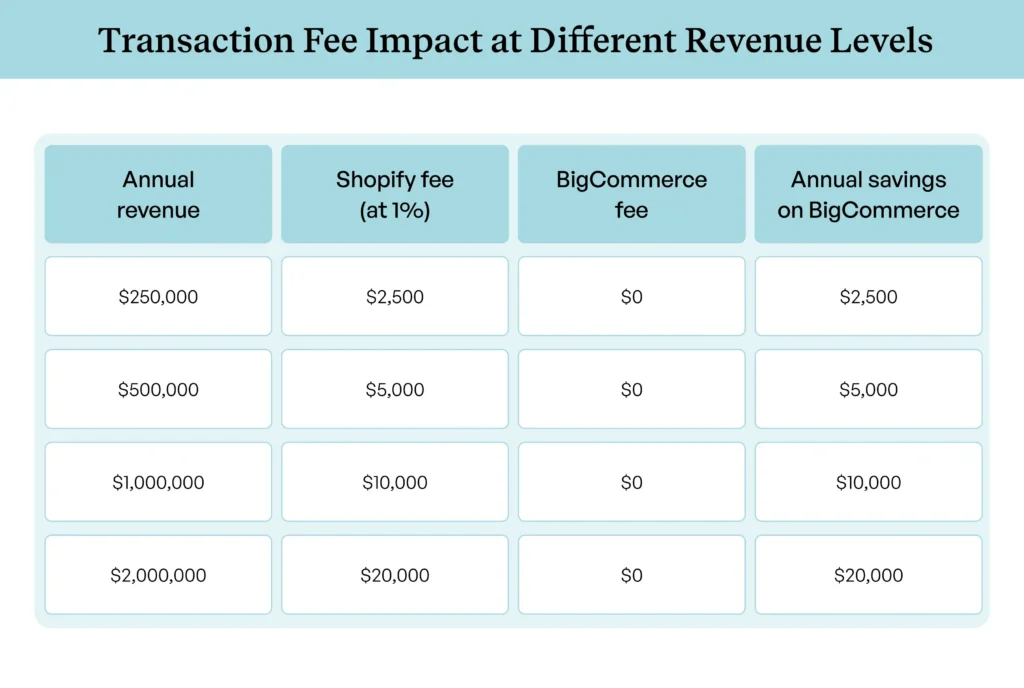
BigCommerce charges zero transaction fees on any payment processor, on any BigCommerce pricing plan. Shopify charges 0.6% to 2% on every sale processed through a third-party gateway outside Shopify Payments. For stores processing $1 million-plus annually, this difference alone can represent $5,000 to $20,000 in annual savings on BigCommerce.
When using Shopify Payments, Shopify removes its platform-level transaction fees entirely, though credit card processing rates and payment processing fees still apply at standard rates.
Which platform gives you more native features versus app dependency?
The BigCommerce vs Shopify native features debate shapes your true cost and operational complexity. How much the core platform delivers out of the box determines how many premium options and additional costs your business absorbs over time.
What BigCommerce includes natively
Multi-currency support, advanced product variants (up to 600 SKUs per product versus Shopify’s 100), B2B pricing tools, customer groups segmentation, multi-storefront capability, and advanced reporting are all built into BigCommerce at standard plan levels.
Product reviews, abandoned cart recovery on the grow plan, and faceted search filtering all come included without reaching for the app marketplace. BigCommerce’s free themes also provide more built-in customization than Shopify’s equivalents at the free tier.
What Shopify handles through apps
Shopify’s core is intentionally lean. Advanced product options, tiered pricing, wholesale access controls, multi-storefront functionality, and detailed product descriptions customization require apps. Many carry their own subscription fees that compound as your ecommerce store grows.
The trade-off is ecosystem depth: Shopify’s app store houses 16,000-plus tools covering every conceivable use case. Shopify Email also gives merchants 10,000 free sends per month before additional costs apply.
Built-in depth vs app flexibility: BigCommerce reduces total cost of ownership through native functionality for complex needs. Shopify’s app ecosystem provides broader depth of specialized solutions for ecommerce website optimization. The right answer depends on how many advanced capabilities your business needs natively versus how much value you place on ecosystem breadth and ease of use.
Here is a quick BigCommerce vs Shopify comparison to help you make an informed choice:
| Factor | BigCommerce | Shopify |
| Starting price | $39/month (Standard) | $39/month (Basic) |
| Enterprise pricing | Custom | $2,300/month (Plus) |
| Transaction fees | 0% on any gateway | 0.6% to 2% outside Shopify Payments |
| B2B features | Native at standard tiers | Limited below Plus |
| Multi-storefront | Native on mid-tier plans | Requires Plus |
| Staff accounts | Unlimited on all plans | Capped on lower plans |
| Product variants per SKU | Up to 600 | Up to 100 |
| App ecosystem | Smaller, targeted | 16,000-plus apps |
| Point of sale | Third-party required | Native Shopify POS |
| Free trial | 15-day free trial period | 3-day free trial |
Can BigCommerce or Shopify handle wholesale selling better?
BigCommerce handles wholesale selling better when you need native B2B features inside the ecommerce platform. Shopify works better when ease of use, checkout quality, and app flexibility matter more. Both still need help for offline orders, AI order entry, and ERP-connected workflows.
BigCommerce for wholesale selling
BigCommerce has stronger built-in B2B capabilities for wholesalers that want fewer apps in their stack. Customer groups, price lists, company accounts, quote management, and multi-storefront support create a structured wholesale setup. This helps brands manage account-specific pricing and role-based buyer access.
It can reduce app dependency for mid-sized B2B sellers that need wholesale functionality inside the platform. BigCommerce works best when native B2B tools match daily workflows in wholesale distribution.
Shopify for wholesale selling
Shopify is easier to manage and has stronger customer support, including 24/7 live assistance. Its 2026 B2B updates added company profiles, volume pricing, and basic catalog controls on paid plans. The Shopify dashboard also creates a polished user experience. The wholesale setup still depends on the Shopify app store for advanced pricing, access control, quoting, and multi-storefront workflows.
This makes Shopify suitable for DTC-led brands adding wholesale. At higher order volumes, wholesale-first businesses may find app dependency harder to manage. For wholesale operators evaluating whether Shopify is genuinely good for wholesale, the limitations become clearer at higher order volumes.
Where both platforms still fall short
Both platforms support basic wholesale selling. Neither was built around the full operating model of wholesale teams. Sales reps need better tools for trade shows, showroom selling, field visits, and offline order capture. Operations teams need clean PO processing, real-time inventory visibility, customer-specific pricing, and ERP-ready order data.
For wholesale-heavy businesses, the better question is not BigCommerce or Shopify alone. It is whether the commerce platform can support daily wholesale workflows without adding friction, manual work, or disconnected apps across your ecommerce store.
Also read: Best Shopify B2B Alternatives For Wholesalers
When should you choose BigCommerce over Shopify?
BigCommerce earns its place when native B2B features and transaction fee savings outweigh Shopify’s ecosystem advantages for your business model.
- Native B2B features like customer groups, price lists, and company accounts without paying enterprise pricing for access.
- Wholesale order volumes are a margin concern, and you need the freedom to use any payment processor without being locked into a single one.
- Multi-storefront capability under one account to serve different buyer segments from separate online store experiences.
- Catalog complexity demands advanced product variants with up to 600 SKUs per product built into the standard plan.
When should you choose Shopify over BigCommerce?
Shopify or BigCommerce decisions favor Shopify when speed and ecosystem depth carry more weight than native feature depth for your ecommerce business.
- Speed to launch and ease of use in daily management are top priorities for your small business or growing online store.
- Primary revenue channel is DTC with straightforward catalogs, and you value the Shopify POS point of sale for retail.
- The breadth of the Shopify app store, with 16,000-plus tools, covers all sales channels.
- Checkout conversion through Shop Pay is a critical revenue optimization lever and customer experience priority.
Why do wholesale teams need WizCommerce beyond BigCommerce and Shopify?
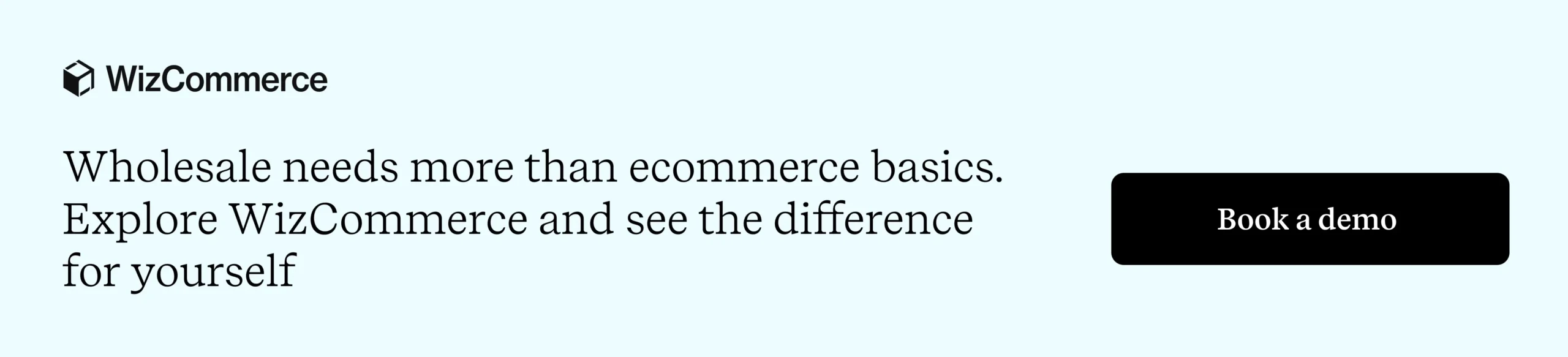
BigCommerce and Shopify each address pieces of the B2B puzzle. Neither was designed from the ground up for the full operational reality of wholesale selling. WizCommerce was built for wholesalers, manufacturers, and distributors who need every core wholesale workflow operating natively from day one.
- WizShop: A B2B ecommerce platform gives wholesale buyers a self-serve ordering experience with assigned catalogs, customer-specific pricing, order history, and account-level controls built into every interaction. Buyers place repeat orders online while pricing and catalog access stay aligned with their business relationship automatically.
- WizOrder: A Mobile B2B order taking app supports rep-led selling across trade shows, showrooms, field visits, and offline environments where connectivity cannot be guaranteed. Sales reps capture orders, manage carts, check customer details, and sync all activity once connectivity returns.
- AI sales copilot: The AI sales copilot helps reps act on customer, order, quote, inventory, and activity data through conversational queries. It surfaces follow-up opportunities, recommends products, prepares reps for meetings, and helps teams respond faster without searching across multiple dashboards.
- AI order and quote automation: The AI order entry assistant captures incoming POs from emails, PDFs, scans, and other formats. It validates SKUs, quantities, pricing, and customer data against ERP rules. It also maps customer-specific product codes to internal SKUs and creates ERP-ready orders with fewer manual corrections than any test run on either ecommerce platform would produce.
- WizStudio: It supports wholesale product presentation by helping teams create catalog-ready images and product visuals with AI. WizStudio is useful for brands that need strong digital catalogs, buyer-facing assets, and updated product imagery without repeated photoshoot cycles and software costs.
- ERP and system integrations: WizCommerce connects with ERP, accounting, inventory management, and CRM tools so teams sync pricing, inventory, and order data across systems. Its integration approach supports real-time two-way sync, pre-built connectors, custom workflows, and error handling for wholesale operations at any size.
For wholesalers evaluating Shopify or BigCommerce, the question is whether either ecommerce platform can support the operational complexity your wholesale business runs on today. WizCommerce removes that question entirely.
Book a demo to see how.
Frequently asked questions
Does BigCommerce charge transaction fees on any plan?
No. BigCommerce charges zero platform transaction fees on any BigCommerce pricing plan regardless of which payment gateway you use. This applies to the standard plan through enterprise plan tiers. You still pay your payment processor’s credit card rates and payment processing fees, which vary by provider and volume.
Can Shopify match BigCommerce’s native B2B features without apps?
Shopify extended B2B features to all paid plans in 2026, including company profiles and volume pricing. Catalog caps, limited checkout customization, and the absence of native multi-storefront support on standard plans mean Shopify still trails BigCommerce on native B2B depth. The gap narrows at the Shopify Plus pricing level, though native multi-storefront and unlimited pricing tiers remain a BigCommerce advantage.
Which platform is better for businesses selling both B2B and DTC?
BigCommerce handles blended B2B and DTC selling better through native multi-storefront support and customer groups segmentation at standard tiers. Shopify manages it through blended stores with B2B mode enabled, though the checkout process constraints and catalog limits create friction for large enterprises running both channels at scale.
Is it easy to migrate from BigCommerce to Shopify or vice versa?
Migration between platforms requires careful planning around URL redirects, product data export, customer account recreation, and SEO preservation. Both platforms offer import tools for basic migration. Complex catalogs with custom fields, B2B pricing tiers, and customer groups require additional custom development work and thorough testing in a staging environment to verify data accuracy before going live.
Which platform offers better checkout conversion rates in 2026?
Shopify’s checkout, powered by Shop Pay, delivers a one-click accelerated experience that consistently outperforms standard checkout flows. Shopify reports that Shop Pay can convert up to 50% better than guest checkout. BigCommerce offers a fully customizable checkout on all plans with no platform restrictions, making it more flexible for businesses with complex needs around payment processing and order workflows.
What are users saying about BigCommerce vs Shopify on Reddit?
Reddit users emphasize that Shopify is the industry standard for ease of use, design flexibility, and its unmatched app marketplace. However, they frequently criticize its “app tax. They also praise BigCommerce for its native B2B functionality and zero transaction fees, though noting its steeper learning curve.