Skip to content



TL;DR
|
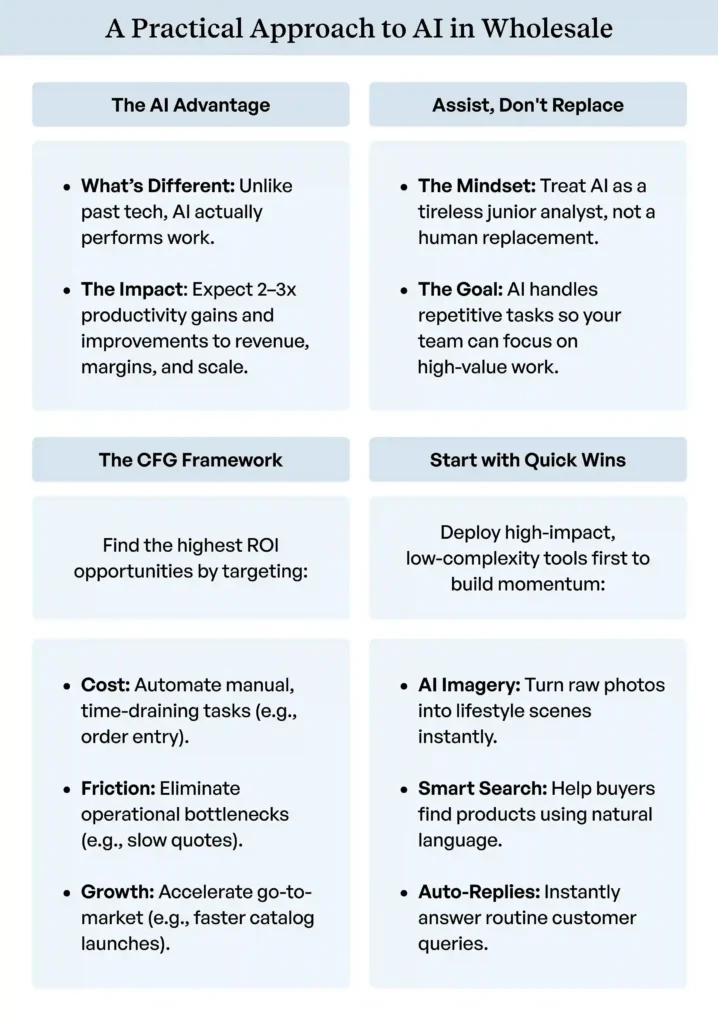
Artificial intelligence is the operating standard for companies that want to stay competitive today. It’s already shaping how orders are processed, how sales teams work, and how catalogs are built and managed.
If you run a wholesale or distribution business, you’ve probably heard the promises – faster operations, fewer errors, better customer experience. The real question is simpler: where does AI actually fit into your day-to-day workflow, and what’s worth implementing first?
In wholesale, you’re dealing with large catalogs, customer-specific pricing, purchase orders coming in from multiple channels, and sales cycles that rely on relationships. Not every AI use case applies here, and not every tool delivers real value.
This guide focuses on AI use cases in e-commerce, especially for B2B and wholesale teams. We’ll walk through the most practical use cases of AI in B2B e-commerce and wholesale distribution, where they actually make an impact, and how teams are using them to reduce manual work, respond faster, and handle more volume without growing headcount.
What is AI in B2B e-commerce and wholesale distribution?
AI in B2B e-commerce and wholesale refers to software that automates repetitive tasks, makes data-driven decisions, and helps teams move faster without doing everything manually.
It’s not about replacing your sales team or overhauling your entire operation. It’s about taking the parts of your workflow that slow you down, like entering orders, creating quotes, sorting product data, or responding to routine requests, and letting AI handle them in the background.
For most wholesale businesses, AI shows up in very practical ways:
- Reading and processing purchase orders (even when they come in messy formats like PDFs or emails)
- Suggesting products based on a buyer’s past orders or preferences
- Helping sales reps generate quotes faster with the right pricing applied
- Cleaning up and enriching product catalogs
- Generating product images or variations without needing full photoshoots
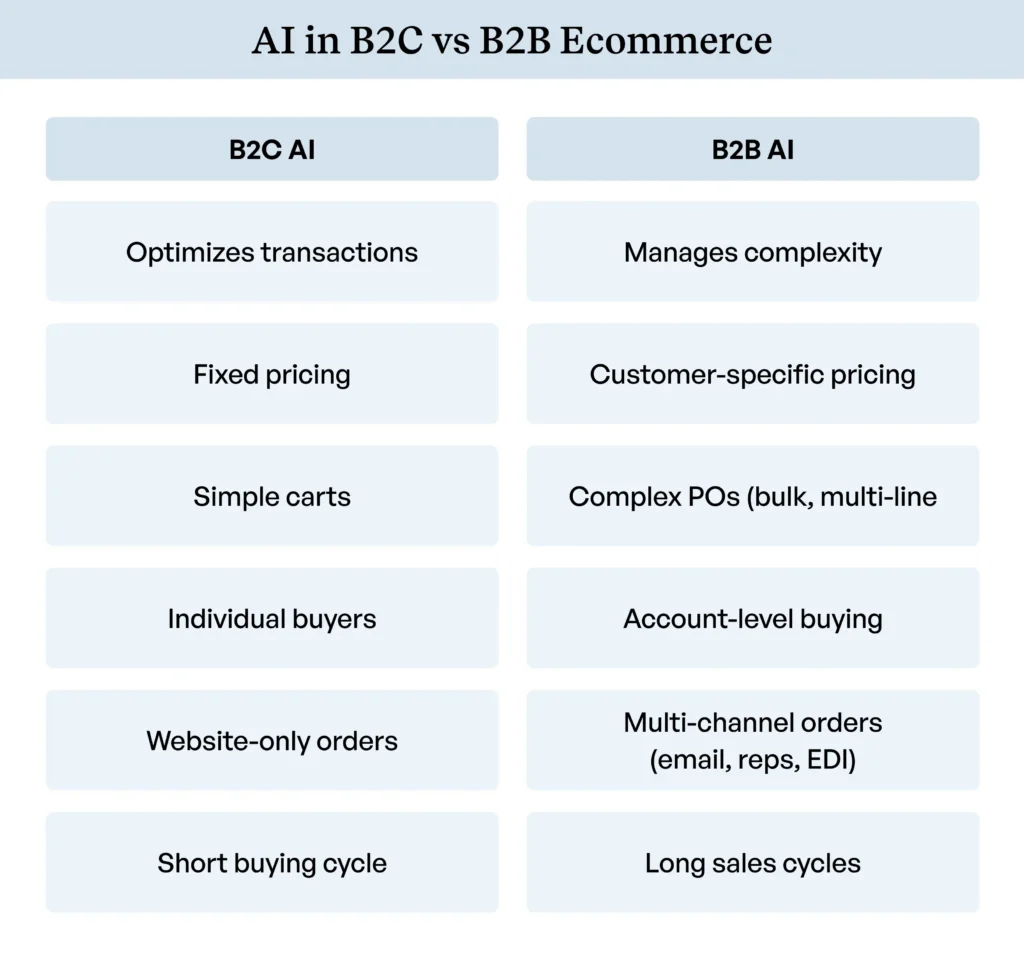
At its core, AI helps wholesale teams handle more volume, with fewer errors and less back-and-forth. The key difference from B2C is complexity.
Why wholesalers are adopting AI now?
For years, AI adoption in wholesale lagged behind B2C retail due to messy data, complex ERP systems, and internal resistance. Those barriers are falling fast, and adoption has accelerated. Today, 60% of B2B businesses are actively investing in AI, 67% are already using it in their B2B e-commerce platforms, and adoption has grown by 270% in the past four years. Moreover, 79% of companies plan to increase their AI investment, indicating a clear shift from experimentation to real use.
The labor shortage is forcing automation
Wholesale operations rely heavily on manual work, but hiring and retaining staff is getting harder and more expensive. Instead of scaling headcount, businesses are using AI to handle repetitive tasks like order processing and customer requests, allowing smaller teams to manage higher volumes with fewer errors.
Digital-first B2B buyers are raising the bar
Today’s buyers expect fast, seamless experiences similar to platforms like Amazon Business, including real-time pricing, quick order confirmation, and instant responses. If that experience isn’t there, they switch vendors. AI in B2B e-commerce helps wholesalers meet these expectations without slowing down internal teams.
Also read: How AI Is Making B2B Businesses More Efficient
ERP data is finally ready to be used
Wholesalers already have years of data stored in systems like NetSuite, SAP, Sage, Microsoft Dynamics, and QuickBooks, but it hasn’t been easy to use. AI tools can now connect to this data and turn it into insights, helping teams forecast demand, understand buying patterns, and make better sales decisions.
Top 10 AI use cases in B2B e-commerce
Below are the most impactful, proven AI use cases in B2B e-commerce and wholesale operations, organized by business function.
1. AI-powered order entry and processing
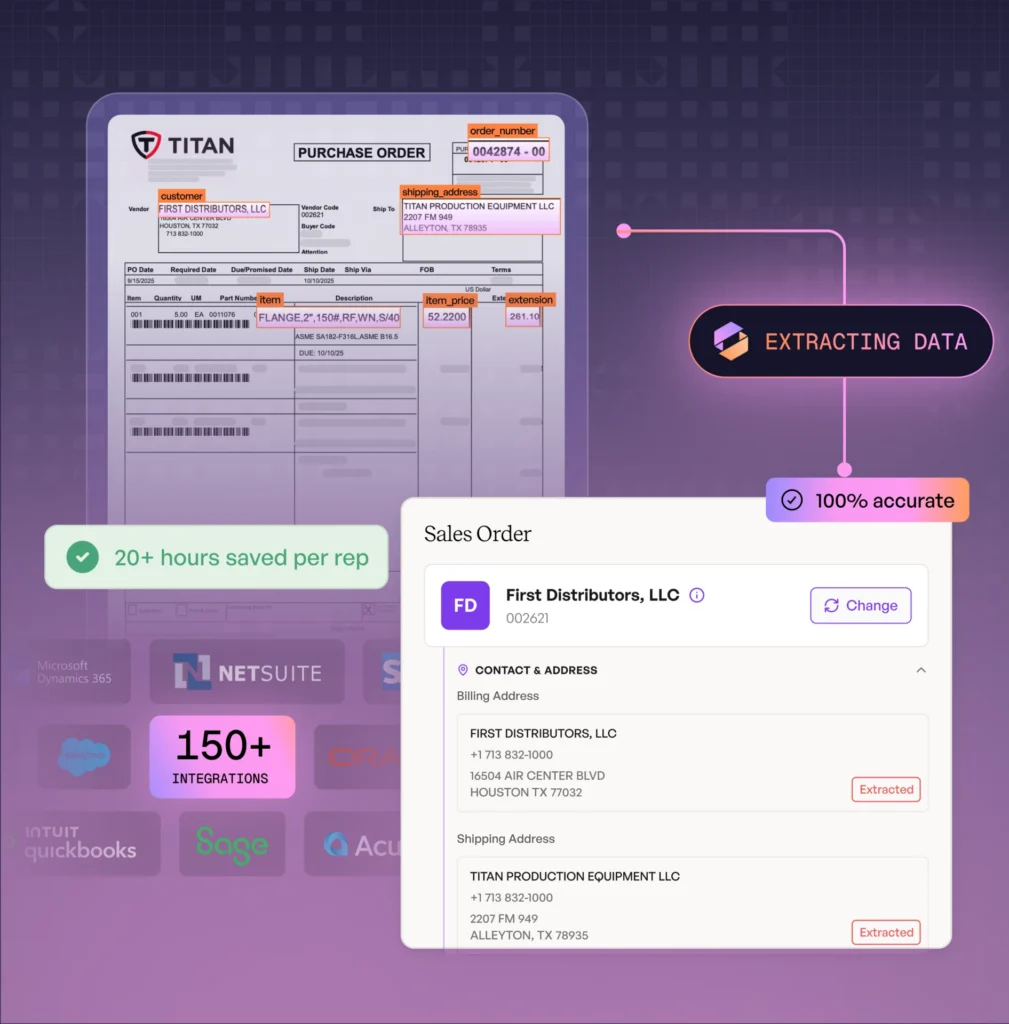
Order entry is one of the highest-volume, most error-prone manual tasks in wholesale. A typical distributor receives purchase orders via email attachments (PDFs, spreadsheets), EDI, fax, and phone, in dozens of different formats from hundreds of customers. Staff re-key each PO into the ERP, match customer part numbers to internal SKUs, validate pricing, and check inventory. It’s slow, expensive, and introduces errors that create fulfillment problems downstream.
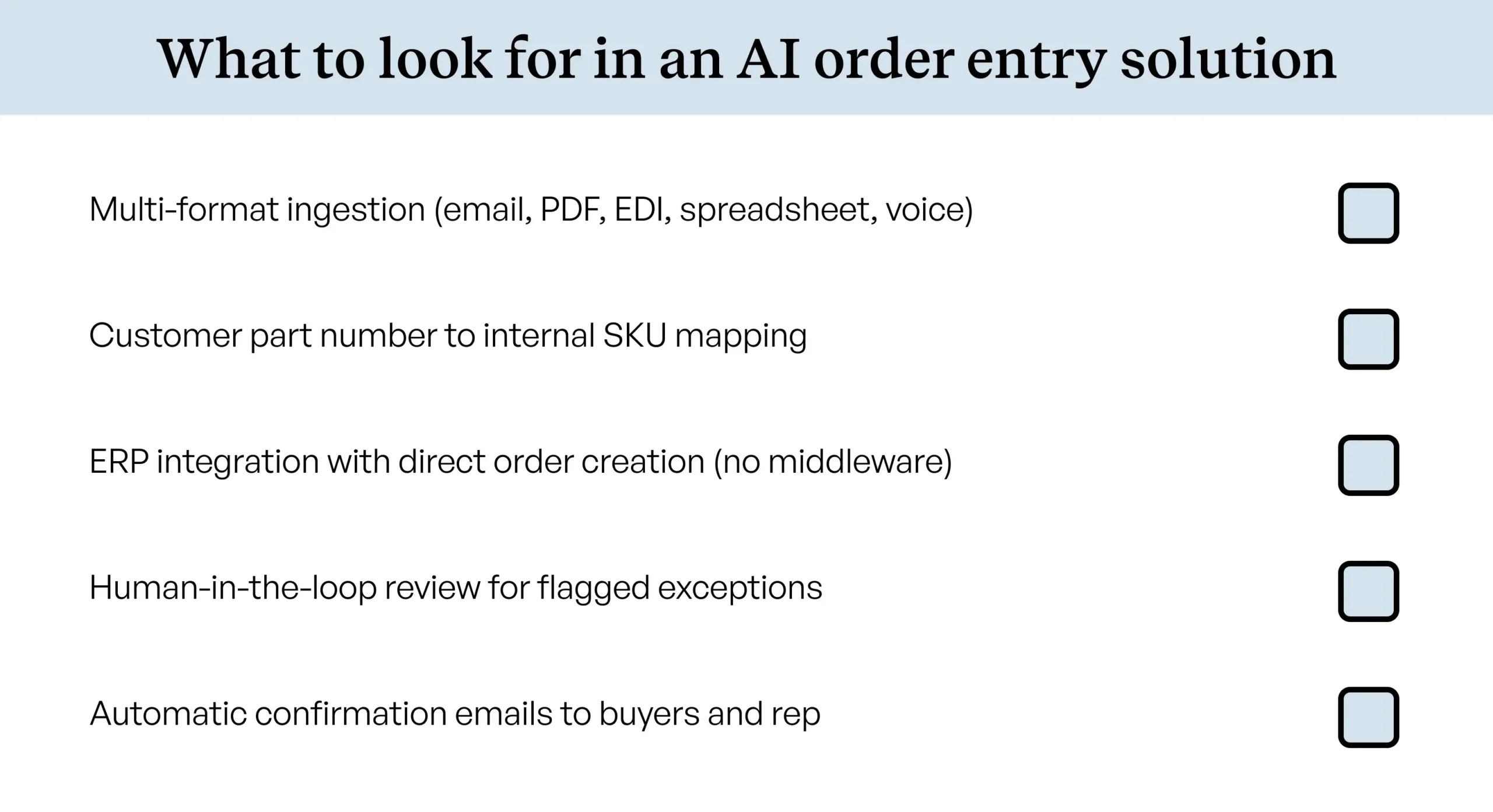
AI order entry automation handles this by:
- Reading incoming POs from any format, email attachments, PDF scans, spreadsheets, or even voice messages
- Extracting all line items, SKUs, quantities, pricing, and customer details automatically.
- Mapping customer-specific product codes to internal SKU numbers without manual lookup.
- Validating data against ERP rules, price lists, inventory, and past orders
- Flagging discrepancies for human review and generating an ERP-ready sales order
- Sending an automatic confirmation to the customer.
Real result: The brand Howard Elliott Collection reduced order processing time from 4 hours to 15 minutes per order using WizCommerce’s AI Order Entry Assistant, a 94% reduction in processing time.
For businesses processing hundreds of orders per month, a 60-minute reduction per order represents thousands of hours of recovered capacity annually.
2. AI quote and pricing automation
Quoting in wholesale is one of the most time-consuming and error-prone tasks. Prices vary by customer, volume tier, contract terms, and negotiated discounts, and a single quote can span dozens of line items across multiple categories. Sales reps manually cross-reference price lists, check inventory, and apply customer-specific rules, time that could be spent closing deals.
AI quote and pricing automation handles this by:
- Generating accurate, customer-specific quotes in seconds using the correct price list, discount structure, and inventory levels
- Applying MOQ rules, volume tiering, and contract terms automatically
- Suggesting relevant upsell or cross-sell items based on what’s being quoted
- Producing formatted quote documents ready to send to buyers
- Tracking quote expiry and triggering follow-up reminders
- Recommending optimal prices in real time using transaction history, customer lifetime value, and demand signals
Result: Businesses using AI for pricing decisions have reported meaningful improvements in win rates and margin protection. Sales teams can now generate quotes on the spot, even from mobile devices during customer meetings or trade shows, cutting response times from days to minutes. Faster, accurate quoting improves win rates and gives wholesalers a clear competitive edge.
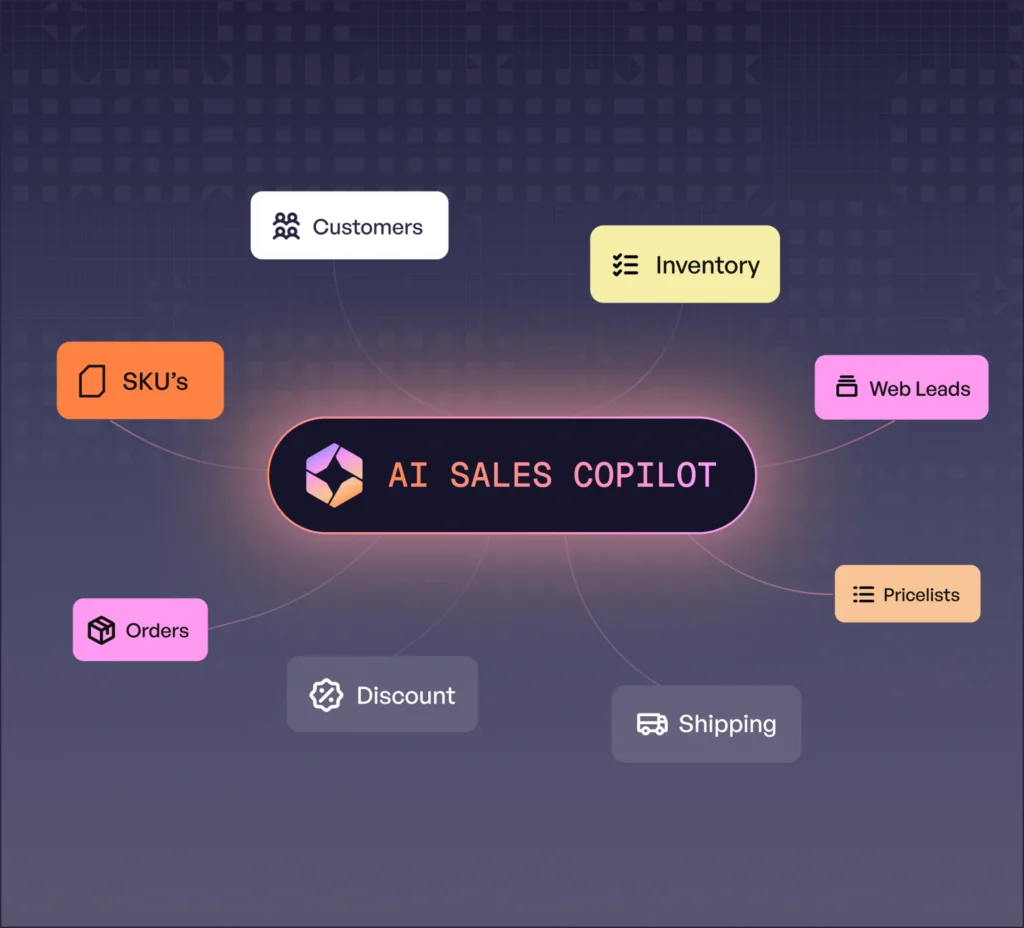
3. AI sales copilot and CRM intelligence
Wholesale sales reps often manage 50 to 200+ accounts, and preparing for each customer call can be overwhelming. They need to know: what did this account order last? What’s pending? Which products are they browsing? Who needs follow-up today? Without AI, this means digging through dashboards and ERP reports.
An AI Sales Copilot gives reps these answers in plain language, drawn from live sales data, just like asking a well-informed colleague. A copilot is only as good as the record it reads, which is why the platform choice comes first – we compare the best CRM for wholesale on exactly that basis.
A modern AI Sales Copilot enables sales teams to:
- See a full customer summary before any meeting: recent orders, open quotes, activity, payment status
- Identify accounts needing follow-up based on inactivity, expiring quotes, or inventory alerts
- Surface products that a customer has been viewing on the B2B portal
- Create orders and quotes during live customer conversations
- Build and send personalized catalogs on the road by account segment or category
- Monitor accounts affected by stock changes or delivery delays in real time
Beyond boosting individual productivity, AI in the CRM also enables churn prediction, lead scoring, and pipeline forecasting, giving sales managers a real-time view of revenue risk and opportunity without a dedicated analytics team. This works only when the copilot reads a CRM for distributors and wholesalers holding order history and contract pricing on the account — a general-purpose CRM has the conversation but not the transaction.
“The AI Sales Copilot has transformed how our team sells. Reps no longer dig through dashboards or reports, they just ask a question and get exactly what they need.” — Kimberley Lambert, Digital Marketing, Tremont Floral
Also read: The Future of AI Sales Teams
4. AI-powered inventory management and demand forecasting
Inventory is the single largest working capital investment for most wholesalers. Getting it wrong, either overstocking slow-moving items or running out of fast-moving ones, directly hits margin, customer satisfaction, and cash flow. Traditional inventory management relies on manual reorder points, gut-feel decisions, and seasonal estimates based on last year’s numbers. AI makes this process dynamic and data-driven.
AI inventory and demand forecasting handles this by:
- Analyzing historical sales and customer data across SKUs and segments
- Tracking seasonal patterns and emerging trends
- Monitoring current open orders and pending POs
- Incorporating external signals such as market events, competitor activity, and weather
- Considering lead times and supplier reliability
The system produces a dynamic, SKU-level forecast that updates continuously, so planners can make smarter decisions every day rather than working off static spreadsheets.
AI-driven inventory management can improve inventory accuracy up to 95% and reduce stock-outs and overstocks, lowering total inventory costs by around 10%.
AI can also flag suppliers with deteriorating delivery performance, suggest the most reliable suppliers for reorders, and optimize delivery routes for cost and efficiency. This turns inventory management from a reactive task into a proactive, profit-protecting function.
5. AI product recommendations and personalization
Product recommendations in B2B wholesale are underused but highly valuable. When a buyer logs into a distributor e-commerce solution, the system already has rich data, purchase history, category preferences, seasonal patterns, and account-specific pricing. AI uses this data to suggest the right products at the right time, making reordering faster and more relevant.
AI product recommendations handle this by:
- Delivering account-level recommendations based on the buying patterns of the entire business, not just one user
- Respecting contract pricing and customer-specific product restrictions
- Surfacing relevant slow-moving items that match the buyer’s profile
- Adjusting recommendations based on seasonal demand and timing
Result: AI recommendation engine increases average cart value per order by analyzing purchase data, trends, and account-level behavior. AI can tailor the entire portal experience, showing buyers their most reordered items, highlighting frequently viewed or wishlisted products, and presenting a catalog aligned with their needs. This reduces friction in the reorder process and leads to larger, more frequent orders.
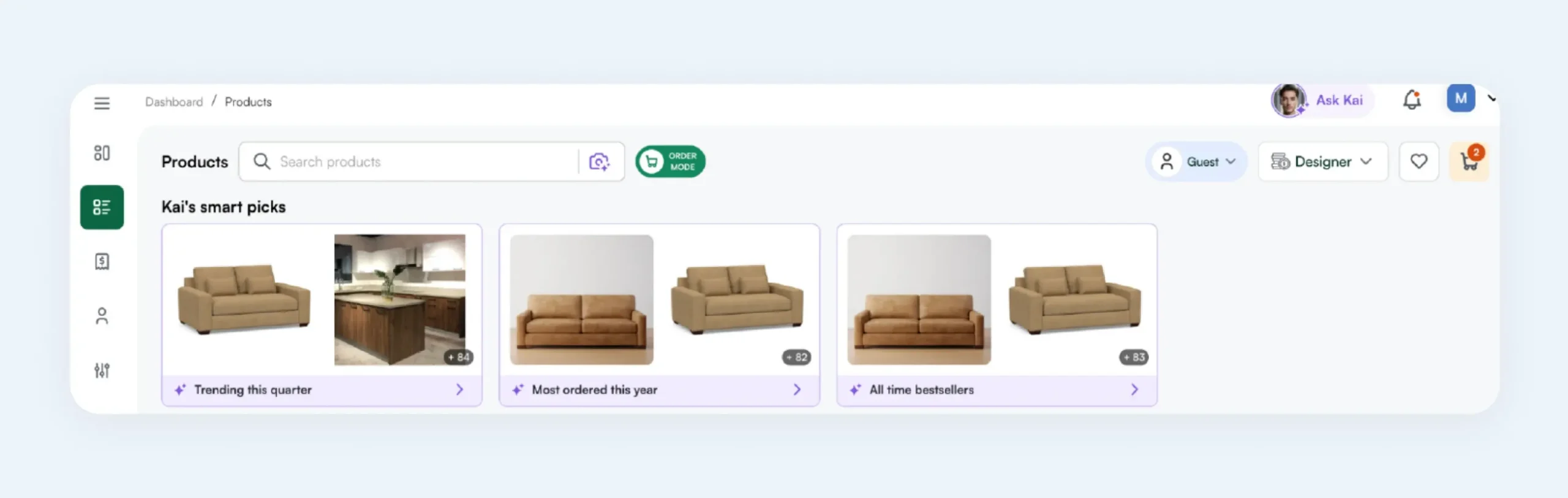
WizCommerce’s recommendation engine applies this at the account level, analyzing each customer’s past purchase data, trends, and buying behavior to suggest products for both online buyers and sales reps in the field.
6. AI for Product Photography and Visual Commerce
Product photography is one of the most overlooked but high-impact areas in B2B wholesale. Creating catalog-ready images for hundreds or thousands of SKUs is expensive, time-consuming, and hard to scale. Brands need studio shots, lifestyle images, variant photos, and technical drawings, and a full photoshoot can take months, delaying product launches and seasonal campaigns.
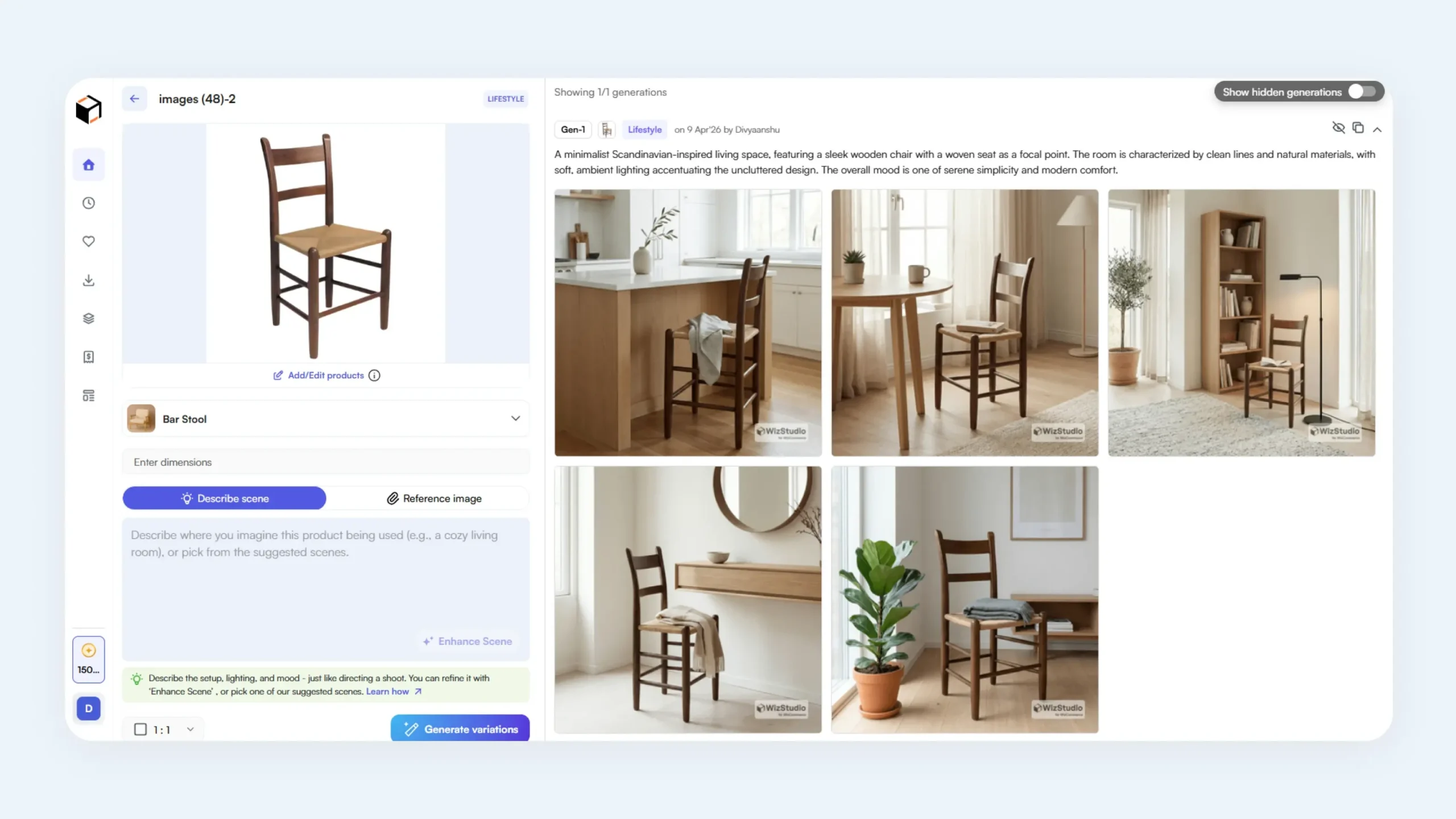
AI product photography handles this by:
- Generating lifestyle images with models, environments, and custom scenes from a single product photo
- Creating clean silo shots with consistent backgrounds, lighting, and shadows
- Producing line drawings and technical spec visuals automatically
- Generating variant images for different colors, sizes, or materials
- Creating short videos and 360-degree product views for digital catalogs
- Processing hundreds of SKUs in bulk within days instead of months
Wholesalers can also edit product images with AI to standardize backgrounds, adjust lighting, and apply consistent styling across an entire catalog without re-shooting a single product.
For wholesalers selling on marketplaces like Faire or their own portals, image quality directly affects conversion. Buyers choose products that look polished and ready to sell. AI makes that level of quality accessible, even for brands without in-house studios.
What sets an AI product photography generator for wholesale apart is its ability to maintain product accuracy, preserving colors, textures, and proportions while supporting large SKU volumes, multi-product staging, and workflows built for catalog production at scale.
“With WizStudio, we now create full catalogs with AI, featuring models and outdoor scenes, at a fraction of the cost of traditional photoshoots. We’ve produced over 500 product images in just days.” — Kerri Christman, VP of Marketing
7. AI-powered search and catalog discovery
Wholesale catalogs are large, complex, and often hard to navigate. This poses a challenge for buyers, as most aren’t searching casually; they’re looking for specific products with exact attributes. A query like “3/4 inch copper elbow” needs results that understand dimensions, material, and compatibility, not just keyword matches.
AI-powered search for B2B catalog handles this by:
- Enabling natural language search, so buyers can search the way they speak
- Applying attribute-aware filtering across dimensions, materials, certifications, and compatibility
- Mapping typos, synonyms, and part number variations to the correct products
- Reducing zero-result searches by surfacing the closest relevant alternatives
- Personalizing search results based on the buyer’s account history and preferences
Poor search is a silent conversion killer. If a buyer can’t find what they need quickly, they either call a sales rep, adding manual work back into the process or switch to a competitor whose catalog is easier to use. AI search removes that friction and keeps ordering self-serve.
8. AI in Customer Service and Self-Service Support
B2B customer service in wholesale is dominated by a small set of repetitive questions: Where is my order? When does it ship? Is this item in stock? What is my account balance? Can I get a price on X? These requests are predictable, pulled from structured data, and costly to handle manually at scale.
AI-powered customer service addresses this by:
- Providing order status chatbots connected to live ERP data, so buyers get real-time updates without calling
- Enabling self-service portals where buyers can manage returns, request credit memos, and update payment details
- Routing tickets intelligently by classifying inbound requests and assigning them to the right team
- Sending proactive notifications when delays, stock issues, or payment problems occur
B2B buyers increasingly expect to handle routine tasks on their own. When those interactions shift from human agents to AI-powered self-service, the cost savings are ongoing, and service becomes faster and more consistent.
9. AI for marketing automation and lead scoring
B2B marketing has historically been underinvested compared to B2C, AI is changing that by utilizing AI for automation and lead scoring in wholesale using existing customer and behavioral data to run personalized, data-driven campaigns at scale without a large marketing team.
Key AI marketing applications for wholesalers:
- Scoring leads based on browsing activity, email engagement, company size, and product interest to identify which prospects are most likely to convert
- Automating email campaigns with dynamic segmentation based on where each contact is in the buying cycle
- Re-engaging dormant accounts with personalized outreach triggered by past purchase behavior
- Monitoring competitor pricing and market signals to inform positioning and promotions
- Generating content such as product descriptions and email sequences, with human review before publishing
For most wholesalers, the highest-impact use case is simple: using purchase history to predict when a customer is ready to reorder, then triggering a personalized message at that moment. This increases reorder frequency without increasing marketing spend.
10. Generative AI for content creation at scale
Generative AI is changing how wholesale businesses produce content by reducing the time and cost required to create large volumes of catalog material. The biggest impact is on structured, repeatable content that would otherwise take significant manual effort across hundreds or thousands of SKUs.
The strongest use cases include:
- Product description generation: AI turns structured product data, such as dimensions, materials, and certifications, into accurate, SEO-optimized descriptions at scale.
- Catalog content: AI generates category introductions, feature highlights, and positioning for new product launches.
- Sales collateral: AI drafts one-pagers, email pitches, and presentation copy that sales teams can quickly personalize.
This works best with a human-in-the-loop approach. AI produces fast, consistent first drafts, while humans refine the output, verify technical accuracy, and ensure the content aligns with brand and compliance requirements.
Use cases of AI in wholesale distribution
While the use cases above apply broadly to AI for B2B e-commerce, wholesale distribution has specific operational characteristics that create unique AI opportunities. The following applications are particularly high-value for wholesale-first businesses. For a complete guide to using AI in wholesale distribution, read our blog on it.
1. Trade show and rep-driven order taking
Selling in bulk(wholesale) often takes place at trade shows, showrooms, and in-person visits, where printed catalogs and unreliable connectivity slow down closing deals. With AI-enabled mobile order entry, reps can now take orders, create quotes, and check inventory in real time, even in low-connectivity environments, and orders sync to the ERP automatically. Beyond order taking, AI gives reps pre-call intelligence in the field: which accounts in a territory are due for follow-up, which items a buyer has been browsing online, and which promotions are relevant to their product mix.
2. Net terms and B2B payment complexity
Wholesale transactions typically involve net payment terms (Net 30, Net 60, Net 90), partial payments, and sometimes factoring arrangements. AI in wholesale distribution helps automate the monitoring of accounts receivable, flag overdue accounts before they escalate, and trigger the appropriate collections workflow. AI can also identify the optimal payment terms to offer new accounts based on their credit profile and industry benchmarks.
3. Multi-channel catalog management
Wholesalers sell across multiple channels at once, including their own B2B portal, sales rep tools, marketplaces, and EDI connections with large buyers. Each channel often requires different pricing, catalog visibility, and content formats. AI-driven catalog management maintains these channel-specific rules, automates updates, and ensures consistency without manual intervention.
4. ERP-connected AI for real-time intelligence
The most effective AI implementations in wholesale are those directly connected to ERP data. Rather than building a separate AI system that relies on data exports, modern AI tools integrate directly with ERPs like NetSuite, SAP Business One, Microsoft Dynamics, Sage, and QuickBooks to read and write data in real time. This allows tools like WizCommerce’s AI sales copilots to pull live customer and order data, and AI order entry systems to create transactions directly within the ERP, eliminating the need for manual handoffs.
Also read: From Spreadsheets to AI: How Mid-Market Distributors Are Competing with Giants
How to implement AI for B2B e-commerce and wholesale operations
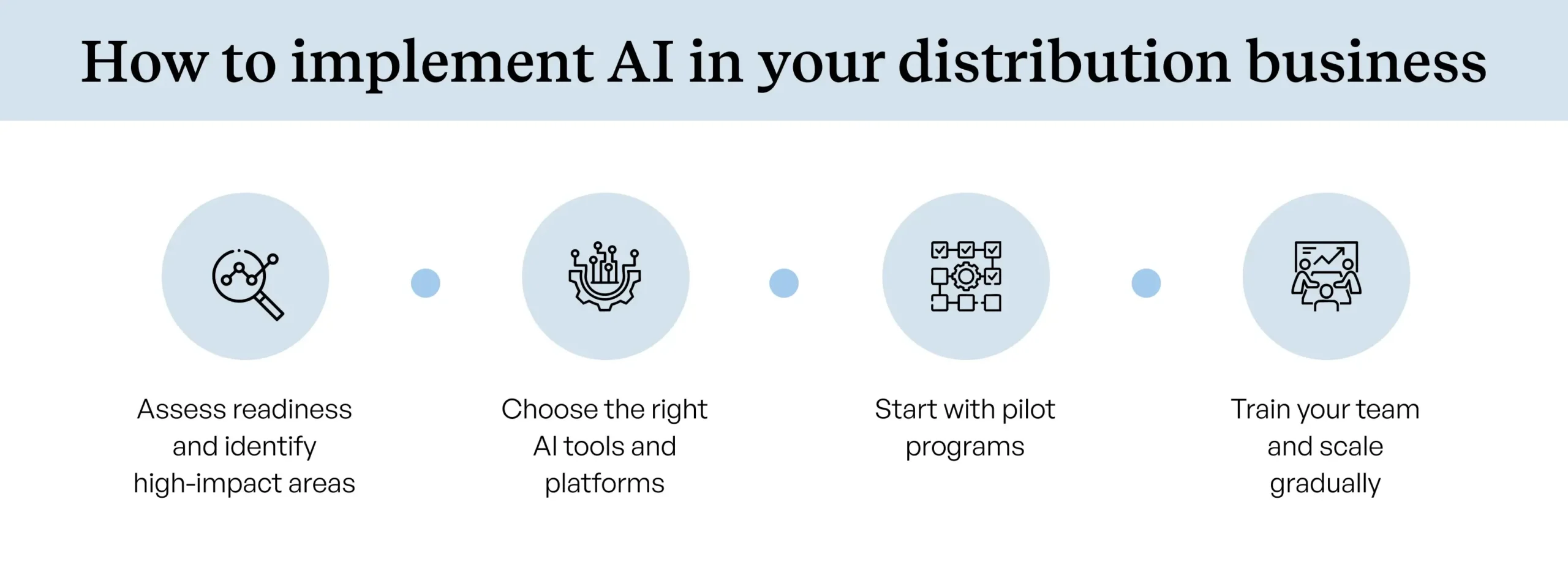
The most common mistake in B2B AI implementation is trying to do too much at once. Start with one high-volume, high-impact use case, prove measurable results, and expand from there.
Below is a practical step-by-step implementation for wholesale businesses:
- Audit your manual processes first: Identify high-volume, repetitive tasks with frequent errors. Prioritize rule-based processes that don’t require human judgment, like order entry from PDFs.
- Clean your ERP data before you deploy anything: Ensure product catalogs, customer records, pricing, and order history are complete and accurate. Confirm your AI tool integrates directly with your ERP (NetSuite, SAP, Dynamics, Sage, QuickBooks).
- Start with one use case and set a clear baseline metric: Deploy AI on the highest-priority workflow. Set baseline metrics (e.g., order processing time, quote turnaround, cart value) and track performance over 30–60 days.
- Involve your team early and frame AI as a workload reducer: Involve frontline users in the selection process, run a pilot, and make AI faster and easier than manual alternatives. Position AI as a productivity tool, not a replacement.
- Expand to adjacent use cases once the first one is working: Once adoption is solid and results are proven, extend AI to related workflows, quote automation, sales copilot features, catalog management, and product recommendations.
Common challenges of AI in B2B e-commerce and wholesale distribution
Wholesale businesses cite consistent barriers to AI adoption. Understanding them in advance makes implementation significantly smoother.
| Challenge | What it looks like | What to do about it |
| Messy ERP data | Duplicate customer records, missing product attributes, inconsistent pricing history | You don’t need a perfect ERP; you need clean data in the specific fields your first AI use case will read. Run a focused audit on those fields before deployment. |
| Integration complexity | AI vendors promise “easy integration,” but don’t account for heavily customised ERP setups | Look for pre-built, bi-directional, real-time integrations with your specific ERP. Ask for references from customers on the same system. Avoid batch-based exports dressed up as integrations. |
| Team resistance | Staff work around the AI tool rather than with it, so adoption stalls and accuracy never improves | Bring frontline users into the selection process early. Frame AI as something that removes tedious work, not something that removes people. |
| Implementation timeline and cost | Enterprise AI projects can run 12–18 months and cost far more than budgeted | Modern SaaS platforms built for wholesale use pre-trained models and pre-built ERP connectors. Deployment is typically weeks, not quarters, and the cost reflects that. |
WizCommerce’s AI solutions for wholesalers and distributors
Most wholesale businesses don’t struggle to understand why AI is valuable. The harder question is where to start and how to connect it to the systems and workflows that already exist. WizCommerce addresses that by embedding AI directly into its B2B order management system and the tools wholesale teams use every day—from order management and sales to catalog operations—rather than requiring a separate implementation.
Here’s what that looks like in practice:
AI sales order entry software: WizCommerce’s AI reads incoming purchase orders from any format, email, PDF, spreadsheet, EDI, or even voice messages, extracts all order details, validates them against your ERP, and creates a clean sales order automatically. It also generates accurate, customer-specific quotes in seconds, so your team spends less time on admin and more time with customers. For in-person order taking (especially at trade shows), the WizOrder, a B2B sales rep app supports QR code scanning, inventory sync, and offline functionality.
AI quote automation assistant: It reads inbound RFQs from any format, identifies the sender, and maps requested line items to your internal SKUs. It then automatically applies the correct customer-specific pricing logic, contract terms, and product rules to generate a highly accurate, sales-ready quote in minutes.
AI Sales Copilot: Rather than pulling reports before a customer call, reps can ask plain-language questions: what did this account’s last order, which quotes are pending, what have they been browsing, and get answers from live data. For reps managing 50 to 200+ accounts, this makes preparation faster and customer conversations more productive.
AI product photography: WizStudio generates catalog-ready product images like lifestyle images, silo shots, line drawings, and product variants from a single raw photo. For wholesale businesses managing large SKU catalogs, this removes one of the most common bottlenecks in launching new products or entering new selling channels.
AI product recommendations: WizCommerce’s recommendation engine analyzes each account’s purchase history, seasonal patterns, and browsing behavior to surface relevant products on the B2B customer portal and within the sales copilot for rep-led selling. Wholesale businesses using this see an increase in average cart value per order.
AI in wholesale works best when it’s connected to your actual operations, your ERP, your order flow, your catalog, your sales team. That’s exactly what WizCommerce is built for.
Book a demo and see how you can revamp your wholesale operations with AI.
FAQs on AI Use Cases in B2B E-Commerce
1. What is the most impactful AI use case for wholesale businesses in 2026?
The most impactful AI use case for wholesale businesses in 2026 is AI-powered order entry automation. It targets the highest-volume, most error-prone workflow in distribution. By using natural language processing to read POs from any format and validating against historical data, businesses cut processing time by over 90%, improving accuracy and directly benefiting their bottom line.
2. What ERP systems does AI for wholesale connect to?
AI for wholesale connects to major ERP systems, including NetSuite, SAP Business One, Microsoft Dynamics, Sage, QuickBooks, and Acumatica. The strongest integrations are bi-directional and real-time, pulling inventory, pricing, and order data to support informed decisions. WizCommerce offers pre-built ERP connectors that deliver actionable insights without manual imports or middleware.
3. How long does it take to implement AI in a wholesale business?
Implementing AI in a wholesale business typically takes two to eight weeks, depending on the use case and ERP complexity. Order entry automation software with pre-built integrations deploys in two to four weeks. A full AI Sales Copilot takes four to eight weeks, based on data quality, team readiness, and existing business operations complexity, including dynamic pricing configurations.
4. What are the best AI use cases in e-commerce for wholesale distributors?
The best AI use cases for wholesale distributors span key areas, including order entry automation, predictive analytics for demand forecasting, AI-powered pricing strategies, and sales copilot tools. These use cases directly improve supply chain management, optimal inventory levels, and sales efforts. WizCommerce bundles all these capabilities into one platform built specifically for wholesale and distribution operations.
5. How does AI improve B2B e-commerce conversion rates?
AI improves B2B e-commerce conversion rates by analyzing buyer behavior and historical sales data to deliver personalized product recommendations, smarter catalog search, and faster quote generation. These improvements enhance user experience, enhance customer support, increase customer engagements, and reduce friction in the reorder process, helping ecommerce companies drive growth through larger, more frequent orders.
6. Is AI in wholesale e-commerce only for large companies?
AI in wholesale e-commerce is not only for large companies. Modern SaaS platforms bring the power of AI to mid-market businesses with 10 to 500 employees. Cloud-based tools eliminate infrastructure costs that once favored enterprise buyers, helping smaller e-commerce companies achieve measurable business growth and take their wholesale operations to the next level.
7. What data does AI need to work in a wholesale business?
AI needs three core inputs to work in a wholesale business: at least 12 months of historical sales data from your ERP, complete product information with accurate attributes and pricing, and customer behavior records, including account tiers. Machine learning models trained on clean, consistent data consistently outperform those built on disorganized datasets.