Skip to content



Remember when expanding internationally meant opening physical offices and hiring local staff before you could sell a single product? Today, a wholesaler in Texas can serve retailers across Southeast Asia from their existing warehouse.
The global e-commerce market for cross-border shopping is expected to hit $5.06 trillion by 2028, and forward-thinking wholesalers are positioning themselves to capture their share.
But here’s what many wholesale business owners don’t realize: international expansion requires a completely different playbook than domestic growth. The relationships and pricing strategies that built your local success might actually hurt you in foreign markets.
In this guide, you will learn exactly what is global ecommerce for your wholesale business. We outline the step-by-step process to build sustainable international revenue streams. You will discover how modern global commerce platforms facilitate this massive digital transition effortlessly.
What is global e-commerce?
Global e-commerce, also known as international ecommerce or cross-border ecommerce, is the practice of selling products or services online to customers in different countries than where the business is based.
It involves businesses expanding their reach across geopolitical borders to tap into new opportunities and acquire new customers worldwide.
How is global e-commerce different from domestic wholesale operations?
The shift from domestic to international sales involves fundamental changes across every aspect of your global business. Here is how global operations compare to what you are doing now:
| Aspect | Domestic operations | Global operations |
| Pricing | Single currency, local market rates | Multi-currency pricing, exchange rate management |
| Payment terms | Standard domestic terms | Extended terms varying by region and culture |
| Shipping & logistics | Local/regional carriers, familiar processes | International logistics, customs, duty calculations |
| Compliance | Domestic regulations only | Multiple tax systems, import/export rules, data privacy laws |
| Customer relationships | Face-to-face meetings, phone calls, single time zone | Cross-cultural communication, multiple time zones |
| Technology platform | Basic ecommerce functionality | Multi-language, international payment processing, complex integrations |
| Credit management | Familiar credit checking systems | International credit verification, currency risk |
| Marketing | Local trade shows, regional advertising | International events, localized content, cultural adaptation |
For wholesalers, this evolution requires sophisticated systems and processes while maintaining the personal relationships and complex pricing structures that drive wholesale success.
How is B2B global ecommerce different from B2C global ecommerce?
Understanding global ecommerce in B2B matters because the rules are fundamentally different from B2C. Order volumes, payment structures, compliance demands, and relationship dynamics all operate on entirely different terms when your buyers are businesses rather than individual shoppers.
- Order size and volume: B2C transactions involve single-unit or small orders from individual consumers. B2B global ecommerce involves bulk orders, minimum order quantities, and tiered pricing structures negotiated between businesses across markets.
- Payment terms and methods: B2C buyers pay upfront at checkout using digital wallets or cards. B2B global ecommerce runs on net terms, purchase orders, and invoice-based payment cycles that can span weeks or months.
- Buyer relationships: B2C commerce focuses on fast, one-time transactions for individual buyers. In B2B, global ecommerce depends on long-term retailer relationships, account managers and repeat order cycles to sustain revenue.
- Compliance complexity: B2C sellers face standard consumer protection laws. B2B global ecommerce requires navigating import and export regulations, VAT, trade documentation and multi-jurisdiction compliance that varies by country and product category.
- Technology requirements: B2C platforms prioritize high-volume transactions and basic personalization. B2B global ecommerce platforms need multi-currency pricing, customer-specific catalogs, approval workflows and ERP integrations to handle wholesale complexity effectively.
Explore B2B ecommerce best practices to see how these differences shape platform and process decisions.
Is global e-commerce worth it for your wholesale business?
Before diving into the “how,” let’s address the “why.” Going global can feel like a lot of work, especially when you don’t know where to start. But global ecommerce comes with distinct benefits worth understanding.
01. Revenue diversification and growth potential
When you’re operating in a single market, your revenue is tied to that economy’s retail health. Global expansion creates multiple revenue streams that can offset domestic market fluctuations, often with higher margins due to less competition in new markets.
02. Access to emerging retail markets
While your local ecommerce market might be saturated with competitors, emerging markets often present untapped new opportunities for wholesale partnerships. Countries with growing middle classes, expanding retail sectors, or developing consumer behavior patterns can offer significant growth potential for wholesalers who establish relationships early.
03. Seasonal balance and inventory optimization
International expansion allows wholesalers to balance seasonal demand across hemispheres. While your domestic retailers might be clearing summer inventory, online stores in the Southern Hemisphere are gearing up for their peak season. This seasonal arbitrage can improve inventory management turnover and cash flow.
04. Competitive advantages in global supply chains
Operating internationally positions your wholesale business as a global player, which can be valuable when competing for exclusive brand partnerships or large retail contracts. International brands often prefer working with wholesalers who understand global commerce and can support their international retail expansion within the supply chain.
Also read: 15 Best B2B E-Commerce Platforms in 2026 with Comparison Table
What components does your business need to sell globally in B2B?
Before you can expand internationally, your business needs four core components firmly in place to handle global ecommerce in B2B.
- Globally ready B2B e-commerce storefront: Your storefront must support multi-currency pricing, customer-specific catalogs, and international checkout flows built for your target market. A well-structured storefront drives stronger conversion rates from international retail prospects and creates a professional user experience from the first order.
- International payment methods and net terms: Different markets have different payment preferences, from ACH in North America to bank transfers in Europe. Supporting the right international payment methods and net terms reduces barriers and builds retailer confidence in your business across regions.
- Cross-border shipping and logistics visibility: International wholesale orders involve complex freight requirements, customs documentation, and variable lead times. Real-time cross-border shipping and logistics visibility helps your team and retailers stay aligned on shipping costs and order status across borders.
- Tax, compliance, and regulatory readiness: Each country brings its own tax rules, import regulations, and business license requirements. Tax, compliance, and regulatory readiness mean your operations can move into new regions without costly legal delays or compliance gaps affecting your international expansion.
What are the biggest challenges you’ll face with global wholesale ecommerce?
International expansion isn’t without its hurdles. Understanding these challenges upfront allows you to plan accordingly:
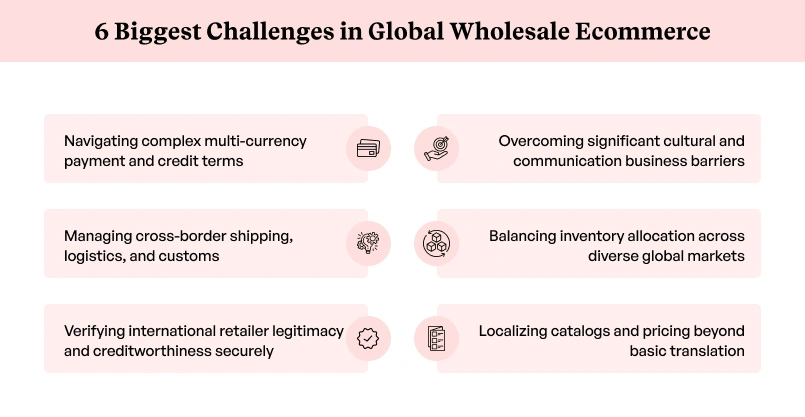
01. Payment processing and credit management
Managing wholesale payment options across multiple countries becomes complex quickly. Different regions have different expectations for payment terms—while standard terms might work domestically, some international markets expect extended payment periods. Currency fluctuations can also impact your margins significantly on large wholesale orders.
B2B e-commerce platforms like WizCommerce solve these challenges through its B2B payment solution WizPay, which offers customizable payment terms that adapt to regional market expectations, support multiple payment methods, including payment links and ACH transfers, and provides advanced credit management with advance payments and flexible refund options.
02. International shipping and logistics complexity
Wholesale orders often involve larger quantities and different packaging requirements than retail orders. Managing customs documentation, duty calculations, and shipping costs for bulk orders requires sophisticated logistics planning. What works for domestic LTL shipping might be completely inadequate for international container shipments.
03. Retailer verification and credit checking
Ensuring that international retailers are legitimate businesses with good credit becomes more challenging across borders. Domestic credit checking services don’t work internationally, and verifying business licenses and financial stability requires different approaches in each market.
04. Cultural and communication barriers
Successful wholesale relationships depend on clear communication and an understanding of cultural differences. Best practices that work with domestic retailers might be inappropriate internationally — negotiation styles, relationship-building approaches, and product data presentation preferences vary significantly between cultures.
05. Inventory management across markets
Allocating inventory between domestic and markets in foreign countries while maintaining adequate stock levels for both becomes a complex balancing act. Seasonal differences, shipping lead times, and minimum order quantities all impact inventory planning for international wholesale operations.
| Challenge | Key issues | Solution |
| Payment processing & credit management | Different payment term expectations by region, extended payment periods, currency fluctuations affecting margins, and complex payment term management | Use multi-currency payment platforms, hedge currency risk, establish regional payment terms, and implement credit insurance |
| International shipping & logistics | Larger quantities and different packaging needs, complex customs documentation, duty calculations, and inadequate domestic shipping solutions | Partner with international freight forwarders, use logistics management software, and establish regional distribution centers |
| Retailer verification & credit checking | Domestic credit services don’t work internationally, difficult cross-border business verification, and varying approaches needed per market | Use international credit agencies, require trade references, implement letter of credit terms, and work with local partners |
| Cultural & communication barriers | Different negotiation styles, varying relationship-building approaches, and different product presentation preferences | Hire local sales representatives, invest in cultural training, adapt marketing materials, and attend regional trade shows |
| Inventory management across markets | Complex domestic/international allocation, seasonal differences, varying lead times, and minimum orders | Implement advanced inventory management systems, use demand forecasting tools, and establish safety stock policies by region |
06. Localization beyond language translation
Effective localization in global ecommerce is about more than translating your ecommerce website into the local language alone. It means adapting pricing displays, local language content, and customer service norms to fit each target market. Retailers in different regions expect communication that reflects their specific business culture and local preferences, not a one-size approach.
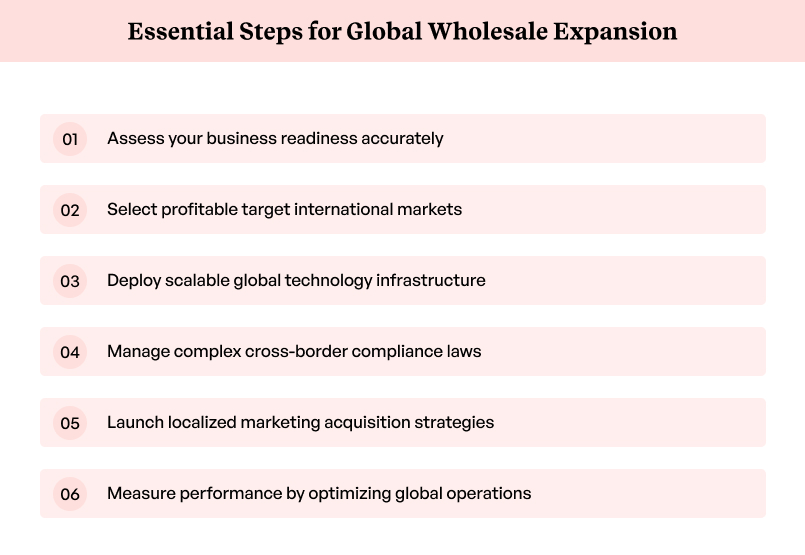
Your 8-step guide to global ecommerce success
Now that you understand what global ecommerce business entails and why it matters for wholesale businesses, let’s walk through the systematic approach to international expansion that actually works for wholesalers.
Step 1: Assess if your wholesale business is ready for global expansion
Before you start researching international markets, you need to honestly evaluate whether your wholesale operation is prepared for the complexities of global operations. International expansion amplifies both strengths and weaknesses, so this assessment is crucial for wholesalers.
Use this checklist to evaluate whether international expansion makes strategic sense for your operation:
Market opportunity assessment:
- Is your domestic market becoming saturated or highly competitive?
- Have you identified specific international markets and target audience with demand for your products?
- Do you have products that travel well internationally (not fragile, perishable, or highly culturally specific)?
- Are there international retailers actively seeking suppliers in your product category?
Business readiness evaluation:
- Do you have stable, profitable domestic operations?
- Can you maintain domestic customer service while expanding internationally?
- Do you have adequate working capital to fund international expansion?
- Can your current team handle the additional complexity of digital commerce operations across borders?
Competitive advantage analysis:
- Do you offer unique products or better pricing than existing international suppliers in online channels?
- Can you provide better service, more reliable delivery, and international experience than current market players?
- Do you have expertise or certifications that give you credibility in international markets?
- Are there gaps in the international market that your business could fill to build a clear competitive advantage?
Resource and capability check:
- Do you have access to international legal and compliance expertise?
- Can you invest in technology infrastructure for international operations?
- Are you prepared to adapt your products or services for different markets to improve the buying experience?
- Do you have the patience for longer sales cycles and relationship building with potential customers?
Risk tolerance assessment:
- Can your business handle extended payment terms and currency fluctuations?
- Are you comfortable navigating different regulatory environments?
- Can you manage the complexity of international shipping and logistics?
- Are you prepared for the cultural learning curve of international business?
Scoring your assessment:
- 15-20 checkmarks: Strong candidate for international expansion
- 10-14 checkmarks: Consider addressing gaps before expanding
- Under 10 checkmarks: Focus on strengthening domestic operations first
If you’re checking most of these boxes, you’re likely ready to move forward. If not, focus on strengthening these areas before expanding internationally.
Step 2: Research and choose your target international markets
Market selection can make or break your international wholesale expansion. Here’s how to identify the right markets for your business:
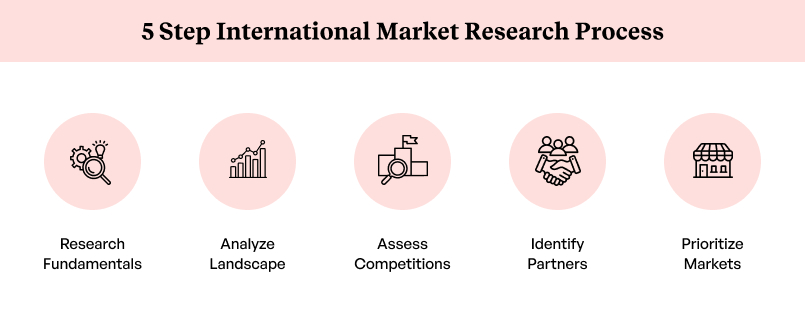
1. Research market fundamentals
Start with countries where your product category has proven demand and growing retail sectors. Look for expanding middle-class populations, developed retail infrastructure, reasonable import regulations, and stable economic conditions. Staying on top of ecommerce trends in target regions and understanding key trends shaping international wholesale markets gives you a meaningful edge and helps you prioritize the right regions first.
2. Analyze the retail landscape
Map out major retail chains, independent retailers, and emerging segments in your target countries. Understand local pricing structures, top online stores, margin expectations, and seasonal buying cycles that affect wholesale purchasing patterns.
3. Assess competition and gaps
Identify existing wholesalers serving your target retailers. Analyze their offerings, pricing, and service levels to find gaps where your business can add value or compete effectively.
4. Identify potential partners
Research local distributors, sales representatives, or retail partners who could accelerate your market entry. These relationships often determine wholesale success in international markets. Working with local marketing experts can speed up your understanding of regional consumer behavior and buying expectations.
5. Prioritize your markets
Score potential markets based on retail market size and growth, ease of market entry, competition levels, currency stability, and cultural compatibility. Focus on 2-3 markets that offer the best opportunity-to-effort ratio for your wholesale business.
Step 3: Build your global wholesale technology infrastructure
Your technology infrastructure is the backbone of international wholesale success. It needs to handle the complexity of wholesale operations across multiple markets while maintaining the customer experience your retail partners expect.
Platform requirements for global wholesale: Your B2B ecommerce platform must support wholesale-specific needs:
- Multi-currency pricing with automatic margin calculations
- Customer-specific pricing and volume discount structures
- Minimum order quantity enforcement by market
- Integration with international payment processors for wholesale terms
- Retailer approval workflows and credit management tools
Key technical capabilities for wholesalers:
- Real-time wholesale inventory management between domestic and international markets
- Automated currency conversion with margin protection features
- Tiered pricing structures for different retailer categories
- Integration with international shipping carriers for wholesale quantities
- Comprehensive reporting across all international wholesale operations
Global B2B ecommerce solutions like WizCommerce are specifically designed for these wholesale complexities, offering rapid implementation with built-in features like multi-tier pricing, retailer approval workflows, and international compliance tools. Unlike generic platforms that require extensive customization, these purpose-built solutions seamlessly connect with existing ERP and inventory systems while handling complex international payment requirements automatically.
Step 4: Navigate legal requirements and compliance
International compliance isn’t just about avoiding problems—it’s about building trust with international partners and customers. Here are the key legal areas wholesalers must address:
| Compliance area | Key requirements | Action items |
| Trade regulations | Import/export licenses, product certifications, customs documentation | Research product-specific requirements, obtain necessary licenses, prepare customs paperwork |
| Data privacy | GDPR (Europe), CCPA (California), regional data protection laws | Implement consent mechanisms, establish data handling procedures, review privacy policies |
| Tax obligations | VAT registration, income tax, transfer pricing, digital services tax | Register for applicable taxes, understand reporting requirements, and plan for tax implications |
| Contract law | International enforceability, jurisdiction clauses, and dispute resolution | Work with international legal counsel, adapt contract templates, and establish governing law |
Start with one target market to build comprehensive compliance processes that become reusable templates for future expansion. Work with experienced international legal counsel from the beginning to prevent costly mistakes and build partner confidence.
Since regulations change frequently, establish ongoing relationships with legal experts in each market to stay updated on changes affecting your wholesale operations.
Step 5: Develop your international pricing and payment strategy
Pricing strategy in global ecommerce in B2B involves far more than currency conversion; it requires understanding regional payment norms and credit expectations in international markets. Use this checklist to build a comprehensive strategy that accounts for local conditions and B2B complexity.
Currency and market research
- Analyze exchange rate volatility and develop hedging strategies
- Research local purchasing power and price sensitivity of the target audience
- Study competitor pricing and positioning strategies
- Determine market-specific pricing approaches (premium vs. competitive)
Pricing structure setup
- Create volume discount tiers for different order quantities
- Establish customer-specific pricing for key accounts
- Design market-specific pricing strategies by region
- Plan seasonal and promotional pricing structures
Payment processing and terms
- Research preferred B2B payment methods in each target market
- Set up multi-currency payment processing capabilities
- Establish credit terms that match local business practices
- Implement international credit checking procedures
- Create clear payment policies and collection procedures
- Consider payment insurance for larger transactions
Risk management and automation
- Plan currency hedging strategies for large transactions
- Set up automated pricing updates based on exchange rates
- Choose a B2B payment platform that can manage multiple price lists across markets
Managing this complexity manually becomes impossible as you scale. Modern B2B payment platforms like WizPay by WizCommerce address these challenges by supporting up to 15 different price lists for various international markets, automating customer-specific pricing applications, and providing real-time currency conversion with comprehensive payment processing, including ACH, credit processing, and international compliance handling.
See how WizPay simplifies international payment collection for wholesale businesses →
Step 6: Launch your international marketing strategy and customer acquisition
International marketing strategies require balancing what works domestically with local preferences and cultural nuances. Focus on building authentic relationships rather than simply translating domestic campaigns.
Localize your digital presence
Adapt your content marketing to address regional business challenges while optimizing for local search engines beyond Google. Adjust the use of social media strategies to match platform preferences in each market and create case studies and success stories that resonate with local business practices and cultural values.
Prioritize trade shows and events
Research major industry events and trade shows in target markets and adapt your booth design and networking approach to local business cultures. Plan follow-up processes that work effectively across time zones while respecting regional communication preferences and relationship-building styles.
For practical guidance on this, see our trade show success tips guide for maximizing ROI.
Build local partnerships
Establish relationships with local partners who can provide valuable market insights, cultural guidance, and established connections that accelerate market entry. Focus on partners who understand the local business landscape, as these partnerships often determine success or failure in international wholesale markets.
Modern wholesale ecommerce platforms like WizCommerce support international marketing with QR code generation and barcode scanning for seamless trade show order collection, custom presentation tools for creating branded international pitches, AI-powered customer-specific product recommendations, and multi-language support that maintains brand consistency across markets.
Step 7: Manage international relationships and scale operations
Once you’ve launched in international markets, the focus shifts to ongoing relationship management and scaling operations effectively across multiple regions.
Communication across time zones
| Challenge | Solution |
| Time zone gaps | Establish coverage windows that overlap with target market business hours |
| Asynchronous work | Create comprehensive documentation and processes that work without real-time interaction |
| Service continuity | Build redundancy in customer service coverage with team members in different regions |
| Technology barriers | Use collaboration tools and automated responses to bridge communication gaps |
International customers have varying service expectations based on cultural norms. Response time expectations differ significantly—some cultures expect immediate responses while others are comfortable with longer timeframes.
Adapt your communication style and problem resolution approaches to match local preferences, and ensure you have local language support capabilities that match your target markets.
Performance tracking essentials
Monitor market-specific KPIs, customer satisfaction by region, and financial performance accounting for currency fluctuations. Adjust measurement methods for cultural differences and set realistic growth timelines based on local market maturity.
Build lasting partnerships
Focus on consistent communication, reliable delivery, and cultural understanding. Regular check-ins, transparent communication about challenges, and consistent follow-through build trust more effectively than grand promises. Supporting a strong customer base in each market drives long-term online sales growth across your international operations.
Scale with technology
International wholesale platforms like WizCommerce provide omnichannel experiences connecting online and offline interactions, streamlined partner onboarding, comprehensive analytics across regions, and AI-powered lead scoring to prioritize opportunities based on data-driven insights.
Step 8: Measure success and optimize your global operations
International expansion requires continuous measurement and optimization. What works in one market might need adjustment in another.
Key performance indicators by category
| Metric type | What to track | Why it matters |
| Revenue | Revenue per market, customer acquisition cost by region, lifetime value by geography | Identifies profitable markets and growth opportunities |
| Operations | Order fulfillment times, shipping costs, return rates by market | Reveals operational inefficiencies and improvement areas |
| Customer | Satisfaction scores, repeat purchase rates, support response times | Cultural differences affect expectations and loyalty |
| Market | Market share growth, competitive positioning, penetration rates | Shows your competitive strength in each region |
Essential reporting capabilities
Your analytics system must provide unified reporting across all markets and channels, currency-normalized data for accurate comparisons, and cultural context for interpreting consumer behavior. Include predictive analytics for international demand forecasting to improve inventory planning and market expansion decisions. Tracking market trends across regions keeps your strategy aligned with where wholesale demand is actually moving.
Continuous improvement framework
Establish regular review cycles for each international market with feedback loops from new customers and partners. Use regional performance data to optimize processes and prioritize technology updates. Document what works in each given region to accelerate expansion into similar regions.
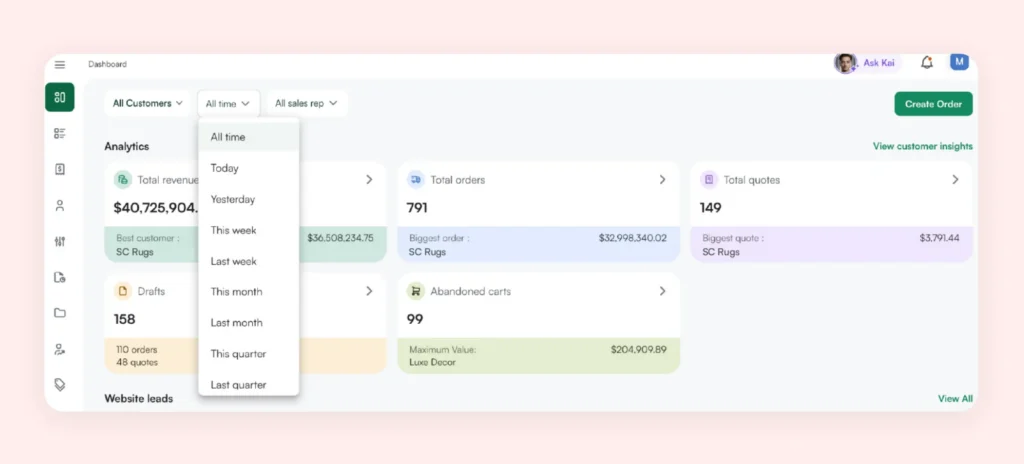
Advanced wholesale ecommerce platforms like WizCommerce provide customizable dashboards with insights across all international markets, market-specific tracking by region and currency, AI-powered recommendations for international sales optimization, and integration capabilities that combine data from all business systems for complete visibility into global operations.
How WizCommerce helps wholesalers operate globally?
WizCommerce is an AI-powered B2B commerce platform built specifically for wholesalers, distributors, and manufacturers. It centralizes online and rep-led selling, automates repetitive operations, and gives wholesale teams the tools to manage international orders, pricing, and compliance from a single system — making it one of the most complete commerce platforms for wholesalers expanding internationally.
- WizShop provides a globally ready B2B storefront with multi-currency pricing, customer-specific catalogs, international checkout flows, and a consistent shopping experience for retailers across every market you enter.
- WizPay handles cross-border payment processing, net terms, ACH transfers, and international compliance requirements automatically within the platform, improving operational efficiency for finance teams.
- WizOrder lets sales reps capture orders at trade shows and in-person meetings, even in low-connectivity environments — supporting mobile commerce order-taking wherever your team sells.
- AI Sales Copilot delivers customer-specific product recommendations and AI-powered lead scoring to help your team prioritize high-value international opportunities with real precision.
- WizStudio generates AI-powered catalog assets and product data to help wholesalers present inventory consistently and professionally across different markets and channels.
WizCommerce gives wholesalers everything they need to streamline cross-border operations, grow total revenue from international markets, and compete with consistency across regions.
Your global wholesale expansion action plan: Getting started today
Ready to take the leap into international wholesale markets? The eight-step framework outlined above provides the roadmap, but successful global ecommerce depends on having the right technology foundation to execute your expansion strategy.
WizCommerce stands out as the purpose-built solution for global wholesale operations. Unlike generic ecommerce platforms that require extensive customization for wholesale needs, WizCommerce provides everything wholesalers need for international success once they understand what global ecommerce is and what it demands operationally.
- Rapid global deployment: Get your international wholesale operations live quickly without months of development and customization. WizCommerce’s built-in international capabilities mean you can focus on building retailer relationships rather than managing technology complications.
- Comprehensive wholesale features: Multi-tier pricing for up to 15 different international markets, retailer approval workflows, customer-specific pricing automation, and real-time local currency conversion with margin protection. Every feature is designed specifically for wholesale complexity.
- Seamless integration: Connect with your existing ERP, inventory, and accounting systems without disrupting domestic operations. WizCommerce handles the complexity of international compliance, online channels management, payment processing, and reporting across all markets from a single ecommerce platform.
WizCommerce’s international advantages:
- WizPay international compliance: Handles complex international payment requirements and regulatory compliance automatically for wholesale transactions
- Trade show digitization: QR code generation and barcode scanning for seamless international trade show order collection across key areas of your field sales operations
- WizAI recommendations: Customer-specific, AI-based product recommendations and lead scoring to prioritize international opportunities based on real buying signals
- Omnichannel experience: Connect online and offline interactions across all international markets for a unified customer experience
WizCommerce provides a comprehensive platform and support system designed specifically for wholesale international expansion. With built-in wholesale capabilities and proven results, it provides the foundation for sustainable international wholesale growth.
Take the first step toward global wholesale expansion today. Schedule a demo with WizCommerce to see how the platform can accelerate your international growth and unlock new retail markets for your wholesale business.
Frequently asked questions
1. How much does it cost to expand your wholesale business internationally through global ecommerce?
Costs include technology infrastructure, legal compliance setup, marketing expenses, and operational setup. Global ecommerce is much more cost-effective than traditional international expansion, requiring physical showrooms or local offices.
2. How long does it take to see results from international wholesale e-commerce expansion?
Timeline varies based on market complexity, wholesale sales cycles, and product-market fit. International wholesale expansion is a long-term strategy requiring patience to build sustainable retailer relationships across borders.
3. What’s the biggest mistake companies make when entering global e-commerce markets?
The most common mistake is replicating domestic strategies without adaptation, including using inappropriate marketing messages, choosing the wrong platforms, and underestimating regulatory requirements. Expanding to too many markets simultaneously also spreads resources too thin.
4. Do I need different technology platforms for different countries in global e-commerce?
No, using different platforms creates operational complexity. Choose a platform designed for international operations with multi-currency support, integrated payment processing, and unified reporting. Global B2B solutions like WizCommerce handle multiple international markets from a single platform.
5. What payment methods should I accept in different countries for global e-commerce?
Payment preferences vary by region: North America uses credit cards and ACH, Europe prefers bank transfers, Asia-Pacific uses mobile payments. For B2B, expect extended payment terms, purchase orders, and invoice-based payments.
6. Is cross-border e-commerce the same as international e-commerce?
Cross-border ecommerce refers to tactical aspects like logistics and payments, while international e-commerce encompasses broader strategic market expansion. For practical B2B purposes, both involve selling across geopolitical borders with international regulations and currencies.
7. What are examples of successful global e-commerce companies?
Amazon, Alibaba, and Shopify demonstrate what global e-commerce looks like at scale in B2C. In global e-commerce in B2B, wholesalers using purpose-built platforms like WizCommerce successfully expand across borders, managing multi-currency pricing, international orders, and retailer relationships from a single system without the complexity of generic platforms.
8. What are the best strategies for global B2B e-commerce growth?
The most effective strategies include selecting the right target market, building a wholesale-native ecommerce platform, and establishing local partnerships. Investing in compliance readiness and localizing your customer experience also contributes directly to sustainable international growth.
9. What features are required for a global B2B e-commerce platform?
A global B2B ecommerce website needs multi-currency pricing, customer-specific catalogs, international payment options, ERP integrations, and retailer approval workflows. It should also support multiple price lists, tiered discounts, and real-time inventory management visibility across all international markets you operate in.
10. How big is the global e-commerce market?
The global e-commerce market is expected to surpass $5.06 trillion in cross-border sales by 2028. B2B ecommerce accounts for a significant share of this growth, with US B2B ecommerce online sales projected to exceed $3 trillion by 2028, according to industry estimates.