Skip to content



The top B2B marketplaces in the USA for 2026 are Amazon Business, eBay Business, Faire, and Ankorstore for reaching business buyers, Alibaba, Global Sources, and DHgate for global sourcing, and Mirakl, Novi, and Carro for marketplace infrastructure. Which one earns your catalog comes down to three numbers: the commission you pay, the buyers the marketplace actually attracts, and how much control over branding, pricing, and customer data you keep.
The opportunity is significant. The Gross Merchandise Value (GMV) of the Top 100 online marketplaces reached $3.832 trillion in 2024, according to Digital Commerce 360, and B2B e-commerce is projected to account for an even larger share through 2025 and beyond.
This guide compares all 10 on fees and fit, explains how we evaluated them, and closes with the decision that matters more than which marketplace to pick: when a marketplace is the right channel at all, and when your own B2B storefront wins.
The 10 top B2B marketplaces in the USA at a glance
| Marketplace | Category | Best for | Fees and commissions | US buyer focus |
|---|---|---|---|---|
| Amazon Business | Broad B2B marketplace | Domestic reach at any size | Free to join; Business Prime from ~$179/yr + referral fees | High |
| eBay Business | Auction and direct sales | Flexible sales formats | $21.95 to $299.95/mo + 2% to 12% final value fees | High |
| Faire | Curated wholesale | Boutique and indie brands | Commission on sales; free for buyers | High |
| Ankorstore | European wholesale | Indie retail in Europe | 24% first order, 12% repeat; 0% on invited customers | Low (EU) |
| Alibaba | Global sourcing | International expansion | $3,499 to $10,999/yr seller plans | Low (global) |
| Global Sources | Verified Asian suppliers | Electronics and fashion | Free browsing; premium and trade-show fees | Low |
| DHgate | SMB sourcing hybrid | Cost-effective bulk | Seller commissions | Low |
| Mirakl | Marketplace software | Enterprises building their own | Custom enterprise licensing | n/a |
| Novi | Procurement software | Procurement automation | Subscription, scales with size | n/a |
| Carro | DTC/Shopify wholesale | Shopify-native brands | Subscription and/or commission | Medium |
How we evaluated these B2B marketplaces
WizCommerce works with the wholesalers, distributors, and manufacturers who sell on these marketplaces every day, so we evaluated them the way a seller deciding where to list a catalog would. Every marketplace here was checked against five criteria in 2026:
- Fee and commission transparency: We verified published seller costs, subscriptions, commissions, and final value fees, and flagged where pricing is custom or opaque. Commission structure decides your margin before your first order lands, and it is the first thing to check on any faire wholesale marketplace listing, because a 15% reorder rate and a 25% new-customer rate are two different numbers doing one job.
- Buyer network fit: A marketplace is only as good as the buyers it brings. We assessed whether each platform’s buyer base matches wholesale categories, order sizes, and US demand.
- Seller control: Branding, pricing flexibility, and customer data ownership vary widely. Marketplaces that let sellers keep more control scored higher.
- Payment terms and cycles: We weighed payout speed and financing options, since 30 to 90 day marketplace payment cycles strain wholesale cash flow.
- Category accuracy: Classifying entries by actual function — several platforms here run consumer and C2C business marketplaces alongside their B2B arms, and we assessed only the business-selling side.
That last criterion is why this list is grouped: buyer marketplaces first, global sourcing platforms second, and marketplace infrastructure last, so you compare like with like.
The 10 top B2B marketplaces in the USA, compared for sellers
Here are the top B2B marketplaces in USA that successful sellers use to scale their wholesale operations.
US and buyer-focused marketplaces
Start here if your goal is reaching US business buyers directly. These four take listings from wholesale sellers and bring the demand to you.
1. Amazon Business

Category: Comprehensive B2B Marketplace
Amazon Business ranks among the top B2B marketplaces in USA due to its extensive logistics and supply infrastructure. It helps sellers reach business buyers who need bulk purchasing, volume discounts, and streamlined procurement processes.
Core capabilities:
- Business-exclusive pricing: Access to business-only pricing tiers and bulk discounts for volume purchases
- Multi-user account management: Customizable permissions and approval workflows for team collaboration
- Procurement system integration: Seamless connectivity with existing procurement systems and tax exemption management
- Business Prime benefits: Enhanced shipping options and advanced analytics capabilities for subscribers
- Advanced spend analytics: Comprehensive visibility and reporting tools for budget tracking and procurement optimization
Ideal For: Businesses of all sizes seeking to sell to other businesses through a reliable, scalable marketplace with wide reach and seamless integration with Amazon’s proven infrastructure.
Pros:
- Massive buyer network: Access to millions of business customers actively seeking products and services
- Logistics excellence: Leverage Amazon’s world-class shipping and fulfillment network for reliable delivery
- Established trust: Benefit from Amazon’s reputation and established buyer relationships
Cons:
- Intense competition: High competition may make it challenging to differentiate and stand out among other sellers
- Limited branding control: Restricted ability to customize store appearances and direct customer communication
- Platform fees: Subscription costs and referral fees can impact profit margins
Pricing: Free to join; Business Prime subscription starts at approximately $179/year for up to 5 users for premium shipping and analytics. No selling fees for purchases.
2. eBay Business
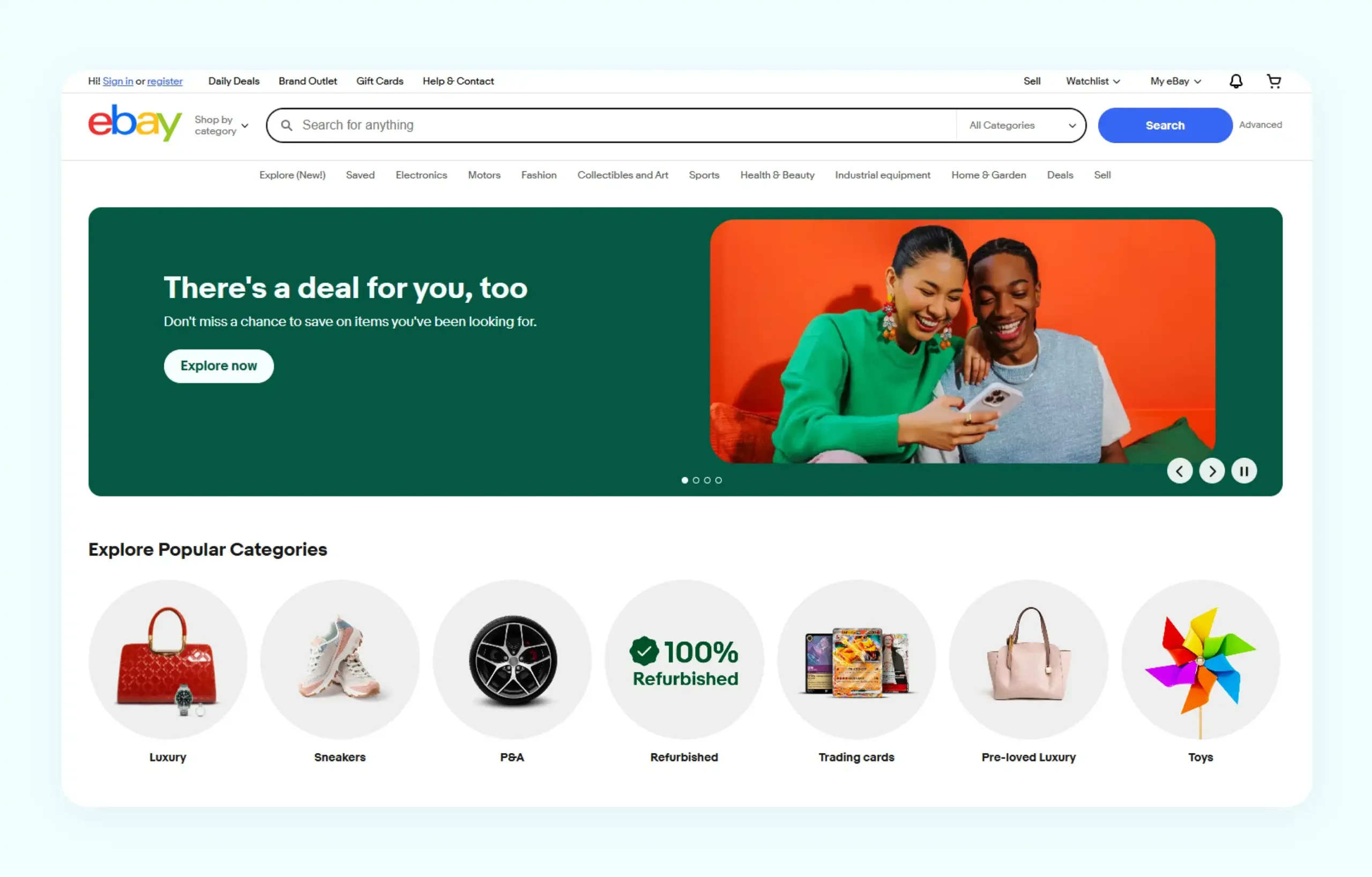
Category: Auction & Direct Sales Marketplace
eBay Business secures its position among top B2B marketplaces by combining consumer-style flexibility with wholesale options. It facilitates business buyers and sellers with a mix of fixed-price and auction formats, suitable for a wide range of products.
Core capabilities:
- Flexible sales formats: Choice between bulk buying options and auction-style sales with dynamic pricing
- Trust & safety systems: Established seller ratings and comprehensive buyer protection mechanisms
- Volume transaction support: Robust support for large quantity listings and complex product variations
- Global commerce infrastructure: Integrated payment processing and worldwide shipping solutions
- Established marketplace: Mature global logistics and payments infrastructure for reliable transactions
Ideal For: Mid-sized businesses seeking flexible selling options to reach diverse global buyers, including those requiring auctions and direct sales.
Pros:
- Global market access: Large and diverse international user base with established worldwide presence
- Sales format flexibility: Unique combination of auction and fixed-price options for diverse selling strategies
- Infrastructure reliability: Proven global logistics and payments infrastructure ensuring seamless transactions
- Business tools: eBay offers tools like multi-user account access, bulk listings, and business analytics.
Cons:
- Limited B2B focus: Less specialized for complex B2B workflows compared to dedicated business platforms
- Fee structure: Potentially higher costs for very large or frequent bulk transaction volumes
- Generic B2B features: Limited business-specific functionality compared to purpose-built B2B solutions
Pricing: eBay Business sellers pay $21.95–$299.95/month for store subscriptions, with insertion and final value fees (2%–12%) based on category and sales volume. Higher-tier plans offer more listings, business tools, and shipping supply credits. For large enterprises, the monthly fee is $2,999.95.
3. Faire
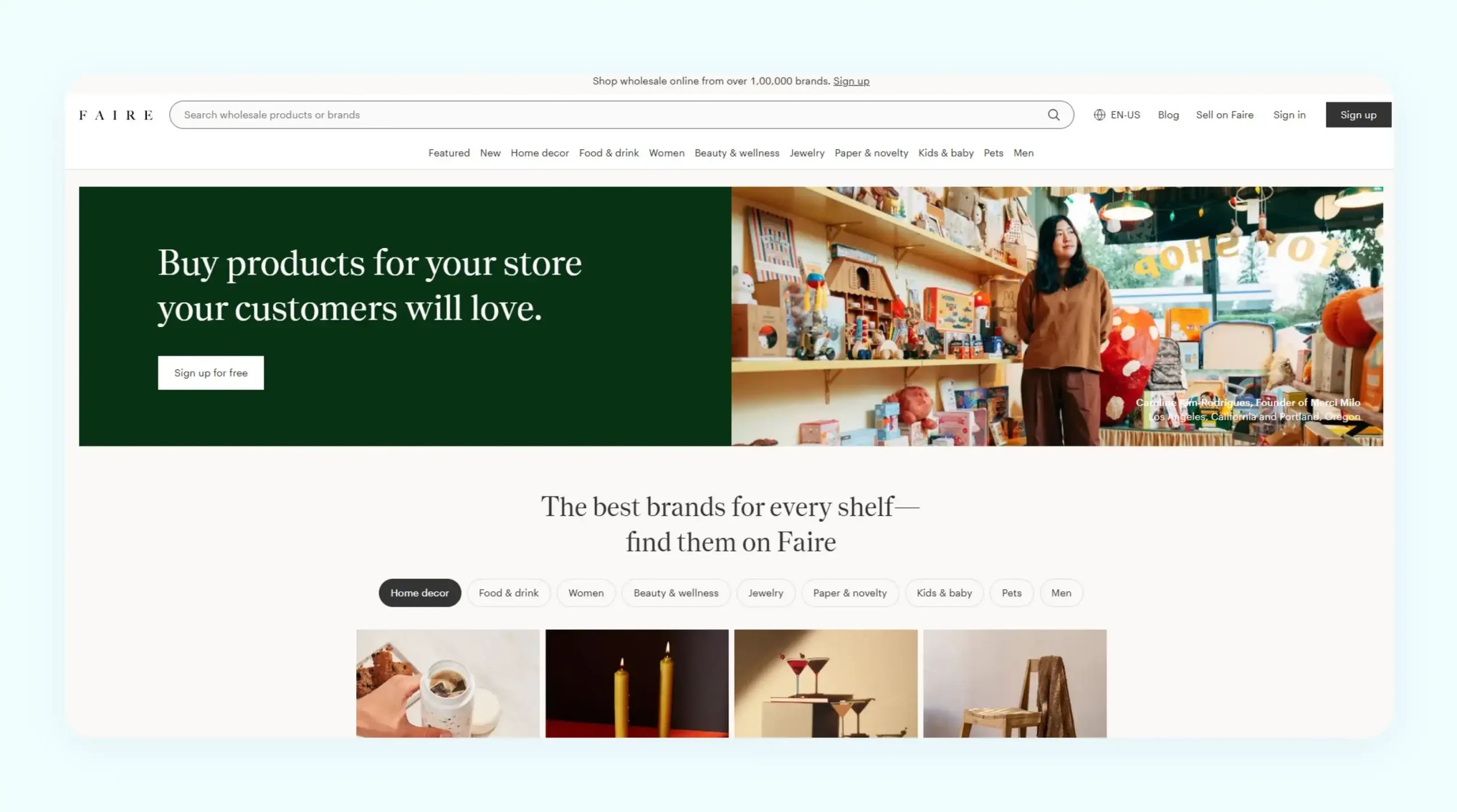
Category: Curated Lifestyle & Fashion Wholesale
Faire has emerged as one of the top B2B marketplaces for curated wholesale, connecting independent retailers with artisanal and boutique brands, focusing on unique lifestyle, home, and fashion products. It emphasizes risk-free trials and flexible payment terms geared toward small business retail buyers.
Core capabilities:
- Curated quality selection: Carefully vetted product selection emphasizing quality and uniqueness
- Risk-free trial programs: Return options on new products to minimize buyer financial risk
- Flexible payment solutions: Net payment terms and accommodating credit options for cash flow management
- Business intelligence tools: Automated reordering systems and comprehensive sales analytics
- Community-driven discovery: Strong brand discovery features and networking opportunities for retailers
Ideal For: Small retailers and boutiques who want to source unique and handcrafted products with minimal risk and flexible purchasing terms.
Pros:
- Unique product focus: Specialized focus on independent brands and distinctive merchandise differentiation
- Risk mitigation: Flexible terms significantly reduce buyer financial risk and barriers to entry
- Networking value: Strong community features facilitate brand discovery and business relationship building
Cons:
- Category limitations: Product selection restricted primarily to lifestyle and fashion market segments
- Scale constraints: Less suitable for large-scale industrial procurement requirements and bulk needs
- Platform size: Smaller operational scale compared to major global marketplace platforms
Pricing: Free for buyers; sellers pay commission fees on sales, typically industry-standard rates.
If you’ve been considering Faire, learn why wholesale brands are moving beyond Faire and exploring new Faire alternatives.
4. Ankorstore
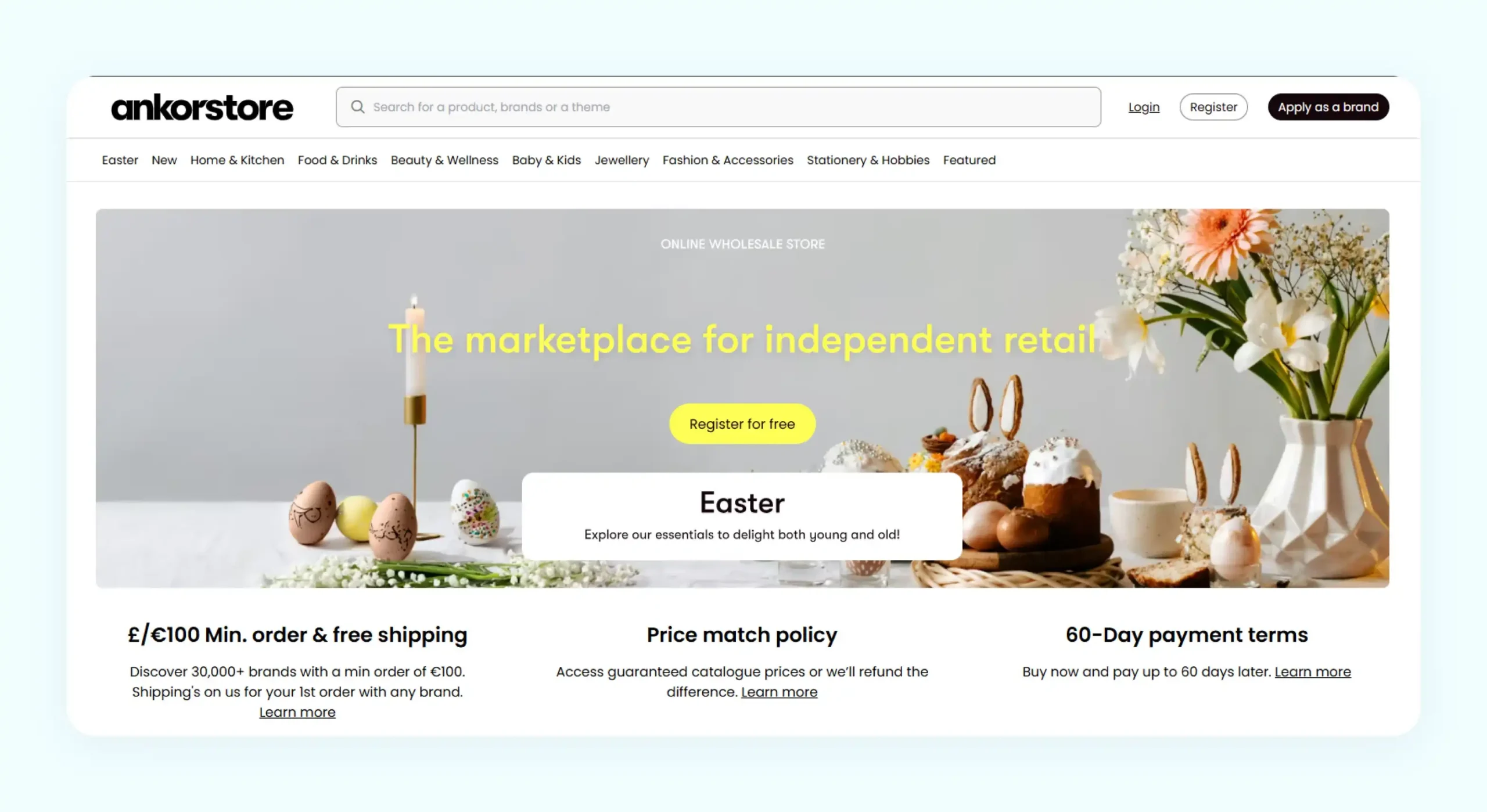
Category: European Wholesale Marketplace
Ankorstore has quickly become one of the top B2B marketplaces in Europe for independent retailers, focusing largely on lifestyle, fashion, and home products, and promoting flexible orders and payments specially for indie businesses.
Core capabilities:
-
- European market focus: Curated European-focused brand and retailer network with regional expertise
- Flexible payment terms: Net payment terms with no minimum order requirements for cash flow optimization
- Brand discovery tools: Advanced discovery tools highlighting unique and independent brands
- Community-driven platform: Community-focused approach specifically designed for small retailers
- Quality curation: Quality-focused product selection with emphasis on craftsmanship and uniqueness
Ideal For: Independent retailers and brands primarily in Europe, seeking curated lifestyle product sourcing with flexible terms.
Pros:
-
- Independent brand support: Strong support for indie and boutique brands with flexible business terms
- Cash flow management: Flexible payment terms significantly ease cash flow constraints for small businesses
- Curated excellence: Quality-focused and carefully curated product selection with high standards
Cons:
-
- Regional limitations: European regional focus limits global reach compared to international marketplace platforms
- Scale constraints: Smaller product catalog and user base compared to global marketplace giants
- Minimum order value: The minimum order value of £100, excluding VAT, may deter small businesses or first-time buyers from engaging with Ankorstore.
Pricing: 24% commission on opening orders, 12% commission on subsequent orders, and no fee for directly invited B2B customers.
Global sourcing marketplaces
These three are where US sellers and buyers connect with international, largely Asia-based, supplier networks. Expect global reach, longer logistics, and sourcing-first buyer intent.
5. Alibaba
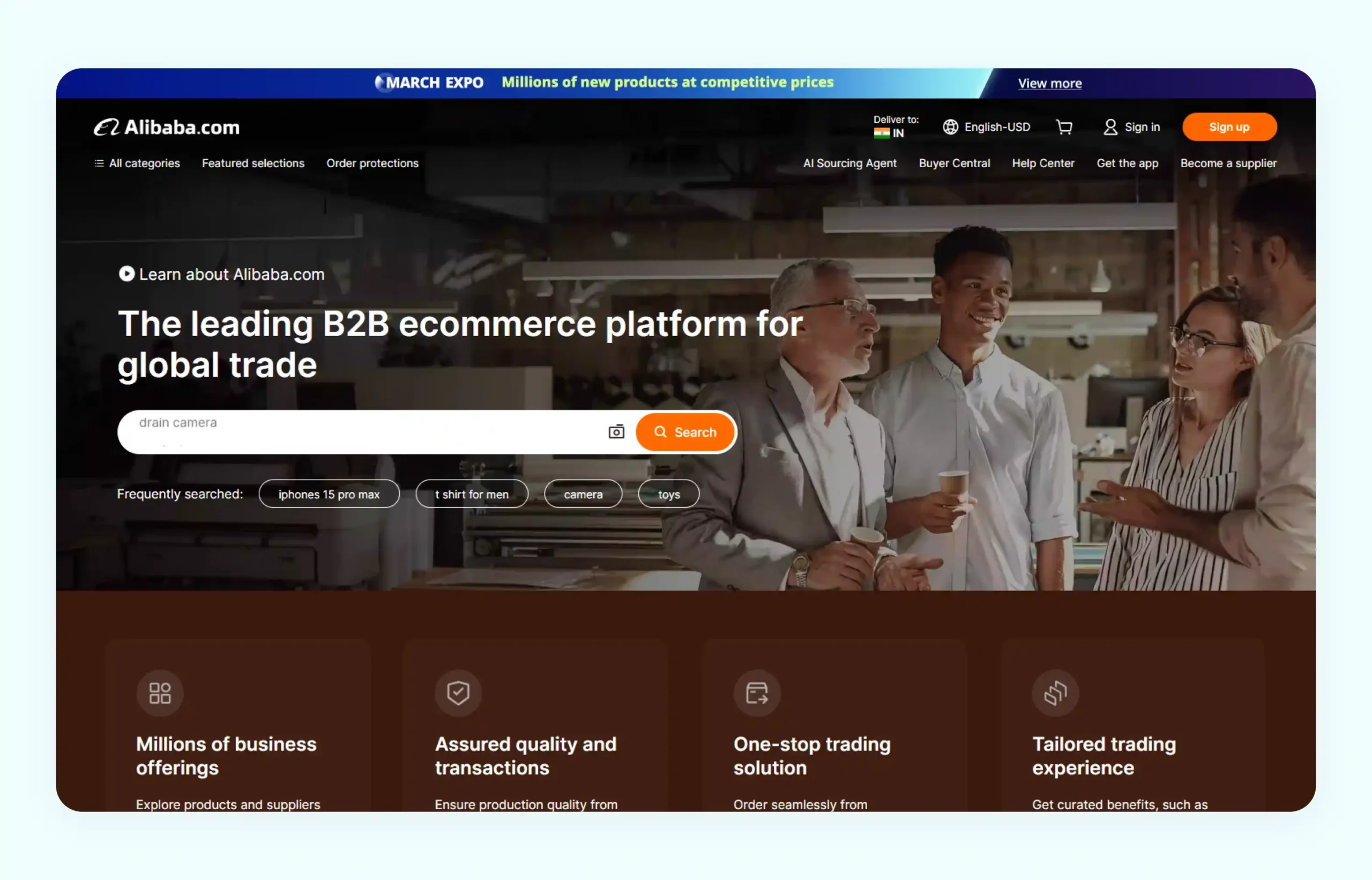
Category: Global Manufacturing & Wholesale Marketplace
Alibaba consistently ranks among the top B2B marketplaces in the world, providing access to a vast network of international buyers seeking products from manufacturers and wholesalers worldwide. While known for suppliers from China, it also offers opportunities for US manufacturers and distributors to reach global markets, particularly in Asia and other international regions.
Core capabilities:
- Global buyer network: Access to millions of international buyers seeking various products across diverse industries
- Trade Assurance protection: Comprehensive payment security and transaction protection for international trade
- Verified seller profiles: Alibaba verifies seller profiles before listing, building trust and credibility with potential customers
- Multi-language support: Platform automatically translates storefronts into 18 languages for international accessibility
- Custom manufacturing support: Platform accommodates flexible order quantities and custom manufacturing requests
Ideal For: US manufacturers and distributors looking to expand internationally and reach global buyers, particularly in Asian markets, with emphasis on bulk orders and custom manufacturing capabilities.
Pros:
- Massive global reach: Access to vast network of international buyers seeking various products
- Transaction security: Trade Assurance program offers comprehensive protection with robust security measures
- International expansion: Multi-language support enhances accessibility for global market expansion
Cons:
- Intense competition: High competition can make it challenging for brands to differentiate and stand out
- Communication barriers: Potential language and cultural communication challenges with international buyers
- Longer sales cycles: Extended shipping times and international logistics may impact customer satisfaction
Pricing: Alibaba’s Standard seller plan costs $3,499 per year (with $500 in ad credits), while the Premium plan is $10,999 per year (with $2,000 in ad credits and priority support). Both options grant access to Alibaba’s global marketplace, but sellers must budget for these annual fees plus any additional marketing or visibility spend.
Note: Alibaba periodically revises its pricing tiers, always verify current rates on Alibaba.com before committing.
6. Global Sources
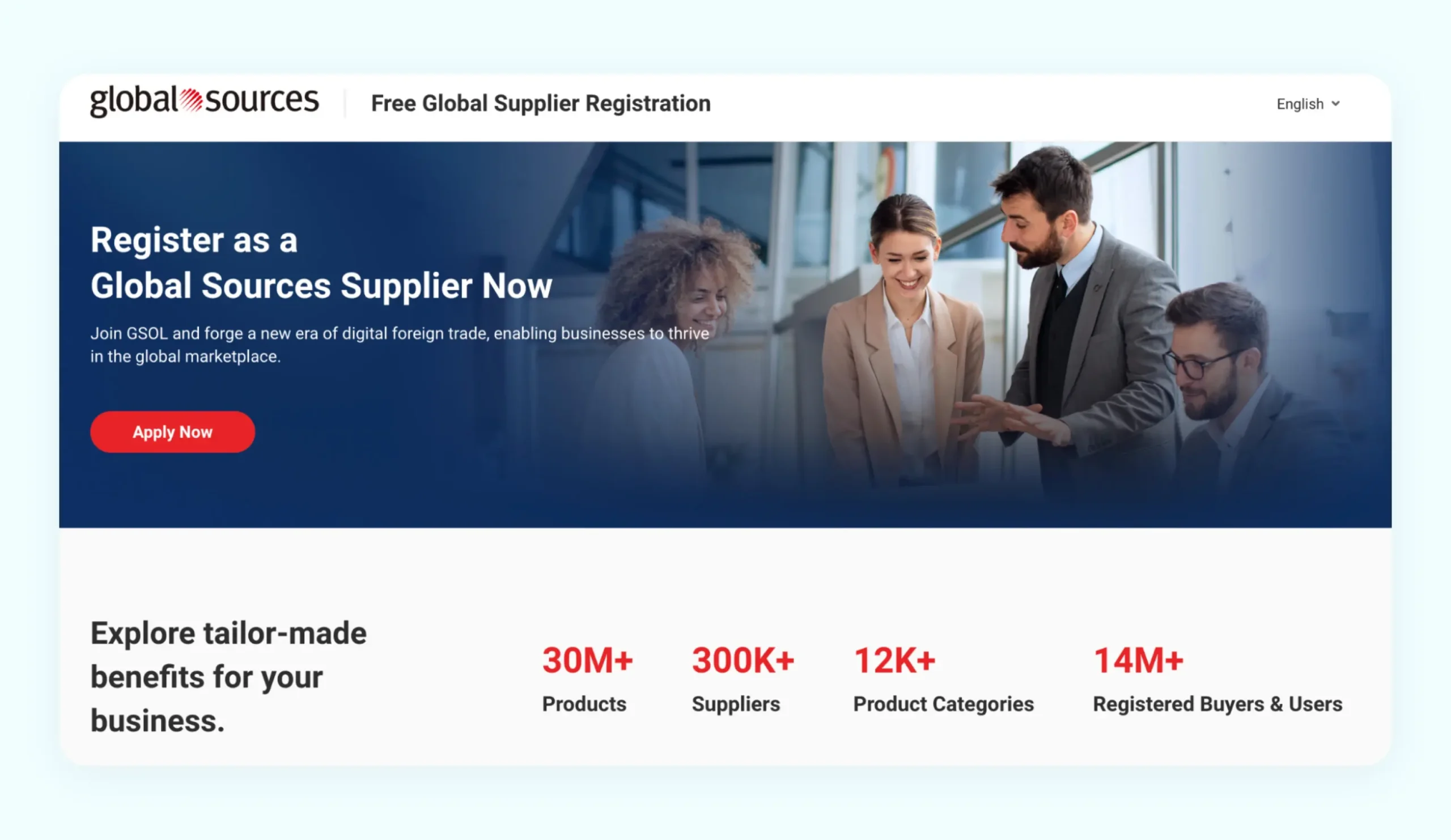
Category: Verified Asian Supplier Platform
As you evaluate the best B2B marketplace in USA and beyond, platforms like Global Sources show that quality verification often matters more than sheer size especially for electronics and fashion sourcing
Global Sources maintains its position among top B2B marketplaces through premium supplier verification, emphasizing quality and reliability, especially in electronics, mobile accessories, and fashion. It complements online sourcing with physical trade shows.
Core capabilities:
- Premium supplier verification: Rigorous supplier auditing and verification with stringent quality standards
- Hybrid sourcing approach: Integration of online store with dedicated trade shows and sourcing events
- Specialized product focus: Deep expertise in electronics, gadgets, and fashion product categories
- Quality control services: Professional buyer lead generation and comprehensive quality assurance
- Multi-channel engagement: Strategic combination of digital platform and physical trade show interactions
Ideal For: Professional suppliers seeking to reach quality-focused buyers in electronics and fashion, with opportunities for physical trade interactions and premium positioning.
Pros:
- Quality assurance excellence: Industry-leading supplier verification with rigorous auditing standards
- Comprehensive sourcing options: Unique hybrid model combining online platform with physical trade show opportunities
- Specialized expertise: Strong reputation and niche focus on quality-centric products with reliable suppliers
Cons:
- Higher investment requirements: Additional costs associated with trade show participation and premium features
- Limited category breadth: More restricted product category range compared to broader marketplace platforms
- Premium positioning costs: Higher overall investment required for accessing premium features and trade show benefits
Pricing: Basic browsing is free; premium features and participation in trade events may incur additional fees.
Now that you understand how B2B marketplaces operate, let’s examine some of the leading platforms that wholesalers and manufacturers are using to grow their businesses.
7. DHgate
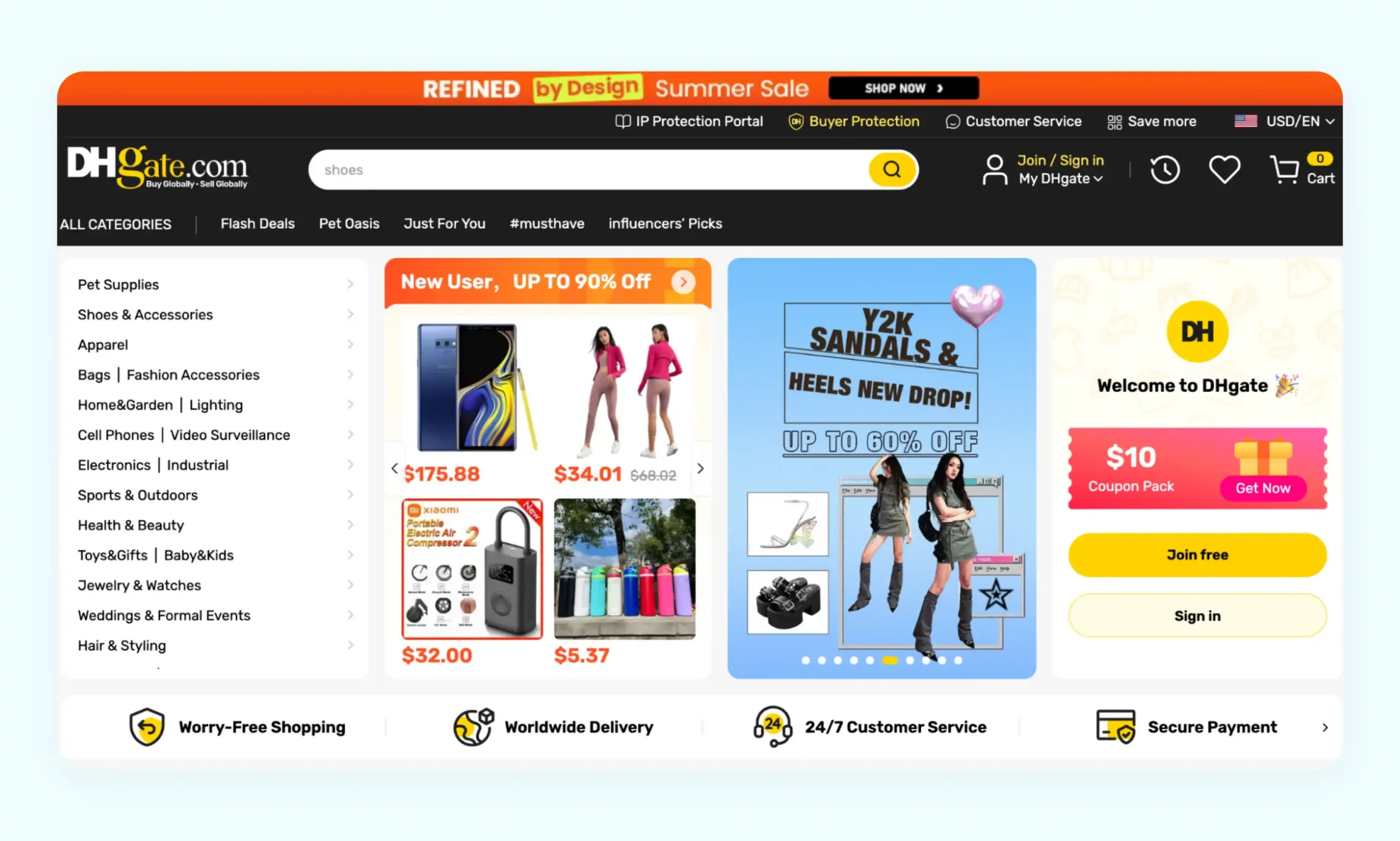
Category: SMB-Focused B2B/B2C Hybrid
DHgate ranks among the top B2B marketplaces for small and medium businesses seeking cost-effective solutions with bulk products at competitive prices, especially consumer electronics, apparel, and accessories.
Core capabilities:
- Multi-category, extensive product range: Extensive product selection across major wholesale categories and industries
- Comprehensive buyer protection: Robust protection programs with thorough dispute resolution mechanisms
- Communication infrastructure: Advanced buyer-seller communication tools and negotiation platforms
- Global logistics integration: Seamless integration with international shipping and logistics providers
- Cost-effective solutions: Competitive bulk purchasing solutions with accessible pricing structures
Ideal For: Small to medium international sellers looking to reach global buyers through a cost-effective platform with strong buyer protection and flexible shipping options.
Pros:
- Cost-effective sourcing: Excellent value for cost-effective bulk purchasing at competitive market prices
- Strong safety net: Comprehensive buyer protection features with reliable dispute resolution systems
- Supplier network scale: Extensive supplier network providing wide product variety and sourcing flexibility
Cons:
- Quality consistency issues: Variable quality standards among suppliers requiring careful vendor selection and evaluation
- Extended delivery times: Longer international shipping times impacting delivery expectations and planning
- Limited geographic diversity: Predominantly Chinese supplier base limiting geographic sourcing diversity
Pricing: Free for buyers; sellers pay commissions; buyer protection services may have additional fees.
Marketplace software and adjacent platforms
The three platforms below are not marketplaces you list products on. They appear in every top-marketplace search, so we include them with their accurate category: infrastructure for building or automating B2B commerce. If you are choosing where to sell this quarter, focus on the seven above.
8. Mirakl
Category: Marketplace Technology Provider
While not a traditional marketplace, Mirakl powers many of the top B2B marketplaces through its technology platform, enabling enterprises to launch and manage their own multi-vendor marketplaces rather than hosting a marketplace itself, emphasizing scalability and customization.
Core capabilities:
- Complete platform technology: Mirakl’s technology includes comprehensive marketplace software and management tools for full ecosystem control
- Vendor management systems: Advanced vendor onboarding and catalog management capabilities
- Enterprise integration: Deep integration with enterprise ERP, procurement, and payment systems
- Brand customization: Fully customizable branding and storefront with complete design control
- Scalable architecture: Enterprise-grade scalable infrastructure for large marketplace ecosystems
Ideal For: Large enterprises and brands seeking to create their own customizable B2B marketplace ecosystem with full control over design and operations.
Pros:
- Total control: Complete marketplace control and branding capabilities with full operational autonomy
- Enterprise scalability: Highly scalable infrastructure designed for large enterprise ecosystem management
- System integration: Comprehensive enterprise system integration with ERP and procurement platform connectivity
Cons:
- Resource intensive: Requires significant setup and ongoing operational management resources
- Technology focus: Technology provider model rather than direct marketplace for actual buying and selling activities
- High investment: Enterprise-grade investment requirements with substantial implementation and operational costs
Pricing: Custom pricing based on license and implementation requirements; typically enterprise-grade investment.
9. Novi
Category: B2B Procurement Platform
Novi complements the top B2B marketplaces by focusing on procurement automation, focusing on streamlining supply chain processes through digital catalogs, purchase order management, and budget tracking, designed for medium to large enterprises.
Core capabilities:
- Digital catalog management: Advanced digital catalogs with real-time inventory updates and tracking
- Procurement automation: Comprehensive purchase order automation and tracking systems
- Collaborative workflows: Multi-user collaboration tools and budget management capabilities
- System integration: Seamless integration with ERP and finance systems for unified operations
- Spend optimization: Comprehensive spend visibility and procurement optimization tools
Ideal For: Enterprises with aspiration to digitize procurement workflows and enhance spend visibility with integrated software solutions.
Pros:
- Process efficiency: Effectively streamlines procurement and budgeting processes for operational excellence
- Team collaboration: Significantly enhances collaboration capabilities within buying teams and departments
- Operational integration: ERP integration substantially improves overall operational efficiency and workflow
Cons:
- Limited marketplace function: Not a traditional marketplace; lacks direct supplier matchmaking capabilities
- Resource investment: Requires substantial corporate resource investment for implementation and ongoing management
- Narrow focus: Limited to procurement functionality rather than comprehensive marketplace activities and features
Pricing: Subscription-based; customized pricing scales with company size and feature set.
10. Carro
Category: DTC-Focused Wholesale Platform
Carro represents the next generation of top B2B marketplaces, specifically designed for direct-to-consumer (DTC) brands and Shopify retailers. It uses data to connect brands and retailers and supports online wholesale marketplaces with inventory and order management.
Core capabilities:
- Data-driven matching: Advanced data-powered matchmaking between brands and retailers for optimal partnerships
- Ecommerce platform integration: Seamless integration with ecommerce platforms, particularly Shopify
- Automated management: Comprehensive automated order and inventory management systems
- Brand visibility tools: Dedicated wholesale storefronts for enhanced brand visibility and control
- Technology-driven approach: Technology-focused approach to wholesale relationship management and optimization
Ideal For: DTC brands and retailers on Shopify or similar platforms seeking efficient wholesale connections with automation.
Pros:
- Ecommerce integration: Streamlined integration with ecommerce tools and platforms for operational efficiency
- Analytics-based discovery: Data-backed brand discovery using advanced analytics for optimal matches
- Process automation: Comprehensive automation of wholesale processes reducing manual effort for brands
Cons:
- Platform specialization: Primary focus on Shopify ecosystem limiting broader platform compatibility
- Limited user base: Smaller supplier and buyer base compared to established global marketplace platforms
- Narrow market focus: Limited compatibility and appeal outside the Shopify and DTC brand ecosystem
Pricing: Subscription and/or commission-based models, tailored per brand and retailer needs.
Now that we’ve explored the top B2B marketplaces and their unique strengths, you might be wondering: “Why should I consider selling on these platforms at all?” It’s a fair question, especially when you factor in the fees, competition, and platform restrictions we’ve discussed.
The answer lies in the significant advantages these B2B marketplace platforms offer- benefits that have helped thousands of manufacturers, distributors, and wholesalers scale their operations beyond what traditional sales methods could achieve. Many of these overlap with the broader benefits of B2B ecommerce, which apply whether you sell on a marketplace or your own storefront. While each B2B e-commerce marketplace has its own approach, they all share common advantages that can transform your business growth trajectory.
Before we dive into the challenges and alternatives, let’s examine why the best B2B marketplace platforms continue to attract sellers worldwide, despite their limitations.
What are the benefits of a B2B e-commerce marketplace?
Here are the key advantages that make the best online B2B marketplace platforms whether you’re selling through a B2B portal in USA or reaching global buyers essential tools for modern wholesale sellers:
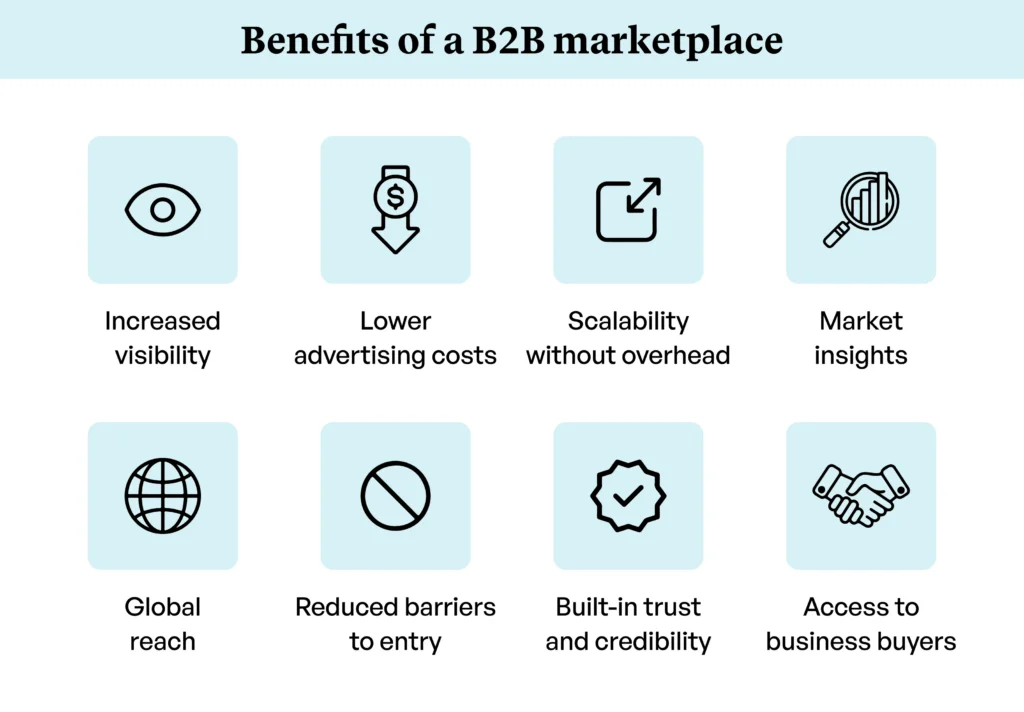
1. Increased Visibility: Gain exposure to a larger business audience, attracting more potential buyers who are actively searching for products in your category.
2. Lower Advertising Costs: Reduce marketing expenses by directly connecting with buyers in the marketplace, eliminating the need for extensive traditional advertising campaigns.
3. Scalability Without Overhead: Expand sales reach without the need for additional physical space, extra staff, or significant infrastructure investments.
4. Market Insights: Access valuable data on trends, optimal pricing, and buyer preferences to make informed business decisions and optimize your product offerings.
5. Global Reach: Sell to a worldwide customer base, extending business beyond local markets and accessing international buyers you wouldn’t reach otherwise.
6. Reduced Barriers to Entry: Start selling quickly without the complex setup required for your own ecommerce platform, getting your products to market faster.
7. Built-in Trust and Credibility: Leverage the best B2B marketplace platforms’ established reputation and security features
8. Access to Business Buyers: Connect directly with businesses that need bulk purchasing, volume discounts, and long-term contracts, exactly what B2B sellers offer.
These benefits explain why the top B2B marketplaces continue to attract sellers worldwide. However, it’s important to understand the full picture before making your decision.
Challenges of selling on online B2B marketplace platforms
While these benefits make the best B2B marketplace platforms incredibly attractive for scaling your wholesale business, the complete picture includes some important challenges that every seller should understand before diving in.
The difference between sellers who thrive and those who struggle often comes down to preparation, knowing what obstacles to expect and having strategies to overcome them. Here are the key challenges you’ll need to navigate when selling on the best online B2B marketplace platforms:
1. Balancing growth with challenges
While the top B2B marketplaces provide excellent opportunities, sellers must navigate complex sales processes, high competition, and platform restrictions. Success requires a deep understanding of marketplace operations and strategic positioning to maintain profitability.
2. Remote sales dominance
With the majority of B2B revenue now driven by remote and digital transactions, a trend that has only accelerated post-pandemic, businesses selling through a B2B marketplace in USA must fully optimize their online presence.
3. Intense competition
Online marketplaces are crowded with sellers offering similar products. To stay ahead, businesses must differentiate themselves with competitive pricing, unique product offerings, and strong customer service, which requires continuous effort and investment.
4. Commission and fees
Many platforms charge listing fees, commissions on sales, or subscription costs. These expenses can significantly reduce profit margins, making it essential for sellers to carefully evaluate pricing strategies and cost structures.
5. Limited control over branding and customer interaction
Standardized marketplace structures restrict sellers from customizing store appearances and marketing efforts. As a result, businesses struggle to build brand identity and engage customers directly, limiting long-term relationships.
6. Complex transactions
B2B sales often involve bulk orders, contract negotiations, and customized shipping. Managing these complexities within a marketplace framework can be time-consuming, requiring businesses to invest in automation and efficient order management. Sellers whose reps also write orders in person usually solve this with dedicated order-writing software, which is where WizCommerce is compared as an alternative to Perenso.
7. Strict platform policies
Marketplaces enforce stringent guidelines on pricing, product descriptions, and dispute resolution. Sellers must comply with these rules, limiting their ability to adjust pricing models or marketing approaches based on market demand.
8. Data dependency on third-party platforms
Since customer insights are controlled by the marketplace, sellers lack direct access to first-party data. This makes it challenging to create personalized marketing campaigns or build customer loyalty outside the marketplace.
9. Longer payment cycles
Unlike direct sales, online marketplaces often impose delayed payment terms, sometimes extending up to 30-90 days. This can create cash flow issues for businesses that rely on steady revenue streams for operations and growth.
10. Risk of price wars
With multiple sellers offering similar products, constant price undercutting becomes a challenge. Engaging in price wars can significantly reduce profit margins and affect long-term business sustainability if not managed strategically.
Strategies to become successful in online B2B marketplaces
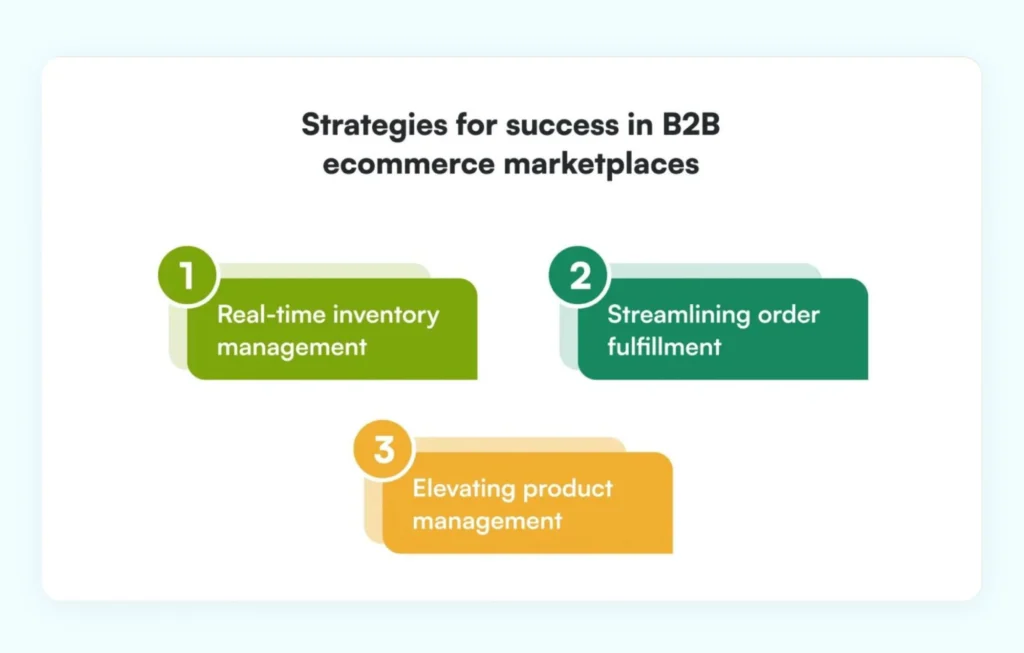
Alright, you know where to sell, but how do you ensure you’re mastering these marketplaces? Deciding to start a new B2B business takes time. Following these B2B ecommerce practices may increase your chances of success and get you ready for launch.
1. Real-time inventory management
When exploring B2B e-commerce marketplaces, utilizing real-time inventory management software is crucial to ensure smooth operations. With platforms like Shopify’s B2B marketplace, you can streamline inventory management across all sales channels, preventing the frustration of selling out-of-stock items to potential buyers.
2. Elevating product management
In the dynamic landscape of B2B marketplaces, meeting the demand for expert knowledge from B2B customers is paramount. Implementing a strong Product Information Management (PIM) system is essential for efficiently managing a diverse product catalog across multiple channels. This software ensures data consistency by syncing critical product information, including SKU numbers, descriptions, and pricing structures.
3. Streamlining order fulfillment
Efficient order fulfillment is critical for success in B2B e-commerce marketplaces, where handling bulk orders poses unique challenges. Partnering with third-party logistics providers like Shopify Fulfillment Network is essential to ensure the timely delivery of products to B2B customers. These providers offer advanced fulfillment technologies and international warehouses, optimizing the fulfillment process.
Additionally, exploring fulfillment services provided by the chosen online B2B marketplace platform, such as Amazon Business’s Fulfilled by Amazon, further streamlines operations and enhances customer satisfaction and retention.
The Better alternative: Your own B2B e-commerce website
While the top B2B marketplaces offer immense opportunities, they also come with limitations like intense competition, platform fees, and restricted branding control, and those three trade against each other rather than moving together: the wholesale websites like faire that charge less usually give you less control over the buyer record, and the ones that hand over buyer contact details charge more for doing it. To truly succeed, businesses need a dedicated B2B ecommerce marketplace website that provides full control over operations, branding, and customer relationships.
When a marketplace makes sense, and when your own channel wins
Sell on a marketplace when you need buyer discovery you cannot generate yet: entering a new category, testing US demand for an imported line, or filling capacity while your direct channel grows. Run your own B2B storefront when repeat orders drive your revenue, because that is exactly when commissions of 8 to 24%, delayed payouts, and rented customer relationships cost the most. Most successful wholesalers run both, using marketplaces for acquisition and their own site for the reorders that carry the margin. That split matters most for gift, home, and lifestyle brands selling through Faire or Ankorstore, where B2B gift accessories handles the seasonal assortments, pre-packs, and account pricing a marketplace listing cannot.
Why choose a B2B website over marketplaces?
1. Full control over branding & user experience: Customize your website, showcase your products, and create a seamless buying journey without marketplace restrictions. Build your brand identity exactly as you envision it.
2. No commission or marketplace fees: Keep more of your profits instead of paying high platform fees that can range from 8-24% per transaction.
3. Better customer relationships: Own your customer data and personalize marketing efforts to drive loyalty and repeat sales. Build direct relationships that lead to long-term partnerships.
4. Flexibility in pricing & negotiations: Implement custom pricing, bulk discounts, and tiered pricing models tailored to your buyers without platform restrictions.
5. Advanced B2B features: Offer complex B2B functionalities like quote management, approval workflows, custom catalogs, and negotiated pricing that many marketplaces don’t support.
6. SEO and marketing control: Optimize your website for search engines and run targeted marketing campaigns to attract the right buyers directly to your platform.
7. Integration capabilities: Connect seamlessly with your existing ERP, CRM, and accounting systems without marketplace limitations.
8. Data ownership: Access complete analytics and customer insights to make informed business decisions and improve your operations continuously.
A dedicated B2B e-commerce website isn’t just an alternative to marketplaces, it’s the foundation for sustainable, long-term growth in the B2B space. While marketplaces can play a crucial role in your strategy, having your own platform ensures you’re building a business that you truly own and control.
How WizCommerce empowers B2B sellers
While marketplaces are useful, having your own B2B e-commerce website is the best long-term strategy. A dedicated B2B e-commerce platform like WizCommerce gives you full control over branding, pricing, and customer relationships without marketplace restrictions.
Key features:
- AI-driven product recommendations – Increase sales with personalized product suggestions
- Seamless ERP & accounting integrations – Connect with QuickBooks, NetSuite, and other systems
- Flexible pricing & customer-specific catalogs – Offer tailored pricing structures for different buyers
- Automated order processing – Reduce manual efforts with smart workflows
- Multi-user accounts & role-based access – Empower teams with controlled access levels
- Freight & bulk order management – Simplify complex shipping and logistics
Ready to move beyond the limitations of top B2B marketplaces? Get in touch with us today!
Frequently asked questions
1. Which is the best B2B marketplace?
The best B2B marketplace depends on your specific needs and target market. Amazon Business offers the largest reach, making it the best B2B marketplace for manufacturers seeking maximum exposure. Alibaba excels for global expansion, particularly in Asian markets. Faire works best for artisanal and lifestyle brands targeting boutique retailers. Consider your product category, target buyers, fee structure, and required features when choosing.
2. What are the best B2B wholesale marketplaces?
The best B2B wholesale marketplaces are Faire and Ankorstore for curated retail products, Amazon Business for broad-catalog domestic wholesale, and Alibaba for factory-direct sourcing. Faire and Ankorstore offer net payment terms and low entry minimums, which makes them the strongest picks for independent retailers stocking unique brands. Match the marketplace to your buyer: boutiques favor curated platforms, while volume buyers start on Amazon Business.
3. What is the largest B2B marketplace in the world?
Alibaba is considered the largest B2B marketplace globally, providing access to millions of international buyers and suppliers worldwide across virtually every product category. It dominates the global B2B space with comprehensive industry coverage and extensive international market share. Amazon Business also holds the strongest position among top B2B marketplaces in USA, particularly in North American and European markets, offering access to millions of business customers. Together, these two platforms top most comparisons of B2B wholesale websites for buyers sourcing at scale, in both global and US markets.
4. What are the 4 types of B2B markets?
The four types of B2B markets are producer markets (manufacturers buying inputs to make products), reseller markets (wholesalers and retailers buying finished goods to resell), government markets (federal, state, and local agencies), and institutional markets (hospitals, schools, and non-profits). Most B2B marketplaces serve producer and reseller markets, which is where wholesale sellers should focus first.
5. What are the top 5 online marketplaces?
By overall sales volume, the largest online marketplaces globally are consumer platforms such as Taobao, Tmall, Amazon, JD.com, and Pinduoduo. In B2B specifically, the top five are Amazon Business, Alibaba, Faire, eBay Business, and Global Sources. Judge B2B marketplaces separately from consumer rankings, since buyer behavior, order sizes, and fee structures differ completely.
6. Which is the best platform for B2B?
It depends on whether you need a marketplace or a platform. A B2B marketplace (Amazon Business, Faire) is a shared venue where you list alongside competitors and pay commissions. A B2B ecommerce platform powers your own branded storefront with your pricing, your customer data, and no marketplace fees. Marketplaces suit new-buyer discovery; a platform wins once repeat orders drive your revenue. For platform picks, see our guide to the best B2B ecommerce platforms.
7. What are the top B2B marketplaces in USA specifically?
The top B2B marketplaces in USA include Amazon Business (best for domestic reach and logistics), Faire (ideal for lifestyle and boutique wholesale), and Carro (purpose-built for Shopify and DTC brands). For businesses sourcing from US suppliers or looking for wholesale B2B marketplaces like Alibaba but closer to home, platforms like Global Sources and DHgate serve as strong alternatives. The best B2B portal in USA for your business will depend on your product category, order volume, and target buyer profile.