Skip to content



The secret of successful companies that maintain smooth operations is using a robust CRM for sales teams.
These powerful tools centralize customer information, automate routine tasks, and provide invaluable insights. By optimizing sales processes and personalizing interactions, the best CRM for sales teams empowers reps to close deals faster and build stronger customer relationships. CRM software for sales team has emerged as a game-changer in boosting efficiency and productivity. They ensure no lead slips through the cracks and every customer interaction is perfectly timed and tailored.
In this blog, we’ll explore some of the top CRM for sales teams and showcase their pricing plans and standout features. Whether you’re a small business or a large enterprise, choosing the right CRM for sales teams can be your ticket to skyrocketing success. Let’s get started!

Summary table
Here are the 7 top CRM for sales teams that you can integrate into your business:
| CRM Name | Best For | Key Features | Starting Price |
| WizCommerce | Wholesale distributors and B2B brands needing inventory context | WizOrder mobile app, AI sales assistant, Visual catalog management, Custom B2B portal | Quote-based |
| Close CRM | High-velocity sales teams and SMBs | Advanced sales automation, Call and SMS broadcast, Lead nurturing and scoring, Customer insights | $9 per user/month |
| HubSpot | Managing sales, marketing, and service in one place | Advanced sales automation, Lead nurturing and scoring, Call and SMS broadcast, Customer insights | Free version available; Paid starts at $752/month |
| Pipedrive | Businesses prioritizing visual pipeline clarity | Customizable pipelines, LeadBooster, Email segmentation, Web visitor tracking | $14 per user/month |
| Zoho CRM | Scalable sales management for small to large enterprises | Workflow automation, Email tools, Marketing campaigns, Contact management | $800/user/month |
| Agile CRM | Small to mid-market businesses wanting an all-in-one tool | Advanced sales automation, Project management, Social media integration, Gamification | Free (up to 10 users); Paid starts at $8.99 per user/month |
| Brevo CRM | Growing brands prioritizing customer communication | Email and SMS marketing, Real-time chat, Landing pages, Contact management | $8.08/month |
1. WizCommerce
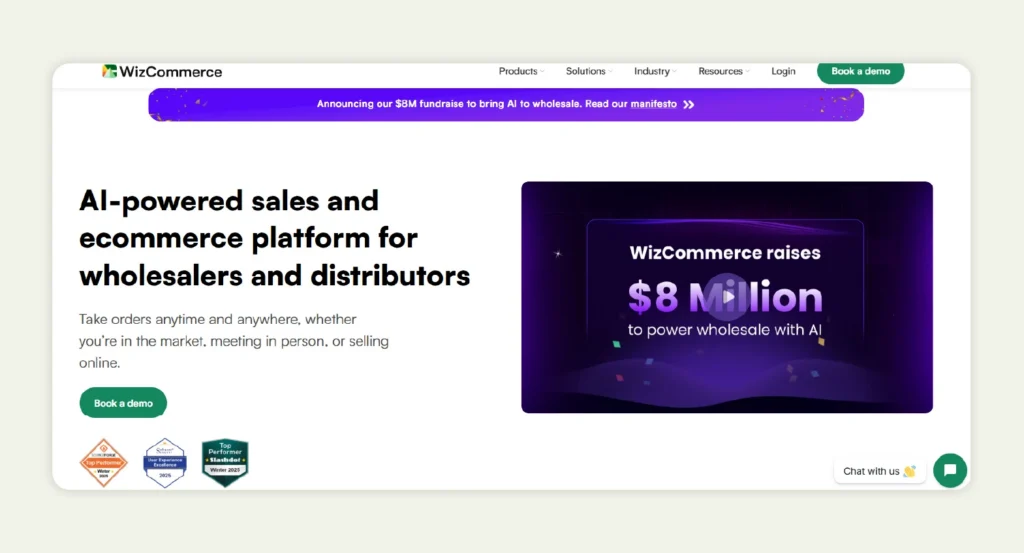
WizCommerce is a B2B ecommerce platform that also operates as a specialized, actionable CRM for wholesale distributors that merges relationship management directly with the transaction process, rather than keeping them in separate silos. Unlike generic CRMs that primarily log contact details, WizCommerce connects customer profiles directly to live inventory, order history, and specific pricing tiers, allowing sales reps to manage territories and segment buyers with real-time operational context. This makes it uniquely effective for B2B brands because it bridges the gap between knowing a customer and selling to them; enabled by AI assistants like Kai and Ella that automate quoting and data entry, it ensures sales teams focus on driving revenue rather than managing administrative records.
Pricing plan
WizCommerce uses quote-based pricing, which includes a B2B ecommerce portal and a B2B order-taking app.
Key features for sales teams
- WizOrder (order-taking app): A high-performance mobile app that supports barcode scanning for sales reps to take orders and access stock levels both offline and effortlessly in the field or at markets.
- Kai (AI sales assistant): An industry-first AI sidekick that identifies which customers are most likely to order, suggests alternatives for out-of-stock items, and summarizes customer history before a meeting.
- WizShop (custom B2B portal): A branded, self-service portal where your customers can place their own bulk orders 24/7, syncing directly with your sales rep’s dashboard.
- Visual catalog management: Sales reps can instantly generate professional, high-quality product presentations and digital catalogs to share with buyers on the fly.
- Omnichannel data sync: Whether an order is placed on the web, through the app, or manually entered, WizCommerce keeps your ERP, CRM, and inventory perfectly in sync.
2. Close CRM
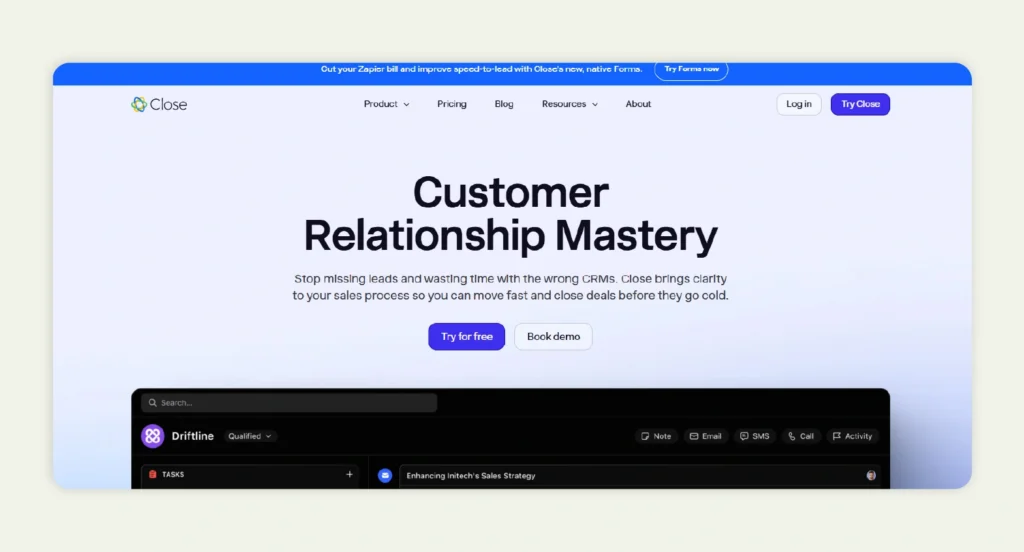
Close CRM is a cost-effective, comprehensive CRM software for sales team designed specifically for high-velocity sales. It simplifies management by combining essential functionalities into one platform, making it perfect for small to medium-sized businesses.
With its intuitive interface and powerful features, Close CRM helps sales teams manage their operations seamlessly.
Pricing plan
Close CRM offers transparent, tiered pricing designed for businesses of all sizes. Their Solo plan begins at $9 per month monthly for individual reps, while their most popular Growth plan which unlocks automated workflows is priced at $99 per user/month. For larger teams requiring a predictive dialer and custom roles, the Scale plan sits at $139 per user/month.
Key features
- Customer insights and analytics: Gain valuable insights into customer behavior and sales trends with detailed analytics.
- Contact management: Easily organize and maintain customer and prospect information in one centralized location.
- Advanced sales automation: Automate repetitive sales tasks to boost efficiency and streamline workflows.
- Lead nurturing and scoring: Prioritize and nurture leads based on their potential value and engagement.
- Call and SMS broadcast: Reach out to customers with bulk call and SMS capabilities for effective communication.
- Deal management: Track and manage deals through each stage of the sales pipeline for better visibility and control.
Pros and Cons
| Pros | Cons |
| Responsive customer support | Limited advanced marketing tools |
| Robust automation and analytics capabilities | Can be expensive for larger teams |
3. HubSpot
HubSpot is widely considered a top CRM for sales teams because it offers a wide range of features to manage sales, marketing, and customer service in one place.
Its intuitive interface and powerful functionalities make it an excellent choice for sales teams looking to streamline their processes and enhance productivity.
Pricing plan
HubSpot is famous for its free CRM version, which provides basic contact management at no cost. For professional features, the “Starter” plan begins at $752/month if you commit yearly and $1,253/month if you commit monthly. Mid-market teams typically opt for the “Professional” tier at $66,697/month billed annually for 3 core seats to access advanced marketing automation and deeper sales analytics.
Key features
- Customer insights and analytics: Access in-depth analytics to understand customer behavior and optimize sales strategies.
- Advanced sales automation: Automate key sales processes to increase efficiency and reduce manual work.
- Contact management: Centralize all your customer and prospect information for easy access and management.
- Lead nurturing and scoring: Identify, prioritize, and nurture leads based on their engagement and potential.
- Call and SMS broadcast: Communicate with your audience through mass call and SMS functionalities.
- Deal management: Monitor and manage your sales deals throughout their lifecycle to ensure smooth progression and closure.
Pros and Cons
| Pros | Cons |
| Robust free plan | High cost for advanced features |
| User-friendly interface | Limited customization in lower-tier plans |
| Excellent automation features | Complexity in setting up integrations |
4. Pipedrive
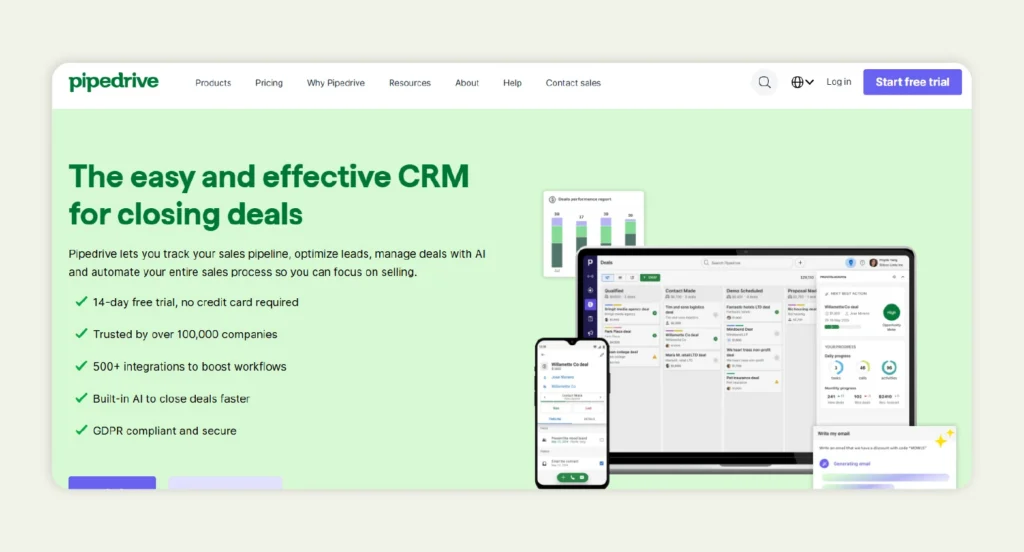
Pipedrive is a sales-focused platform designed to streamline the sales process. Its visual pipeline management makes it one of the top CRM software for businesses that prioritize clarity and are looking to enhance their sales operations.
Whether you’re a small business or a large enterprise, Pipedrive offers scalable solutions to meet your needs.
Pricing plan
Pipedrive maintains an affordable entry point with its “Lite” plan starting at $24 per user/month (monthly). To access the email marketing automation and nurturing sequences that most sales teams require, the “Growth” plan is available at $49 per user/month. Their “Ultimate” plan, which offers maximized usage limits and sandbox testing, costs $99 per user/month.
Key Features
- Customizable pipelines: Tailor your sales pipelines to match your unique sales processes and stages.
- LeadBooster: Capture and qualify leads efficiently with LeadBooster’s powerful lead generation tools.
- Contact management: Keep all your customer and prospect information organized and easily accessible.
- Sales automation: Automate repetitive sales tasks to save time and increase productivity.
- Email segmentation and tracking: Segment and track emails to understand engagement and improve communication.
- Web visitor tracking: Monitor website visitors to gain insights into their behavior and identify potential leads.
Pros and Cons
| Pros | Cons |
| Extensive customization options | Limited advanced reporting |
| Robust automation and sales tools | No free version is available |
Also read: How B2B Sales Automation Improves Efficiency?
5. Zoho CRM
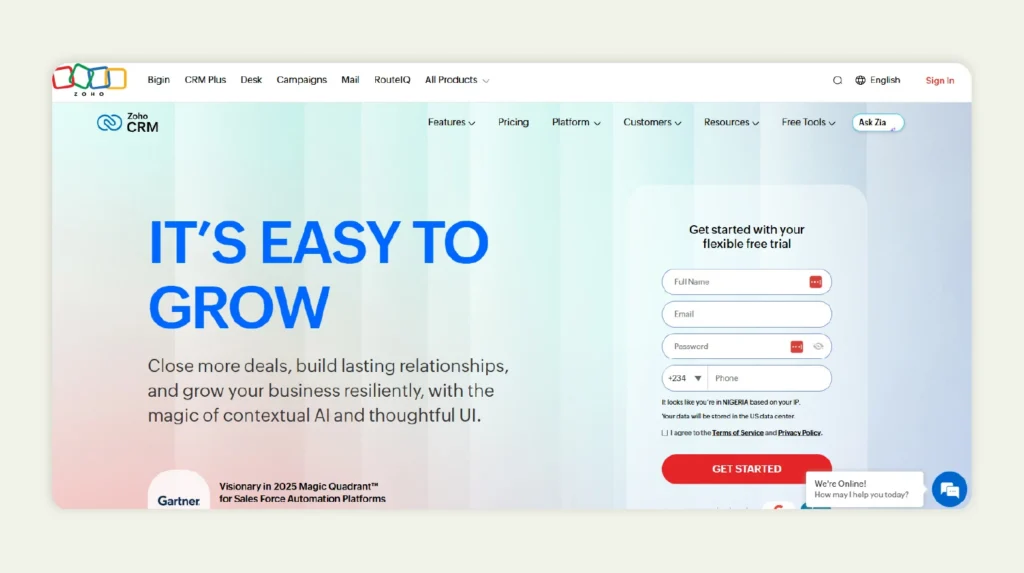
Zoho CRM is a feature-rich platform that supports various aspects of sales management, customer relations, and business operations. It is designed to be scalable, making it a reliable CRM software for sales teams in small businesses and large enterprises.
Pricing plan
Zoho CRM’s “Standard” plan is $800 per user/month (billed annually). For teams wanting to leverage Zia AI and advanced forecasting, the “Enterprise” plan is $2400 per user/month, while the “Ultimate” edition with high-level business intelligence is $2600 per user/month.
Key features
- Contact management: Organize and manage all your customer and prospect information in one place.
- Workflow automation: Automate routine tasks to streamline processes and increase efficiency.
- Email tools: Utilize advanced email tools for effective communication and campaign management.
- Marketing campaigns: Plan, execute, and track marketing campaigns to drive engagement and sales.
Pros and Cons
| Pros | Cons |
| Robust sales forecasting tools | Some users report a steep learning curve |
| AI-powered automation and analytics | No social integration in the free version |
| Highly customizable workflows and reports | Limited customer support hours (8/5) |
6. Agile CRM
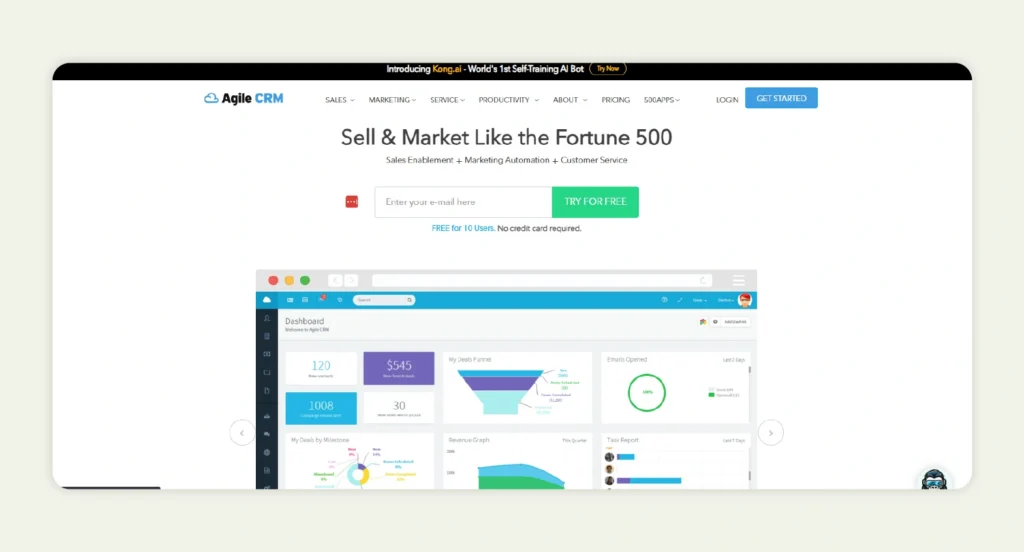
Agile CRM is a cost-effective, comprehensive CRM software for sales team designed specifically for small to mid-market businesses. It simplifies management by combining sales, marketing, and service functionalities into one platform, making it perfect for [businesses of all sizes] looking for an all-in-one tool.
With its intuitive interface and powerful features, Agile CRM helps sales teams manage their operations seamlessly.
Pricing plan
Agile CRM remains a top choice for startups because it is free for up to 10 users. Their paid “Starter” plan is very accessible at $8.99 per user/month, providing [marketing automation] and landing page builders. The “Enterprise” plan, which offers unlimited deals and over 50+ plugins/integrations, is priced at $47.99 per user/month.
Key features
- Contact management: Easily organize and maintain contact information and prospect details in one centralized location.
- Advanced sales automation: Automate repetitive sales tasks and business processes to boost efficiency and streamline workflows.
- Project management: Track post-sale tasks and internal deliverables using built-in project management tools.
- Social media integration: Monitor social media interactions and engage with leads across multiple social channels directly from the dashboard.
- Email marketing: Create and track high-impact email marketing campaigns to nurture leads through the sales funnel.
- Gamification: Boost team performance by using leaderboards and rewards to encourage healthy competition among team members.
Pros and Cons
| Pros | Cons |
| Robust all-in-one feature set | Limited integrations compared to larger CRM solutions |
| Affordable for startups | Some users report a steep learning curve for automation |
| Excellent marketing automation | Occasional lag in real-time data updates |
7. Brevo CRM
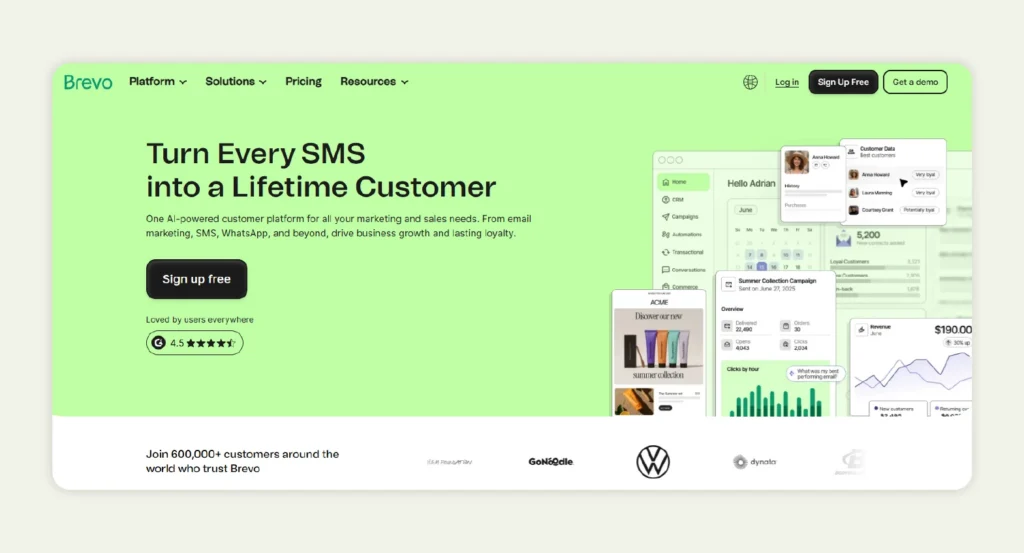
Brevo (formerly Sendinblue) is a cost-effective, comprehensive CRM software designed specifically for growing brands. It simplifies management by combining essential communication functionalities into one platform, making it perfect for those who prioritize customer experience.
With its intuitive interface and powerful features, Brevo CRM helps sales teams manage their operations seamlessly.
Pricing plan
Brevo offers a unique approach by charging based on email volume rather than a “per-seat” license. While they have a robust free plan, their “Sales CRM” is actually free for unlimited users, with Standard Plan of $16 per month, Professional Plan at $449 per month and Enterprise custom pricing plan that allows you access to CSM support and custom data integrations.
Key features
- Contact management: Centralize customer data and interaction history to ensure your service teams have full context.
- Advanced sales automation: Automate repetitive sales tasks and follow-up sequences to improve total cost of ownership efficiency.
- Email and SMS marketing: Reach out to customers with bulk capabilities for effective, direct communication.
- Free tier: Brevo offers a generous free tier that includes basic contact management for unlimited contacts.
- Real-time chat: Engage with website visitors in real time to capture leads before they leave your site.
- Landing pages: Build custom pages to capture contact information and drive more prospects into your CRM.
Pros and Cons
| Pros | Cons |
| Excellent email marketing delivery | CRM functionality is more basic than specialized tools |
| Very high ease of use | Reporting tools are less granular for deep CRM data analysis |
| Scalable free CRM option | Limited mobile CRM features |
Benefits of CRM for sales teams
Looking to supercharge your sales team’s performance? The right CRM tool can make all the difference. From tracking leads to automating follow-ups, robust CRM software for a sales team can streamline operations and boost productivity. Here are the advantages of using CRM software for sales teams
- Enhanced organization and efficiency: A CRM system centralizes customer information, tracks sales pipeline progress, and prioritizes tasks. It integrates communication tools, ensuring consistent and timely interactions, which improves productivity and fosters better customer relationships. Adopting a CRM for sales teams helps organizations increase their sales by up to 29%.
- Better lead management: CRM software for sales teams ensures that no lead falls through the cracks. For instance, HubSpot CRM provides features like lead scoring and email tracking, allowing sales reps to prioritize and engage with the most promising leads. Using a CRM also helps cut down the sales cycle by 8-14% and improve customer retention.
- Improved collaboration: B2B ecommerce platforms like Salesforce and WizCommerce facilitate better team collaboration by integrating various communication channels and offering shared access to customer information. This ensures everyone is on the same page to work together more effectively.
- Data-driven insights: Integrating WizCommerce with HubSpot results in a powerful analytics tool that helps sales teams track performance, forecast sales, and identify areas for improvement. These insights are crucial for making informed decisions and strategizing effectively.
Features to look for while evaluating CRM for sales team
- Contact and deal management: At the heart of any best CRM for sales teams is the ability to manage contacts and deals. This includes tracking interactions, managing customer information, and monitoring deal progress. WizCommerce excels in this area with its intuitive interface and detailed activity feeds.
- Sales automation: automation features help reduce manual tasks, allowing sales reps to focus on selling. For sales representatives, this means that routine activities such as data entry, lead tracking, and follow-ups are handled automatically, significantly reducing the time spent on administrative work.
- Integration with other tools: A high-quality CRM software for sales team should integrate seamlessly with other business tools. This integration ensures that data flows smoothly between systems, reducing the need for manual data entry and minimizing the risk of errors.
- Reporting and analytics: Comprehensive reporting and analytics are vital for tracking performance and identifying trends. By generating detailed reports, sales teams can monitor key metrics such as conversion rates, sales cycle lengths, and revenue growth.
- Customization and scalability: As your business grows, your CRM for sales teams should be able to scale with you. WizCommerce and Zoho CRM are highly customizable, allowing businesses to tailor the system to their specific needs.

Conclusion
Choosing the best CRM for your sales team is about more than just storing data; it’s about simplifying your entire workflow. While traditional CRM solutions track conversations, WizCommerce bridges the gap for wholesalers by turning those conversations into closed orders.
By adding specialized B2B tools and AI insights to your current business processes, you empower your reps to drive transactions, not just manage contacts.
Book a demo with WizCommerce today and transform your existing database into a high-octane B2B sales engine.
FAQs
Which CRM software is best for sales teams?
Many CRMS offer superb and top-notch features that cover most B2B demands. Still, WizCommerce is considered one of the best CRM software for sales teams because it integrates seamlessly with existing platforms to eliminate the need for switching between tools. It offers an all-in-one experience that combines advanced automation, customer insights, and a user-friendly interface to maximize team efficiency.
What is the best CRM for sales teams in 2026?
The best CRM for sales teams in 2026 is one that prioritizes AI-driven insights and payment flexibility to meet modern B2B buyer expectations. Tools like WizCommerce lead the way by offering omnichannel experiences and smart product suggestions that help teams close deals faster in a competitive market.
How do I choose the right CRM for my sales team?
To choose the right CRM for your sales team, you should evaluate your business size and specific goals to ensure the software’s features align with your workflow. It is also essential to consider scalability and customization options so the system can grow alongside your organization.
What are the common CRM mistakes sales teams make?
Common CRM mistakes sales teams make include overcomplicating customizations and failing to maintain high data quality within the system. Additionally, many teams struggle when they neglect proper training or fail to integrate their CRM with other essential communication tools.
How can sales teams use CRM effectively to boost sales?
Sales teams can use CRM effectively to boost sales by leveraging automated lead scoring and detailed analytics to prioritize high-potential deals. By centralizing interactions, reps can also personalize their outreach, ensuring every customer interaction is perfectly timed and tailored for success.
What is the simplest CRM to use for sales reps?
The simplest CRM to use for sales reps is WizCommerce, which is specifically designed with an intuitive interface to reduce the learning curve. Its straightforward layout and robust automation make it incredibly easy to use, allowing reps to spend less time on data entry and more time selling.
Which CRM is best for beginners in sales?
The best CRM for beginners in sales is one that offers a user-friendly interface and a robust free plan, such as HubSpot. These platforms allow new reps to learn the basics of contact and deal management without being overwhelmed by overly complex enterprise features.