Skip to content



High-quality product photography is a key ingredient of ecommerce success. Online sellers know this. And that’s why they have historically invested heavily in professional photography services to create visuals that drive conversions.
But today, the whole visual production game has evolved. AI-driven image generation and editing tools have exploded in capability and adoption. These tools can generate photorealistic product images and contextual lifestyle scenes at a fraction of the cost(and time).
This raises a critical question: if AI can now perform tasks that once required costly photoshoots and complex logistics, does traditional product photography still justify its role today? To answer this question, let us perform an objective comparison of both approaches in this article.
Where do traditional ecommerce product photography services shine and struggle?
Traditional ecommerce product photography services deliver unquestionable realism. But it also comes along with structural constraints. To evaluate its relevance today, it’s essential to look at where it still excels and where it begins to fall short.
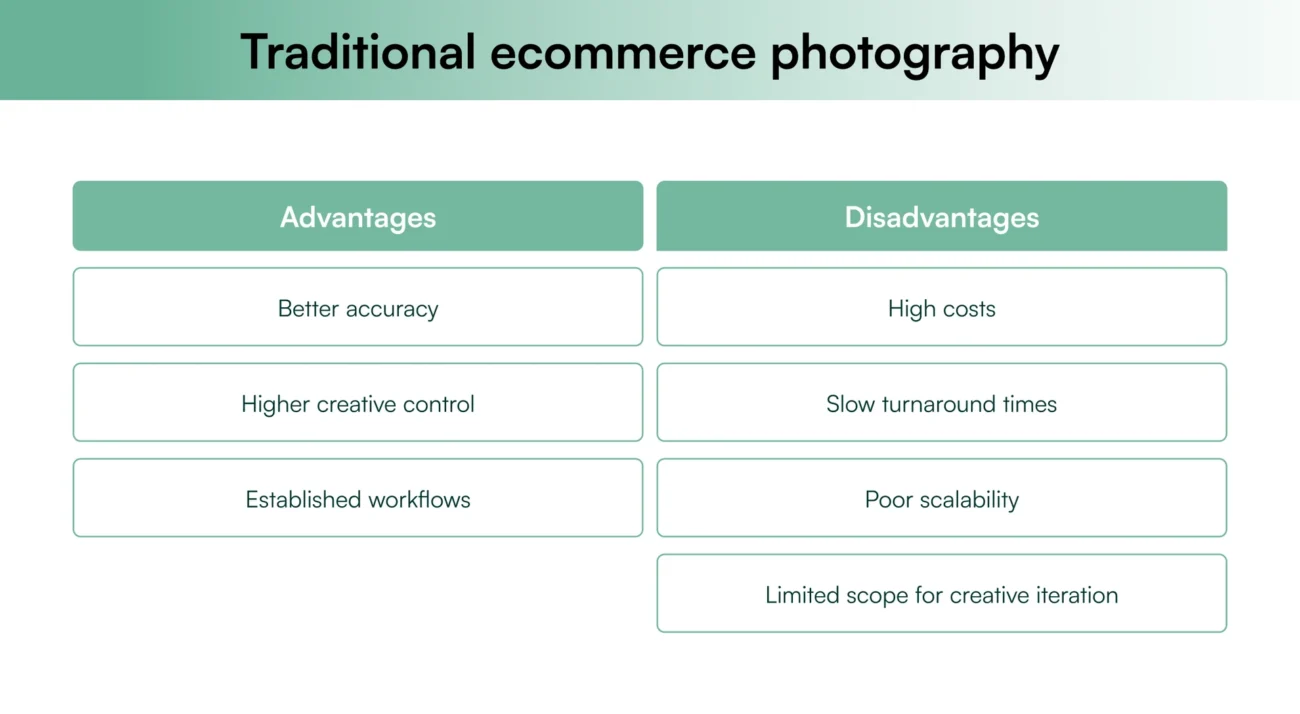
Where does traditional product photography shine?
✅ Accuracy: Professional shooting of a product captures its true textures, materials, finishes, and proportions. This is especially important for categories like fashion, jewellery, beauty, and premium home goods, where visual accuracy drives purchase confidence.
✅ Creative control: Traditional product photography gives brands hands-on control over how products are physically styled and presented. They can manage fine details such as material behaviour, surface finish, fit, and real-world scale.
✅ Established workflows: Many brands and agencies rely on mature photography workflows they understand and trust. For regulated or high-risk categories, this familiarity reduces uncertainty around output quality.
Where does traditional product photography struggle?
❌ High and inflexible costs: Studio rentals, photographers, stylists, props, and post-production add up quickly. Costs scale with every new SKU and variation.
❌ Slow turnaround times: Coordinating schedules, shipping samples, setting up shoots, and editing images can take weeks. This slows product launches and delays go-to-market timelines.
❌ Poor scalability for large catalogs: Traditional photography is not designed for rapid expansion. Maintaining consistent visuals across hundreds or thousands of products becomes operationally heavy and expensive.
❌ Limited agility for creative iteration: Testing new backgrounds or lifestyle contexts often requires reshoots. This restricts A/B testing and channel-specific optimisation.
Why are brands switching to AI from traditional ecommerce photography services?
AI-powered product photography is not just a practical alternative for traditional photography services; it aligns better with how modern ecommerce teams operate at scale. Here are 4 key reasons why many brands are making the switch to AI product photo generators today:
1. Massive cost savings
AI eliminates many of the fixed and variable costs associated with traditional photoshoots. There are no studio rentals, photographer fees, sample shipping, props, or reshoots. You pay only for the images you generate. This means what was once a high, unpredictable expense is converted into a controlled and repeatable cost.
WizStudio is 20X cheaper than traditional product photoshoots.
2. Unlimited creative variations
With AI, you can generate multiple backgrounds, angles, and contextual scenes from a single product image. This makes it easy to produce tailored visuals for your catalog without repeating the production process. In other words, creative experimentation becomes a standard workflow rather than a budget exception.
WizStudio removes creative limits as you can generate unlimited image variations for the same product.
3. Faster speed to market
AI compresses production timelines dramatically. Instead of waiting weeks for shooting and post-production, you can generate upload-ready visuals in minutes. This speed allows you to respond quickly to market trends and accelerate product launches.
WizStudio offers up to 10x faster go-to-market for your new collections
4. Scalable workflows for large catalogs
AI-powered workflows are built for scale. Whether updating hundreds of SKUs, rolling out seasonal visuals, or expanding into new markets, brands can maintain consistency without multiplying effort or cost. This makes AI particularly effective for ecommerce teams managing large or frequently changing product catalogs.
WizStudio places no restrictions on catalog size, allowing you to scale to any number of products.
How much do traditional product photoshoots cost in 2026 when compared to AI platforms?
Let’s assume you are a Shopify brand launching a new product line. You need both standard catalog images and supporting lifestyle visuals.
The catalog calls for:
- 10 white-background product images for listing pages
- 10 lifestyle images used for secondary views
While the styled images follow a consistent backdrop and visual theme, each frame requires different props to create variation.
White-background images:
- 10 images × ($25–$50 per image)
- One-time setup fee of $300–$500
- Estimated cost: $550–$1,000
Styled images:
- A photographer will require a half-day shoot, which will typically cost you $2,500.
- Additional props add approximately $200.
- Estimated cost: $2700
Total estimated cost when you use traditional photography services = $3,250–$3,700
When you use an AI platform like WizStudio, the same set of 20 ecommerce-ready images (10 white-background catalog shots and 10 styled visuals) can be created at a fraction of the cost. For instance, on the Starter plan, which includes 20 image credits for $250, you can generate, refine, and download all required images without studio bookings, photographer fees, setup costs, or props.
Total estimated cost when you use an AI platform = $250

Common myths about AI product images debunked
Despite rapid adoption, AI-powered product photography is still surrounded by misconceptions. Separating these myths from reality is essential while evaluating where AI genuinely fits into your visual strategy. Here are 6 such myths:
Myth 1: “AI images look fake.”
Early AI outputs struggled with realism, and this probably shaped this false perception. Today’s AI product image tools generate photorealistic visuals that meet ecommerce standards. When trained on real product inputs and guided by structured prompts, AI images are often indistinguishable from traditionally shot images in online listings.
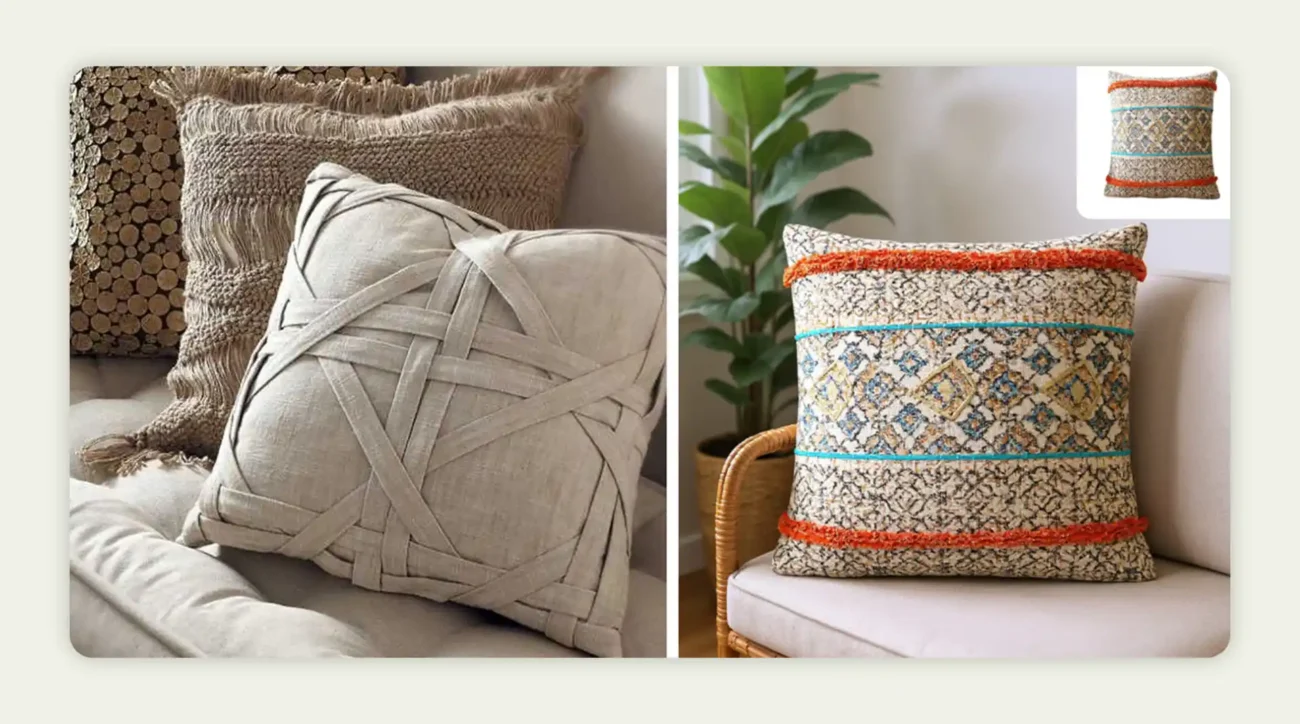
For example, in the two images above, it is difficult to distinguish which was generated using AI and which was captured through a traditional photoshoot. (For reference, the image on the right was created using WizStudio.)
Myth 2: “You lose control over the brand aesthetic.”
In reality, AI increases control rather than reducing it. Most modern AI image generators let you define consistent backgrounds, lighting styles, color tones, and visual themes across every image. If you want, you can even set up your brand aesthetic as repeatable visual rules, which will then be applied consistently across your catalogs.
For instance, Ganz, the popular wholesale home decor brand, used WizStudio to generate more than 500 lifestyle feature images with consistent brand aesthetics, thereby supporting multiple catalog brands and social content.
Myth 3: “It can’t handle complex products.”
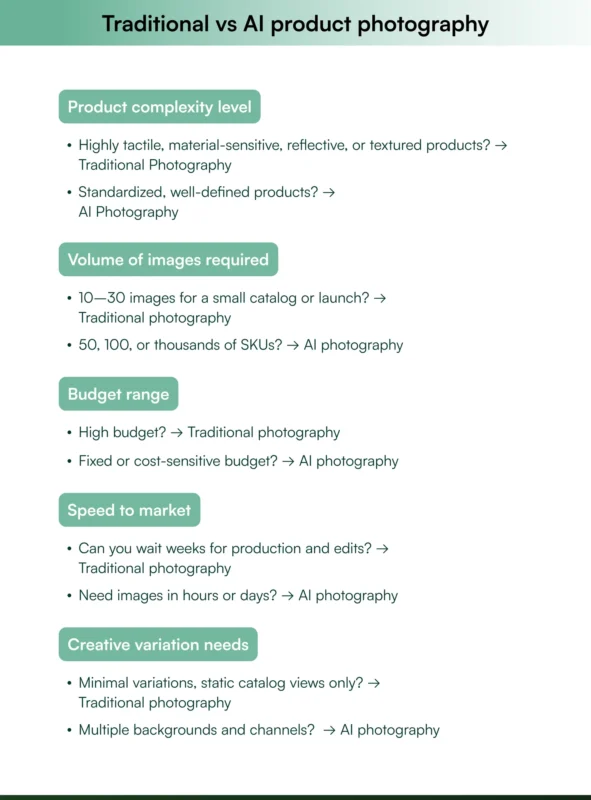
AI is particularly effective for products with defined shapes, packaging, and surfaces. This typically covers a large portion of ecommerce catalogs. However, for highly tactile, material-sensitive, reflective, and textured items, AI can still be used for supplementary visuals such as lifestyle scenes and variations. Traditional ecommerce product photography, on the other hand, can be used for handling edge cases. Many brands adopt this hybrid approach to maximize efficiency without compromising accuracy.
For example, even though the home décor item shown below features a material-sensitive, reflective surface, AI platforms can still generate accurate and highly aspirational lifestyle visuals from it. This demonstrates that AI can serve as an excellent supporting option for brands working with complex, reflection-prone products.

Myth 4: “AI images lead to copyright issues.”
Most reputable AI product image platforms like WizStudio are built for commercial use. Such platforms generate original outputs rather than copying existing images. When you use your own product images as inputs and operate within platform licensing terms, AI-generated visuals are completely safe to use across ecommerce and other channels without added copyright risk.
Myth 5: “AI requires technical expertise.”
Modern AI platforms are designed for marketers and business owners, not graphic designers or engineers. Image generation workflows are prompt-driven and visual. This allows even non-technical users to create production-ready images with minimal onboarding. This lowers dependency on external agencies and speeds up internal execution. For instance, in WizStudio, all it takes is 3 simple steps to generate studio-quality visuals – Upload your product image, describe the style you want, and get results.
Myth 6: “AI will completely replace traditional photography.”
AI is not a total replacement. It’s a strategic complement. Traditional photography still plays a role for premium launches and products requiring physical validation. AI fills the gaps where scale, speed, and creative iteration matter most. The future of ecommerce visuals is not AI versus traditional photography, but using a hybrid model where each will shine in its own area.
So, do you still need an ecommerce product photography service in the age of AI?
The answer is not a simple yes or no. It depends on your scale and business priorities. Traditional ecommerce product photography services still make sense for products where physical accuracy is non-negotiable. However, for most modern ecommerce brands managing growing catalogs, frequent launches, tight budgets, and multi-channel demands, AI-powered platforms offer a far more practical solution. They deliver speed, scalability, creative flexibility, and dramatic cost savings that traditional photography simply can’t match.
Remember – the smartest approach isn’t choosing one over the other, but knowing when to rely on AI, when to use traditional photography, and how a hybrid model can give you the best of both worlds.
WizStudio: The present and future of AI-driven ecommerce product photography
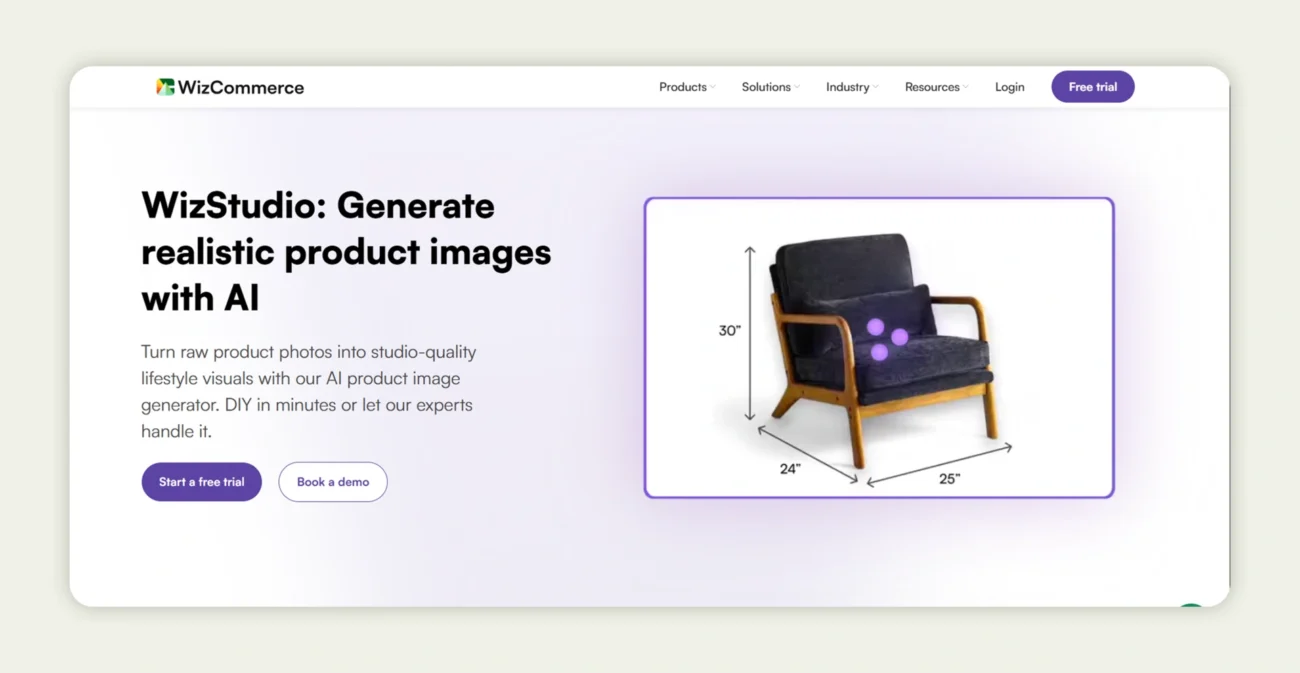
If traditional ecommerce product photography still feels like your only “professional” option, WizStudio challenges that assumption head-on. With WizStudio, generating studio-quality visuals cannot be faster and simpler. With just a basic product image and a prompt, WizStudio transforms your raw shots into polished, on-brand visuals.
What truly sets WizStudio apart is the breadth of use cases supported. You can instantly create lifestyle images by placing products in realistic, brand-aligned environments, or stage multiple SKUs together for clean group shots and catalog visuals.
Beyond generation, WizStudio also functions as a complete enhancement toolkit. It can generate natural shadows, extend or clean up backgrounds, remove unwanted elements, and even create precise line drawings with dimensions for technical listings.
For brands that want the speed of AI with the finesse of human creativity, WizStudio’s hybrid done-for-you plan bridges that gap. Our in-house experts refine your AI-generated outputs to ensure every image meets professional and marketplace standards.
In an era where scaling visual content without scaling costs feels impossible, WizStudio proves otherwise. Curious to see what WizStudio is capable of? Sign up for a free trial and experience it firsthand.
Frequently Asked Questions
1. How much does an ecommerce photoshoot cost?
An ecommerce photoshoot can range from a few hundred to several thousand dollars. It depends on the number of products, the type of product imagery required, photo studio time, and post-production work. Costs increase with styled shots, props, multiple angles, reshoots, and large catalogs. This makes traditional photography a significant recurring expense for growing brands.
2. How to take professional photos for ecommerce?
Professional ecommerce photos require consistent lighting, clean backgrounds, accurate color representation, and sharp focus. This can be achieved through a studio setup with proper lighting equipment. The more convenient and cost-effective way is to use AI-powered platforms like WizStudio that can generate studio-quality images from product photos.
3. What does an ecommerce photographer do?
An ecommerce photographer plans and executes product photoshoots. They handle everything from lighting to composition and styling to post-production. They operate with a single goal – to create accurate, visually appealing images that meet platform guidelines. However, picking the right ecommerce photographer is very important for a successful output. More importantly, you need to have a large budget to use their services.
4. What is ecommerce photography, and why is it important?
Ecommerce photography focuses on creating product images optimized for online selling. It is important because today’s customers rely entirely on visuals to evaluate products. This makes image quality critical for building trust, reducing returns, and improving conversion rates.
5. What should I look for when choosing an ecommerce photography service?
Look for their experience with ecommerce platforms. That’s the number one criterion. Apart from that, check their consistency in output and whether they have clear and transparent pricing. Most importantly, their service should scale with your catalog and align with your timelines and budget constraints.
6. What are the benefits of hiring a specialized ecommerce product photographer?
A specialized ecommerce photographer understands platform standards, catalog consistency, and buyer behaviour. They can deliver images that are optimized for listings and reduce trial-and-error. They also ensure visual accuracy, which is especially valuable for premium or detail-sensitive products. However, such specialized product photographers are very expensive to hire.
7. What is the process for booking an ecommerce product photography session?
The process typically involves defining image requirements, sharing product samples, agreeing on timelines and pricing, scheduling the shoot, and reviewing edited images. Revisions or reshoots may follow before final delivery. However, this may extend timelines depending on complexity and volume.
8. Can you recommend top ecommerce photography studios in the US?
There are plenty of traditional ecommerce photography studios across the US—especially in hubs like New York, Los Angeles, and Chicago—offering product-on-white, lifestyle shoots, and basic editing. But if you want a more scalable and consistent alternative to those traditional ecommerce photography studios, WizStudio gives you a unified platform with faster turnarounds, on-brand templates, and built-in optimization for web and marketplace listings so your visuals are ready to sell, not just to look good.
9. Are there ecommerce photography studios located in major Texas cities like Austin, Houston, and San Antonio?
Yes, you’ll find many traditional ecommerce photography studios in major Texas cities like Austin, Houston, and San Antonio, typically offering in-studio shoots, simple retouching, and local production support. However, instead of juggling multiple local studios in different Texas cities, WizStudio lets you centralize your ecommerce visuals on one platform. This streamlines briefs, approvals, and asset delivery while ensuring consistent quality and branding across all your product photography.