Skip to content




Pepperi is a unified B2B commerce platform built for consumer goods manufacturers and wholesalers. It consolidates B2B ecommerce, mobile order-taking for sales reps, trade promotions, retail execution, and route accounting.
However, the true Pepperi cost often goes beyond the base subscription fee. Here is a breakdown of Pepperi pricing, hidden costs, and how it compares to prominent alternatives like WizCommerce.
What is Pepperi?
Pepperi is a software platform that allows businesses to manage B2B sales by combining e-commerce, field sales apps, and trade promotions into a single system. Designed primarily for industries like food and beverage, fashion, and consumer goods, it aims to connect various sales channels under one roof, though its modular design means businesses must select and pay for specific features individually.
What is the Pepperi pricing structure?
Pepperi pricing is based on a quote-based model with three main tiers: Pro Plan, Corporate Plan, and Ultimate Plan. The cost of the Peepri platform varies based on business size, annual order volume, specific modules required, number of users, and integration complexity.
- Pro: Starting at US $500/month
- Corporate: Starting at US $1,500/month
- Ultimate: Contact sales for pricing
Pepperi Pro Pricing Plan
Here are the features you will get in the Pro plan:
- Web & native mobile apps (online/offline)
- Barcode scanning
- Unlimited SKUs & accounts
- Multiple price lists
- Smart search
- Map view with GPS navigation
Pepperi Corporate Pricing Plan
Everything covered in the Pro plan, plus:
- Approval workflows
- Custom domain & branded login
- Minimum/maximum order limits
- Related items/substitutions
- Access to financial info/invoices.
This is where per-seat licensing begins to bite. Every new sales rep you hire adds a fixed, recurring cost.
Pepperi Ultimate Pricing Plan
Everything covered in the Corporate plan, plus:
- Trade promotions
- Multiple storefronts
- Multi-currency & multi-language support
- Route accounting (van ordering & inventory tracking)
- Real-time shipping/tax rates.
Are there any hidden fees or additional costs when using Pepperi?
Implementation and setup fees
Pepperi is not a “plug-and-play” solution. Because of complex data migration, ERP integrations, and custom workflow requirements, implementation fees are significant. You should expect to add between $10,000 and $50,000+ to your Pepperi cost just to get the system up and running before your subscription even begins.
Per-seat licensing
Unlike platforms that offer unlimited staff accounts, Pepperi pricing charges per user. Every sales rep, merchandiser, and administrator you add increases your monthly bill. For a growing sales team, these “seat” costs can add thousands of dollars to your annual overhead.
Modular add-ons
Pepperi pricing at its base covers only the core platform. Critical functions like Trade Promotions, Retail Execution, and Route Accounting are sold as separate modules. As your requirements evolve, you will likely need to purchase additional modules, further inflating the total Pepperi cost.
Reliance on professional services
User feedback indicates that self-service configuration is limited. Many simple changes or customizations require you to engage and pay for Pepperi’s professional services team, rather than being able to handle them in-house.
Operational costs (support constraints)
While users report that support is helpful, the team operates primarily on Central European Time. For businesses in other time zones, this can lead to operational delays during critical issues. Additionally, users have reported recurring technical glitches that require frequent support interaction, costing your team valuable time.
For a detailed comparison with other competitors, explore our guide on the best B2B ecommerce platforms.
How much does Pepperi cost for a mid-size company?
For a mid-sized B2B business with moderate complexity, here is how much you will end up paying for the Pepperi platform:
| Cost component | Estimated annual cost |
| Base subscription with 2-3 modules | $10,000-$25,000 |
| User licenses (15-25 users) | $3,000-$8,000 |
| Integration partner fees (if needed) | $2,000-$10,000 |
| Total estimated annual cost | $20,000-$50,000+ |
Also read:NuORDER Pricing in 2026: How Much It Costs & Is It Worth It?
How does Pepperi compare to WizCommerce?
To help you evaluate your options, here’s how Pepperi stacks up against WizCommerce:
| Capability | Pepperi | WizCommerce |
| Pricing model | Custom quote-based, modular | Quote-based, plan-led with transparent tiers |
| User licensing | Per-seat licensing | Unlimited users (plan-dependent) + per-seat licensing |
| Implementation | Paid implementation with costs varying by complexity and modules | Paid implementation that is typically faster and more predictable |
| Module structure | Purchase individual modules as needed | Full B2B features included across plans |
| AI capabilities | Not prominent within the platform | Built-in Kai (AI sales assistant)Ella (AI order automation)AI-powered product discovery on B2B portals |
| Product image generation | No native tool | Native WizStudio, an AI product image generator |
| Sales rep tools | Comprehensive mobile order-taking app | Modern sales rep interface with AI assistance |
| Offline functionality | Full offline sync capabilities | WizOrder supports offline sync; optimized for modern, ecommerce-first workflows |
| Product search & discovery | Basic search functionality | Advanced search with fuzzy matching, SKU and attribute search, and AI-powered product recommendations |
| Trade promotions | Robust dedicated module | Native promotional capabilities |
| ERP integration | Proprietary iPaaS, extensive ERP support | Seamless integration with QuickBooks, NetSuite, and major ERPs |
| User interface | Functional, purpose-built | Modern, intuitive ecommerce experience |
The core difference between Pepperi and WizCommerce is that Pepperi is built as a commerce platform for CPG brands with complex omnichannel needs. Whereas WizCommerce is purpose-built for wholesale brands that prioritize e-commerce-first B2B commerce with modern UX, AI capabilities, and straightforward implementation. For the full side-by-side on features, migration, and support, see why wholesale teams pick WizCommerce as the best Pepperi alternative.
Also read: B2B Commerce Features Buyers Expect in 2026
Key questions to ask when evaluating any B2B platform
When comparing Pepperi to alternatives like WizCommerce, ask vendors these critical questions:
| Implementation & Setup | What can I configure myself vs what requires professional services?What’s the typical implementation timeline for a business of my size?Are there setup tasks that require vendor involvement even after initial launch? |
| Costs & Pricing | What’s included in the base subscription vs sold as add-ons?How do user licenses scale as my team grows?What are typical integration costs for my specific ERP system? |
| Support & Service | What are your support hours and in what time zones?What’s the average response time for urgent issues?Do I get a dedicated account manager or a general support queue? |
| Contract & Commitment | What are the contract terms (annual, quarterly, month-to-month)?What’s your refund or cancellation policy if the platform doesn’t meet my needs? |
| Product & Roadmap | What new features have you released in the past 6 months?What’s on your product roadmap for the next year?How do you handle feature requests from customers? |
These questions help you understand the total cost of ownership and the realities of implementation beyond sales presentations.
Why do brands choose WizCommerce?
For wholesale and B2B businesses evaluating ecommerce platforms, WizCommerce represents a compelling alternative that directly addresses cost, complexity, and usability challenges.
WizCommerce is selected by wholesale brands seeking:
Native B2B features in one plan: Access customer-specific pricing, custom catalogs, quote workflows, and dedicated wholesale portals directly within the base plan without purchasing extra modules.
Clear user-based pricing: WizOrder Pricing starts at $250 for up to 5 users with a predictable $50 per additional user, avoiding hidden fees, forced upgrades, or complex module combinations.
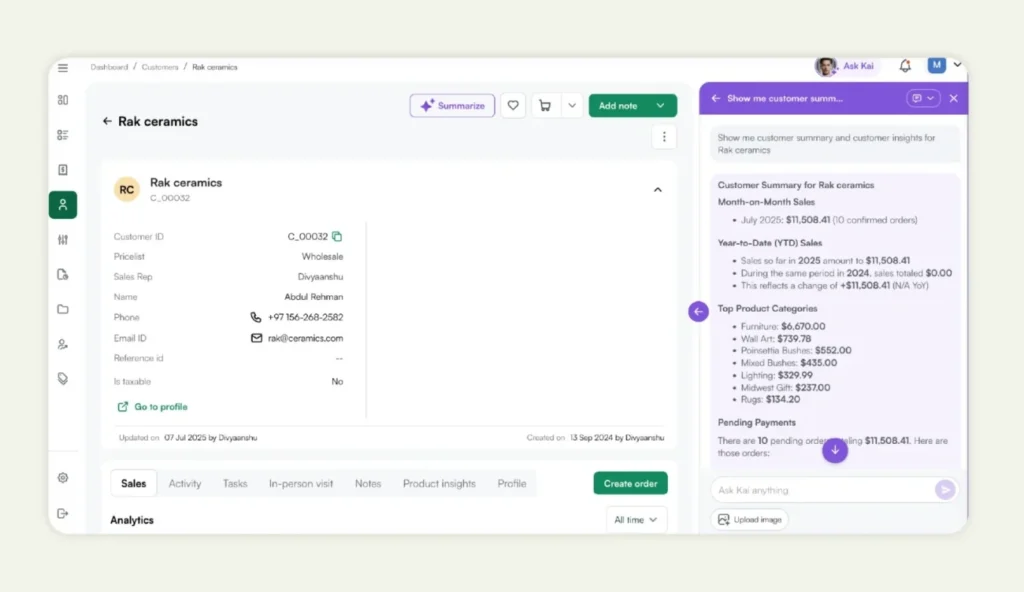
Built-in AI automation: Leverages native assistants Kai (for smart product recommendations) and Ella (for automatically extracting and processing orders from emails) to streamline daily tasks.
Rapid launch: Go live in 2–4 weeks with no-code configuration and team training that eliminates reliance on expensive external developers.
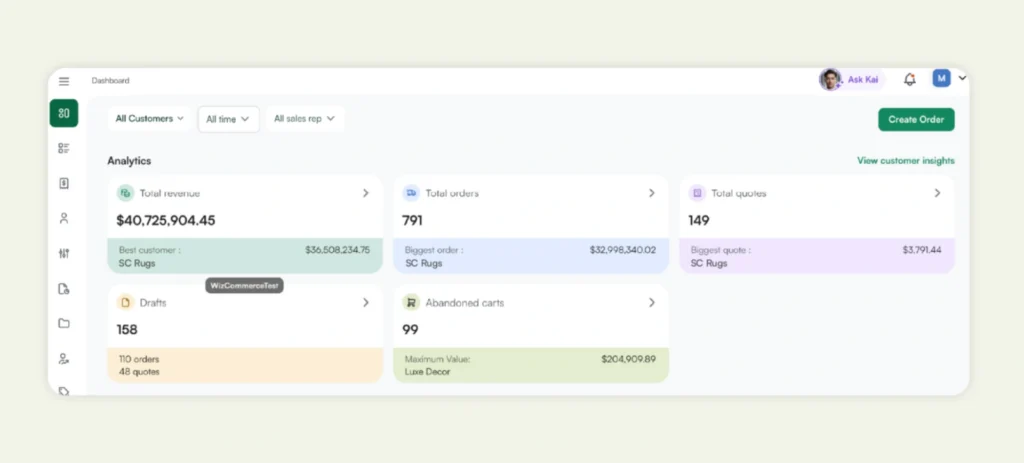
All-in-one toolkit: Replaces fragmented apps with built-in PDF catalog generation, advanced inventory management, detailed analytics, promotional tools, and sales rep territory tracking.
Integrated ecosystem: Features flexible B2B payment processing via WizPay (supporting cards and net terms), AI-driven product photography with WizStudio, and seamless real-time syncing with ERPs like QuickBooks and NetSuite.

Operational independence: Reduces vendor dependency with self-service admin tools for managing catalogs, pricing rules, and workflows without needing constant technical support.
Conclusion
Pepperi is a robust tool for CPG brands with complex field sales needs, but its modular pricing and implementation fees make it a heavy investment. For wholesalers who want a modern, AI-powered B2B platform with scalable costs and faster time-to-value, WizCommerce is the superior choice.
Book a demo to see how WizCommerce can work for your wholesale business.
FAQs
How much does Pepperi cost?
Pepperi pricing starts at $500 per month ($6,000+ annually) for the Pro tier, with Corporate plans around $1,500 per month and enterprise pricing available via custom quotes. The base subscription excludes per-seat user licenses, modules, and implementation fees, so total costs rise with team size and complexity. Most mid-market businesses report $20,000–$50,000+ in annual costs, while larger enterprise setups can exceed this.
What is Pepperi pricing for small businesses?
Pepperi pricing starts at $500 per month, but additional costs for implementation, per-user licenses, and modules often make it expensive for small businesses. Even simple setups commonly reach $10,000–$20,000+ in the first year, and reviews note that scaling Pepperi costs can be challenging compared to more ecommerce-focused B2B platforms.
Does Pepperi charge transaction fees?
No, Pepperi costs do not include a per-transaction fee. The platform includes a generous annual transaction pool with your subscription. You still pay standard payment processor fees (2-3%), but Pepperi doesn’t add license fees or per-order charges.
Can I try Pepperi before purchasing?
Pepperi pricing does not include a subscription-free trial. Evaluation is demo-based through sales. However, the mobile app includes a limited free trial mode for exploration. Prospective customers participate in a demo-based evaluation: schedule a consultation, receive a personalized demo, and get custom Pepperi pricing.
What modules does Pepperi offer?
Pepperi offers modules including B2B Ecommerce, Field Sales/Mobile Order Taking, Trade Promotions, Retail Execution, Route Accounting/DSD, Inside Sales & Support, and Operational Analytics. Modules are purchased individually based on your needs, allowing flexibility but requiring careful cost planning.
What are Pepperi alternatives for wholesale businesses?
Top alternatives include WizCommerce (modern B2B platform with scalable pricing and AI assistance), NuORDER (visual wholesale commerce), Shopify Plus (enterprise ecommerce), BigCommerce Enterprise (robust B2B features), and specialized platforms like JOOR or Handshake depending on your specific needs.
What is the current Pepperi pricing structure in 2026?
In 2026, the Pepperi pricing model is quote-based and modular. Pepperi pricing plans generally start at $500/month for Pro and $1,500/month for Corporate, excluding per-user licenses, modules, and implementation fees.
Does Pepperi offer special pricing for sales teams or enterprise clients?
Yes. Pepperi pricing includes custom enterprise pricing for large sales teams, global deployments, and high transaction volumes. Discounts may apply based on user count, long-term contracts, and bundled modules, but pricing is negotiated individually and not publicly listed.