Skip to content



If you are looking to build a website on BigCommerce, understanding the BigCommerce pricing plan structure is important. Unlike other platforms that charge based solely on the features you use, BigCommerce ties your monthly cost directly to your annual sales volume. This means as your business grows, your cost of platform automatically increases.
In this article, we break down the BigCommerce pricing plans for 2026, reveal their “hidden” costs, and compare them against B2B-first alternatives like WizCommerce, so that you can make informed decisions.

What is BigCommerce?
BigCommerce is an ecommerce platform that enables businesses to create online stores and sell products directly to their consumers and wholesale buyers. Built to support both B2C and B2B ecommerce,
BigCommerce provides the infrastructure to manage product catalogs, process orders across multiple sales channels, accept payments, and handle inventory management, all without needing extensive technical expertise or custom development.
BigCommerce pricing explained
The four BigCommerce pricing plans are categorized by features and annual online sales volume. Here’s an overview of the cost, which provides a useful comparison point when evaluating WooCommerce pricing.
- Standard Plan: $39 when paid monthly and $29 per month when paid annually
- Plus Plan: $105 when paid monthly and $79 per month when paid annually
- Pro Plan: $399 when paid monthly and $299 per month when paid annually
- Enterprise Plan: Custom (starting ~$1,000+/month)
BigCommerce Standard Plan
The BigCommerce Standard plan costs $39 per month on a month-to-month basis, or $29 per month ($348 total) when billed annually. This plan is designed for businesses with an online sales threshold of up to $50,000 per year.
Here’s what you will get in the Standard pricing plan:
- Unlimited products, file storage, bandwidth, and staff accounts.
- Online storefront, Point of Sale, and sales channels (Amazon, eBay, Walmart, Facebook/Instagram).
-
Marketplace channels carry their own costs on top of your BigCommerce plan. If home goods is your category, compare those against the Wayfair business login and seller fee structure before adding the channel.
- Single-page checkout, Apple Pay/Google Pay/Amazon Pay, multi-currency support, real-time shipping quotes, professional reporting tools, built-in blog, and product ratings/reviews.
- 24/7 tech support (phone, chat, & ticket).
Note: Once your trailing 12-month sales exceed $50,000, you will have to upgrade your account to the Plus plan ($105/mo) to continue using the platform.
BigCommerce Plus Plan
BigCommerce Plus plan costs $105 per month on a monthly cycle or $79 per month ($948 total) when billed annually. This tier is required for businesses with annual online sales between $50,000 and $180,000.
Everything covered in the Standard plan plus:
- Customer groups and segmentation.
- Abandoned cart saver and persistent cart.
- Stored credit cards.
- Up to 5 storefronts (Multi-Storefront).
BigCommerce Pro Plan
For high-volume merchants, the BigCommerce Pro plan costs $399 per month (billed monthly) or $299 per month when billed annually. This plan accommodates businesses with annual sales up to $400,000/ year.
If your revenue exceeds the $400k mark, BigCommerce adds an incremental fee of $150 per month for every additional $200k in sales, up to $1 million.
Pro plan covers everything included in the previous tier, plus:
- Google customer reviews.
- Product filtering and custom product filtering.
- Up to 8 storefronts (Multi-Storefront).
BigCommerce Enterprise Plan
The BigCommerce Enterprise plan is a custom-priced solution tailored for large-scale operations and high-volume B2B merchants.
While there is no fixed public price, most Enterprise contracts start at approximately $1,000 to $2,000+ per month, depending on your annual GMV (Gross Merchandise Volume) and specific feature requirements.
Additional features offered in the Pro pricing plan are:
- Unlimited API calls.
- Price lists.
- Express routing, priority support, customer success management, and API support.
- ShipperHQ shipping rules engine.
- Custom Multi-Storefront limits.
A critical limitation of BigCommerce pricing plans is that if your annual sales exceed your plan’s threshold, you are forced to upgrade to the next plan, even if you don’t need the additional features.
Also read: 15 BigCommerce Alternatives You Can Try This Year
Additional BigCommerce cost beyond subscription
Payment gateway cost
While BigCommerce does not charge its own transaction fees on any plan, you will still encounter processing fees from payment providers. Those add-on layers are what separate a plan fee from real total cost. Our guide to B2B ecommerce pricing breaks down how subscription, transaction, integration, and implementation costs stack up across platforms. Rates typically range from 2.2% to 2.9% + $0.30 per transaction, depending on the processor (e.g., Stripe, PayPal).
However, using the built-in “BigCommerce Payments” (powered by Braintree) can unlock pre-negotiated rates that decrease as you upgrade your plan tier.
Third-party app cost
Although BigCommerce offers more native features than competitors, most scaling businesses still require 3-7 third-party apps to operate fully.
You should budget an additional $75–$300+ per month for essential tools such as email marketing (Klaviyo, Mailchimp), advanced reviews (Yotpo), loyalty programs (Smile.io), and shipping integrations, all of which charge their own recurring subscription fees.
Hidden costs
- Forced Upgrades: This is the most significant “hidden” cost. If you exceed your annual sales threshold (e.g., $50k/year for Standard), BigCommerce automatically moves you to a more expensive tier, regardless of whether you need the additional features. Selling through marketplaces adds a parallel set of costs your plan fee never shows — our guide on how to sell on Wayfair covers the commission and onboarding requirements on that side.
- B2B Edition: Accessing professional wholesale tools like advanced quoting and net terms would require you to purchase the “B2B Edition” add-on, a cost that has to be recovered somewhere, so wholesale pricing gets worked out from landed cost and platform overhead together, with volume tiers set to clear both.
- Themes & Design: While there are free options, professional premium themes cost between $150 and $400. Furthermore, because BigCommerce uses the complex Stencil framework, custom design changes often require hiring specialized developers, which can range anywhere from $3,000 to $20,000 and more.
- Domain Names: Custom domains are not included in your subscription and must be purchased separately (approx. $6–$20/year).
- POS Systems: If you sell in person, you will need to budget for third-party POS subscriptions (like Clover or Square). These often involve both upfront hardware costs and ongoing monthly software fees.
Also read:NuORDER Pricing in 2026: How Much It Costs & Is It Worth It?
How does BigCommerce compare to WizCommerce?
To help you evaluate your options, here’s how BigCommerce stacks up against WizCommerce across key capabilities:
| Capability | BigCommerce | WizCommerce |
| Platform focus | B2C + limited B2B | B2B wholesale commerce |
| Pricing model | Tiered by sales volume + features | Quote-based, plan-led |
| Sales thresholds | Must upgrade when exceeding thresholds | No forced upgrades based on revenue |
| B2B functionality | Basic on all plans; advanced only on Enterprise | Built-in, full-featured across plans |
| User interface | Complex, steep learning curve | Intuitive, user-friendly platform |
| Implementation | Self-service or agency (often $5K-$20K+) | Included onboarding support |
| AI sales assistant | Third-party apps or custom development | Built-in Kai: AI sales co-pilot for reps |
| AI order automation | Manual or requires apps | Built-in Ella: Automates email orders and quotes |
| AI product images | Requires third-party tools/apps like Pebblely | Native WizStudio image generator |
| Wholesale/quoting | Requires Enterprise tier or apps | Native functionality on all plans |
| ERP integration | Limited native options, often requires middleware | Seamless integration with QuickBooks Desktop, QuickBooks Online, NetSuite, and major ERPs |
| Free trial | 14-day free trial period | Demo-based evaluation |
The most significant difference between BigCommerce and WizCommerce lies in their approach.
BigCommerce is built for businesses that are willing to handle technical complexity and developer costs. WizCommerce, on the other hand, is purpose-built for B2B wholesale commerce, where you can create workflows to manage customer-specific catalogs, quotes, and order-taking. If you are weighing a switch, see the full side-by-side on rep ordering, migration, and support in our breakdown of WizCommerce as a BigCommerce alternative for wholesale brands.
For a detailed comparison of other platforms, explore our guide on the best B2B ecommerce platforms.
WizCommerce features that B2B brands appreciate
Native B2B tools without enterprise costs: Access customer-specific pricing, quote management, net terms, volume discounts, and separate wholesale portals on all plans without forced upgrades or third-party apps.
Predictable, growth-friendly pricing: We believe your software costs shouldn’t spike just because you had a good sales month. WizCommerce eliminates revenue-based thresholds and platform transaction fees.
AI-driven sales and operations: Stop paying for fragmented app stacks. Our built-in assistants, Kai and Ella, automate quote generation and order entry directly from your inbox, saving your team hours of manual data entry.
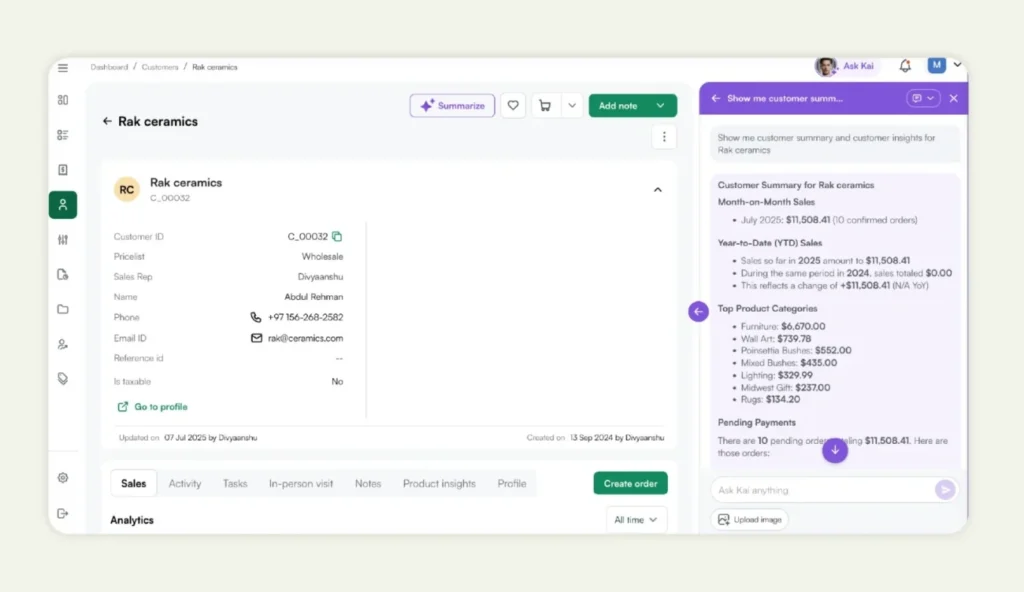
Fast implementation: While BigCommerce migrations can take months, WizCommerce is designed for speed. Launch in weeks with native B2B workflows that don’t require hiring a specialized developer team.
All-in-one functionality: Replaces fragmented app stacks with native inventory management, sales rep territory tracking, customer segmentation, promotional tools, and detailed analytics.
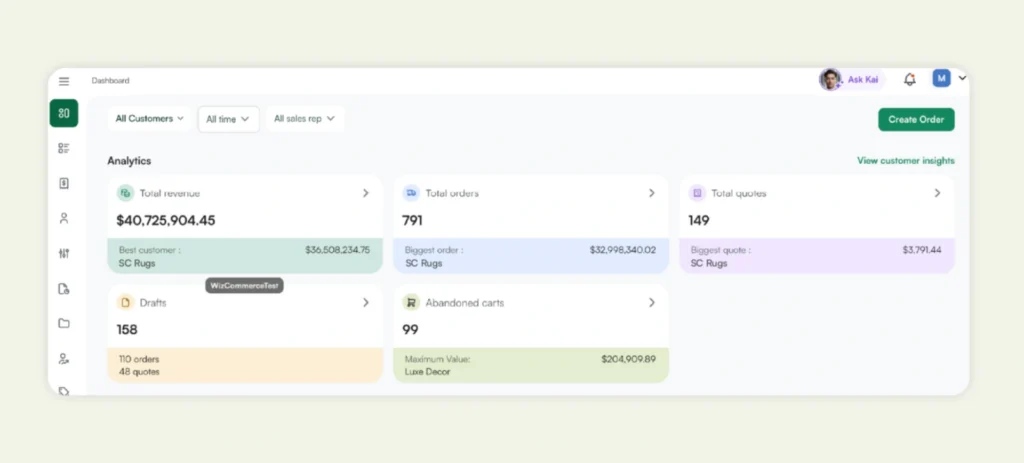
Integrated ecosystem: Features flexible B2B payment processing (WizPay) with custom terms, AI product photography (WizStudio) built in rather than stitched together through separate tools like Flair, and seamless QuickBooks and ERP syncing (NetSuite, Sage, etc.) for real-time data accuracy.

Conclusion
Although popular, BigCommerce’s revenue-based pricing thresholds, technical complexity, and enterprise-only B2B features create challenges for wholesale businesses looking to scale efficiently.
Understanding the true cost, including forced upgrades, developer requirements, and limited native wholesale functionality, is essential before committing. For B2B operations seeking full wholesale capabilities without enterprise pricing or technical overhead, purpose-built platforms offer a more direct path to growth.
Book a demo to see how WizCommerce can work for your wholesale business.
FAQs
1. How much does BigCommerce cost?
BigCommerce costs start at $39/month for the Standard plan (up to $50K annual sales), $105/month for Plus (up to $180K), $299/month for Pro (up to $400K), and custom pricing starting around $2,000+/month for Enterprise. Your actual cost will be higher when factoring in payment processing fees (2.2%-2.9% + $0.30 per transaction), apps ($75-$300+/month), premium themes ($150-$400), domain registration ($14-$20/year), and custom development ($3,000-$20,000+). Most businesses spend $6,000-$20,000+ annually depending on sales volume and customization needs.
2. Is BigCommerce good for a small business?
BigCommerce can work for small businesses with technical expertise and straightforward B2C needs, but it has a steeper learning curve than simpler platforms. The right plan also depends on what you’re selling — a low-margin, high-volume wholesale business example will hit BigCommerce’s revenue thresholds far sooner than a niche one. The forced upgrade when exceeding sales thresholds can be challenging for growing businesses, and small B2B or wholesale operations often find better value in platforms like WizCommerce that provide native wholesale features without requiring Enterprise plan pricing.
3. What is the cheapest website for ecommerce?
The cheapest option depends on your business model. Shopify Starter ($5/month) and Etsy (no monthly fee) are cheaper for very low volumes, while BigCommerce Standard ($39/month) and Shopify Basic ($39/month) are entry points for full online stores. However, apps, transaction fees, and development costs often triple the base price. B2B and wholesale businesses typically find WizCommerce offers better total cost of ownership with native features included.
4. What are the pros and cons of BigCommerce?
BigCommerce’s pros include a strong set of built-in ecommerce features (reducing reliance on apps), no extra transaction fees when you use third-party payment processors, solid SEO tools, scalability for large catalogs and high traffic, broad multi-channel integrations, and unlimited products/bandwidth on many plans; the cons are a steeper learning curve, potential forced plan upgrades as sales grow, deeper customization that often needs developer help, more advanced B2B capabilities typically gated behind Enterprise, support that can feel uneven on lower tiers, fewer free themes, and add-on costs that can push total spend beyond the base subscription.
5. What is the processing fee for BigCommerce?
BigCommerce doesn’t charge additional transaction fees beyond payment processor rates. With BigCommerce Payments, credit card rates start at 2.59% + $0.49 (Standard), decreasing to 2.29% + $0.49 (Plus) and 1.99% + $0.49 (Pro/Enterprise). Third-party processors like Stripe or PayPal typically charge 2.2%-2.9% + $0.30 per transaction. This is better than Shopify’s dual-fee structure, and Enterprise customers can negotiate better rates.
6. Is BigCommerce free to use?
No, BigCommerce is not free to use and doesn’t offer a permanent free plan. The platform requires a paid subscription starting at $39/month for the Standard plan. BigCommerce offers a 14-day free trial to test the platform, but you’ll need a paid subscription plus funds for payment processing, apps, themes, domain registration, and potential custom development to launch successfully.
7. Is Shopify cheaper than BigCommerce?
Shopify and BigCommerce both start at $39/month, but total costs depend on your needs. Shopify charges transaction fees (0.5%-2%) when not using Shopify Payments, while BigCommerce doesn’t. However, BigCommerce forces upgrades based on sales volume thresholds, which can make it more expensive as you grow. For B2B and wholesale businesses, both require expensive upgrades (Shopify Plus or BigCommerce Enterprise), making WizCommerce a more cost-effective alternative.
8. Does BigCommerce take a percentage of sales?
No, BigCommerce does not take a percentage of sales as a platform fee. There are no transaction fees or license fees when using third-party payment processors. However, you still pay payment processing fees to your gateway (typically 2.2%-2.9% + $0.30) and must upgrade to higher-priced plans when exceeding sales thresholds, which indirectly increases costs as revenue grows.