Skip to content



For wholesalers in home goods and furniture, selling through an online marketplace is one of the fastest ways to reach a large, purchase-ready audience. Four platforms worth knowing about are Wayfair, Amazon, eBay, and Faire. Before comparing platforms, it is important to understand how Wayfair pricing differs from traditional commission-based marketplace models. Wayfair focuses exclusively on home goods and furniture, connecting suppliers directly with millions of shoppers through a curated, invite-only program.
Amazon is the largest general marketplace in the US, offering scale and built-in logistics infrastructure. eBay gives sellers more control over pricing and works well for both fixed-price and auction-format listings. Faire is built specifically for B2B wholesale, connecting brands with independent retail buyers through a net-terms model.
Understanding Wayfair pricing before you commit is essential because the platform operates on a wholesale model, unlike most marketplaces, which directly shape how you set margins, plan logistics, and manage your bottom line. More importantly, you need to understand what control you give up in exchange for access to Wayfair’s audience.
![WizCommerce B2B ecommerce platform for wholesale brands]](https://wizcommerce.com/wp-content/uploads/2026/03/WizCommerce-B2B-ecommerce-platform-for-wholesale-brands-1024x273.webp "WizCommerce B2B ecommerce platform for wholesale brands]")
What is Wayfair Marketplace?
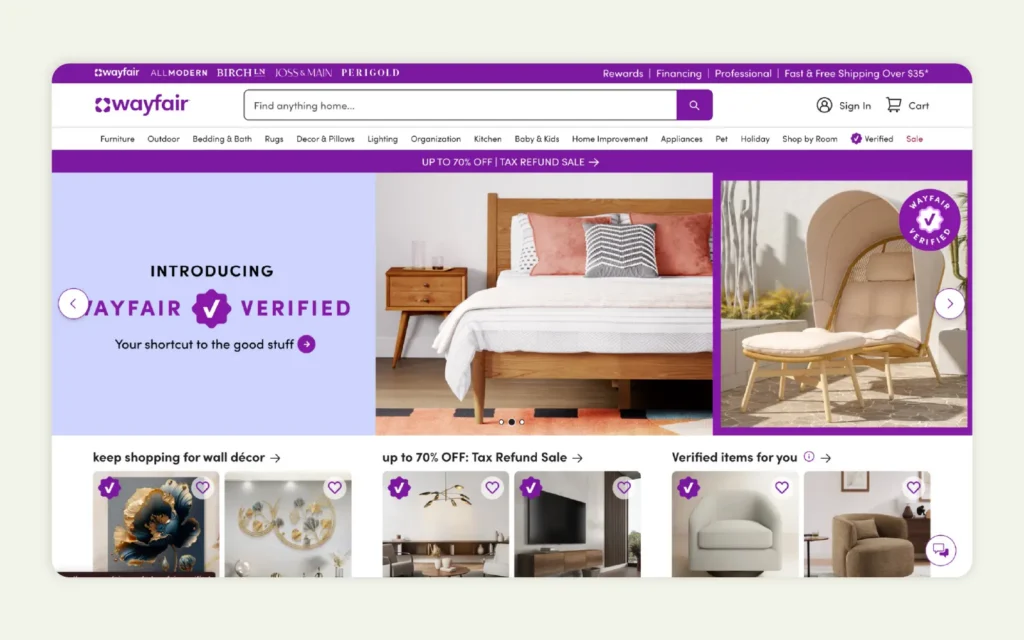
Wayfair is a US-based ecommerce platform founded in 2002, specializing exclusively in home goods, furniture, decor, lighting, appliances, and flooring. With over 22 million active customers, it is one of the largest home-focused marketplaces in North America. Wayfair operates through a portfolio of brands, including Birch Lane, Joss & Main, AllModern, and Perigold, alongside thousands of third-party suppliers.
Unlike Amazon or eBay, Wayfair is not an open marketplace. It runs an invite-only partner program, meaning sellers must apply and be approved before they can list products. The platform is designed for suppliers and manufacturers in the home category, not individual resellers.
Also Read – 8 Best Wayfair Alternatives You Should Try in 2026
Who can sell on Wayfair?
Wayfair accepts suppliers in the home goods and furniture category, including manufacturers, wholesalers, and distributors.
To qualify, you must have dropshipping capabilities (fulfilling orders directly to the end customer) and carry a minimum of $1 million per occurrence and $2 million in aggregate product liability insurance.
Brands that sell décor, rugs, bedding, kitchen goods, outdoor furniture, pet items, and related home products are the best fit.
How much does it cost to sell on Wayfair?
Wayfair’s pricing model for sellers is fundamentally different from most major marketplaces. There are no listing fees, no monthly subscription fees, and no traditional commission or referral fee charged to suppliers. Instead, Wayfair pays you a wholesale price for your products and retains control over the final retail price shown to customers. The margin Wayfair earns comes from the spread between what it pays you and what it charges shoppers.
When it comes to understanding wayfair pricing as a supplier, it is important to know that the Wayfair pricing model is based on wholesale base costs rather than referral commissions. Having a clear understanding of how Wayfair pricing works is essential before submitting your supplier application.
| Cost type | Amount | Notes |
| Listing fee | $0 | No charge to list products |
| Monthly subscription fee | $0 | No recurring platform fee for sellers |
| Commission / referral fee | $0 (traditional) | Wayfair earns from the wholesale-to-retail margin, not a % charged to you |
| Shipping (standard orders) | Covered by Wayfair | Wayfair pays shipping on standard dropship orders |
| CastleGate fulfillment | Variable | Optional Wayfair warehouse program; costs negotiated separately |
| Product liability insurance | $1M+ per occurrence | Required before applying; arranged by the seller with their insurer |
But the key tradeoff is control. You do not control the final retail price, promotional discounts, or how your products are positioned alongside competitors. Your margin protection depends entirely on how carefully you set your wholesale base cost. This structure makes Wayfair’s business pricing fundamentally different from Amazon or eBay.
Understanding Wayfair’s pricing model for retail
Once you set your wholesale base cost, the Wayfair pricing system takes control of the final retail price customers see. According to Wayfair’s official partner documentation, the platform uses a dynamic pricing system that continuously learns optimal price points and adjusts them automatically.
Wayfair’s algorithm accounts for your wholesale base cost, competitive market pricing, shipping costs, inventory positioning, and incident rates (returns and damage) to determine what retail price to display.
This means the retail price on Wayfair can change without your input, and the platform may discount your products during promotional events such as Way Day.
That lack of retail price control makes it difficult to maintain consistent brand positioning or enforce MAP policies across channels.
The practical implication for sellers: your profitability depends almost entirely on setting a wholesale base cost that protects your margins regardless of what retail price Wayfair ultimately shows. You do not control what the customer pays, which makes careful margin planning the most important variable in how Wayfair business pricing works for suppliers. Because Wayfair pricing is algorithm-driven, suppliers must build margin buffers into their wholesale costs to protect profitability.
How to set up a seller account on Wayfair
Wayfair uses an application-based onboarding process. There is no self-serve signup, and approval is not guaranteed. Here is how it works:
- Apply at sell.Wayfair.com: Complete the application with your business name, seller category (wholesale, brand, distributor), product catalog size, fulfillment center locations, and annual revenue.
- Meet the requirements: Confirm you have dropshipping capabilities and product liability insurance of at least $1M per occurrence and $2M aggregate before submitting.
- Wait for review: Wayfair reviews applications within 3 to 5 business days. Full approval, including catalog review, can take 2 to 4 weeks depending on complexity.
- Upload your catalog: Once approved, use Partner Home to upload products via quick upload (Excel template) for large catalogs, or guided upload for individual listings.
- Go live: Products go live after Wayfair reviews listings for compliance with their Supplier Code of Conduct. You begin receiving orders fulfilled directly to customers.
- Marketing Tools: Wayfair’s performance marketing tools, including sponsored placements, are available in Partner Home once your account is active.
3 Wayfair alternatives wholesalers can try in 2026
Wayfair is one channel, but wholesale home goods brands in the US have several other marketplaces worth evaluating. Here are three alternatives, each with a different fee structure and buyer audience.
Amazon Business
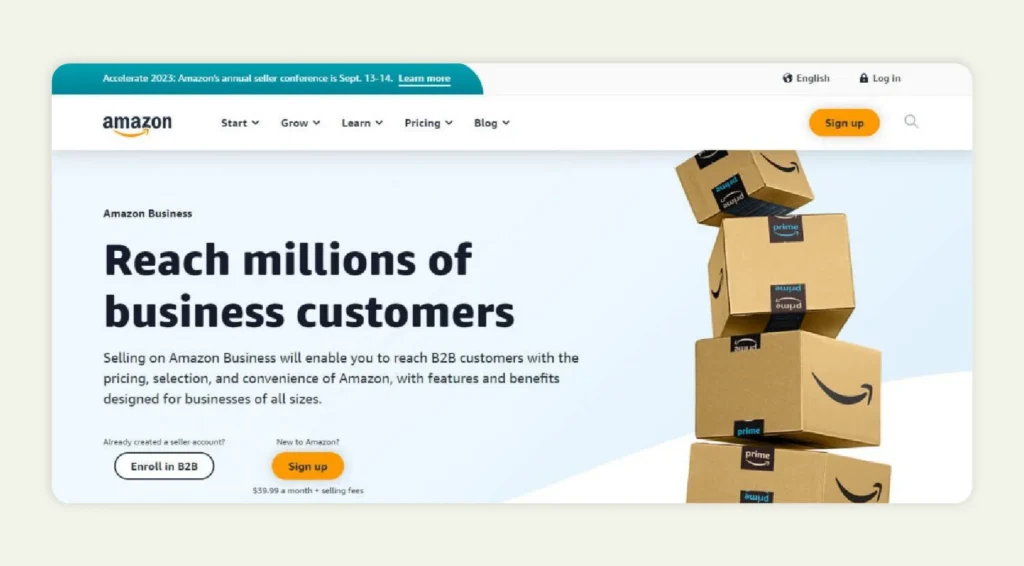
Amazon is the largest ecommerce marketplace in the US, with hundreds of millions of active shoppers. The Amazon Business program adds a B2B layer on top of the standard marketplace, allowing sellers to offer bulk pricing, net-30 payment terms, and business-only price points to verified buyers. Unlike Wayfair, sellers on Amazon set and control their own retail price, giving more flexibility over margins. The tradeoff is a more complex fee structure and significantly higher competition across home goods categories.
| Cost type | Amount | Notes |
| Professional Seller plan | $39.99/month | Required for sellers listing more than 40 units/month |
| Referral fee – Furniture | 15% on first $200; 10% above $200 | Charged on each sale price, not on your wholesale cost |
| FBA fulfillment | Variable by size and weight | Optional; sellers can also fulfill themselves (FBM) |
| Storage fees (FBA) | $0.78–$2.40/cu ft/month | Higher rates October through December |
While Amazon gives pricing control, the layered referral fees, FBA charges, and advertising costs can compress margins quickly.

eBay is a well-established marketplace with a large presence in home goods, furniture, decor, and appliances. Unlike Wayfair, there is no application process. Any registered seller can list products immediately, making it accessible for wholesalers who want to move inventory quickly or test new product lines. eBay supports both fixed-price and wholesale lot listings, which works for B2B sellers moving larger quantities to business buyers.
| Cost type | Amount | Notes |
|---|---|---|
| Insertion fee | $0 for first 250 listings/month; $0.35 after | Resets each calendar month |
| Final value fee – Home & Garden | 12.7% of total sale amount + $0.40/order | Total includes item price, shipping, and tax |
| eBay Store subscription | $4.95–$349.95/month | Optional; reduces final value fees and increases free listing allowances |
| Payment processing | Included in final value fee | eBay Managed Payments; no separate PayPal fees |
eBay works well for liquidation and testing, but it is not structured for long-term wholesale relationship building.
Faire
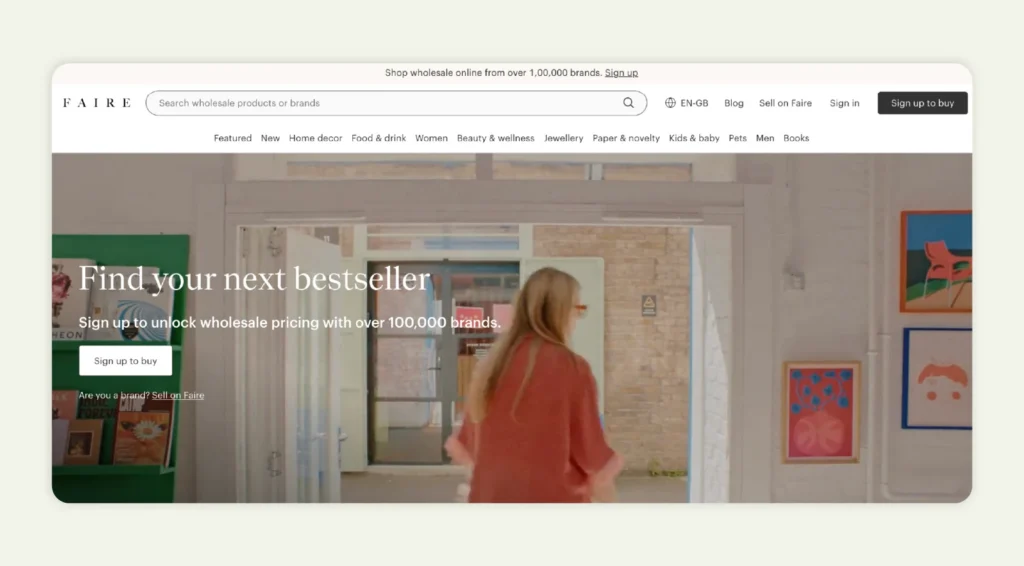
Faire is a wholesale marketplace built specifically for B2B transactions between brands and independent retail buyers. It is the most relevant Wayfair alternative for wholesalers because the entire model is oriented around wholesale relationships rather than individual shoppers. Faire pays brands upfront and extends net 60 terms to buyers, free returns on opening orders, and uses an AI-powered discovery engine to match your products with buyers likely to reorder. For a detailed comparison of Faire versus other wholesale platforms, see our Faire alternatives blog.
Also Read – Top 7 Websites Like Faire.com In The Wholesale Market
| Cost type | Amount | Notes |
|---|---|---|
| Account setup | $0 | Free to create a brand account |
| Commission – marketplace orders | 15% + $10 new customer fee per order | Applies when Faire brings you a new retailer |
| Commission – Faire Direct orders | 0% | When you bring your own existing buyers via Faire Direct link |
| Payment processing | 1.9%–3.5% + $0.30/order | Fee depends on payout speed: 60-day (1.9%), 30-day (2.4%), next-day (3.5%) |
Faire’s model supports wholesale relationships, but brands are still operating inside Faire’s ecosystem, subject to its commission structure and platform rules.

Create your ecommerce website with WizCommerce
Every marketplace in this guide offers access to buyers. None of them give you ownership of the buyer relationship. You do not control pricing fully, customer data, merchandising, or platform policy changes. That tradeoff becomes more expensive as your wholesale business grows.
Wayfair sets your retail price. Amazon’s referral fees stack up quickly. eBay’s buyer base skews toward individual shoppers. Faire’s commission structure rewards discovery, not loyalty.
The better approach is to build your own digital presence where you have full control over your buyers, your pricing, and your brand experience, and that is exactly what WizCommerce helps you do.
WizCommerce has already supported 500+ wholesale brands and helped generate over $1 billion in wholesale revenue. Rather than listing you on a shared marketplace, WizCommerce builds a personalized B2B storefront tailored entirely to your specific buyers, product catalogs, and business workflows.
When comparing Wayfair pricing to other marketplace fee structures, the biggest difference is the lack of a visible commission percentage.
| Platform | Retail Price Control | Commission Fees | Own Buyer Data | Long-Term Asset |
| Wayfair | No | No traditional % | No | No |
| Amazon | Yes | 15%+ | Limited | No |
| eBay | Yes | ~12% | Limited | No |
| Faire | Yes (wholesale) | 15% new buyers | Limited | No |
| WizCommerce | Full | No marketplace commission | Yes | Yes |
Conclusion
Wayfair pricing is not just about what the platform costs to join but also about what you trade away: control over your retail price, your buyer relationships, and your brand positioning. Evaluating Wayfair pricing alongside Amazon, eBay, and Faire helps clarify the true Wayfair cost beyond just listing fees.
For wholesalers who want a proven home goods marketplace without upfront fees, Wayfair is a legitimate starting point. For broader reach and price control, Amazon and eBay offer strong alternatives. For brands focused solely on B2B wholesale relationships, Faire’s net-terms model is the most purpose-built of the three.
But for wholesale brands that want to build lasting buyer relationships without marketplace dependency, the most sustainable path is owning your own digital channel. WizCommerce is a purpose-built B2B ecommerce platform for wholesale brands and distributors. It replaces fragmented app stacks with a single system that includes a personalized storefront, AI-powered sales tools (Kai and Ella), flexible B2B payment processing (WizPay), ERP integration with QuickBooks and NetSuite, and AI product photography (WizStudio). Whether you sell furniture, home goods, or industrial products,
WizCommerce is designed to give your wholesale business full control over its digital sales channel. Book a demo to see it in action.
FAQs
How does Wayfair pricing work for sellers?
Wayfair pays suppliers a wholesale price they set, then controls the final retail price using a dynamic algorithm that factors in competition, shipping costs, and demand. Sellers pay no listing or commission fees. Profitability depends on setting a wholesale cost that protects your margins regardless of what retail price Wayfair displays.
What is Wayfair Professional pricing?
Wayfair Professional pricing is part of Wayfair’s B2B buyer program designed for verified business buyers, including interior designers, property managers, small business owners, and real estate professionals. Members receive up to 15% off everyday pricing, free shipping on orders over $35, and access to dedicated account managers. It is not a selling tier. The Wayfair Professional membership cost is $0, but discounts vary by product and order size.
What are Wayfair shipping prices for sellers?
Under Wayfair pricing, standard dropship orders are shipped at Wayfair’s expense. Sellers do not pay per-shipment fees. These Wayfair shipping prices do not include CastleGate storage or negotiated warehouse fees. They may incur separate storage and fulfillment costs, negotiated as part of that arrangement.
Is Amazon or Wayfair better for wholesale home goods sellers?
It depends on your priorities. Wayfair charges no listing or referral fees but surrenders retail price control to its algorithm. Amazon charges a 15% referral fee on furniture up to $200 (10% above) plus a $39.99/month plan fee, but sellers control their own retail pricing. Amazon also has significantly more traffic and a broader B2B buyer program.
Is Faire better than Wayfair for B2B wholesale?
Faire and Wayfair serve different models. Wayfair sells to consumers using your wholesale cost as the base. Faire is a true wholesale-to-retail platform where your buyers are independent retailers. Faire charges 15% commission on new orders but 0% on your existing buyer accounts, making it better suited for brands with an established wholesale customer base.
How does Wayfair’s business pricing work for bulk orders?
Wayfair sells to consumers using a wholesale model, so suppliers set a base wholesale cost and Wayfair sets the retail price. For business buyers under Wayfair Professional, bulk discounts may apply depending on product category and order size. However, sellers do not directly negotiate bulk pricing with buyers. Wayfair manages promotional pricing and discounts through its internal pricing system.
How do I find out if my business is eligible for Wayfair Professional discounts?
You can apply for Wayfair Professional through the Wayfair Professional signup page. Eligibility is typically limited to verified businesses such as interior designers, contractors, property managers, real estate professionals, and registered companies. You must provide business documentation, such as a resale certificate, tax ID, or business license, for verification before accessing member pricing.
What are the main pricing differences between Wayfair Business and regular Wayfair accounts?
Wayfair Professional accounts receive business-only perks such as up to 15% off select items, volume discounts on eligible products, tax-exempt purchasing, and dedicated account support. Regular Wayfair accounts pay standard retail pricing and do not receive business-specific discounts or services. Sellers, however, operate under the same wholesale pricing model regardless of who purchases the product.