Skip to content



Many wholesale brands start on marketplaces for one simple reason: access. After successful onboarding, their products become visible to thousands of potential buyers within days. For furniture and home goods sellers, Overstock is one such marketplace that can act as an instant growth lever. But before getting started with Overstock, most sellers have one key question: how does Overstock pricing work? In other words, what will it cost them to sell on Overstock? In this guide, we break down everything you need to know about Overstock cost, so you can make an informed decision on whether the platform is worth your investment.
What is Overstock, and who is it for?
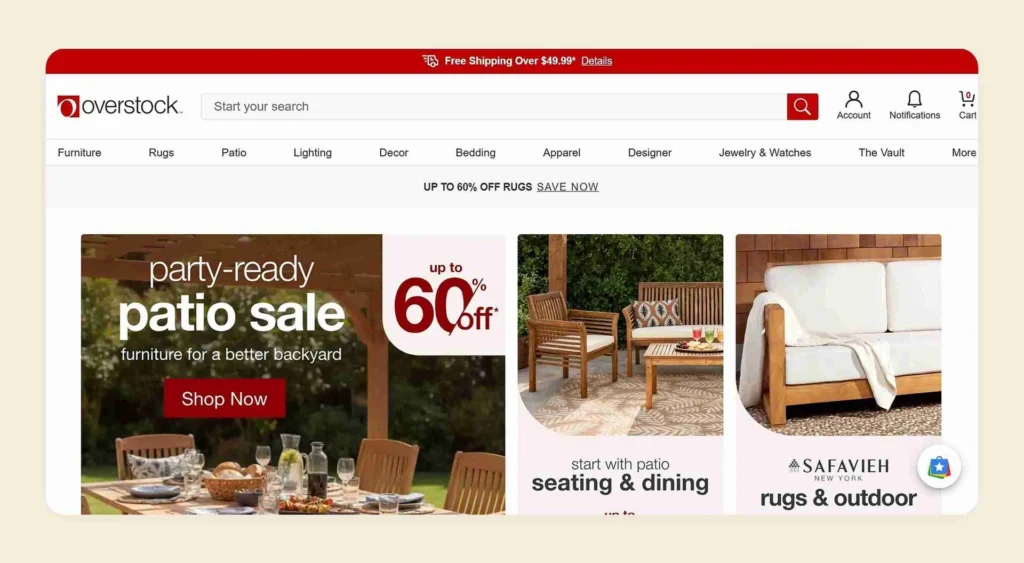
Overstock (now operating under the Bed Bath & Beyond marketplace ecosystem) is an online marketplace that connects third-party sellers(both wholesalers and retailers) with a large audience of buyers seeking value-driven products. It primarily caters to brands and suppliers in categories like furniture and home essentials. Sellers can list new products and handle orders through a centralized partner platform.
The platform offers a variety of growth tools, including site-wide promotions, advertising opportunities, performance insights, and enhanced content options that help increase product visibility and drive sales. Sellers retain control over fulfillment and operations while benefiting from streamlined onboarding and access to a broad customer base.
How does Overstock pricing work? Different fees explained
Overstock follows a typical marketplace pricing model where you pay a mix of fixed and variable fees tied to listing and selling your products. Here is a breakdown of the key Overstock fees in 2026:
Listing fees
You pay a small fee to list each product on the platform. These typically range from $0.10 to $3.50 per item. It largely depends on the category and listing type. Registration itself is free, so you only start paying when you begin listing products.
Final value fees
Once your product sells, Overstock charges a commission on the transaction. For lower-priced items, this is relatively modest. It ranges around 3% for items priced under $25. However, this again can vary based on product category and pricing tiers.
Optional listing upgrades
To improve visibility, you can pay for promotional enhancements. These include options like bold listings (around $1) and highlighted listings (around $5). You also have featured placements costing approximately $13.17. While optional, these costs can add up if you rely on them to stay competitive.
Image and merchandising costs
The first product image is free, but additional images can cost extra (for example, up to 6 more images at around $0.10 each). High-quality visuals are essential in categories like furniture, so this is a small but important consideration.
Relisting flexibility
One advantage is that if your product does not sell, you can typically relist it for free. This reduces the risk of repeated listing costs while you optimize pricing or positioning.
Additional costs sellers often overlook on Overstock
While the above fees are relatively easy to understand, the real cost of selling on Overstock often comes from operational and competitive pressures, and the same holds one layer down the stack, where nuorder pricing adds per-seat licences and a one-time implementation fee of around $7,500 on top of the quoted subscription. As you scale, these “hidden” costs can quietly eat into your margins. Here are the key ones to watch out for:
Return handling and refunds
Returns are a natural part of selling online. This is especially true in categories like furniture and home goods. But beyond the refund itself, you must absorb reverse logistics costs and restocking efforts. Then you also need to handle potential product damage. All of these can significantly impact profitability.
Promotional spend to stay visible
Simply listing your products is rarely enough. To stay competitive, you may have to invest in featured listings or discounts to gain visibility. Over time, this becomes a recurring cost rather than a one-time boost.
Inventory storage and management
If you are holding inventory to meet marketplace demand, you also need to account for warehousing and stock management systems. Slow-moving products can further increase holding costs and tie up working capital.
Pricing pressure and discounting
Marketplaces are inherently competitive. When multiple sellers offer similar products, the pricing strategy often becomes the main differentiator. This leads to frequent discounting, which may help drive volume but gradually reduces your margins.
Operational overhead
Managing orders, updating listings, handling customer queries, and maintaining product data across the marketplace all require time and resources. Whether handled in-house or through tools, this operational overhead adds to your total cost of selling.
The key takeaway is that Overstock’s visible fees are only part of the equation. To truly evaluate profitability, you need to factor in these ongoing, less visible costs that come with competing and scaling on a marketplace.
Overstock pricing at work: An example
To understand how Overstock pricing impacts your margins, let us look at a simple example.
Imagine you are selling a furniture item priced at $100.
You start with a listing fee of around $1 (this can vary, but we will take a mid-range value). Once the product sells, Overstock charges a final value fee. While lower-priced items may attract ~3%, for simplicity, let us assume a value of 5%, which comes to $5.
Now, to stay competitive, you decide to boost visibility with a highlighted listing ($5) and add 5 extra images ($0.50 total). At this point, your total marketplace-related costs are already around $11.50.
So from your $100 sale, you are left with $88.50 before even accounting for product cost, shipping, returns, or operational overhead, and the fair comparison is against a platform subscription, where bigcommerce pricing starts around $29 a month billed annually but the wholesale tools sit behind a separate B2B Edition add-on..
Now layer in real-world factors:
- A small discount to stay competitive, say 10% off, brings your selling price down to $90
- Shipping and handling could cost another $10–$15, depending on the product
- Any return or damage further impacts margins
Suddenly, your profit margin starts shrinking much faster than expected.
This is a simplified example, but it highlights an important point: while individual fees may seem small, they compound quickly. And as you scale, these combined costs can have a meaningful impact on your overall profitability.
Is Overstock worth the cost for sellers in 2026?
The honest answer is: it depends on where you are in your growth journey.
For many brands, Overstock is a great starting point. It offers immediate access to a large and ready-to-buy audience and removes the need to build your own ecommerce infrastructure from scratch. If your goal is to test demand or get quick traction, the platform can deliver value.
However, as you scale, the equation starts to change.
What begins as a low-cost entry point can gradually become more expensive. Listing fees and ongoing promotional spend start adding up. The impact is particularly severe for those sellers managing large B2B catalogs or competing in crowded categories. Margins get tighter, and maintaining visibility often requires continuous investment rather than a one-time effort.
At the same time, there is a less obvious trade-off, which is not directly related to cost: control.
When you sell on a marketplace like Overstock, you are operating within someone else’s ecosystem. That means limited ownership over customer relationships and restricted branding opportunities. There is also less flexibility in how you present and grow your business. Over time, this can make it harder to build a differentiated brand or create long-term customer loyalty.
And that is where build your own branded storefront begins to enter the conversation, especially for brands looking to take back control and build a more sustainable growth engine beyond marketplaces.

WizCommerce: A better alternative to Overstock for B2B ecommerce
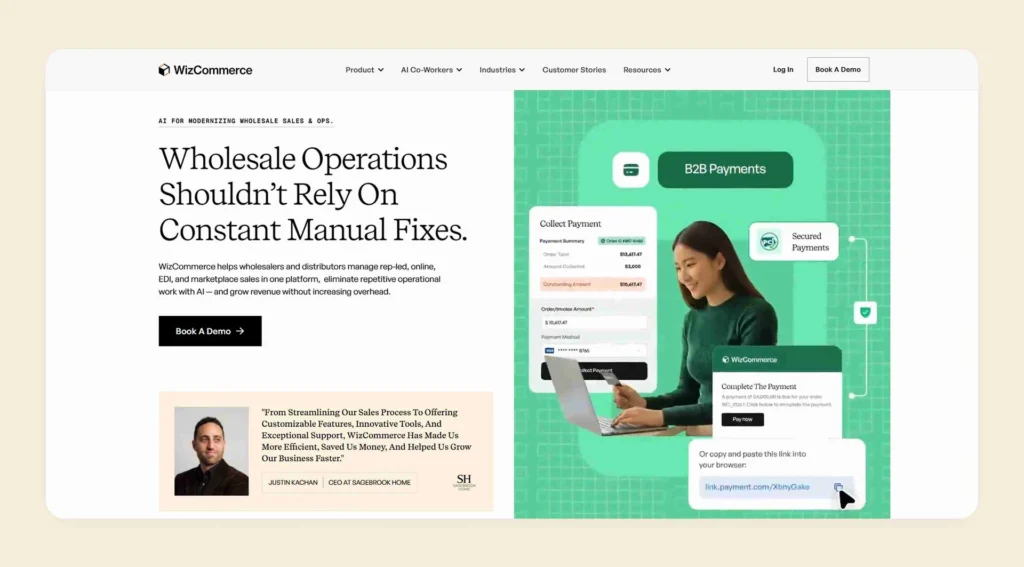
It’s clear – While marketplaces like Overstock help you tap into existing demand, they come with trade-offs. High commissions and limited control over branding are two really critical ones.
But when you build your own ecommerce storefront, you shift from renting an audience to owning the entire customer experience. You control pricing, branding, and buyer relationships, while also retaining your margins instead of paying recurring marketplace fees.
WizCommerce, a B2B ecommerce platform designed for manufacturers, wholesalers, and brands, allows you to create a fully branded wholesale storefront where retailers can browse and place orders directly with you. WizCommerce also simplifies backend operations with built-in order management and dedicated retailer portals. Your buyers or reps can log in, view catalogs, place repeat orders, and track purchases, creating a seamless ordering experience for your team.
A hybrid model also works well. You can use Overstock as a discovery channel during the initial days to reach new customers, move excess inventory, and benefit from built-in traffic. Slowly, you can direct serious buyers and repeat customers to your own B2B storefront built on WizCommerce.
Here are a few capabilities of WizCommerce:
Build a personalized storefront
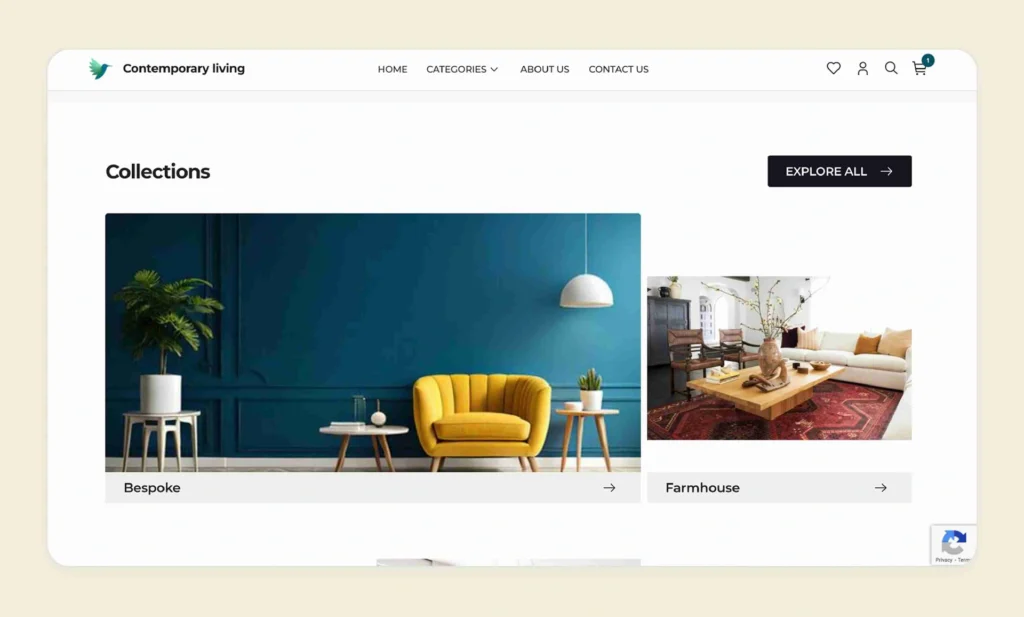
You can create a fully branded wholesale buying experience with flexible themes and layouts tailored to your brand’s aesthetic. Similarly, the platform allows you to build custom collections based on buyer contracts, regions, or pricing terms. This ensures each customer only sees products relevant to them.
Set up tailored pricing

WizCommerce gives you complete control over how you sell to different buyers with fully customizable pricing and payment structures. You can assign custom price lists to each buyer based on region, sales channel, order volume, or contract terms. This ensures every customer sees pricing tailored specifically to them. Alongside this, you can define flexible payment terms beyond standard options like Net 30 or Net 60, and automatically apply them to the right buyers.
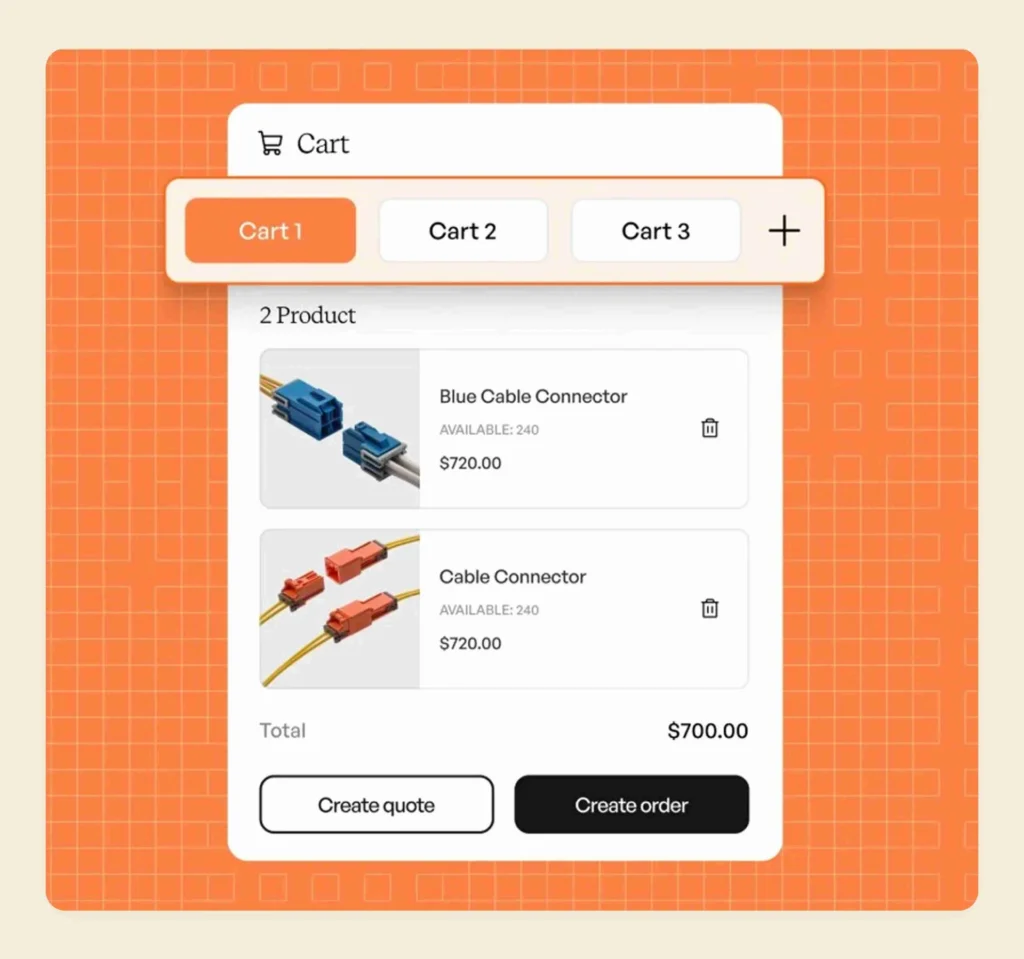
Wishlists and multi-carts

You can give buyers the flexibility to plan and organize purchases effortlessly. They can save products to wishlists for future consideration and create multiple carts for different projects, locations, or timelines. Everything is automatically saved to their account, allowing them to return anytime and pick up exactly where they left off.
Generate quotes
This feature makes it easy for your reps to generate and manage professional quotes with customer-specific pricing applied automatically. Reps can quickly create and send quotes directly from a dedicated sales rep app, while every quote is saved, tracked, and ready for follow-up.
AI sale copilot
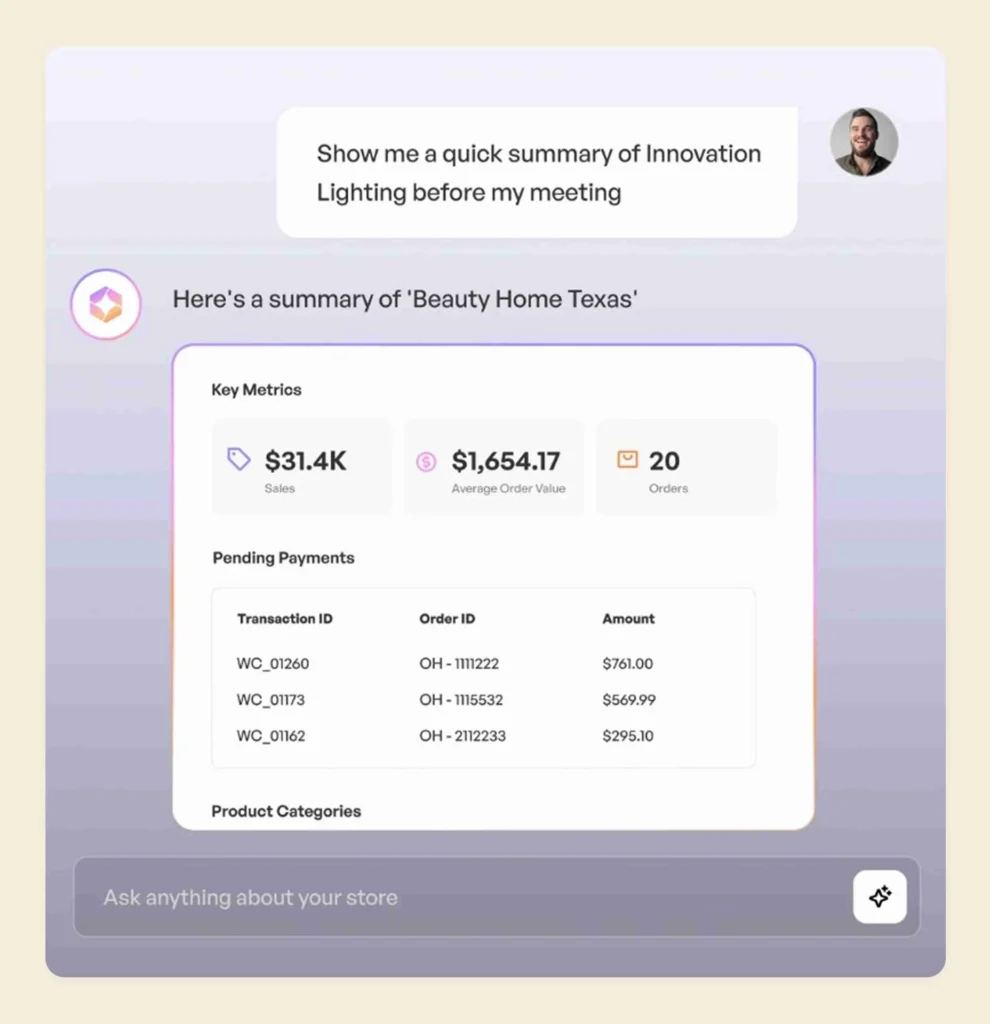
This feature acts like a built-in ChatGPT for your sales operations. It allows your reps to ask natural-language questions across customers, orders, and pipeline and instantly get precise answers without switching tools. It also recommends best-fit products based on real buyer behavior, helping reps confidently suggest what customers are most likely to purchase. During live conversations, reps can simply describe requirements and let AI automatically generate accurate quotes or orders with the right products, pricing, and terms.
So, if you are ready to move beyond marketplace limitations and build your own wholesale channel, book a demo with WizCommerce today. Get a fully branded, commission-free B2B storefront that you truly own in no time.
Frequently Asked Questions
How does Overstock pricing work?
Overstock pricing works through listing fees, category-based commissions, and optional advertising costs that vary by product. Hidden operational costs tied to order fulfillment and returns can also eat into your margins and brand value quickly. Building your own wholesale storefront on WizCommerce offers a more scalable, commission-free alternative with full pricing control.
Why do retailers use Overstock?
Retailers use Overstock for two distinct reasons. As sellers, they use it to meet customer demand, move seasonal items through clearance sales, and tap into built-in marketplace traffic. As buyers, retailers use Overstock to purchase products in bulk from wholesalers at attractive, value-driven rates that suit their resale margins.
Is Overstock pricing cheaper than regular pricing?
Overstock pricing is generally cheaper than regular pricing because the marketplace caters to consumer preferences for value-driven products and competitive discounts. While this helps sellers capture market share and drive volume, it puts sustained pressure on margins. With WizCommerce, you can maintain consistent pricing without competing in a discount-heavy environment.
Which is cheaper, Wayfair or Overstock?
Whether Wayfair or Overstock is cheaper depends on your product category, pricing strategy, and ability to respond to market changes. Both platforms pressure sellers to discount competitively, reducing margins over time. With WizCommerce, you can avoid price wars and sell directly to retailers with full control over your pricing strategy.
Why is Overstock so much cheaper?
Overstock is much cheaper because it focuses on discounted inventory, clearance sales, and competitive seller positioning, often helping sellers move obsolete inventory quickly. This creates constant pressure to reduce prices to remain visible. A WizCommerce storefront allows commission-free selling with complete pricing control and no forced discounting to protect your margins.
How much does Overstock charge for shipping?
Overstock shipping costs vary by product size, category, and seller strategy, with many sellers absorbing costs to maintain competitive service levels. Overstock return shipping costs follow similar variability. Poor supply chain management can amplify these costs significantly over time. WizCommerce gives you greater margin control and flexibility over how shipping costs are structured and passed on.
How do sellers use Overstock to manage excess inventory and improve cash flow?
Sellers use Overstock to manage excess inventory by liquidating excess stock and surplus goods that inflate inventory costs and strain warehouse management capacity. Converting overstock into sales reduces the cost of goods tied up in storage and helps maintain healthier stock levels, especially when demand forecasting or inventory management falls short.
Can Overstock help with inventory management and demand forecasting challenges?
Yes, Overstock can help businesses overcome poor inventory management by providing a channel to move surplus stock quickly. By combining historical data with predictive analytics, sellers can improve accurate demand forecasting, maintain safer stock levels, and achieve more efficient inventory management, ultimately reducing storage fees and enhancing overall supply chain efficiency over time.