




Contents
- 1 What is a B2B fashion commerce platform?
- 2 The fashion and apparel B2B landscape
- 3 Essential features of a B2B fashion commerce platform
- 3.1 1. Custom pricing and volume discounts
- 3.2 2. Product catalog management
- 3.3 3. Inventory management integration
- 3.4 4. Order management system
- 3.5 5. Advanced search and filtering
- 3.6 6. Real-time order tracking
- 3.7 7. Secure payment processing
- 3.8 8. Analytics and reporting
- 3.9 9. ERP and CRM integration
- 3.10 10. Mobile compatibility
- 4 Why fashion businesses choose specialized B2B platforms?
- 5 How to choose the right B2B apparel ecommerce platform?
- 6 WizCommerce: Purpose-built for wholesale fashion
- 7 Implementation of best practices
- 8 Industry success patterns
- 9 Future trends shaping B2B fashion commerce
- 10 Conclusion
- 11 FAQs about B2B fashion ecommerce
Are you struggling to keep up with the fast-paced evolution of the fashion industry? As the fashion and apparel sector continues to expand, selecting the right B2B fashion commerce platform has become crucial for wholesale success. The global B2B ecommerce market for fashion has evolved, with digital wholesale transactions growing rapidly. 83% of B2B buyers prefer ordering through digital commerce.
These specialized platforms streamline operations and unlock new opportunities for growth and innovation. In this comprehensive guide, we’ll explore how the right platform can transform your fashion business, examining key features, implementation strategies, and emerging trends shaping this digital landscape.
What is a B2B fashion commerce platform?
A B2B fashion platform is a specialized digital solution enabling apparel manufacturers, wholesalers, and distributors to sell products to retailers, boutiques, and other businesses. Unlike consumer-focused platforms, these systems offer bulk pricing, complex order management, and multi-tier customer accounts designed specifically for fashion wholesale operations.
These platforms serve as digital showrooms where you can showcase collections, manage orders, process payments, and handle the complexities of wholesale trading, including large orders, customizations, and multi-currency transactions. Key users include apparel manufacturers, fashion distributors, and brands selling to retail buyers globally.
The fashion and apparel B2B landscape
The fashion and apparel industry, valued at $1.79 trillion globally in 2024, constantly seeks innovations to streamline wholesale operations and expand market reach. Industry data reveals that 73% of B2B buyers prefer online commerce now prefer ordering through digital channels, and brands with B2B fashion ecommerce platforms report higher order accuracy and faster fulfillment compared to traditional phone and email-based ordering.
Modern B2B ecommerce fashion platforms have emerged as pivotal tools, enabling efficient wholesale transaction management, expanded distribution networks, and seamless interactions between brands and retail buyers. These platforms offer sophisticated yet user-friendly environments for product showcasing, order management, and payment processing while handling the unique complexities of fashion wholesale.
Essential features of a B2B fashion commerce platform
B2B ecommerce platforms for fashion and apparel brands must offer specialized features that address the unique demands of fashion wholesale.
1. Custom pricing and volume discounts
Wholesale fashion requires flexible pricing strategies. Your platform should enable tiered pricing structures, customer-specific catalogs, and volume-based discounts that incentivize larger orders. For any B2B apparel commerce platform, flexible pricing is non-negotiable in wholesale fashion. Advanced systems support seasonal pricing adjustments reflecting the dynamic nature of fashion collections.
2. Product catalog management
An essential feature for fashion and apparel platforms is robust product catalog management. This allows brands to display extensive product lines with detailed descriptions, high-quality images, and complete variant information (colors, sizes, materials). Efficient catalog management supports variant matrices, seasonal collection organization, and quick updates to match fast-changing fashion trends.
Also read: Best Practices & Tools For Product Catalog Management
3. Inventory management integration
Integrating inventory management systems with the B2B fashion platform ensures that inventory levels are automatically updated as orders are placed. Real-time inventory synchronization prevents overordering and stockouts. For fashion brands managing multiple SKUs across various colors and sizes, integration is critical. Advanced systems offer multi-warehouse tracking, automated low-stock alerts, and pre-order management for upcoming collections.
4. Order management system
A sophisticated order management system (OMS) is critical for handling the complexities of fashion wholesale from order placement through fulfillment and shipping. Fashion-specific OMS features include pre-pack ordering (common in apparel wholesale), seasonal order windows, minimum order quantity enforcement, and split shipment management.
5. Advanced search and filtering
To accommodate the vast array of products typical in fashion, advanced search and filtering capabilities are vital. This enables buyers to quickly find products by category, size, color, style, fabric, or price range. Smart search features like visual search, style recommendations, and filter memory for repeat orders significantly improve buyer efficiency.
6. Real-time order tracking
Tracking orders in real-time allows customers to manage their profiles, view order histories, track current orders, and repeat purchases with ease. Providing transparency throughout the shipping process with milestone notifications, estimated delivery windows, and carrier integration. This visibility is essential for B2B transactions where large orders and tight delivery schedules are common.
7. Secure payment processing
Secure payment processing is critical to protecting financial data and building trust with buyers. B2B platforms for fashion and apparel must adhere to high-security standards like PCI DSS to ensure that all transactions, including bulk orders, are safe from fraud and breaches.
Fashion wholesale typically requires multiple payment options, including net terms (30/60/90 days), credit account management, partial payments for large orders, and integration with trade credit providers.
8. Analytics and reporting
Track sales performance, customer behavior, and inventory levels. Key reports should include best-seller analysis, seasonal performance comparisons, buyer purchase patterns, and style/color trend analytics to guide product development and marketing strategies.
9. ERP and CRM integration
Centralize customer data and automate sales processes through native integrations with systems like QuickBooks, NetSuite, Epicor Prophet 21, SAP, Salesforce, and HubSpot. This connectivity ensures that customer interactions and inventory management are cohesive and efficiently managed across all channels. For fashion brands, this means synchronized data between design, production, sales, and fulfillment departments.
Also read: 14 Best ERP Software for Apparel Industry: A Complete Guide
10. Mobile compatibility
With 43% of buyers using mobile devices for research and ordering, mobile optimization directly impacts conversion rates. Mobile platforms should load within 3 seconds, feature touch-optimized navigation, and provide full functionality matching desktop versions. A mobile-optimized B2B fashion ecommerce platform ensures that buyers can place and manage orders on the go, which is especially important in the fast-paced world of fashion where decisions and transactions need to happen swiftly and seamlessly.

Why fashion businesses choose specialized B2B platforms?
Understanding the benefits of dedicated B2B apparel ecommerce platforms helps explain why leading fashion wholesalers are making the switch from generic solutions.
- Expanded global reach: Access worldwide markets without physical presence, connecting with retailers and distributors across time zones while enabling 24/7 ordering.
- Enhanced buyer experience: Provide seamless, personalized shopping with custom pricing, product recommendations, and efficient order processing that encourages repeat business.
- Increased sales efficiency: Streamline the sales process from order placement to fulfillment. Automated processes reduce errors and ensure quick processing, crucial when trend cycles move rapidly. Brands are processing more orders with the same sales team after implementation.
- Better inventory management: Real-time tracking and supply chain visibility help avoid stockouts and overstock situations. This reduces dead stock and improves cash flow through better inventory turnover.
- Data-driven decisions: Gain insights into which styles sell best in specific regions, optimal pricing strategies, and emerging trend signals that inform design decisions.
- Reduced operational costs: Automation of order processing, customer management, and inventory control reduces order processing costs and eliminates manual data entry errors.
How to choose the right B2B apparel ecommerce platform?
Selecting the right platform requires careful evaluation of several factors. Consider scalability to handle business growth and seasonal traffic spikes, customization options to match your brand aesthetic, robust security features, and compliance with PCI DSS and GDPR, a user-friendly interface design that reduces training time, and comprehensive customer support with dedicated account management.
Look for platforms that offer fashion-specific features, such as variant management, pre-packaged ordering, and seasonal collection tools, rather than general ecommerce solutions that require extensive customization.
WizCommerce: Purpose-built for wholesale fashion
WizCommerce stands out as an AI-powered B2B fashion commerce platform specifically designed for wholesalers, distributors, and manufacturers. Trusted by 500+ businesses, it addresses the critical pain points of fashion wholesale.
Here’s how WizCommerce compares to leading alternatives:
| Features | WizCommerce | JOOR | NuORDER |
| Target audience | Wholesalers, distributors, manufacturers across industries. | Fashion-focused brands & high-end retailers | Multi-industry brands (fashion, outdoor, etc.) |
| AI recommendations | Built-in Kai (up to 25% AOV increase) | Limited | Limited |
| Offline mobile app | Full offline functionality | iPad app available | iPad app available |
| Trade show tools | Barcode scanning, QR codes, and offline mode | JOOR Passport digital shows | digital shows |
| 24/7 online storefront | Included | Included | Included |
| AI-powered imagery | WizStudio (no photoshoots needed) | Not available | Not available |
| Payment processing | Multiple options, flexible terms | Multi-currencies, 60-day terms | Built-in payment tracker |
| ERP integration | Native (QuickBooks, NetSuite, Epicor, SAP) | large Integrations | API/FTP integrations |
| Implementation time | Less than 30 days | Varies by size | Varies by size |
| Customer support | 24/7 with a dedicated success manager | Business hours support | Service team |
| Pricing model | Low-cost and transparent | Enterprise pricing | Tiered pricing |
| Virtual showrooms | Included | Available | 360⁰ imagery |
| Real-time analytics | Built-in reporting | Advanced reporting | Turnkey reporting |
| Best for | B2B businesses needing an AI-powered, affordable, quick-to-deploy solution | Global fashion brands seeking an extensive buyer network | Brands wanting visual merchandising & collaborative buying |
Why fashion wholesalers choose WizCommerce?
AI-powered sales intelligence: Kai makes product discovery effortless with smart search, “View Similar” recommendations for out-of-stock items, and AI-powered upselling that increases average order value by up to 25%.
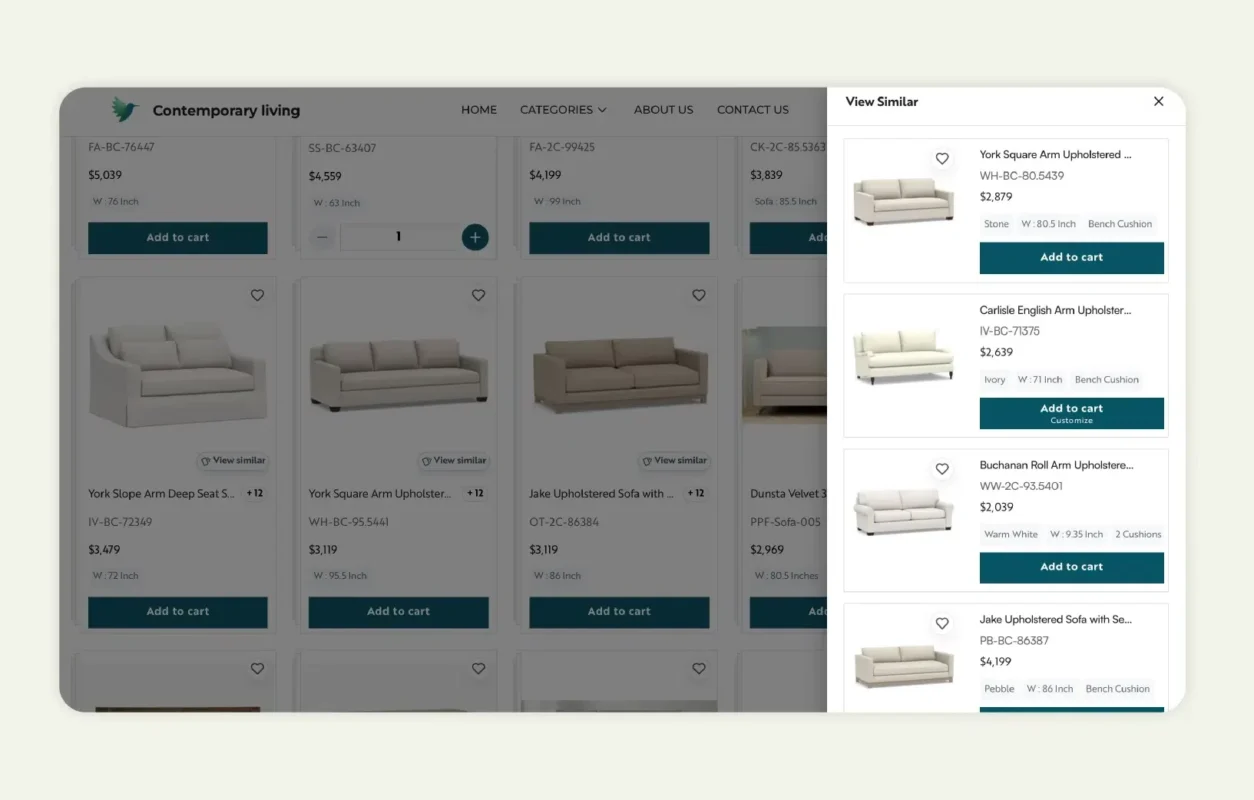
Omnichannel order taking: Sales representatives can take orders in the field using iPads with real-time inventory access, at trade shows with barcode scanning and offline functionality, or buyers can place orders 24/7 through the online storefront. All orders sync seamlessly across channels.
WizStudio for visual content: Create AI-powered lifestyle imagery without photoshoots or Photoshop, reducing content creation costs while maintaining professional quality.

Native integrations: Seamlessly connect with your existing tech stack, including QuickBooks, NetSuite, Epicor Prophet 21, SAP, Salesforce, Shopify, and major shipping carriers, eliminating manual data entry and ensuring real-time synchronization.
Trade show excellence: Advanced search and barcode scanning simplify complex catalogs, enabling faster order writing that directly increases sales. The offline-capable app works even in areas with poor connectivity.
Quick implementation: Go live in under 30 days with low-cost implementation and 24/7 expert support with dedicated customer success management.

Implementation of best practices
When implementing a new B2B ecommerce platform for fashion and apparel brands, following proven best practices ensures maximum ROI and smooth adoption.
1. Planning and goal setting
Establish comprehensive goals encompassing increased sales, better customer engagement, and streamlined operations. Set SMART goals that guide project scope and expectations. Consider your target audience (wholesale, retail, or both), product complexity (number of SKUs), and revenue goals (percentage from ecommerce). Fashion brands typically manage 500-5,000+ SKUs across multiple seasons, requiring robust systems.
2. Platform selection and customization
Assess platforms for feature sets, compatibility with existing workflows, and customization capabilities. Create a detailed requirements document covering must-have features, nice-to-have features, and deal-breakers. Involve stakeholders from sales, operations, IT, and customer service in the evaluation.
3. Data migration and integration
Plan migration meticulously to prevent data loss and minimize downtime. Key data to migrate include customer accounts with credit terms, historical orders for reorder functionality, product catalogs with all variants, pricing structures, and inventory levels. Test integrations thoroughly before going live.
Read more: B2B Ecommerce Replatforming and Migration Guide for 2025
4. Staff training and customer onboarding
Create role-specific training for sales reps, customer service, warehouse staff, and administrators. Develop customer onboarding with video tutorials, comprehensive FAQs, live webinars, and dedicated support during transition. Consider offering incentives for early adoption, such as discounts on first orders placed through the new platform.
5. Launch and marketing
Plan a strategic launch highlighting the benefits over previous solutions. Include email campaigns, personalized demos for key accounts, launch promotions, and quick response teams to address issues promptly.
For instance, Gucci has set a remarkable standard in digital marketing within the luxury fashion industry. A cornerstone of Gucci’s strategy has been its adaptive marketing tactics that cater specifically to a younger audience. This includes collaborations with cultural icons and digital influencers to refresh its brand image continuously. For instance, the partnership with artist GucciGhost brought a fresh, contemporary twist to Gucci’s collections, resonating well with younger demographics.
6. Continuous optimization
Monitor platform performance and gather user feedback continuously. Track order conversion rate, average order value, time from login to order completion, customer adoption rate, and satisfaction scores. Schedule quarterly reviews to assess performance against goals.
Industry success patterns
Learning the successful strategies of industry leaders provides valuable insights into how digital innovation drives wholesale success in fashion.
Below are several examples from recognized brands. Their success highlights the importance of agility and real-time data analytics in B2B platforms.
1. Zara’s fast fashion model
Zara, a leader in fast fashion, excels at rapid product development and supply chain, bringing trends from runway to retail in 15 days, processing over 450 million items annually through digital infrastructure.
For a B2B apparel ecommerce platform, this underscores the importance of agility and responsiveness to market trends. Incorporating flexible logistics and real-time data analytics can help platforms offer timely solutions to business clients. Key takeaways include real-time inventory visibility, rapid catalog updates, and data-driven trend forecasting.
2. Nike’s digital innovation
Nike’s digital commerce saw an increase in total revenue, driven by their B2B platform featuring 3D product visualization, virtual showrooms, and AI-powered inventory recommendations that increased order accuracy. This demonstrates how technology enhances engagement and simplifies wholesale buying.
Burberry’s digital strategy increased brand engagement and drove significant traffic to their B2B ordering portal, showing how social media and digital marketing complement wholesale platforms.
Fashion brands implementing modern B2B fashion ecommerce solutions see a reduction in order processing time from 48 hours to 4 hours with order accuracy improvements, average order value increases through AI recommendations, and more productivity per sales rep.
Future trends shaping B2B fashion commerce
Staying ahead of emerging trends ensures long-term competitiveness.
1. B2B fashion platforms adopting AI
AI and machine learning are transforming fashion ecommerce through predictive ordering, style recommendations, demand forecasting, dynamic pricing, and visual search. Early adopters report increases in cross-selling success.
Artificial Intelligence (AI) and machine learning are transforming the fashion ecommerce sector through predictive ordering, style recommendations, demand forecasting, dynamic pricing, and visual search, enabling highly personalized shopping experiences.
For fashion brands, this means being able to present customers with products they are more likely to buy, enhancing customer satisfaction and increasing sales. Early adopters of AI in B2B fashion report increases in cross-selling success and improvement in inventory turnover.
2. Augmented reality (AR) for virtual showrooms
Augmented reality enables virtual trade show booths, 3D product visualization showing fabric texture, virtual fit models, and AR-enabled line sheets. This technology not only enhances the online shopping experience but also reduces the likelihood of returns, a significant challenge in the fashion industry. With 71% of buyers saying they would purchase more if they could visualize products better, AR represents a significant competitive advantage for early adopters.
3. Sustainability and ethical sourcing transparency
Sustainability transparency has become critical, with fashion buyers considering more sustainability in purchasing decisions by 2025. Platforms now integrate supply chain transparency, sustainability certifications, carbon footprint calculations, and ethical labor verification.
As consumer awareness about environmental and ethical issues grows, there is an increasing demand for transparency in sourcing and sustainability practices. More fashion buyers are considering sustainability in their purchasing decisions.
B2B ecommerce platforms are responding by integrating tools that allow supply chain transparency, sustainability certifications, carbon footprint calculations, and ethical labor verification. This trend not only helps build trust with buyers but also aligns with global efforts towards more sustainable business practices.
4. Omnichannel integration
Omnichannel strategies are becoming essential in the fashion industry. This provides seamless experiences across all touchpoints with unified inventory, consistent pricing, integrated customer service, and seamless handoffs between sales reps and self-service portals.
B2B ecommerce platforms are increasingly incorporating features that support an omnichannel approach, facilitating consistent and efficient interactions across all sales channels. Brands with strong omnichannel strategies retain customers compared to those with weak strategies.
Also read: Key Differences Between Multichannel & Omnichannel
5. Hybrid trade shows
Trade shows that combine in-person events with digital components extend reach beyond geographical limitations and time constraints, offering interactive and accessible experiences for global buyers. B2B ecommerce platforms are adapting to support live-streaming product launches, digital catalogs with instant ordering, real-time video meetings, and post-show access for extended buying windows.
The hybrid model has proven particularly effective, with brands reporting more qualified leads compared to in-person-only shows, while maintaining the relationship-building benefits of face-to-face interactions.

Conclusion
The integration of specialized B2B ecommerce platforms for fashion and apparel brands delivers measurable improvements in order accuracy, processing speed, customer satisfaction, and revenue growth. As digital wholesale evolves with AI, AR, and omnichannel integration, the competitive advantage of early platform adoption increases.
For those looking to enhance their sales processes, reduce operational costs, and expand their market reach, WizCommerce stands out as a prime solution.
WizCommerce offers the comprehensive solution fashion wholesalers need from its AI-powered order writing and 24/7 online storefront to advanced trade show solutions and seamless ERP integration. With 500+ businesses trusting WizCommerce and implementation in under 30 days, transforming your wholesale operations has never been more accessible.
Don’t let outdated processes hold you back. Contact us today to discover how you can streamline your sales process and achieve remarkable growth.
FAQs about B2B fashion ecommerce
How to start a B2B ecommerce business in fashion?
Select a specialized platform, set up your product catalog with wholesale pricing, establish customer accounts with credit terms, integrate payment and shipping solutions, and create a marketing strategy to attract retail buyers.
What is B2B apparel?
Clothing and fashion products are sold in bulk from manufacturers or distributors to retailers, boutiques, or other businesses, involving larger order quantities and tiered pricing structures.
How to sell clothes in B2B?
Establish a digital showroom where retail buyers can browse collections and access wholesale pricing, attend trade shows, build relationships with buyers, offer flexible payment terms, and maintain consistent inventory.
What does B2B mean in clothing?
Business-to-business transactions where apparel manufacturers or wholesalers sell to retailers or businesses rather than consumers, focusing on bulk orders and long-term buyer relationships.
What is fashion ecommerce?
Buying and selling apparel products through digital platforms. In B2B, this enables wholesale transactions with features like bulk ordering, custom pricing, and integrated order management.
Which ecommerce platform is best for clothing wholesale?
WizCommerce stands out for wholesale fashion due to purpose-built features, including mobile order writing, trade show solutions, AI recommendations, and fashion-specific catalog management, offering native B2B functionality without requiring extensive customization.