Skip to content



TL;DR
|
WooCommerce and Shopify together power tens of millions of online stores worldwide, choosing between them one of the most consequential platform decisions an ecommerce business will make this year. Get it wrong, and you face months of migration work alongside tens of thousands in developer fees to reverse course.
The two platforms take fundamentally different approaches to commerce. Shopify delivers a fully hosted platform with infrastructures managed for you. WooCommerce provides a self-hosted, open-source framework on WordPress where you own and control every layer of the stack. Neither approach is universally superior.
This guide compares WooCommerce vs Shopify across the criteria that matter most to growing businesses in 2026: pricing transparency, ease of use, SEO control, scalability, B2B readiness, and long-term ownership. We will also cover where both platforms fall short for wholesale operations and how WizCommerce fills that gap.
What are the core differences between WooCommerce and Shopify?
The decision between WooCommerce vs Shopify comes down to a fundamental architectural choice: hosted versus self-hosted. Shopify manages your infrastructure, security features, and updates automatically. WooCommerce gives you complete control over every layer, at the cost of managing it yourself. This difference shapes how your ecommerce store operates at every level.
- Platform architecture: Shopify is a fully hosted platform where hosting, security, and updates sit inside the same system. WooCommerce is a WordPress plugin that turns a WordPress website into a fully functional online store, giving you complete ownership of your data and infrastructure.
- Cost model: Shopify charges a monthly subscription through each Shopify plan, with extra fees in some cases. WooCommerce is free to install, while costs depend on your hosting provider, plugins, theme, and technical support.
- Ownership and control: WooCommerce gives complete control over files, database access, and technical changes. Shopify hosts the Shopify store on its infrastructure, which makes management simpler and migration less direct.
- Setup style: Shopify gives store owners a guided path through the Shopify dashboard, themes, product setup, and checkout configuration. WooCommerce needs deeper technical knowledge, especially when plugins affect speed, checkout, or security.
- Best fit: Shopify fits online businesses that want speed, a simpler backend, and managed infrastructure. WooCommerce fits brands that need customization, content depth, and stronger control over the full ecommerce store.
WooCommerce vs Shopify pricing: Which platform costs less to run?
The pricing conversation around WooCommerce vs Shopify is rarely simple as the two platforms have different cost structures. Shopify publishes transparent monthly rates. WooCommerce distributes costs across hosting, plugins, and developer time.
Shopify pricing breakdown
Shopify pricing options range from $39 per month on the basic plan to $399 per month on the Advanced plan, with Shopify Plus starting at $2,300 per month. Here are the key aspects of Shopify pricing:
- Transaction fees of 0.6% to 2% apply unless you use Shopify Payments exclusively.
- Shipping rates are discounted up to 88% depending on your Shopify plan tier.
- The Shopify dashboard provides a unified view of all billing.
- Additional costs include Shopify themes from the Shopify app store ($180 to $350 for premium options).
- Any Shopify app subscriptions needed for advanced features beyond the native feature set require additional payment.
WooCommerce real-world costs
WooCommerce gives you a free core platform, with spending based on how much control and functionality your store needs. Most costs come from hosting, extensions, payment processing, and development support. This makes budgeting flexible, especially for teams that want to scale without platform revenue share.
- Core WooCommerce has no monthly platform subscription.
- Hosting usually costs $25 to $350 monthly.
- Extensions cost $29 to $299 yearly each.
- Payment processors charge their standard processing fees.
- WooCommerce takes 0% revenue share from sales.
For simple stores, Shopify is often cheaper when accounting for the time and technical overhead WooCommerce demands. For large, complex operations where transaction fees compound significantly, WooCommerce can deliver lower long-term costs because there are no per-transaction fees eating into margins at scale.
Also read: How To Use Shopify POS for Convention and Trade Shows
Shopify or WooCommerce ease of use: Which is simpler to manage?
Daily usability determines how much time your team spends on platform management versus selling. The ease-of-use gap between WooCommerce vs Shopify is one of the widest in this comparison.
- Shopify: Launch a functional online store in under an hour with guided onboarding. The Shopify dashboard is polished, and the admin walks you through each step. Non-technical store owners can manage products, orders, and content without developer involvement. The drag-and-drop theme editor makes page building accessible for teams without technical knowledge, and free themes get new stores looking professional from day one.
- WooCommerce: Requires WordPress installation, hosting provider configuration, WooCommerce plugin selection, and WordPress theme setup before you sell a single product. The learning curve is steeper, and ongoing maintenance demands technical expertise that Shopify abstracts away entirely. Every update cycle requires compatibility checks across plugins, themes, and core WordPress files.
Verdict: Shopify wins on speed to launch and daily usability for teams without developers. WooCommerce wins on long-term flexibility for online businesses with technical knowledge and dedicated development resources.
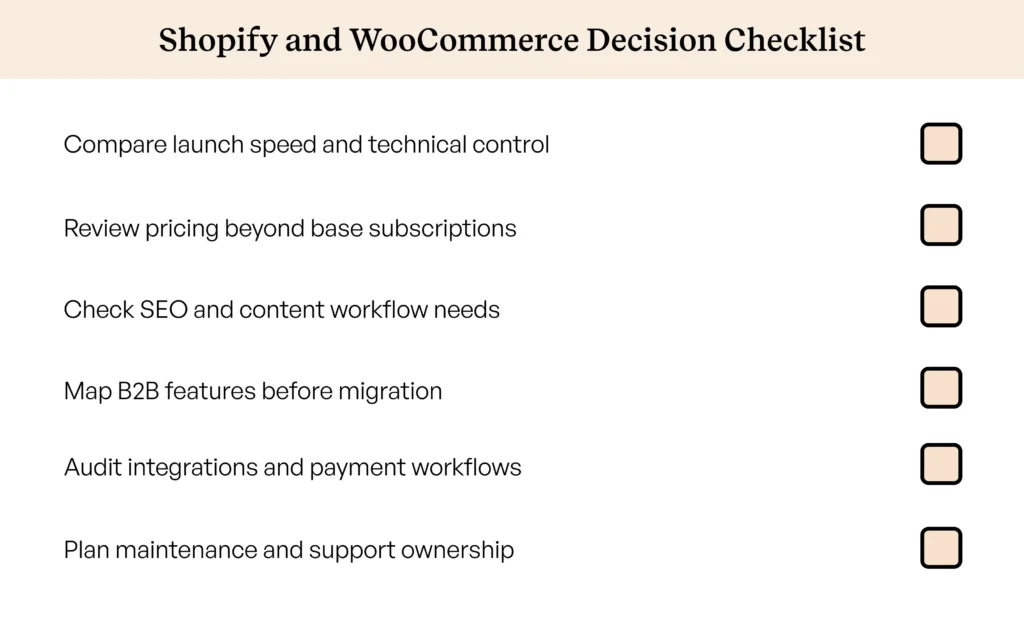
WooCommerce vs Shopify on SEO and content marketing
Both platforms can achieve strong search engine visibility when configured correctly. The difference lies in how much control each gives you over the technical and content layers of SEO.
- URL structure and technical SEO control: WooCommerce provides full control over URL structures, robots.txt, sitemap configuration, canonical tags, and meta descriptions through plugins like Yoast SEO. Shopify enforces a fixed URL structure (/products/, /collections/) that cannot be changed. This limits certain technical optimizations around canonical tags and custom URL paths that SEO teams rely on for competitive verticals.
- Content marketing and blogging: WooCommerce inherits the full WordPress CMS, which remains the most powerful content management and publishing system on the web. For content-driven growth strategies, this is a meaningful structural advantage. Shopify’s blog is functional and has improved with better product pages integration, yet it remains limited compared to WordPress for long-form content, editorial workflows, and product descriptions management at scale.
Both platforms achieve comparable search engine results when properly configured. Content quality, site speed through performance optimization, and backlink profiles matter more than platform choice. Understanding B2B ecommerce best practices around content strategy gives you an edge regardless of which platform you choose.
Here is a quick WooCommerce vs Shopify comparison along key parameters to help you make an informed choice:
| Factor | Shopify | WooCommerce |
| Platform type | Hosted SaaS | Self-hosted open-source |
| Monthly cost | $39 to $2,300-plus | Free core platform with variable stack costs |
| Transaction fees | 0.6% to 2% without Shopify Payments | None from platform |
| Ease of use | Launch in under an hour | Requires WordPress setup and developer skills |
| SEO control | Fixed URLs, limited technical SEO | Full control via Yoast SEO and WordPress |
| Scalability | Automatic, managed by Shopify | Depends on hosting and server optimization |
| B2B features | Native on all plans (limited) | Plugin-dependent (fragmented) |
| Data ownership | Hosted on Shopify servers | Full database control on your server |
Which platform scales better: WooCommerce or Shopify?
WooCommerce vs Shopify scalability comes down to managed infrastructure versus self-managed control. Shopify handles most scaling tasks, while WooCommerce depends on hosting quality and technical setup.
- Shopify: Shopify manages hosting, uptime, checkout performance, and infrastructure scaling for traffic spikes. This helps during promotions, seasonal peaks, social media campaigns, and high-volume launches. Teams can focus on merchandising, marketing campaigns, and conversion work.
- WooCommerce: WooCommerce scaling depends on server capacity, caching, CDN setup, database health, and plugin quality. Large catalogs need careful inventory management and technical planning. A weak hosting setup can slow product pages, checkout, and the overall user experience.
Key distinction: Shopify removes scaling as a concern for store owners who want to focus on selling. WooCommerce gives you more control over performance tuning, at the cost of making server management your responsibility. For teams evaluating how either platform handles B2B catalog complexity, the architecture choice matters even more.
Can Shopify or WooCommerce handle wholesale selling effectively?
Neither Shopify nor WooCommerce was designed with wholesale as the primary use case. Both platforms have added B2B features, yet structural limitations remain across each when wholesale operations scale to serious volume.
Shopify B2B capabilities

Shopify has gradually extended B2B features to plans below Shopify Plus, including company profiles, volume pricing, and basic catalogs. However, catalog caps limit sellers to three active B2B pricing tiers on standard plans.
Offline selling has no native support, and the checkout process disables Google Pay and Apple Pay when B2B mode is active. For Shopify Plus merchants, the native wholesale channel unlocks more capability, yet gaps remain around rep-led selling and ERP connectivity.
If you’re building out a Shopify B2B stack, see our guide to the best wholesale apps for Shopify to understand what the app layer looks like in practice
WooCommerce B2B capabilities
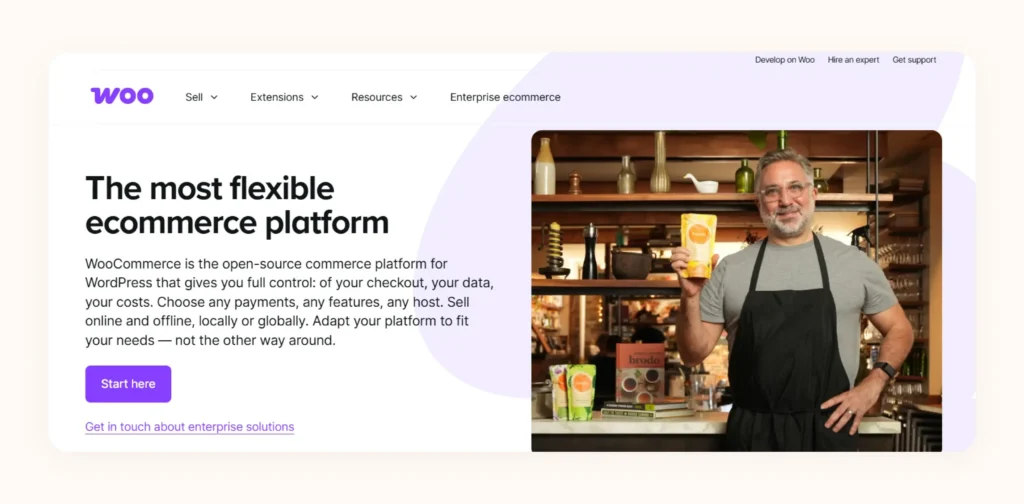
WooCommerce supports B2B through plugins. Features like wholesale pricing, role-based access, minimum order quantities, and registration forms are all available through the WooCommerce plugin ecosystem. Keeping multiple plugins compatible is an ongoing technical burden that increases with every WordPress core update.
The B2B for WooCommerce plugin offers tiered quantity-based pricing and payment methods flexibility, yet it requires significant custom work for international wholesale with complex tax and shipping options logic.
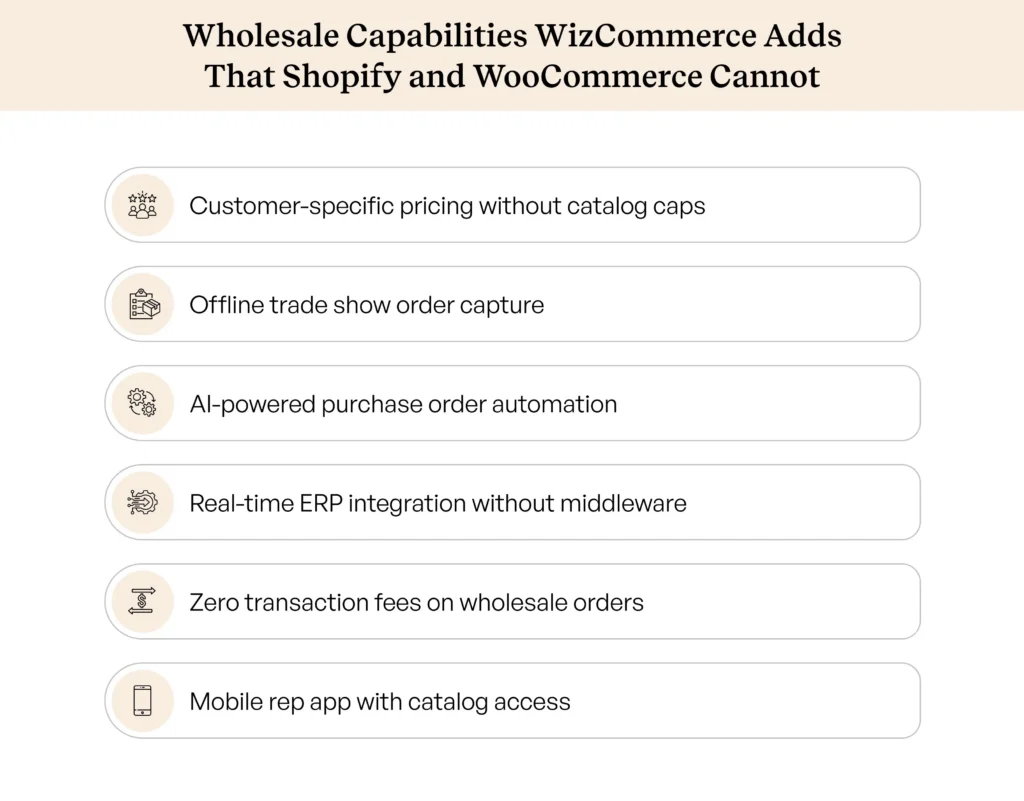
Where both fall short: Neither platform was designed with wholesale as the primary use case. Customer-specific pricing at scale, offline rep-led selling, AI-powered order entry, and real-time ERP integration all require workarounds or third-party middleware on both platforms. For store owners evaluating whether Shopify is genuinely good for wholesale, the answer depends on how much complexity your wholesale channel carries.
If you’re already considering other B2B-native alternatives, our comparison of Zoey vs Shopify covers how purpose-built platforms compare to Shopify’s wholesale channel
When should you choose Shopify over WooCommerce?
Shopify is the stronger choice when speed, simplicity, and managed infrastructure are higher priorities than deep technical control.
- A fast launch timeline matters more than deep customization options over the ecommerce platform stack.
- The team does not have dedicated developers for routine maintenance, updates, and security features management.
- The business sells mainly DTC with a straightforward product catalog and standard fulfillment need including shipping labels.
- A polished checkout process with native payment gateway support and strong conversion optimization is a priority.
For another platform angle, see our BigCommerce vs Shopify comparison.
When should you choose WooCommerce over Shopify?
WooCommerce is the stronger choice when content-driven growth, data ownership, and technical flexibility are central to your strategy.
- Content marketing and blogging through WordPress sit at the center of your sales channels growth strategy.
- Full control over data, server infrastructure, and Google Analytics integration matters to the business.
- The product catalog needs deeper customization options through WordPress-compatible plugins and full themes control.
- Technical expertise is available in-house for setup, updates, and long-term performance optimization maintenance.
Why does WizCommerce fill the gap both platforms leave open for wholesale?
Both Shopify and WooCommerce were designed first for consumer retail. Wholesale operations need customer-specific pricing, offline sales workflows, AI-assisted order entry, ERP sync, and rep-led selling in one connected system. WizCommerce was built for wholesalers, manufacturers, and distributors that need these workflows from day one.
The WooCommerce vs Shopify decision is a DTC platform choice. For wholesale, both platforms require workarounds that a purpose-built system eliminates entirely. Here is what WizCommerce delivers natively.
- WizShop B2B ecommerce portal: WizShop gives buyers a wholesale-native self-serve portal with assigned catalogs, exact pricing, and order history. The shopping experience mirrors what B2B buyers expect from a modern online store, with customer experience quality matching the best practices of consumer platforms.
- WizOrder offline sales rep app: Reps capture orders at trade shows and in the field without internet connectivity, with automatic sync once online. WizOrder closes the offline selling gap that both Shopify and WooCommerce leave entirely unaddressed.
- AI order and quote automation: The AI Order & Quote Entry Assistant reads purchase orders and Request for Quotes (RFQs) from emails, PDFs, spreadsheets, and scans. It extracts order details, validates data against ERP rules, and creates clean sales orders and quotes without manual data entry.
- AI Sales Copilot: The AI Sales Copilot helps reps find customer context, past orders, quotes, inventory details, and next-best actions through conversational queries. This makes sales follow-up faster without switching across several disconnected tools.
- 100-plus pre-built ERP integrations: NetSuite, QuickBooks, Sage, and Microsoft Dynamics sync pricing, inventory management, and order data in real time with no middleware or developer maintenance required.
- No transaction fees: Revenue stays in your business at wholesale order volumes where per-transaction fees create meaningful margin pressure that compounds across every order cycle.
The WooCommerce vs Shopify decision in 2026 comes down to one central question: do you want to own your technical stack, or do you want someone else to manage it for you? Shopify is the faster, simpler path for most DTC businesses. WooCommerce is the more flexible path for content-driven online businesses with technical knowledge and development capacity.
For wholesale operations, neither platform was built with your requirements as the starting point. WizCommerce exists to fill that gap.
Book a demo with WizCommerce to see the difference a purpose-built wholesale system delivers versus adapting a retail platform.
FAQs
Can I migrate from WooCommerce to Shopify without losing SEO rankings?
Yes, with proper planning. Use 301 redirects for every URL, maintain canonical tags and meta descriptions accuracy, and submit an updated sitemap to search engines immediately after migration. Rankings will dip temporarily during the transition period, and recovery depends on redirect accuracy and how quickly search engines recrawl your new Shopify store domain.
Does Shopify charge transaction fees if I use a third-party payment gateway?
Yes. Shopify applies transaction fees of 0.6% to 2% on all sales processed through third-party payment gateways outside Shopify Payments. These fees are applied on top of the gateway’s own credit card processing rates. Using Shopify Payments eliminates the platform transaction fees entirely, making it the most cost-effective payment option for Shopify store operators.
Is WooCommerce really free to use for ecommerce?
The WooCommerce plugin itself is free to install. Hosting usually costs $10 to $350 monthly depending on traffic and setup complexity, premium WordPress themes ($50 to $200), essential features plugins for payment gateways, SEO through Yoast SEO, and security features ($200 to $1,000-plus annually), plus developer time for setup and ongoing maintenance of your WooCommerce store.
Which platform is better for international selling with multiple currencies?
Shopify handles multi-currency through Shopify Markets with native payment options and localized pricing built into the Shopify dashboard. WooCommerce supports multi-currency through WPML ($99 per year) with translated product pages, checkout process, email marketing, and shipping options. Both work, and Shopify requires less configuration, while WooCommerce offers deeper control through community forums and custom configuration options.
Can WooCommerce or Shopify handle 100,000-plus SKU catalogs reliably?
Shopify Plus handles large catalogs with managed infrastructure and automatic scaling with no server intervention needed from store owners. A WooCommerce store with 100,000-plus SKUs requires enterprise-level managed hosting, database optimization, and CDN configuration. Both platforms can handle the volume, with WooCommerce requiring more technical expertise and performance optimization investment to maintain a reliable user experience.