Skip to content



B2B commerce and the online channel are not the same thing. But most wholesale businesses treat them like they are. After all, if you’re selling to other businesses through a website or digital portal, that’s B2B commerce, right?
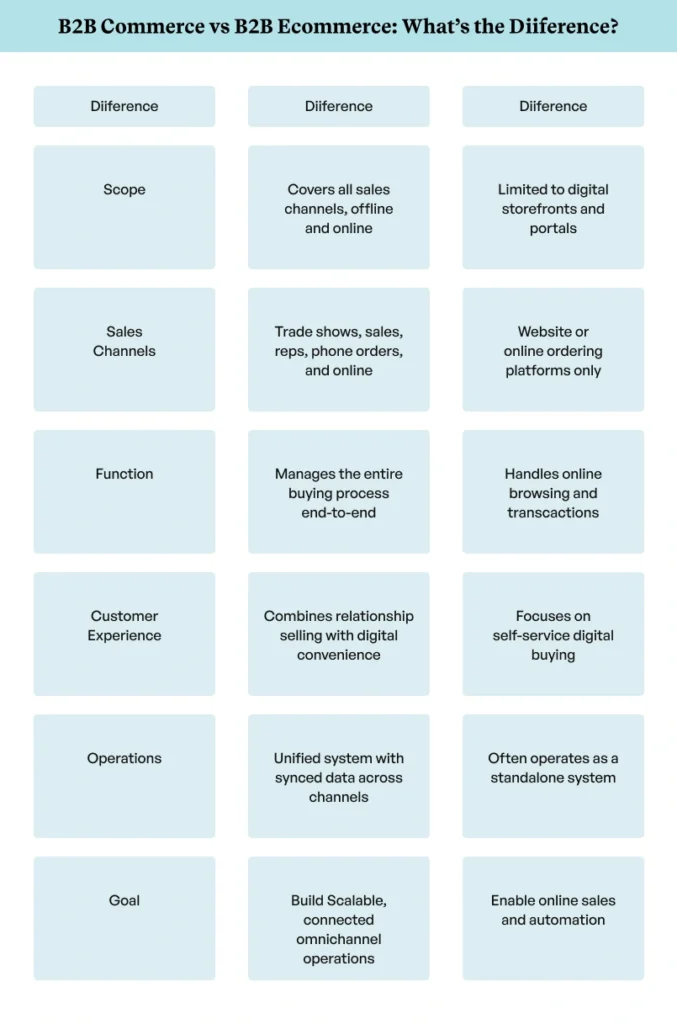
That’s not exactly correct. The online channel is just one part of the equation; it’s the digital storefront. B2B commerce, on the other hand, is the entire engine that powers wholesale trade, every rep visit, trade show, phone order, and digital interaction combined.
If you’re treating online selling as the whole picture, you’re likely missing the bigger opportunity to fully digitize your B2B commerce operations and unlock scale, speed, and smarter selling across every channel.
This blog is your complete guide to understanding B2B commerce: what it is, how it’s evolving, and why it’s critical for modern wholesale businesses to think beyond the screen. Whether you’re a business leader trying to future-proof your operations or a digital strategist rethinking your tech stack, this guide will help you connect the dots and make informed decisions.
What is B2B commerce?
B2B commerce, or business-to-business commerce, is the whole ecosystem of transactions between companies, from manufacturers and wholesalers to distributors, resellers, and retailers. It encompasses every process involved when one business sells to another, across both offline and online channels.
B2B commerce is about long-term relationships, bulk ordering, personalized pricing, and tailored workflows. It doesn’t just happen online; it spans every touchpoint where businesses interact and conduct transactions.
Most people associate B2B commerce with a website or digital storefront, but that’s just one piece of the puzzle. In reality, B2B commerce spans two primary channels, and the medium commonly used in each are:
1. Offline channels
These are traditional, relationship-driven selling methods, incredibly relevant in the B2B space.
- Trade shows and industry events
- Phone orders and fax
- In-person appointments and showroom visits
- Field sales process and rep visits
- Paper-based order forms and invoices
2. Online channels
These digital interfaces allow for scalable, self-service, and automated selling.
- B2b ecommerce websites and portals
- Digital product catalogs
- Customer-specific buyer dashboards
- Automated reordering and online payments
Today’s most successful businesses effectively combine these two channels, offering customers the convenience of digital interactions without sacrificing the personal touch of offline experiences.
How is B2B commerce different from B2C commerce?
While both B2B and B2C (business-to-consumer) involve selling products or services, the way they operate is fundamentally different. B2B commerce involves businesses selling to other businesses, think a manufacturer supplying a retailer, or a wholesaler fulfilling a distributor’s order. B2C commerce, on the other hand, is a business selling directly to an individual consumer.
Here’s a side-by-side breakdown of how B2B and B2C commerce differ across the dimensions that matter most for wholesale businesses:
| Key aspects | B2B commerce | B2C commerce |
| Definition | Transactions between two businesses, e.g., a manufacturer selling to a wholesaler or distributor | Transactions between a business and an individual consumer, e.g., a retailer selling to a shopper |
| Buyer type | Procurement managers, business owners, buying teams, and resellers | Individual consumers making personal purchases |
| Order volume | High-volume, bulk orders with recurring purchase cycles | Smaller, one-off or occasional orders |
| Pricing model | Negotiated, customer-specific pricing, volume discounts, and contract-based terms | Fixed, publicly listed pricing is the same for all buyers |
| Sales cycle | Longer: involves multiple stakeholders, approvals, RFPs, and contract negotiations | Short: typically a single-session purchase decision |
| Customer relationship | Long-term, relationship-driven with ongoing contracts and dedicated account management | Transactional, with a limited ongoing relationship post-purchase |
| Personalization | Deeply personalized, custom catalogs, pricing, and payment terms per buyer | Broad-based, segmented by demographics or purchase behavior |
| Decision-making | Multiple stakeholders involved: finance, procurement, operations, requiring consensus | Individual buyer makes the decision independently |
| Operational complexity | High: custom contracts, manual invoicing, multi-channel order management | Lower: standardized checkout, payment, and fulfillment workflows |
Understanding this distinction is critical for wholesale businesses. B2B commerce demands a completely different operational model, one built around relationship management, flexible pricing, and multi-channel selling rather than a streamlined, high-volume consumer checkout experience.
How B2B commerce has evolved: From offline trade to digital operations
The digitization of B2B commerce is not a recent development. It’s a multi-decade evolution driven by technology, shifting buyer behavior, and the growing operational demands of wholesale businesses. What began as cautious experimentation with digital tools has become the foundation for how modern wholesale operations are run.
According to Gartner, 80% of B2B sales interactions are expected to occur in digital channels by 2025. But that shift isn’t just about moving buyers to a website; it’s about digitizing every part of the buying journey, from how reps take orders in the field to how invoices are generated and reconciled.
A brief timeline of how business-to-business commerce went digital
1. Early adoption (1990s – 2000s)
The internet age sparked the first wave of transformation. A few pioneering B2B companies began experimenting with basic online order forms and static digital catalogs. Most transactions still happened through phone calls, faxes, and in-person rep visits, but the seeds of digital commerce had been planted.
2. Acceleration (2000s – 2010s)
With the rise of Google, online advertising, and SEO, B2B companies found new ways to reach buyers before a rep ever made contact. Email automation and CRM systems began replacing printed brochures and paper-based workflows, and digital catalogs started supplementing trade show binders.
3. Present (2010s – present)
Digital operations are now fully embedded in the B2B commerce strategy. Buyers expect to be able to research, compare, and transact across multiple channels, and sellers who can’t support that lose deals to those who can. The transformation is no longer optional; it’s a baseline requirement for staying competitive.
Key factors driving the shift
1. Evolving buyer expectations
Modern B2B buyers, especially millennials and Gen Z, prefer to research, compare, and place orders digitally. They expect the same level of convenience and transparency in wholesale as they experience in consumer purchasing.
2. The limits of manual operations
Businesses have realized that spreadsheets, paper order forms, and disconnected systems don’t scale. Manual workflows create errors, slow down fulfillment, and put a ceiling on how much a team can handle. Digitizing these processes removes that ceiling.
3. Digitizing every channel, not just the online one
The most important shift in modern B2B commerce is the recognition that digital transformation isn’t about moving everything to a website. It’s about connecting all channels; offline and online, into a single, synchronized operation. That means:
- Trade shows and field sales: Sales reps use AI-powered B2B sales apps for on-the-spot order-taking, replacing paper forms and manual entry.
- Phone orders: Converted into digital records in real-time through integrated order management systems using a B2B order-taking app.
- Showroom visits: Sales reps use tablets and digital catalogs instead of printed binders, with orders synced immediately to back-office systems.
- Paper invoices: Replaced by cloud-based order management and automated billing workflows.
This is what B2B digital commerce actually means: not just moving your business online, but building a connected operation where every channel, in-person, by phone, or through a portal, feeds into the same system, with the same data, in real time.
Read more: How to Choose a Digital Catalog Software for Your Business?
Key challenges in B2B commerce
Managing B2B commerce across multiple channels, customer types, and sales teams is genuinely complex. Unlike B2C, where the buyer journey is relatively predictable, B2B commerce involves custom pricing, long relationships, and transactions that happen across too many touchpoints to manage manually. Here are the five most common operational challenges wholesale businesses face and why they’re harder to solve than they look.
1. Fragmented channels with no single source of truth
Most wholesale businesses run their offline and online sales in parallel, but not together. A rep writes an order at a trade show; it doesn’t appear in the online portal. A buyer reorders through the website; the rep doesn’t know about it. Without a unified system connecting all channels, teams spend more time reconciling data than serving customers.
2. Manual order processing that doesn’t scale
Phone orders, emailed spreadsheets, and handwritten forms are still common in wholesale, and they create compounding problems. Every manual touchpoint is a risk for errors, delays, and duplicated work. As order volume grows, these processes become bottlenecks that limit how fast a business can operate.
3. Pricing complexity across buyers and channels
B2B pricing is rarely simple. A single wholesale business may have dozens of price lists: by customer, by region, by volume, by contract running simultaneously. Managing these manually across a sales team, an online portal, and a mobile order-taking app without a unified system leads to pricing errors, disputes, and lost trust.
4. Inventory and data silos
When the field sales team, the B2B customer portal, and the back-office ERP are not connected in real time, inventory data becomes unreliable. Reps oversell products that are not in stock. Buyers receive outdated pricing. Finance teams reconcile numbers manually because no system holds the complete picture.
5. Inconsistent buyer experience across touchpoints
A buyer who places an order with a rep on Monday and logs into the online portal on Wednesday expects to see the same order history, the same pricing, and the same account data. When those systems don’t talk to each other, the buyer experience breaks down and so does trust. This inconsistency is one of the biggest barriers to building the long-term relationships that B2B commerce depends on.
B2B commerce trends every wholesale business should know
The way B2B businesses buy and sell has evolved more in the last five years than in the previous two decades. New technology, shifting buyer behaviors, and growing pressure to operate efficiently are reshaping the industry. For manufacturers, distributors, and wholesalers, staying competitive means adapting to these trends now, not next year. Here are the key B2B commerce trends reshaping the wholesale landscape:
1. The digitization of offline sales channels
Traditional sales methods haven’t disappeared; they’ve evolved. Sales reps now use mobile apps to streamline order-taking at trade shows, digital catalogs power showroom visits, and phone orders are captured digitally in real time. The shift isn’t from offline to online, it’s from disconnected to unified. Businesses that digitize all their channels, including the offline ones, are pulling ahead.
2. Rising buyer expectations for transparency and self-service
B2B buyers today want to log in, view their full order history, track shipments, and reorder with one click, regardless of how the original order was placed. The days of ‘call us for pricing’ are fading fast. Buyers increasingly expect to manage their accounts online on their own terms. Businesses that can offer that level of visibility and control will earn loyalty; those that can’t will lose it.
3. The shift to omnichannel commerce operations
Running separate systems for your online portal and your field sales operation is no longer sustainable. The trend is toward a single, connected commerce operation where offline and online order data, pricing, and customer history are unified. This isn’t just a technology decision, it’s a strategic one. Businesses that operate this way deliver better buyer experiences and make faster, more accurate internal decisions.
Read more: How to Master Omnichannel Commerce?
4. Procurement teams becoming more digitally demanding
The people buying on behalf of businesses are more digitally sophisticated than ever. They expect structured product data, real-time inventory visibility, automated reorder capabilities, and catalog integrations that work with their own procurement systems. Wholesale businesses that can’t meet these expectations will find themselves removed from vendor shortlists in favor of those that can.
5. Real-time data and ERP integration as a baseline requirement
Disconnected tools and delayed data slow everything down. Wholesale businesses are increasingly recognizing that real-time integration between their order management, ERP, CRM, and inventory systems is not a premium feature; it’s table stakes. Without it, operations are reactive rather than proactive, and scaling becomes a manual effort rather than a structural advantage.
Why is WizCommerce the Best B2B Commerce Platform for Modern Wholesalers?
In a crowded landscape of B2B commerce platforms, WizCommerce stands out as a proper all-in-one solution, built from the ground up for how wholesale businesses sell today. WizCommerce offers a unified B2B commerce platform that combines two powerful tools in one ecosystem:
- WizShop: An AI-powered digital commerce platform for self-service ordering
- WizOrder: A mobile-first AI-powered B2B order-taking app for sales reps, trade shows, and in-person visits
Together, these give wholesalers a seamless, scalable, and fully connected B2B commerce solution, eliminating the need for plugins, middleware, or third-party tools.
Whether your buyer orders through a digital portal, calls a representative, or places an order at a showroom, WizCommerce captures all transactions in one place and synchronizes them in real time across your systems.
Here’s how WizCommerce combines all the B2B commerce features a modern wholesale business needs to succeed.
1. Omnichannel sales – managed in one place
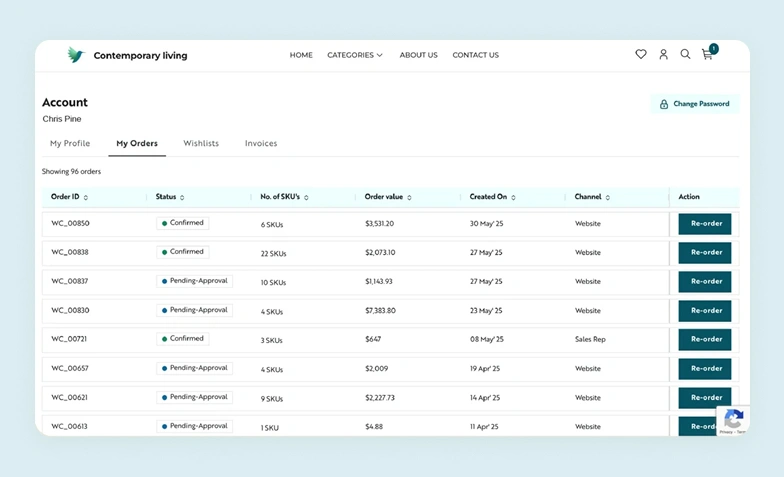
WizCommerce connects all your B2B sales channels: trade shows, field sales, digital ordering, and phone orders into a single, unified experience. While the digital commerce platform and the order-taking app operate as separate tools, they communicate in real time, giving your team an accurate 360° view of customer activity, pricing, and order history. This coordinated system reduces friction and simplifies order management across every touchpoint.
2. AI-powered selling tools
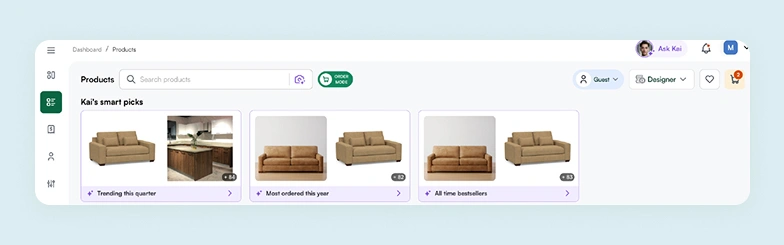
WizAI, WizCommerce’s AI selling tool, uses advanced machine learning to deliver personalized product recommendations, reorder predictions, and guided selling for your sales team. The built-in AI Copilot helps reps know what to pitch next, while lead scoring highlights the most promising buyers. The platform also suggests alternative items for out-of-stock SKUs, supports AI-powered image search, and automates upsell and cross-sell paths, helping buyers and sellers make faster, more informed decisions.
3. Customer-specific pricing and catalogs
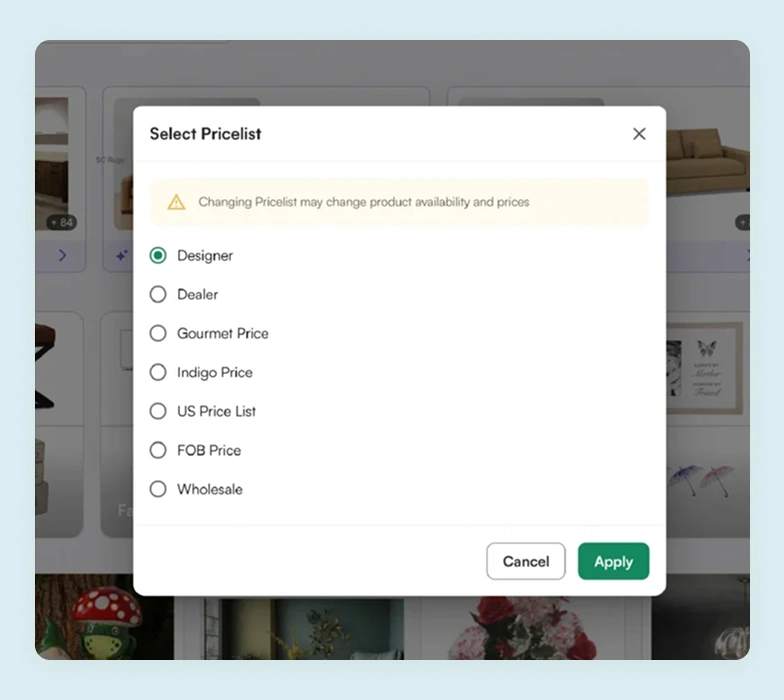
WizCommerce makes it straightforward to assign custom catalogs, price lists, and payment terms to individual buyers or buyer groups. Whether you’re managing thousands of SKUs or selling to diverse customer segments, the platform maintains pricing accuracy across every channel, ensuring your team delivers the right deal to the right buyer, every time.
4. Real-time ERP and inventory sync

WizCommerce offers native integrations with leading ERP systems, including QuickBooks, NetSuite, Sage, and Microsoft Dynamics 365 Business Central. Orders, pricing, stock availability, and customer data sync in real-time across systems, eliminating manual updates, preventing overselling, and keeping your financials and operations fully aligned.
5. Mobile-first order-taking for reps
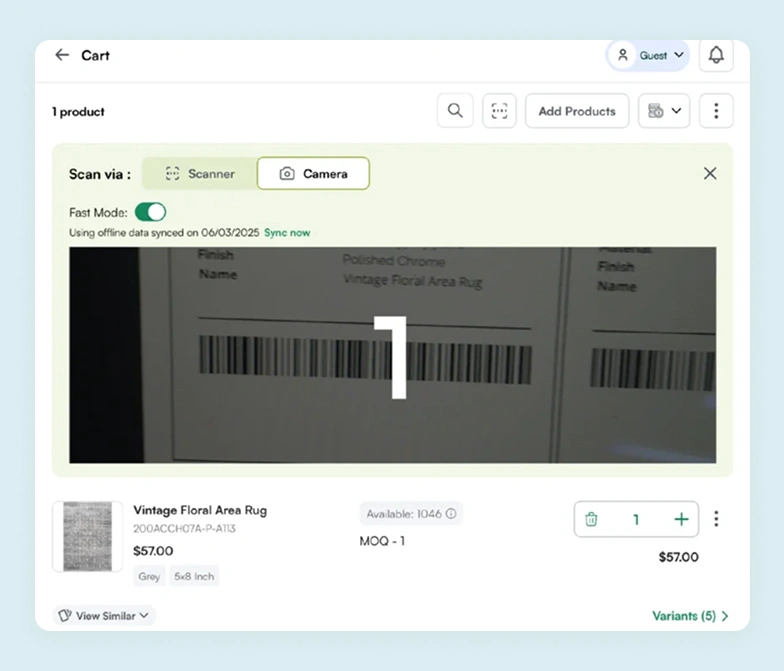
WizOrder is designed for both Android and iOS and built for high-volume wholesale environments, trade shows, road sales, and showroom visits alike. Reps can create multiple carts per customer, add multiple shipping addresses, and work offline with automatic sync once reconnected. Real-time product information, inventory data, and buyer-specific pricing are always in the rep’s hands, making order-writing fast, flexible, and error-free.
6. Self-service digital commerce portal
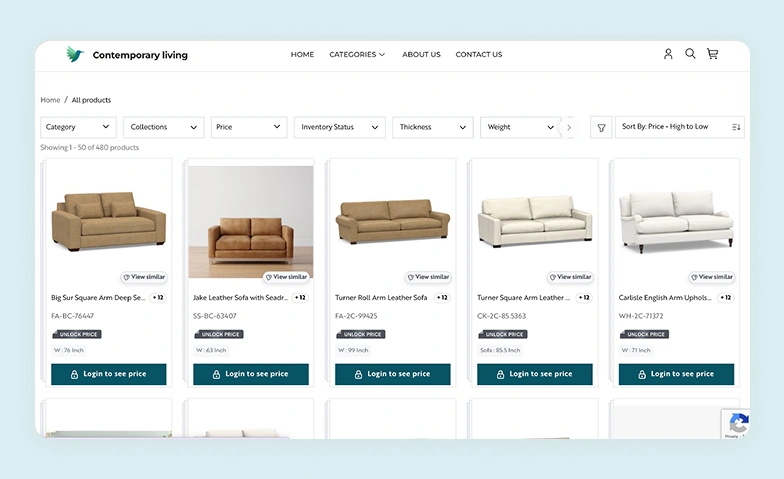
WizCommerce’s digital commerce portal empowers buyers to browse, order, and manage everything on their own terms. It supports bulk ordering, one-click reorders, saved carts, payments against invoices, and advanced wholesale controls such as customer approval flows and the ability to showcase products without displaying prices. This gives you complete control over the buyer journey while meeting modern buyer expectations for speed and convenience.
7. Data-driven insights and automation
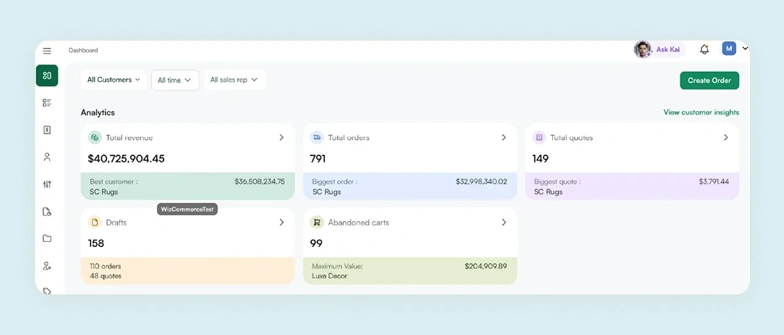
Every interaction on WizCommerce generates actionable data from orders placed to buyer browsing behavior. Dashboards let you track top customers, fast-moving SKUs, inactive buyers, and your best-performing sales reps. Use that intelligence to automate follow-ups, tailor promotions, and sharpen your inventory and sales strategy without needing a large ops team to run it.
Real success story: How Antique Curiosities unified their B2B commerce with WizCommerce
Antique Curiosities, a wholesale art company, relied on outdated tools such as Repzio and WooCommerce, and faced the following problems:
Problems
- The order-writing app (Repzio) and the digital commerce platform (WooCommerce) didn’t communicate with each other.
- Missing essential B2B workflows, like the ability to showcase products without showing pricing.
- Orders placed via sales reps weren’t visible on the website, causing confusion and duplication.
- Couldn’t handle product complexity, customizations, and price lists across buyer segments.
WizCommerce solution
Antique Curiosities adopted a proper B2B commerce approach, not just a digital one. They optimized both their offline and online sales channels by implementing WizOrder, a B2B order-taking app, and WizShop, a digital commerce platform.
Both platforms are designed to communicate with each other in real-time, ensuring that orders placed through sales representatives are instantly visible on the digital commerce portal and vice versa. This created a unified 360° solution that streamlined operations, eliminated duplicate work, and delivered a seamless experience for both customers and internal teams.
Results
- 20% revenue growth
- 90% fewer website complaints
- 10+ hours saved every week
The future of B2B digital commerce is unified, digital & intelligent
B2B commerce is no longer just about taking orders. It’s about building connected, efficient, and scalable systems that power long-term business growth.
As buyer expectations shift and sales channels evolve, wholesale businesses must adopt a modern B2B commerce approach that integrates AI, automation, and omnichannel selling to deliver a seamless experience.
Whether it’s simplifying your trade show order flow, syncing data with your ERP, or empowering buyers with a personalized digital commerce portal, WizCommerce gives you the tools to digitize every part of your B2B sales engine.
The question isn’t whether you should modernize, it’s how quickly you can get started.
Book a demo with WizCommerce to unify your entire B2B commerce operation from field sales to online ordering in one platform.
FAQs
What does B2B commerce mean?
B2B commerce means business-to-business commerce, the complete ecosystem of transactions where one business sells to another across both offline and online channels. It covers larger order volumes, longer sales cycles, negotiated pricing, and long-term relationships spanning a range of industries, from raw materials to office furniture, covering the sale of goods exchanged between manufacturers, distributors, and retailers.
What are the key features of a B2B commerce platform?
The key features of a B2B commerce platform include customer-specific pricing, bulk ordering, real-time inventory visibility, ERP integration, and omnichannel order management. Strong platforms also support data analytics, payment processing, and self-service buyer portals. WizCommerce delivers all of these capabilities in one unified system, built specifically for wholesalers managing sales across different channels simultaneously.
What is the difference between B2B and B2C commerce?
The difference between B2B and B2C commerce lies in the target audience, complexity, and relationship depth. B2B commerce involves business buyers placing large, recurring orders with negotiated pricing and longer sales cycles. B2C commerce targets individual consumers with fixed pricing and shorter purchasing decisions. B2B digital commerce demands far greater operational flexibility and personalization than standard consumer ecommerce platforms typically provide.
How does B2B commerce impact sales and revenue?
B2B commerce impacts sales and revenue by enabling businesses to attract new customers and reach potential buyers across multiple channels, reduce manual order processing errors, and support larger order volumes efficiently. Digitizing offline and online sales channels together improves customer satisfaction and drives repeat purchasing. Businesses using unified platforms like WizCommerce report measurable revenue growth by eliminating operational bottlenecks that previously limited their scaling capacity.
What trends are shaping B2B commerce in 2026?
The trends shaping B2B commerce in 2026 include the digitization of offline sales channels, rising buyer expectations for self-service and transparency, omnichannel operations, and generative AI powering smarter selling tools. In recent years, procurement teams have become more digitally demanding, expecting real-time inventory data, automated reordering, and seamless integration between electronic commerce platforms and their own internal systems.
Why is B2B commerce important for businesses?
B2B commerce is important for businesses because it powers the entire wholesale trade engine, from manufacturers to distributors to retailers. It supports long-term customer relationship management, enables businesses of all sizes to scale efficiently, and generates consistent revenue through repeat purchases. Without a structured B2B commerce approach, businesses rely on disconnected manual processes that limit growth and damage customer needs fulfillment.
What challenges do businesses face in B2B commerce?
The challenges businesses face in B2B commerce include fragmented sales channels, manual order processing that does not scale, complex pricing across different channels, inventory data silos, and inconsistent buyer experiences across touchpoints. These issues slow fulfillment, create errors, and erode customer satisfaction. WizCommerce addresses these challenges directly by unifying offline and online operations into one synchronized, real-time commerce platform.