Skip to content



The pricing of a typical B2B ecommerce platform is just the tip of an iceberg. While license fees are easy to see, most cost drivers lie hidden beneath the surface.
These cost drivers stem from integrations, pricing logic, approval workflows, and ongoing operations. And emerge only after real customers, contracts, and internal systems are involved.
This is why B2B commerce platform pricing feels hard to compare. Teams focus on entry costs, only to uncover higher investment later as operational and technical complexity increases.
What does B2B ecommerce pricing mean, and why is it important?
B2B ecommerce pricing defines how businesses set, manage, and enforce prices for online B2B transactions. It includes contract-based rates, volume discounts, customer-specific pricing, and approval rules, all executed through an ecommerce platform rather than manual negotiation.
Today, buyers are 57%-70% thorough in their research before contacting sales. If your platform pricing is unclear or uncompetitive at that stage, the deal is often lost before the first conversation even begins.
The pricing of your best B2B ecommerce platforms directly impacts your profit margins through transaction fees, subscription costs, and integration expenses. These costs compound across every sale. If your platform’s pricing structure is unclear or inflexible, you lose deals during the research phase, before conversations even begin.
Clear price points and a defined price range helps
- Validate fit against competitor pricing
- Align price points with customer segments
- Plan costs as the business scales
- Speed up approvals and ROI decisions
- Select the right ecommerce platform with confidence
- Avoid budget uncertainty and margin risk
- Understand the impact on inventory management and customer satisfaction
Without pricing clarity, teams struggle to justify spend, forecast costs, or evaluate the impact on inventory management and customer satisfaction. As a result, selecting a B2B ecommerce model or platform has become a structural decision. It influences margins, internal efficiency, and customer retention over several years.
Suggested reading: 15 Best B2B Ecommerce Strategies for Business Growth in 2026
From initial setup to long-term maintenance, B2B commerce platform costs vary based on several factors, which we’ll explore next.
What are the different types of B2B commerce platform pricing models?
B2B commerce platform pricing is not just about what you pay today. It determines how costs evolve as order volume increases, workflows become more complex, and integrations deepen.
The right product pricing model for your business depends on your industry, cost structure and customer base. The pricing model a vendor uses often has a bigger impact on long-term B2B ecommerce platform cost than the initial implementation itself.
Here’s an overview of the types of B2B pricing models and how they work:
| B2B commerce platform pricing model | How it works | Cost risk associated | Best suited for |
| SaaS subscription | Recurring fee based on users, orders, or features | Subscription creep as usage grows | Early-stage or mid-market teams |
| Flat licensing | Fixed platform fee regardless of volume | Higher upfront commitment | High-volume, margin-sensitive businesses |
| GMV/usage-based | Pricing tied to Gross Merchandise Value or activity | Margin erosion at scale | Fast-growing, revenue-first teams |
| Feature-tiered | Capabilities unlocked across predefined plans | Sharp jumps between tiers | Businesses with phased requirements |
| Custom/enterprise | Tailored based on complexity and scale | Variable and negotiated | Large, complex B2B operations |
Let’s get into the detailed analysis of each B2B pricing type.
1. SaaS subscription
SaaS platforms charge a recurring monthly or annual fee, typically based on user count, order volume, or enabled capabilities.
A business may begin with a stable subscription covering core users and features, then see costs rise gradually as more teams come onto the platform or additional functionality is activated.
2. Flat licensing vs gross merchandise value (GMV) or usage-based
With flat licensing, businesses pay a fixed fee regardless of sales volume. GMV-based pricing ties platform cost to the total value of transactions processed, while usage-based models may factor in order count or API activity.
GMV pricing aligns cost with growth, but can significantly increase B2B commerce pricing at scale. Flat licensing provides cost stability, often at the expense of higher upfront investment.
3. Feature-tiered
Feature-tiered models bundle functionality into predefined plans. Lower tiers typically support basic commerce needs, while higher tiers unlock customer-specific pricing, automation, analytics, and system integrations.
This approach lowers entry barriers, but costs rise quickly as businesses move into more advanced operations.
4. Custom and enterprise structures
Enterprise pricing is tailored rather than published. Costs are shaped by pricing complexity, transaction volume, integration depth, security requirements, and support levels.
At this level, B2B commerce platform pricing reflects the platform’s role as operational infrastructure rather than a simple sales channel.
B2B commerce platforms use very different pricing strategies, and the model a vendor follows often matters more than the headline cost. Here’s an example of leading platforms based on their pricing structure and the types of businesses they best serve.
| Platform | Pricing strategy | Best for |
| WizCommerce | Subscription-based pricing that scales with users and transaction volume. | Manufacturers and wholesalers need omnichannel B2B with field sales and self-service ecommerce. |
| Shopify Plus | Subscription pricing combined with Gross Merchandise Value–based fees. | Businesses seeking a fast B2B launch with low IT overhead and app-based extensibility. |
| BigCommerce (B2B Edition) | Quote-based enterprise subscription pricing. | Companies running B2B and B2C on a single platform with controlled costs. |
| Adobe Commerce | License-based pricing tied to Gross Merchandise Value and customization scope. | Large enterprises require deep customization and complex workflows. |
| Salesforce Commerce Cloud | Revenue-linked pricing based on Gross Merchandise Value or per-order models. | Enterprises are already invested in the Salesforce ecosystem. |
Key factors influencing B2B commerce platform pricing
B2B commerce platform pricing in 2026 is shaped less by feature lists and more by how platforms respond to shifting buyer behaviour, automation needs, and regulatory pressure. Five forces are redefining both platform expectations and cost structures.
Conventional cost drivers
These factors have always influenced B2B ecommerce platform pricing and remain foundational.
1.Platform features and scalability
Platforms offering advanced features like bulk order processing, real-time inventory management, and customer-specific pricing typically come at a higher cost. The more scalable the platform, the more businesses can expect to invest upfront.
2. Customization and integrations
The level of customization required to meet specific business needs will also drive up costs. Seamless integration with existing systems (like ERP, CRM, or inventory management software) often requires additional investment.
3. Security and compliance
Ensuring that your platform meets industry-specific security standards and compliance regulations may add to the overall cost. Features like data encryption, fraud detection, and regular security updates are essential for protecting sensitive information.
4. Ongoing maintenance and support
After the initial setup, ongoing costs like software updates, technical support, and platform maintenance will continue to impact the overall investment.
Modern cost drivers
Alongside these fundamentals, newer capabilities are redefining what drives cost and complexity.
- Personalization at scale has become the baseline. Leading platforms now deliver a “store of one” for each buyer, showing only contract-approved products, real-time negotiated prices, and industry-relevant content. Such personalization demands advanced pricing logic, customer data models, and deep system integration, making it a material cost driver.
- Pragmatic AI and generative AI have moved into everyday operations. In fact, AI is the first tech wave that directly drives revenue, margin, and scale for wholesalers. AI’s capabilities reduce manual effort but increase platform complexity and overall B2B ecommerce platform cost.
- AI personal shoppers are changing how buying happens. As buyers rely on AI agents to configure orders and negotiate, platforms must support AI-to-AI interaction with machine-readable pricing and rules.
- Autonomous and zero-click commerce is shifting ordering from reactive to predictive. API-driven replenishment and AI-led forecasting reduce inventory waste but require real-time, automation-ready architectures.
- Finally, frictionless payments under tightening compliance are raising the bar. Supporting modern payment models while meeting expanding regulatory requirements adds ongoing development and governance costs, making payments a growing contributor to B2B commerce platform pricing.
Core components of a typical B2B commerce platform pricing models
| Cost area | Typical cost type | Key cost trigger | Impact on your business |
| Platform licensing & subscription | Recurring |
|
Sets baseline spend; costs rise as usage and revenue grow |
| Implementation & integrations | One-time (high) |
|
Largest upfront cost; delays value if underestimated |
| Commerce design & custom development | One-time/variable |
|
Drives user adoption and operational efficiency |
| Hosting & infrastructure | Recurring/variable |
|
Becomes significant at scale; affects performance and reliability |
| Data migration & real-time sync | One-time/risk-heavy |
|
Impacts data integrity and platform stability long-term |
| Ongoing maintenance & support | Recurring |
|
Determines total cost of ownership over the platform lifecycle |
B2B commerce platform pricing is best understood as a stack of interdependent investments, rather than a single line item. While licensing is often the most visible expense, it typically represents only part of the total cost of ownership.
Here’s a breakdown of the six main components of B2B ecommerce platform pricing, where the budget is actually allocated and why those costs scale differently across businesses.
1. Platform licensing and subscription
The licensing or subscription fees form the core of B2B commerce platform pricing. These fees can vary widely depending on whether you’re opting for a cloud-based solution or an on-premise platform.
SaaS models usually charge monthly or annual fees based on factors like the number of users or transactions, while on-premise solutions may involve a one-time purchase plus ongoing costs for updates.
2. Add-ons, plug-ins and extensions
Most B2B commerce platforms offer a core set of features, but you’ll likely need additional tools like payment gateways, customer relationship management (CRM) integration, and marketing automation. These add-ons or plug-ins often come at an extra cost, either as one-time purchases or recurring subscription fees, depending on the service provider.
3. Website design and development
Design and development costs reflect how closely the platform must be tailored to actual B2B buying behaviour. Unlike B2C commerce, B2B transactions involve non-linear journeys, negotiated pricing, approvals, and multiple user roles.
Custom dashboards, role-based permissions, approval chains, and contract-aware pricing experiences require additional design and engineering effort. While these costs are typically lower than licensing or integration work, they directly affect adoption and efficiency.
4. Hosting and infrastructure
Infrastructure costs are driven by traffic volume, performance expectations, geographic reach, and uptime requirements. Cloud-based hosting offers flexibility and scalability, but introduces variable costs tied to compute usage, storage, and bandwidth.
As order volumes increase or global users are added, infrastructure spend becomes more visible. Businesses operating in regulated or mission-critical environments may also require redundancy, disaster recovery, and strict uptime guarantees, all of which raise hosting costs. At scale, infrastructure becomes a strategic component of B2B commerce pricing, not just a technical detail.
5. Data migration and real-time synchronization
Data migration is one of the most underestimated cost areas in B2B ecommerce. Migrating customer records, product catalogues, pricing rules, and historical orders from legacy systems is time-intensive and highly sensitive to data quality.
Costs increase with data volume, inconsistencies, and the number of source systems involved. Real-time synchronization adds another layer of complexity, particularly when inventory levels, pricing, and order status must remain accurate across ERP, CRM, and commerce systems. Poorly executed migration can undermine trust in the platform and create long-term operational risk.
6. Ongoing maintenance and support
Once your platform is up and running, you’ll need to budget for ongoing maintenance. Post-launch costs are a permanent part of B2B commerce platform pricing, covering:
- Software updates and security patches
- Technical support and troubleshooting
- Performance monitoring and compliance changes
Most vendors offer tiered support models. Basic support may be sufficient early on, but as the platform becomes business-critical, higher SLAs, faster response times, and managed services often become necessary. These recurring costs significantly influence total cost of ownership over the platform’s lifecycle and should be planned from the outset, not treated as optional extras.
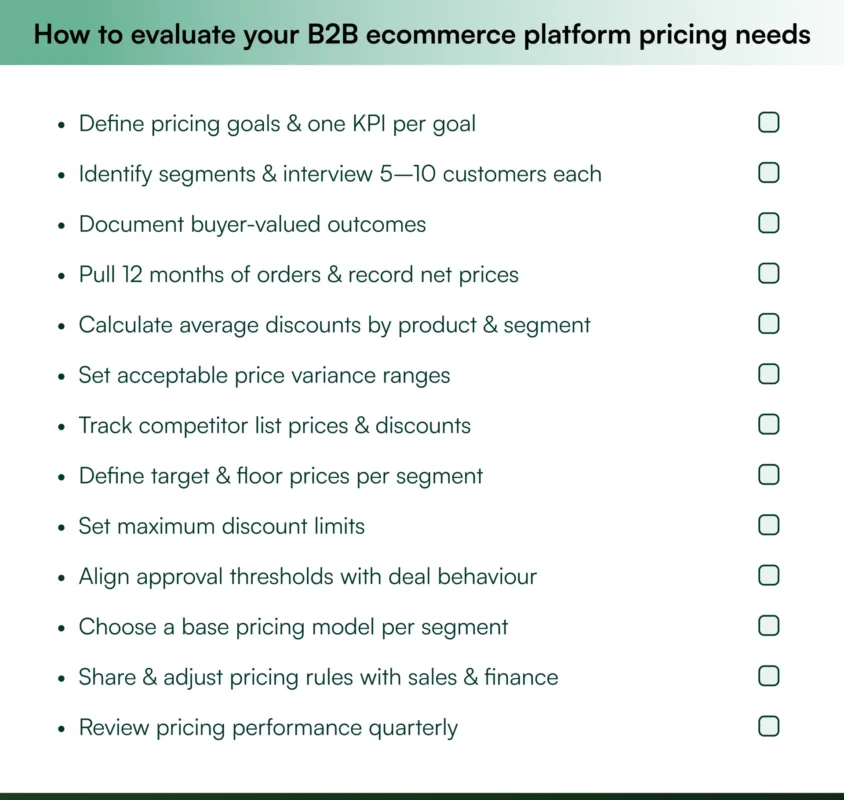
How to choose a B2B ecommerce platform pricing strategy (+ evaluation checklist)
Businesses use pricing strategies to execute their pricing models. In B2B, sales cycles are complex and revenue stakes are high. You need to understand your market deeply.
Step 1. Start with clear business goals
Focus on a few clear objectives. Maybe you want to grow revenue in a key product line. Or increase win rates. Or protect margins on high-value deals.
Pick two or three KPIs for the next couple quarters. Build them into your systems so they enforce themselves automatically.
Step 2. Ground your B2B commerce pricing in real data
B2B pricing works best when you combine three inputs: what buyers tell you, what they actually buy, and what competitors are doing.
Talk to customers about outcomes they care about. Look at what people really paid in past deals. Track competitor pricing.
This approach keeps quotes consistent across your team. It also makes price changes easier to defend.
Here’s what you can do:
- Interview 5 to 10 customers per segment. Ask what outcomes matter to them. Find out what prices feel too low, fair, or too high.
- Pull a year of order data. Record actual paid prices after discounts for each product and segment. Identify the typical range.
- Track your three closest competitors. Note their list prices, standard discounts, and terms.
When you’re done, create a simple reference sheet for each product and segment. Include target price, floor price, allowed discounts, and when to review. Share it with your team before major pricing decisions.
Step 3. Account for deal complexity and approval friction
B2B deals rarely move in straight lines. Multi-stakeholder approvals, procurement reviews, and budget cycles all slow things down.
Map how long approvals actually take at different price thresholds. If deals under $50K close in two weeks but deals over $50K take six weeks, your pricing tiers need to reflect that reality. Buyers will push you just under thresholds to avoid internal red tape.
Also track discount approval patterns. If your sales team needs manager sign-off for discounts over 15%, but most competitive deals require 18-22% off, you’re creating unnecessary bottlenecks that cost you deals.
Step 4. Separate the list price from the realized price
What you publish and what customers pay are rarely the same number. The gap between them reveals how your pricing actually works.
Calculate your average discount rate by segment and product line over the past year. If you’re consistently discounting 25% off list price, your list price is fiction. Either lower your published price or tighten discount authority.
Also, look at price variance within segments. If similar customers are paying wildly different amounts for the same product, you don’t have a pricing strategy—you have negotiation chaos. Narrow that variance by setting clearer guardrails on when and why discounts apply.
Step 5. Make it operational
A pricing strategy guides how you price products or services. It’s based on market demand, customer behaviour, and competition. The goal is to understand what buyers will actually pay.
Choose a base model for each product or segment. Define when exceptions make sense. Document everything so your sales team and checkout system stay consistent.
Hidden B2B ecommerce platform costs and budget traps to avoid
Even well-planned projects can exceed budget when hidden costs surface after implementation. These traps are common across B2B commerce initiatives and directly affect long-term B2B commerce pricing.
1. Underestimated integration effort
Initial estimates often assume clean data and standard connectors. In practice:
- Mismatched schemas: Your ERP uses product codes differently than your commerce platform expects
- Custom pricing logic: Volume breaks, contract pricing, and customer-specific discounts require custom middleware
- Real-time synchronization: Inventory accuracy across 3+ systems demands continuous data orchestration, not batch updates
Pro tip: Integration typically costs 2-3x initial estimates when legacy systems are involved.
2. Feature dependency creep
Many platforms advertise modular pricing, but essential B2B capabilities are frequently locked behind higher tiers:
- Customer-specific pricing and catalogues
- Multi-level approval workflows
- Quote-to-order automation
- API rate limits that actually support your transaction volume
Pro tip: What vendors present as “optional” often becomes mandatory once you’re mid-implementation. Ask upfront what tier companies like yours actually need to operate.
3. Change management and adoption costs
Training internal teams, adjusting workflows, and migrating sales processes are rarely included in platform pricing. Budget blindspots include:
- Sales team onboarding and resistance to new quoting tools
- Customer portal adoption campaigns
- Process documentation and internal knowledge transfer
Pro tip: Poor adoption increases operational friction and reduces ROI.
4. Ongoing compliance and security updates
Regulatory changes, security patches, and accessibility requirements introduce recurring costs that are often excluded from initial proposals:
- GDPR, CCPA, and regional data privacy laws
- PCI-DSS compliance for payment processing
- WCAG accessibility standards for public-facing portals
Pro tip: It is important to understand that these aren’t one-time fixes. They’re continuous obligations that require developer time and audits.
5. Support escalation after launch
Basic support may be sufficient early on, but growing transaction volumes and system dependencies often require higher SLAs. Here’s how support needs typically escalate:
- Year 1: Basic email support works fine when the platform handles lower order volumes
- Year 2: As the platform processes 60% of orders, you need 4-hour response times to avoid bottlenecks
- Year 3: When downtime costs $50K per hour, managed services with guaranteed uptime become non-negotiable
Pro tip: This progression can double your annual support costs within 24 months.
Beyond the major traps above, here are other hidden B2B commerce platform pricing aspects you must consider:
- Payment gateway fees: Transaction fees, monthly minimums, and PCI compliance charges that scale with volume
- Third-party app subscriptions: Tax automation, shipping calculators, review platforms, and analytics tools add up quickly
- Custom reporting and analytics: Standard dashboards rarely cover B2B needs like customer-specific margin analysis or sales rep performance
- Data storage overages: Product images, documents, customer files, and order history can exceed base storage limits
- API call limits: High-frequency inventory checks or price updates may trigger overage charges on usage-based APIs
- Mobile app development: If your platform doesn’t include native mobile ordering, custom app development is a separate cost
- Localization and multi-currency: Translation services, regional tax rules, and currency conversion fees for international expansion
Practical budgeting tips for B2B commerce platform pricing
Building a competitive B2B ecommerce platform requires investment, but cost overruns are usually a planning issue, not a technology one.
A disciplined approach to budgeting helps control spend without limiting growth.
1. Clarify requirements early
Define the exact B2B capabilities you need, the customer segments you serve, and the sales channels you must support. Clear scoping reduces rework, change requests, and unnecessary customization later.
2. Evaluate pricing structures, not just prices
Vendors use very different pricing models. Assess how each model behaves as usage increases and choose options that remain economical as operations scale.
3. Plan for growth, not just launch
Account for how costs will evolve as order volumes rise, workflows become more complex, and new markets are added.
4. Separate integration cost from licence cost
Request itemised estimates for ERP, CRM, OMS, and inventory integrations. Integration complexity often exceeds platform licensing and is a frequent source of budget overruns.
5. Budget for post-launch ownership
Include ongoing costs for support SLAs, security updates, compliance changes, and performance optimization. These recurring expenses materially affect total cost of ownership but are often excluded from initial budgets.
Conclusion
B2B teams often lose cost control when contract pricing, approvals, and ERP dependencies become operational. Pricing rules evolve, buyers scale, and order frequency rises—without tolerance for cost spikes.
WizCommerce addresses this by incorporating customer-specific pricing, contract enforcement, buyer-level catalogues, sales-assisted ordering, and approvals into the core platform. These capabilities do not require add-ons or tier upgrades.
ERP integration is native, keeping pricing, inventory, and orders aligned in real time and reducing middleware overhead.
Platform costs remain constant with increasing order volume or buyer activity, allowing for a predictable total cost of ownership as complexity grows.
Book a demo with WizCommerce to evaluate fit against your B2B pricing model. Transform your commerce strategy today!
Frequently Asked Questions (FAQs)
What is the B2B pricing?
B2B pricing is the method businesses use to price products for other businesses. It includes negotiated rates, volume-based discounts, contract pricing, and customer-specific rules, rather than fixed public prices.
How much does a B2B website cost?
A B2B ecommerce platform cost typically ranges from $10,000 to over $100,000. The final cost depends on platform licensing, integrations, custom workflows, security requirements, and ongoing maintenance.
What are the 4 types of pricing?
The four main B2B commerce pricing types are cost-plus pricing, value-based pricing, competitive pricing, and dynamic pricing. Each model reflects different margins, buyer relationships, and market conditions.
How to calculate B2B price?
To calculate a B2B price, add operating margin to product cost, then adjust for volume, contract terms, and customer value. B2B commerce pricing is usually designed for long-term relationships, not one-off sales.
Also read: How to Price Handmade Items For Wholesale: A Complete Guide
What is the difference between B2B and B2C pricing?
The difference between B2B and B2C pricing is the structure. B2B pricing is negotiated and volume-based, while B2C pricing is fixed and public. B2B commerce pricing focuses on contracts and lifetime value.
What is B2B marketplace pricing?
B2B marketplace pricing defines how sellers price products on multi-vendor platforms. It often includes subscriptions, commissions per order, or hybrid models, affecting the overall B2B ecommerce platform cost for sellers.
What are the 5 pricing approaches or strategies with examples?
The five common pricing strategies are cost-plus, value-based, tiered, contract-based, and dynamic pricing. For example, tiered pricing lowers per-unit cost as order volume increases.
What are the three types of B2B purchases?
The three types of purchases are new-task purchases, straight rebuys, and modified rebuys. Each impacts approval cycles, buying risk, and how ecommerce pricing is evaluated.
Is there a free trial available for leading B2B commerce platforms?
Most leading B2B commerce platforms do not offer full free trials. SaaS vendors may provide limited trials or sandbox access, while enterprise platforms usually offer guided demos or proofs-of-concept instead of trial environments.
Always confirm trial terms with the vendor—what features are included, how long it lasts, and whether integrations are supported during the trial—so you can evaluate whether the platform matches your operational needs.