Skip to content




Many wholesale websites are simply PDF catalogs stitched together with email-based ordering, along with “call us for pricing” pages. Interestingly, these businesses didn’t intentionally design their websites this way. They simply followed their competitors. For a long time, this approach felt acceptable because wholesale buying itself was relationship-driven. Sales reps filled the gaps. Buyers adjusted. Orders moved.
But expectations have changed today. Today’s buyers want clarity before they reach out. They expect intuitiveness across every interaction. In other words, building a wholesale website now requires a different mindset: one that treats the website not as a list of products, but as an extension of the daily wholesale operations. In this guide, we will guide you on how to build a wholesale website for maximum business impact.

What is a wholesale website?
A wholesale website is not just an online store with a login wall. It is a digital representation of how B2B commerce actually works and an ecosystem that supports relationship-driven selling at scale. Unlike standard ecommerce websites, which are designed for anonymous browsing and fixed pricing, wholesale websites operate on context.
What a buyer sees depends on who they are. A distributor may view negotiated price lists, minimum order quantities, and credit terms that are entirely different from another account. Similarly, ordering workflows of a wholesale website are designed for bulk purchasing, repeat orders, approvals, and reordering.
What are the key components of a wholesale website?
The following components form the backbone of a high-impact wholesale website:
- Buyer-specific login and access control: Allows each buyer to log in and view a catalog tailored to their account and permissions. It prevents exposing the wrong information to the buyers, which could lead to pricing conflicts and operational risk.
- Role-based pricing and customer-specific price lists: Automatically applies negotiated prices, contract rates, volume discounts, and promotions at the buyer level.
- Structured B2B product catalog with bulk SKUs and variants: A B2B catalog organizes products by attributes, variants, case packs, and bulk units, unlike consumer-style product pages, which focus on individual item purchases.
- Minimum order quantities (MOQ) and pack-size rules: Enforce business rules such as minimum quantities, case sizes, or pallet-level ordering directly within the ordering flow. It reduces manual corrections and order cancellations,
- Quick order, bulk upload, and repeat-order capabilities: These tools allow your buyers to place large or recurring orders quickly from within the portal.
- Real-time inventory visibility and availability indicators: Shows accurate stock levels or availability signals to set the right expectations before orders are placed.
- Flexible payment terms (credit, net terms, invoicing): Reflects real-world wholesale payment arrangements like net terms, credit limits, partial payments, and invoicing instead of always forcing one-size-fits-all prepaid checkouts.
- Order management and approval workflows: Supports internal teams or buyer-side stakeholders to review, approve, or modify orders before they are finalized.
- Sales rep–assisted ordering alongside self-serve buying: Sales representatives can create or modify orders on behalf of buyers without disrupting the digital experience.
Why do B2B brands need a wholesale website today?
Here are some compelling reasons to invest in an efficient wholesale website today:
1. B2B buyers now expect self-serve purchasing experiences
Today’s B2B buyers prefer researching and ordering on their own time. They cannot wait for emails or sales callbacks. A wholesale website meets this expectation by enabling frictionless self-serve buying while still supporting complex B2B rules in the background.
2. Increasing demand for buyer-specific pricing and catalogs
Wholesale relationships are built on negotiated pricing and contract terms. Then, there are curated product assortments that differ by buyer. A dedicated wholesale website allows brands to deliver all these ecommerce personalization rules digitally. There are zero manual workarounds or offline documents.
3. Need to scale wholesale operations without adding headcount
As order volumes and customer counts grow, manual processes around catalog management and order management quickly become tedious. A wholesale website automates these workflows to a great extent. This means you can easily scale revenue without proportionally increasing operational staff.
4. Faster buying cycles to beat the competition
In the extremely competitive B2B markets, speed often determines who wins the order. A wholesale website shortens buying cycles by removing back-and-forth emails. There is instant pricing and inventory visibility that allows buyers to place orders the moment they are ready.
How to build a wholesale website?
Wholesale buyers expect the same speed and convenience as B2C, without losing the flexibility of negotiated terms. Building a wholesale website requires designing for these expectations from day one. Here are the key steps you need to follow:
1. Choose the right wholesale ecommerce platform
The success of your wholesale website depends heavily on the platform you choose. Unlike B2C ecommerce, where ease of use alone can be sufficient, B2B commerce requires a platform that can handle the inherent complexities of wholesale selling. When you rely on B2C platforms for B2B use cases, you might end up stitching together plugins and workarounds. This can add to your operational overheads.

WizShop is a B2B-first ecommerce platform built specifically for wholesalers. It supports buyer-specific catalogs, custom pricing, customer approval flows, one-click reorders, and analytics out of the box. Along with deep ERP integrations, WizShop enables you to build a scalable B2B customer portal that grows seamlessly with your business.
2. Structure your product catalog for B2B buying workflows
When it comes to wholesale, your catalog is your facade through which buyers place high-value orders. When your catalog is built the ‘B2C way’, with focus only on visuals and discovery, it slows down buyers and increases drop-offs. You should instead structure the catalog around how your buyers (retailers) actually think.
For instance, a well-structured B2B catalog:
- Groups related products and variants logically
- Standardizes attributes across the range
- Clearly represents case packs and ordering rules
- Organizes products around use cases or buying scenarios
- Keeps discontinued or restricted products hidden
Such structuring has two benefits. It reduces friction for your buyers. More importantly, it makes your catalog easy to manage for you in the long run.
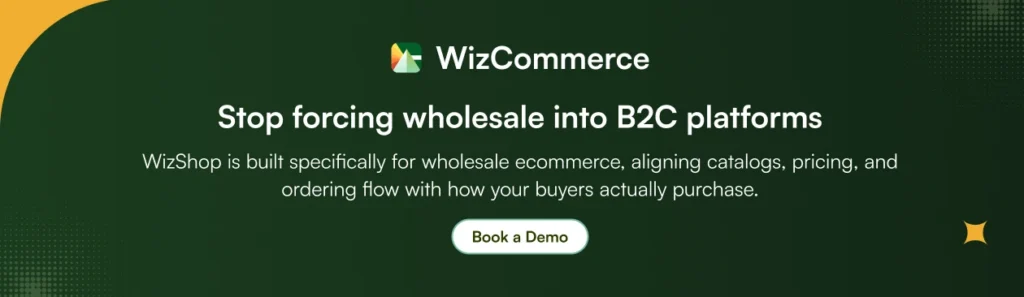
WizShop is built to help you structure your catalog exactly the way your B2B buyers expect to navigate it. For instance, you can add a product to a collection while keeping attributes and visibility consistent across the catalog. This helps your buyers find and compare products easily, while you can keep your catalog clean and scalable.

3. Configure buyer registration and access controls
Not every wholesale customer should see the same products or prices. Buyer registration and access controls define who can access the website and what they are allowed to view. Well-defined access controls prevent unauthorized purchasing and ensure each buyer interacts with a catalog tailored to their account. This creates clarity for buyers while giving you confidence that your orders are placed only by legitimate users.
4. Set up buyer-specific pricing
When it comes to wholesale, different buyers operate under different contracts. There are unique negotiated rates and volume commitments. Such aspects must be reflected accurately at the point of purchase. When pricing logic lives outside your website, your sales reps are forced to rely on manual checks. This can slow down order velocity. So, it is important that you set buyer-specific pricing rules and discounts directly within the wholesale website.
WizShop supports buyer-specific pricing and login-based price reveals natively. You can define custom price lists for individual retailers based on different factors like buyer type or geography. You can also layer item-level and cart-level discounts on top to run targeted promotions without disturbing base pricing.
5. Enable bulk ordering and quick reorders
In wholesale, large and repetitive orders are the norm. As a result, buyers value speed over exploration. If placing an order requires clicking through multiple product pages or re-entering the same information repeatedly, your website becomes a bottleneck rather than a convenience over offline order placement.
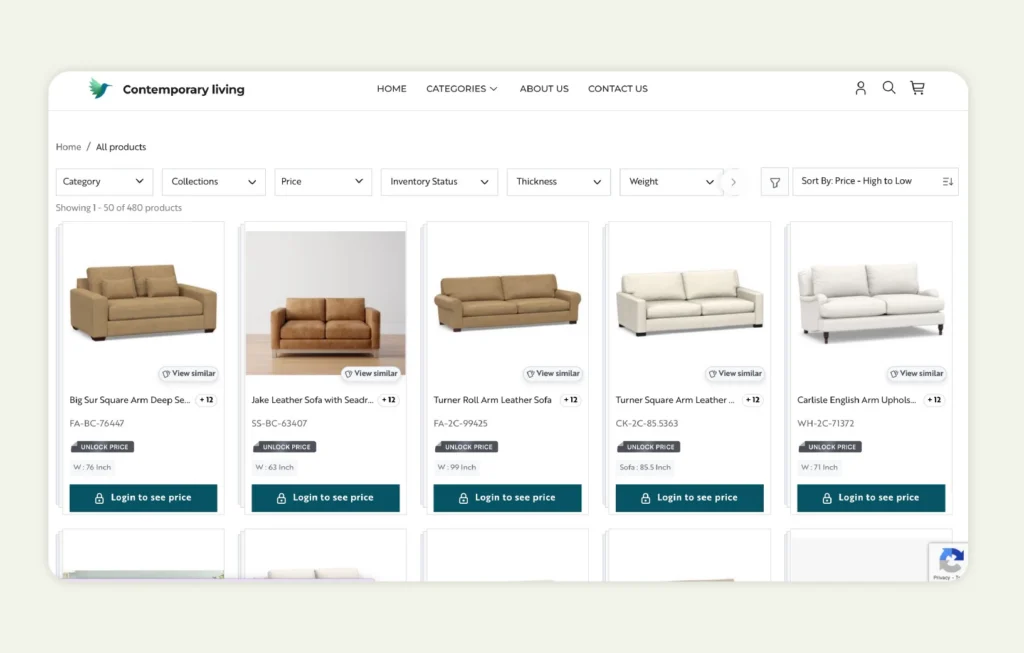
Always use the bulk ordering tools and quick reorder capabilities of your ecommerce platform to allow buyers to place bulk and repeat orders quickly. This dramatically reduces ordering time and improves the frequency of repeat purchases. For instance, WizShop supports one-click reordering out-of-the-box to enable your repeat buyers to place orders seamlessly.
6. Integrate ERP system
A wholesale website cannot operate in isolation from your core business systems. Inventory levels, product data, customer accounts, and order details must stay aligned with your backend operations to avoid mismatches. When you integrate your ecommerce platform with your ERP system, your buyers will see accurate data while your internal teams work with the latest information only.
WizCommerce integrates with most of the the top ERPs in the market, including Microsoft Dynamics 365 Business Central, NetSuite, Sage, Epicor Prophet 21, SAP Business One, and SAP S/4HANA.
7. Optimize the site for speed and usability
Slow or cluttered websites introduce unnecessary friction into the B2B buying process. If key actions like searching products or placing repeat orders take too long, your buyers are more likely to revert to offline channels, or worse, switch to competitors.
To improve speed and usability, focus on anything that slows your buyers down. This includes:
- Keeping pages lightweight by optimizing assets and limiting unnecessary scripts that slow down load times
- Ensuring key actions like search and product filtering are fast and intuitive
- Avoiding visual or technical clutter that adds load without value.
- Designing the interface to work seamlessly across desktop and mobile devices, with clear layouts and hierarchy.
8. Test end-to-end ordering flows before launch
Even well-designed wholesale websites can fail if real-world buying scenarios are not tested thoroughly. When you set complex rules around pricing, access, approvals, and fulfillment, there are good chances of gaps cropping up. However, this will be revealed only when complete order journeys are simulated.
So, before you launch your B2B website, test end-to-end ordering flows. This will help identify issues before your buyers encounter them. It reduces post-launch firefighting and sets the base for long-term success.
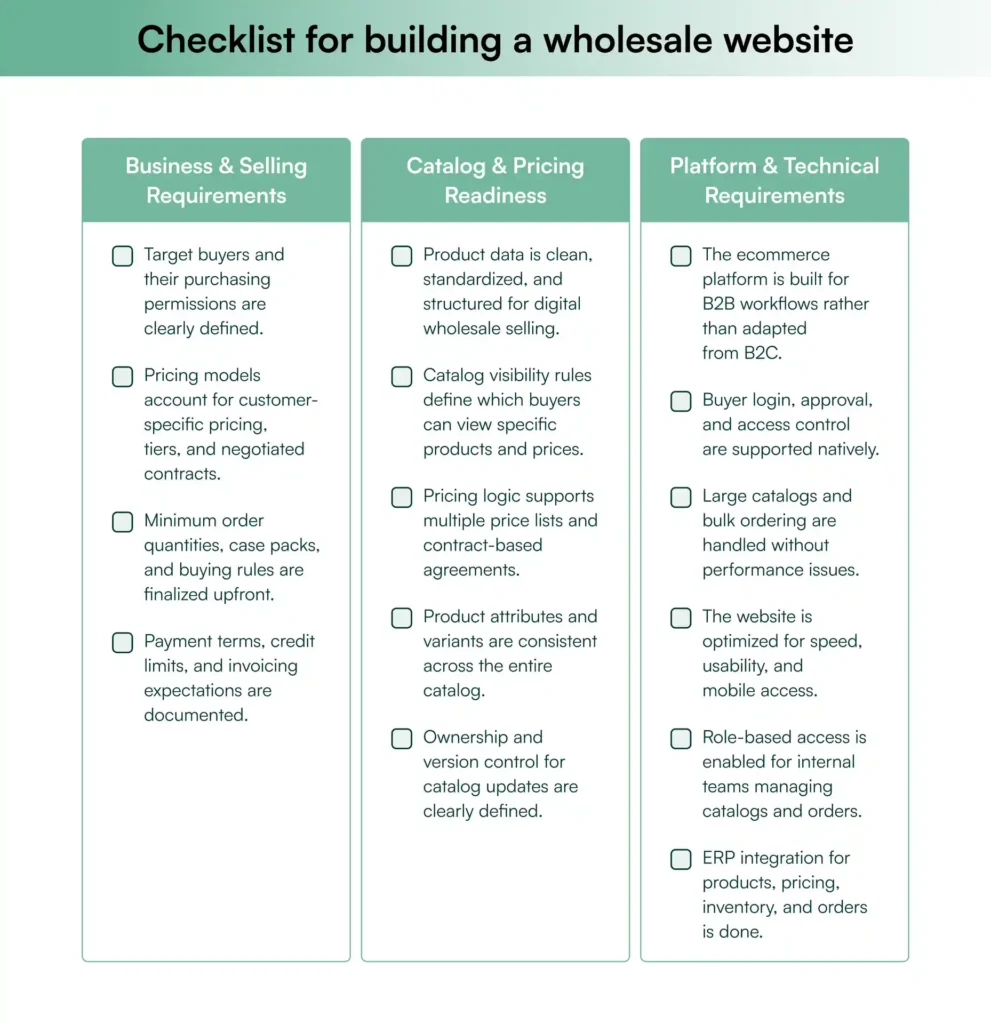
What are the common mistakes to avoid when building a wholesale website?
Knowing how to create a wholesale website is only part of the equation. Avoiding the following mistakes is what separates a site that merely exists from one that truly drives growth:
1. Using a generic B2C ecommerce platform
B2C platforms are built for single-product purchases and prepaid checkouts. Forcing wholesale workflows onto such platforms leads to heavy customization and fragile workarounds. You will be burdened with ongoing operational debt that becomes harder to maintain as your business scales.
Still planning to use a B2C platform for building your wholesale website. Read this blog post first: Pitfalls of building your B2B ecommerce website on a B2C ecommerce platform.
2. Hardcoding pricing
Hardcoded universal pricing may work if you have a handful of buyers. But it will quickly break down when your target audience expands, as contracts and negotiated rates vary by buyer. Flexible and automated pricing rules are essential in wholesale because they allow pricing to scale and adapt without constant manual intervention.
3. Poorly structured product catalogs for large SKUs
A poorly structured wholesale catalog often looks like a D2C product list. Such catalogs tend to have inconsistent attribute naming, no grouping by variants or pack sizes, and no support for bulk units or case-level ordering. . When catalogs are poorly structured, buyers struggle to find the right products and your teams will spend excessive time correcting orders and data errors.
4. Not supporting sales rep–assisted ordering
Wholesale selling is rarely fully self-serve. This is especially true when you have complex or relationship-driven accounts. Ignoring sales-assisted ordering creates a disconnect between your digital channels and sales teams. This ultimately reduces adoption and weakens buyer relationships.
5. Failing to plan for scale and catalog growth
Many wholesale websites are designed around the current product list. Businesses assume that the catalog will remain relatively static. But before they realize, their SKUs, variants, buyer-specific assortments, and pricing rules expand. Such short-term thinking leads to fragile structures that are hard to maintain and slow to adapt. It ultimately restricts growth instead of supporting it.
How to create a wholesale website with WizShop
WizShop helps you build a wholesale website by eliminating the need to piece together multiple tools or adapt B2C platforms for B2B use cases. You get a solid B2B-first foundation that supports your catalog, pricing, and order management workflows effortlessly. By keeping your website tightly connected to your existing workflows, WizShop also enables you to launch your product offerings faster and future-proof your wholesale business.
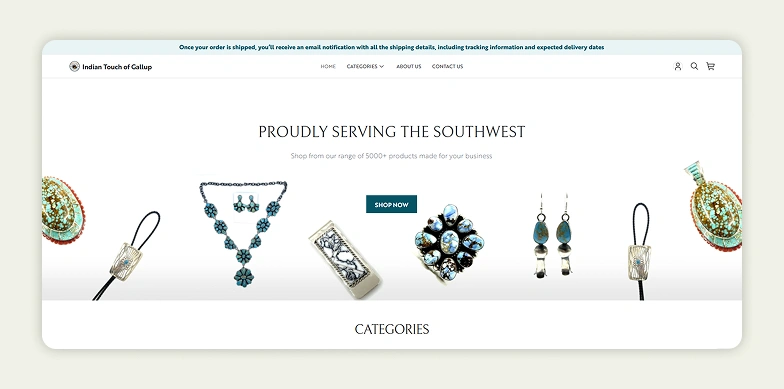
For instance, Indian Touchof Gallup, a wholesale jewelry business, used WizShop to transform their online sales operations after struggling with manual Excel data, email and call-based orders, and inadequate attempts with B2C-first platforms like Shopify and Wix.
Through WizShop, they launched a digital wholesale portal that automated and streamlined previously manual processes, provided features designed specifically for wholesale workflows (including custom pricing and user-centric buyer experiences), and offered a self-serve ordering mechanism that significantly expanded their reach. This transformation helped Indian Touch of Gallup generate $279,000 in new revenue within just five months.
Book a demo now to see WizShop in action.
Frequently Asked Questions
Which website platforms are best for creating a wholesale website?
The best platforms for creating a wholesale ecommerce website are those built specifically for B2B commerce. WizCommerce is a strong choice because it supports buyer-specific catalogs, custom pricing, minimum order requirements, inventory management, repeat ordering process, trade show operations, and sales-rep workflows out of the box. Unlike B2C platforms, it handles wholesale complexity natively and integrates deeply with ERP systems.
How can I set up pricing tiers for wholesale customers on my website?
You can set up pricing tiers for wholesale customers on your website by creating buyer-specific price lists mapped to accounts, customer groups, or regions. B2B platforms like WizCommerce allow tiered pricing, volume-based discounts, and contract pricing. This ensures that each buyer sees a negotiated wholesale price for different products, while keeping your base price intact and maintaining consistent pricing logic across wholesale orders.
What features should every wholesale website include?
The features every wholesale website should include are buyer registration and approval, account-based pricing, MOQs, bulk ordering, quick reorders, and ERP integration for efficient management. Additional essential features include catalog structuring for B2B workflows, inventory visibility, order history, mobile responsiveness, and secure payment processing. These features reduce manual effort and help buyers place bulk orders efficiently.
How do I make sure my wholesale site only allows approved buyers to view prices?
To make sure your wholesale site only allows approved buyers to view prices, enable login-based access so that only approved buyers can unlock pricing, catalogs, and ordering features. A platform like WizCommerce supports this natively. It ensures sensitive pricing and products remain hidden from the public and visible only to authorized wholesale customers.
How can I integrate payment options suitable for B2B wholesale transactions?
You can integrate payment options suitable for B2B wholesale transactions by including credit terms, invoicing, bank transfers, and partial or deferred payments. A powerful wholesale ecommerce platform like WizCommerce supports multiple payment methods. This flexibility allows buyers to pay using familiar business payment terms without disrupting order workflows.
How do wholesale websites work?
Wholesale websites operate on an account-based model where wholesale buyers register and get approved before accessing pricing and catalogs. Once logged in, they see personalized wholesale products, prices, ordering rules, and payment terms. Orders flow directly into backend systems like ERP.