Skip to content




If you’re a wholesaler dealing in furniture and home goods, your growth path need not run only through showrooms or trade fairs. Many ecommerce marketplaces specializing in these categories are available, where hundreds of retailers search and purchase products in bulk every day. Wayfair is one such key marketplace. If you plan to join Wayfair as a seller any time in the future, you might have many key questions around it. This practical guide answers everything you need to know, from how to sell on Wayfair to how much it costs for you to operate on it.

What is Wayfair?
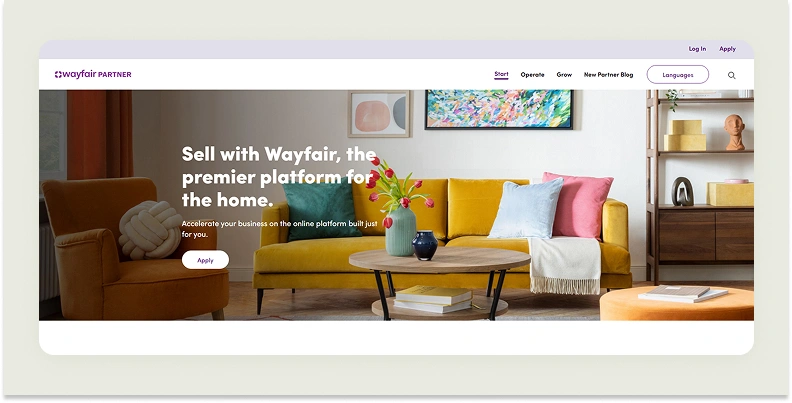
Wayfair is a major online destination for furniture, decor, and home goods, connecting retailers (both end customers and retailers) with wholesalers and manufacturers. While the platform offers customers and retailers access to a wide assortment of home products to purchase in bulk at attractive rates, it gives wholesalers and manufacturers access to a large base of buyers actively searching for relevant products.
At the center of this ecosystem is the Wayfair Partner program, which allows approved wholesalers to list and sell their products directly on Wayfair’s sites across North America and Europe. Through the partner platform known as Partner Home, you can manage your product catalog, update inventory, ship and fulfill orders, and handle day-to-day operational tasks from a single interface. The platform also provides data insights and tools designed to help you understand buyer demand and grow your business on Wayfair.
How does Wayfair work?
Wayfair operates like any other B2B ecommerce marketplace, connecting sellers and buyers, and supporting transactions between them. But from an operational point of view, here are the key steps covering how Wayfair works for a seller:
- Onboarding: You, as a seller, apply to become a Wayfair partner. Once approved, you receive access to Partner Home, Wayfair’s seller management platform.
- Catalog integration: You upload product information such as specifications, images, and identifiers, which Wayfair uses to create product listings.
- Pricing structure: As a seller, you set the base cost for each product you list. Wayfair then adds its own margin on top of this base cost and uses the resulting price as the customer-facing selling price on the platform.
- Orders from buyers: When a buyer purchases a product on the portal, Wayfair sends a purchase order to you through Partner Home. So, in essence, Wayfair is your buyer.
- Fulfillment and shipping: You prepare and ship the product directly to the customer or use Wayfair logistics services such as CastleGate.
- Payment and performance tracking: Wayfair manages the customer transaction, while you track orders and manage inventory.
This model allows you to focus on aspects that are under your control, such as inventory, while Wayfair handles product discovery, marketing, fulfilment, and the overall purchasing experience for buyers.
How much does it cost to sell on Wayfair?
One of the reasons many furniture and home goods brands consider Wayfair is its relatively simple cost structure compared to other ecommerce marketplaces. Unlike Faire or Overstock, Wayfair does not charge listing fees or a percentage commission on each sale. Instead, it operates on a unique model where you, as a seller, set the base cost for your products, and Wayfair purchases the items at that cost when an order is placed.
Because of this model, you are paid the entire base cost you set for each item sold, rather than losing a part of it as a commission to the platform facilitating the transaction. Shipping is also handled through Wayfair’s logistics network. Orders are billed to Wayfair’s shipping accounts and fulfilled according to their shipping processes, which simplifies logistics for many suppliers. However, you might have to pay a 2% fee on every order if you choose the Quick Pay option, which is one of the faster payout processing methods offered by Wayfair.
Example of Wayfair’s cost structure
Let’s say you list a dining table on Wayfair and set the base cost at $200.
- A buyer purchases the table on Wayfair.
- Wayfair sends the order to you and pays the $200 base cost agreed upon.
- Wayfair then sells the product on its site at a price it determines, for example, $320.
In this scenario, you, the seller, receive the agreed wholesale amount ($200), while Wayfair manages the customer-facing price, marketing, and sales process.
How to become a seller on Wayfair? steps & requirements
To start selling on Wayfair, you need to ensure that you are prepared across three key areas: product readiness, operational capability, and business verification. Wayfair expects you to have a well-documented product catalog, the ability to dropship products from a warehouse in their selling region, and furnish the required legal, tax, and banking details to receive payments. Having these elements ready helps you complete onboarding faster and launch your products on the platform more smoothly. Here are the key requirements you need to fulfill, along with the steps to become a seller:
Seller requirements
- Product catalog readiness: At least one product ready to sell with 3+ high-quality images (minimum 1000×1000 px) and detailed specifications such as product name, model number, materials, dimensions, and wholesale cost.
- Category eligibility: Products must fall within Wayfair’s supported categories and avoid restricted items such as perishables, certain electronics, or medical devices.
- Dropshipping capability; Ability to ship orders from a warehouse or 3PL located in the region where you plan to sell.
- Business verification: Legal business information, such as a business registration number, tax IDs, and banking details to receive payouts.
- Operational setup: A clear process to manage orders, update inventory, print shipping labels, and handle returns using Wayfair’s portal or integrations like EDI or API.
How to be a seller on Wayfair: Key steps
Step 1: Apply to become a Wayfair partner
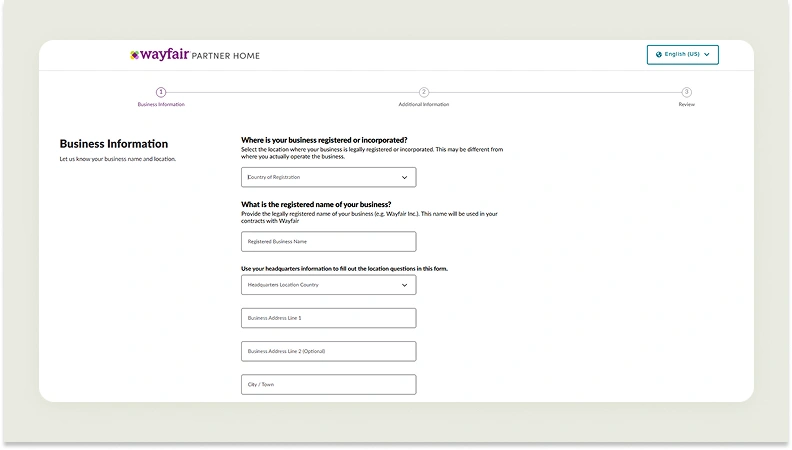
The first step is to apply through the Wayfair Partner Portal by submitting your business information. This includes sharing company details, tax ID, banking information for payouts, and proof of product liability insurance. Wayfair reviews the application and typically responds with the next steps within a few business days.
Step 2: Get approved as a Wayfair vendor
Once your application is submitted, Wayfair evaluates your business and product catalog. The review process checks product quality, pricing structure, fulfillment capability, and whether your catalog fits Wayfair’s home goods categories. This approval process usually takes 2–4 weeks before you are officially accepted into the marketplace.
Step 3: Set up your partner home dashboard
After approval, you gain access to partner home, Wayfair’s seller management dashboard. This is where you configure account settings, manage inventory, track orders, and access analytics. Properly setting up this dashboard ensures smoother operations and better control over product listings and order flow.
Step 4: Upload and optimize your product catalog
Next, you upload your product catalog using Wayfair’s listing tools. Each product should include high-resolution images, complete specifications, and detailed descriptions optimized for Wayfair’s search algorithm. Well-structured listings help improve product visibility and conversion rates on the platform.
Step 5: Sync inventory and manage stock
You must keep inventory synchronized with Wayfair to prevent stockouts or overselling. Many sellers integrate third-party systems to automatically update inventory levels and manage replenishment. Maintaining accurate stock levels ensures smoother operations and avoids order cancellations.
Step 6: Process orders and fulfill shipments
Once products go live, customer orders are sent directly to you through the dashboard. You have to prepare and ship the products according to Wayfair’s packaging and shipping guidelines. You can either ship directly from your own facilities or use Wayfair’s CastleGate fulfillment program to improve delivery speed and logistics efficiency.
How to sell products on Wayfair successfully: Best practices and tips
Wayfair operates as a highly structured marketplace where operational reliability and competitive pricing are the two main determiners of how well you perform as a seller. Here are some best practices to help you succeed on Wayfair:
Create detailed and complete product listings
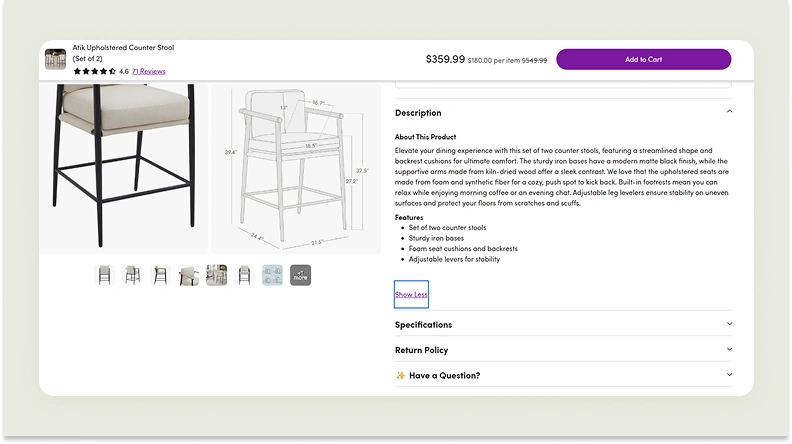
Always get the basics right. Make sure every listing on Wayfair includes detailed specifications such as dimensions, materials, weight capacity, assembly requirements, and care instructions. High-quality images from multiple angles and clear product descriptions help buyers evaluate the product and improve conversion rates. For instance, here is a listing with all the critical information fully furnished.
Adopt a competitive pricing strategy
Wayfair is a highly price-competitive marketplace. Your visibility and conversion largely depend on the base price you set. Since Wayfair adds its own margin on top of your base cost to determine the final selling price, setting the right value becomes even more critical. If your base cost is too high compared with similar products in the category, Wayfair may not be able to price the product competitively, which can reduce its visibility and sales potential.
Maintain adequate inventory levels
Inventory is one thing you have control of when selling in a marketplace like Wayfair. Insufficient inventory and frequent out-of-stock situations can directly impact your visibility and sales performance on the platform. When products go out of stock, they may lose momentum in search results and take time to regain traction even after being restocked. Maintaining healthy inventory levels and keeping your stock data updated helps ensure your listings remain active.
Support timely fulfillment
Even when you are using Wayfair’s logistics services for fulfilment, you still have to coordinate the operational side of shipping from your facility. This includes arranging daily pickups for small parcel orders and properly registering large parcel shipments in Partner Home so Wayfair can schedule the pickup. Ensuring orders are prepared promptly and pickups are coordinated efficiently helps shipments move on schedule and allows you to maintain strong operational performance on the platform.
What are the downsides of selling on Wayfair?
While Wayfair offers significant reach for your home goods, relying on it as a primary sales channel can also come with certain limitations. Here they are:
Pricing pressure
Because Wayfair controls the retail pricing and focuses heavily on competitiveness across its marketplace, you will face constant pressure to maintain lower base costs. This can make it difficult for you to preserve margins, especially in categories where many sellers offer similar products.
Limited brand control
Wayfair largely owns the customer-facing experience on the platform. While you can manage elements such as product images, specifications, and descriptions, key aspects like the final retail price, promotions, merchandising placement, and overall presentation are controlled by Wayfair. This means you have limited influence over how your products are positioned within the marketplace. It can make it harder to maintain a consistent brand narrative compared to selling through your own ecommerce store.
Over-dependency on the marketplace
As with any large marketplace, when you rely entirely on Wayfair for sales, you risk becoming dependent on a single platform for a significant portion of your revenue. Changes to platform policies, algorithms, or merchandising priorities can directly impact your product’s visibility and your sales performance.
Advertising and promotional costs
While listing products on Wayfair gives you access to a large audience, gaining visibility often requires participating in promotions or spending on advertisements. These activities can reduce margins and make it harder for you to compete with established sellers on the platform.
Limited direct customer relationships
When buyers purchase through Wayfair, they own the customer relationship. You do not receive direct access to customer contact information, which makes it difficult to build long-term relationships or market to those buyers outside the platform.
Because of these challenges, many wholesalers eventually start looking for ways to complement Wayfair’s sales with direct wholesale channels, where they can maintain stronger control over pricing, brand experience, and retailer relationships.

A better alternative to Wayfair: Building a branded B2B store using WizCommerce
Selling on Wayfair is certainly helpful to reach a large audience of retailers for your business. However, relying only on Wayfair is not ideal, considering the many disadvantages of such a sales model. This is where B2B ecommerce platforms like WizCommerce can play an important role in helping you manage your B2B sales more independently.
WizCommerce allows you to build a fully branded B2B ecommerce storefront where retailers and buyers can browse products and connect directly with you or your reps. Instead of depending solely on a third-party marketplace, you can create your own digital wholesale channel that reflects your brand identity and supports direct relationships with buyers. Having your own B2B storefront also gives you full control over pricing and customer data.
Many businesses choose to combine both approaches. Wayfair continues to act as a discovery channel that introduces your products to new buyers, while repeat customers and long-term retail partners can be encouraged to place orders directly through your WizCommerce-powered B2B store. This hybrid strategy helps you reap the benefits of both models.
Here are some of the core B2B ecommerce capabilities offered by WizCommerce:
1. Customer-specific pricing and wholesale pricing tiers
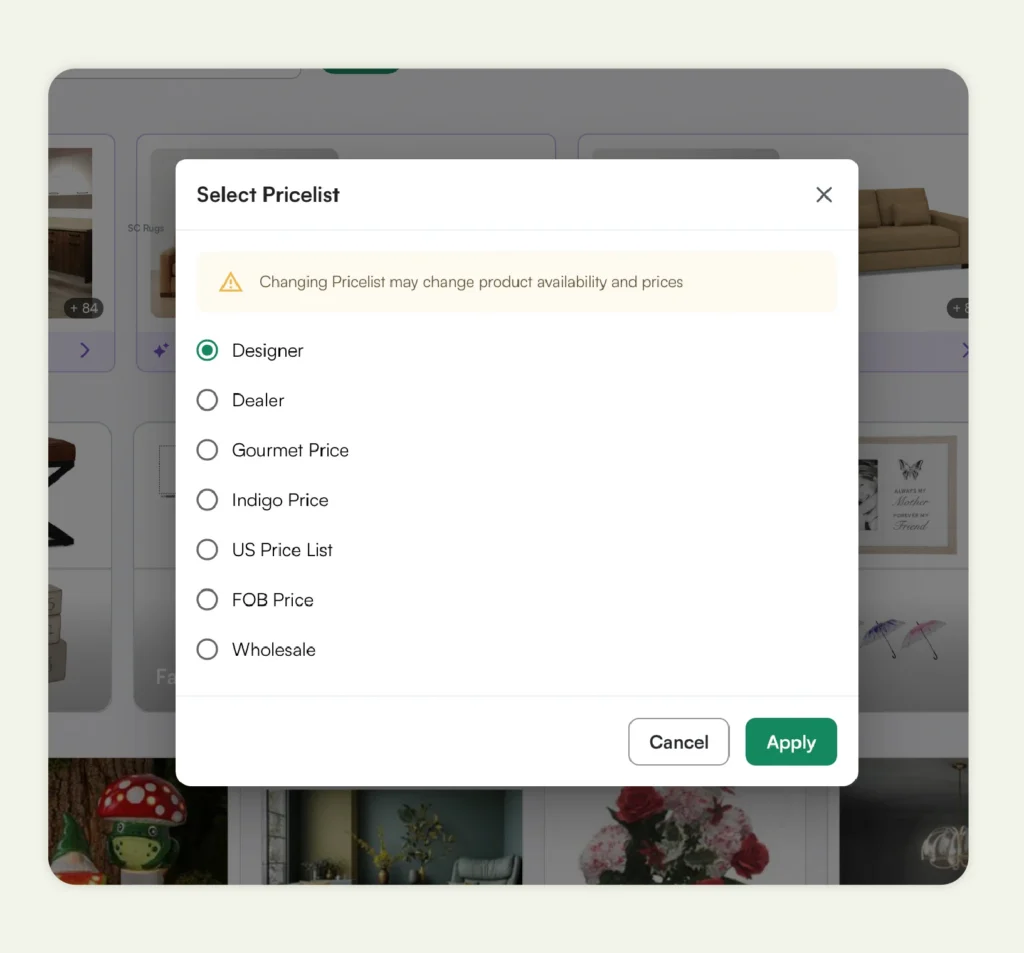
Wholesale businesses rarely sell products at one universal price. WizCommerce allows you to create customer-specific price lists and tiered pricing structures for different retailers or regions. Buyers automatically see the pricing that applies to their account when they log in. When it comes to Wayfair, you have no flexibility in pricing apart from setting the base price of your product.
2. Bulk ordering and wholesale-friendly checkout
Wholesale purchasing often involves large orders, case packs, and minimum order quantities. WizCommerce is built specifically for these workflows. Your buyers can place bulk orders easily and purchase complex product variants in a single transaction. In contrast, Wayfair is primarily designed for retail-style purchasing experiences. It prioritizes single-product consumer transactions rather than high-volume wholesale orders with negotiated buying rules.
3. One-click reordering for repeat buyers
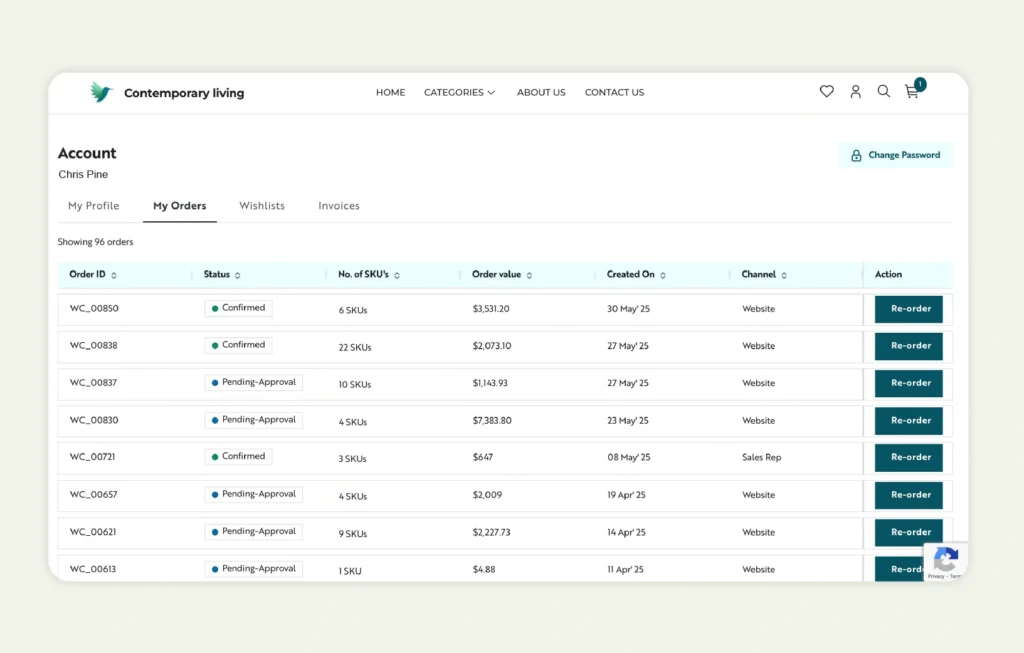
Wholesale relationships rely heavily on repeat orders. WizCommerce includes features such as quick reorder flows, allowing your buyers to reorder previously purchased items with just a few clicks. This type of streamlined repeat purchasing experience is usually not available on marketplaces like Wayfair.
4. Real-time inventory visibility
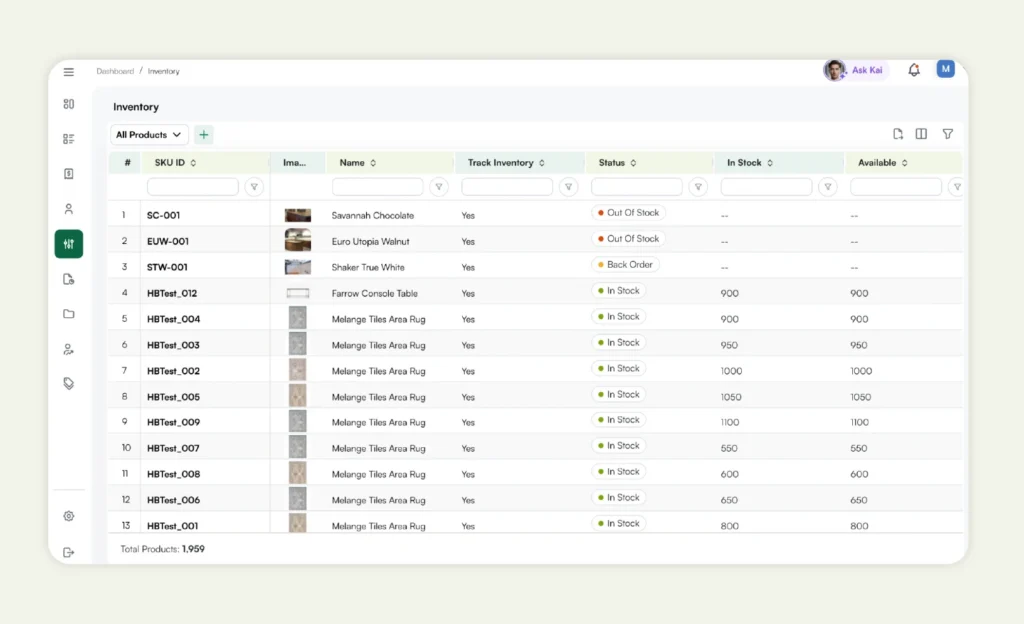
WizCommerce integrates with your backend systems so that your buyers and sales reps can view accurate stock levels directly while placing orders. This includes information about available inventory and other stock status updates. On many marketplaces, you cannot expose real-time operational data to specific buyers. Retail partners, therefore, lack deeper visibility into inventory availability or incoming stock.
5. Seamless ERP and accounting integrations
WizCommerce integrates directly with many ERP systems so that pricing, inventory, and order information remain synchronized across the entire tech stack. Marketplace platforms typically function as standalone sales channels. Integrations with your internal ERP are limited and often require manual reconciliation or third-party connectors.
6. Dedicated sales rep app for field selling and trade shows
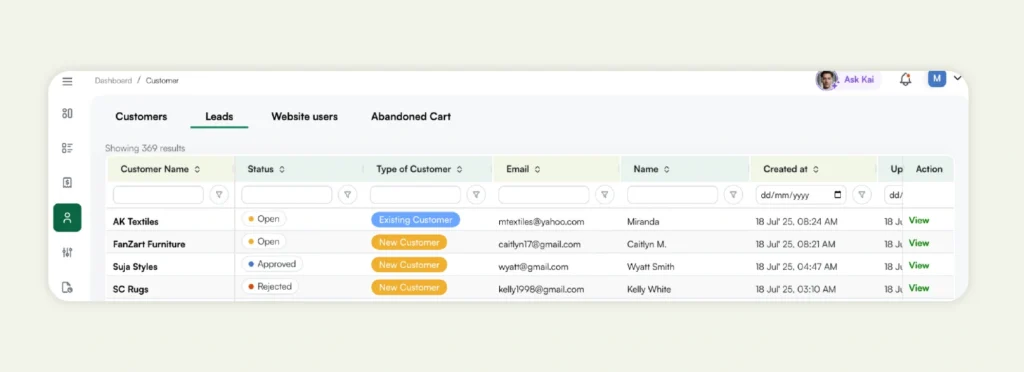
WizCommerce includes a mobile sales rep app designed for your wholesale sales teams. Reps can access product catalogs, apply customer-specific pricing, check inventory, and capture orders instantly during meetings, trade shows, or field visits. Wayfair does not provide tools to support rep-led selling or in-person order capture. They are primarily designed for online transactions rather than hybrid sales models involving field representatives.
7. AI-powered product discovery and recommendations
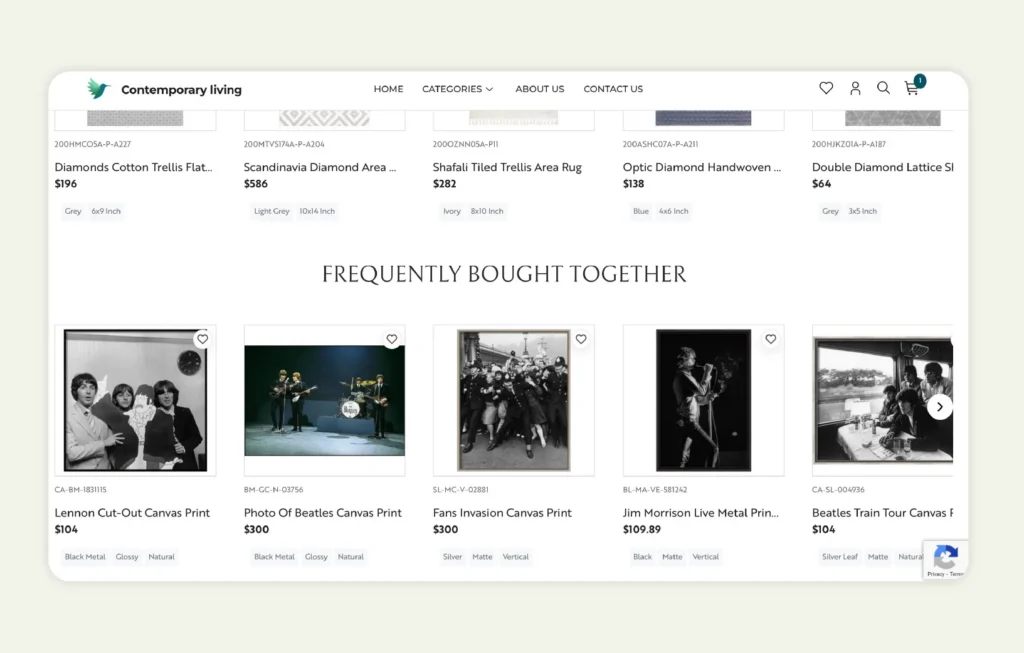
WizCommerce includes AI-powered search and recommendation capabilities that help your buyers and sales reps discover relevant products based on purchasing patterns and buying behavior. Marketplaces typically recommend products based on general marketplace data rather than your specific retailer relationships. As a result, the recommendations may not reflect your sales strategy or merchandising priorities.
If you want to reduce dependence on marketplaces like Wayfair while building stronger retailer relationships, launching a branded B2B storefront can be a powerful next step. WizCommerce provides the infrastructure to build and manage such a storefront. Want to know more about WizCommerce’s capabilities? Book a free demo now.
Frequently Asked Questions
What does it cost to sell on Wayfair?
The cost to sell on Wayfair is based on a wholesale model where you set a base cost for your products, and Wayfair determines the final retail price by adding its margin. You do not pay any listing fees or subscription fees. However, you may have to pay a 2% fee if you choose the Quick Pay option for faster payments.
What percentage does Wayfair take?
The percentage Wayfair takes does not follow a standard commission model. Instead, you set a base cost, and Wayfair adds its own margin to determine the final retail price customers see. This means the exact percentage Wayfair earns can vary depending on the product category, pricing strategy, and competitive positioning within the marketplace.
How do I list a product on Wayfair?
To list a product on Wayfair, you first need to become an approved Wayfair seller. After onboarding, you can upload your catalog comprising a wide range of products through Partner Home, Wayfair’s supplier management platform. This involves adding product specifications with keywords, imagery, pricing, and inventory details. Once approved and published, your products become available for potential customers to discover and purchase on Wayfair’s online store.
What are the disadvantages of Wayfair?
The disadvantages of Wayfair include pricing pressure, limited brand control, strong marketplace competition, and reduced access to direct customer relationships. Because Wayfair manages the customer experience, you have less control over pricing and branding. Many home decor sellers complement marketplace sales with a branded storefront built on platforms like WizCommerce for facilitating stronger direct wholesale relationships.
What are the alternatives to Wayfair?
Some popular alternatives to Wayfair include marketplaces such as Faire, Overstock, Houzz, and Walmart Marketplace for home goods sellers. However, relying only on marketplaces can limit your brand control and customer ownership. Many wholesalers also use their own storefront built on platforms like WizCommerce to create their own digital wholesale channels and sell directly to retailers alongside marketplace platforms.
What’s better, Wayfair or Overstock?
Whether Wayfair or Overstock is better depends on your margin requirements and target audience. Wayfair focuses heavily on furniture and home goods with a wholesale-style supplier model, while Overstock operates more like a traditional commission-based marketplace. Both have a massive customer base and attract thousands of shoppers every day. Many brands also use WizCommerce to build independent B2B sales channels beyond marketplaces and boost sales.
Is it difficult to become a seller on Wayfair?
Becoming a seller on Wayfair is not overly difficult, but it does require approval. You must apply through the Wayfair Partner Program and meet their quality and fulfillment standards before you can list products and start selling through their partner portal.