Skip to content



Dynamic pricing in B2B wholesale is no longer a concept reserved for airlines or hotel chains. For manufacturers, distributors, and wholesalers operating in increasingly competitive markets, the ability to adjust prices based on real time data, demand fluctuations, and customer behavior has become a genuine operational advantage.
B2B wholesalers face a distinct set of pressures: tightening profit margins, supply chain volatility, competitor pricing pressure, and buyers who arrive at every negotiation better informed than ever before. Static price lists that made sense five years ago are now a liability. The businesses winning in 2026 are those that treat pricing as a living variable, not a fixed number agreed upon once a year and left untouched.
This guide breaks down what dynamic pricing in B2B wholesale actually means, how it differs from fixed pricing, how it protects revenue, and which dynamic pricing strategies are worth implementing. For wholesale businesses looking to enhance their pricing strategies, we also cover how WizCommerce’s pricing infrastructure provides the right foundation.

What does dynamic pricing in B2B wholesale mean?
Dynamic pricing in B2B wholesale refers to a pricing model in which prices are adjusted based on a combination of factors including market conditions, inventory levels, customer segments, buyer behavior, and competitive signals, rather than being fixed at a static rate for all buyers and all situations. Unlike consumer surge pricing, dynamic B2B pricing strategies are typically structured, account-based, and governed by commercial relationships.
The objective is not to maximize revenue on a single transaction but to optimize profit margin across a portfolio of buyers, products, and timeframes. This means charging a loyal high-volume buyer differently from a new prospect, adjusting prices as stock levels fluctuate, and responding to competitor pricing shifts before they affect your market share. Done well, dynamic pricing in B2B wholesale is about offering the right price to the right buyer at the right time, without eroding either the relationship or the margin.
How dynamic pricing in ecommerce works?
At its core, how dynamic pricing works in B2B wholesale involves collecting and analyzing sales data, market trends, and customer behavior signals to identify where prices should shift. A dynamic pricing system applies pre-set rules or machine learning models to recommend or automatically apply the most appropriate price for a given buyer, order size, or product at a given moment.
Dynamic pricing software can factor in variables such as inventory management data, competitor pricing feeds, seasonal demand fluctuations, and even price elasticity signals from historical orders. The more sophisticated the pricing engine, the more variables it weighs simultaneously. At the operating level, this translates into a live pricing environment where sales teams are equipped with the accurate price point without needing to renegotiate every transaction manually.
How dynamic pricing differs from fixed wholesale pricing?
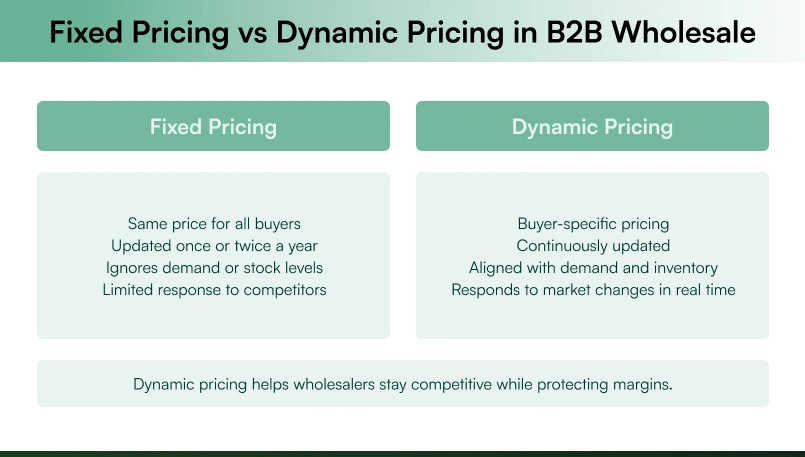
Fixed pricing assigns a set number to a product or product group that applies uniformly across most buyers and most timeframes, regardless of volume, timing, or individual account value.
Let’s understand the key differences between fixed wholesale pricing and dynamic pricing in B2B wholesale
- Responsiveness to market conditions: Fixed pricing remains static even when market conditions shift, leaving wholesalers either over-pricing into lost deals or under-pricing into eroded margins. Dynamic pricing in B2B wholesale adjusts continuously, ensuring the price of a product stays aligned with current market trends, supply costs, and competitor pricing realities at any given moment.
- Buyer-level personalization: Fixed pricing offers the same rate to all buyers regardless of their order history, volume, or loyalty. Dynamic pricing enables customer segments to be priced differently based on customer needs, purchasing patterns, and relationship depth, increasing customer satisfaction and long-term retention without a blanket discount.
- Inventory and demand alignment: Fixed pricing ignores stock levels and demand fluctuations, meaning a fast-moving item gets the same price whether it is scarce or abundant. Dynamic pricing in B2B wholesale ties the price of a product to inventory levels and demand signals, allowing revenue management optimization across the full catalog in real time.
- Impact on margin and competitive edge: Fixed pricing makes it easy to plan but difficult to protect margin when costs shift or higher prices become justifiable. Dynamic pricing gives wholesalers a competitive advantage by enabling competitive pricing responses and higher margins on constrained stock, without exposing the entire catalog to across-the-board adjustments.
How dynamic pricing in B2B wholesale boost revenue while preserving your margins?
The core tension in B2B pricing is that reducing prices to win deals compresses margins, while maintaining prices to protect margins risks losing deals. Dynamic pricing in B2B wholesale resolves this tension not by choosing one side but by applying different logic to different situations.
When inventory levels are high and demand is soft, lower prices for specific customer segments move stock without a blanket markdown. When high demand outpaces supply, the same system supports higher prices on constrained SKUs without alienating core buyers on stable lines. The result is a profit margin profile that reflects the actual market rather than a historical average.
Customer relationships are preserved because dynamic pricing in the B2B context is account-aware. A longstanding buyer does not suddenly face a price hike on a routine reorder. Instead, their pricing reflects their customer experience history, their volume commitments, and any negotiated terms baked into the relationship. New buyers or opportunistic orders may face different price points, which is both commercially rational and widely accepted in wholesale markets.
The data dimension is equally important. Sales data from each transaction feeds back into the pricing logic, enabling continuous refinement. Over time, a wholesaler using dynamic pricing in B2B wholesale develops a clearer picture of price sensitivity by product, by segment, and by season, turning pricing into a genuine instrument of revenue management rather than a cost-plus calculation left on autopilot.
4 core wholesale dynamic pricing strategies for 2026
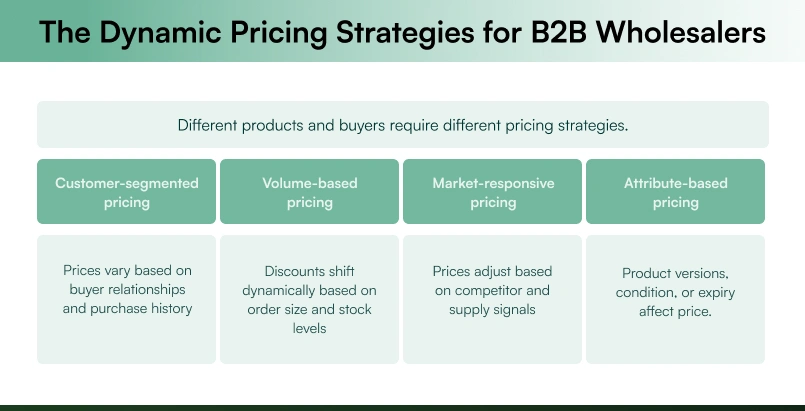
Successfully implementing dynamic pricing for wholesale business requires choosing the right approach for your catalog, customer base, and operational maturity. Here are four wholesale dynamic pricing strategies built for B2B realities in 2026.
- Customer-segmented pricing: Adjusting rates based on loyalty or buying power. Rather than a single rate card, this strategy assigns different price points to distinct customer segments based on relationship depth, order frequency, and negotiated terms. High-value accounts receive preferential rates that reflect their contribution to your customer base, while new or low-volume buyers are quoted standard rates, protecting both customer relationships and profit margin.
- Volume-based fluctuations: Moving beyond simple bulk discounts to real-time inventory-led pricing. Instead of a fixed tier structure, this approach adjusts volume pricing based on current inventory levels and demand fluctuations. When stock levels are high, incentives increase to accelerate movement. When supply tightens, the discount threshold adjusts accordingly, preventing margin erosion in high demand windows.
- Market-responsive adjustments: Responding to competitor shifts or supply chain costs. This strategy monitors competitor pricing and supply chain cost signals to trigger price changes at the appropriate level. Rather than waiting for a quarterly review, a dynamic pricing system applies adjustments in real time, ensuring your competitive pricing position does not gradually fall out of alignment with market conditions.
- Attribute-based pricing: Pricing based on specific product versions or expiration dates. Certain products carry pricing complexity that a flat rate cannot capture, including price sensitivity tied to product version, condition, shelf life, or configuration. This strategy enables product pricing to reflect the actual value of a product at a given moment, particularly for perishables, seasonal lines, or products with near-term expiry dates.
For a broader view of how these fit into your overall approach, read the guide on B2B pricing strategies.

Simplify dynamic pricing for wholesale business with WizCommerce
Dynamic pricing in B2B wholesale requires an operational foundation that can execute flexible pricing at scale, across thousands of SKUs, dozens of buyer accounts, and multiple channels simultaneously. At WizCommerce, we are built precisely for this kind of complexity. While we do not function as a standalone dynamic pricing software, our pricing infrastructure gives manufacturers and wholesalers the tools to implement the core mechanics of dynamic pricing for wholesale business without custom development or fragile plugin stacks.
Our WizShop Custom Price List feature enables buyer-specific pricing across every account in your catalog, while WizOrder gives your sales reps the ability to apply and switch between those price lists on the spot, whether at a trade show, in a client meeting, or during a remote call. Together, they create a pricing environment that is responsive, account-aware, and commercially consistent, the practical foundation any wholesale dynamic pricing strategy initiative needs to operate reliably. For more context on how we approach pricing, see the full guide on wholesale pricing strategies.
- Custom price lists per buyer account: We enable individual price points for each wholesale account, supporting negotiated rates, segment-based pricing strategies, and promotional pricing without manual overrides or spreadsheet management across your customer base.
- Seamless price switching for sales reps: WizOrder allows your sales teams to switch between price lists instantly on any product or detail page, ensuring the right price is presented to the right buyer in every interaction, on or offline, without delays or errors.
- Inventory-linked catalog visibility: Our real-time inventory sync ensures sales data and stock levels are always visible to reps and buyers, supporting informed price points decisions that reflect actual availability rather than outdated catalog data.
- ERP integration for margin-aware pricing: Our native integrations with QuickBooks, NetSuite, and other ERP systems ensure that pricing decisions are grounded in accurate cost data, giving your sales teams the margin visibility they need to negotiate confidently without undermining your profit margin.
Explore how we support end-to-end B2B ecommerce strategies for wholesalers looking to scale.
Ready to give your pricing operations the infrastructure they need? Book a demo with WizCommerce and see how our custom pricing tools built for B2B wholesale can protect your margins and accelerate growth.
FAQs
What is the pricing strategy for wholesalers?
Wholesalers typically combine tiered volume pricing, cost-plus with margin floors, contract-based rates, and competitive pricing aligned to market trends. Dynamic pricing in B2B wholesale adds responsiveness, adjusting price points based on real-time data, demand fluctuations, and account-level customer behavior to continuously protect the profit margin without renegotiating every transaction.
What are examples of dynamic pricing?
Airlines adjust ticket prices based on seat availability and peak travel seasons. Hotels apply surge pricing during peak times. Event tickets shift with high demand. In B2B wholesale, dynamic pricing in e-commerce manifests as buyer-specific rates tied to inventory levels, volume thresholds, and seasonal demand, making it one of the most practical use cases in wholesale commerce.
What are the disadvantages of dynamic pricing?
Without clear governance, dynamic pricing can damage customer relationships if price changes appear arbitrary. Managing a dynamic pricing system across large catalogs adds operational complexity. Poor implementation introduces margin volatility rather than stability. Transparency and well-defined rules are essential best practices for any successful dynamic pricing initiative in a wholesale business to avoid eroding customer satisfaction and trust.
What is the main goal of dynamic pricing?
The main goal of dynamic pricing in B2B wholesale is to align the price of a product with its real market value. This protects profit margin during high demand, clears stock levels in slow cycles, and gives businesses a sustainable competitive advantage by replacing the status quo of rigid pricing with commercially intelligent flexibility.
What is the first step in implementing dynamic pricing?
The first step is market research: auditing your current pricing model, mapping customer segments, and identifying where margin is lost. From there, analyzing sales data and price elasticity informs the rules any pricing engine will execute. Investing in a platform with flexible pricing infrastructure, such as WizCommerce, gives your sales teams the foundation to act on those insights immediately.