Skip to content



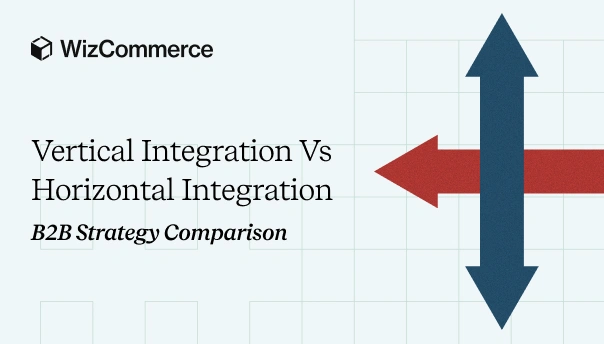
For businesses, the battle is no longer just about profits. It is about gaining control of market share, cutting costs, building loyal customers, and outmaneuvering competitors. That’s where two powerhouse integration strategies come in: vertical integration vs horizontal integration.
Both approaches are reshaping industries and are part of most leaders’ growth roadmaps today. A study by Deloitte shows that 83% of leaders expect their own organization’s deal volume, which includes vertical and horizontal integrations, to increase “somewhat” or “significantly” in the coming years.
In this guide, we break down the key differences between vertical integration vs horizontal integration, walk through real-world examples of each, and give you a practical framework to decide which strategy suits your business goals. You will also see how WizCommerce helps B2B businesses execute either path with the right operational infrastructure in place.
What is vertical integration?
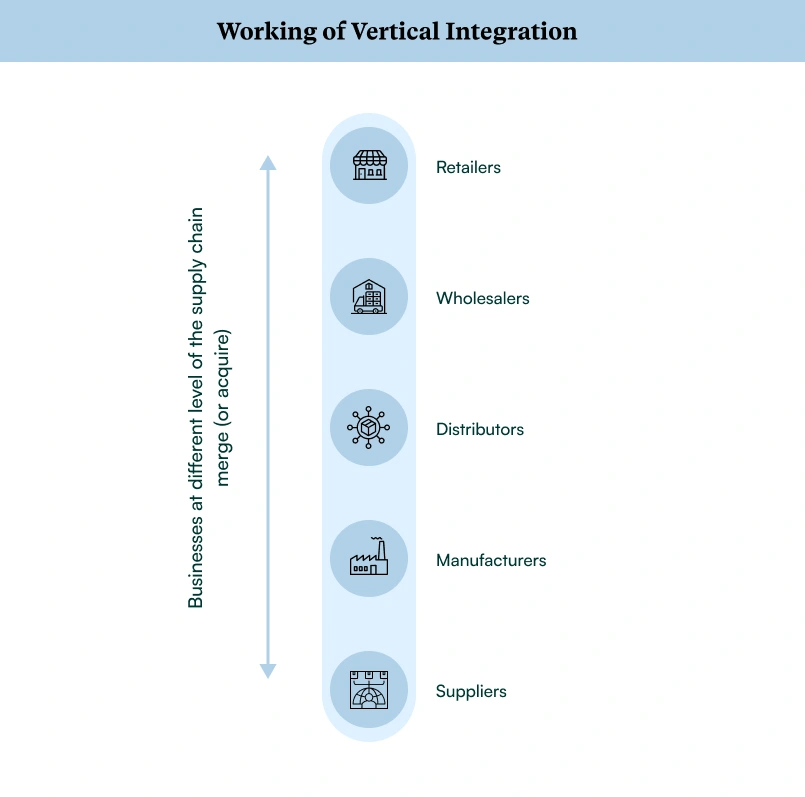
Vertical integration is a business strategy where a business takes ownership of two or more key phases of the supply chain, thereby integrating them into its operations. This is done mainly to achieve cost savings and ensure better quality control. It often involves acquiring or merging with external suppliers (upstream) or distribution channels and retailers (downstream) to gain more control over the value chain.
Understanding vertical integration vs horizontal integration starts here, with recognizing that vertical moves go deeper into the same chain rather than wider across the market.
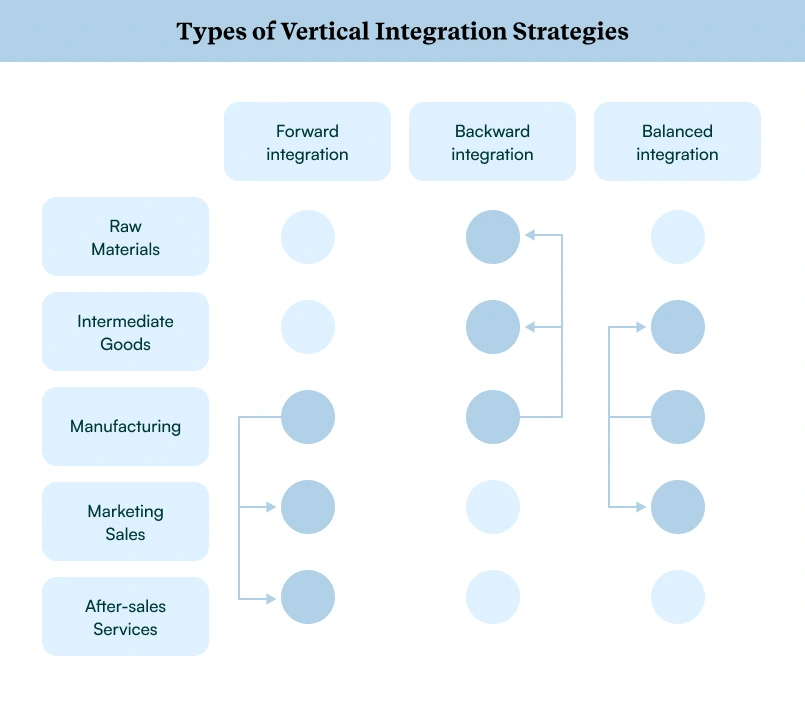
Vertical integration can be of three types:
- Backward Integration: When the business acquires or merges with its suppliers. This is done to secure the supply of raw materials and lower input costs. For example, a coffee chain buys a coffee farm.
- Forward Integration: When the business moves closer to the end customer by acquiring distributors, retail stores, or other customer-facing operations. For example, a clothing manufacturer starts their own ecommerce website.
- Balanced Integration: It is a blend of backward vertical integration and forward integration. The business takes control of both its suppliers and its distribution channels to create a fully integrated supply chain. For example, an oil company drills for crude, refines it, and sells it through its own gas stations.
Examples of vertical integration
Here are some well-known examples that highlight how vertical integration drove competitive advantage for a business:
Apple acquiring Anobit and AuthenTec
Apple, the American consumer electronics corporation, which once outsourced the production of key components, now controls nearly its entire manufacturing supply chain. From chipsets to device casings, they own everything. Apple’s acquisition of Anobit, the flash-memory controller designer, and AuthenTec, the biometrics and mobile-security firm, is a strong example of vertical integration in the technology sector.
These vertical integrations strengthened Apple’s control over flash storage technology and fingerprint sensors in iPhones, iPads, and MacBooks. More importantly, they helped Apple deliver highly distinctive products that are difficult to replicate.
McDonald’s acquiring Dynamic Yield
Dynamic Yield was an AI-powered personalization platform. By acquiring it, McDonald’s gained better control over how customer data is used. Post-acquisition, it could seamlessly customize drive-thru menus, app experiences, kiosk interactions, and digital ordering flows with the help of Dynamic Yield’s tech.
This vertical integration resulted in better ordering efficiency, more upselling opportunities, and a consistent customer experience across all digital touchpoints of McDonald’s. It is a compelling case study in how forward integration into customer-facing technology can reshape the distribution process.
Amazon acquiring Kiva Systems
Amazon reduced its reliance on external suppliers in logistics by building its own delivery network, Amazon Logistics. More importantly, it acquired a prominent name in the robotics sector, Kiva Systems, to automate their warehouse operations.
This acquisition, a well-cited example of vertical integration, resulted in reduced delivery times and lowered production costs for Amazon. It also enabled Amazon to scale its fulfillment capabilities to meet growing customer demand while tightening control over its company’s supply chain at every stage.
Tesla’s lithium supply chain acquisition
Tesla’s push to control its lithium supply chain is one of the clearest recent examples of backward vertical integration in action. By acquiring lithium mining rights and building its own battery production through the Gigafactory, Tesla reduced its dependence on third-party suppliers for a core competency that directly affects profit margins and vehicle delivery timelines.
This move also gave Tesla better quality control over battery cell performance. With lithium being a critical input in electric vehicle production, owning that upstream stage of the value chain has allowed Tesla to manage lead times and scale production in ways that competitors relying on external suppliers simply cannot match.
Advantages and disadvantages of vertical integration
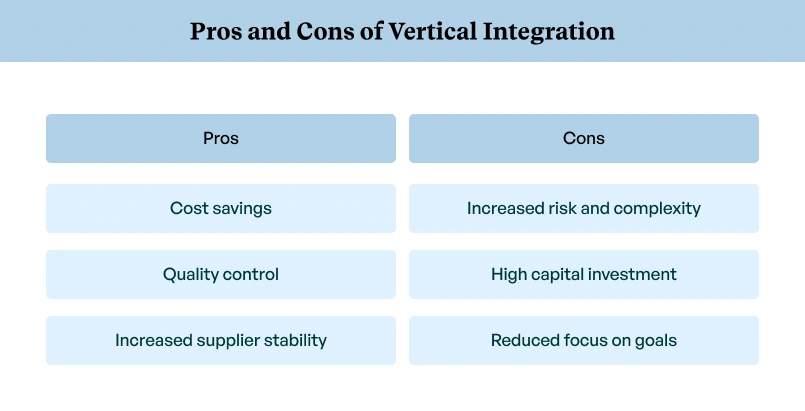
Here are some key positives and negatives of integrating vertically:
Pros of vertical integration
- Cost savings: It helps cut costs by removing intermediaries and reducing transaction expenses. There are also cost savings due to streamlined supply chain management operations.
- Quality control: By overseeing the entire supply chain, you can maintain consistent quality control standards at every stage. This results in better product reliability and a stronger competitive advantage over rivals who depend on third parties.
- Increased supplier stability: By owning or closely controlling key suppliers, you reduce the risk of disruptions and ensure a steady supply of critical components or raw materials.
Cons of vertical integration
- Increased risk and complexity: Expanding into different levels of the supply chain introduces new operational complexity and added layers of management challenges.
- High capital investment: Vertical integration demands substantial financial resources to acquire or develop new infrastructure, technologies, or distribution channels.
- Reduced focus on goals: When you stretch yourself across multiple areas of the supply chain, you may become preoccupied with managing internal processes and lose sight of your primary business goals.
What is horizontal integration?
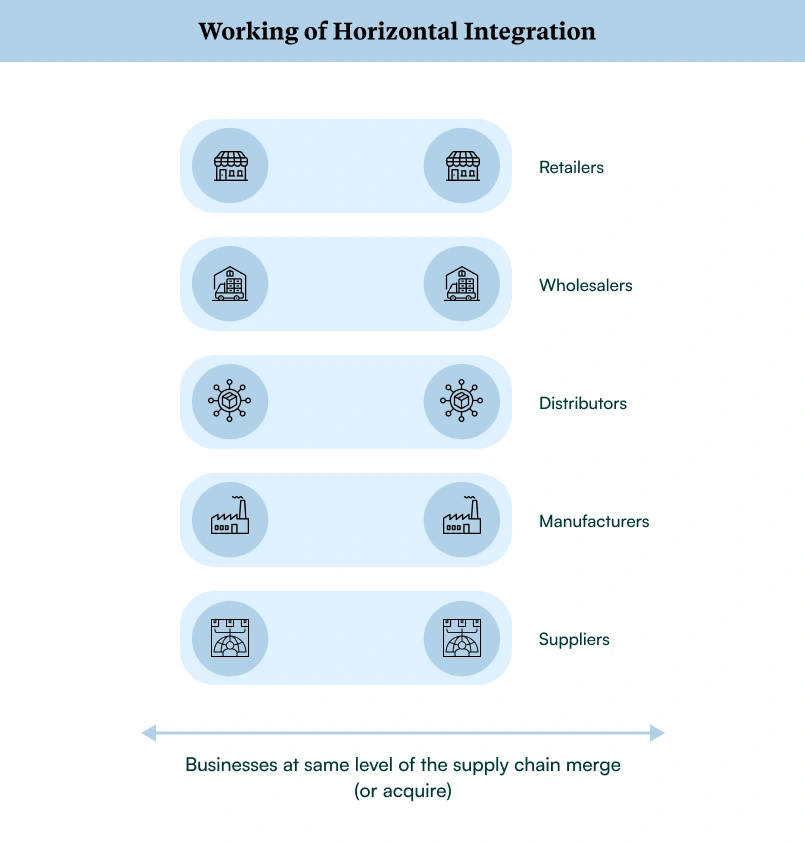
Horizontal integration is a business strategy in which a company expands by merging with or acquiring other firms operating at the same level of the value chain and within the same industry. It involves combining with competitors, similar businesses, or similar producers. The main objectives of horizontal integration are to increase market share, reduce competition, and benefit from economies of scale.
When weighing vertical integration vs horizontal integration, the key distinction here is that horizontal strategies expand a company’s market position across the industry, while vertical strategies deepen its control within the supply chain.
Types of horizontal integration
Horizontal integration takes different forms depending on a company’s business goals, market conditions, and the nature of the acquiring company. Here are the main types:
- Full acquisition: A company purchases another company outright and absorbs its operations, assets, and customer bases entirely into its own structure. The merged company operates under a unified brand and management. Disney’s acquisition of 21st Century Fox is a strong illustration. Disney absorbed Fox’s entire content library and studio operations to significantly expand its market presence and content dominance.
- Merger: Two companies of comparable size combine to form a single new entity, pooling resources and capabilities. Neither company fully absorbs the other. The Exxon and Mobil merger is a classic example as both energy giants joined forces to form ExxonMobil. They created a company with far greater market power and economies of scale than either held independently before the deal.
- Partial acquisition: A company acquires a controlling but not complete ownership stake in another business operating at the same level of the value chain. This approach preserves some independence for the acquired entity. It is common in industries where regulatory bodies require the preservation of a degree of competitive separation between merged entities.
- Joint venture: Two or more companies in the same industry form a shared entity to pursue a specific business strategy or enter new markets together. Unlike a full merger, both parent companies retain their own independent operations. Joint ventures are popular in sectors where antitrust laws limit outright acquisitions and where entering a new geography requires shared risk between parties.
How does horizontal integration differ from a conglomerate merger?
Horizontal integration and conglomerate mergers are both growth mechanisms, but they serve fundamentally different purposes and carry different potential risks. Understanding this distinction matters when deciding which path aligns with your strategic management priorities and market conditions.
- Industry focus: Horizontal integration involves merging with or acquiring similar businesses operating in the same industry at the same stage of production. A conglomerate merger, by contrast, combines companies from entirely different markets or sectors with no operational overlap between them.
- Objective: A horizontal integration strategy aims to increase market share, reduce competition, and achieve economies of scale within a known sector. Conglomerate mergers are motivated by revenue streams diversification and reducing exposure to a single market or industry cycle.
- Operational synergy: Companies pursuing horizontal and vertical integration can integrate production processes, sales teams, and distribution channels relatively naturally because they already operate in the same space. Conglomerate mergers rarely produce operational synergies because the businesses involved serve entirely different customer bases and have different infrastructure needs.
- Regulatory exposure: Horizontal integration attracts significant scrutiny from regulatory bodies and faces potential antitrust challenges because it directly reduces competition within an industry. Conglomerate mergers face less antitrust pressure since the companies involved are not direct competitors in any given region or sector.
Examples of horizontal integration
Here are some real-world examples that show how horizontal integration played out for some of the businesses:
Disney acquiring 21st Century Fox
Disney’s takeover of 21st Century Fox is a classic example of horizontal integration within the entertainment world. By joining forces with another industry heavyweight, the Walt Disney Company significantly broadened its content library. Through this acquisition, it brought hit franchises like “X-Men” and “Avatar” under its umbrella.
This integration with a direct competitor boosted Disney’s market dominance in both film and television sectors. The deal is widely studied as a reference case study in horizontal integration strategy because of how cleanly it expanded Disney’s product lines and market power without moving into a different stage of production.
Facebook acquiring Instagram
With both platforms operating in the social media space, this move is a strong example of horizontal integration between two companies competing at the same level of the value chain in digital engagement. The acquisition enabled Facebook to capture a large slice of the digital engagement market.
This strategic purchase expanded Facebook’s reach into younger demographics and amplified its advertising capabilities by unifying audiences across platforms. The consolidation also streamlined operations through shared infrastructure, offering meaningful cost savings and improved profit margins at scale.
Exxon and Mobil merger
The 1999 merger of Exxon and Mobil is one of the defining examples of horizontal integration in the United States energy sector. Both companies were direct competitors operating at the same stage of the petroleum supply chain: exploration, refining and retail distribution through gas stations. By combining, the merged company ExxonMobil achieved far greater economies of scale, significantly reduced production costs and gained substantial market power in both upstream and downstream operations.
The deal was closely scrutinized by regulatory bodies and required significant divestitures under antitrust laws before it received federal approval. The scale of the combination made it one of the most consequential corporate mergers in United States history.
Advantages and disadvantages of horizontal integration
Here are some key positives and negatives of integrating horizontally:
Pros of horizontal integration
- Increased market power: Merging with competitors or similar businesses strengthens a company’s position in the industry, allowing it to reduce competition and exert greater influence over pricing and market dynamics.
- Cost efficiency through economies of scale: Consolidating operations and resources helps streamline processes, lower production costs, and boost overall efficiency, leading to improved profitability.
- Broader customer reach: Horizontal integration opens the door to a wider customer base and additional distribution channels, enabling greater market presence and higher online sales potential across new markets.
Cons of horizontal integration
- Cultural misalignment: Merging with similar companies can lead to cultural differences and operational friction. This particularly makes it difficult to align teams, processes, and company values effectively.
- Regulatory and antitrust concerns: As market concentration increases, regulators may closely scrutinize the deal for potential antitrust violations. This is particularly true if you are a large or dominant player in the industry.
- Operational complexity and financial strain: Managing multiple entities in the same sector can be challenging and resource-intensive. It often involves high costs, potential debt accumulation, reduced financial agility, and short-term hits to profitability.
Summary of differences: Vertical integration vs horizontal integration
When comparing vertical integration vs horizontal integration, the most important question is what kind of control you are trying to gain:
| Factor | Vertical integration | Horizontal integration |
| Primary purpose | To gain control over the supply chain (either upstream or downstream) | To increase market share and reduce competition |
| Value chain involvement | Expands into different levels of the value chain (e.g., suppliers or distributors) | Expands within the same stage of the value chain (e.g., competitors) |
| Market control | Enhances control over production processes, distribution channels, and quality control | Increases influence over market pricing and customer base |
| Risk level | Higher operational complexity due to added complexity and capital investment | Moderate risk, mainly around integration and cultural alignment |
| Cost implications | High initial investment, but potential long-term cost savings | Moderate to high cost, but often leads to economies of scale |
| Impact on competition | Does not directly reduce competition, but creates barriers for new entrants | Directly reduces competition by consolidating industry players |
Factors to consider when choosing between vertical and horizontal integration
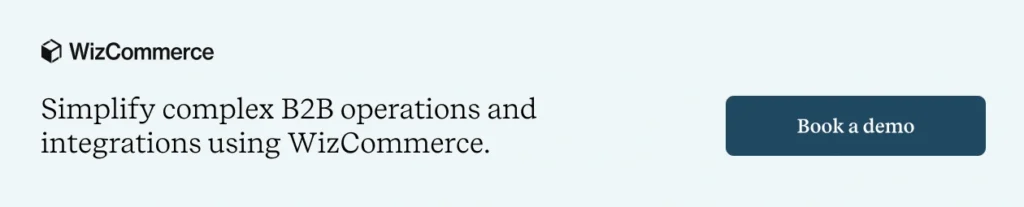
Deciding between vertical integration vs horizontal integration isn’t just a textbook strategy; it’s a pivotal move that can reshape your business’s future. To arrive at the right decision, you need to consider the following factors.
Understanding how these factors interact with your supply chain management infrastructure and digital transformation readiness is essential before committing to either path:
1. Market dynamics and emerging trends
Start by evaluating evolving consumer preferences, trending technologies, and competitive forces. Consider whether the functions you’re acquiring will stay relevant in the long run and whether your target audience will value the benefits offered by these functions.
❓Key questions to ask yourself:
- Will these processes retain relevance as the market evolves?
- Are customers seeking breadth or depth in offerings?
- Will our post-merger strategy stay aligned with industry trends?
2. Strategic objectives
Clarify what you aim to achieve through integration. If your primary goal is gaining a larger customer base and lowering unit costs, horizontal integration might serve best. If your focus is quality assurance and control over production or distribution, vertical integration could be a better route.
❓Key questions to ask yourself:
- What are your short and long term business goals?
- Will this integration path directly support those goals?
3. Resource availability
Evaluate your financial health, leadership bandwidth, and operational expertise. A business with robust logistics or procurement capabilities might benefit more from vertical integration in the supply chain. Those with strong brand presence and market access may find horizontal growth more manageable.
❓Key questions to ask yourself:
- Can you afford and manage this integration?
- Do you have the skillsets needed to execute it effectively?
- Will the merger amplify your core strengths?
4. Legal landscape
Legal barriers can derail even the most promising integrations. For instance, horizontal mergers might draw antitrust scrutiny, while vertical ones may raise issues around licenses, IP, or supplier exclusivity.
❓Key questions to ask yourself:
- Could this merger lead to market dominance concerns?
- Are there compliance risks in either direction?
- What steps can I take to mitigate these issues in advance?
5. Market structure and competitive layout
Examine whether your industry is dominated by a few large players or consists of many small competitors. In concentrated markets, merging horizontally with peers may offer scale and power. In fragmented ones, vertical integration could give you an edge through better process control.
❓Key questions to ask yourself:
- Are you competing in a concentrated or fragmented space?
- Would consolidation or supply chain mastery deliver a stronger advantage?
6. Time and implementation horizon
Horizontal integration often produces faster wins including quicker market entry and increased brand exposure. Vertical strategies tend to be slower but offer sustainable benefits, such as consistent quality and long-term cost savings.
❓Key questions to ask yourself:
- How quickly do you need to see results?
- Will the integration disrupt customer experiences or improve them?
7. Technology compatibility
One of the most underestimated challenges in any merger is tech alignment. Companies often run on different platforms, and integrating these systems smoothly is crucial for operational success. Before merging or acquiring, find out if the other company uses modern, flexible tech solutions like API-first or headless commerce platforms that enable smoother integration.
This matters especially when both entities have built distinct ecommerce and ordering workflows. Understanding supply chain management requirements across both businesses before the deal closes can save significant time and cost during the integration phase.
❓Key questions to ask yourself:
- Are your systems and workflows technologically compatible?
- What tools can bridge the tech gap?
- Which solution partners can help unify operations effectively?
8. Ecommerce and digital operations readiness
Whether you are pursuing vertical integration vs horizontal integration, your digital transformation readiness will determine how quickly you can extract value after the deal closes. A clothing manufacturer integrating forward into direct retail needs a B2B ecommerce platform that can handle customer-specific pricing and order management.
A car manufacturer acquiring distribution networks will need inventory and fulfillment systems that talk to each other in real time. For businesses looking to understand what this readiness involves operationally, exploring wholesale distribution software options is a strong starting point.
How can WizCommerce help with vertical and horizontal integrations?
WizCommerce is an AI-powered B2B commerce platform designed to help businesses modernize their sales operations, strengthen customer relationships, and grow sustainably in competitive markets. Unlike generic B2C platforms or third-party marketplaces, WizCommerce is custom-made to meet the unique demands of B2B commerce, offering the flexibility and control businesses need to scale on their own terms.
How does WizCommerce support vertical integration?
If you’re bringing more of the supply chain under your control, WizCommerce enables operational efficiency and internal alignment post-acquisition with features like:
- Seamless ERP integration: Real-time syncing between WizShop (our B2B ecommerce platform) and the ERP of your merged entity ensures accurate pricing, inventory, and order data across all systems. This ERP integration eliminates manual errors, giving you tighter control over internal workflows despite being a larger organization.
- Custom price lists: When acquiring a supplier or logistics partner, varying pricing rules among different kinds of buyers can create friction. WizCommerce helps unify these with tailored price lists for every type of buyer. This ensures a standardized, controlled sales process across vertically aligned operations.
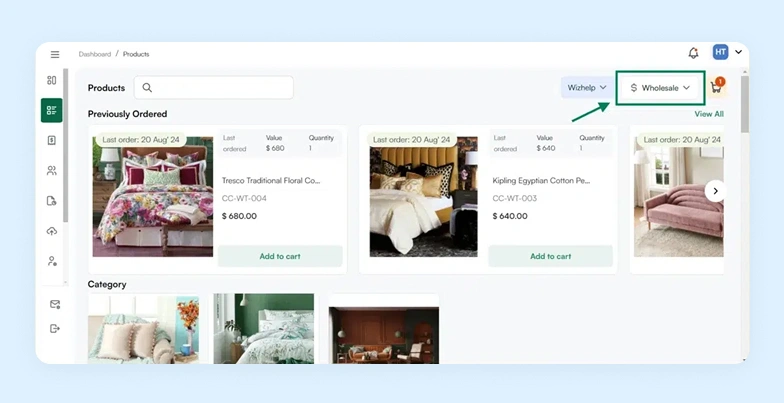
- Customer account management: Vertical integration increases operational complexity. WizCommerce reduces support load by enabling buyers to independently access order status, invoices, and quotes, freeing your team to handle other aspects of the business.
- AI-driven product recommendation: When integrating downstream, availability of teams can shift. WizCommerce automatically recommends substitutes for out-of-stock items, helping maintain continuity in fulfillment and optimizing inventory usage across integrated supply chains.
How does WizCommerce support horizontal integration?
If you’re expanding into new customer segments, geographies, or product categories, WizShop helps you scale while keeping the buying experience consistent and efficient with the following features:
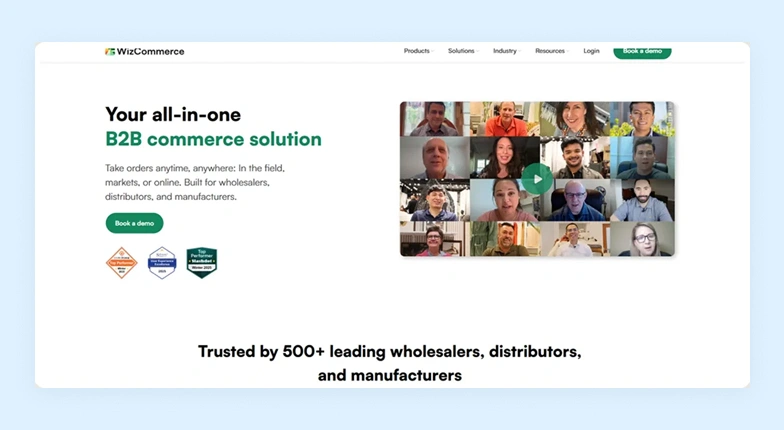
- Infinite customization: Horizontal integration often means managing diverse brands or buyer personas under one roof. WizCommerce enables custom storefronts, catalogs, and user journeys for each business unit. At the same time, it maintains a unified backend, ensuring a consistent yet tailored experience.
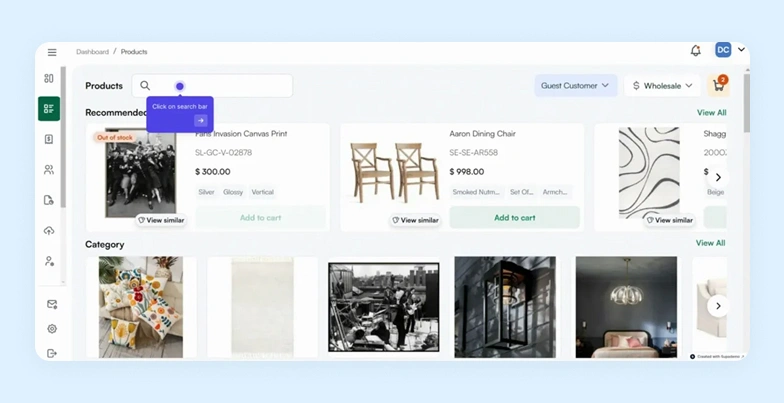
- Advanced product discovery: As you broaden your product catalog by acquiring complementary businesses, product sprawl can overwhelm sales reps. WizCommerce’s powerful search, filters, and sorting tools help them navigate the expanded offering with ease, preserving the simplicity of the buyer journey.
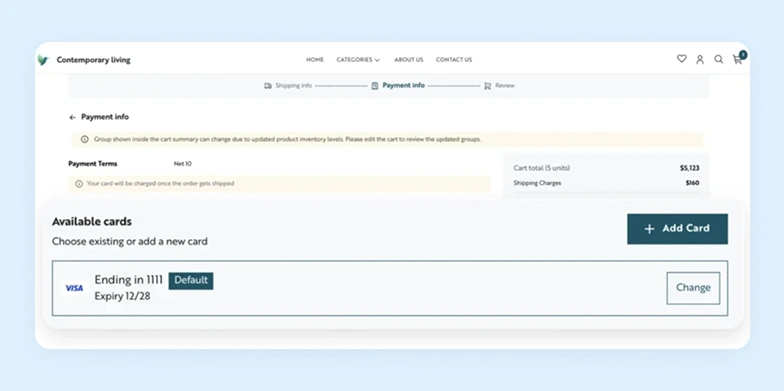
- Flexible B2B checkout: Serving newly acquired customer bases means accommodating different checkout options. With support for POs, net terms, split payments, and delivery preferences, WizCommerce ensures that expanded customer bases, post-horizontal integration, experience frictionless transactions.
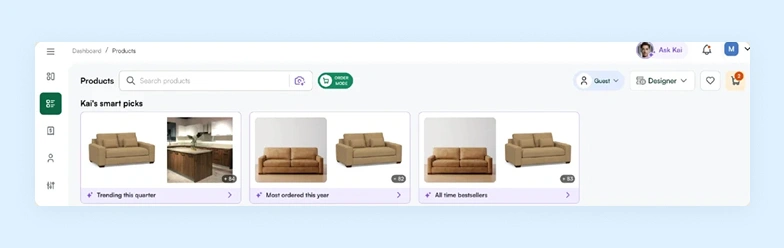
- AI-powered recommendations: When adding new product lines or brands through horizontal integration, cross-sell opportunities often go untapped. WizCommerce’s AI engine surfaces relevant suggestions based on buyer behavior. This helps you immediately extract more value from your expanded product portfolio.
Wrap up
Whether you’re scaling through vertical integration vs horizontal integration, success depends on more than just strategy. It hinges on execution. In the B2B space, that means having a commerce platform built for operational complexity, flexibility, and growth.
WizCommerce checks all those boxes and helps deliver faster, smarter, and more personalized buying experiences across every stage of your integration journey.
Book a free demo to see how WizCommerce supports your B2B growth through vertical, horizontal, or any integration path you choose.
Frequently asked questions
Does Coca-Cola use vertical or horizontal integration?
Coca-Cola primarily uses vertical integration. It is known for controlling its entire supply chain right from owning bottling plants to managing distribution networks. However, it has also used horizontal strategies at times, such as acquiring other beverage brands like Bodyarmor to expand its portfolio.
What is the main difference between a horizontal and vertical merger?
A horizontal merger occurs between companies in the same industry and at the same stage of production, while a vertical merger involves companies at different stages of the supply chain, such as a manufacturer responsible for production merging with a distributor responsible for product sales.
What is the difference between upstream and downstream vertical integration?
Upstream vertical integration refers to a company acquiring or merging with businesses earlier in the supply chain, like external suppliers or raw material providers. In contrast, downstream vertical integration involves taking control of later stages, such as distribution, retail, or direct-to-consumer sales.
What US company was famous for horizontal integration?
Carnegie Steel is one of the most cited examples of a company famous for horizontal integration in the United States. Andrew Carnegie systematically acquired competing steel producers throughout the late 19th century, consolidating the industry under a single entity. This drove economies of scale and gave Carnegie Steel formidable market power over pricing and production processes across the American steel industry.
What is an example of vertical integration?
A strong example of vertical integration is Amazon’s acquisition of Kiva Systems. By bringing robotics and fulfillment automation in-house, Amazon eliminated reliance on external suppliers for a critical stage of its company’s supply chain. This move reduced lead times, lowered production costs, and gave Amazon better control over its distribution process at scale..
What is a real life example of horizontal integration?
The Disney acquisition of 21st Century Fox is a real-life example of horizontal integration that reshaped the entertainment industry. The acquiring company absorbed a direct competitor’s content library, studios and distribution assets. The result was a dramatically expanded market share, stronger market position and deeper economies of scale across product lines.
What is another name for horizontal integration?
Horizontal integration is sometimes referred to as horizontal merger or horizontal expansion. In strategic management literature, it may also appear as lateral integration when describing similar businesses combining across different markets or geographies. The core idea remains the same: combining companies that operate at the same stage of production to achieve greater market dominance and economies of scale.