Skip to content



When it comes to Virto Commerce, there’s one thing the ecommerce platform doesn’t openly share: its pricing. Instead of transparent plans or public tiers, Virto Commerce follows a closed-door and quote-based pricing model. For B2B brands, this lack of visibility makes it difficult to compare alternatives and determine whether the platform fits their financial capacity. In this article, we will help you better gauge the platform’s value by breaking down how Virto Commerce pricing really works using the limited public information available and real-world industry patterns.

What is Virto Commerce, and who is it best for?
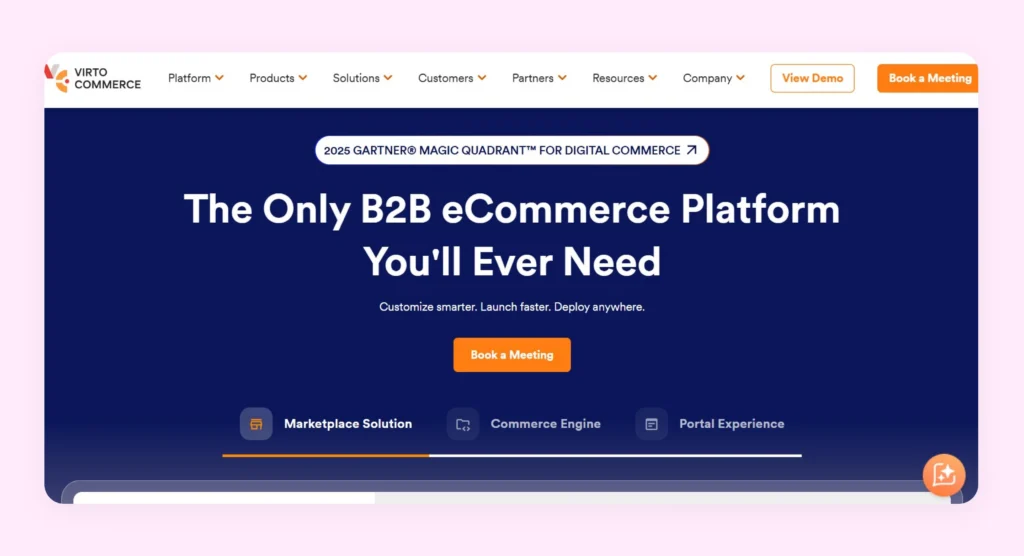
Virto Commerce is a composable and cloud-native ecommerce platform that is well-suited for large-scale commerce operations. It works by separating your front end from the back end and relies heavily on APIs and modular components. In theory, this gives you freedom to customize every layer of your commerce stack. However, this also means you’re expected to build your own ecosystem on top of the platform.
As a result, Virto Commerce is not meant for small businesses. It is also not an ideal choice for all those looking for quick setup and plug-and-play simplicity. If you are a large enterprise dealing with complex B2B or B2B2C models, it can be considered an option. For instance, if you are an enterprise managing multiple buyer types or multi-region-specific operations, it can help streamline your operations to an extent.
Want tips on how to pick the best B2B ecommerce platform for your business? Check out this guide: How to Choose a B2B Ecommerce Platform for Your Business.
How does Virto Commerce pricing work?
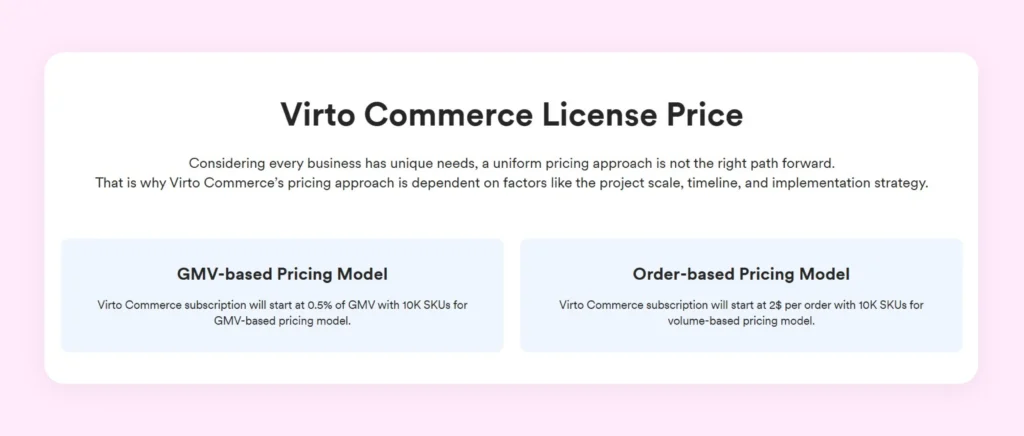
Virto Commerce operates on a sales-led pricing model. This means every potential customer receives a tailored quote based on their business size and technical requirements, which contrasts with the more open cost structure discussed in WooCommerce pricing. So before you receive a concrete number, you’re expected to explain your use case, projected volume, infrastructure needs, and customization requirements. Only after this process does Virto Commerce determine what you’ll pay.
While the company doesn’t openly disclose full pricing breakdowns, available information on their website suggests that Virto Commerce primarily relies on two main licensing models:
1. GMV-based pricing model
Under the GMV (Gross Merchandise Value) model, pricing is tied directly to how much revenue your business generates. Subscriptions typically start at around 0.5% of GMV. There is also a base allowance of approximately 10,000 SKUs.
This means the more you sell, the more you pay. As your revenue grows, your licensing costs increase alongside it. While this may sound reasonable for high-growth businesses, it also means your expenses are directly linked to performance. In other words, your success is always an ongoing cost factor.
2. Order-based pricing model
In this model, pricing is calculated based on the number of transactions processed through the platform. Plans start at $2 per order. There is a baseline of 10,000 SKUs. Here, your costs grow with transaction volume rather than revenue. For businesses that process large numbers of low-value orders, such as wholesalers or B2B distributors, this model can become expensive quickly. Even modest margins can be affected when every order carries a fixed platform fee.
Both pricing models reinforce the same message: “Virto Commerce is designed to monetize scale”. So, irrespective of whether you choose GMV-based or order-based pricing, your costs are going to increase as your business grows. If you are wondering how much a typical B2B ecommerce platform costs in 2026, check out this guide: B2B Commerce Platform Pricing 2026: How Costs & Models Work.
What’s included in the Virto Commerce cost?
Your subscription fee for Virto Commerce generally covers a broad set of functional modules. Instead of offering fixed feature bundles, the platform provides access to different capabilities based on your requirements. As a result, what is included in your license can vary from what your competitor has. Nevertheless, here are some common B2B ecommerce features typically included in most Virto Commerce licenses:
- Order management system (OMS): It covers tools for managing complex order workflows. This includes tasks like split shipments, approval processes, returns, and order status tracking.
- Catalog & product information management (PIM): It covers capabilities related to maintaining multi-level catalogs, custom attributes, product variants, large product datasets, etc.
- B2B portal and self-service features: It offers customer-facing portals for ordering, accessing invoices, managing accounts, and viewing order history.
- Personalization and recommendation capabilities: You get AI-supported features for product recommendations and behavioral targeting.
- Content management & CMS integration: The platform offers basic content creation tools for landing pages and banners.
- Pricing, promotions & quoting tools: You get support for personalized pricing and bulk discounts. You can also set up contract-based catalogs and CPQ-related workflows.
- API-based integrations: There are open APIs and connectors for integrating with ERP systems, CRMs, payment providers, analytics platforms, and other third-party tools.
What are the additional costs to consider with Virto Commerce?
The licensing fee of Virto Commerce represents only one part of the overall investment. There are several additional costs hiding in plain sight that can significantly influence your total cost of ownership. Below are the key cost areas that you should factor into your budget planning:
1. Solution partner costs
Virto Commerce is not a plug-and-play platform. It is deployed through certified system integrators or specialized solution partners. These partners are responsible for designing the architecture, configuring modules, customizing workflows, and ensuring the platform aligns with business requirements. The costs of these partners can vary based on project scope and regional labor rates.
- Approximate cost: $50,000 – $200,000
2. Data migration and integration
Most Virto Commerce implementations involve migrating existing product, customer, and order data from legacy systems. This means it is commonly integrated with ERP systems for finance and inventory, CRM platforms for customer management, PIM tools for product data, and analytics or marketing systems. Although APIs enable these connections, real-world integrations often require custom middleware, data mapping, synchronization logic, and continuous monitoring, all of which can add to your operational expenses. Furthermore, most third-party platforms come with their own subscription or licensing fees, which contribute to long-term operating costs.
- Approximate cost: $5,000 to $50,000
3. Infrastructure
Depending on the deployment model, you have to manage your own infrastructure at different levels. For self-managed or private cloud environments, this includes costs related to cloud hosting, storage, networking, load balancing, and backup systems. Security investments such as firewalls, encryption, compliance tooling, and penetration testing may also be required. Additionally, high-availability setups and disaster recovery solutions can further increase infrastructure spending.
- Approximate cost: $10,000 to $40,000
4. Ongoing maintenance
After go-live, long-term operational costs become a key consideration. Regular platform updates and security patchesrequire planning and deployment efforts. In customized environments, upgrades may involve refactoring existing code to ensure compatibility. Performance optimization is another recurring cost, especially as your product volume and user base grow. This may include database tuning and frontend optimization.
- Approximate cost: $15,000 – $50,000
Is Virto Commerce worth the cost?
To determine whether Virto Commerce is worth your investment, it is important to evaluate the platform from a total cost of ownership perspective. This means considering not only how much you pay to use the software, but also how much you spend on development, integrations, infrastructure, and ongoing maintenance. To illustrate this better, let’s examine a practical example using the GMV-based pricing model of Virto Commerce.
Imagine you are a mid-sized B2B wholesaler launching an ecommerce ecosystem using Virto Commerce.
- Annual online revenue (GMV): $5 million
- Product catalog: 20,000 SKUs
- If pricing starts at around 0.5% of GMV, the annual license cost would be: $5,000,000 × 0.5% = $25,000 per year.
- As your revenue grows, this cost increases automatically. For instance, if your GMV reaches $10 million, your licensing fee doubles to $50,000 annually.
At first glance, this may seem reasonable. However, licensing is only the starting point. Here is a breakdown of other costs involved and the total cost of ownership for a Virto Commerce-powered store –
| Cost category | Approximate cost (Per year) |
| License (GMV-based) | $25,000 |
| Solution partner costs | $50,000 – $200,000 |
| Data migration and Integration | $5,000 to $50,000 |
| Infrastructure | $10,000 to $40,000 |
| Support & Maintenance | $15,000 – $50,000 |
| Total Cost Of Ownership | $105,000 – $36500 |
As you can see, the licensing fee represents only a fraction of your first-year investment. The majority of costs come from development and operations. This means Virto Commerce can deliver strong returns only when you fully utilize its flexibility and enterprise-level capabilities. Also, organizations with strong in-house development benefit by reducing dependency on external partners and lowering long-term operating expenses.
The platform’s returns may be difficult to justify for small or mid-sized businesses with simple ecommerce needs, such as basic catalogs or standard checkout, as much of its advanced functionalities may remain unused. Similarly, companies without internal technical resources often face high ongoing partner costs for updates and maintenance. This, again, can significantly reduce ROI.
If you are a brand seeking faster implementation, predictable costs, built-in B2B functionalities, and no heavy technical overhead, a virto commerce alternative becomes the logical next step, and the ones built for wholesale reach payback inside 30 days rather than across a full replatform cycle. This is where WizCommerce stands out.

Why WizCommerce is a value-driven alternative to Virto Commerce for B2B brands?
While Virto Commerce is built for highly complex enterprise architectures, it often requires heavy customizations and long implementation cycles, the point at which non-technical teams start looking for a virto alternative where editing a tiered price list does not need a developer. You get built-in wholesale features related to customer-specific pricing, bulk ordering, reordering, ERP integration, tradeshow support, and a lot more. This means you can launch quickly without extensive technical overhead.
At the same time, WizCommerce provides the flexibility and customization capabilities needed by growing and large enterprises. You can adapt workflows and integrations as they scale. So, by reducing dependency on external partners and minimizing long-term development costs, WizCommerce helps lower your total ownership expenses without compromising on operational efficiency.
Looking for a scalable, cost-effective Virto Commerce alternative? Book a demo now.
Frequently Asked Questions
What are the main pricing options available for Virto Commerce?
The main pricing options available for Virto Commerce include a GMV-based model and an order-based model. In the former, your subscription fees are tied to a percentage of sales revenue. In the latter, your fees depend on transaction volume. Instead of fixed public tiers, pricing is customized based on your business size and usage levels. While this makes costs flexible, it also makes it far less predictable for long-term budgeting. This is not the case with WizCommerce, where the pricing is predictable, and there are no hidden costs.
How does Virto Commerce’s subscription model work?
Virto Commerce’s subscription model works through an enterprise structure negotiated via direct sales, typically based on revenue and order volume. It can also depend on the selected modules. You pay an annual or multi-year license fee, which grants access to the platform and core functionalities. As your usage grows, subscription costs will multiply quickly, which is typically not the case with WizCommerce.
Are there any hidden fees or additional costs with Virto Commerce pricing plans?
There are several hidden fees or additional costs with Virto Commerce pricing plans that are not included in the base subscription. These often include implementation partner fees, custom development, system integrations, infrastructure, and ongoing support. The subscription cost of third-party apps may also apply. As a result, the total cost of ownership is often significantly higher than the initial license fee alone.
What factors influence the cost of implementing Virto Commerce for a business?
The factors influence the cost of implementing Virto Commerce for a business include project complexity, integration counts, and customization requirements. Catalog size, and geographic deployment are some of these. Businesses with complex B2B workflows or multi-region setups usually face higher costs. The availability of in-house technical resources and reliance on external partners also play a major role in determining overall implementation expenses.
How does Virto Commerce pricing compare to other B2B ecommerce platforms?
Virto Commerce pricing compares to other B2B ecommerce platforms by positioning itself in the higher-cost enterprise segment. While it offers strong flexibility and modularity, its pricing and implementation overhead can be significant. In contrast, WizCommerce focuses on deploying your store in the fastest time possible and at completely predictable pricing, making it more accessible for growing distributors and wholesalers with limited technical resources.
Is there a free trial or demo available for Virto Commerce?
There is no self-service free trial or demo available for Virto Commerce, typically. Virto Commerce does not typically offer a self-service free trial. Instead, interested businesses can request a guided demo or proof-of-concept through the sales team or certified partners. These demos are usually customized to specific use cases and requirements. This will help you evaluate the platform’s suitability before committing to a long-term contract.
Can I customize my Virto Commerce plan based on my business needs?
Yes, You can customize your Virto Commerce plan based on your business needs by choosing specific modules and deployment models. Pricing is adjusted accordingly during negotiations. While this flexibility allows tailored solutions, it can also increase complexity and cost. Many businesses prefer platforms like WizCommerce that offer more predictable pricing with quicker implementation.