Skip to content



Have you ever sent out a quote to a potential client and then heard nothing back? You put in the effort to craft the perfect proposal, whether manually or using AI-powered quote automation tools, only to be met with silence. The good news is that a well-structured process can turn the tide in your favor: the follow-up email quotation.
Did you know that following up with leads within one minute can boost your chances of conversion by 391%? That stat highlights how crucial timely follow-up quote emails are in the sales process. So, the next time you are tempted to wait it out, remember that quick action can make all the difference in whether a deal closes or fades.
Imagine you sent a follow-up email for a quotation on a big project that could significantly boost your business, but days pass, and there is no response. A well-timed quotation follow-up email shows your potential client that you are proactive, professional, and genuinely interested in their business.
This guide covers how to write a follow-up email after sending a quotation to a client, when to send it, and which templates convert best across different stages of the buyer decision cycle.
Why do clients go silent after you send a follow-up quote?
Silence after sending a quote follow-up email is more common than most sellers expect. Understanding the real reasons buyers go quiet helps you address those reasons directly in your follow-up quotation email rather than sending a generic check-in that gets ignored.
- Internal approval delays: Most B2B purchases require sign-off from multiple stakeholders before a decision can move forward. Your contact may be waiting for budget approval, a manager review, or input from their sales team before they can respond to your follow-up email quotation with any certainty.
- Competing priorities at the time of receipt: Buyers receive your quote during their normal working day, when they are under competing demands. Your proposal lands in their inbox alongside other urgent tasks, and even interested buyers can lose track of a quotation follow-up email when their schedule gets disrupted.
- Price concerns left unaddressed in the original quote: When buyers see a price that surprises them or raises questions, many go quiet rather than respond with objections. They may need further clarification on the value proposition before they can respond. If your original quote did not anticipate their concerns, a follow-up offering to discuss specific benefits can reopen the conversation.
How long to wait before sending a follow-up email on a quotation?
Timing your follow-up quote email correctly is one of the most practical decisions you make in the entire sales process. If you send it too early, you come across as impatient. Wait too long, and your proposal gets buried under newer priorities. Almost 44% of salespeople give up after one follow-up, yet one follow-up is rarely enough to close a deal.
Let’s break down the factors that affect the timing of your follow-up and find that perfect moment to hit send.
Factors affecting the timing of a response
- The urgency of the client’s needs: If the potential client expressed an urgent need or tight deadline, a prompt follow-up email after sending a quotation to the client within 24 to 48 business hours shows you are attentive and ready to act on their timeline. Waiting too long in urgent situations signals that you are not paying attention to your client’s needs.
- The complexity of the quotation: A detailed, multi-line quote requires more time to review. If your proposal involved custom configurations or significant investment, waiting a full week before sending your follow-up email quotation gives the buyer enough space to review it with their team without feeling pressured by early check-ins.
- Industry standards and client expectations: Different industries have different norms for response times and communication cadence. In legal, manufacturing, or construction sectors where decisions are made deliberately, a quotation follow-up email sent after a full week aligns better with how buyers in those industries operate.
Optimal waiting period before sending the first follow-up email
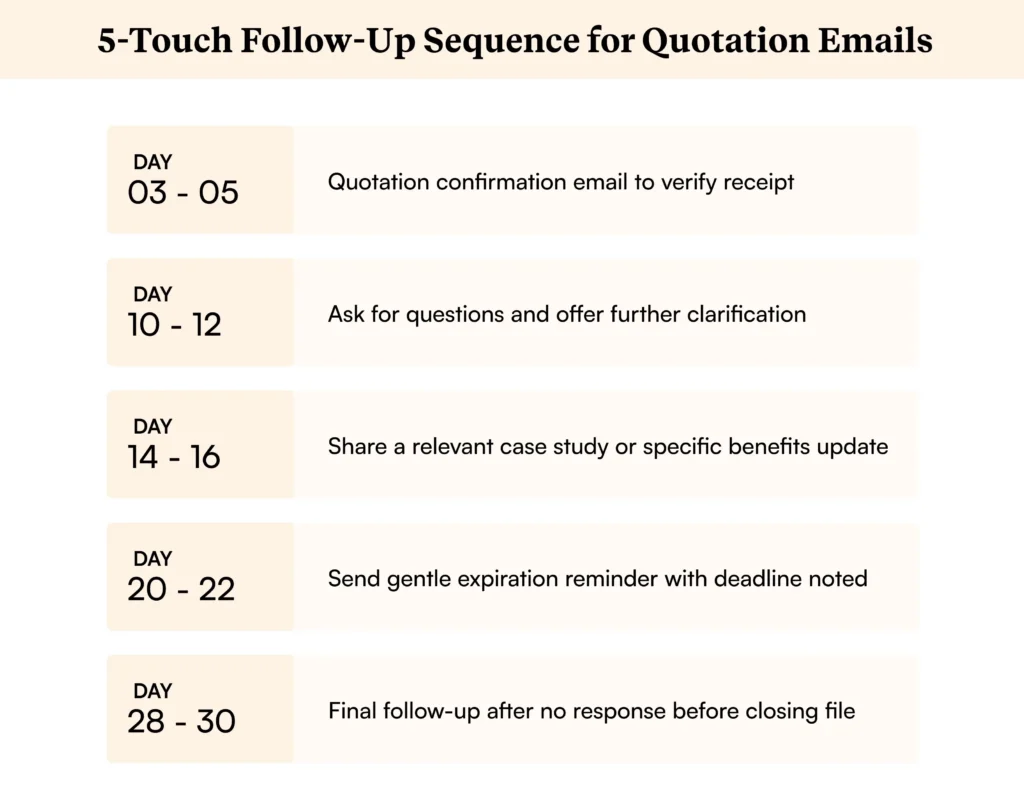
Three business days to one week is the recommended window for the first follow-up quote touchpoint. This gives the prospective client enough time to review your quote without feeling pressured. If you mentioned a specific decision timeline in your original proposal, align your follow-up with that commitment; consistency builds trust across every communication channel.
For trade show contexts where follow-up timing is compressed, this guide on high-point market email marketing and templates covers how to adapt your sequence for post-event buyer conversations.
Pro tip: Keep a record of every first email you send with a date stamp. When the best time to follow up arrives, you will have the exact context needed to personalize your message rather than sending a generic nudge that adds no new value to the conversation.
6 High-converting Quotation Follow-up Email Templates
Crafting the perfect follow-up email can significantly impact your chances of closing a deal.
One effective approach is using iLovenote; its AI email writer analyzes your provided details about the client and situation and generates personalized emails.
Did you know that 96% of organizations believe that email personalization can improve email marketing performance? This highlights how crucial it is to personalize your follow-up emails. Here are some effective templates to guide you in creating impactful follow-up emails.
1. Template: confirmation of receipt
This is the foundational quotation confirmation email sample that every seller should send within three business days of the original quote.
Email subject line: Did you receive our quote for [project name]?
Body:
Hi [Contact Name],
I hope your week is going well. I wanted to confirm that you received the quote I sent on [date] for [service name]. If anything needs further clarification or you need additional information before moving forward, I am happy to set up a quick call at your convenience.
Please let me know if there is a best time that works for your busy schedule.
Best regards,
[Your Name]
[Phone number] |
[Email address] | [Company name]
When to send: 3 business days to one week after the initial quote.
2. Template: asking for questions
Email subject lines: Did we explain everything well? / Do you have questions?
Body:
Hi [Contact Name],
I wanted to check in and see if you had any questions about the quote I sent on [date]. If there are any key points you would like to revisit or any specific needs that were not fully addressed in the original proposal, I am happy to discuss them directly.
Feel free to reply here or book a quick call whenever works best for you.
Best regards,
[Your Name]
When to send: 2-3 weeks after the quotation is sent.
3. Template: expiration reminder
Email subject lines: Friendly reminder: Your offer will expire
Body:
Hi [Contact Name],
This is a gentle reminder that the quote I provided on [date] is set to expire on [expiration date]. If you need more time or have further questions before reaching your final decision, please let me know, and we can discuss extending the offer.
We are still very interested in supporting your specific needs and are ready to move forward whenever you are.
Best,
[Your Name]
When to send: Close to the expiration date, 3 days to one week in advance.
4. Template: proposal accepted
Email subject line: Thank you! One last question before we start
Body:
Hi [Contact Name],
Thank you for accepting our proposal. We are excited to move this forward. Before we begin, I wanted to confirm the final details and check whether you need any additional resources or clarification on the next step.
Your feedback is valuable to us, and we are here to ensure everything goes smoothly as we move forward.
Thanks again,
[Your Name]
When to send: Immediately after the proposal is accepted.
5. Template: proposal rejected
Email subject line: Thank you!
Body:
Hi [Contact Name],
Thank you for considering our proposal. While I’m sorry to hear that you’ve decided to go in a different direction, I appreciate the opportunity to discuss your needs. If possible, could you share any feedback on why our proposal wasn’t a fit? This will help us improve for future opportunities.
Please do not hesitate to reach out if your specific needs change or if we can offer assistance down the line. We would love to stay on good terms.
Best regards,
[Your Name]
When to send: The same day the proposal is rejected.
6. Template: follow-up after no response
This follow-up quotation email is specifically for situations where your previous email received no reply after a reasonable window has passed.
Email subject line: [First name] — quick question on your [project name] quote
Body:
Hi [Contact Name],
I sent over a follow-up email quotation for [project name] [last week] and wanted to check in briefly. I understand your busy schedule, and I’m looking to pressure you. I simply want to confirm this is still relevant and that I have addressed any outstanding questions or areas needing clarification.
If the timing is not right or if priorities have shifted, I am happy to revisit this at a better moment. A quick question: Is there anything in the proposal I can adjust to better align with your client’s needs?
Happy to jump on a phone call if that is easier than email.
Best regards,
[Your Name]
[Phone number]
[Contact information]
When to send: 2 to 4 weeks after the previous email with no response received
These templates are designed to keep your communications professional, friendly, and effective. Remember, the key is to be polite, clear, and persistent without being pushy.
Templates only work if something reminds you to send them. That tracking usually sits in the CRM rather than the inbox – see our comparison of the best CRM for wholesale, and our guide to tools for a successful B2B sales process.
For teams that also handle trade show selling and post-show follow-up, the trade show marketing and follow-up guide covers how to connect your in-person pipeline with your email sequences for a unified sales process across all channels.
3 Must-Have Elements of a Successful Follow-Up Quotation Email
Follow-up emails are a core part of your sales process, often determining whether you close a deal or lose a prospective client. According to DMA, personalized emails account for 58% of total revenue through segmented campaigns. This is why every follow-up email quotation must include these three elements to perform.
1. Killer subject lines to grab attention
Your potential client opens their inbox and sees dozens of unread messages. A compelling subject line is the first thing that determines whether your follow-up email for quotation gets opened or ignored. A strong email subject line is direct, relevant, and creates a sense of purpose without being sensational.
Subject lines like “Did you receive our quote for [project name]?” or “Quick question about your [service name] proposal” are specific, low-pressure, and invite a reply. The open rate of your follow-up quotation email lives or dies on this single line of text, so treat it as a headline, not a formality.
The best way to test subject line performance is to compare two variations across consecutive sends to similar audiences. Track open rate differences and let real data guide your refinement rather than assumptions about what sounds professional.
2. Clear and compelling call to action(CTA)
Once your cold email or follow-up quote email is opened, the reader needs to know exactly what to do next. A clear and specific CTA removes that friction. Whether it is scheduling a quick call, confirming receipt of the follow-up email quotation, or answering a simple question, your CTA should be one clear action, not a list of options that creates decision paralysis.
Phrases like “Are you open to a 10-minute phone call this week to discuss the next step?” or “Can you confirm whether the scope in the quote matches your specific needs?” are both low-pressure and direct. The best chance of getting a reply is to ask for a response that requires minimal effort from a busy schedule.
3. Professional and friendly tone
Striking the right tone of your follow-up quotation email means being approachable without being casual and professional without being cold. Your good email reflects your brand and your company name simultaneously. Phrases like “I hope this email finds you well” or “I am here to help with any further questions” set a constructive tone that makes your email feel like a conversation rather than a pressure tactic.
Avoiding a sales pitch tone in your follow-up email for quotation is critical because buyers who are still evaluating will disengage the moment they feel sold to rather than supported. Lead with helpfulness, and the value proposition will come through naturally.
Tips for Enhancing Follow-Up Emails
Follow-up emails that improve consistently over time outperform those that rely on a fixed template. 74% of marketers say targeted and personalized emails improve customer engagement rates, which means your best practices for follow-up quote emails should evolve as you gather data.
1. Respect email etiquette and branding
Professional language, clean formatting, and zero typos are the baseline for any follow-up email after sending quotation to client. Your emails should also reflect your company name and brand visuals consistently. A branded email template builds recognition across every touchpoint and signals to the buyer that they are dealing with a credible, organized business.
2. Include comprehensive contact details in the email footer
Every follow-up email quotation should end with your full contact details in the footer — including your phone number, email address, company name, and relevant social media profile links or your company website. Making it easy to reach you through any communication channel reduces the friction that stops buyers from responding when they are ready to engage.
3. Sound human and personalize emails
No one likes receiving emails that sound like they were generated by a robot. Make your emails sound human by personalizing them. Use the recipient’s name, reference past conversations, and tailor the content to their specific needs. Personalization shows that you’ve put thought into your communication and are genuinely interested in helping them.
4. Optimize email templates based on feedback
Your follow-up quotation email templates should be living documents. Track which subject lines drive the highest open rate, which CTAs generate the most replies, and which case study references get the best engagement. Use that data to continuously refine your approach. If a specific email template consistently underperforms, adjust it, do not wait for it to improve on its own.
Tracking Your Follow-Up Emails
Keeping track of your follow-up email for quotation sequences is critical to understanding what is working and what is not. Modern teams now rely on AI-powered tools that prioritize which quotes to follow up on based on buyer intent and give your sales team real-time visibility into how potential clients are engaging with your messages. For B2B sellers managing quotes across multiple accounts, understanding this visibility is covered in the context of B2B ecommerce best practices and how data-informed selling improves close rates over time. Tracking works best when the quote and its follow-ups sit on the account itself, which is why CRM and quoting for distributors belong in the same system rather than two. An expiring quote then surfaces as a task against the buyer’s record instead of waiting in a rep’s sent folder.
Benefits of email-tracking
Email tracking tells you whether your follow-up email quotation was opened, how many times it was viewed, and whether any links were clicked. This is valuable data that lets your sales team prioritize follow-up effort on engaged leads rather than spending equal time on buyers who never opened the message. Knowing when a potential client re-reads your proposal signals that they are reconsidering, the right time for a personal phone call.
Insights provided by tracking tools
Tracking tools surface open rate, click-through rate, and reply time metrics that show you how effective each quote follow-up email variation is across your full pipeline. If emails sent at a specific time of day consistently outperform others, adjust your sending schedule accordingly. If a case study link inside a follow-up quotation email gets frequent clicks, build more of that additional resources content into your templates going forward.
Common mistakes to avoid in quotation follow-up emails
In the world of follow-up emails, there’s a fine line between being persistent and being pushy. Striking the right balance is crucial to maintaining a positive relationship with potential clients. Here’s how to avoid coming off as too aggressive while still keeping the conversation alive.
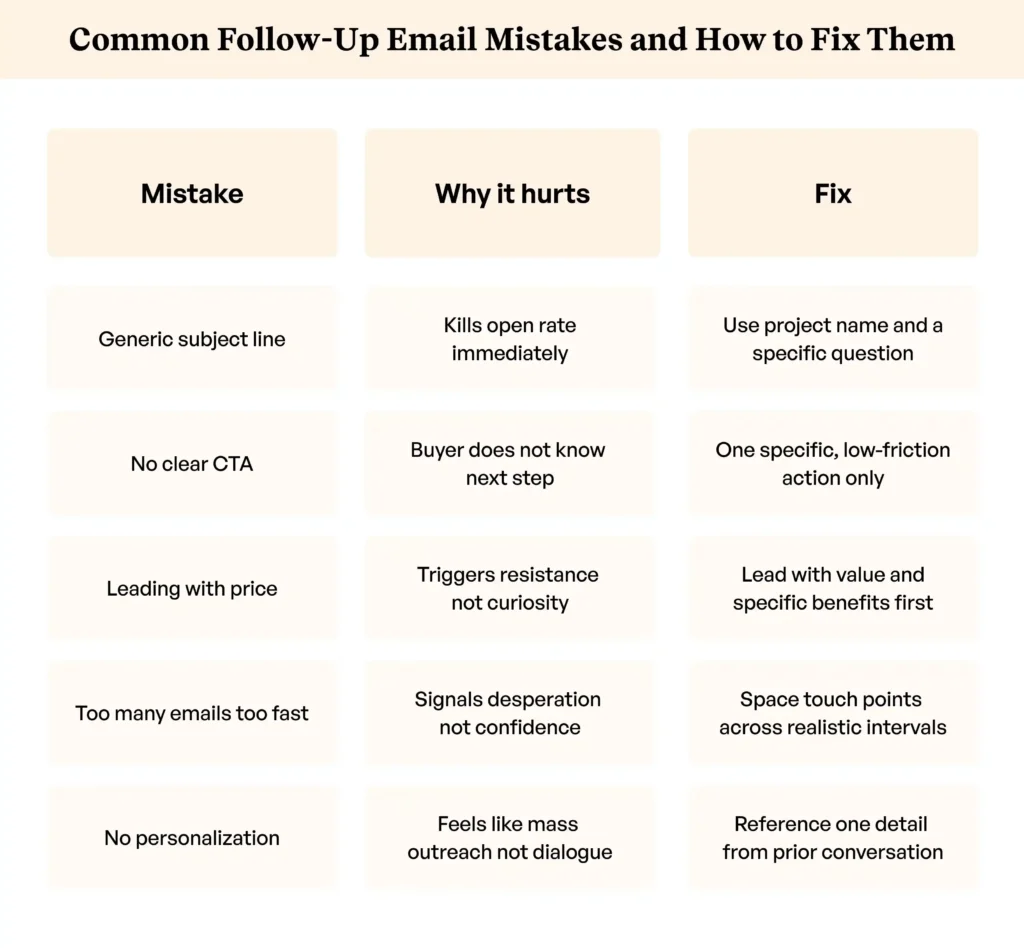
- Sending too many follow-ups too quickly: Flooding a prospective client with multiple messages in a single week creates the impression that you are desperate rather than confident. Space your follow-up quotation email sequence across realistic intervals that match the decision timeline your buyer is actually working within.
- Using a generic subject line: A vague email subject line like “Following up” gives the recipient no reason to open your email. Reference the project name, service name, or a quick question that makes the content immediately relevant to them.
- Leading with price rather than value: A follow-up email for quotation that opens by defending your price rather than reinforcing your specific benefits triggers resistance rather than curiosity. Lead with what the buyer gains, and the price conversation will follow more naturally.
- Failing to offer a clear next step: Every quotation follow-up email must end with one specific, frictionless action. If you leave the next step ambiguous, buyers default to doing nothing, which keeps the deal stuck at the same stage indefinitely.
- Ignoring non-reply signals and continuing regardless: Know when to stop. If a potential client has not responded after four or five follow-up quote touchpoints over a month-long window, a graceful exit email that closes the loop on good terms is more professional than continued pursuit.

Automate your quotation follow-up workflow with WizCommerce
Mastering the art of follow-up email quotation sequences can make a real difference in how consistently your sales team closes deals. Timing, personalization, a compelling subject line, and a clear CTA are the four variables that determine whether your quotation follow-up email moves a deal forward or gets buried in the inbox.
Strategic follow-up quote emails reflect your commitment to the potential client and show that your sales process is built around their timeline rather than your urgency. Even when a final decision does not go your way, professional communication on good terms keeps the door open for future business.
WizCommerce gives your sales team the infrastructure to manage quotation workflows, automated follow-up sequences, and order processing from a single platform. From initial quote generation through to closing and onboarding new wholesale accounts, WizCommerce removes the manual work that slows down response rates and drains selling time. The platform’s AI quote and order automation converts incoming purchase orders, automates quote generation, and handles follow-up sequencing so reps focus on conversations rather than administration.
Book a demo with WizCommerce and see how it transforms your follow-up operations.
Frequently asked questions
1. What is a follow-up email?
A follow-up email is a professional message sent after an initial interaction, such as a sales pitch, job interview, sent quotation, or meeting, with the core purpose of maintaining momentum, clarifying next steps, or politely reminding the recipient to take a specific action, thus helping to nurture the relationship and move a process toward a tangible outcome.
2. What are examples of good follow-up emails?
Examples of good follow-up emails are those that add value rather than just checking in, such as a Value-Add Follow-Up that shares a relevant case study or new product insight, a Recap Email sent after a meeting that summarizes key discussion points and clearly outlines next steps for both parties, or a Break-Up Email that offers an out clause to politely gain a definitive yes or no answer.
3. What is the best follow-up email?
The best follow-up email is one that is highly concise and personalized, references a specific detail from the last interaction to jog the recipient’s memory, and contains a single, clear call-to-action (CTA), such as a low-pressure question like: Are you open to a quick 10-minute call this Thursday to finalize the plan?
4. How to follow up on a request for quotation?
To follow up on a request for quotation, send a brief email a few days after the initial quote, re-attaching the proposal for convenience, and pivot the conversation away from the price toward the value by saying something like, I wanted to check if the proposal aligned with the timeline and solution you were hoping for to achieve a specific goal.
5. How to follow up on getting a quote?
To follow up on getting a quote, send a polite, short message with a clear next step, using a subject line that references the project name, and ask a specific, low-friction question such as, “Did you have a chance to review the quote, and “Are there any technical details I can clarify for you?”
6. How to send a reminder email for quotation?
To send a reminder email for a quotation, use a subject line that creates a gentle nudge, such as Quick question on your quote for Project, and keep the body extremely brief, simply confirming receipt, re-attaching the document, and offering to walk them through the details or make adjustments to better fit their budget or scope.
7. How do you follow up on a quote email?
You follow up on a quote email by sending a concise, personalized message that re-attaches the quote, asks one specific question to encourage a reply (e.g., Are there any concerns about the timeline or features I should address?), and offers assistance or clarity, thereby removing any friction that might be preventing their decision.
8. How to follow up on an email with no response politely?
To politely follow up on an email with no response, send a brief message referencing the original topic or email subject, briefly summarize the value you offered to jog their memory, and end with a clear, low-pressure request like, Please let me know if there’s anything further I can assist with or if I should connect with someone else on your team.
9. How many follow-up emails should you send after a quotation?
Research shows that 80% of sales require five or more follow-ups, yet most sellers stop after one. For a follow-up email quotation sequence, three to five touchpoints spaced across a 30-day window is the practical best practice standard for most wholesale sales process contexts. Stop after five unanswered attempts and close the loop with a professional exit email that keeps the relationship on good terms.
10. What is the difference between a follow-up email and a reminder email on a quotation?
A follow-up quotation email moves the conversation forward by asking a quick question, offering additional information, or addressing further clarification needs. A reminder email focuses on a specific deadline, like an expiration date or a next step that requires action by a set date. Both have a place in a quote follow-up email sequence, and the distinction determines which email template and email subject line to use at each stage of the buyer journey.