Skip to content



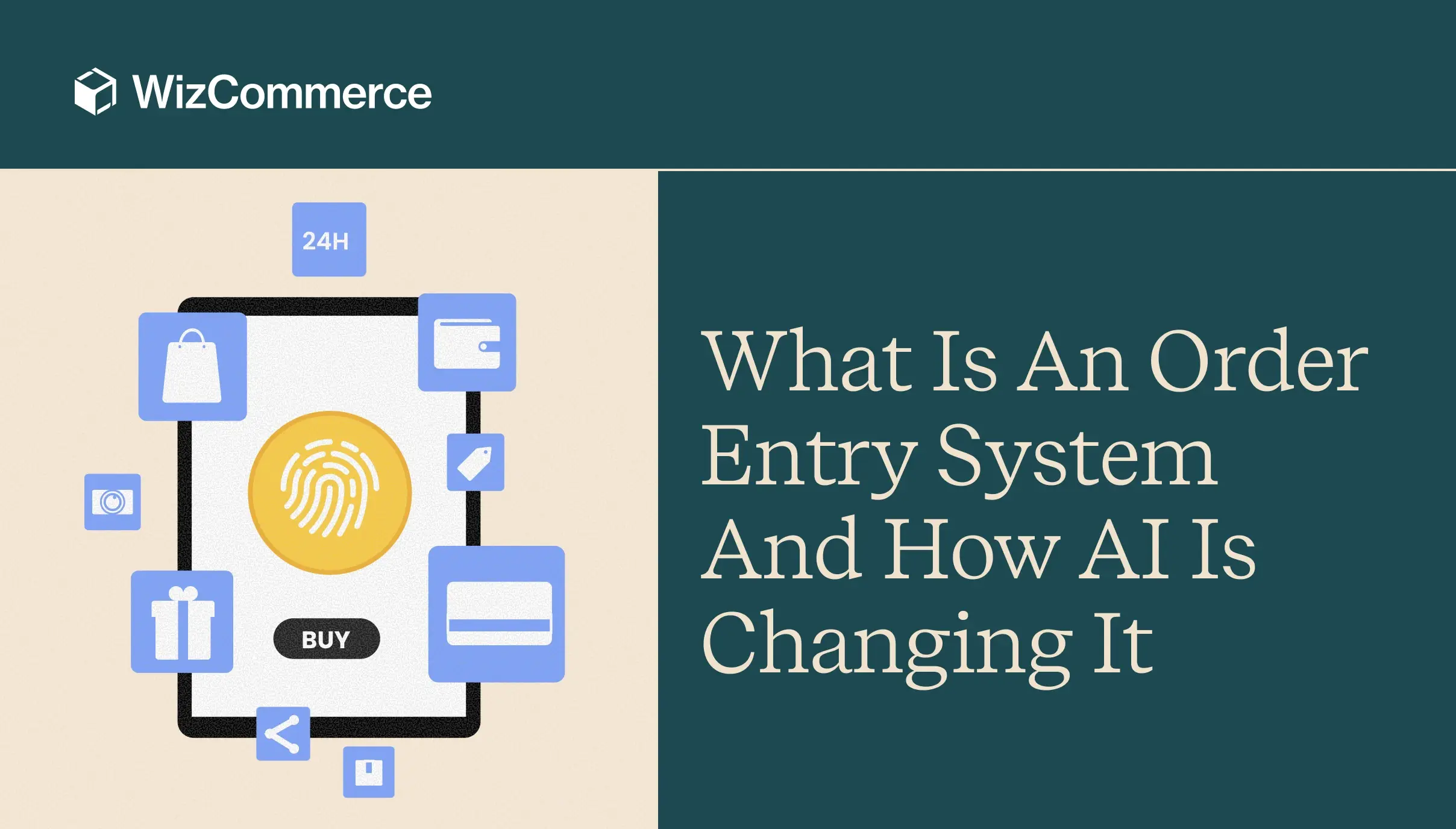
Today’s buyers have 3 basic expectations from sellers – fast responses, accurate deliveries, and real-time updates. If you are a seller handling 10 orders in a day, meeting these expectations is not an impossible task, even if you manage orders manually. But what if it is 100 or 1000 orders? That’s when an order entry system becomes indispensable. Many such sellers already use order entry systems to automate operations, but the systems are quite traditional, hampered by disconnected and outdated workflows.
Smart businesses are switching to AI-powered order entry systems that can drastically reduce manual intervention and predict errors before they happen. In this guide, we will take you through order entry system definition, how it functioned in the past, and how AI is changing it today.
What is an order entry system?
An order entry system is a software solution that helps you capture, process, manage, and track customer orders in a more structured and efficient way. Instead of relying on emails, spreadsheets, or manual paperwork to manage orders, you can use an order entry system to centralize the entire order management process from the moment an order is received to the point it is fulfilled. Here are the core functions of an order entry system:
- Capture customer orders accurately and in a standardized format
- Centralize order information for better visibility across teams
- Have a single source of truth for order data for the sales, inventory, finance, and operations teams
- Validate pricing, quantities, customer details, and inventory availability automatically
- Track order status in real time from creation to delivery
- Generate reports and insights for better operational and revenue decisions
- Automate repetitive workflows such as approvals, invoicing, and notifications
Think of it as the central nervous system of your order fulfilment process. It ensures that every order follows a standardized workflow and gets completed successfully, whether the orders come through sales reps, ecommerce platforms, distributors, or customer service teams.
Types of order entry systems
Today, most order entry systems fall into three major categories: EDI-based systems, AI/OCR-based systems, and RPA-based systems. Here’s how they differ in terms of working:
1. EDI-based systems
EDI (Electronic Data Interchange) based order entry systems are one of the oldest and most widely used forms of order automation. It is particularly used in large enterprises and supply chain-heavy industries. These systems work by exchanging business documents such as purchase orders(EDI 850), invoices(EDI 810), and shipping notices(EDI 856) in standardized digital formats between systems. Instead of a human manually entering order information, the order data flows directly from one company’s ERP or procurement system into another company’s order management system.
The biggest advantage of EDI-based systems is speed and consistency. Since the data follows predefined standards and formats, you can process large order volumes with minimal manual intervention and fewer errors. However, since EDI systems are highly dependent on predefined templates and standardized formats, they struggle when order formats vary across customers. Setting up EDI integrations can also be expensive and time-consuming.
2. AI/OCR-based systems
AI and OCR (Optical Character Recognition) based order entry systems are designed to solve one of the biggest challenges in modern automated order processing: handling unstructured data. Today’s businesses receive orders through emails, PDFs, scanned documents, spreadsheets, handwritten forms, or even images. OCR technology helps extract text and data from documents, while AI adds intelligence by understanding context, identifying patterns, validating information, and learning from previous orders.
Together, they capture critical order details such as product names, quantities, SKUs, pricing, and customer information from a wide variety of formats without requiring strict templates. This makes AI/OCR-based systems highly valuable for businesses that deal with diverse customers, inconsistent order formats, and high document volumes. In other words, it’s suitable for almost every other modern business today.
3. RPA-based systems
RPA (Robotic Process Automation) based order entry systems automate repetitive, rule-based tasks by mimicking human actions within software applications. Instead of deeply integrating systems, RPA bots interact with applications the same way a person would, such as clicking buttons, copying data, filling forms, downloading files, or updating records across multiple systems.
RPA is especially useful in businesses that operate on older legacy systems where direct integrations are difficult, expensive, or impractical. For example, an RPA bot can automatically take order details from an email, enter them into an ERP system, trigger approvals, and update order statuses without requiring major infrastructure changes. However, RPA works best in stable environments with clearly defined workflows. If interfaces change frequently or order formats become highly unpredictable, it starts losing its effectiveness
| Aspect | EDI-based systems | AI/OCR-based systems | RPA-based systems |
| Primary function | Exchange structured order data between systems | Extract and process unstructured order data | Automate repetitive tasks across applications |
| Input format | Standardized EDI documents like EDI 850 | Emails, PDFs, scanned files, images, spreadsheets | Existing business applications and workflows |
| Technology used | Electronic Data Interchange (EDI) | Artificial Intelligence + OCR | Robotic Process Automation |
| Best suited for | Large enterprises with standardized workflows | Businesses handling varied order formats | Companies using legacy systems with limited integrations |
| Flexibility | Low | High | Moderate |
| Handling unstructured data | Poor | Excellent | Limited |
| Scalability | High only for structured environments | High across diverse workflows | High only for repetitive rule-based tasks |
| Maintenance complexity | High during setup and partner onboarding | Requires AI model training and optimization | Requires bot updates if interfaces change |
| Major limitation | Struggles with variable formats | No major limitation | Sensitive to UI or workflow changes |
Challenges in the traditional order entry system
Traditional order entry systems were built for a time when workflows were more predictable, and buyers largely followed standardized procurement processes. But today’s business environment is far more dynamic. As a result, a traditional order entry system struggles to keep up due to some unique challenges, such as:
Manually entering order details into ERP/OMS
While using a traditional order management system, your teams have to sometimes manually read purchase orders from emails, PDFs, spreadsheets, or paper documents and then input the information into ERP or order management systems. B2B sales order processing automation removes that step. This is mainly due to its inability to extract data from varied sources and a lack of seamless connectivity with ERP systems.
Dependency on rigid rules
Traditional systems typically depend on predefined validation rules to check product SKUs, customer details, pricing agreements, shipping addresses, and inventory availability. While this works in highly structured environments, it becomes difficult to manage when customer requirements change frequently.
Frequent errors and manual back-and-forth communication
Manual workflows, no matter how experienced your team is, can lead to data entry mistakes, duplicate records, missing information, incorrect pricing, or inventory mismatches. Resolving these issues usually requires repeated communication between different teams, resulting in delays in order fulfillment.
Limited ability to handle variability in data sources
While handling different document formats is already challenging, managing orders coming from multiple data sources is even more difficult. Modern businesses receive orders through marketplaces, retailers, emails, phone calls, ecommerce storefronts, distributor portals, and sales teams, each with its own structure and processing requirements. Traditional order entry systems are not built to efficiently handle this level of variability. As the number of order channels increases, you might have to fall back on multiple rigid workflows or become heavily dependent on manual processing.
Order confirmation only after manual review
Despite using an order entry system, some of your orders cannot move forward until someone manually reviews and verifies the information. This is because of the surfacing of frequent exceptions involving pricing, inventory availability, customer details, and compliance requirements before confirming the order. While this review process helps reduce mistakes, it also creates delays in order acknowledgment and fulfillment.
How is AI transforming modern order entry systems?
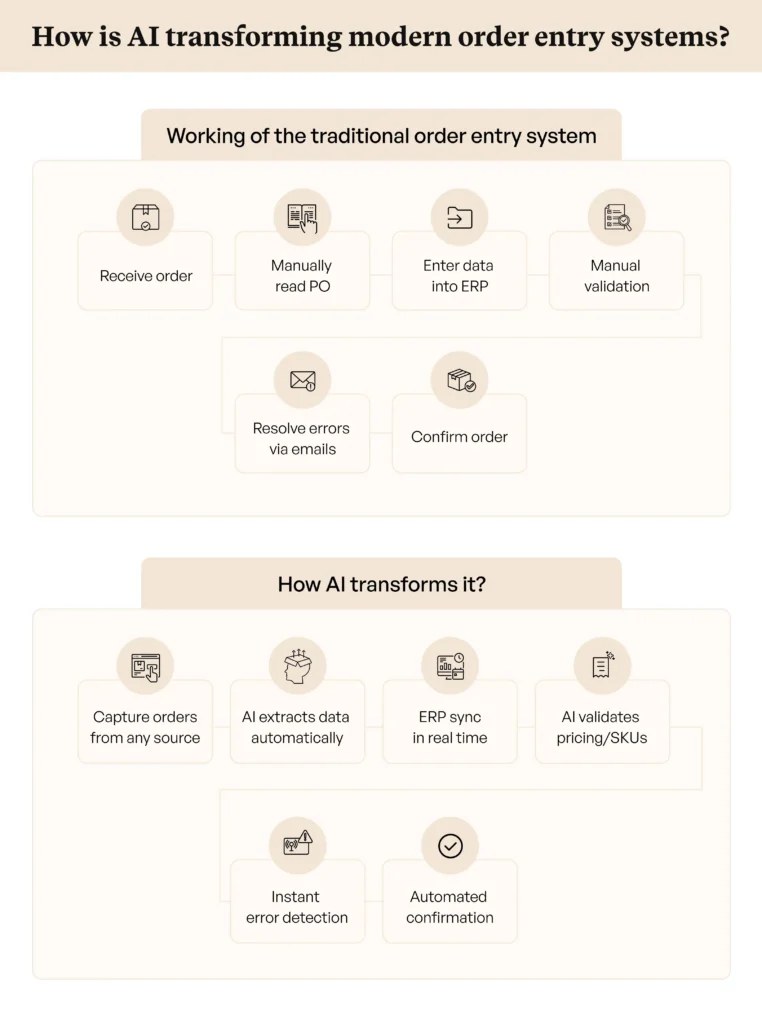
Instead of simply digitizing manual work, an AI-based order entry system understands, interprets, validates, and processes orders with minimal human intervention. Here are some ways in which it transforms modern order entry systems:
Centralizes order capture across channels
One of the biggest advantages of AI-powered order entry systems is their ability to centralize orders from multiple channels into a single workflow. AI-powered platforms can automatically capture and consolidate order information regardless of the source or format.
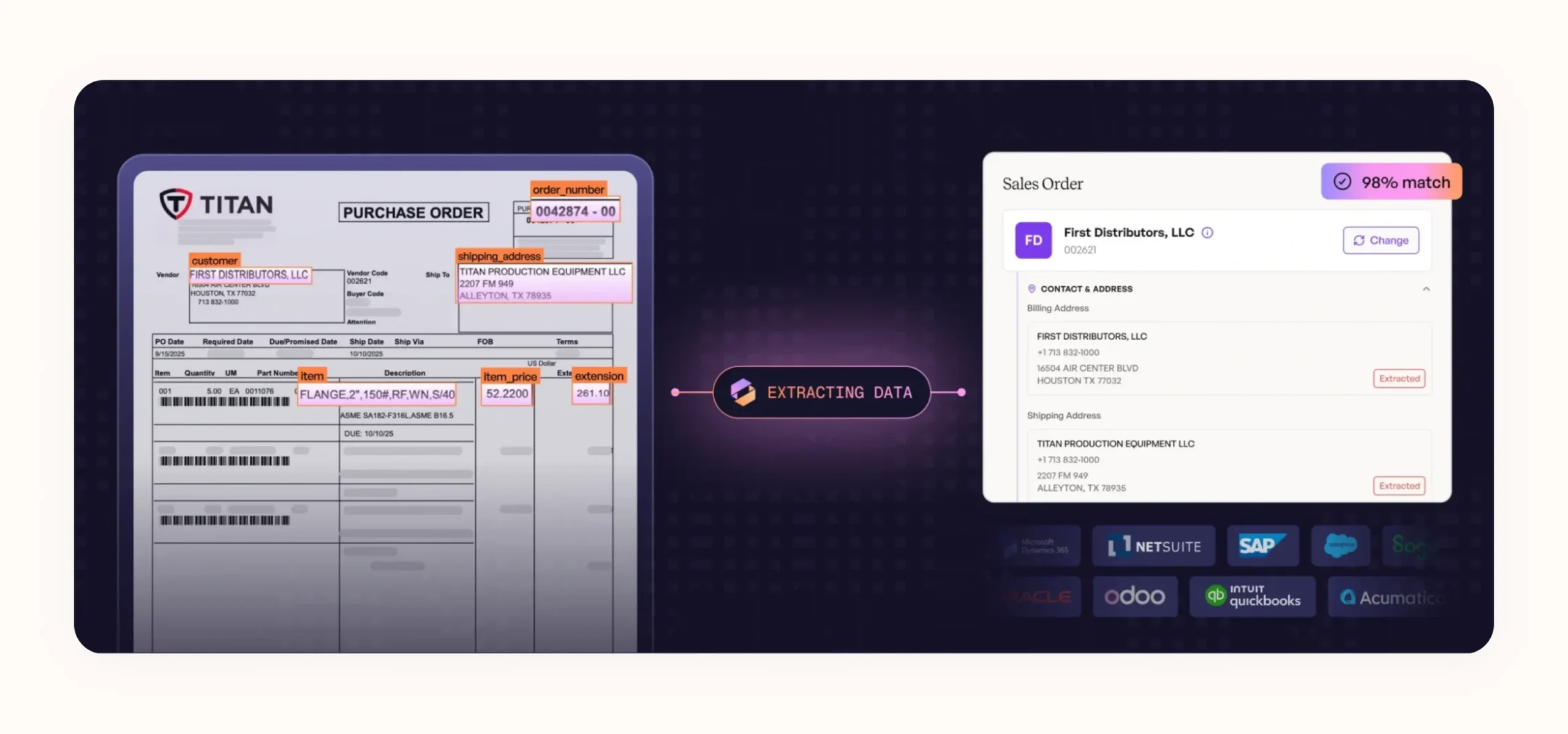
For instance, WizCommerce’s AI Order Entry Software can extract RFQs and POs from emails, PDFs, scans, voice messages, and handwritten documents. It then unifies incoming orders into one intelligent processing layer, making it easier for your teams to track and manage orders without switching between systems or manually organizing data.
Automated data entry and validation
AI significantly reduces the need for manual order entry by automatically extracting key information from unstructured documents. It often uses OCR technology to convert document content into machine-readable text, and finally interprets the context and structure of the order intelligently.
Beyond extraction, AI also validates the data automatically by cross-checking pricing agreements, inventory availability, customer records, and product catalogs. For instance, WizCommerce’s AI Order Entry Assistant cross-checks all details against ERP data, price lists, inventory, and past orders. This reduces human errors and accelerates order processing. Unlike traditional systems that rely heavily on rigid templates, such AI-powered systems also continuously learn from previous orders and improve accuracy over time.
Integration with ERP systems
Modern AI order entry system are designed to work alongside your ERP platform rather than replace it entirely. Once order data is captured and validated, AI systems can automatically push the information into your backend systems for fulfillment, invoicing, inventory allocation, and shipment processing.
This integration layer creates a more connected operational workflow where data moves seamlessly between systems without manual intervention. WizCommerce’s AI Order Entry Assistant can be integrated with a variety of ERP systems, such as Microsoft Dynamics 365, NetSuite, and Epicor order entry integration for wholesalers, helping you experience faster order processing while reducing synchronization issues and duplicate data entry from day one.
Real-time error detection and correction
Traditional order entry workflows often identify issues only after manual review, leading to delays and repeated communication with customers. AI changes this by enabling real-time anomaly detection and intelligent validation throughout the order lifecycle.
AI-powered systems can instantly flag missing fields, duplicate orders, pricing mismatches, invalid SKUs, inconsistent quantities, or unusual order patterns before the order progresses further. In some cases, the system can even recommend corrections automatically based on historical order behavior and business rules.
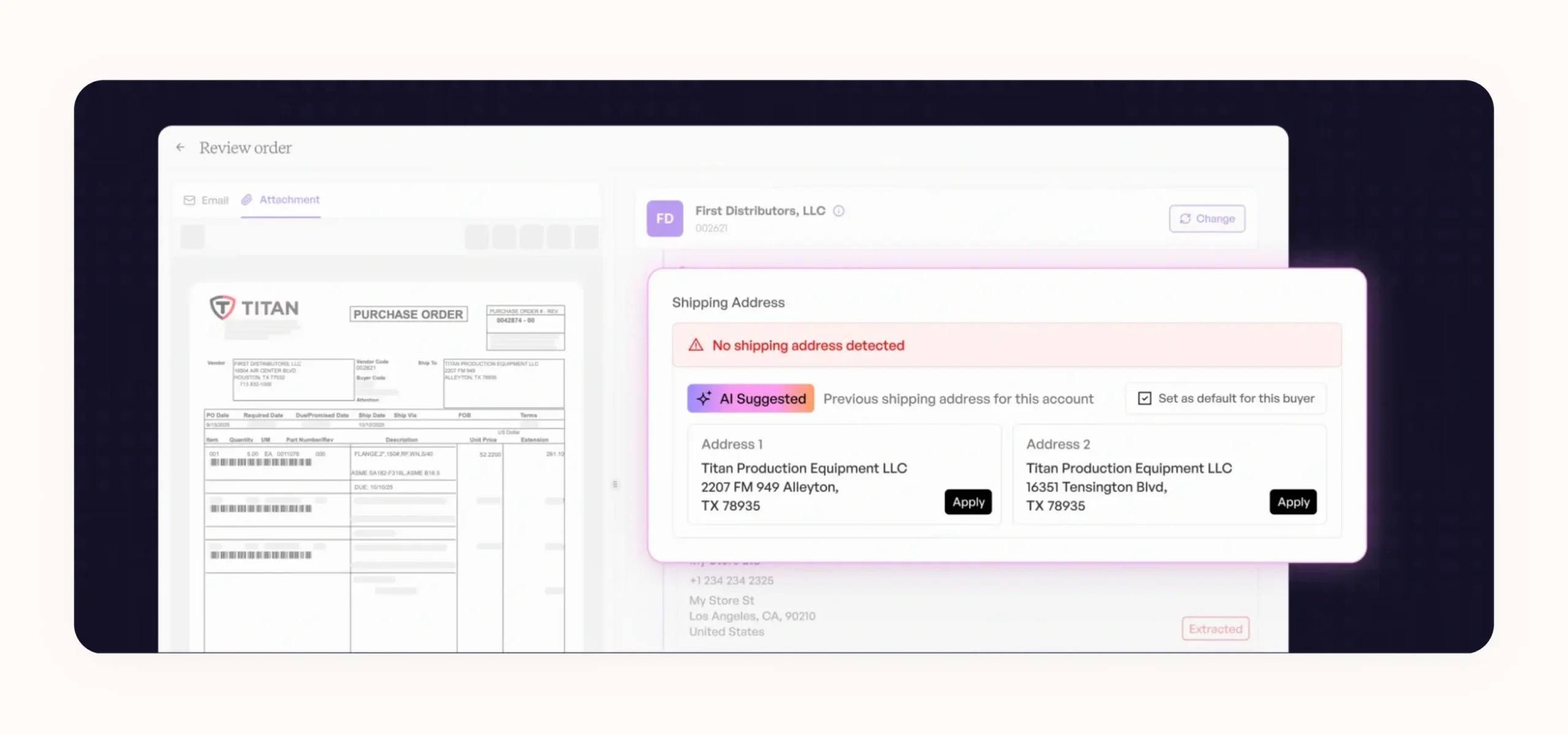
For instance, WizCommerce’s AI Order Entry Assistant detects missing fields, mismatched SKUs, wrong pricing, and unclear information and then recommends actions. This proactive approach significantly reduces order exceptions and minimizes operational disruptions.
Sends automated confirmations and tracking
AI-powered order management software also improves communication and visibility after the order is processed. Once an order is validated and entered into the system, automated workflows can instantly trigger order confirmations, shipping notifications, invoice generation, status updates, etc.
Instead of customers waiting for manual responses from your sales or operations teams, they receive faster and more consistent communication throughout the order lifecycle. This not only improves customer experience but also reduces the administrative burden on your internal teams.
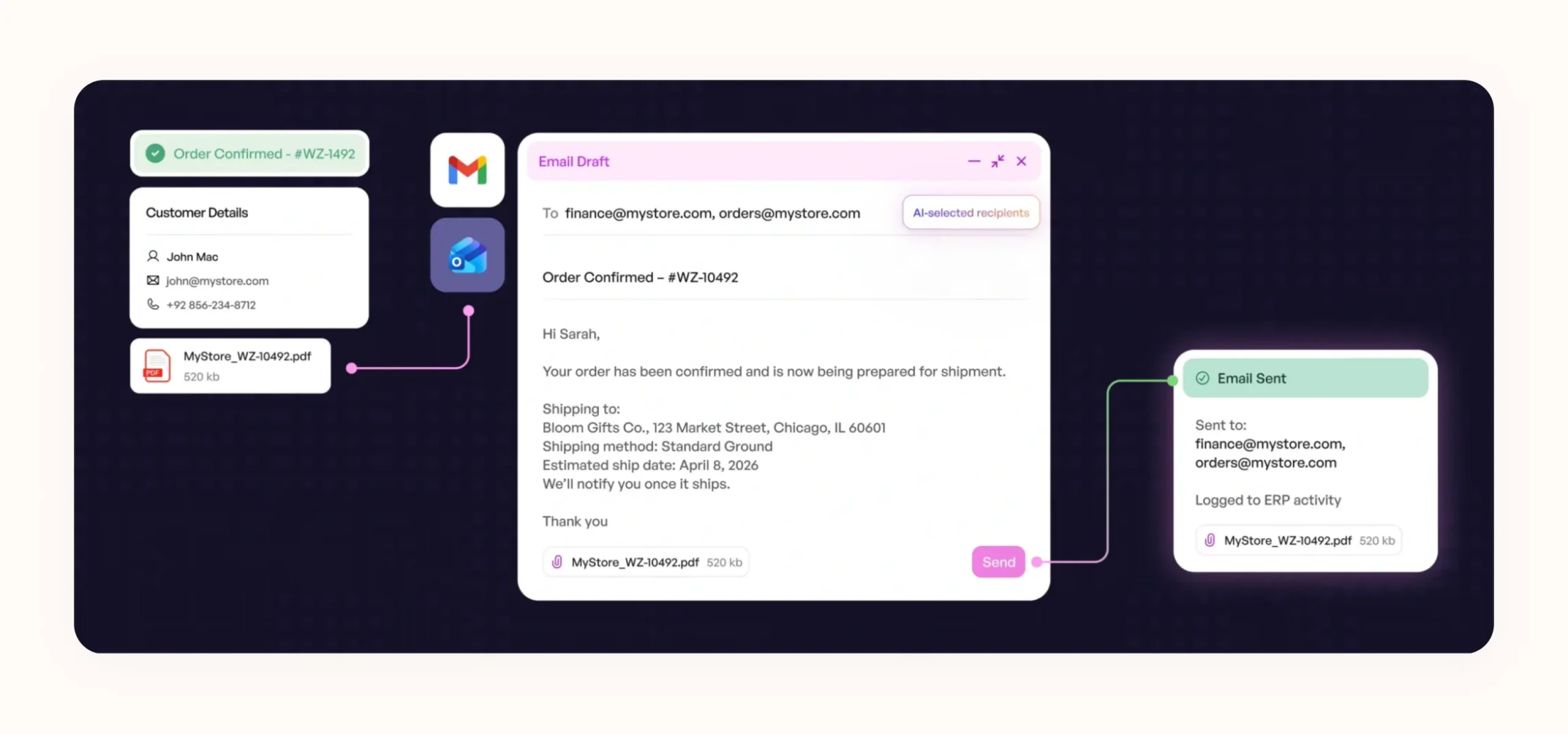
WizCommerce’s AI Order Entry Assistant automatically emails confirmation to customers and sales reps once the order is created, so that all the stakeholders are informed in real time.
10 Signs your business needs an AI-based order entry system
As your order volumes grow and customer expectations become more demanding, your traditional order entry system can quickly become the reason for operational bottlenecks. Here are some clear signs that your current order entry automation software is no longer scalable and you could benefit from an AI-based order entry system:
- Your team manually enters large volumes of order data into the ERP
- Orders arrive in multiple formats, such as PDFs, emails, spreadsheets, images, or handwritten documents
- You frequently deal with order entry mistakes, duplicate records, or missing information
- Order confirmations and processing take longer than customers expect
- Your teams spend too much time validating SKUs, pricing, inventory, or customer data manually
- You struggle to manage orders coming from multiple sales channels or marketplaces
- Scaling order operations requires hiring more people instead of improving efficiency
- Your existing workflows depend heavily on repetitive manual reviews and approvals
- Customers regularly follow up for order status updates or corrections
- Your current system cannot easily adapt to changing customer requirements or order formats
The natural next step would be to begin selecting the right order entry system. Our detailed breakdown of the best solutions might be helpful.
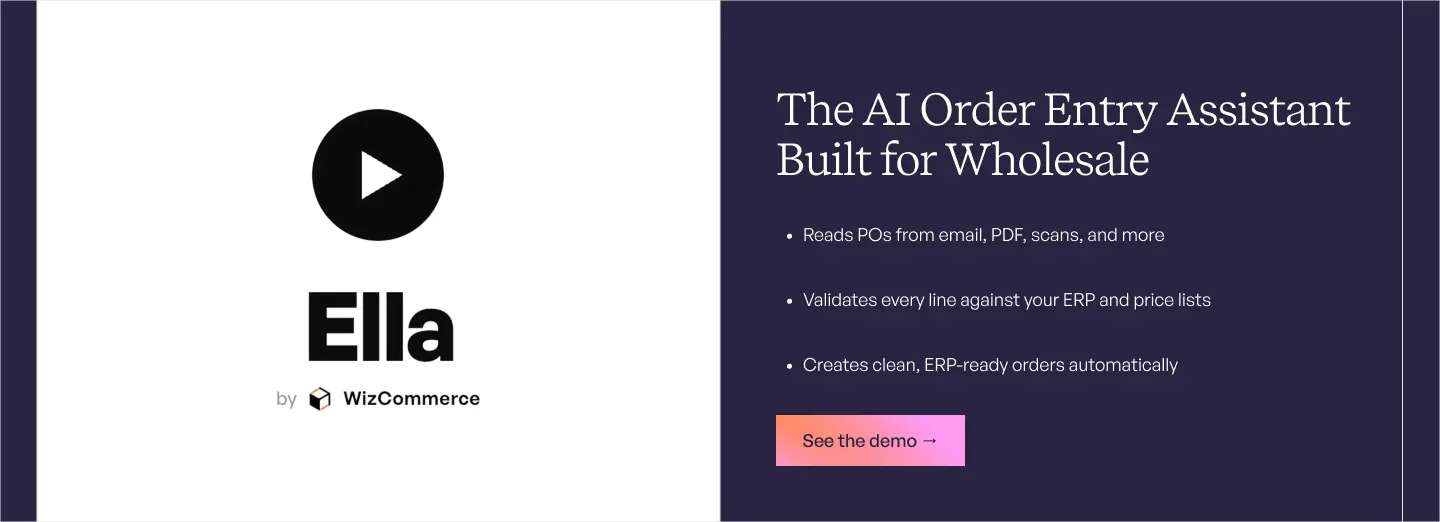
How does WizCommerce automate order entry end-to-end?
WizCommerce’s AI Order Entry Assistant helps you process orders faster and improve fulfilment accuracy across the entire order lifecycle. By automating data capture, extraction, validation, and notification, it minimizes costly order errors and prevents your teams from getting overwhelmed by handling growing order volumes manually. It also improves customer experience through faster confirmations and more reliable order processing, thereby making it a win-win for all stakeholders involved.
So, if your business is struggling with manual order processing or increasing operational complexity, it may be time to move toward a smarter, AI-powered platform. Book a demo with WizCommerce to see how its AI Order Entry Software can help accelerate your order processing at scale.
Frequently Asked Questions
1. What is order entry automation?
Order entry automation is the process of using software to automatically capture, validate, and process customer orders without too many manual tasks. Instead of manual data entry into ERP systems, AI-powered order entry involves the extraction of order details, checking for errors, updating backend systems, and triggering fulfillment workflows automatically.
2. What does an order entry do?
An order entry is a record of key details such as products, quantities, pricing, inventory availability, and shipping information used for coordinating workflows between sales, finance, operations, and warehouse management teams. Using it, you can process orders accurately and efficiently.
3. Can AI automate order processing completely?
AI-powered order entry software can automate a significant portion of order processes, especially repetitive tasks like data extraction, validation, Enterprise Resource Planning updates, confirmations, and tracking. However, you may still require human oversight for complex exception handling, compliance checks, or unique customer requirements. Modern AI-based order management software greatly reduces manual entry, but complete automation depends on workflow complexity and business-specific processes.
4. How is AI used in order entry automation?
AI is used in order entry automation to extract information from unstructured documents, validate data intelligently, detect errors in real time, and automate workflows across systems. Combined with OCR technology, AI can process orders from emails, PDFs, handwritten forms, spreadsheets, and images while continuously learning from previous orders to improve speed and accuracy over time.
5. How AI is transforming order entry?
AI is transforming order entry by making systems more intelligent, adaptive, and scalable. Unlike traditional systems that rely on rigid rules and templates, AI-powered platforms can understand varied order formats, automate validations, detect anomalies instantly, and streamline workflows across multiple channels. This enables you to process orders faster, reduce errors, and improve customer experience significantly.
6. Why traditional order entry fails in modern enterprises?
Traditional order entry systems struggle because they were designed for predictable workflows and structured formats. Modern enterprises receive orders through multiple channels and in varying formats, making manual processing inefficient and error-prone. Dependency on rigid rules, repetitive reviews, disconnected systems, and slow validations often creates delays and poor scalability in high-volume environments.
7. What is the future of order automation?
The future of order automation lies in AI-driven systems that combine intelligent document processing, predictive analytics, workflow automation, and real-time decision-making. Businesses will increasingly move toward automated order entry systems that can self-learn, handle unstructured data effortlessly, and automate complex workflows end-to-end. The focus will shift from simple automation to creating faster and highly adaptive order operations.
8. What industries use AI for order entry?
AI-powered order entry systems are widely used across industries that handle large order volumes and complex workflows. This includes manufacturing, wholesale distribution, retail, ecommerce, logistics, healthcare, consumer goods, food and beverage, and industrial supply businesses. Any industry receiving orders from multiple channels or in varied formats can benefit significantly from AI-based order automation.