Skip to content




Most home furnishing sales teams were built for one kind of buyer. Outside reps covered a territory, visited home furnishing stores every few weeks and wrote the big orders at High Point, Atlanta and Las Vegas. That model worked when independent retailers placed most of the volume, and it still works for many of them today.
The buyers around that model have changed. Interior designers now source a growing share of home furnishings, and they buy by project rather than by season. A designer order is often a single sofa in a custom fabric, priced against a client budget and approved weeks after the first quote. A rep paid to open stores and write large seasonal orders has little reason to chase that work, so designer accounts often go unserved.
Home furnishing also asks more of every seller than most categories do. The same team has to quote custom upholstery across dozens of fabric grades, sell stock that is still on a container and explain freight programs that change from state to state. A sales organization built around one type of rep cannot do all of that well.
The fix is to match each type of buyer with the team and tools that suit how it buys. The sections below cover how to split your customers, who should own each group and how to structure the team around them.
Who buys home furnishing at wholesale, and how each group buys

Home furnishing wholesalers usually sell to three groups of buyers, and each one needs its own sales approach.
1. Interior Designers
Here, order sizes are smaller and project-driven. Selling to them starts with knowing how a designer works.
- They visit various wholesale websites to curate products for projects.
- They create mood boards and storyboards to present to clients.
- They require customer approval on cost sheets.
- Physical samples are crucial, especially for textiles.
Designer orders also carry details that a retail order rarely does. A designer may want a sofa in their client’s own material, a different fabric grade on the seat and the back, or a width that is not in the catalog, and needs a firm price for each option before the client signs off. Many designers also buy once per project, so they expect a quote first and an order later.
Winning a designer’s projects comes down to saving them time on sourcing and approvals. Three things help most.
a) Allow them to send mood boards and receive curated product recommendations.
b) Enable them to download these recommendations in various formats (PowerPoint, PDF, Excel).
c) Stay in the loop on their ongoing projects to ensure you’re part of the evaluation process.
The good news? Most of this can be done remotely! So, what would be the best way to cater to this segment? Let’s find out.
Why an inside sales model fits the designer segment
1. Designers
Designers rarely need a rep at the door. They need someone who knows the catalog, can answer a fabric or lead time question the same day and can pull together options for a project while the client is still deciding. An inside sales team built for designers does this by phone, email and video from your office.
With this model in place, one inside salesperson can effectively manage 500-1000 designers, making 70-100 calls daily, provided the b2b home furnishing stack behind them carries project-based wishlists and each designer’s own price list.
The same stack has to price custom work. When every frame, cushion and fabric grade carries its own upcharge in one place, the inside team can quote a customized chair during the call instead of emailing the factory and coming back two days later.
You do not need to hire a full team to start. Customer service staff already know your collections, finishes and order process, so moving two or three of them onto designer accounts is a low-risk way to test the model before you add headcount.
Outside reps still have a place in designer sales. Some projects need a rep on site to show finishes, bring a fabric book or meet the designer’s client in a showroom. When the inside team flags those visits, reps go in knowing there is a live project, which makes the trip worth their time.
Equipping those visits with an order-writing app matters too, which is why wholesalers running mobile invoicing tools often compare an inSitu Sales alternative that syncs orders straight to the ERP.
2. Independent home furnishing retailers
Independent home furnishing stores are often family businesses run by a second or third generation of owners. They buy on relationships, expect to see the same rep every season and like to sit on a sofa or see a finish in person before they commit to a floor sample. Outside reps should own these accounts and visit them regularly.
These retailers still place many of their biggest orders at market. During High Point, Atlanta Market Week or Las Vegas, every rep working your showroom should be able to write an order for any buyer who walks in. Each order should then be tagged to that market and credited to the buyer’s territory rep, so reps help each other on the floor without losing commission.
Between markets, send new online sign-ups and reorders from each territory to the rep who covers it. Reps then treat your website as part of their territory instead of competing with it.
3. National chains and large retail accounts
A handful of large retail customers can make up a big share of a home furnishing wholesaler’s volume. Give each of them, or a small group of them, a key account manager who owns the buyer relationship, the forecast and the order calendar. In home furnishing, this role also works closely with product development, because large retailers often ask for exclusive finishes, private-label collections or a modified version of a bestseller.
Large retailers often buy by the container or direct from your overseas factory. Their account manager needs to plan orders by cubic feet to fill a 20-foot or 40-foot container, work to factory minimum order quantities, and quote container or direct-import pricing that differs from your catalog price.
Give every seller the same view of stock and freight
Two questions decide most home furnishing orders, which are when the piece can ship and what freight will cost. Reps who only see stock on hand lose sales on items arriving with the next container, so every seller should see what is in stock, in transit and on order, along with the next arrival date.
Freight needs the same treatment. With rates that change by state, order minimums for free or flat freight, and LTL, white glove or liftgate delivery on larger pieces, reps should see the freight cost on the order itself instead of calling the office for a quote. A sales rep app connected to your ERP puts stock, arrival dates and freight in front of designers’ inside reps, field reps and key account managers alike.
A sales team structure for home furnishing wholesalers
The right structure depends on how big your sales team is and how your revenue splits across designers, retailers and key accounts. A common model is shown in the chart below.
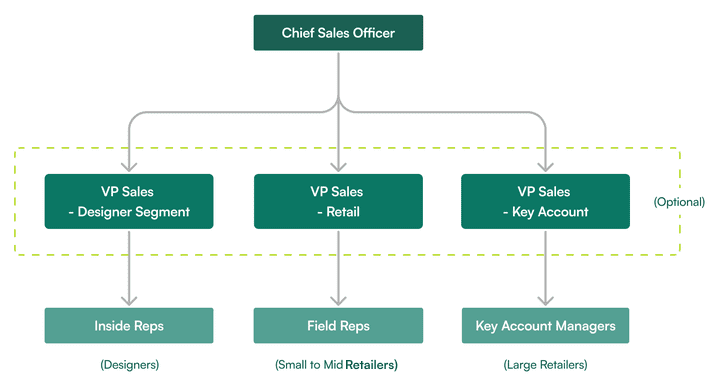
Smaller wholesalers can skip the VP layer and have the head of sales manage the inside team, field reps and key account managers directly. Add a VP for each channel once a team grows past what one leader can coach, or once designer revenue is large enough to need its own targets.
Each account should also have one clear owner. Record the segment, the owning rep or team and the latest project or quote in a CRM for wholesalers, so a designer who calls in reaches the inside team and a store owner reaches their territory rep. Sales leaders also need results by territory, such as the top-selling items and finishes in each region and each rep’s year-over-year numbers, to decide where to add reps or inside sales capacity.
This structure allows home furnishing wholesalers to balance customer focus with efficient sales operations, while remaining scalable based on their specific needs.
Putting the new structure in place
Start with the segment that is least served today, which for most home furnishing wholesalers is the designer channel. Pilot an inside team on a set of designer accounts, track quote turnaround and project wins for a quarter, and then decide where to add people. Field reps and key account managers keep the accounts they serve best, and the whole team works from the same stock, pricing and freight data.
Frequently asked questions
What is the difference between inside sales and outside sales in home furnishing?
Inside sales teams work remotely by phone, email and video, which suits interior designers and smaller accounts that place project-based or frequent orders. Outside sales reps visit stores and work market showrooms in person, which suits established retailers that buy on relationships and place larger seasonal orders.
When should a home furnishing wholesaler add an inside sales team?
Add one when designer and small-account orders start waiting on your outside reps. Common signs include quotes that take days to go out, designer accounts nobody has contacted in a quarter, and reps who skip small projects because the commission does not justify a visit.
Should a home furnishing brand use independent reps or salaried reps?
Independent reps or a rep group are usually the faster and cheaper route for a smaller brand, because you pay commission only on what sells and get access to their existing retail accounts. Salaried reps and key account managers start to make sense once a territory or a group of large accounts brings in enough volume to cover a fixed salary.
How do independent sales reps get paid?
Independent sales reps usually work on straight commission, which means they earn a percentage of the wholesale value of each order instead of a salary. Most brands pay monthly, either when the order ships or when the retailer pays, and send a statement listing the customer, ship date, invoice amount less shipping and the commission due.