Skip to content



The best AI order entry software for Epicor depends on more than whether a vendor says it integrates with Epicor. The first thing to check is which Epicor product it actually supports, because Kinetic, Prophet 21, Eclipse, and BisTrack are not interchangeable.
A platform proven on Kinetic does not automatically support Prophet 21, Eclipse, or BisTrack. That distinction matters early in the evaluation, before your team spends time on demos and technical reviews for a platform that may not work with the Epicor environment you actually run.
This comparison looks at 10 platforms that offer AI-powered order entry or broader automation with documented Epicor support. We compare which Epicor products they publicly support, how focused they are on inbound order entry, and where each platform fits best. For a deeper look at APIs, field mapping, validation, and order write-back, see our guide to Epicor integration with AI order entry software.
Best AI Order Entry Platforms That Integrate With Epicor Compared
The best AI order entry platforms for Epicor differ in how they connect with Epicor, how focused they are on inbound order automation, and how quickly they can move from incoming purchase orders to ERP-ready sales orders. Here is a side-by-side comparison of 10 platforms that support Epicor order entry and automation workflows.
| Platform | Epicor integration | Built for | AI order entry focus | Accuracy | Implementation | Pricing |
| Ella by WizCommerce | Prophet 21, Eclipse, Kinetic | Wholesalers, distributors & manufacturers | Dedicated AI order entry & quote automation | 99% | <30 days | Custom |
| Conexiom | Prophet 21, Eclipse, Kinetic | Distributors & manufacturers | Dedicated order automation within a broader document suite | 99% | ~21 days | Custom |
| Canals AI | Prophet 21, Eclipse | Distributors & manufacturers | Dedicated AI order entry & quote automation | 96% | ≤30 days | Custom |
| Ordermatic | Kinetic, Prophet 21, Eclipse | Distributors | Dedicated AI order entry | 90% | 14–28 days | Custom |
| Esker | Epicor via Enlighten.Net | Enterprises | Order management within a broader automation suite | 95% | 56–84 days | Custom |
| Fluent | Kinetic | Epicor Kinetic users | Dedicated Epicor order entry automation | 98.6% | 28–42 days | From $600/mo |
| Enlighten.Net | Prophet 21, Eclipse, Kinetic | Epicor users | Order automation alongside finance workflows | 98% | <14 days | Custom |
| Workist | Epicor | Sales back-office teams | Dedicated AI order & RFQ processing | 80% | 2–42 days | Custom |
| virtualworkforce.ai | Kinetic | Distributors & manufacturers | Email and document-driven order entry | 67% | 28–56 days | Custom |
| Kognitos | Kinetic | Enterprise operations teams | Order entry within a broader automation platform | 99% | 15–45 days | Consumption-based |
Note: Vendors measure accuracy differently, so the percentages may not mean the same thing.
1. Ella by WizCommerce
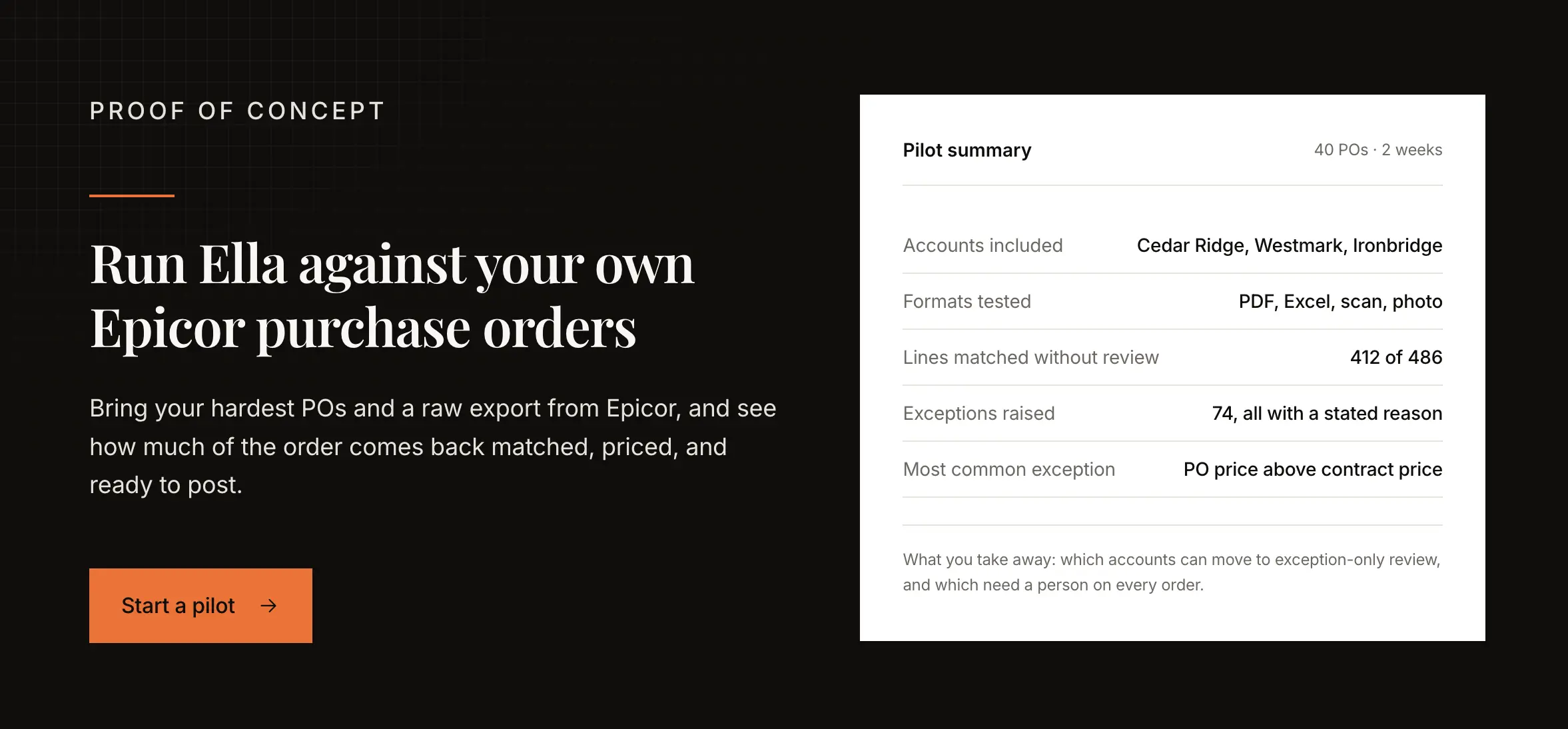
Ella by WizCommerce is an AI order entry and quote automation platform built for wholesalers, distributors, and manufacturers using Epicor and other major ERPs. It turns incoming purchase orders and RFQs into validated orders and quotes without requiring customers to change how they send them.
What it does
- Reads orders from PDFs, spreadsheets, email bodies, scans, and images.
- Matches customer part numbers with ERP product data.
- Checks pricing, quantities, units of measure, inventory, and customer-specific rules.
- Flags mismatches and exceptions before the order is created in Epicor.
- Uses field-level confidence scores to show reviewers exactly what needs attention.
- Automates both order entry and quote creation in the same product.
Key strengths
- Built specifically for wholesale, distribution, and manufacturing workflows.
- Handles customer-specific pricing, case packs, MOQ rules, UOMs, and product cross-references.
- Customer-specific rules can be added in plain English without rebuilding the workflow.
- Review is exception-based, so teams can focus on uncertain fields instead of checking every line.
- Supports both orders and RFQs, reducing the need for separate automation tools.
Limitations
- Teams looking only for basic document extraction may not need the broader order and quote workflow.
- More complex customer rules and ERP workflows still need to be configured during implementation.
Best for: Wholesalers, distributors, and manufacturers that want dedicated AI order entry and quote automation connected to Epicor, with strong support for complex B2B order rules.
2. Conexiom
Conexiom is an AI order automation platform for distributors and manufacturers, with published support for Epicor Prophet 21, Eclipse, and Kinetic. It captures incoming orders, validates them against ERP data, corrects common issues, and sends clean order data into Epicor.
What it does
- Reads orders from PDFs, spreadsheets, email, CSV files, images, handwritten notes, fax, and other incoming formats.
- Validates customer, product, pricing, inventory, and other order data against Epicor.
- Automatically corrects and standardizes order data before it reaches the ERP.
- Flags exceptions that need human review instead of sending incomplete or uncertain orders through.
- Supports both touchless processing and review-based workflows depending on the order.
Key strengths
- Supports Prophet 21, Eclipse, and Kinetic with documented Epicor-specific order automation.
- Publishes 95%+ extraction accuracy out of the box and 99%+ order-entry accuracy into the ERP.
- Handles a wide range of order formats, including image-based and handwritten purchase orders.
- Includes preconfigured ERP validations and customer-specific order rules.
- Broader document automation can also cover invoices, acknowledgements, and other transaction types.
Limitations
- The broader document-automation scope may be more than a team needs if sales order entry is the only workflow they want to automate.
- Pricing is custom, so the total cost depends on order volume, document coverage, and implementation scope.
- Teams looking for a lightweight order-entry-only product may find the platform broader than necessary.
Best for: Larger distributors and manufacturers that want high-volume AI order automation across Prophet 21, Eclipse, or Kinetic, with strong ERP validation and support for multiple document workflows.
3. Canals AI
Canals AI is an AI order and quote automation platform built for distributors and manufacturers, with integrations for Epicor Prophet 21 and Eclipse. Its strongest focus is on industrial and construction-supply workflows where customer requests often arrive in complex or inconsistent formats.
What it does
- Turns incoming orders and RFQs into ERP-ready quotes or sales orders.
- Reads PDFs, spreadsheets, emails, handwritten notes, takeoffs, and voice inputs without requiring fixed templates.
- Matches requested products against the distributor’s product catalog.
- Pulls customer, ship-to, product, quantity, UOM, pricing, availability, and special-instruction data into the order.
- Lets reps review the prepared order or quote before submitting it to the ERP.
- Learns from customer preferences and rep behavior to improve future product recommendations.
Key strengths
- Built specifically around distributor and manufacturer sales workflows rather than general document processing.
- Handles complex inputs such as handwritten material lists and construction takeoffs in addition to standard PDFs and spreadsheets.
- Supports both order entry and quote automation in the same workflow.
- Publishes customer results showing up to 90% time savings on sales order entry.
- Extends beyond sales order entry into adjacent distribution workflows such as takeoff automation, purchasing, and receiving.
Limitations
- Rep review is still part of the workflow for many orders and quotes, so teams looking for fully touchless processing should evaluate how much review can be automated.
- Its broader distribution-operations scope may be more than teams need if the only goal is straightforward inbound order entry.
- Complex product matching and customer-specific logic may require more setup for businesses with highly customized catalogs or pricing structures.
Best for: Industrial and building-products distributors running Prophet 21 or Eclipse that want AI order entry and quote automation, especially for complex customer requests such as takeoffs, handwritten lists, and emailed RFQs.
4. Ordermatic
Ordermatic is a focused AI order entry platform for distributors using Epicor Kinetic, Eclipse, and Prophet 21. Unlike broader automation suites, its product is centered specifically on turning incoming customer orders into validated sales orders with less manual entry.
What it does
- Reads incoming purchase orders from email, PDFs, spreadsheets, scans, and other document formats.
- Extracts customer, product, quantity, pricing, and shipping information from each order.
- Matches order data against ERP records before the sales order is created.
- Flags exceptions and uncertain fields for review instead of passing incomplete data through.
- Keeps order entry as the core workflow rather than one module inside a larger automation platform.
Key strengths
- Purpose-built for order entry, which keeps the product and implementation focused on one operational problem.
- Supports Epicor Kinetic, Prophet 21, and Eclipse, making it relevant across several common Epicor environments.
- ERP validation helps catch mismatched products, pricing, and customer information before orders move forward.
- Human review can remain in the workflow for exceptions while straightforward orders require less manual handling.
- The narrower scope can make it easier for teams that do not need a larger order-to-cash or document automation suite.
Limitations
- Teams looking to automate accounts payable, invoicing, or broader back-office document workflows may need additional tools.
- Its specialist focus gives companies fewer adjacent automation capabilities to expand into compared with larger enterprise suites.
Best for: Distributors using Epicor Kinetic, Prophet 21, or Eclipse that want a focused AI order entry platform without the added scope of a broader automation suite.
5. Esker
Esker is an enterprise automation platform covering order-to-cash, accounts payable, procurement, and related finance workflows. Its order management product handles inbound customer orders, while Epicor connectivity is supported through its partnership with Enlighten.Net.
What it does
- Captures customer orders from email, EDI, portals, punchout, mobile, and ERP-connected workflows.
- Uses AI to extract order data, route documents, and reduce manual entry.
- Supports one-click and touchless processing for eligible orders.
- Brings EDI and non-EDI orders into the same workflow with exception handling and visibility.
- Extends beyond order entry into accounts receivable, accounts payable, procurement, and other finance processes.
Key strengths
- Strong fit for large organizations that want to automate several order-to-cash and finance workflows under one platform.
- Supports multiple order channels rather than focusing only on emailed purchase orders.
- Enterprise-grade governance, security, reporting, and workflow controls suit more complex environments.
- Enlighten.Net adds Epicor-specific expertise across Prophet 21, Eclipse, and Kinetic environments.
- Order management can sit alongside AP, AR, procurement, and document management without introducing separate systems.
Limitations
- The broader platform can be more than a team needs if inbound order entry is the only workflow they want to automate.
- Larger enterprise deployments typically involve more implementation planning and internal coordination than a focused order-entry product.
- Teams should clarify ownership between Esker and Enlighten.Net during implementation and ongoing support.
Best for: Larger enterprises using Epicor that want order-entry automation as part of a broader order-to-cash, AP, and procurement automation strategy.
6. Fluent
Fluent is an AI automation platform built specifically for Epicor Kinetic. Its product suite covers order entry, quote entry, purchase-order processing, shipment workflows, and analytics, with each automation designed around the Kinetic workflow it ultimately updates.
What it does
- Automates sales order entry directly within Epicor Kinetic workflows.
- Extracts and validates customer, product, quantity, pricing, and shipping information before creating the order.
- Supports quote entry, purchase-order processing, shipment automation, and other adjacent Epicor workflows.
- Uses Kinetic data and business rules as part of the automation process.
- Offers analytics alongside transaction automation within the same Epicor-focused product family.
Key strengths
- Built specifically around Epicor Kinetic rather than supporting multiple ERP families.
- Deep Kinetic focus can make complex workflow and business-rule handling easier to configure.
- Order entry, quoting, and adjacent workflows can be automated within the same product ecosystem.
- Publishes 98.6% extraction accuracy for its order-entry automation.
- Useful for teams that want a vendor with strong familiarity across multiple Kinetic processes.
Limitations
- The single-ERP focus gives companies less flexibility if they operate multiple ERP systems or plan to change platforms.
- Teams that only need basic order entry may not need the wider set of Kinetic automation and analytics capabilities.
- Different workflows may require separate Fluent agents or packages, so the overall scope should be confirmed during evaluation.
Best for: Epicor Kinetic teams that want AI order entry together with other Kinetic-specific automation workflows from a specialist vendor.
7. Enlighten.Net
Enlighten.Net is an Epicor-focused automation provider covering Prophet 21, Eclipse, and Kinetic. Its offering combines order automation with accounts payable, accounts receivable, and document management, making it broader than a dedicated order-entry tool.
What it does
- Automates customer order entry across Prophet 21, Eclipse, and Kinetic.
- Captures and processes customer documents alongside supplier invoices and other finance workflows.
- Uses Esker automation as part of its broader Epicor-focused offering.
- Supports document management, AP, AR, and sales order automation within the same environment.
- Helps Epicor teams reduce manual entry across both customer-facing and back-office workflows.
Key strengths
- Strong Epicor focus across Prophet 21, Eclipse, and Kinetic.
- Can automate customer orders and finance-document workflows under one broader setup.
- Useful for organizations that want to standardize several Epicor-related automation projects with one provider.
- Combines Epicor-specific expertise with Esker’s broader automation capabilities.
- Can be a practical fit when sales order entry, AP, and document management are being evaluated together.
Limitations
- The broader finance and document-automation scope may be more than teams need if sales order entry is the only priority.
- Sales order automation sits alongside AP, AR, and document management, so buyers should evaluate how much depth they need specifically in the order-entry workflow.
- The Esker partnership adds another layer to implementation and support ownership that should be clear from the start.
Best for: Epicor distributors and manufacturers that want to automate customer orders alongside AP, AR, and other document-heavy workflows.
8. Workist
Workist is an AI order entry and sales back-office automation platform for wholesalers and manufacturers. It processes incoming orders and RFQs from email and documents, validates the data against ERP master records, and prepares structured transactions for the ERP.
What it does
- Captures orders from emails, PDFs, spreadsheets, and image files.
- Extracts customer, item, pricing, quantity, delivery, and other order data.
- Validates extracted information against ERP master data before transfer.
- Flags discrepancies and asks the team for input when something does not match.
- Transfers validated orders into the ERP through interfaces such as API, EDI, XML, or SFTP.
- Supports RFQ processing alongside order entry.
Key strengths
- Order entry is a core product workflow rather than one use case inside a general automation platform.
- Strong validation layer helps catch mismatched items, customer data, pricing, and delivery details before they reach the ERP.
- Supports touchless processing for straightforward orders while routing exceptions to a reviewer.
- Can process orders regardless of document layout or language.
- Workist says 60–90% of orders can typically run fully automatically, depending on the workflow.
Limitations
- More complex enterprise ERP environments can require a longer setup than Workist’s standard plug-and-play deployments.
- Teams only looking for basic OCR or document extraction may not need the broader validation and RFQ capabilities.
- Its sales back-office focus is strongest around order and inquiry processing rather than broader finance automation.
Best for: Wholesalers and manufacturers that want AI order entry and RFQ automation with strong ERP validation and exception handling.
9. virtualworkforce.ai
virtualworkforce.ai is an AI order entry automation platform for manufacturers and distributors using Epicor Kinetic. It focuses on orders arriving through email, PDFs, spreadsheets, and other documents, then validates the extracted information before preparing the sales order in Epicor.
What it does
- Reads order information from emails, PDFs, spreadsheets, scanned documents, and other incoming formats.
- Extracts customer, product, quantity, pricing, delivery, and address information.
- Checks order details against customer, product, and business data before creating the transaction.
- Flags unclear pricing, product descriptions, quantities, or delivery instructions for human review.
- Prepares validated sales orders for processing in Epicor Kinetic.
Key strengths
- Strong fit for teams processing a large share of customer orders through email and shared inboxes.
- Handles both structured and unstructured order formats without requiring customers to move to a portal.
- Combines document extraction with business-rule checks rather than stopping at basic OCR.
- Keeps human review in the workflow for unusual or uncertain orders.
- Built around manufacturing and distribution order-processing use cases.
Limitations
- Its strongest use case is document and email-driven order entry, so teams with most volume already flowing through EDI or ecommerce may see less value.
- Orders with unclear product descriptions, unusual pricing, or conflicting instructions can still require human review.
- Teams looking to automate a wider set of finance or back-office processes may need additional automation tools.
Best for: Epicor Kinetic manufacturers and distributors that receive a high volume of customer orders through email, PDFs, spreadsheets, and scanned documents.
10. Kognitos
Kognitos is an agentic process automation platform that can automate workflows across Epicor Kinetic and other enterprise systems. Instead of focusing only on order entry, it lets operations teams build and manage processes in plain language, with order entry handled as one of several possible ERP workflows.
What it does
- Automates ERP processes across sales, operations, finance, and customer service.
- Lets business users describe and modify workflows in plain language rather than writing traditional automation scripts.
- Can automate order entry steps such as extracting order data, validating information, and creating transactions in Epicor Kinetic.
- Connects order-entry tasks with other processes that may involve email, documents, approvals, and ERP actions.
- Supports broader process automation beyond sales orders within the same platform.
Key strengths
- Useful for companies that want to automate several Epicor processes rather than deploy a tool for order entry alone.
- Plain-language workflow creation can give operations teams more control over how automations are built and changed.
- Can connect order entry with adjacent workflows across finance, customer service, and operations.
- Flexible enough to support highly customized processes that do not fit a standard order-entry workflow.
- One platform can be used across multiple departments and automation use cases.
Limitations
- Order entry is not a prebuilt specialist product, so teams may need to configure more of the workflow themselves.
- Product matching, contract pricing checks, units of measure, customer-specific rules, and exception handling may require additional setup.
- Companies solving only inbound order entry may find a dedicated order-entry platform simpler to deploy and manage.
Best for: Epicor Kinetic teams that want to automate several ERP and back-office processes, with order entry as one part of a broader automation strategy.
Which AI Order Entry Platform Is Best for Your Epicor Setup?
The best AI order entry platform for Epicor depends on how focused you want the solution to be. Ella, Canals AI, Ordermatic, Fluent, Workist, and virtualworkforce.ai are built primarily around order entry and related sales workflows. Conexiom combines dedicated sales order automation with broader document processing, while Esker, Enlighten.Net, and Kognitos extend further into finance and enterprise process automation.
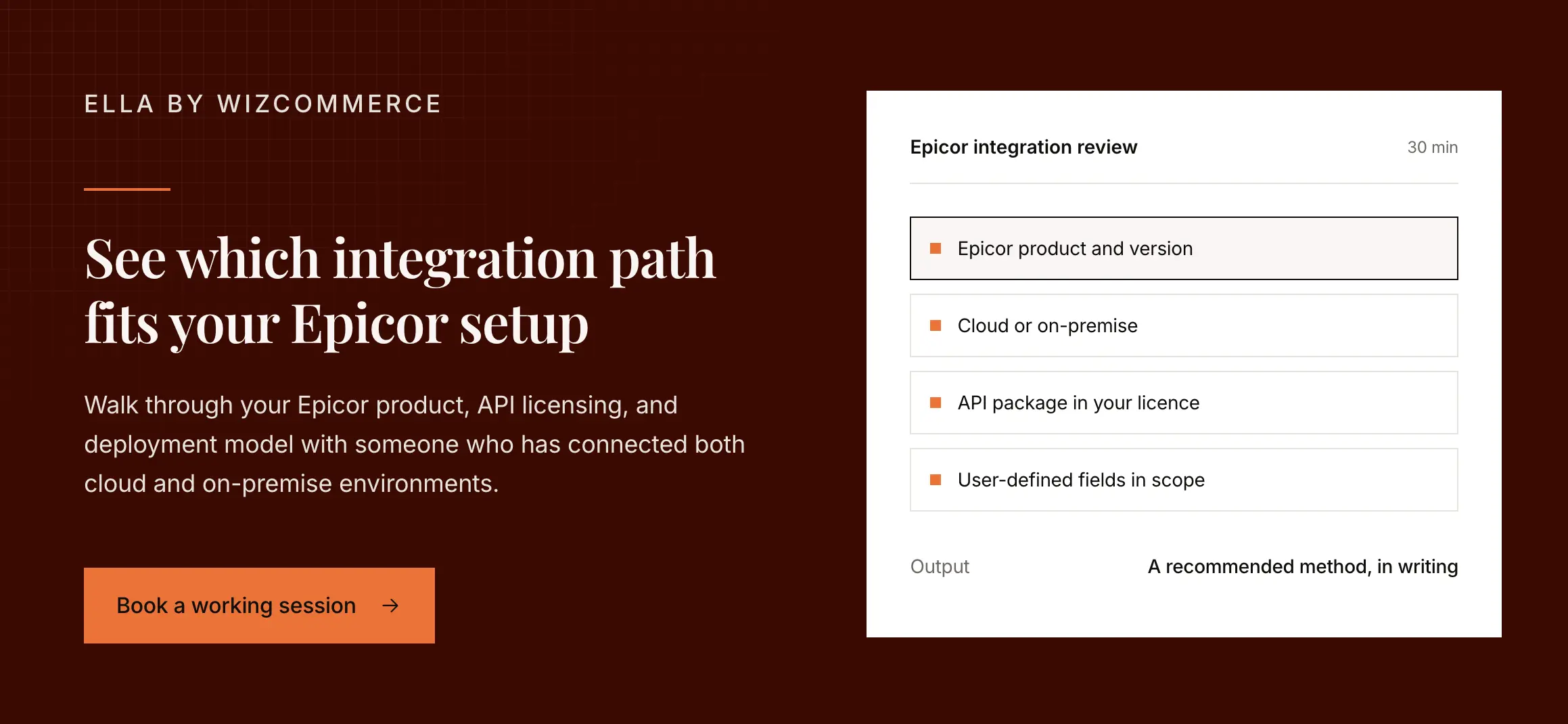
Your Epicor environment is the next filter. Some platforms support multiple Epicor products, while others are more focused on a specific setup such as Kinetic. From there, compare how each platform handles product matching, pricing and quantity checks, mismatches, human review, implementation time, and the level of automation you need.
Once you have narrowed the list to two or three platforms, our Epicor integration with AI order entry software guide explains the API, field mapping, validation, review, and write-back process in more detail.
FAQs
Which are the best AI order entry platforms for Epicor Prophet 21?
Top options for Epicor Prophet 21 include Conexiom, Canals AI, Ordermatic, Enlighten.Net, and Esker through Enlighten.Net. WizCommerce also supports Prophet 21 through an API-based integration path. The main difference is whether you want a dedicated order-entry product or a broader document and finance automation platform.
Which are the best AI order entry platforms for Epicor Eclipse?
Top AI order entry options for Epicor Eclipse include Conexiom, Canals AI, Ordermatic, Enlighten.Net, and Esker through Enlighten.Net. Conexiom, Canals AI, and Ordermatic are more focused on order automation, while Enlighten.Net and Esker cover a wider set of document and finance workflows.
Which are the best AI order entry platforms for Epicor Kinetic?
Top options for Epicor Kinetic include Ella by WizCommerce, Conexiom, Ordermatic, Fluent, Enlighten.Net, virtualworkforce.ai, Kognitos, and Esker through Enlighten.Net. Fluent is particularly focused on Kinetic, while platforms such as Ella and Conexiom combine order entry with additional sales or document-automation capabilities.
Which top AI order entry platforms support multiple Epicor ERPs?
Conexiom, Ordermatic, and Enlighten.Net support multiple Epicor environments, including Prophet 21, Eclipse, and Kinetic. Esker can also cover multiple Epicor environments through its partnership with Enlighten.Net. These platforms are useful for companies operating across more than one Epicor system.
Which are the best purpose-built AI order entry platforms for Epicor?
Ella by WizCommerce, Canals AI, Ordermatic, Fluent, Workist, and virtualworkforce.ai are among the more order-entry-focused options in this comparison. Conexiom also offers dedicated sales order automation, while Esker, Enlighten.Net, and Kognitos cover order entry as part of broader automation platforms.
Which top Epicor AI order entry platforms also automate quotes or RFQs?
Ella by WizCommerce, Canals AI, Fluent, Workist, and Conexiom also support quote or RFQ-related workflows. Ella combines AI order entry and quote automation in the same product, which can be useful for teams handling both purchase orders and quote requests through the same sales workflow.
Which is the best AI order entry platform focused specifically on Epicor?
Fluent is one of the most Epicor-focused options in this comparison, with its product suite centered on Epicor Kinetic workflows. Other platforms support Epicor alongside additional ERP systems, which can be more suitable for companies operating across multiple ERP environments.
How do the best dedicated AI order entry platforms differ from broader automation platforms?
Dedicated AI order entry platforms are built around workflows such as PO capture, product matching, pricing checks, mismatch detection, exception review, and sales-order creation. Broader automation platforms can handle order entry too, but also cover areas such as accounts payable, procurement, document processing, and general business-process automation.