Skip to content



Before we dive into B2B sales order automation, let me ask: Does the word “automation” threaten you? Do you think automation is complex, and you instinctively look over things that demand changes?
If you answered yes, let us get something out of the way. We get it; everything is automated nowadays, and you may feel overwhelmed at times. So, let us take you on a journey where we break everything down for you, from assessing whether you need B2B sales order automation software and why you might need it, to how you can automate and what outcomes you can expect.
Ready? Let’s go!
Automation and customer experience (CX): How are they related?
In the rapidly evolving B2B sales landscape, one thing remains constant: the paramount importance of customer experience.
Here’s why CX matters:
- 42% of customers are willing to pay more for a better customer experience.
- Improved CX can increase corporate revenue by 10-15%.
- Nearly 90% of customers switch to a competitor after a bad experience.
- 64% of buyers prioritize customer experience over price when making a purchase.
As businesses strive to meet the ever-growing expectations of modern consumers, manual sales processes pose numerous challenges. Let’s dive in.
How manual sales processes affect customer experience
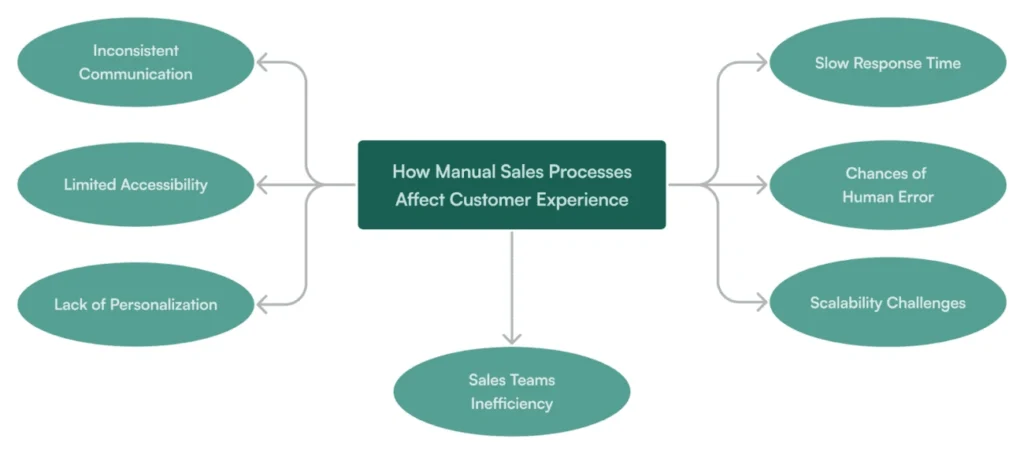
Manual sales processes can pose significant challenges when it comes to customer experience. Here are some of the key challenges associated with manual sales processes and their impact on CX:
1. Slow response time: Manual processes cause delays in customer service, order processing, and issue resolution, frustrating customers and leading to a poor CX.
2. Inconsistent communication: Manual processes increase the chance of communication errors among sales team members, confusing customers and disrupting their experience.
3. Limited accessibility: Manual processes are restricted to business hours, inconveniencing customers who need assistance or want to make purchases outside those times.
4. Chances of human error: Manual processes are prone to mistakes, such as entering incorrect information or mishandling inquiries, which can lead to delays and dissatisfaction.
5. Lack of personalization: Manual processes make it difficult to personalize the customer experience, resulting in generic interactions and diminished satisfaction.
6. Scalability challenges: Manual processes become harder to scale as businesses grow, requiring costly hiring and training and risking compromised CX due to increased workload.
7. Sales team inefficiency: Manual processes lead to redundant tasks and paperwork, reducing sales team productivity and prolonging the sales cycle, ultimately affecting CX negatively.
TL, DR: Manual processes are hindering your CX → Great CX is important for your business → Great CX can come from B2B sales automation
From manual to automatic: B2B sales automation benefits
Now that we have convinced you of the importance of CX and how manual sales are harming your business, let’s break down how technology can revolutionize your workflow.
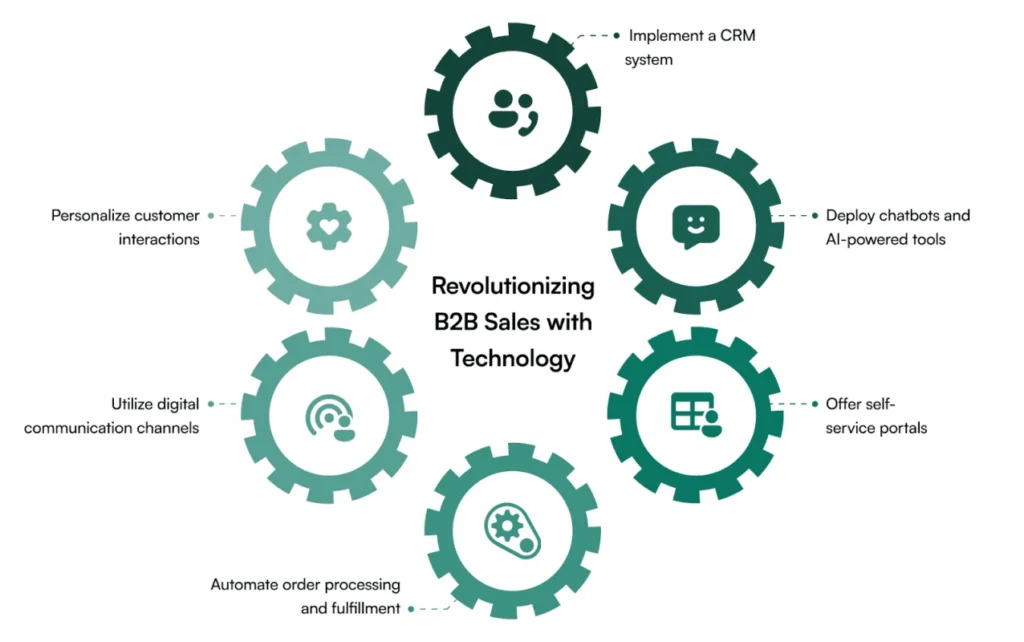
- CRM system implementation: A CRM system consolidates customer data, streamlines sales processes, and enables personalized interactions, enhancing the overall customer experience.
- Chatbots and AI tools deployment: Integrating chatbots and AI tools provides 24/7 support, speeds up response times, and improves customer satisfaction by handling routine inquiries and facilitating self-service options.
- Self-service portals: Offering self-service portals empowers customers to access account information, place orders, and resolve issues independently, reducing reliance on manual processes and enhancing satisfaction.
- Automated order processing: Automating order processing and fulfillment minimizes errors, expedites delivery times, and ensures a smoother purchasing experience for customers.
- Digital communication channels: Leveraging digital communication channels like email, live chat, and social media messaging enables real-time engagement and faster resolution of inquiries, strengthening customer relationships.
- Personalized interactions: Automation allows for personalized interactions at scale by analyzing customer data and tailoring sales and marketing efforts to individual preferences and behavior, increasing relevance and engagement.
What is B2B sales order automation?
B2B Sales Order Automation (SOA) is the process of automating the various stages of fulfilling sales orders, from order capture to fulfillment and beyond. In practice, B2B sales order processing automation covers intake, validation, and the ERP handoff. Its primary purpose is to streamline the order management process, eliminate manual tasks, and enhance efficiency.
Advanced technologies such as Artificial Intelligence (AI) and Machine Learning (ML) are at the heart of sales order automation solutions. These technologies enable intelligent decision-making, automate repetitive tasks, and optimize workflows for better business outcomes, but let’s not concern ourselves with the nitty-gritty of how it’s done. Rather, let’s see what it can mean for your business.
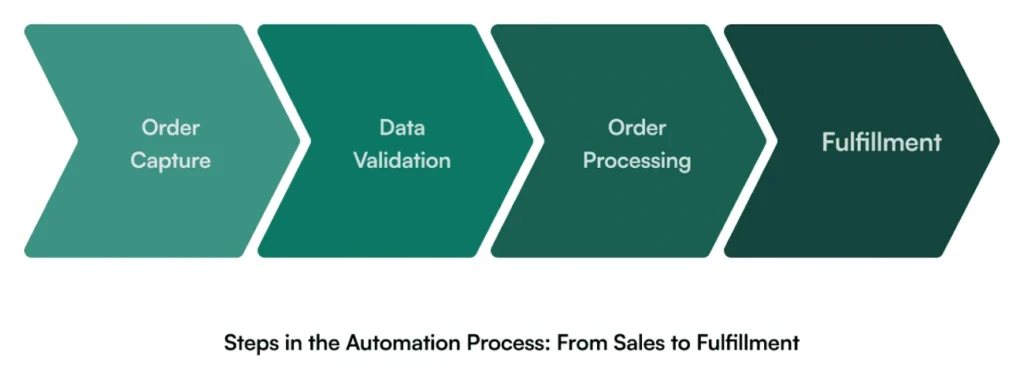
The automation process typically involves several steps:
- Order capture: Customers can place orders through self-service portals or assisted channels like a sales rep app, which enables real-time order capture, improves accuracy, and speeds up processing.
- Data validation: Orders are validated against predefined business rules to ensure accuracy.
- Order processing: Orders are entered into the system, triggering fulfillment workflows.
- Fulfillment: Orders are picked, packed, and shipped with real-time tracking available.
Also read: B2B sales automation for time optimization
Implementation: How to automate B2B sales order management
- Syncing customer records across applications: One of the first steps in implementing Sales Order Automation is to sync customer records across applications, ensuring consistency and accuracy across the sales ecosystem. This involves integrating customer data from various sources, such as CRM, ERP, and e-commerce platforms, into a centralized database.
- Uploading client documents to file hosting services in real-time: Another critical aspect of B2B Sales Order Automation is uploading client documents to file hosting services in real-time. It ensures that sales reps have access to the latest customer information, product catalogs, and pricing lists, enabling them to provide accurate and up-to-date information to customers.
- Automating notifications for sales reps when orders arrive: B2B Sales Order Automation can also automate notifications for sales reps when orders arrive, ensuring timely follow-up and action. It includes sending alerts to sales reps via email, SMS, or push notifications, allowing them to respond quickly and efficiently to new orders.
Key benefits of sales order automation for your business
1. Improved efficiency
Automating sales order processing reduces manual effort and eliminates the need for repetitive data entry tasks. That is what sales order processing automation delivers across the whole cycle. This results in faster order processing times, enabling sales teams to focus on more strategic activities such as nurturing leads and closing deals.
2. Reduced errors
Manual data entry is prone to errors, which can lead to costly mistakes such as incorrect orders, shipping delays, and billing discrepancies. By automating sales order processing, businesses can minimize the risk of errors and ensure greater accuracy in order fulfillment.
3. Faster order fulfillment
Automated sales order processing workflows enable orders to be processed and fulfilled more quickly. This can lead to shorter lead times, improved customer satisfaction, and increased likelihood of repeat business.
4. Enhanced customer experience
Streamlined sales order processing contributes to a better overall customer experience. Customers appreciate prompt order confirmation, accurate order tracking, and timely delivery of their purchases. By providing a seamless ordering process, businesses can build trust and loyalty with their customers.
5. Real-time inventory management
Automated B2B sales order processing systems are often integrated with inventory management software, providing real-time visibility into stock levels. This enables businesses to maintain optimal inventory levels, prevent stockouts, and fulfill orders more efficiently.
6. Enhanced CRM-integration
Another benefit of B2B Sales Order Automation is its ability to enhance CRM integration for better collaboration and customer relations. By syncing customer data across systems and automating communication workflows, businesses can improve visibility, consistency, and responsiveness, leading to stronger relationships and higher customer satisfaction.
7. Better decision-making
Automated sales order processing generates valuable data and insights that can inform strategic decision-making. By analyzing order trends, sales performance, and customer preferences, businesses can identify growth opportunities, optimize inventory management, and refine their sales strategies.
8. Cost-savings
By reducing manual labor and minimizing errors, automated sales order processing can result in significant cost savings for businesses. Additionally, streamlined workflows enable sales teams to handle higher order volumes without the need for additional resources, leading to greater operational efficiency and improved profitability.
Technological considerations for automated sales order processing
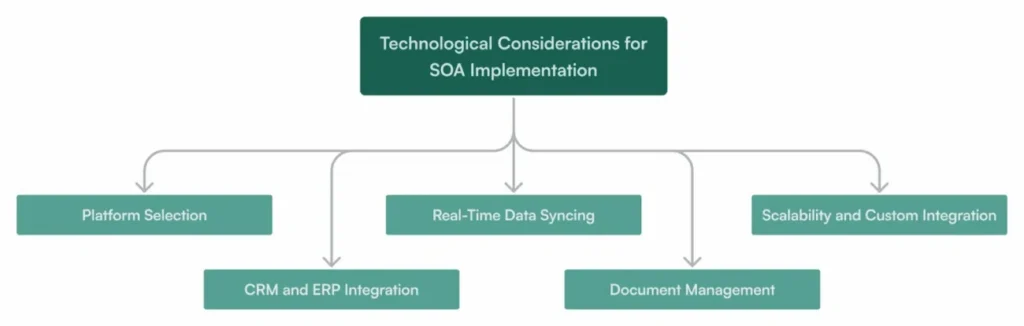
1. Platform selection
Choosing the right automation platforms and tools is crucial. Evaluate solutions based on functionality, scalability, and integration ease to align with your business goals effectively.
2. CRM and ERP integration
Ensure seamless integration with existing CRM and ERP systems. This facilitates data sharing and automation across the sales ecosystem, enhancing efficiency and consistency.
3. Real-time data-syncing
Prioritize real-time data syncing for accurate information across applications. This ensures that customer data, product catalogs, and pricing lists remain updated, benefiting both sales reps and customers.
4. Document management
Efficient document management is essential for smooth SOA implementation. Ensure necessary documents are easily accessible and synchronized, streamlining the sales process.
5. Scalability and custom integration
Plan for future growth by considering scalability and custom integration services. Work with technology partners to develop tailored solutions that meet your evolving business needs while maintaining flexibility for expansion.

Implement sales order automation with WizCommerce
A better customer journey starts with removing the friction of manual work. But how do you actually bridge the gap between “manual chaos” and a seamless experience?
To truly bridge the gap between manual chaos and a streamlined customer journey, businesses are turning to specialized sales order automation platforms that act as the “connective tissue” between their sales team and their ERP.
A platform like WizCommerce serves as a prime example of this technology in practice. Rather than forcing your team to type data into your system manually, the sales and ecommerce platform uses AI-driven extraction to “read” purchase orders and sync them instantly. This doesn’t just save time; it ensures that the customer experience remains consistent.
Here is exactly how WizCommerce automates your sales orders to make life easier for everyone:
- AI-powered intake: Instead of a rep spending 20 minutes on one email, an AI order and quote automation software processes the order in seconds, validating it against your live inventory.
- Omnichannel syncing: Whether an order comes from a sales rep app, a wholesale portal, or a direct email, it all flows into a single source of truth.
- Eliminating order dark time: Because the system is integrated with your ERP (like NetSuite, QuickBooks, or SAP), customers get instant confirmation and real-time tracking, fulfilling the modern demand for transparency.
By automating these steps, you aren’t just buying software; you are giving your sales team their time back. Instead of being data entry clerks, they can go back to being partners to your customers, which is where the real growth happens.
Want to see how this looks for your specific workflow? Book a demo with WizCommerce today to see how you can transform your customer journey in minutes
FAQs
What software is used for sales orders?
Software used for sales orders typically includes Enterprise Resource Planning (ERP) systems, Customer Relationship Management (CRM) tools, and dedicated order management platforms. For a comprehensive solution, you might consider WizCommerce, which offers end-to-end automation and a specialized sales portal to enhance the B2B customer journey.
How to automate purchase orders?
You can automate purchase orders using AI order entry software that captures order data from emails, PDFs, spreadsheets, and other documents, then automatically validates and enters the information into your ERP or accounting system. Advanced solutions can also apply business rules, route approvals, and generate purchase orders without manual data entry, helping businesses reduce errors, speed up processing, and improve procurement efficiency.
What is an example of sales order automation in B2B?
An example of sales order automation in B2B is the use of a self-service portal where customers place orders that are instantly validated against real-time inventory and pricing rules. Another common example is the automated synchronization of client documents and order data between a CRM and an ERP system, eliminating the need for manual intervention.
How does B2B sales order automation improve the customer journey?
B2B sales order automation improves the customer journey by providing faster response times, 24/7 accessibility, and highly accurate order tracking. It removes the friction of manual errors and delays, allowing for a more personalized and reliable purchasing experience that builds long-term loyalty.
How do I automate my B2B sales process?
To automate your B2B sales process, start by syncing your customer records across all applications to create a centralized, accurate database. You should then deploy AI tools, chatbots, and automated notifications to handle routine inquiries and keep your sales team alerted to new opportunities in real time.
What software is used for sales order automation?
Software used for sales order automation includes intelligent document processing tools, integrated CRM platforms, and specialized B2B automation software like WizCommerce. These solutions work together to automate data validation, order processing, and fulfillment tracking to maximize operational efficiency.