Skip to content




Imagine walking into a store where a knowledgeable salesperson instantly understands your preferences and guides you to the products you need. Now, translate that experience to your online B2B store. This is exactly what a B2B product recommendation system achieves: it anticipates buyers’ needs, personalizes product suggestions, and drives engagement without constant human intervention.
Personalized recommendations for B2B ecommerce aren’t just a convenience; they’re a necessity. Generic listings overwhelm buyers, while targeted suggestions increase conversion, reduce friction, and build loyalty. In fact, businesses using product recommendations in B2B ecommerce have seen up to a 70% boost in conversion rates, and repeat customers are four times more likely to return when suggestions are tailored to their preferences.
Ready to see how a B2B product recommendation engine can transform your online store? Let’s explore the types, benefits, and strategies that make these systems essential for modern B2B commerce.
Benefits of product recommendations
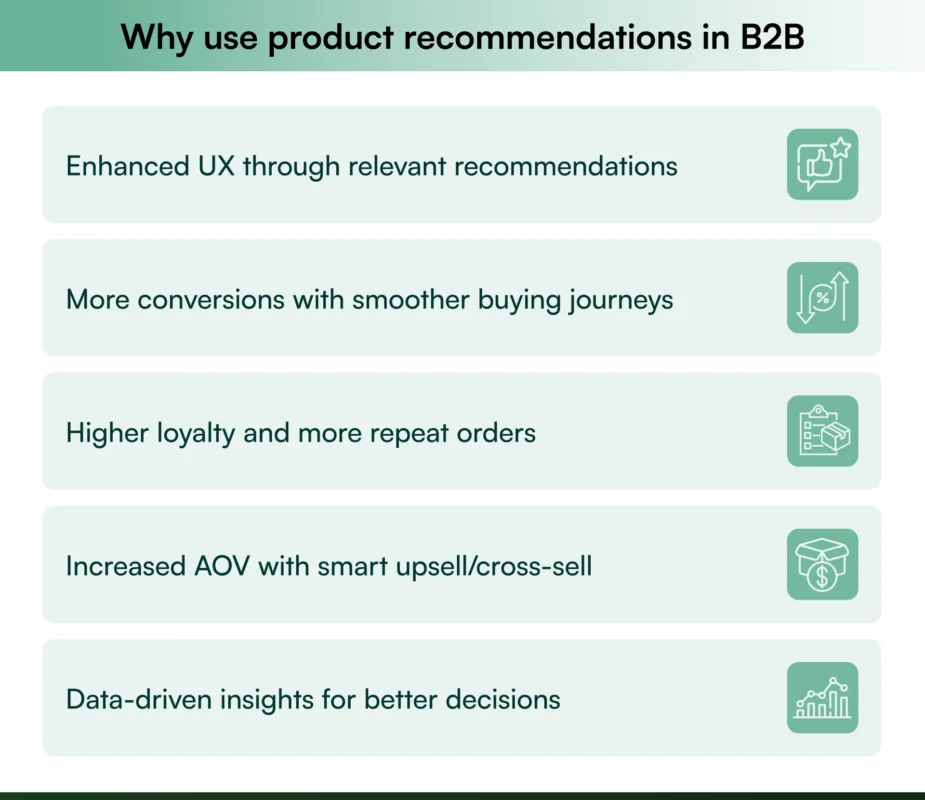
A B2B product recommendation system can transform the buyer experience while boosting your sales. Here’s how:
1. Enhanced user experience
By analyzing buyer behavior, a B2B personalized recommendation system delivers relevant product suggestions that match each customer’s preferences. Personalized product recommendations use customer data and behavior to tailor suggestions, significantly enhancing the overall shopping experience. By presenting items that align with the customer’s preferences and previous interactions, businesses can create a sense of understanding and connection with their audience. This creates a seamless, efficient shopping experience, helping buyers find what they need without frustration. Think of it as giving each buyer a personal B2B assistant online.
Amazon’s “Customers who bought this item also bought” feature exemplifies the success of personalized recommendations. By analyzing purchase history and item relationships, Amazon provides highly relevant suggestions, which contribute to its reputation for convenience and customized shopping.
2. Increased conversion rates
Relevant product recommendations for B2B simplify the purchasing process. Businesses that leverage a product recommendation engine see higher conversion because buyers are guided toward products they’re most likely to need, reducing decision fatigue and abandoned carts.
Fashion retailers like Zara have seen substantial benefits from integrating effective product recommendations. By showcasing similar styles or accessories that complement what customers are already viewing, these companies have enhanced the shopping experience, leading to higher conversion rates. The use of dynamic recommendations, adjusted in real-time based on browsing behavior, further amplifies this effect.
3. Improved customer retention
Product recommendations play a crucial role in customer retention by continuously providing value and relevance to the shopping experience. A B2B recommendation engine continuously presents relevant products, keeping buyers engaged over time. This ongoing personalization fosters a loyal relationship between the customer and the brand, encouraging repeat business. Customers feel understood and valued, making them more likely to return.
4. Upselling and cross-selling opportunities
With a smart product recommendation system, businesses can suggest complementary items or premium options. For example, a company buying office supplies might be recommended ergonomic chairs or extended warranties, increasing average order value (AOV) without aggressive sales tactics.
5. Data-driven insights for growth
Every recommendation provides insights into buyer preferences and trends. Leveraging this data helps businesses optimize inventory, refine marketing strategies, and enhance overall operational efficiency. Ecommerce recommendation engines turn data into actionable decisions that improve both the user experience and profitability.
What are the main types of product recommendation engines in B2B commerce?
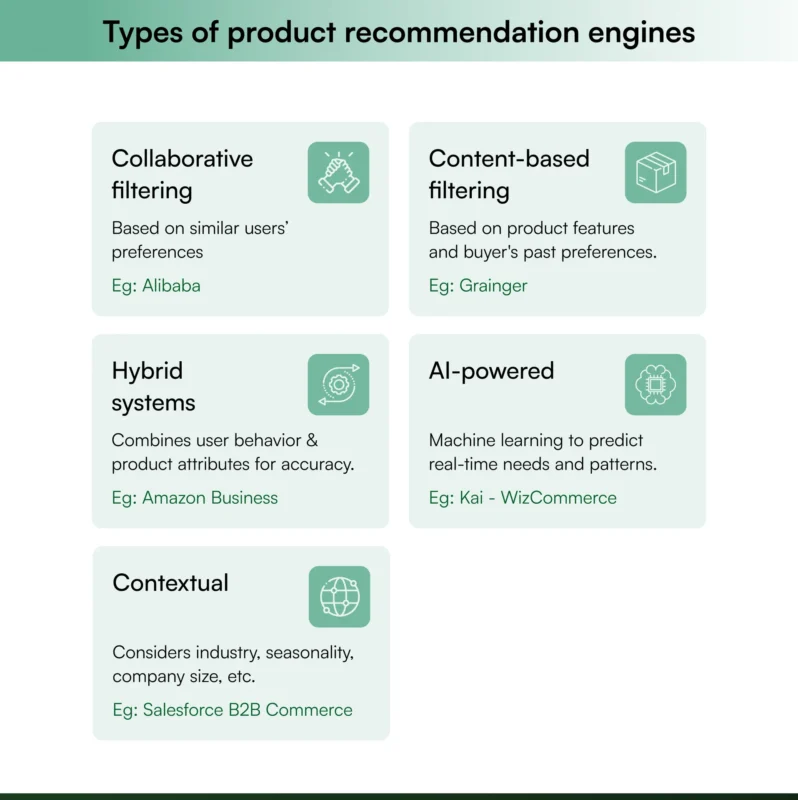
B2B buyers operate on a larger scale and with more complex needs than typical retail shoppers. Orders are often bulk, scheduled, and tied to operational requirements, meaning mistakes or delays can be costly. That’s why the most effective B2B recommendations remove guesswork, speed up ordering, and help teams avoid errors that impact inventory, logistics, and profitability.
Choosing the right B2B product recommendation engine depends on your business goals, buyer behavior, and the type of products you sell. Here are the main approaches:
1. Collaborative filtering
A product recommendation system using collaborative filtering predicts a buyer’s preferences based on the likes and behaviors of similar users. This method assumes that if users A and B have agreed on their preferences in the past, then the recommendations liked by user A will also be of interest to user B. If one business often buys a certain type of industrial equipment, the engine can suggest related products purchased by other companies with similar needs. It leverages the collective opinions of the user community to recommend items without needing to understand the content of those items.
Alibaba is a prime example; it recommends SKUs to buyers based on what similar wholesale accounts with comparable order patterns have viewed or purchased, such as “Businesses like yours also bought…” bundles or frequently paired products.
Pros: Helps buyers discover products they may not have searched for.
Cons: Struggles with “cold start” for new products or buyers.
2. Content-based filtering
This B2B personalized recommendation system focuses on product attributes and buyer profiles. Recommendations are generated by matching features of products with a buyer’s past interactions or stated preferences. For instance, a buyer who orders eco-friendly packaging might receive suggestions for other sustainable supplies.
Grainger uses content-based logic to recommend items with similar specifications, such as size, material, brand, voltage, or industry use case, based on what a buyer has previously viewed or ordered (e.g., “More straps that match your current pallet size”).
Pros: Works well for new buyers or unique products.
Cons: Limited to the features already known, may miss cross-category opportunities.
3. Hybrid recommendation systems
Hybrid ecommerce recommendation engines combine collaborative and content-based approaches to maximize relevance. They use both user behavior and product attributes, providing more accurate and diverse recommendations. B2B commerce, hybrid systems ensure buyers see both familiar products and complementary options they may not have considered. For example, Amazon Business can recommend items by combining what similar companies bought (collaborative) with detailed product specs (content-based). A facilities buyer browsing cleaning supplies might see recommended SKUs that are popular among similar businesses and match their preferred brand, pack size, and certification requirements.
Pros: Provides more accurate and diverse recommendations, reduces cold-start issues, adapts to user preferences and interactions.
Cons: More complex to implement and maintain.
4. AI-powered product recommendations
Advanced B2B recommendation engines leverage machine learning to dynamically adapt to buyer behavior in real-time. AI can spot patterns across large datasets, predict future buying needs, and personalize suggestions for complex B2B purchases. For example, WizCommerce’s Kai can recommend products based on purchase history, product similarity, and real-time browsing behavior, surfacing substitutes when an item is out of stock, suggesting frequently bought-together SKUs for bulk buyers, or highlighting region-specific bestsellers.
Pros: Highly accurate, scalable, and adaptable.
Cons: Requires quality data and technical implementation.
5. Contextual recommendations
Some product recommendations for B2B commerce take into account the context of the purchase, such as industry, company size, seasonality, or order frequency. This ensures suggestions are not only personalized but also practical and timely for the buyer’s business needs. For example, Salesforce Commerce Cloud can suggest products to a business based on its past orders during peak seasons, its industry, and the size of the company, like promoting winter-grade packaging to cold-climate distributors in Q4 or recommending safety gear bundles to a growing construction firm.
Pros: Adds relevance and timeliness, increasing buyer satisfaction.
Cons: Limited if contextual data is incomplete or outdated.
Key components of a B2B product recommendation system
A successful B2B product recommendation system relies on several interconnected components to deliver accurate, personalized suggestions and drive business growth. Understanding these elements helps B2B companies implement a system that truly adds value.
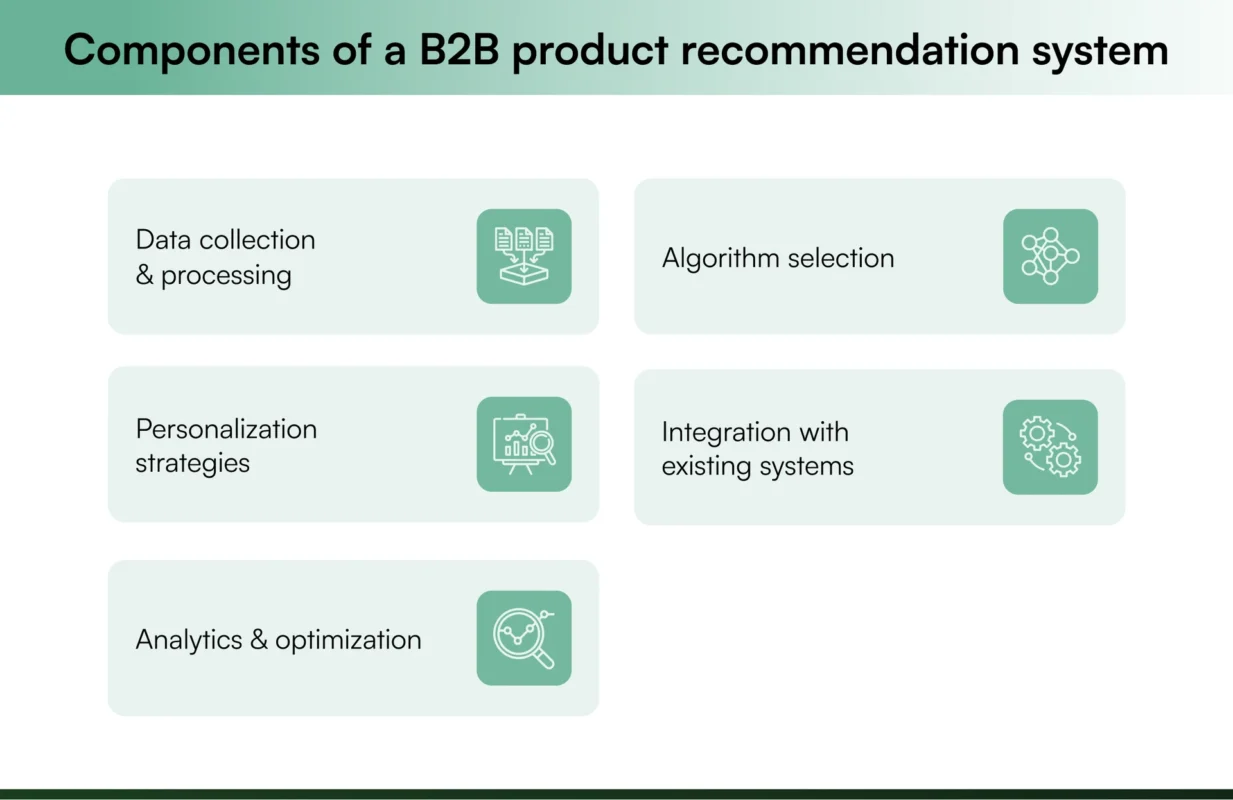
1. Data collection and processing
- User data: The foundation of any recommendation engine is the collection and analysis of user data. This includes tracking user behavior on the platform, such as page views, clicks, purchases, and even time spent on pages. Understanding user preferences and behavior patterns is crucial for tailoring recommendations that are genuinely relevant to each individual.
- Product data: Equally important is gathering detailed information about each product. This data can range from basic details like name, price, and category to more nuanced attributes like style, use case, or compatibility with other products. Comprehensive product data ensures that the product recommendation engine can accurately match products with user preferences.
2. Algorithm selection
The heart of a recommendation engine is its algorithm, which determines how recommendations are generated. As explained in the previous section, options can range from collaborative filtering and content-based filtering to hybrid filtering or more advanced machine learning-based approaches. Selecting the right approach ensures your B2B personalized recommendation system delivers relevant suggestions tailored to each business buyer.
3. Personalization strategies
- User segmentation: Dividing users into segments based on behavior, demographics, or preferences allows for more targeted product recommendations for B2B commerce. By understanding the distinct characteristics of different segments, recommendations can be tailored to meet the unique needs and interests of each group.
- Real-time personalization: Implementing real-time personalization strategies can significantly enhance the user experience by dynamically adjusting recommendations based on the user’s current interactions. This approach ensures that the B2B product recommendations engine remains relevant and timely, improving the accuracy and effectiveness of the engine.
4. Integration with existing systems
Seamless integration with ecommerce platforms, ERP, or CRM systems ensures that your ecommerce recommendation engines work in real-time, reflecting accurate stock levels, pricing, and product availability. This smooth integration streamlines workflows by reducing manual updates, preventing errors, and keeping product suggestions consistently up to date across all systems.
5. Analytics and optimization
Monitoring the performance of your B2B product recommendation engine is critical. Track metrics like conversion rates, average order value, and repeat purchases to continuously refine algorithms and improve the buyer experience. This ensures that recommendations remain relevant, effective, and aligned with business goals, ultimately boosting sales and customer satisfaction.
Challenges and solutions in building B2B product recommendation engines
| Challenge | Why it matters | Practical solutions |
| Data privacy & security | Large volumes of buyer data increase risk; weak protection erodes trust and repeat purchases. | Anonymize user data, encrypt data at rest and in transit, use secure storage, and clearly explain how data is collected and used. |
| Algorithm accuracy & bias | Biased or inaccurate models can favor certain products/segments and reduce relevance for buyers. | Combine methods (hybrid models), apply AI/ML, use cross-validation and regularization, and tune model complexity to improve accuracy. |
| Cold start problem | New users/products lack history, so recommendations can be weak or irrelevant early on. | Use content-based filtering, ask for initial preference inputs, show popular or curated items, and gradually incorporate behavior data. |
| Scalability | Growing users, SKUs, and events can slow systems and degrade recommendation quality. | Use efficient data storage, cloud infrastructure, and scalable algorithms designed to handle large datasets in near real time. |
| Continuous optimization | Buyer behavior and catalogs change, so “set and forget” engines quickly become outdated. | Track KPIs (CTR, AOV, conversions, repeat purchases), run A/B tests, and regularly retrain/refine algorithms based on performance data. |
How to implement product recommendations for B2B?
Implementing an ecommerce recommendations engine is a strategic move for ecommerce platforms aiming to enhance user experience and boost sales. The process involves several key steps, from seamless integration with existing systems to continuous optimization based on performance data. Below are the essential steps to effectively implement product recommendations.
Integration with e-commerce platforms
- API integration: The backbone of integrating recommendation engines with e-commerce platforms is the Application Programming Interface (API). APIs enable the recommendation system to communicate with the e-commerce platform, sharing data on user behavior, product details, and transaction histories. Seamless API integration ensures that recommendations are dynamic, reflecting real-time data and interactions. This integration process involves mapping out the data flow between the recommendation engine and the e-commerce platform, ensuring that the API calls are optimized for efficiency and speed.
- Tailoring recommendation systems: Each business has unique needs, goals, and customer bases, necessitating the customization of recommendation systems. Customization can involve adjusting the algorithms to prioritize certain types of products, modifying the user interface to better match the brand, or integrating with specific business logic to align recommendations with business strategies. For instance, a fashion ecommerce site might customize its recommendation engine to focus on style compatibility and seasonal trends, while a bookstore may prioritize author series, genres, and reader ratings. Netflix’s recommendation system, customized to prioritize viewing history and user ratings, provides highly personalized content suggestions, demonstrating the power of tailored recommendation engines.
A/B testing
- Significance of A/B testing: A/B testing is crucial for evaluating the effectiveness of different recommendation algorithms and configurations. By comparing the performance of two or more versions of the recommendation system under controlled conditions, businesses can identify which strategies most effectively drive engagement, conversion rates, and sales.
- Conducting controlled experiments: To conduct A/B testing, traffic to the e-commerce platform is split between the different versions of the recommendation system. Key performance indicators (KPIs) such as click-through rates, conversion rates, average order value, and user satisfaction are then measured and analyzed. This data-driven approach allows businesses to make informed decisions about which recommendation strategies to adopt, refine, or discard.
Success stories and case studies
Amazon’s product recommendations: Amazon’s recommendation engine is widely reported to drive around 35% of its total sales by combining collaborative filtering, content-based signals, and machine learning. It analyzes behavior such as browsing, add-to-cart, and purchase history to power modules like “Customers who bought this also bought” and “Frequently bought together.” The same underlying approach is used in Amazon Business, helping procurement teams quickly discover relevant alternatives, bundles, and replenishment items for B2B orders.
Grainger’s B2B personalization: Industrial distributor Grainger is often highlighted as a best-in-class B2B ecommerce site, using strong search, filters, and personalization to help time-pressed business buyers get to the exact SKU they need. Grainger leverages data and AI-powered personalization to serve individualized product suggestions and targeted content, so repeat buyers see relevant parts, accessories, and consumables aligned with their role, industry, and past orders, which improves both user experience and conversion in a very complex catalog.
WizCommerce’s Kai (AI sales assistant for B2B): Kai is an AI sales assistant built specifically for wholesale and distribution teams on top of WizCommerce’s AI-first B2B commerce platform. Rather than just showing recommendations on a webpage, Kai supports reps directly by identifying sales opportunities in their territory, preparing meeting materials, recommending products based on buyer history, and automating follow-ups, freeing reps from manual admin and helping them spend more time actually selling, as part of WizCommerce’s recently funded push to become an AI operating system for wholesale.

Emerging trends in ecommerce recommendation engines
The world of B2B product recommendation engines is evolving rapidly, driven by AI, machine learning, and new ways of interacting with buyers. Staying ahead of these trends ensures your business delivers highly relevant suggestions that boost sales and strengthen relationships.
1. Artificial intelligence and machine learning
AI and ML are at the forefront of enhancing recommendation systems, offering unprecedented accuracy in predicting user preferences. As these technologies evolve, we can anticipate even more sophisticated integration, allowing for real-time learning from user interactions and behaviors to refine recommendation algorithms continuously.
2. Contextual recommendations
The incorporation of contextual information, such as location, time of day, and device usage, into recommendation engines marks a significant trend. Context-aware recommendations provide a more nuanced understanding of user needs, adapting suggestions to fit changing scenarios and enhancing the relevance of recommendations.
3. Voice-activated recommendations
With the rise of voice-activated devices, there’s a growing need to optimize product recommendations for voice-enabled environments. This involves developing strategies that understand and respond to voice queries with personalized suggestions, making the shopping experience more interactive and accessible.
As these trends reshape the wholesale landscape, businesses need tools that can actually execute on them, not someday, but right now. Platforms like WizCommerce bring together AI-driven recommendations, real-time inventory syncing, and cross-channel recommendation capabilities, helping businesses implement personalized product suggestions that drive conversions and customer loyalty. Instead of juggling disconnected systems or manual workflows, wholesalers can plug into one ecosystem designed for speed, accuracy, and smarter selling.
Book a demo to see how your business can match these emerging trends with real operational readiness with a platform built for modern wholesale.
Frequently asked questions
What is a product recommendation system?
A product recommendation system suggests items a buyer is likely to purchase based on behavior, purchase history, or similar buyer patterns. Platforms like WizCommerce use machine learning to generate these suggestions automatically, helping wholesalers increase average order value with minimal manual input.
What are the risks of recommendation systems?
If set up poorly, recommendation systems can show irrelevant products, rely on outdated data, or create “filter bubbles” where buyers only see a small set of items. It can also misfire when inventory isn’t synced, causing out-of-stock suggestions.
Do recommendation systems use NLP?
Many modern systems use Natural Language Processing (NLP) to understand product descriptions, search queries, and customer reviews. This helps the system understand text so it can match intent with more accurate suggestions. For example, a system could use NLP to understand that a user who enjoys “dark humor” in movie reviews might like other films with similar themes or genres, even if they aren’t directly related by cast or director.
What is the difference between a recommendation system and a recommender system?
There is no substantive difference between a recommendation system and a recommender system; the terms are used interchangeably. Both refer to a subclass of information filtering systems that seek to predict a user’s rating or preference for an item. The goal of these systems is to provide personalized, relevant suggestions to users, improving their experience and increasing engagement.
What is a product recommendation system using AI?
A product recommendation system using machine learning to analyze patterns like purchase frequency, cart behavior, or product affinity, and then suggests the most relevant items automatically. It updates its suggestions as customer behavior changes. An example is WizCommerce’s AI recommendation engine, which updates suggestions in real time as buyers browse, making the experience feel more personalized and intentional.
Which company has the best recommendation system?
Many companies are known for having excellent recommendation systems, but giants like Amazon, Netflix, and Spotify are often cited as leaders. These companies have invested heavily in AI and machine learning to build highly sophisticated systems that are integral to their business model. Amazon’s system is famous for its ability to increase sales by suggesting relevant products, while Netflix’s system is highly effective at keeping users engaged by recommending shows and movies they are likely to enjoy.
How to build a recommendation system using AI?
To build a recommendation system using AI, you first need to establish a clear business objective and collect a massive amount of high-quality data. Next, you select and train an AI model, such as a deep learning neural network or matrix factorization algorithm, on this data. The model learns to predict user behavior based on past interactions. Finally, you integrate the trained model into your application using an API and continuously monitor its performance to refine and improve the recommendations.