Skip to content



Whether you’re managing a small fleet or a large-scale operation, the ability to streamline your processes can make all the difference in your bottom line. This is where route accounting software for distributors comes into play.
Route accounting software for distributors is specifically designed to help distributors manage their operations more efficiently. These solutions streamline key aspects of the business, including route planning and optimization, order management, customer relationship management (CRM), sales force automation, financial management, and reporting and analytics.
By integrating these features, distributors can reduce costs, enhance customer relationships, and make informed business decisions with ease.
In this blog, we’ll dive deep into the key features of route accounting software and explore how to choose the right solution for your business. Whether you’re looking to boost efficiency, strengthen customer relationships, or drive profitability, understanding and leveraging the right software is your first step toward success.
What is route accounting software?
Route accounting software for distributors is a game-changer, especially for those involved in direct store delivery (DSD). This specialized software streamlines the entire distribution process, making it easier for businesses to manage sales, deliveries, and invoices efficiently. But what exactly does it do, and why is it so essential for distributors?
At its core, route accounting software is designed to support various crucial modules:
- Manage on-the-go sales directly from delivery vehicles, ensuring accurate and real-time data entry.
- Track and manage products that are placed on consignment at retail locations, with automated invoicing when items are sold.
- Maintain optimal inventory levels by automating the replenishment process, and reducing stockouts and excess inventory.
- Streamline data exchange between distributors and retailers, ensuring seamless communication and reducing manual errors.
- Enable retailers to pay only for items that have been sold, improving cash flow management for both parties.
One of the standout benefits of route accounting software for distributors is its ability to eliminate inefficiencies and bottlenecks in the invoicing process. By automating and optimizing these tasks, distributors can expect several tangible financial benefits:
- Enhanced accuracy and efficiency lead to more sales opportunities.
- Automation reduces manual labor and errors, cutting down on operational expenses.
- Overall, the system’s efficiency translates into higher profitability.
In an industry where time and accuracy are critical, investing in route accounting software can make all the difference. It’s more than just a tool; it’s a strategic asset that drives growth and profitability for distribution companies.
Key features of route accounting software for distributors
When it comes to enhancing the efficiency and effectiveness of your distribution process, route accounting software for distributors is an indispensable tool. But what exactly makes this software so powerful? Let’s explore some of the key features that set it apart:
1. Address geocoding for route planning
Easily map out your delivery routes by importing customer data directly from QuickBooks or Excel. Whether it’s shipping or billing information, this feature allows you to place your customers directly on the map, ensuring that every delivery is planned with precision.
2. Route compliance
Stay on top of your field operations with real-time GPS tracking for sales reps and drivers. Time-stamped deliveries and invoice submissions give you the visibility you need to monitor performance and ensure that schedules are adhered to without fail.
3. Multiple route optimization
Efficient route planning is critical to reducing costs and improving delivery times. This feature calculates the most efficient routes between multiple stops, minimizing time and mileage and ultimately cutting down on overhead costs.
4. Inventory management
Manage your inventory with ease by assigning “virtual warehouses” or individual inventories to your reps and drivers. With live updates after each completed invoice submission, you’ll have a real-time view of inventory levels in the field, ensuring that stock is always accurately tracked.
5. Integration with sales analytics software
For businesses looking to make data-driven decisions, this feature is a game-changer. The route accounting software for distributors can connect with enhanced sales analytics tools, allowing you to export insights as visualized data or detailed pivot tables for in-depth analysis.
While route accounting software streamlines your distribution, pairing it with WizCommerce enhances efficiency. WizCommerce’s advanced sales automation and order management tools integrate seamlessly with your distribution process, ensuring your entire operation runs smoothly.
6. Proof of delivery
Capturing proof of delivery is made simple with this software. Sales reps can easily capture signatures on completed invoices and, using customizable templates, email them directly to customers. This ensures that every delivery is documented and verified, reducing disputes and enhancing customer satisfaction.
How to choose route accounting software for distributors?
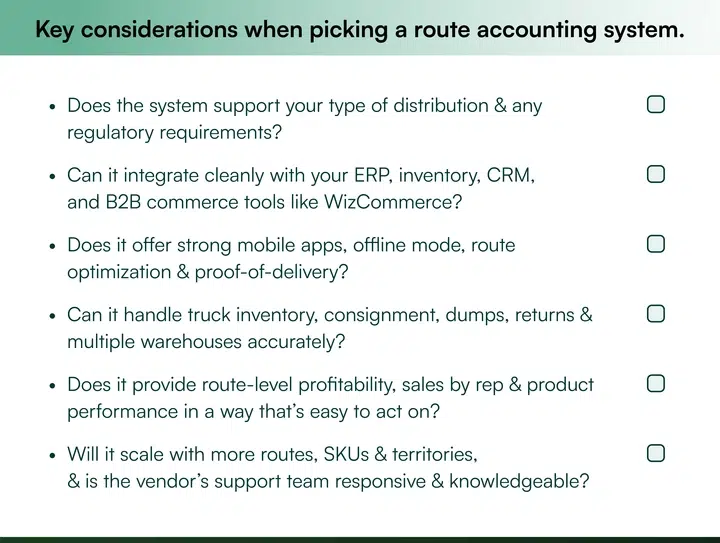
Selecting the ideal route accounting software for distributors is a critical decision that can significantly impact your business’s efficiency and profitability. With so many options available, it’s essential to choose a solution that aligns with your specific needs.
Here’s a step-by-step guide to help you make an informed choice:
1. Assess your business needs
Start by thoroughly evaluating your business’s requirements. Consider the size of your operation, the complexity of your delivery network, and the volume of orders you handle daily.
Are you managing a small fleet or a large-scale distribution network? Identifying these factors will help you narrow down your options and find a route accounting software for distributors that fits your business model.
2. Evaluate online booking capabilities
If your business relies on online customer bookings, it’s crucial to find software that offers robust online booking features. Look for a solution that includes a user-friendly web portal or mobile app, allowing customers to place orders conveniently.
Ensure that the software can seamlessly integrate with your existing website or e-commerce platform, providing a smooth and efficient booking experience for your customers.
3. Consider scheduling and dispatch features
Efficient scheduling and dispatching are vital for optimizing delivery routes and ensuring timely order fulfillment.
Choose a route accounting software that includes advanced scheduling features such as route optimization algorithms, real-time GPS tracking, and automated route adjustments. These features will help streamline your operations, reduce delivery times, and maximize the efficiency of your distribution fleet.
Also Read: How to Optimize and Manage Your Sales Order Process?
4. Assess invoicing functionalities
Invoicing is a crucial part of managing your cash flow and financial health. Look for software that offers comprehensive invoicing functionalities, such as automatic invoice generation, customizable templates, and integration with your accounting systems.
The right software should also support various billing requirements, including recurring billing, variable pricing, and discounts, to accommodate the unique needs of your business.
5. Evaluate integration capabilities
Integration with other business systems, such as CRM and ERP platforms, is essential for seamless data flow and efficient workflows. Ensure that the route accounting software you choose offers flexible integration capabilities.
This will allow you to synchronize data across different departments, improving collaboration and centralizing your operations for better efficiency.
Each route accounting software for distributors comes with unique features and strengths, tailored to different business needs. To make the best choice, consider factors such as pricing, scalability, user-friendliness, and the specific features that align with your operational goals. By carefully evaluating these aspects, you can select a software solution that not only meets your current needs but also supports your long-term growth and success.
Common challenges distributors face with route accounting software
Even the best route accounting software for distributors can fall short if it’s not implemented and used correctly. Many distributors focus on features and demos, but overlook the real-world obstacles that can slow adoption, create bad data, and hurt ROI. When you think about how to choose route accounting software for distributors, it’s just as important to understand what can go wrong as it is to know what to look for in a product.
The table below highlights some of the most common challenges, the impact they have on your business, and practical ways to avoid them.
| challenge | result | How to avoid it |
| Complex data migration & weak integrations | Dirty or inconsistent data between your route accounting system, ERP, CRM, and inventory tools leads to billing errors, duplicate customers, and visibility gaps. | Plan a structured migration, clean your data before import, and prioritize vendors with proven integrations to your ERP and accounting stack. Run test migrations and reconcile sample routes before going live. |
| Low adoption by drivers & reps | Field teams avoid the system, fall back to paper or spreadsheets, and you lose real-time visibility into sales, inventory, and delivery performance. | Choose user-friendly, mobile-first software, involve reps and drivers in the selection process, and invest in hands-on training and simple SOPs. Pilot with a few routes first and refine based on feedback. |
| Inaccurate truck & route inventory | Stockouts, over-ordering, and mismatched counts between trucks, warehouse, and system data create write-offs, lost sales, and frustrated customers. | Require field users to log all movements (loads, returns, dumps, swaps) in the route accounting software, and enable real-time or scheduled syncs with your warehouse and inventory systems. Audit trucks regularly. |
| Limited pricing & promotion flexibility | Reps struggle to apply customer-specific pricing, discounts, and promotions correctly, which erodes margin or forces time-consuming credits later. | Confirm that the system supports complex B2B price lists, contract pricing, and promo rules. Test real customer scenarios during demos, not just generic examples, before you choose a vendor. |
| Hard-to-use reporting & poor visibility | Leadership can’t easily see which routes, reps, or products are performing, so decisions on pricing, inventory, and territories are slow or based on guesswork. | Look for intuitive dashboards and exportable reports focused on route-level KPIs (sales, margin, returns, on-time delivery). Involve finance and operations in defining the reports they need upfront. |
| Underestimating total cost of ownership | You get surprised by implementation fees, hardware, customizations, or integration costs, and ROI is harder to justify internally. | Build a full cost model that includes licenses, devices, implementation, training, integrations, and support. Compare vendors on total cost of ownership over 3–5 years, not just monthly price per user. |
| Compliance gaps in regulated industries (e.g., beverage) | Incomplete or inaccurate data for regulated products leads to audit risk, compliance issues, and potential fines. | If you operate in regulated categories, ensure your route accounting software can capture the product, package, account, and territory details you need and integrate with ERP/compliance tools. Validate workflows with your finance and legal teams before rollout. |

Best route accounting software for distributors
When you start evaluating route accounting software for distributors, it’s easy to get overwhelmed by feature lists and demos. Instead of chasing a single “perfect” tool, it’s better to shortlist a few proven options and then apply a clear framework for how to choose route accounting software for distributors based on your routes, order volume, and tech stack.
Here are some of the leading solutions distributors often consider:
1. VIP route accounting
VIP is a long-standing route accounting and technology platform built for beverage distributors and bottlers, combining route accounting, warehouse management, sales execution, delivery, financials, and analytics in a single ecosystem.
Distributors use VIP’s route accounting system to:
- Enter and process orders, post A/R payments, and manage driver settlements from one place
- Route drivers, sales reps, and merchandisers while keeping products, retailers, and pricing information in sync
- Tie in warehouse management, mobile delivery apps, and integrated payments (VIPPAY) so they can capture check/credit/ACH in the field and speed up order-to-cash
For distributors, especially in regulated beverages, VIP is an end-to-end route accounting software solution that delivers deep industry fit and strong reporting.
2. Laceup
LaceUp offers a Direct Store Delivery (DSD) route accounting solution designed for wholesale distributors that want to increase sales and cut waste on delivery routes. Built on Android, it helps automate mobile invoicing, inventory control (including truck inventory), and route-based sales activities.
Distributors use LaceUp to:
- Reduce manual data entry and invoicing errors
- Speed up on-truck sales and credit processing
- Gain clearer visibility into route profitability and product performance
It’s a strong fit for distributors running classic DSD models, especially in food, beverage, and C-store channels.
3. Solid Route Accounting by Solid Innovation

Solid Route Accounting positions itself directly as “route accounting software for distributors” and focuses on organizing routes, integrating accounting operations, and boosting route sales.
Key strengths include:
- Centralized route management across all drivers and territories
- Integration with top accounting solutions for clean financials
- Mobile tools for DSD, van sales, and inventory control in the field
For distributors looking for a robust route accounting tool with strong reporting and mobile sales, Solid Route Accounting is worth a look.
4. eoStar route accounting software
eoStar is a comprehensive route accounting solution for modern beverage and food distributors, designed for three-tier distribution systems across beer, wine, spirits, non-alcoholic beverages, and increasingly snacks and foodservice.
eoStar helps distributors:
- Manage route accounting, pricing, promotions, and settlements in a single database
- Combine warehouse management, electronic picking and palletization, mobile sales and delivery (eoTouch), and retailer e-commerce (eoMarket) into one ecosystem
- Gain real-time visibility into inventory, sales, receivables, and route performance so operations, sales, and finance teams all work from the same data
For distributors evaluating how to choose route accounting software, eoStar is a strong candidate when you need deep route functionality plus integrated WMS, BI, and mobile tools.
5. inSitu Sales

inSitu Sales offers a field sales app with built-in routing and route accounting capabilities. It’s designed to be accessible for smaller distributors with per-user pricing and cloud hosting.
With inSitu, distributors can:
- Plan and optimize routes for field reps
- Capture orders, invoices, and payments on mobile devices
- Sync with accounting and ERP systems like QuickBooks, SAP B1, and Xero
If you’re looking for a more lightweight route accounting tool that still integrates with your financial systems, inSitu Sales is a practical option.
WizOrder for route-based B2B distributors
When you think about how to choose route accounting software for distributors, it’s easy to focus only on routing, inventory, and invoicing. But the quality of your order capture at the stop is just as important, and that’s exactly where WizOrder by WizCommerce fits in.
WizOrder is a B2B sales and order-taking app built specifically for reps and distributors. It gives your field team a fast, visual way to capture orders on mobile or tablet, with a digital catalog, customer-specific pricing, and real-time data from your ERP and accounting tools.
Instead of scribbling orders on paper or juggling spreadsheets, reps can:
- Browse a rich product catalog with variants and custom products, then build accurate orders in a few taps.
- See live inventory and pricing pulled from your ERP, so what they promise on the route matches what’s actually in stock and on the books.
- Leverage AI-powered recommendations to upsell, cross-sell, and suggest reorders based on the customer’s history, increasing average order value without adding friction to the visit.
This results in a tighter loop between selling, routing, and accounting:
- Sales reps create better, larger, and error-free orders at the point of sale.
- Route accounting software for distributors uses that clean data to plan and execute efficient routes, manage inventory on trucks, and automate invoicing.
- Finance and leadership get reliable reports on route performance, margins, and growth opportunities.
For distributors already using route accounting software, WizOrder becomes the perfect front-end companion at each stop. Orders captured in WizOrder can flow into your ERP and, from there, into your route accounting and fulfillment processes, so your drivers, warehouse team, and finance teams are all working off the same, accurate data.
Book your demo now to make every route more profitable, every invoice more accurate, and every customer visit more valuable without disrupting the systems you already rely on.
FAQs
What is route accounting software?
Route accounting software is a specialized system that helps distributors manage everything that happens along a delivery or sales route, including orders, invoices, payments, returns, inventory, and customer data in one place. It connects reps and drivers in the field with ERP and accounting, so you get cleaner data, faster billing, and clearer route profitability.
Are there any route accounting software options specifically designed for B2B distributors?
Route accounting software options specifically designed for B2B distributors include platforms like LaceUp, Encompass, and eoStar, which are built around wholesale and route-based models such as DSD, van sales, and recurring B2B orders.
Which route accounting software is best for distributors in 2026?
The best route accounting software for distributors in 2026 is the one that fits your size, industry, routes, and tech stack. There’s no single “winner” for everyone. A small local fleet with simple pricing needs something very different from a multi-region beverage distributor with strict compliance requirements.
Which free software is best for inventory management?
Free or freemium options like Zoho Inventory’s free plan, Odoo Community (open-source), and Sortly’s free tier can work for very small businesses that only need basic stock tracking. WizCommerce also offers a free version, but it’s built for B2B wholesalers and distributors, and most growing wholesale teams eventually move to paid plans to get advanced pricing, multi-warehouse support, and deeper integrations.
What are the common challenges distributors face with route accounting software?
Common challenges distributors face with route accounting software include messy data migration, weak ERP/CRM integrations, low field-user adoption, inaccurate truck inventory, limited pricing flexibility, and hard-to-use reporting. Avoid them by looking beyond feature lists and choosing route accounting software that matches your workflows, users, and long-term strategy.
How do route accounting systems support regulated beverage sales?
Route accounting systems support regulated beverage sales by capturing detailed route-level data on products, packages, territories, and accounts for every invoice, return, and credit. That information feeds ERP and compliance tools so distributors can meet audit, tax, and reporting requirements while respecting pricing and territory rules.
How much does routing software cost?
Routing software costs range from low per-user monthly fees for simple route-planning apps to higher subscription and implementation costs for full route accounting software for distributors. Always compare total cost of ownership, licenses, hardware, setup, integrations, and support against the time saved, fewer errors, and expected revenue gains.
What factors should be considered when choosing an accounting system?
The factors that should be considered when choosing an accounting system for distributors include industry fit, support for route-based workflows, and seamless integration with your route accounting software, ERP, CRM, and B2B commerce stack. You should also weigh usability, reporting, scalability, and total cost of ownership against your growth plans.