Skip to content



AI in wholesale distribution helps distributors optimize inventory, predict customer orders, and automate sales processes. For businesses managing complex catalogs and multiple customers with different pricing needs, artificial intelligence addresses common operational challenges.
The business case is clear. According to McKinsey, embedding AI in operations can reduce inventory by 20 to 30 percent, cut logistics costs by 5 to 20 percent, and lower procurement spend by 5 to 15 percent. Distributors are achieving these cost savings and efficiency gains by implementing AI in specific areas of their operations.
This guide breaks down how AI in wholesale distribution works across every key function: revenue growth, inventory management, customer service, warehouse operations, and data analytics. Let’s get started!

What is AI in wholesale distribution and why does it matter now?
What is AI in distribution? AI in distribution refers to the application of artificial intelligence technologies to optimize and enhance various aspects of the distribution process. This includes using AI for advanced analytics, inventory management, customer service, and operational efficiency.
Why distributors are using it now:
The wholesale distribution industry is getting more complex. Customers want faster responses and personalized service. You’re managing inventory across multiple warehouses. Your sales team spends too much time on manual data entry and quote generation instead of selling.
AI helps by analyzing your data to:
- Predict which products will be in demand before you run low
- Identify which customers are likely to place orders soon
- Suggest which products to recommend based on purchase history
- Automate repetitive tasks like order processing and inventory tracking
For distributors managing thousands of products and hundreds of customer accounts, these capabilities mean less time spent guessing and more time acting on reliable information, a competitive advantage that helps their wholesale business stay ahead of the rest.
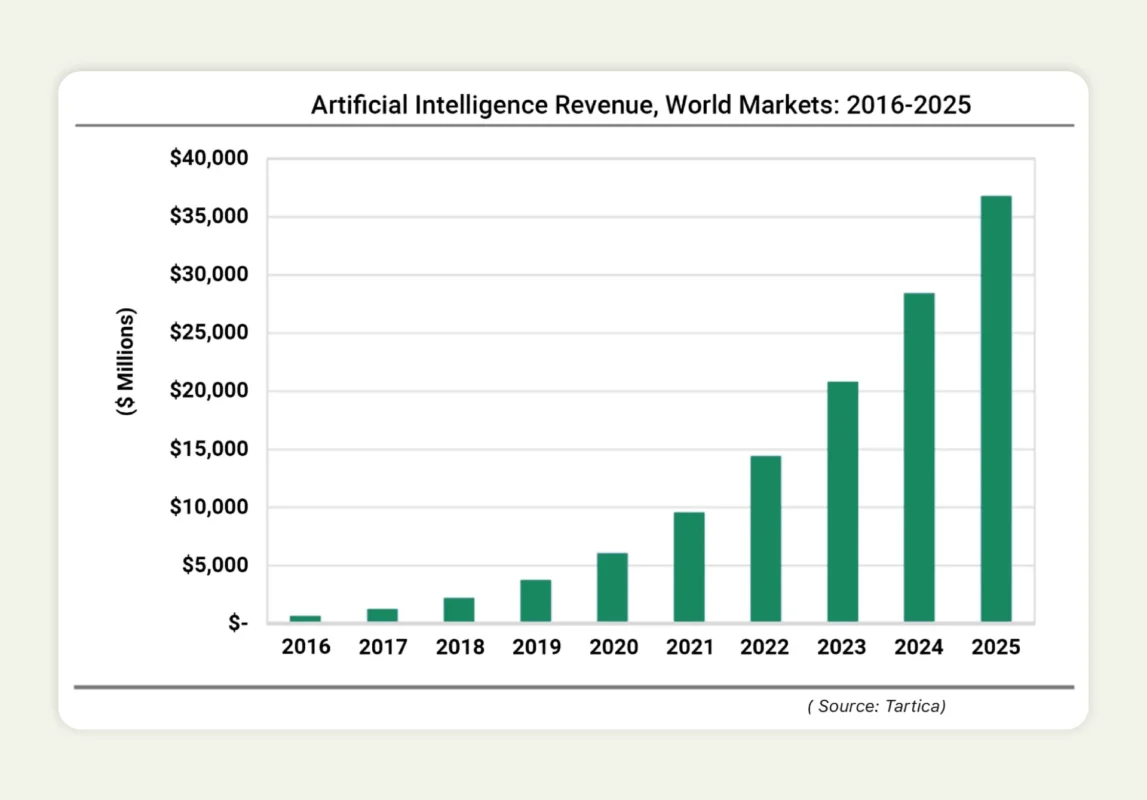
By 2040, AI adoption is expected to soar to 34.8%, with over 1.3 million businesses leveraging its capabilities to fuel innovation.
But what does that actually look like in your day-to-day operations?
The 5 Critical Roles of AI in Distribution for Wholesale Businesses
Before diving into specific applications, it’s important to understand that ai in wholesale distribution isn’t a single tool; it’s a collection of technologies working together to solve operational challenges. AI helps distributors in five main ways. Here’s what it actually does:
Role 1: Driving revenue through intelligent sales automation
AI looks at your sales history to show your team which customers are most likely to buy and what they’re likely to order. Instead of your sales reps spending hours digging through spreadsheets to figure out who to call, the system tells them: “These 10 customers usually reorder around now” or “This customer bought Product A, and 80% of customers who buy A also buy Product B.”
Role 2: Predicting customer reorders before they happen
If a customer orders the same products every three months, AI notices that pattern. It can alert your sales team a week before the customer typically reorders, so you can reach out proactively. This turns you from an order-taker into a partner who anticipates needs.
Role 3: Mastering inventory with AI-powered forecasting
AI analyzes what you’ve sold over time accounting for seasonal changes, trends, and unusual spikes, to predict what you’ll need in stock. This means you’re less likely to run out of fast-moving items or waste money storing products that don’t sell.
Role 4: Automating warehouse operations and logistics
AI can determine the most efficient routes for deliveries, suggest optimal storage locations in your warehouse, and even power robots that handle picking and packing. The result: orders get out faster and with fewer errors.
Role 5: Delivering exceptional customer experiences
AI enables chatbots that answer common customer questions instantly, recommends products based on what each customer has bought before, and sends personalized follow-ups. Customers get faster service and more relevant suggestions without your team doing extra work.
These five roles of ai in distribution work together synergistically. Improvements in one area often enhance performance in others.
How AI drives revenue growth for wholesale distributors
For wholesale distributors, AI in wholesale distribution can be a game-changer in boosting revenue. It’s like having a strategic advisor. This guide focuses on top AI use cases in ecommerce, showing how AI constantly monitors and analyzes your sales data to uncover opportunities. Here’s how AI can drive your revenue growth:
1. Analyzing purchase patterns and preferences
AI dives deep into your sales data to identify trends and patterns. It looks at what products are selling, who’s buying them, and when. This analysis helps you understand customer preferences and anticipate demand, allowing you to stock the right products at the right time. By aligning your inventory with market demand, you can reduce excess stock and increase sales.
2. AI-driven recommendations to increase order value
AI achieves this by analyzing data to deliver tailored suggestions. From recommending related products to highlighting frequently bought items, AI increases the average order value, resulting in more sales per transaction and a significant boost to your overall revenue.
3. Using AI for personalized marketing campaigns
Marketing campaigns become much more effective with AI. By segmenting your customers based on their buying behavior, AI enables you to create targeted marketing campaigns that resonate with each segment. According to the Marketing AI Institute’s 2024 State of Marketing AI survey, 41% of businesses currently use AI to create personalized consumer experiences, with marketers focusing on personalization, revenue acceleration, and data analytics.
Personalized emails, promotions, and advertisements tailored to specific customer needs lead to higher engagement and conversion rates. This targeted approach ensures your marketing dollars are spent more efficiently, driving higher returns.

Revenue matters, but so does controlling costs. That’s where inventory management comes in.
How to use AI for inventory management in distribution?
Managing inventory can be a headache, but with AI, it becomes a whole lot easier and more efficient.
Did you know AI can cut inventory costs by 20% to 50% through better demand prediction and inventory optimization? This reduction is crucial for improving profit margins and overall business health. Here’s how AI can revolutionize your inventory management:
1. Demand forecasting to optimize stock levels
According to a McKinsey report, AI-driven demand forecasting can reduce errors by up to 50%, helping businesses maintain optimal inventory levels and avoid costly stockouts and overstock situations.
AI analyzes past sales data and market trends to predict future demand. By optimizing your stock levels, you reduce carrying costs and ensure you always have the right products on hand.
2. Automated restocking and discount strategies
With AI, you can automate the restocking process. The system monitors real-time inventory levels and automatically places replenishment orders when stocks run low. A recent study states that AI can automate inventory tracking and replenishment processes, leading to a 15% increase in operational efficiency.
As a result, this automation reduces the time spent on manual tasks, allowing staff to focus on more strategic activities.
Additionally, AI can help you develop discount strategies for slow-moving items, ensuring they don’t sit on your shelves gathering dust.
3. Matching slow-moving inventory with the right buyers
AI can identify customers most likely to be interested in your slow-moving products. By targeting the right buyers, you can clear out old inventory more efficiently and make room for new stock. This not only improves cash flow but also helps maintain a fresh product lineup.
4. Dynamic safety stock management
Traditional safety stock calculations often fail to account for sudden changes in demand or supply chain disruptions. AI dynamically adjusts safety stock levels in real-time based on multiple variables like seasonality, supplier reliability, and lead times. This proactive approach ensures you’re never under- or over-stocked, providing a safety net that’s both cost-efficient and responsive to real-world volatility.

Better inventory management helps, but getting products out the door efficiently is just as important.
How can AI be used in a warehouse?
AI can streamline your operations, making them more efficient and cost-effective. By automating repetitive tasks, AI frees employees to focus on more strategic and creative activities, enhancing overall productivity. Here’s how:
1. Warehouse automation: Sorting, picking, and storing
AI can automate various warehouse tasks such as sorting, picking, and storing items. This reduces the time and effort required to manage inventory and minimizes errors, leading to a more efficient warehouse operation.
2. Use of robotics in enhancing operational efficiency
Robots powered by AI can handle repetitive and physically demanding tasks, improving productivity and reducing the risk of workplace injuries. Robots don’t get tired, don’t forget steps, and don’t make errors from fatigue. Your human workers can focus on tasks that require judgment and problem-solving instead of endless walking and lifting.
3. Route optimization for better delivery performance
AI analyzes traffic patterns and delivery routes to optimize logistics. If you’re delivering to 15 locations today, AI might determine that Route A saves 45 minutes and 20 miles compared to the route your driver would normally take. Over time, these savings add up to significant reductions in fuel costs, vehicle wear, and delivery times, meaning happier customers and lower operating costs.
Speaking of happier customers, let’s talk about how AI changes customer service.
How using AI in wholesale can enhance customer service
Customer service is a crucial part of your business, and AI can take it to the next level. AI-powered chatbots and virtual assistants provide instant responses to customer inquiries, ensuring 24/7 support and reducing wait times. This means human intervention from customer service reps is needed only for bigger requests.
By analyzing customer interactions and feedback, AI can personalize the customer experience, offering tailored recommendations and solutions. Here’s how:
1. Instant customer support with AI chatbots
AI-powered chatbots provide instant support to your customers, answering their queries in real time. This means no more waiting on hold or delayed email responses. Over 80% of customers report satisfaction with AI chatbot interactions, indicating that AI can effectively meet customer needs and expectations in service contexts. Customers get the information they need right away, improving their overall experience with your business.
2. Personalized recommendations and customer engagement
AI uses data to make personalized product recommendations, engaging customers more meaningfully.
Did you know that companies using AI for personalized marketing and sales strategies report a 10-15% increase in customer retention rates (McKinsey), directly contributing to higher lifetime customer value and revenue?
You can increase customer satisfaction and drive more sales by suggesting products based on their past purchases and browsing behavior.
3. Improving customer satisfaction and loyalty
Instead of waiting for customers to reach out, AI helps you anticipate their needs and contact them first. If a customer typically reorders every 60 days and it’s been 55 days, the system can prompt your team to send a friendly reminder.
Or if a customer’s order volume has dropped recently, AI flags it for your sales team to check in. Maybe the customer switched to a competitor, or maybe they just forgot. Either way, a proactive call shows you’re paying attention and care about their business.
This kind of proactive service builds stronger relationships than just processing orders as they come in.
All of this (sales, inventory, warehousing, service) generates data. AI helps you actually use it.
AI-powered analytics for wholesale distribution
Data is the backbone of AI, and effectively utilizing it can give you a significant competitive edge. Let’s explore how data-driven analytics can transform your wholesale distribution operations.
1. Making informed decisions using historical data
You’ve been collecting data for years: what sold, when it sold, who bought it, at what price. AI turns that historical data into useful information.
Questions like “Which products have the highest profit margins?” or “Which customers generate the most revenue?” are easy. But AI can answer harder ones: “Which products are frequently returned and why?” or “Which customer segments are growing fastest?” These insights help you decide where to focus your efforts and resources.
2. AI’s role in predictive analytics
Predictive analytics powered by AI can forecast future trends and customer behaviors. This allows you to stay ahead of the market and adapt your strategies accordingly. Whether it’s anticipating customer needs or preparing for market shifts, predictive analytics keeps you on the front foot.
3. Analyzing risks and opportunities in real-time
AI can monitor market conditions and analyze risks and opportunities in real time. This means you can respond quickly to changes, mitigating risks and capitalizing on new opportunities as they arise.
For example, if a key product’s demand suddenly spikes across multiple customers, the system flags it so you can increase inventory before you run out. Or if order volume from a major customer segment drops unexpectedly, you get an alert to investigate.
4. Enhancing sales and marketing strategies with data segmentation
AI can segment your customer base using behavioral, transactional, and demographic data, allowing you to tailor your sales and marketing strategies for different customer groups. This precision targeting improves campaign performance, increases conversion rates, and ensures that your messaging resonates with the right audience at the right time.
This segmentation also helps you allocate resources efficiently, spending more time on high-value accounts and automating service for smaller, self-sufficient customers.
So how do you actually get started with AI in your business?
How to implement AI in your distribution business
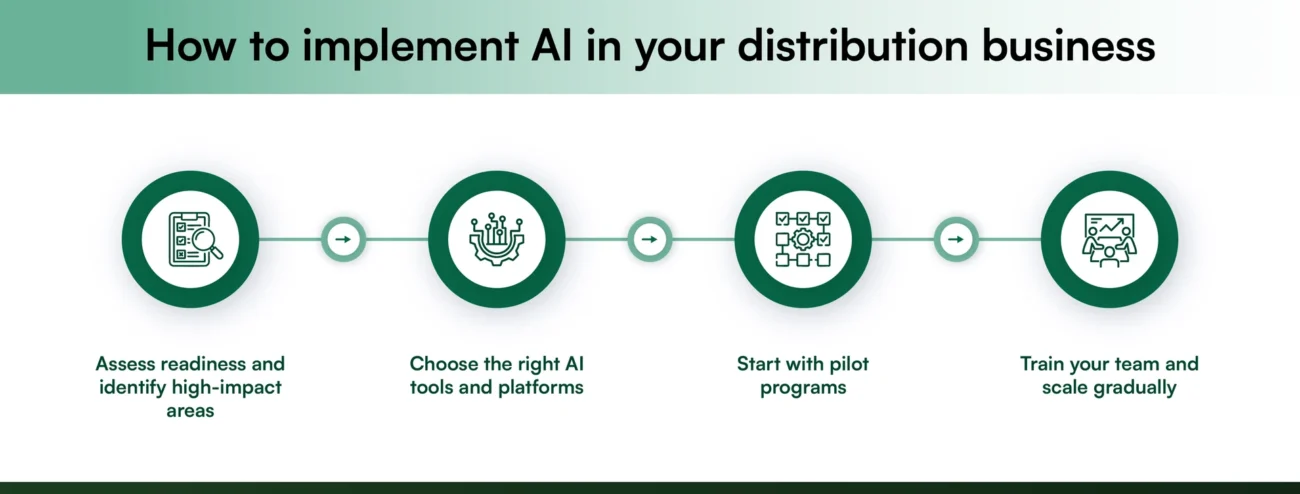
Step 1: Assess your readiness and identify high-impact areas
Pick one problem to solve first. Look for areas where:
- Your team spends hours on repetitive manual work
- Errors cost you money (stockouts, wrong shipments, missed sales opportunities)
- You’re making decisions based on guesswork instead of data
Common starting points: forecasting inventory for fast-moving products, identifying which customers to call this week, or automating responses to common customer questions.
Before choosing, check if you have at least 1-2 years of historical data for this area. If not, pick a different starting point.
Step 2: Choose the right AI tools and platforms
Most distributors use platforms that include AI features (like WizCommerce) rather than building from scratch.
What to look for:
- Integrates with your existing ERP or inventory system
- Vendor provides implementation support and training
- You can start with one feature and add more later
- Pricing is clear and fits your budget
Get demos from 2-3 vendors. Ask them to show you exactly how it would work with your data and systems.
Step 3: Start with pilot programs
Test with a small scope:
- One product category for demand forecasting
- One sales team for lead scoring
- One type of customer inquiry for chatbots
Run it for 60-90 days. Track specific metrics: Did forecast accuracy improve by X%? Did quotes get generated Y minutes faster? Did we reduce stockouts by Z%?
If the results are good, expand. If not, adjust or try something different.
Step 4: Train your team and scale gradually
Show your team how it makes their work easier:
- Sales reps: “This shows you which 10 customers to call today”
- Warehouse staff: “This tells you the fastest picking route”
- Customer service: “This handles simple questions so you can focus on complex issues”
Give them hands-on practice, not just a manual to read. Address concerns directly. Once they’re comfortable (usually 2-3 months), add the next feature or expand to another team.
Importance of a clear data strategy
A clear data strategy is crucial for successful AI adoption. Here’s why:
- Data quality: Ensure your data is accurate, clean, and well-organized. Poor-quality data can lead to incorrect AI predictions and insights.
- Data integration: Integrate data from various sources to provide a comprehensive view of your operations. This integration enhances the effectiveness of AI algorithms.
- Data security: Protect your data with robust security measures to prevent breaches and maintain customer trust.
Even with a solid plan, you’ll hit obstacles. Here are the most common ones and how to handle them.
Overcoming common AI implementation challenges
While AI offers numerous benefits, implementing it comes with its own set of challenges. Here’s how to navigate some common hurdles:
1. Scaling up AI initiatives
Scaling AI from a pilot program to full implementation can be challenging. Here are some tips:
- Start small: Begin with manageable projects and gradually expand as you gain more experience and confidence.
- Incremental implementation: Roll out AI solutions in phases, allowing time for adjustments and learning at each stage.
- Continuous evaluation: Regularly assess the performance of AI tools and make necessary tweaks to optimize their effectiveness.
2. High bandwidth and computational needs
AI requires significant computational power and bandwidth, which can be a barrier for some businesses. Consider these strategies:
- Cloud solutions: Utilize cloud-based AI services to access the necessary computational resources without heavy upfront investment.
- Optimize infrastructure: Upgrade your IT infrastructure to support AI workloads efficiently.
- Collaborate with providers: Work closely with AI technology providers to understand and meet the technical requirements.
3. Training costs and operational adjustments
Implementing AI often requires significant training and adjustments to existing workflows. Here’s how to manage these aspects:
- Comprehensive training programs: Invest in robust training programs to ensure your team is well-equipped to handle AI tools.
- Change management: Develop a change management plan to help employees adapt to new technologies and processes from legacy systems smoothly.
- Continuous support: Provide ongoing support and resources to address any challenges that arise during and after implementation.
Understanding these trends and challenges, you can adopt AI strategically and effectively in your distribution business.
Platforms like WizCommerce are built to handle these implementation challenges for you.
WizCommerce: AI-powered B2B commerce for wholesale distributors
WizCommerce is a B2B commerce platform built specifically for wholesale distributors and manufacturers, demonstrating how AI in wholesale distribution can be implemented without technical complexity.
Kai: Your AI sales assistant
Kai is WizCommerce’s AI assistant built specifically for wholesale distribution. It understands B2B commerce and helps your sales team work smarter:
- Prioritize your day: “Show me customers most likely to order this week” or “What happened while I was gone?”
- Prep for meetings: “Get me ready for my 1 PM call with Acme Corp.” Kai summarizes customer history, open quotes, and recommends relevant products
- Find products faster: “Find beige throws under $50 for a coastal store.” Search by price, region, style, or customer preferences
- Suggest alternatives: “What items can be offered as a replacement for SKU 1234?” when products are out of stock
- Target customers: “Pull a target list for today’s discount email” based on customer behavior and purchase patterns
- Work after hours: Sends reorder reminders, follows up on quotes, and drafts replies while you’re offline
Ella: Your AI order & quote automation employee
Ella handles the time-consuming order entry work, allowing your inside sales team to focus on selling and supporting customers. She reads purchase orders and RFQs from every channel, understands the details, and turns them into clean, ERP-ready orders in seconds. Retyping line items or chasing down missing information is no longer needed.
- Consolidate PO chaos: pull emailed, faxed, scanned, and PDF POs into a single, prioritized queue.
- Read any format: extract customer details, SKUs, quantities, prices, and ship-to info from structured or unstructured documents, including handwritten or low-quality scans.
- Create ERP-ready orders: map every field into the correct place in your ERP using 1,000+ pre-built connectors, so orders post automatically without middleware or manual typing.
- Validate before it hits your team: catch missing PO numbers, invalid SKUs, and price mismatches, and only route true exceptions for human review.
- Close the loop: send confirmations to customers and reps automatically so everyone knows the order is booked and moving.
WizStudio: AI lifestyle imagery for faster go-to-market
WizStudio removes one of the biggest bottlenecks in wholesale distribution: product imagery. Instead of waiting weeks for traditional photoshoots, teams upload basic product shots, describe the scene they want, and get studio-quality lifestyle images in minutes, ready for catalogs, line sheets, marketplaces, and ecommerce.
- Turn raw photos into lifestyle scenes: transform simple cut-outs or warehouse images into fully styled room scenes that match your brand and target customer.
- Scale creative production: generate hundreds of images for new collections, seasonal campaigns, and marketplace listings without expanding your studio team or booking sets.
- Edit with AI, not Photoshop layers: remove backgrounds, add shadows, expand frames, and adjust scenes with simple prompts instead of manual retouching.
- Cut content costs and lead times: brands see up to 20× lower costs and 10× faster time-to-market compared to traditional photoshoots, while improving visual consistency across every SKU.
Ready to see how AI can work in your distribution business? Book a demo to see WizCommerce in action today.
Frequently asked questions on AI in wholesale distribution
How is AI being used in the supply chain?
AI is used across supply chains for demand forecasting, inventory optimization, route planning, and predicting potential disruptions. It analyzes data from suppliers, warehouses, sales, and logistics to help companies anticipate problems, optimize delivery routes, and make faster decisions about what to stock and where to send it.
How to use AI in the distribution business?
Start by identifying one specific problem, like predicting which customers will reorder, forecasting inventory needs, or automating customer service responses. Choose an AI tool or platform that integrates with your existing systems, test it with a small pilot program, and expand gradually as you see results. Focus on areas where you have good historical data and where improvements will have a measurable impact.
What is an example of AI in supply chain management?
A common example is AI-powered demand forecasting. The system analyzes years of sales history, seasonal patterns, market trends, and external factors (like weather or economic indicators) to predict what products you’ll need and when. This helps distributors maintain optimal inventory levels, reducing both stockouts and excess inventory costs.
Will AI replace supply chain management?
No. AI handles data analysis, predictions, and repetitive tasks, but it doesn’t replace the human judgment needed for supplier relationships, negotiations, crisis management, and strategic decisions. The most effective approach combines AI’s analytical power with human expertise. AI suggests what to do based on data, and people make the final decisions considering factors the system can’t account for.
What are the benefits of using AI in distribution?
Key benefits include better inventory management through accurate demand forecasting, increased sales through personalized recommendations and lead scoring, faster operations through warehouse automation and route optimization, improved customer service with 24/7 chatbot support, and data-driven decision-making with real-time analytics. Most distributors see cost reductions in inventory carrying costs, logistics expenses, and labor hours spent on manual tasks.