Skip to content




Selling handmade items one order at a time feels quite manageable, sometimes easier than creating the actual product. But the moment a random retailer pops the question – “Do you sell wholesale?”, it’s a whole new ballgame. One key aspect that many creators often struggle with when selling handmade items wholesale is pricing. What used to be a simple “cost of materials + a little extra” now becomes a complex math puzzle with retail markups, margins, order minimums, production capacity, and more. This guide is a shortcut past that panic. We’re going to break down how to price handmade items for wholesale without worrying about undercharging or secretly wondering if you’re being robbed.
What are the key wholesale pricing components of handmade items?
Effective wholesale pricing for handmade items starts with knowing what your product truly costs. Many handmade sellers lose money without realizing it because they ignore expenses hiding in plain sight. So, here are the 4 core components that should shape your wholesale price:
1. Cost of materials
This includes every physical item required to create your product. Raw materials, fabrics, beads, clay, paints, hardware, plus packaging and consumables like glue or thread, all come under this. Here’s a simple rule – If it gets used, even partially, it counts. Most importantly, always track material costs per unit to avoid guesswork later.
2. Cost of labor
Your time is not free. Calculate how much time it takes to make one item and multiply that by your hourly rate. The hourly rate should ideally reflect your skills and experience. Don’t just consider the amount of time spent on making the product. Include prep time, finishing, quality checks, and packing.
3. Overheads and operating costs
These are the sneaky expenses that rarely get accounted for. They usually include your premises rent, electricity, tools, water, equipment maintenance, website fees, transaction charges, marketing spend, shipping supplies, etc. Spread these costs across all units you produce to get a true per-product overhead.
4. Desired profit margin
This is what ensures your business thrives. Your profit margin sits on top of costs and pays for long-term sustainability, innovation, future hires, and growth. Without it, you’re working hard just to break even, which is not a business. It’s just an expensive hobby.
Example: Determining the wholesale price of handmade items
Let’s say you create a hand-poured soy candle. You want to determine its wholesale price. Here’s how the four components come together:
1. Cost of materials
- Soy wax: $0.75
- Wick: $0.15
- Fragrance oil: $0.35
- Jar + lid: $1.00
- Label + packaging: $0.25
Total materials per candle: $2.50
2. Cost of labor
- You spend 30 minutes* making one candle.
- Your chosen hourly rate is $12 (reflecting your skill and time value).
- So, 30 minutes = $6
* Includes prepping materials, melting & pouring wax, cleaning equipment, trimming wicks, curing supervision, and packing.
Total labor per candle: $6
3. Overheads and operating costs
- Workspace rent & utilities: $200 per month
- Website/platform fees: $30 per month
- Tools, equipment maintenance, marketing, etc.: $70 per month
- Total monthly overhead: $200 + $30 + $70 = $300 per month
- Assuming you produce 300 candles per month.
Overheads and operating costs = $1 overhead per candle
4. Desired profit margin
You want a 40% profit margin on top of your costs.
Calculations
- Total cost per candle = Materials + Labor + Overhead = $2.50 + $6 + $1 = $9.50
- Add 40% profit margin: $9.50 × 0.40 = $3.80 profit
- Wholesale price = $9.50 + $3.80 = $13.30 per candle
Your wholesale price should be $13.30 per unit.
Methods of wholesale pricing for handmade items
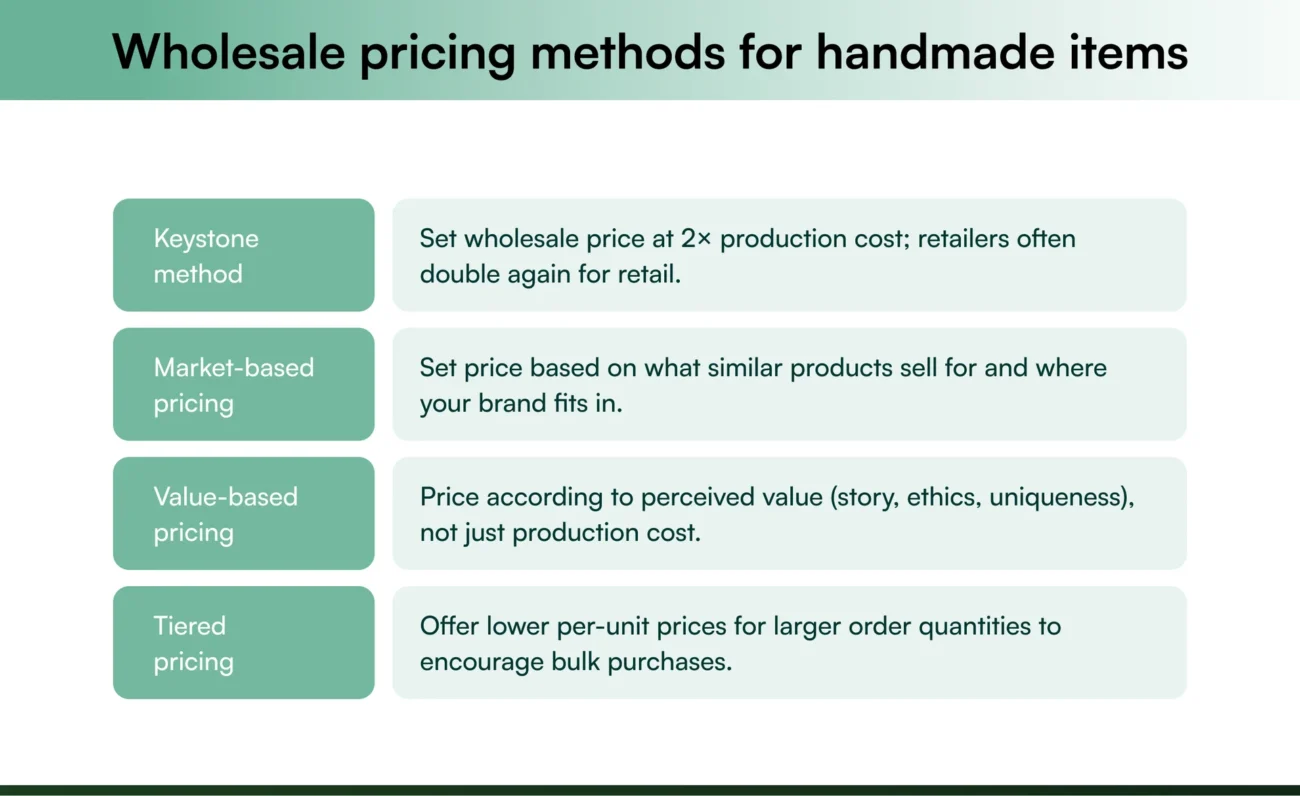
Handmade products don’t fit into one-size-fits-all pricing formulas. Each piece carries its own story and perceived value. That’s why choosing the right wholesale pricing method is crucial. Here are the most reliable pricing approaches that work exceptionally well for handmade sellers:
1. Keystone method
This is one of the most common wholesale pricing methods. It simply doubles the production cost to determine the wholesale price. Likewise, retailers double that again for the final selling price.
It’s a straightforward method that is easy to calculate. However, for handmade items with highly fluctuating production costs, this basic rule of thumb can lead to underpricing or overpricing.
When to use this method: It is suitable if you sell straightforward, repeatable products.
Example: If your handmade candle costs $10 to produce, the wholesale price = $10 × 2 = $20
2. Market-based pricing
This method prices your product based on what similar items are selling for in the market. You compare competitors’ pricing and evaluate where your brand stands. You then set a price that matches or strategically exceeds market expectations.
This method helps you avoid pricing so low that your work looks cheap, or so high that retailers hesitate to stock it. But there’s a catch. If your competitors are underpricing themselves, anchoring your price to theirs can lead you to undervalue your own craftsmanship and repeat their mistakes.
When to use this method: It is suitable if you are selling in a competitive and popular niche where end users generally compare product prices.
Example: If organic handmade soaps similar to yours sell at a retail price of $18–$24, and your production cost is $5, you may price wholesale at $9–$12. This will allow retailers to sell at $18–$24 confidently.
3. Value-based pricing
Instead of pricing based on cost, value-based pricing focuses on what the product is worth to the end customer.
Many handmade buyers don’t purchase just objects. They buy authenticity, craftsmanship, ethics, sustainability, and storytelling. These intangible elements justify higher prices that aren’t tied strictly to your cost of production. So, the final wholesale price is essentially the sum of tangible and intangible elements associated with the product.
When to use this method: This works exceptionally well when the item has emotional appeal, uniqueness, personalization, or brand prestige.
Example: You sell leather journals that are hand-stitched, made from ethically sourced hide, and personalized with initials. Assuming your production cost is $18, but the perceived value to the end user is $70+. You could wholesale it at $35–$40, and retailers can price it at $70–$95.
4. Tiered pricing
Tiered pricing offers different wholesale rates based on order quantity. The more a buyer orders, the bigger the discount they receive. This encourages larger purchases without lowering your base price.
Since production is manual and time-consuming, you need incentives for bulk orders that justify longer work cycles. Tiered pricing respects your labor while rewarding retailers who help you scale.
When to use this method: While this method is not commonly used in handmade items, you can still adopt it if you can scale the production and the retailer is offering huge discounts for large orders.
Example: If a pair of earrings costs $8 to produce, you could structure pricing like this: 1-20 units at $18, 21-50 units at $17, and 51+ units at $16.
So which method should you choose? There’s no universal best option. In fact, some handmade sellers start with keystone pricing, refine with market insights, and eventually adopt value-based pricing as their brand matures. Tiered pricing often comes last, when wholesale demand increases.
What challenges do wholesalers face when pricing handmade items?
Setting the right price is never easy in a craft business because no two products or production cycles are truly identical. It’s less about spreadsheets and more about managing real-world uncertainties. Here are the biggest challenges that handmade sellers often face when setting B2B wholesale prices:
1. Inconsistent production costs
Handmade production rarely follows a fixed formula. Raw material prices fluctuate. Suppliers change terms. Equipment wears out faster because it’s used manually. A single design tweak can alter time and material usage. These variables barely affect machine-made items, where economies of scale keep costs steady. For handmade sellers, this volatility makes it difficult to maintain a stable wholesale price.
2. Difficulty valuing labor
Mass-manufactured items spread labor costs across thousands of identical units. This makes the per-item cost negligible. Handmade items don’t have that luxury. Every piece requires individual attention and craftsmanship. Putting a price on such time-intensive work becomes difficult as the whole process feels personal, not transactional. This emotional connection leads to undervalued labor and shrinking profits.
3. Low margins after giving discounts
In mass production, wholesale discounts work because costs per unit are already low. Handmade items start with higher baseline costs. Most artisans end up offering wholesale discounts without adjusting their pricing structure. This leads to a collapse of margins.
4. Scaling challenges
A machine can produce 1,000 units with the same effort it takes to produce ten. Handmade items can’t scale that way. Increasing wholesale volume means more human hours, more workspace, more tools, and sometimes additional makers. None of these is cheap. If your pricing doesn’t account for this, growth becomes painful.
5. Competition pressure
With B2B marketplaces overflowing with handmade alternatives, artisans often feel compelled to keep prices low just to stay competitive. Shoppers commonly compare handcrafted products to cheaper factory-made versions that look similar but lack the craftsmanship. This creates unrealistic expectations and pushes makers to lower prices just to compete.
6. Fear of losing buyers
Many handmade sellers know their buyers personally and fear that raising prices will break relationships. This emotional dependence makes them hesitant to charge what their work is truly worth. This traps them in a cycle where higher sales don’t translate into higher profits.
What are some best practices to follow while setting wholesale prices for handmade products?
The key to profitable wholesale pricing is to replace emotion-driven guesses with structured business practices. Here are the best practices that can help you avoid the above pitfalls and price your handmade items confidently:
1. Benchmark competitors instead of copying them
While researching competitor prices is important, don’t copy them blindly. We have seen many handmade sellers undervaluing their work to beat the market. When you copy them without accounting for your brand and value, you will make the same mistake and leave valuable money on the table.
2. Account for packaging and shipping from the start
Handmade products are inherently premium, and their packaging must reflect that. Gift boxes, thank-you cards, branded inserts, and protective materials all add to the experience. But they also add to your costs. So, factor every packaging element, along with shipping materials and handling charges, into your wholesale price. Otherwise, you’ll end up absorbing expenses, resulting in lower profit margins.
3. Set clear and sustainable MOQs
MOQ or Minimum Order Quantity is the smallest number of units a buyer must purchase in a single order to qualify for your wholesale price. Setting clear and sustainable MOQs ensures your wholesale orders are worth your time. They help cover your labor, material expenses, and overheads, even at discounted prices. Without MOQs, you risk fulfilling small orders at wholesale rates that barely break even.
4. Offer discounts strategically
Discounts make sense only when higher volumes genuinely reduce your per-unit cost or help you utilize your time and materials more effectively. Handmade sellers often fall into the trap of offering huge discounts and setting low prices just to secure orders. Instead, structure discounts around clear thresholds so retailers feel rewarded for buying more. This will ensure they are not conditioned to expect lower prices every time.
5. Present pricing professionally using a B2B platform
A clear, well-structured wholesale catalog signals that you’re running a serious business, not a casual side venture. When your products and pricing are presented professionally, it minimizes price negotiation and reinforces the value behind your products. Tools like WizCommerce make this even easier by giving you a centralized B2B ecommerce platform to manage pricing and also offer a seamless self-service portal for your buyers to place orders.

Sell handmade items using WizCommerce
The last piece in the puzzle of how to price handmade crafts is the execution of different pricing strategies. WizCommerce was built precisely for that. Designed for wholesalers and distributors, WizCommerce gives you a solid ecosystem to manage your catalog and apply wholesale pricing rules without the associated complexities.
For instance, WizCommerce’s custom price list feature is particularly useful for handmade brands that often deal with varied buyer types such as boutiques, online resellers, event stores, or regional retailers. Instead of offering a single wholesale price to all of them, you can set unique price lists for each of them.
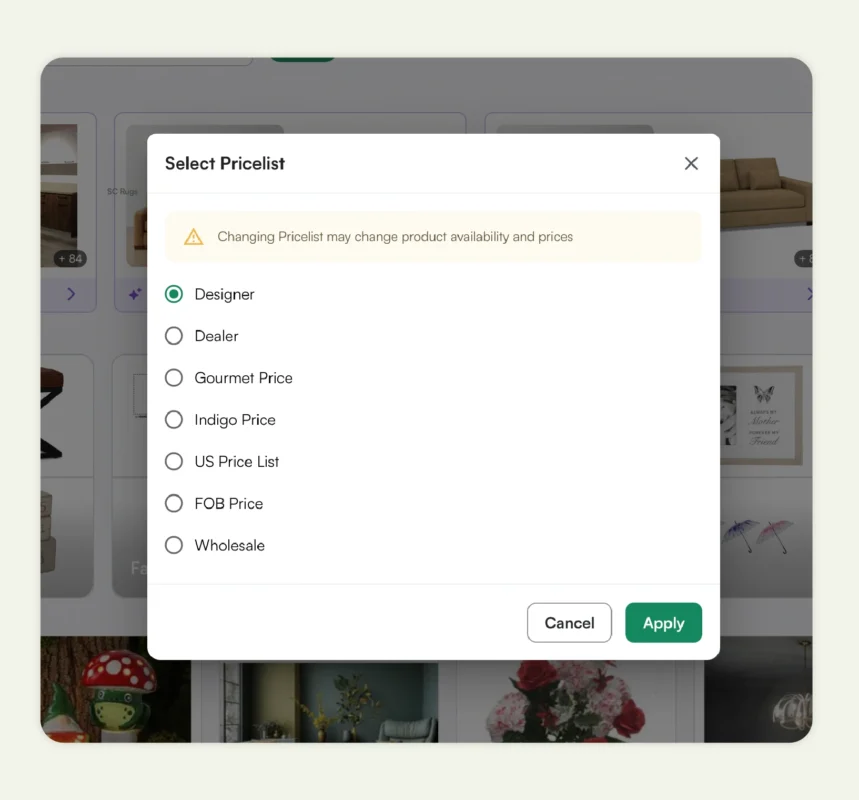
You can also apply negotiated discounts, seasonal offers, or bulk order incentives to your wholesale price, all without juggling spreadsheets or recalculating totals every time.
Thanks to dedicated B2B ecommerce features like these, WizCommerce takes the stress out of pricing for you from day one. You can stop worrying about complex calculations and focus on what you love: creating products.
So what are you waiting for? Book a free demo to explore how WizCommerce can support your handmade business.
Frequently asked questions
1. How to calculate how much to charge for a handmade item?
It’s a simple three-step process. Start by adding the cost of materials to your labour time. Then add the overhead expenses like packaging or tools. Finally, apply a markup to the actual costs to ensure a healthy profit. This method ensures your price hits a sweet spot and always reflects value, covers expenses, and leaves you enough margin so that you have a sustainable business model.
2. What is a good profit margin for handmade items?
This completely varies based on the type of product, target market, competition, and your own needs. But most profitable businesses usually achieve a profit margin between 30% to 50%. For luxury or highly customized items, one can command even higher margins. Ultimately, your margin should compensate for your skill and time and leave you with enough money to grow quickly.
3. What is the most sold handmade item?
Jewelry, candles, soaps, knitted accessories, and personalized gifts consistently feature in the list of the most sold handmade items. They are popular because they’re customizable and gift-friendly. However, trends vary by season, and this list might change again in the future.
4. How should I set my selling price?
While setting your selling price, remember a simple mantra – You’re not only selling a product, you’re selling craftsmanship and the time spent perfecting it. So your final price should reflect all elements of business expenses and production costs, including the maker’s hourly wage, cost of your materials, other overhead costs, and the desired wholesale markup. You should support it with elaborate market research covering demand among potential customers, competitor pricing, and product uniqueness.
5. Do I need insurance to sell handmade crafts?
Insurance isn’t always mandatory. But it’s highly recommended. For instance, a product liability insurance protects you if someone claims your item caused harm. Insurance provides peace of mind and safeguards business owners from unexpected legal or financial risks.
6. How to work out wholesale price for handmade items?
To calculate a wholesale price, first determine your total production cost. Then multiply this number by two to ensure a reasonable profit margin. The basic pricing formula should look like this: Wholesale Price = Total Cost × 2.