Skip to content




When it comes to pricing, successful B2B ecommerce brands share some common traits –
- They don’t throw numbers at the wall; they engineer it.
- They know what they’re products are worth. They communicate that value unapologetically.
- And they grow rapidly without entering a never-ending discount spiral.
But how do they plan and execute a pricing strategy? Let’s find out in this guide, as we show you how to build B2B pricing strategies that protect your margins and turn them into a magnet for attracting potential buyers consistently.
What is a B2B pricing strategy?
A B2B pricing strategy is the framework behind how you turn your products into predictable revenue. In the B2B commerce context, it is not just a price list on the product page. It’s the logic that tells your platform who gets what price, why, and at what volume.
While B2C pricing focuses on simplicity and impulse-driven conversions, B2B pricing operates in a more complex universe. Here, buyers expect tiered pricing, negotiated discounts, contract-based rates, multi-country catalogs, credit terms, etc. Their purchase isn’t a one-time checkout. It’s a long-term commercial relationship where pricing must scale across repeat orders and multiple decision makers. All these should be taken into consideration while building your pricing strategy.
How does a strong B2B pricing strategy help improve profits?
A well-structured wholesale pricing strategy makes sure you are not winning deals at the expense of your margins. Instead of guessing what customers might pay, you design pricing in such a way that it rewards the right buyers, while you experience growth and solid profits.
Here are some ways in which a strong B2B ecommerce pricing strategy helps improve your profits:
- Reduces unnecessary discounting: A good pricing strategy stops your sales teams from negotiating blindly. This protects your pricing integrity and ensures your discounts are strategic, not habitual.
- Improves deal quality: Well-defined B2B ecommerce pricing strategies help focus on high-value buyers. They keep you away from low-margin, high-maintenance accounts that drain resources.
- Increases Customer Lifetime Value (CLTV): A solid strategy emphasizes predictability and transparent terms. These are traits that resonate strongly with B2B buyers. This clarity encourages repeat purchases and more durable customer relationships.
- Accelerates deal velocity: When you have a strategy backed by clear pricing rules and approvals, there is reduced back-and-forth negotiation. This, ultimately, shortens sales cycles.
- Transforms pricing from intuition to intelligence: A pricing strategy is also about replacing guesswork with data and frameworks. It makes revenue more predictable and scalable.
Things to consider when building a B2B ecommerce pricing strategy
To get your pricing strategy right from the start, you need to weigh multiple variables that influence how customers perceive price and how competitors behave. Here are 5 such variables that you need to consider:
- Customer segments & willingness to pay: Different buyers value different outcomes. Understand what each segment cares about and their budget thresholds before setting prices or discounts.
- Cost structure and overheads: Know your true cost-to-serve. This should ideally include production, logistics, onboarding, support, and operational overheads. Your pricing strategy must protect margins while funding growth.
- Competitor pricing: Competitors don’t dictate your pricing. However, they influence expectations. Benchmark wisely to stay competitive without becoming a copycat or triggering a price war.
- Market maturity and industry norms: Mature markets often come with established pricing expectations. On the other hand, emerging markets allow more experimentation. Tailor your strategy based on how price-sensitive and informed buyers are.
- Macroeconomic conditions: External forces directly impact buyer budgets and your costs. Factor in economic volatility (inflation, supply chain, currency swings) so your pricing remains strong and doesn’t erode profitability over time.
What B2B pricing models can you consider?
Pricing models are the methods you use to set prices. They are the tactical mechanisms powering your B2B pricing strategy. When it comes to B2B ecommerce, there are 5 popular pricing models you can adopt. Here they are:
1. Cost-plus pricing
This model involves calculating your total cost per item(including all the overheads) and adding a fixed markup to it. This model is easy to manage at scale and ensures predictable margins across all your SKUs.
However, there is one major drawback. It ignores how much your buyers are actually willing to pay. In other words, you may end up underpricing products that have a higher perceived value.
2. Value-based pricing
This model focuses on setting prices based on the impact your product delivers, not what it costs you to produce. This allows you to charge more for SKUs that offer measurable efficiency gains or operational savings.
However, the challenge is proving that value digitally. Unless your brand or your products offer a capability that competitors cannot match, buyers may perceive your pricing as arbitrary or inflated.
3. Competitive pricing
In this model, you set prices based on B2B marketplace benchmarks or competitor listings. The goal of this model is to ensure your products fall within the range buyers already expect. The primary advantage of this model is faster conversion. Your buyers make decisions quickly when prices appear familiar and competitive.
However, the downside is that if your competitors lower prices or engage in aggressive discounting, you may feel pressured to follow suit, reducing profitability over time.
4. Tiered pricing
This model displays different price levels directly based on order quantity(the more the quantity, the heavier the discount). Buyers can instantly compare tiers and select the one that aligns with their needs. Such a structure increases Average Order Value (AOV) by nudging customers toward higher-volume purchases and helps you monetize different buyer segments efficiently.
The drawback is complexity; if the tiers aren’t clearly differentiated or the value added at each level isn’t obvious, customers may hesitate at checkout or abandon the purchase altogether due to decision overload.
5. Contract pricing
Enterprise or contract pricing is a pricing approach where large buyers receive negotiated rates based on recurring demand or specific product requirements. Instead of the regular price, enterprise buyers get tailored quotes, preferential terms, or exclusive pricing that reflects their long-term value.
This model strengthens partnerships, boosts retention, and drives predictable revenue over time. The trade-off is a longer buying cycle and the need for quoting and approval workflows.
Also read: How to Price Handmade Items For Wholesale: A Complete Guide
How to develop a successful B2B pricing strategy?
Developing a successful B2B pricing strategy requires you to follow a structured process that blends market research, customer insights, cost of goods sold, pricing model, and ongoing optimization. Here are the 5 steps you need to follow to get it right:
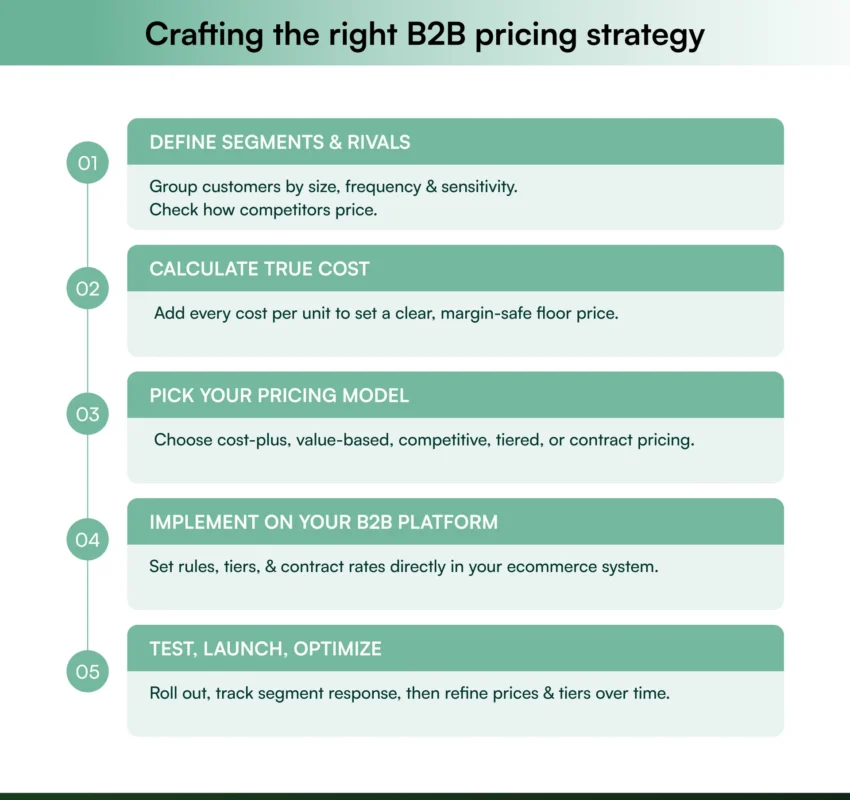
Step 1: Identify customer segments and understand competitor positioning
First and foremost, you must know who you’re pricing for and what options they currently have. Remember – B2B buyers are not a monolithic group. They differ based on order frequency, purchase volume, digital maturity, and willingness to pay. When you segment your customer base and map these variations, you lay a solid foundation for building a successful B2B pricing strategy.
At the same time, you must study competitor pricing models and value propositions carefully. This will help you position your offerings so that buyers perceive clear reasons to choose you over others. Without segment-level clarity and competition insights, your pricing either becomes too high to convert or too low to sustain profitability.
For example, let’s say you run a B2B ecommerce business selling cotton T-shirts to retailers. After analyzing your buyer base, you segment them into:
| Retailer type | Typical order size | Purchase frequency | Price sensitivity |
| Small boutiques | 30–100 pieces | Monthly | High |
| Multi-store retailers | 200–500 pieces | Seasonal collections | Medium |
| Large retail chains | 1,000+ pieces | Quarterly | Low |
Step 2: Calculate the cost of production
The next step is to determine the total cost of producing each unit. This gives you a baseline price and ensures that every pricing decision you make (from volume discounts to promotional offers) still protects your margins.
Your cost of production should include everything that goes into delivering a finished product to your buyer, including raw materials, packaging, ecommerce operations, and logistics. When you have a precise cost structure, you can justify your pricing to retailers and confidently introduce discounts without compromising profitability.
Continuing with the same example of selling cotton T-shirts to retailers, here’s how the production costs break down:
| Cost component | Cost per T-shirt (USD) |
| Fabric and stitching | $2.50 |
| Dyeing and finishing | $0.60 |
| Customization (optional print/logo) | $1.00 |
| Packaging (tags, folding, polybag) | $0.25 |
| Ecommerce platform + operational cost | $0.20 |
| Logistics and delivery | $0.45 |
| Total cost of production | $5.00 |
Step 3: Select the right pricing model
We have seen five different pricing models – cost-plus, value-based, competitive, tiered, and contract. The next step involves choosing one of these models that aligns with how your buyers evaluate value and the type of products you sell. Here is a quick framework that you can use to select the right pricing model:
- Cost-plus pricing: Use this model if you sell standardized items (like office stationery), where cost structures are stable.
- Value-based pricing: Use this when your assortment solves a problem or offers quantifiable ROI. For example, you sell a face serum that is USDA certified and proven to reduce acne scars by 50% in 4 weeks.
- Competitive pricing: Use this when market transparency is high and differentiation is low. For example, you sell earphones and mobile chargers.
- Tiered Pricing: Use this when your catalog supports bulk order placements, and you have the margin cushion to offer better value at each tier.
- Contract/Enterprise pricing: Use this when your business depends on order commitments, configurations, or service levels.
Let us consider the same t-shirt example. Your production cost per piece is $5.00. Based on your positioning and what retailers expect, here’s how your pricing could look using different models:
| Pricing model | Key info | Your wholesale price (per unit) |
| Cost-plus pricing | Required markup = 40% | $7.00 ($5 + 0.4*$5) |
| Value-based pricing | Your product has two differentiating factors that allow you to charge a premium. They are:
|
$15.00 (Premium price over and above the market average) |
| Competitive pricing | Your competition lists the same t-shirt at $5 to $7 | $6.00 (Price that aligns with market expectations) |
| Tiered pricing | You come up with 4 tiers based on order volume |
|
| Contract/Enterprise pricing | A regional retail chain approaches you to stock their new stores with branded t-shirts featuring custom neck labels and exclusive color options.
Instead of charging your standard wholesale rate, you negotiate a two-year supply contract worth $36,000. |
$4.50 (Price that’s according to the buyer’s contract) |
Step 4: Leverage your B2B ecommerce platform to implement the pricing strategy
Once you’ve selected the pricing model, the next step is to execute your pricing strategy with the help of your B2B ecommerce platform. Most modern B2B wholesale platforms allow you to configure pricing rules, automate discounts, manage customer-specific rates, and enforce consistency across your sales channels.
For instance, WizCommerce supports features such as custom price lists, applying discounts to individual items or the entire cart, and contract rates for enterprise customers. The platform also allows you to hide or reveal prices based on login access, ensuring that sensitive pricing tiers are only visible to approved buyers.
By using WizCommerce, you can integrate your B2B pricing strategy directly into your ecommerce infrastructure. This streamlines ordering and gives your buyers complete clarity on what they’re paying and why.
Wondering how much a B2B ecommerce platform costs? Check this guide: B2B Ecommerce Platform Cost for 2026 for answers.
Step 5: Test, roll out, and optimize
No pricing strategy is perfect on day one. The final step is to launch your strategy, observe how different customer segments react, and refine your structure based on real purchasing behavior. Your pricing must also evolve with market trends, retailer expectations, and competitive responses.
In the example, based on your customer segments, you decide to adopt a combination of competitive pricing, tiered pricing, and contract pricing. You track how each segment responds:
| Retailer type | Pricing model | Pricing response |
| Small boutiques | Competitive pricing | They appreciate the transparent per-unit pricing that aligns with the market. |
| Multi-store retailers | Tiered pricing | This group increases order sizes because the mid-tier pricing delivers better margins during new seasonal launches. |
| Large retail chains | Contract pricing | They negotiate a recurring contract. You give reduced rates due to bulk commitments. |
Your test phase confirms that smaller retailers respond to clarity, while mid-sized players love the fact that they can scale up and down based on demand, and enterprise chains find the long-term agreements highly cost-efficient. This validates your choice of pricing models.
What are some common pricing mistakes to avoid in your B2B pricing strategy?
There are some common pitfalls you need to avoid when building your B2B pricing strategy. This will help it to remain competitive and scalable over time. Here they are:
❌ Building a pricing strategy based only on cost. When you ignore perceived value and customer willingness to pay, you risk leaving money on the table or appearing overpriced compared to value-driven competitors.
❌ Framing a conservative strategy due to fear of losing deals. When you undervalue your product just to close sales, you will experience margin erosion and brand dilution.
❌ Not revisiting the pricing strategy regularly. Market conditions and customer needs evolve. Sticking to outdated pricing makes your offering less relevant and reduces your competitive edge.
❌ Creating a complex pricing strategy: Overly complicated tiers and unclear pricing rules can confuse buyers or slow down purchasing decisions.
❌ No alignment between sales, marketing, and finance: When these teams don’t share the same pricing logic and rationale, pricing becomes inconsistent, and revenue leakage becomes inevitable.
Turn your pricing strategy into profit with WizCommerce
WizCommerce is a modern B2B ecommerce platform designed specifically for wholesalers, distributors, and manufacturers who want to streamline their selling process and offer a seamless buying experience to retailers.
Unlike generic ecommerce tools that focus on B2C transactions, WizCommerce understands the complexities of B2B pricing. And that’s why the platform’s pricing engine is built to support flexible and customer-specific pricing models without the need for manual intervention or spreadsheets.
Here are some of the key pricing features offered by WizCommerce:
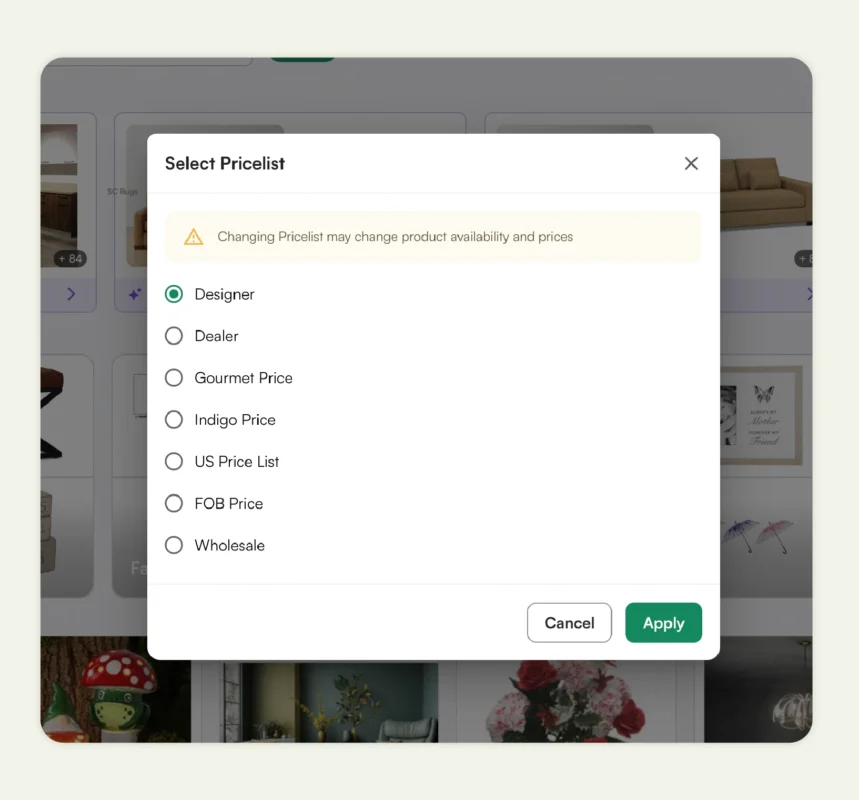
- Custom price lists: Assign unique price lists to different retailers based on buyer persona, business units, geography, etc.
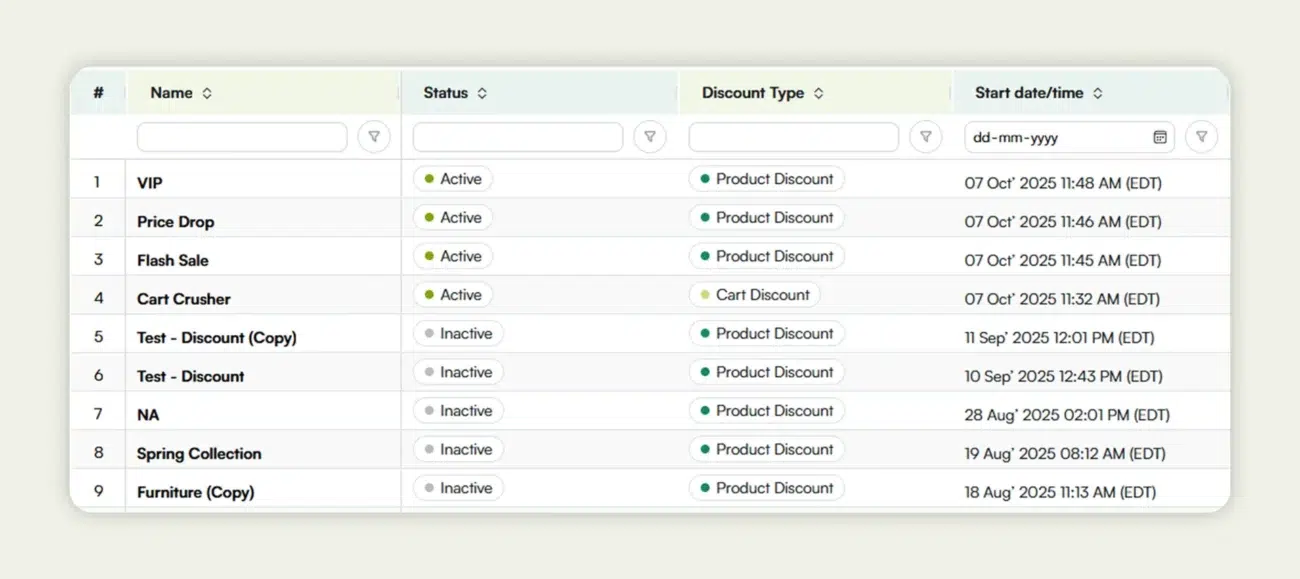
- Item-level and cart-level discounts: Offer discounts on specific SKUs or apply promotional pricing to an entire order without disrupting the base price.
- Contract pricing for enterprise customers: Negotiate long-term pricing agreements with large buyers and automate those rates every time they place an order.
- Login-based price visibility: Customize who sees what by showing or hiding prices based on user roles. This ensures sensitive pricing tiers aren’t exposed publicly.
Together, these capabilities minimize pricing inconsistencies and free your sales team to concentrate on closing deals, rather than spending valuable time resolving pricing queries.
To know more about WizCommerce’s pricing capabilities, book a free demo now.
Frequently asked questions
1. What is the pricing model of B2B?
A B2B pricing model is simply how you structure and present your prices to retailers. Popular pricing models in the ecommerce sector include tiered pricing, contract pricing, cost-plus pricing, competitive pricing, and value-based pricing. To succeed as a wholesaler, you need to select a pricing model that truly reflects the value your products provide.
2. What is the B2B pricing strategy?
A B2B pricing strategy outlines the entire approach you need to adopt in setting and managing prices for your products. It involves understanding the unique needs of the buyers, your market share, the cost of goods sold, and value perceptions. A successful strategy ensures that your pricing aligns with business objectives and supports customer retention at a healthy profit margin.
3. What are the most effective B2B pricing strategies for long-term business growth?
Value-based pricing, tiered pricing, cost-plus pricing, competitive pricing, and contract pricing are usually proven approaches for sustainable growth. Different pricing strategies focus on different factors like customer demand in the target market, business goals, scalability, and ongoing revenue growth. The right strategy and the right pricing structure can help you differentiate from competitors and deepen customer relationships over time.
4. How do companies determine the right price for their B2B products?
Companies conduct market research and rely on data analytics to understand customer willingness to pay, market trends, competitor pricing, and perceived value to determine the right price. They may also use data-driven insights, customer segmentation, and customer feedback to refine the final price. The objective is to balance profitability with customer satisfaction and competitive advantage.
5. What factors should I consider when developing a sustainable B2B pricing strategy?
Key factors include cost structure, customer segments, competitive landscape, value proposition, and long-term revenue goals. Additionally, you must assess market demand, customer value, sales cycle complexity, and pricing transparency expectations. A sustainable strategy adapts as market conditions change and aligns pricing with evolving customer needs.
6. How does competitive pricing impact success in B2B ecommerce?
Competitive pricing plays a significant role in customer acquisition and retention. When you match pricing with your competitors, it results in trust and reduces friction in the buying process. However, competing only on price can lead to margin erosion. So don’t forget to differentiate through value and customer experience.
7. What are the best practices for implementing a B2B pricing model?
Best practices include aligning pricing with value, using customer segmentation, offering transparent and consistent pricing, and integrating automation tools for easier updates. Regular audits, cross-department alignment, and data-based decision-making also improve results. Clear communication with customers ensures trust and reduces negotiation time.
8. What challenges do companies face when setting B2B prices online?
Companies often struggle with pricing transparency, complex negotiation requirements, and varying customer expectations. Managing discounts, custom quotes, and personalized pricing at scale can be difficult without proper tools. Additionally, balancing competitive pressure with profit margins and maintaining pricing consistency across digital channels is a persistent challenge.