Skip to content



Scroll through any e-commerce listing today, and you will notice something. The photos are doing almost all the selling. Not the description, not the price. Because your buyers no longer ‘read’ products, they judge them visually within seconds. And while the importance of great product photography is obvious, e-commerce teams still deal with the messy reality behind the scenes: bloated shoot budgets, endless reshoots, delayed production calendars.
That is why evaluating product photography services is no longer a creative decision. It is an operational one. In this blog, we will break down exactly what you should look for in this evaluation, so that you are left with a photography partner who can grow with your catalog.

Completely new to e-commerce product photography? Get started with some basics in our Beginner’s Guide to Ecommerce Product Photography in 2026.
Why does product photography matter more than ever?
We live in a visually saturated e-commerce photography environment. A space where only strong imagery can help your listing rise above competitors. And as potential customers jump between channels, your visuals become the single consistent storytelling element across all touchpoints.
On top of this, the buyer’s expectations have evolved. White background pack shots are the bare minimum today. Buyers and retailers want lifestyle product photography and images that help them envision how the product will look on their own shelves or in their spaces.
Apart from the above, here are a few additional reasons why product photography matters today more than ever:
1. Great visuals = Higher click-through rates
In crowded online shopping marketplaces, attention is everything. The first impression, often made in milliseconds, comes entirely from the product image. Sharp and visually balanced product photos instantly attract clicks, even before price or reviews come into play. High-quality visuals make your listings more discoverable and can directly lift your click-through rates across search results and social media platforms.
2. Strong imagery = Shortened decision time
Buyers do not have the patience to zoom endlessly or scroll through vague images to understand what they are buying. When visuals clearly capture product details such as color, texture, dimensions, and scale, buyers make faster, more confident decisions. This clarity reduces friction in the purchase journey and minimizes hesitation.
3. Consistent brand-aligned photography = Better brand recall across channels
Visual consistency is about brand identity as much as it is about aesthetics. When every SKU follows a unified tone and composition style, your catalog feels professional. Whether shoppers find you through an ad or your own online store, consistent imagery reinforces your brand presence and helps your products stand out within a recognizable visual ecosystem.
4. Lifestyle visuals = Enhanced emotional buy-in
Today’s buyers do not want to see your product alone. They want to feel it. Lifestyle product photography helps bridge that emotional gap by showing products in real-life settings. A well-styled shot of a candle lit in a cozy room or sneakers worn in motion communicates experience and emotion, building a stronger connection with the viewer. This drives stronger engagement and a deeper desire to place an order.
5. Story-driven images = More usable assets for marketing
Good product images are not for product pages alone anymore. Ecommerce brands are reusing them across paid ads, social media, email marketing, and even print. Story-driven visuals, those that convey mood, function, or brand personality, multiply your creative output. They make every shoot more cost-effective, giving your team a versatile library of assets that support every marketing campaign long after the initial listing goes live.
Before evaluating product photography services, you need to know what you are evaluating for. Different ecommerce product photography formats serve different buyer intent and platform requirements, and choosing the wrong type of photography early on will result in costly reshoots later. Here is our guide to the types of product photography every ecommerce business should understand.
Evaluating product photography services for your ecommerce site: What to look for and questions to ask?
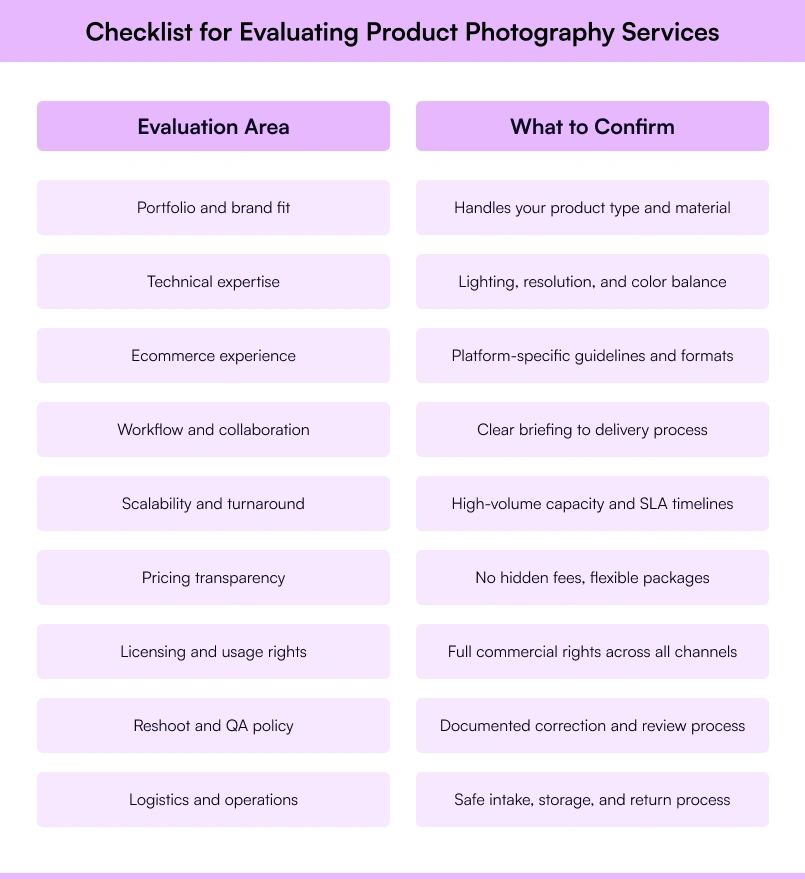
The market is flooded with product photography service providers who claim to be the best in the business. So, to narrow them down to one, you must be evaluating product photography services across a few key areas to ensure your investment pays off in the long run. Here are those areas:
1. Portfolio, style & brand fit
The first filter in evaluating product photography services is always visual proof. You need to assess whether the ecommerce product photography service style matches your brand identity, and whether they have handled products like yours. Because shooting a glossy perfume bottle requires a different skill set than capturing a textured sneaker sole, they demand different skill sets and pose unique challenges. Apparel is the sharpest test of this: a studio can have a flawless packshot portfolio and still have no working answer for how to photograph apparel, since garments need model or mannequin work that hard-goods shoots never develop. You also want to see if their style can match (or be shaped to match) your brand identity.
What to look for:
- Ability to handle material-specific challenges (metal reflections, transparent packaging, highly textural surfaces…).
- Flexibility in visual style (Packshots, lifestyle shots, dark backgrounds, light backgrounds, props, flat-lay, 45-degree angles…).
- Uniformity of output across multiple SKUs/variants.
- Understanding of brand storytelling and visual hierarchy (how to draw focus to the right product features or use composition to express brand tone).
2. Technical expertise & post-production quality
Even the most creative concept can fall flat without technical expertise. In ecommerce photography, where buyers compare products side-by-side and zoom in, details like lighting consistency and color balance can make or break the perception of quality. Your chosen ecommerce product photographer should understand how to shoot well and how to edit expertly. They must make sure every image looks crisp and true-to-life.
What to look for:
- Strong knowledge of lighting setup to maintain a cohesive catalog look.
- Ability to generate photographs with high sharpness and high resolution.
- Ability to shoot balanced compositions with clean backgrounds and professional framing.
- Skilled post-production capabilities such as dust/scratch removal, reflection control, natural shadow creation, and clipping paths.
3. Ecommerce & marketplace experience
Shooting beautiful product images is one thing. Shooting images that sell online is another. A product photography service provider with ecommerce product photography experience understands that every platform has its own visual logic. For instance, Faire favors crisp, zoomable packshots on white backgrounds.
Shopify stores often blend lifestyle and context shots. The right product photographer knows how to balance creativity with compliance so that your listings look great and perform well.
What to look for:
- Familiarity with specific platform guidelines, including size, aspect ratio, background, and image count requirements.
- Knowledge of which angles and compositions convert best for your product category.
- Ability to create both “hero” images and secondary lifestyle or feature shots.
- Experience delivering optimized file formats (JPEG, PNG, WebP) for fast load times and SEO performance.
4. Workflow, collaboration & creative support
A dependable photography partner brings structure and creative clarity to the product photography project. From the initial briefing to final delivery, they ensure everything runs smoothly with clear communication at every stage. The best partners act as true collaborators rather than executors behind the camera. They contribute ideas, refine concepts, proactively suggest styling, and optimize shot compositions. Their goal is to make the creative process effortless while keeping the output unmistakably yours.
What to look for:
- A well-defined workflow (briefing → shoot → review → revisions → final delivery).
- Streamlined communication channels (shared project management boards, communication tools, feedback loops, review tools…).
- Creative input on styling, set design, and visual direction.
- Flexibility to accommodate brand feedback and iteration cycles.
5. Scalability, turnaround time & reliability
As your ecommerce catalog expands, your photography needs grow exponentially. You will have new products, seasonal launches, refreshes for updated packaging, and new variants. That is why scalability and reliability are as important as creativity. The right product photographer should handle both small batches and large-scale shoots without compromising quality or timelines.
What to look for:
- Proven ability to manage high-volume shoots and ongoing catalog updates.
- Efficient workflows that support fast turnaround without quality loss.
- Defined SLAs for delivery timelines, revisions, and approvals.
- Capacity to scale resources (studio space, equipment, editing team) during peak seasons.
6. Pricing, packages & value for money
When evaluating product photography services, cost should not be the deciding factor. But it should be transparent. Many ecommerce brands get caught off guard by hidden add-ons like model fees or rush delivery charges.
A good product photography service provides clear, upfront pricing and flexible packages that align with the number of products and shoot frequency. Whether you are shooting a handful of premium products or hundreds of SKUs monthly, pricing should scale sustainably while maintaining consistent quality.
What to look for:
- Transparent pricing structure with no hidden extras.
- Multiple package options (per image, per SKU, per project, or on a retainer basis).
- Clear breakdown of what’s included: shoot time, number of edits, file formats, delivery timelines, etc.
- Discounts or flexible terms for bulk projects or ongoing partnerships.
7. Licensing, usage rights & legal clarity
One of the most overlooked aspects when selecting a product photography services partner is licensing. Yet it can cause serious roadblocks later if not handled properly. You need to ensure that the product images you pay for can be freely used across every channel where your brand operates. Whether it is your wholesale online store or social campaigns, your usage rights should be clearly defined and unrestricted for commercial purposes. A trustworthy professional product photographer will make these terms simple and transparent.
What to look for:
- Clear licensing agreements covering all your intended use cases
- Full commercial rights to use, modify, or repurpose the images without additional fees
- Avoidance of restrictive clauses (like time-limited rights or platform-specific use)
- Written documentation for legal peace of mind, especially for large-scale or agency-managed brands
8. Reshoot, redo & quality-assurance policy
Even with the best teams, not every photo turns out perfect the first time. That is why a transparent reshoot or redo policy is critical when evaluating product photography services. It protects you from paying twice for errors that are not yours.
A reliable product photography service should have a clear image-review process to quickly resolve quality issues. Whether it is mismatched lighting or deviation from the brief, you should know exactly how and when they will fix it. This builds trust and ensures consistent output without costly delays.
What to look for:
- A documented reshoot or correction policy covering quality concerns or unmet briefs.
- Defined approval stages (previews, proofs, or contact sheets) before final delivery.
- Availability of quality-control steps, such as internal review and consistency checks, before submission.
- Clear timelines for revision requests and reshoot delivery.
9. Logistics & operations (products in, products out)
Behind every polished ecommerce photography image lies a complex logistical process that involves safely transporting products to and from the photography studio. A reliable product photography service provider should have a clear and efficient system for handling product shipments and returns.
This becomes especially important when you are sending high-value or fragile products, or managing large catalogs with multiple batches. Poor logistics lead to delays, misplaced SKUs, or damaged products that eat into your timelines and margins.
What to look for:
- A well-defined process for product intake, cataloging, and labeling upon arrival.
- Secure storage facilities with measures to prevent mix-ups or loss.
- Careful packaging and handling for fragile or high-value products.
- Documentation or tracking systems that keep you informed of product status at each stage.
Also read: Do You Still Need an Ecommerce Product Photography Service in the Age of AI?
What are the common mistakes brands make (and how to avoid them)?
Even with the best intentions, many ecommerce brands end up frustrated with their product photography results because of poor evaluation from the start. Here are some of the most common mistakes brands make when choosing a product photography service and how to steer clear of them.
❌ Choosing solely on the lowest cost: Cheap does not always mean cost-effective. Low-budget services often compromise on image quality or delivery speed. Always compare value, not just price.
❌ Ignoring future needs: Brands often pick studios that know only how to shoot white background packshots. They soon realize they also need lifestyle product photography and motion content. Choose a partner who can scale with your evolving content needs.
❌ Neglecting brand consistency: When each batch looks different in tone or composition, your catalog feels disjointed. Standardize brand guidelines early and ensure your partner can follow them precisely to maintain a consistent look across all product shots.
❌ Underestimating the volume: Small studios may deliver great work for a few SKUs. However, they struggle to maintain quality at scale. If you plan to grow your product lines, ensure your partner can handle high-volume shoots efficiently.
❌ Failing to measure ROI: Brands often do not track whether better imagery is improving click-through rates or conversion rates. Use A/B testing or analytics to understand which visuals drive real business results, then refine your approach accordingly.
Most of these common pitfalls stem from human and operational constraints. Even experienced photography partners can only shoot so fast and edit so much. This is exactly where AI steps in. It removes many of these bottlenecks, allowing ecommerce brands to create and scale high-quality visual content with speed and cost-efficiency.

Why is AI product photography the way to go for ecommerce?
AI has completely changed what’s possible in product photography. What began as a tool for basic background removal has evolved into a powerful creative engine. It is today capable of generating and personalizing visuals at scale.
For ecommerce brands juggling hundreds of SKUs and tight go-to-market timelines, AI platforms bridge the gap between quality and speed. The right platform enables your teams to produce consistent, on-brand images in a fraction of the time and cost it would take through traditional shoots.
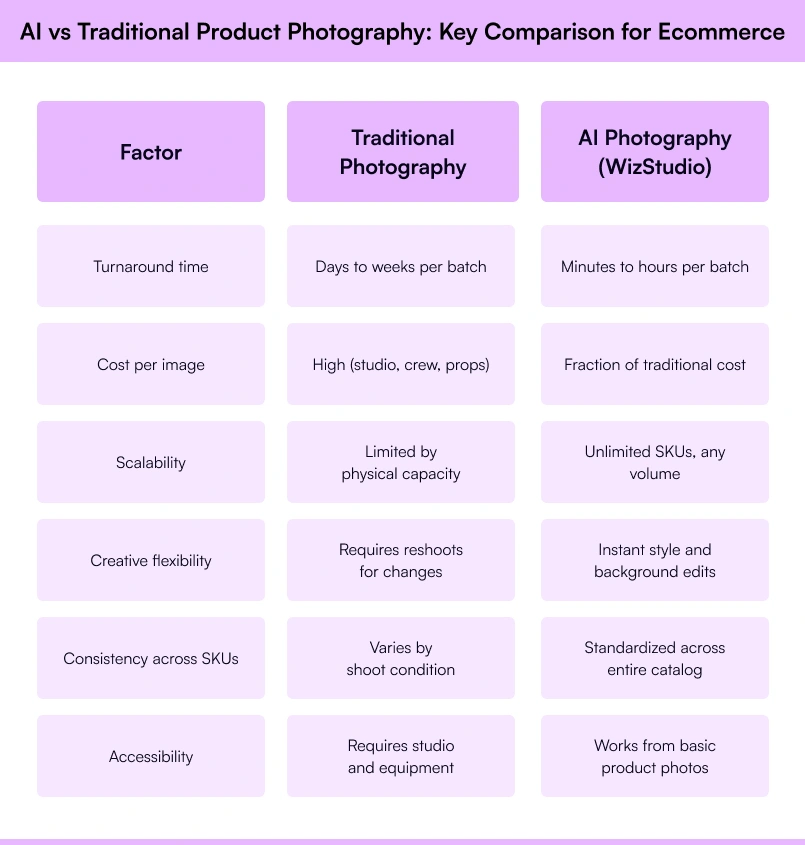
Here are some key benefits offered by an AI platform over traditional photography services:
1. Speed and scalability
With AI platforms, you can generate or restyle visuals almost instantly. Whether you’re launching 10 products or 1,000, AI allows you to produce consistent, high-quality images at a pace that matches your ecommerce calendar.
2. Cost efficiency
AI platforms eliminate the heavy overhead typically associated with traditional photo shoots, including studio rentals, props, stylists, travel, and large production teams. The result is a dramatic reduction in per-image cost without sacrificing quality, making professional-grade visuals affordable even for brands operating on tighter margins.
3. Creative flexibility
AI gives you a level of creative freedom that physical studios can’t match. You can experiment with new backgrounds, lighting styles, color tones, and even entire environments (from lifestyle scenes to seasonal setups), all without a single reshoot. You can even generate image variations of the same image to suit different platforms, giving your visuals infinite adaptability.
4. Consistency
Maintaining a unified visual identity across hundreds of SKUs is one of the toughest challenges in ecommerce. AI solves this with precision. It can standardize lighting, color balance, camera angles, and editing styles across every product image. This consistency builds brand trust and ensures a cohesive look across product listings.
5. Accessibility
AI in ecommerce has democratized the whole product photography game. Even smaller wholesalers and startups can now achieve studio-quality visuals without owning expensive equipment or hiring large teams. With just a few base product images, you can create professional visuals for your website without breaking the bank.
Want to explore the best tools powering this AI revolution? Find out in this list of 10 Best AI Product Photo Generators You Can Try in 2026. If Claid AI is one of the tools you’re evaluating, our breakdown of Claid alternatives ecommerce brands consider covers how it stacks up against other options.
Generate lifestyle-ready product photos at scale with WizStudio

If you are looking to modernize and scale up your product-photography workflow, WizStudio can serve as a powerful launch pad. With our AI product photo generator, you can take raw visuals and transform them into high-quality, lifestyle-ready images.
Rather than relying solely on traditional photo studios, you get a platform designed for ecommerce scale. This means you can keep up with expanded catalogs and fast-moving launches, without worrying about the costs.
Here are some of the key features that make WizStudio stand out:
- Lifestyle image generator: Transform plain product shots into polished, lifestyle-ready visuals in seconds. Simply upload your image, describe the desired style or setting, and let AI deliver studio-quality results. No photoshoot, props, or setup required.
- Multiproduct staging: Showcase multiple SKUs together in a cohesive scene. Upload several product images, arrange them naturally, and create beautifully styled catalog or lifestyle compositions without a single physical shoot.
- AI editing & enhancement suite: Perfect your product visuals with an intelligent suite of AI-powered tools. Add natural, realistic shadows for lifelike silo shots or extend images beyond the frame for flexible cropping. You can even generate precise line drawings with dimension lines, and use the magic eraser to erase objects in photos and remove unwanted distractions.
- Hybrid “done-for-you” service: Not all teams want a fully DIY tool. WizStudio offers an option where your base images go into the platform, and human creatives refine them. This gives you the best of both worlds (AI speed + human finesse)
With WizStudio, you can achieve up to 20× lower costs than traditional photoshoots, launch new collections 10× faster, and experience as much as a 33% boost in conversions.
Sign up for a free trial and start turning your products into compelling lifestyle visuals instantly.
FAQs on How to Evaluate Product Photography Services
1. What are product photography services?
Product photography services help in capturing high-quality images of your products for ecommerce listings, ads, and marketing materials. These services ensure your items are visually appealing and accurately represented, and optimized to attract buyers and increase conversions.
2. What is included in product photography services?
Most product photography services include shooting, lighting setup, background selection, post-production editing, and file delivery. Some product photoshoot services also offer lifestyle imagery, 360° product spins, model or prop sourcing, and creative direction to align visuals with your brand identity.
3. What is 360-degree product photography?
A 360-degree product photography service involves capturing multiple angles of a product and stitching them together to create a rotating, interactive image. It allows buyers to view the product from all sides. This improves engagement and helps them make confident purchase decisions.
4. What makes a good product photography agency?
A good product photography company or agency delivers consistent quality, understands your product category, and aligns with your brand style. They should combine creative direction, technical expertise, scalability, and reliable turnaround, while maintaining transparent pricing and clear communication throughout the project.
5. How much do product photography services cost?
Product photography services cost varies based on product type, complexity, image volume, and editing requirements. Basic packshots may start at $75 per finished image, while lifestyle product photography services can cost more. Many agencies also offer volume discounts or retainer packages for ongoing work.
6. How do I find the best product photography services near me?
Before searching for product photography services near you online, you could start by checking local studios nearby and reviewing portfolios. Check for experience in your product category, client testimonials, and transparent pricing. You can also compare service options on marketplaces or platforms that specialize in ecommerce photography.
7. Why is professional product photography important for ecommerce?
Professional product photography is important for ecommerce because it boosts trust and conversions by presenting products accurately and attractively. Sharp, consistent visuals make listings stand out and build a stronger brand image across wholesale space and marketing channels.
8. How do I hire a product photographer?
After you search for a professional product photographer near me online and narrow down on one, define your project scope, including the number of products, style, and output format with them. Review their portfolios, discuss timelines and pricing, and ensure they understand your brand requirements before finalizing the contract.
9.Can AI product photography fully replace a professional photography service?
No, AI product photography cannot replace a professional photographer for every use case: products with highly tactile surfaces, reflective materials, or premium positioning may still benefit from physical shoots for accuracy. However, for the majority of ecommerce brands managing large catalogs with frequent launches, AI platforms like WizStudio handle the scale, speed, and cost demands that traditional services cannot match. The most practical approach for most business owners is a hybrid model: physical shoots for hero and validation images, AI for catalog depth and lifestyle variations.
10. What deliverables should I expect from a product photography service?
A reliable ecommerce product photography service should deliver final images in your required file formats (JPEG, PNG, WebP), sized for each platform or channel. You should also receive edited, retouched files with consistent color balance, proper background treatment, and organized file naming. Depending on the product photography service provider, deliverables may also include lifestyle variations, 360-degree spins, and raw files.